Test your voice agent
How to Run a Voice Agent Bake-Off (POC Playbook)
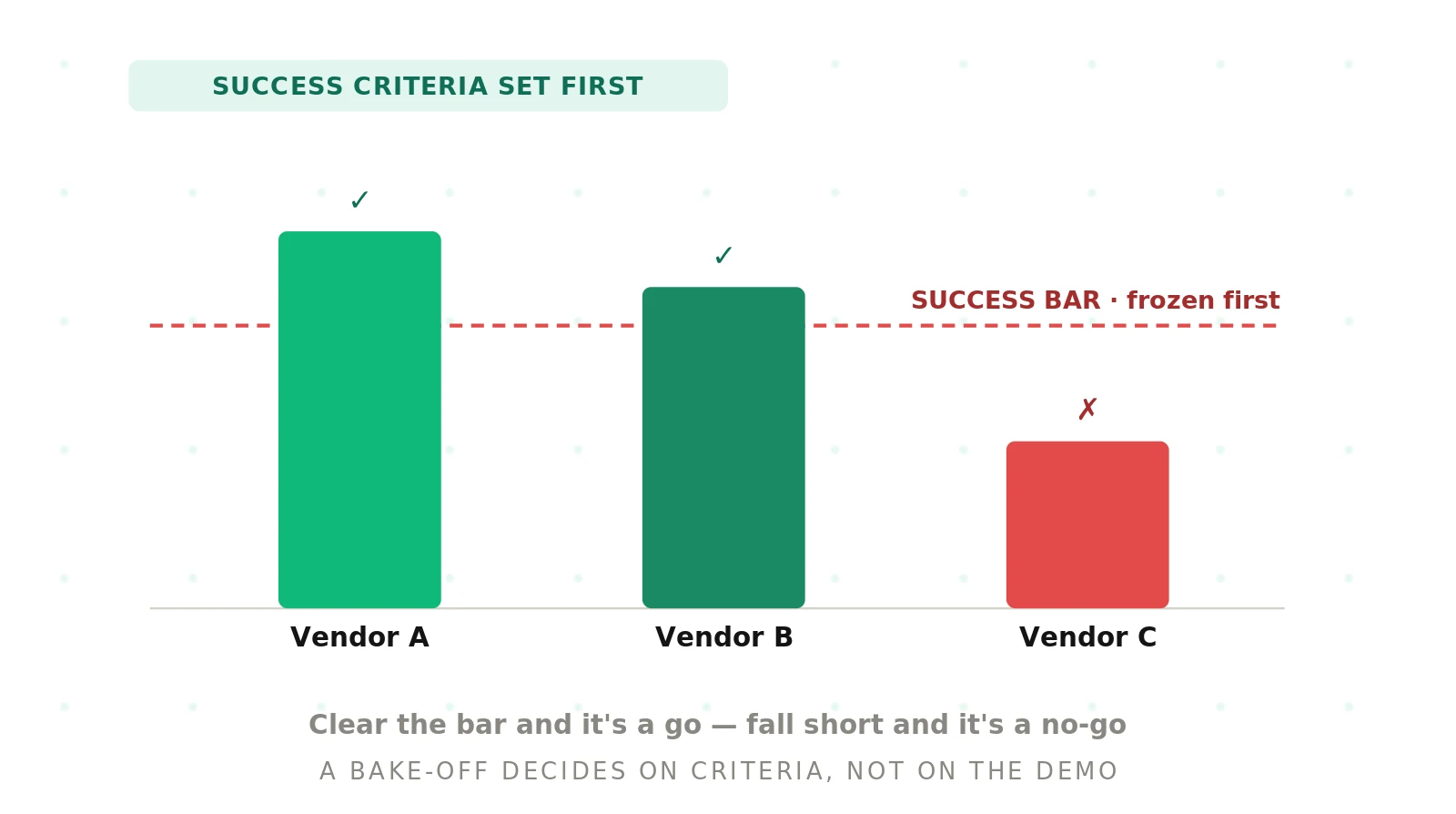
Most voice agent proofs-of-concept end the same way: a few weeks in, everyone agrees a vendor "seems good," a champion pushes for it, and the contract gets signed on a vibe. Nobody wrote down what "good enough" meant before they started, so the POC proved nothing — it just gave the loudest opinion some airtime. A bake-off fixes that by turning the trial into a decision procedure: defined criteria, identical conditions, and a result that either clears the bar or doesn't. This is the playbook.
We will cover why POCs fail, how to set success criteria before you start, the step-by-step bake-off process, and how to keep the comparison fair. It applies the vendor scorecard and shared test set to a time-boxed competitive trial.
Why most voice agent POCs fail
A proof of concept fails as a decision tool for a handful of predictable reasons. No success criteria are defined in advance, so "did it pass?" becomes a matter of opinion. The goalposts move as the trial goes, because a vendor's strengths reshape what the team decides to value. The trial runs on demos and cherry-picked calls instead of representative traffic, so it measures the easy path. And each vendor is evaluated under slightly different conditions, so the results don't compare.
The common thread is that the POC was never set up to produce a verdict. It gathered impressions, and impressions favor whoever demos best — which is exactly the gap between demos and production. A bake-off is a POC redesigned to answer one question objectively: which vendor clears the bar you set.
Set success criteria before you start
The single most important step happens before any vendor is touched: write down what success means, as numbers, and freeze it. These are your acceptance criteria, and they turn the bake-off from a beauty contest into a test.
Define a threshold for each dimension that matters: a task-success or resolution floor, a latency ceiling at p90/p95 judged against a limit like the ITU-T G.114 150ms comfort mark, an accuracy floor on your critical entities, an escalation-accuracy floor, and a safety pass rate. For regulated workflows, map the safety criteria to a framework such as the NIST AI Risk Management Framework. Agree these with the stakeholders who will sign off — including procurement and security — so no one relitigates the bar after seeing the results. A criterion set after the fact is not a criterion; it is a rationalization.
The bake-off playbook
Run the trial as a fixed procedure, identically for every vendor.
1. Define and freeze success criteria — Write the pass/fail thresholds first and get sign-off, so the bar can't move once results arrive.
2. Shortlist candidates — Pick a small set of vendors to trial, using background research to avoid wasting the bake-off on non-starters.
3. Build the shared conditions — Assemble one representative test set from your real calls, or define one slice of live traffic every vendor will handle.
4. Give every vendor identical conditions — Same calls or same traffic slice, same integrations, same scoring, so only the vendor differs.
5. Run long enough to be representative — Time-box the trial, but make it long enough to cover your real scenario mix, not just a quiet afternoon.
6. Score against the frozen criteria — Measure each vendor on the pre-defined thresholds, on your own data, not on vendor-reported numbers.
7. Make the go/no-go call — Decide on the results: the vendor that clears the bar wins, and if none do, the honest outcome is no-go.
Offline bake-off vs live POC
There are two ways to run the trial, and the best programs use both.
| Aspect | Offline bake-off | Live POC |
|---|---|---|
| What it uses | A shared test set of your calls | A slice of real production traffic |
| Speed | Days | Weeks (often 30+ days) |
| Control | Full — identical calls | Partial — real callers vary |
| Best for | Fast, fair head-to-head | Real-world validation before commit |
| Risk to callers | None | Contained, on a limited slice |
Start with an offline bake-off to rank candidates fairly and fast on identical calls, then run a live POC with the finalist on a limited slice of real traffic to confirm it holds up before a full commit. The offline round is a controlled comparison; the live round is a reality check, and the pre-launch testing checklist gates the move to it.
Keep the comparison fair
A bake-off is only as trustworthy as its fairness. Give every vendor the identical test set or traffic slice, the same integrations, and the same scoring rules, so the result reflects the agent and not the setup. Where you can, score blind — evaluate the calls without knowing which vendor produced them — to keep the champion's enthusiasm out of the numbers. Run each vendor at the same expected concurrency, since rankings shift under load, and have a party with no stake in the outcome run or verify the scoring, the case for independent evaluation. Any condition you let differ between vendors is a crack the result will leak through.
A realistic bake-off timeline
A bake-off does not need to be long to be rigorous; it needs to be structured. A workable shape runs about four to six weeks. In week zero, the evaluation owner drafts success criteria and gets sign-off from procurement, security, and the business owner — nothing else starts until the bar is frozen. Week one is the offline round: every shortlisted vendor runs the same shared test set, and the results rank them fairly and fast. The top one or two advance.
Weeks two through six are the live pilot: the finalist handles a limited slice of real traffic while you watch the same metrics hold up under genuine conditions. At the end, the frozen criteria decide — clear the bar and it is a go, fall short and it is an honest no-go. Assign one owner for the numbers, so the decision has a single accountable source rather than a committee of impressions.
Common bake-off mistakes
The failures repeat. Starting without written success criteria, so the decision defaults to opinion. Letting the criteria drift once a favorite emerges. Running on demos and hand-picked calls instead of representative traffic. Giving vendors different conditions, so nothing compares. Ending the trial too early, on too few calls, and mistaking noise for a winner. Skipping the live reality check before a full commit. And letting the loudest stakeholder, rather than the results, make the call. Each one turns a bake-off back into the vibe-based POC it was meant to replace.
Running a voice agent bake-off with Evalgent
Evalgent runs the bake-off as a controlled, repeatable procedure. Scenarios build one shared test set from your real calls, run identically against every candidate, so the offline round is a fair head-to-head. Profiles vary caller accent, pace, and conditions across that set, so no vendor wins on easy calls. Metrics encode your frozen success criteria — resolution, latency percentiles, accuracy, escalation, safety — as explicit thresholds, so each vendor gets a clear pass or fail rather than a subjective grade. Evaluations run the suite at concurrency, and Reviews let your team replay any call behind a score, blind if you choose. Because Evalgent has no stake in the winner, the result is one you can put in front of procurement and security.
The outcome is a bake-off that produces a decision, not a debate: candidates scored on identical conditions against criteria you set in advance. To run a head-to-head trial of the vendors you are weighing, book a demo. For turning the scores into a final choice, see the vendor scorecard.
The bottom line
A voice agent bake-off works when it is designed to produce a verdict: success criteria defined before you start, identical conditions for every vendor, a run long enough to be representative, and a decision made on the results. Skip the criteria and you are back to picking whoever demos best.
Freeze the bar first, run an offline round for a fair ranking and a live round for a reality check, and let the numbers decide. A demo shows you a vendor at its best; a bake-off shows you which vendor clears the bar on the calls you actually get.
Frequently asked questions
What is a voice agent bake-off?
A voice agent bake-off is a head-to-head trial that runs candidate vendors against the same calls or the same slice of real traffic, judged on success criteria defined before the trial starts. Unlike an open-ended proof of concept, it is designed to produce a verdict: the vendor that clears the pre-set thresholds wins, and if none do, the outcome is a defensible no-go.
How do you run a voice agent POC?
Define pass/fail success criteria first and freeze them, shortlist a few vendors, and build one shared test set or a defined slice of live traffic. Give every vendor identical conditions, run long enough to cover your real scenario mix, and score each against the frozen criteria on your own data. Then make the go/no-go call on the results rather than on impressions.
What success criteria should a voice agent POC use?
Set a threshold for each dimension that matters: a task-success or resolution floor, a latency ceiling at p90 and p95, an accuracy floor on your critical entities, an escalation-accuracy floor, and a safety pass rate. For regulated workflows, map safety to a recognized framework. Agree the thresholds with procurement and security before the trial, so the bar can't move after results arrive.
How long should a voice agent bake-off run?
Long enough to be representative of your real traffic, not just a quiet window. An offline bake-off on a shared test set can conclude in days, since you control the calls. A live POC on real traffic usually runs several weeks — often thirty days or more — so it captures the full mix of scenarios, volumes, and caller behavior at scale.
What's the difference between an offline bake-off and a live POC?
An offline bake-off runs candidates against a fixed shared test set of your calls, giving a fast, fully controlled, apples-to-apples ranking. A live POC runs a finalist on a limited slice of real production traffic, giving a slower but real-world reality check before a full commit. Use the offline round to rank fairly and the live round to confirm the winner holds up.
How do you keep a vendor bake-off fair?
Give every vendor the identical test set or traffic slice, the same integrations, and the same scoring rules, so only the agent differs. Score blind where possible, run each vendor at the same concurrency, and have a neutral party verify the scoring. Freeze the success criteria before the trial so no one moves the bar. Any condition you let vary between vendors undermines the comparison.
Why do voice agent POCs fail to produce a decision?
Because they gather impressions instead of measuring against a bar. With no success criteria set in advance, "did it pass?" becomes an opinion; the goalposts move as a favorite emerges; and demos stand in for representative traffic. The result favors whoever presents best, not whoever performs best. A bake-off avoids this by fixing the criteria and the conditions before anyone runs a call.
Should you use real traffic or a test set for a POC?
Use both, in order. Start with a shared test set for a fast, controlled, identical comparison that ranks candidates fairly without any risk to real callers. Then validate the finalist on a limited slice of real traffic to confirm it performs under genuine conditions before committing. The test set gives fairness and speed; the live slice gives real-world confidence.
Related Articles
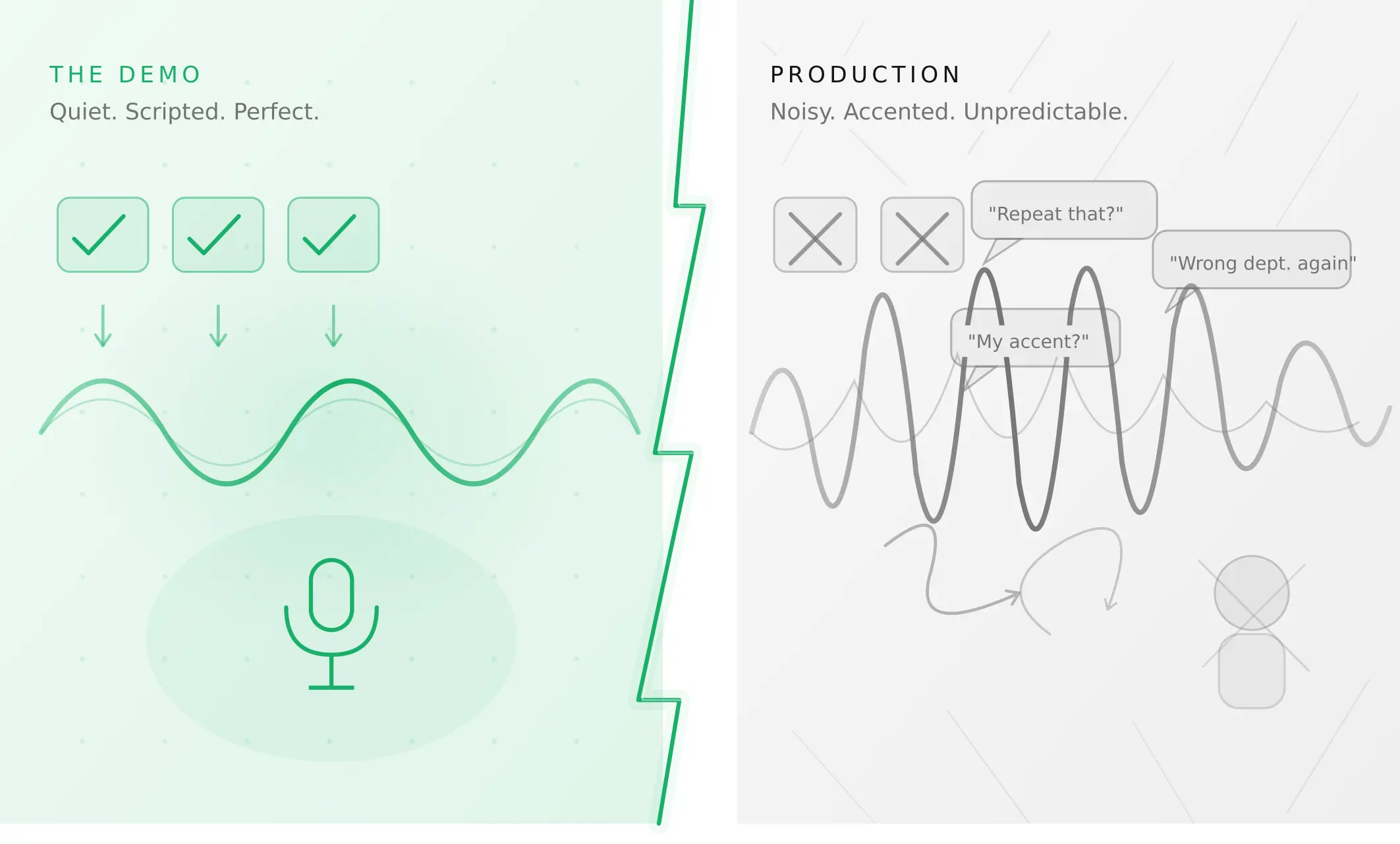
Why AI voice agents fail in production (and how to prevent it)
AI voice agents that ace demos still break in production. Learn the 5 root causes, how to test for each, and what production readiness actually means.
Read more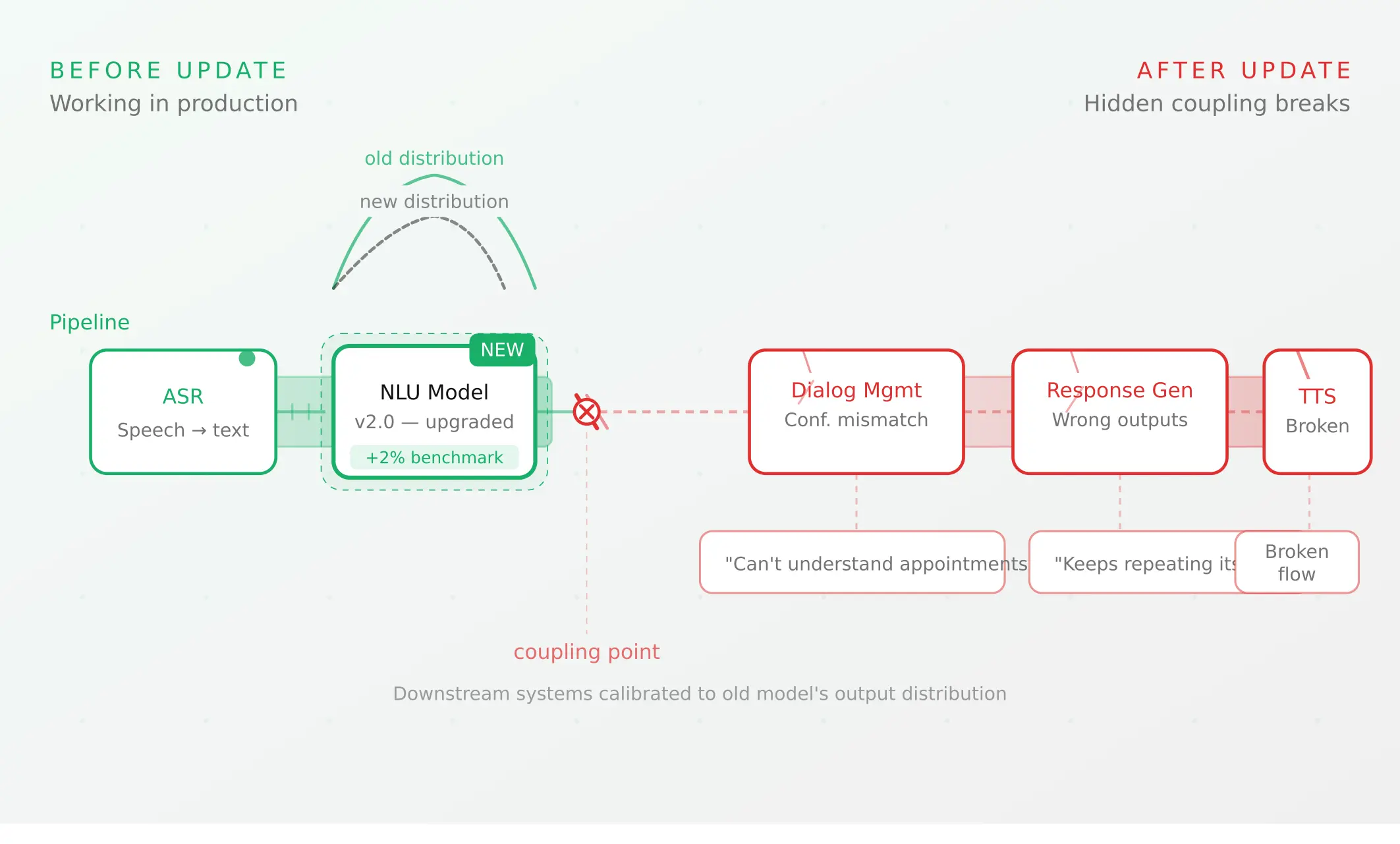
Voice agent regression testing: why LLM updates break production
LLM updates improve benchmarks but break voice agents in 5 predictable ways. How to detect and prevent regressions after every model or prompt change.
Read more