AI Voice Agents in Freight: Are Your Calls Accurate?
On this page
Your product answers freight calls. Maybe it is a TMS add-on, a brokerage platform or a carrier operations tool. It is a trucking AI voice agent, or an AI voice agent for freight brokerage work. The voice agent now works for many brokerages and fleets at once. Each one has its own lanes, rate rules and load formats. A prompt change on Tuesday reaches every dispatcher's phone that night.
The question from an operations lead is blunt. Are the calls accurate? This post helps you answer with numbers. This freight AI voice agent accuracy audit has 12 checks, a scoring rubric, a one-week protocol on live calls and sample-size math. It is not a build guide. For the full QA build, see our complete freight voice agent QA guide.
What freight AI voice agent accuracy means when a call ends in a write
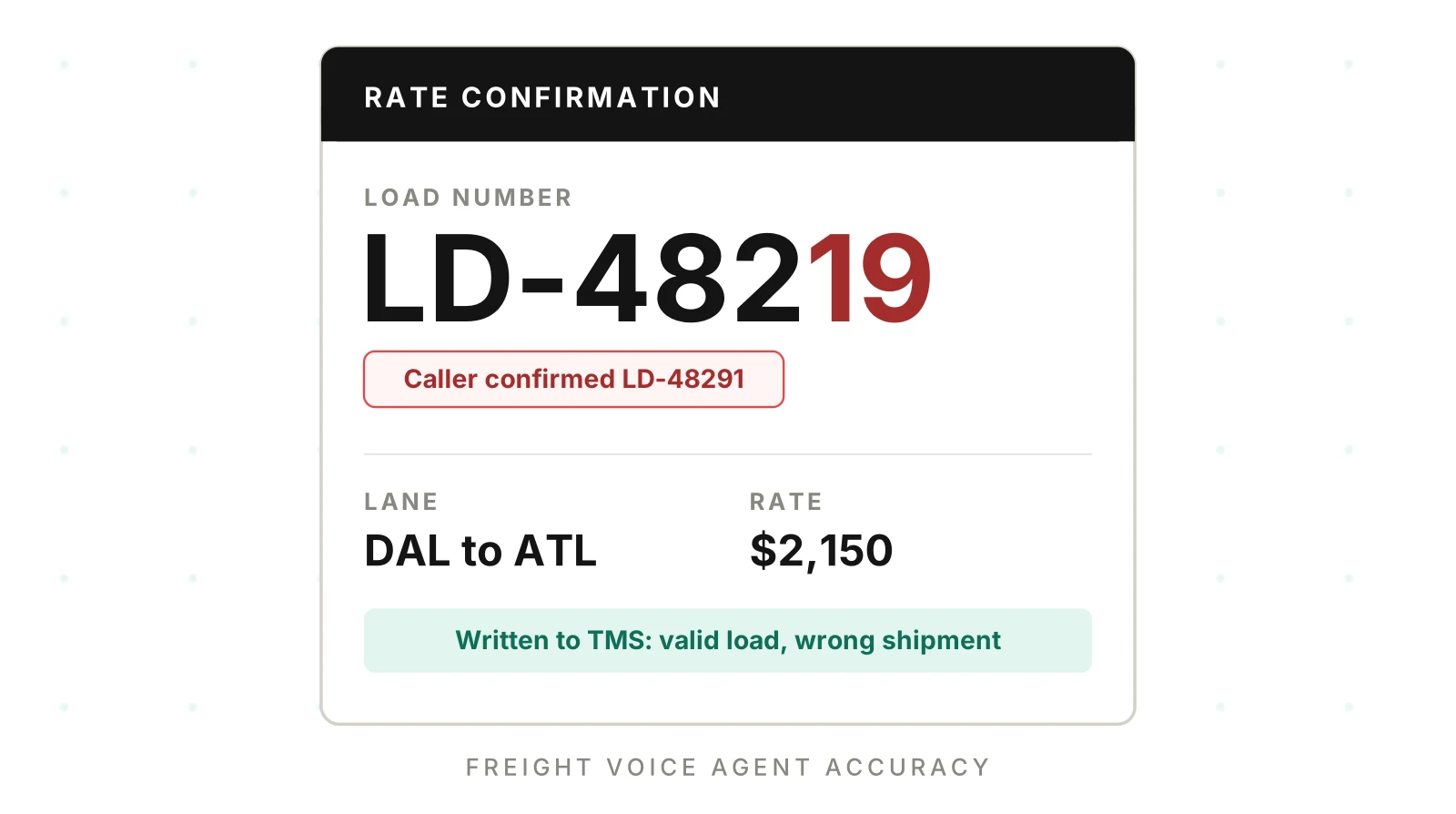
A freight call is rarely a conversation for its own sake. It is the front door to a record. A shipper asks where load 48291 is. A driver reports "empty in Memphis." A carrier agrees to a rate. Each call should end in a lookup, a quote or a write to the TMS.
That is why "the call sounded fine" is a weak signal. The caller heard a calm voice. Nobody heard the record. The error surfaces later, when a customer is told the wrong ETA, a carrier shows up at the wrong dock, or an invoice carries the wrong rate.
Three things hide freight errors:
- Silent corruption. A swapped digit in a load number is still a valid load number. It just belongs to another shipment.
- Delayed discovery. A wrong appointment time shows up as a missed slot, a detention charge or a redelivery fee.
- Per-customer variation. One brokerage says "pro number." Another says "load ID." Another means the shipper's PO.
The chart below shows why identifiers are the first thing to audit. Each character the speech layer gets wrong breaks the whole ID. The values are arithmetic on assumed per-character accuracies, not measured rates.
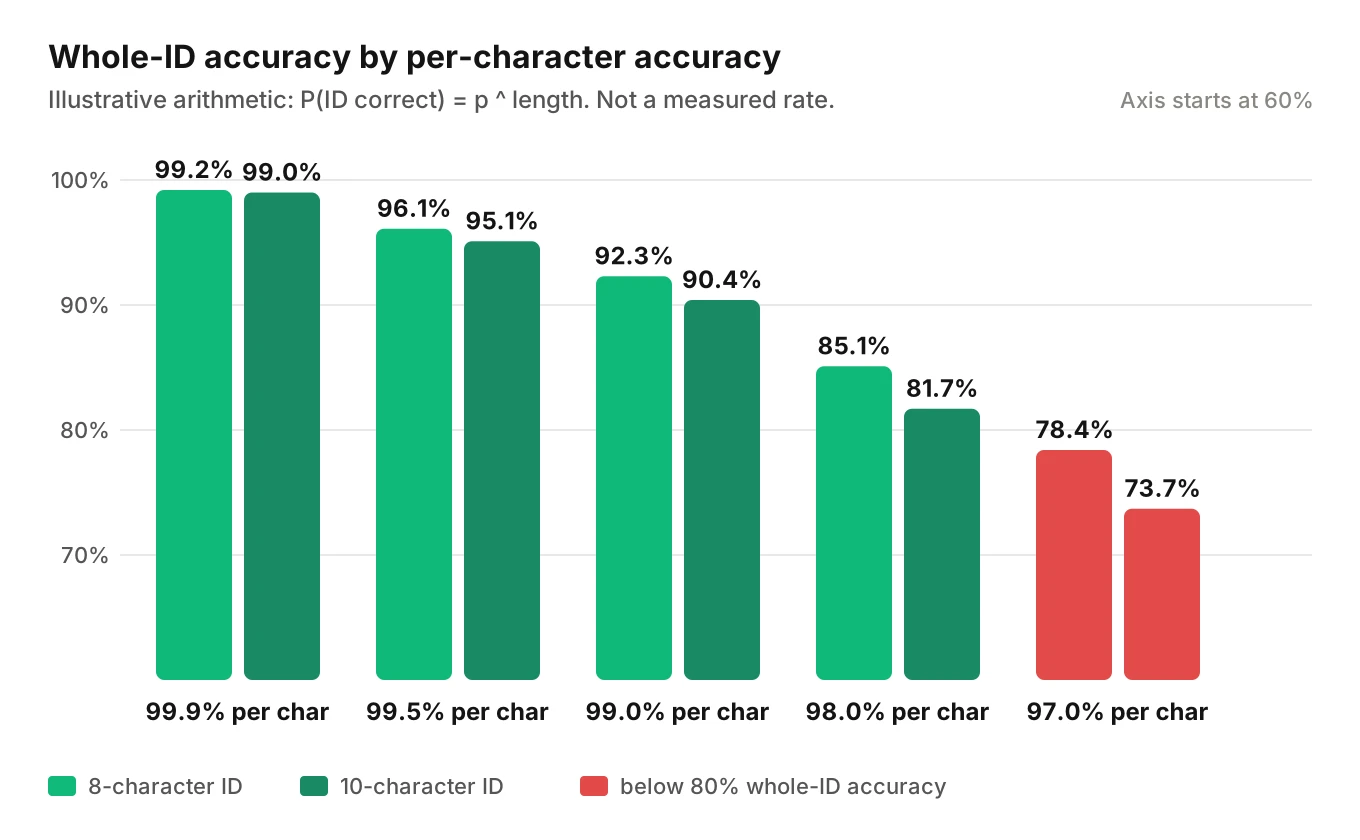
Phone audio is 8 kHz, and drivers call from cabs with engines and wind. Our guide to word error rate explains why a good average hides these failures.
Why transcripts alone miss the errors that matter
Most teams audit by reading transcripts. That works for tone and politeness. It fails for the fields that carry money and location.
Word accuracy is not value accuracy. A 2026 benchmark called VoiceCodeBench scored 19 speech systems on exact recovery of identifiers, paths and similar tokens. Its rankings barely agreed with word-error rankings. Identifiers reached about 87.3 percent exact match in aggregate, so roughly 12.7 percent were not recovered. The audio was English workplace dictation, not phone calls from a truck. Treat it as evidence of a failure class, not a rate for your stack.
Speech models also add words nobody said. Koenecke and colleagues found that about 1 percent of Whisper transcriptions contained entire hallucinated phrases. Of those, 38 percent included explicit harms. It was one model family and one audio set. Still, a made-up "not delivered" or "refused" in a freight call would change the exception code.
So judge the stored record against the audio. Use the transcript as supporting evidence only. This is Evalgent's thesis: most evaluation reads transcripts, and real failures live in the audio. Evalgent evaluates from the audio and attaches evidence to each verdict. That matters for a question like which digit the caller repeated after a correction.
The 12 checks for freight AI voice agent accuracy
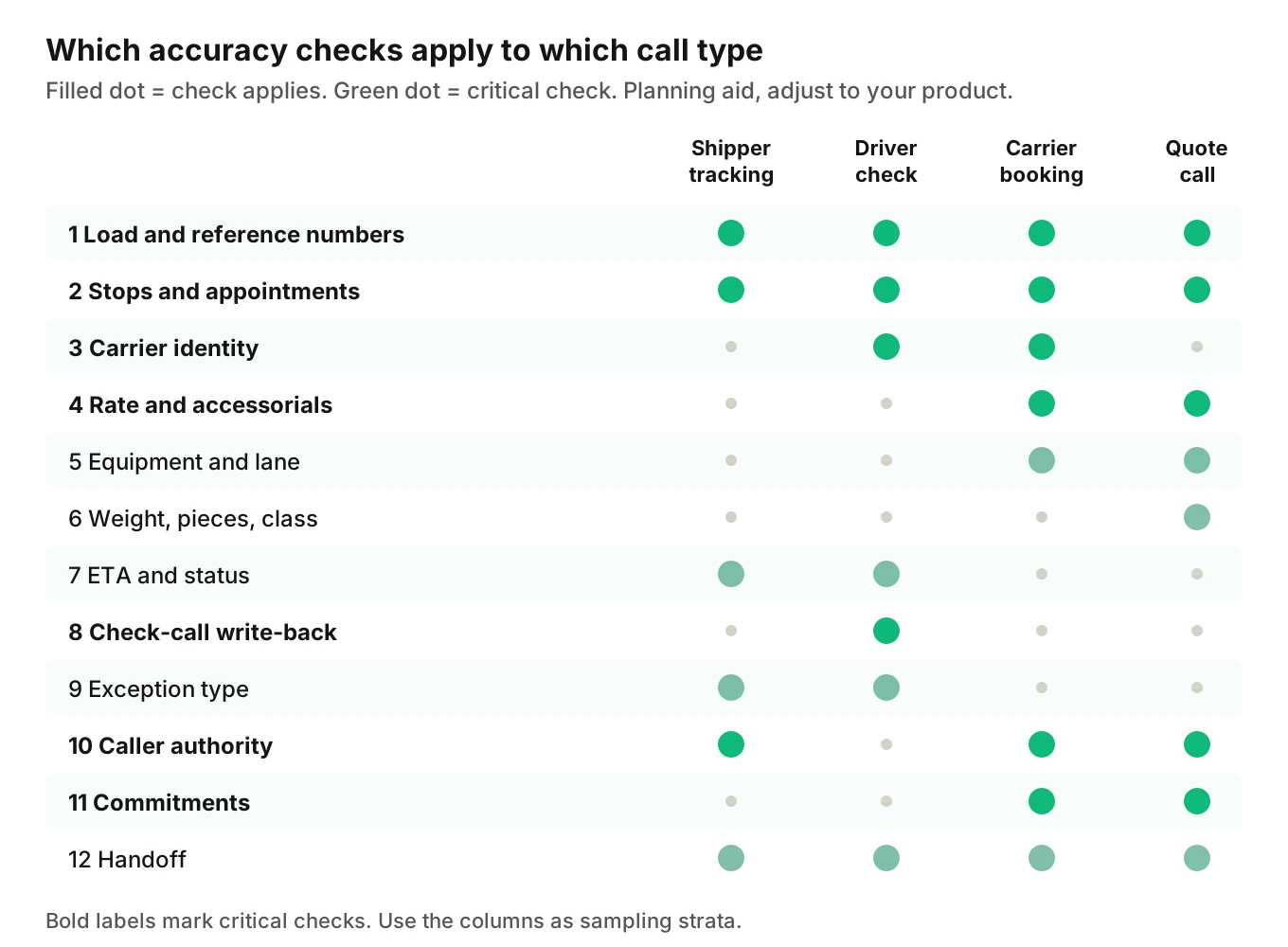
Each check is binary per call, so you can compute a rate. Critical checks move cargo, money or liability. Major checks create rework.
| # | Check | Weight | Pass condition |
|---|---|---|---|
| 1 | Load and reference numbers | Critical | The ID the agent looked up or wrote equals the ID the caller confirmed |
| 2 | Stops and appointments | Critical | Facility, city-state, date and local time zone match the load |
| 3 | Carrier identity | Critical | Spoken MC or DOT number resolves to the carrier on the load |
| 4 | Rate and accessorials | Critical | Quoted or confirmed amount, unit and add-ons match the rate confirmation |
| 5 | Equipment and lane | Major | Trailer type and origin-destination pair match the request |
| 6 | Weight, pieces and class | Major | Captured values equal the BOL, in the right unit |
| 7 | ETA and status statements | Major | Spoken ETA derives from tracking data, not from a guess |
| 8 | Check-call write-back | Critical | Location, status and ETA in the TMS match what the driver said |
| 9 | Exception type | Major | Delay, damage, refusal or detention is coded as the caller described |
| 10 | Caller authority and disclosure | Critical | Load details go only to a verified party on that load |
| 11 | Commitments within authority | Critical | The agent never promised a rate, hold or booking it cannot grant |
| 12 | Handoff | Major | Out-of-scope calls reach a human with context intact |
Checks 1 and 2: load numbers, stops and appointments
Load numbers are the most common join key. The caller may say a PRO number, a BOL number, a PO or a load ID. The agent must work out which. Then it must read the value back and get a yes.
Stops are second. City names collide: Portland, Oregon and Portland, Maine; Columbus, Georgia and Columbus, Ohio; Kansas City on both sides of a state line. Appointment times are local to the facility, not to the caller. A pickup at "6 in the morning" in Dallas is 7 in Atlanta. Script a caller for each.
Check 3: carrier identity
Freight fraud is a real risk for any freight broker AI call flow. Verisk CargoNet's Q2 2025 report says schemes involving document fraud and identity theft are becoming increasingly prevalent. A voice agent that books a load against a misheard MC number is a gift to that kind of scheme.
The FMCSA's QCMobile API can look a carrier up by name, USDOT number or docket (MC) number. It needs an API key, and FMCSA says to verify critical data against official sources. Your check is simple. Did the number the caller spoke resolve to the carrier named on the load? Count a mismatch as a critical failure, even if a human caught it later.
Check 4: rate and accessorials
Rates are spoken in shorthand. "Twenty-one fifty" can be $2,150 or $21.50. "Two fifty" can be $2.50 per mile or $250 flat. "All in" and "plus fuel" change the total. Detention, lumper and layover fees are separate lines on a rate confirmation.
Test the unit, not only the number. AI carrier calls for brokers covers negotiation. Here, pass means the stored amount, unit and add-ons equal what both sides confirmed.
Checks 5 and 6: equipment, lane, weight and class
Equipment errors look small and cost a day: a reefer booked as a dry van, or a 48-foot trailer for a 53-foot ask. Speech adds risk: "fifty-three" and "fifteen-three" sound alike on a bad line. Weight has the same trap. "Fourteen thousand" and "forty thousand" differ by one stressed syllable.
Weight and dimensions matter more since LTL classification changed. NMFTA Docket 2025-1 moved the classification system toward density, with a 13-subprovision scale, and took effect July 19, 2025, according to ODFL. ODFL also warns that classification errors can bring clerical fees, chargebacks and delays. A wrong spoken weight now moves the density, which moves the freight class. See freight quote AI accuracy.
Checks 7 and 8: ETA statements and check-call write-back
When a shipper asks where a load is, the agent answers from tracking data. The failure is a confident answer from stale data, or a guess. This is where freight call monitoring earns its keep. Check, per load tracking AI calls, that every spoken ETA matches the system value at call time, with the right time zone.
In a carrier check call, AI flips the direction: a driver telling the agent where they are. Here the agent writes. The driver says "just passed exit 214 on 40, about two hours out." The agent must store a location, a status and an ETA in separate fields. A wrong write is worse than a wrong answer, because later calls reuse it. See monitoring AI check calls.
Check 9: exception type
Delay, damage, refused delivery, detention and missed appointment are different codes with different owners. A driver saying "they won't unload me" is a detention start, not a delay. Misfiling it hides a billable event. See delivery exception AI calls.
Check 10: caller authority and disclosure
Not every caller may hear every load detail. A stranger who says a load number should not get the consignee, the rate or the driver's phone. Test callers who know the number but are not on the load. Our PII leakage guide covers readbacks.
Check 11: commitments within authority
An agent that says "I can hold that load for you" has made a promise. So has "we can do $2,400." If your product lets the agent negotiate inside a band, test both edges of the band. If it does not, test that it never implies it can. Driver-facing answers about settlement and fuel are covered in driver support AI.
Check 12: handoff
Hazmat questions, claims, rate disputes and accidents must leave the agent. Pass means the call reaches a person who receives the load, the caller and the reason. See escalation accuracy.
The matrix below shows which checks apply to which call type. Use it to pick strata.
A scoring rubric you can copy
The thresholds below are suggestions. Set your own with your customers, based on what an error costs them.
| Weight | Suggested pass line | Suggested alert line |
|---|---|---|
| Critical | 99 percent or better | Any rate above 1 percent |
| Major | 97 percent or better | Any rate above 3 percent |
| Minor | 95 percent or better | Any rate above 5 percent |
Score each customer separately. Then grade the whole account:
- Green: every critical check at or below 1 percent errors, every major check at or below 3 percent.
- Amber: one critical check between 1 and 2 percent, or two majors above 3 percent.
- Red: any critical check above 2 percent, or any check 9 or 11 failure that cost money.
A 2 percent rate from 40 calls differs from 2 percent over 400. Per-customer scoring also catches the multi-tenant trap, where one customer's lane naming breaks an otherwise healthy agent. See one voice agent, 500 customer setups.
How to run a one-week freight AI voice agent accuracy audit on live calls
You need call recordings, the TMS records they created, and one reviewer for a few hours a day. The steps fit one customer or a small group.
1. Day 1: define the unit. One unit is one completed call that ended in a lookup, a write, a quote or a handoff. Exclude voicemail and wrong numbers. Pull every eligible call from the past 7 days, per customer.
2. Day 1: stratify. Split the frame by call type (tracking, check call, carrier booking, quote), by time of day and by any language or accent flag. Sample at least 100 calls per customer, random inside each stratum. Keep every call that ended in a handoff or an error flag. See how to sample live calls.
3. Day 2: join calls to records. For each sampled call, fetch the TMS record the agent touched, or note that none was written. Build a row with values heard in the audio and values stored.
4. Days 2 to 3: label. A reviewer listens to the field-bearing segments, not whole calls. Mark each applicable check pass, fail or not applicable. Record the wrong value and the turn where it went wrong.
5. Day 4: double-label a slice. A second reviewer labels 20 percent. Compute agreement per check. If two people disagree often, the pass rule is vague. Rewrite it.
6. Day 4: compute rates and intervals. Use the script below, per customer and overall.
7. Day 5: classify root causes. Tag each failure as speech capture, language-model reasoning, tool call, stale data or prompt policy. The fix depends on the layer. Our tool call accuracy guide helps with the tool-call layer.
8. Days 6 to 7: fix, then replay. Change one thing at a time. Replay the failing scenarios against the new version before it ships. Re-sample next week.
A simplified scoring script follows. It assumes one CSV row per call with a `customer` column and one `1/0/NA` column per check, where `1` is pass:
import csv, math
from collections import defaultdict

CHECKS = ["load_id","stops","carrier","rate","equipment","weight",
          "eta","writeback","exception","authority","commitment","handoff"]

def wilson(k, n, z=1.96):
    if n == 0:
        return (0.0, 0.0)
    p = k / n
    d = 1 + z * z / n
    c = (p + z * z / (2 * n)) / d
    h = z * math.sqrt(p * (1 - p) / n + z * z / (4 * n * n)) / d
    return (max(0.0, c - h), min(1.0, c + h))

fails = defaultdict(lambda: defaultdict(int))   # customer -> check -> fails
seen  = defaultdict(lambda: defaultdict(int))   # customer -> check -> applicable

with open("audit_rows.csv", newline="") as f:
    for row in csv.DictReader(f):
        for c in CHECKS:
            v = row[c]
            if v == "NA":
                continue
            seen[row["customer"]][c] += 1
            fails[row["customer"]][c] += (v == "0")

for cust in seen:
    for c in CHECKS:
        n, k = seen[cust][c], fails[cust][c]
        if n:
            lo, hi = wilson(k, n)
            print(f"{cust:12} {c:11} {k}/{n}  {k/n:5.1%}  CI {lo:5.1%}-{hi:5.1%}")
Sample size: how many calls prove a rate
Sample size depends on the error rate you hope to show and how tight the answer must be. For a rough plan, use the normal approximation: n = z² × p × (1 − p) / e², with z = 1.96 for 95 percent confidence. These are illustrative planning numbers.
| Expected error rate | Margin of error | Calls needed |
|---|---|---|
| 5% | ±2 points | about 457 |
| 3% | ±1.5 points | about 497 |
| 2% | ±1 point | about 753 |
| 1% | ±0.5 points | about 1,522 |
Small margins on rare errors cost many calls. So you often want a cheaper claim: "no critical failures in n calls." With zero failures, the one-sided 95 percent upper bound on the true rate is about 3 divided by n, the "rule of three."
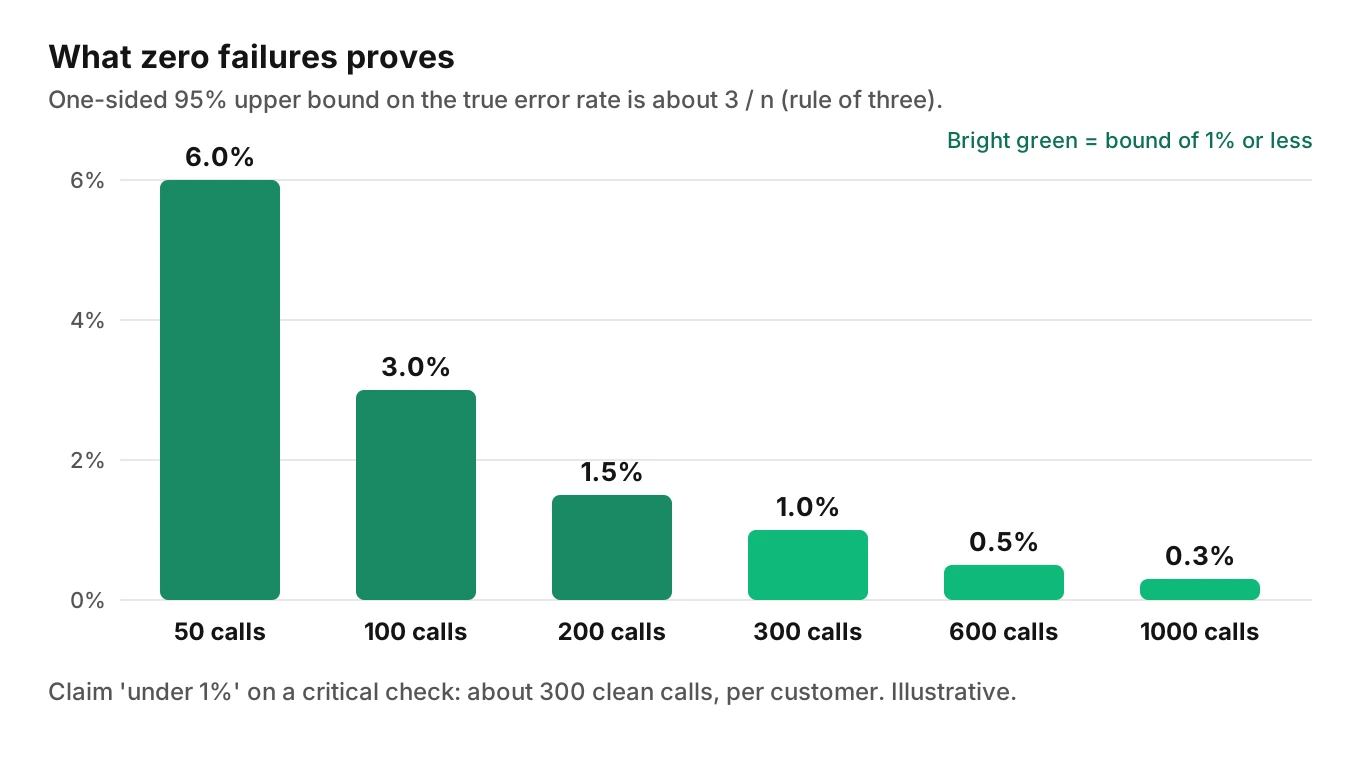
So 100 clean calls prove only that the rate is below about 3 percent. To claim "under 1 percent," you need about 300 clean calls on that check and customer. That is why per-customer audits of critical checks are expensive by hand. It is also the argument for scoring more of your traffic, which our post on scoring every call covers.
A worked example, with assumed numbers: an agent logs 400 check calls a day for one brokerage. A 1 percent write-back error is 4 wrong TMS updates a day, or 20 a week. Nobody notices until a shipper calls.
Freight voice AI testing before you ship a change
An audit tells you where you are. Testing tells you where a change will land. Every prompt edit, model swap or tool change can move a check you did not touch.
Build a regression set from audit failures. For each failed call, script a scenario: caller persona, noise, spoken value and expected stored value. See accent robustness and safe prompt shipping.
Evalgent generates test scenarios from the agent's prompt and flows, with caller profiles for accent, speech pace, interruption level, response delay, background noise and language. Its simulator reaches the agent over phone, SIP or WebRTC. Custom metrics, for example "stored load ID equals confirmed load ID," can run on every call, with humans reviewing verdicts. For live traffic, Evalgent transcribes the recordings customers push, maps them to scenarios and flags tool-call failures, PII leakage and policy failures. It works with teams to set up evals for a first agent; it is not self-serve.
Compliance notes for outbound and recorded calls
Two rules touch the audit. This is general information, not legal advice.
Broker records. Under 49 CFR 371.3, a broker must keep, for each transaction, items such as the consignor's name and address, the originating carrier's name, address and registration number, the bill of lading or freight bill number and the compensation it received. It must keep them for three years. Each party to the brokered transaction may review its record. If your agent writes these fields, a wrong write is a wrong record. The rule applies to brokers, so check how it maps to your customers.
Outbound check calls. In a February 2024 declaratory ruling (FCC 24-17), the FCC said AI-generated voices are "artificial" under the TCPA, as Mayer Brown summarises. Calls to cell numbers with an artificial voice need the called party's prior express consent under 47 U.S.C. 227(b)(1)(A)(iii). The FCC also adopted new consent-revocation rules on September 30, 2026, released October 1, which Kelley Drye describes. Test that the agent honours an opt-out in any phrasing, as in outbound voice agent testing.
Where to go deeper: the freight cluster
This hub scores the whole account. Each neighbour post goes deep on one call type.
- AI voice agents for freight: the complete QA guide is the pillar for building the QA program.
- Load tracking AI calls covers what shippers hear when they ask where a load is.
- Delivery exception AI calls covers tracking numbers and exception wording.
- Freight quote AI accuracy covers weights, lanes and quote errors.
- Driver support AI covers settlement and fuel answers.
- Monitoring AI check calls covers wrong ETAs and load numbers.
- AI carrier calls for brokers covers rates and lanes.
For the general method, start with why voice agents fail in production and the go-live checklist for every new customer.
Frequently asked questions
How accurate are AI voice agents for freight calls?
We found no public benchmark, so treat any vendor percentage with care. It depends on the check. Audit your own calls against the TMS record, per customer, and report each check with a confidence interval.
How do I audit my freight AI voice agent?
Sample at least 100 completed calls per customer, stratified by call type. Join each call to the TMS record it created. Have a reviewer compare the audio to the stored values on 12 checks, then compute error rates with intervals. Classify each failure by layer, fix one thing, and replay before shipping.
What errors do freight AI voice agents make most often?
Mis-heard load numbers, ambiguous city names, local-time mix-ups on appointments, rate units ($2.50 versus $250) and stale ETAs are common failure patterns. So are exception codes filed under the wrong type. This post gives no frequency for them.
How many calls do I need to sample to audit a freight voice agent?
For a rough rate with a 1-point margin at about 2 percent errors, plan about 750 calls. To claim a critical check is under 1 percent after zero failures, you need about 300 clean calls. Start with 100 per customer to find big problems, then add more for the checks that matter.
Does the TCPA apply to AI check calls to truck drivers?
Likely, if the number is a cell phone. The FCC ruled in February 2024 that AI-generated voices are artificial under the TCPA, and artificial-voice calls to cell numbers need prior express consent. Have counsel review your consent and opt-out flow. This is not legal advice.
How do I stop an AI voice agent from mishearing load numbers?
You cannot remove the errors, so contain them. Have the agent read the ID back in chunks and require a yes. Validate the ID against open loads before writing. Test with noisy, accented and fast callers. Then measure exact-match rate on the stored value, not word accuracy on the transcript.
Can an AI voice agent verify a carrier's MC number?
It can check one if you give it a tool. FMCSA's QCMobile API looks up carriers by name, USDOT number or docket number and needs an API key. FMCSA advises verifying critical data against official sources. Test that a misheard MC number returns no match or a name mismatch, and that the agent stops.
How do I test a freight AI voice agent before changing the prompt?
Replay a fixed set of scripted calls against the new version before it reaches live callers. Build the set from past audit failures, with accents, noise and interruptions. Compare stored values, not transcripts. Ship only if no critical check regresses. Our guide on shipping prompt changes safely has the full flow.
The bottom line
Freight AI voice agent accuracy is the match between what the caller said and what the TMS stored. Audit it per customer, on 12 checks, against the audio, before the next prompt change reaches live callers.
Related Articles
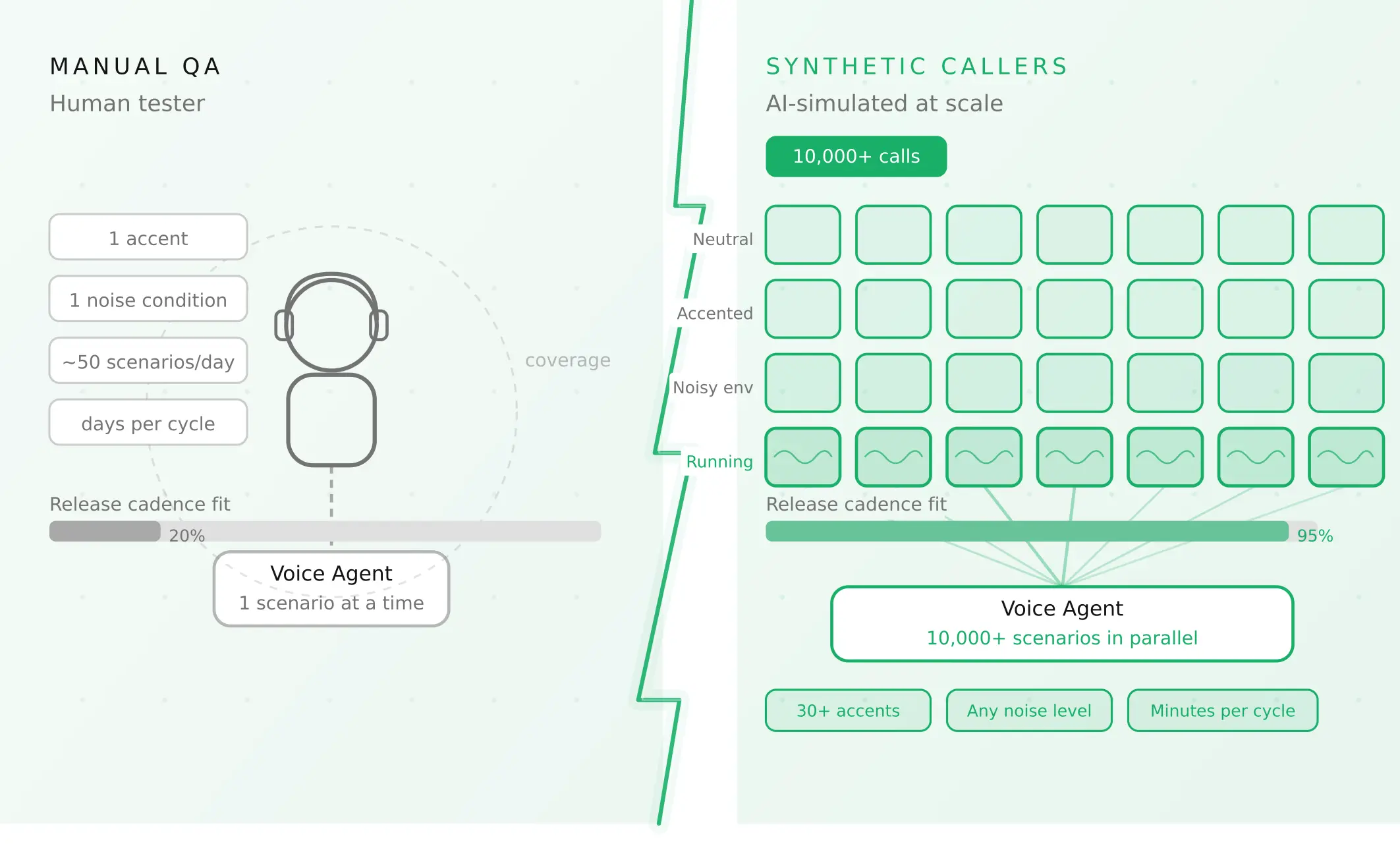
How to automate voice agent testing: synthetic callers vs manual QA
Learn how ai test automation replaces manual QA for voice agents. Compare synthetic callers vs human testers, with a 5-step framework to scale without hiring.
Read more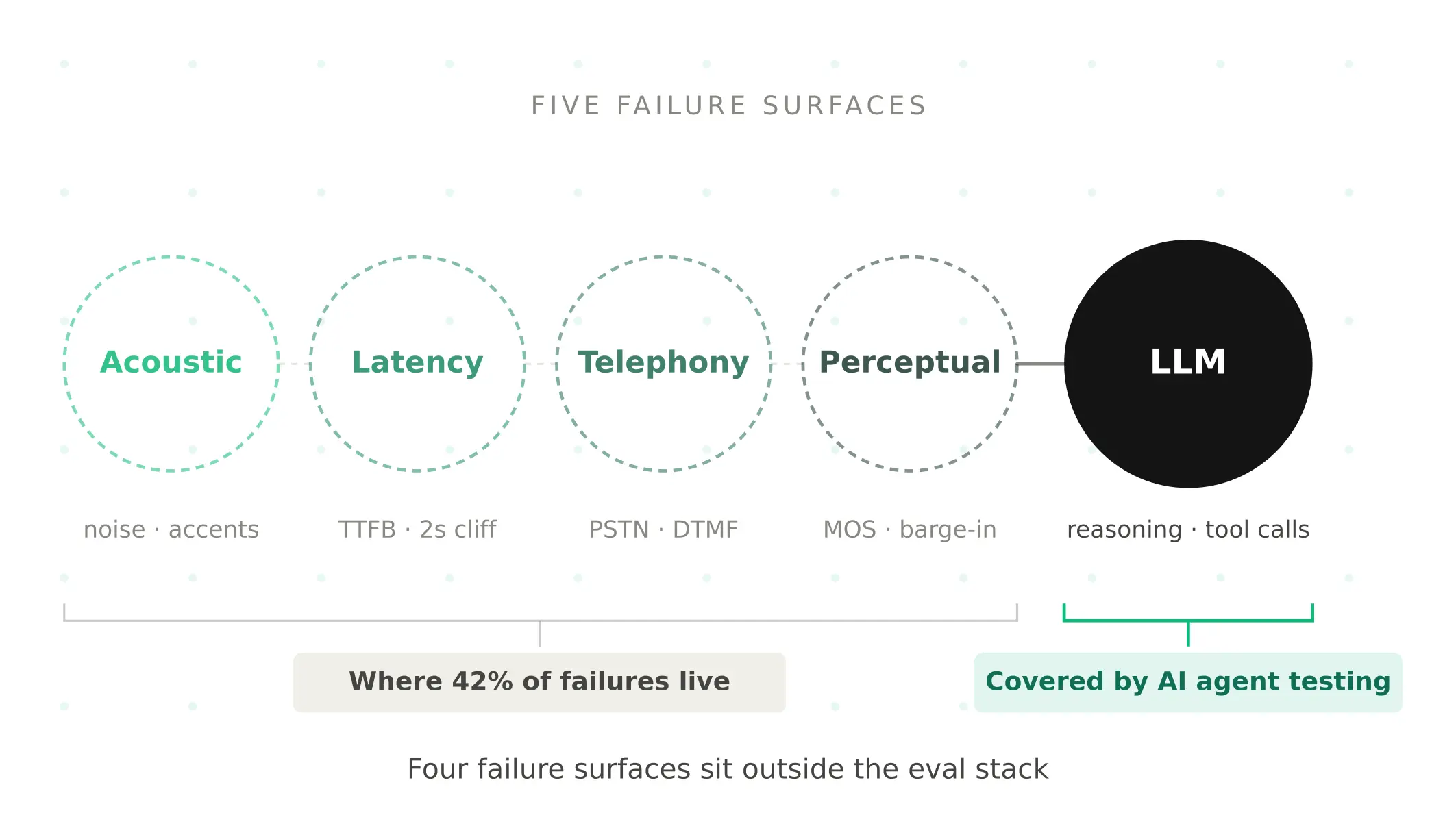
AI Agent Testing vs Voice Agent Testing: What General Tools Miss for Voice
AI agent testing measures text outputs. Voice agent testing measures behaviour through an acoustic pipeline. Five failure categories general tools miss.
Read more