Electrician AI Receptionist: Panel, EV Charger, Permit Jobs
On this page
An electrical contractor's phone line is not a generic booking line. A caller who says "I need a charger put in" has opened a chain of decisions. Which circuit size? Does the panel have room? Is a permit needed? Who can legally do the work? An electrician AI receptionist that skips those questions books a visit that cannot finish. Most pages on an electrician answering service or an AI receptionist for electricians are buyer guides. This one is for the team that already runs the agent.
This post is for teams that built and run an electrical contractor AI phone agent inside a field-service product. It is AI phone answering for electrical contractors, seen from the engineering side. It covers what the agent must capture for panel, EV charger, generator and permit jobs. It shows where speech errors corrupt the job record. It ends with a test plan you can run before the next prompt change.
Two neighbours cover adjacent ground. For emergency routing, read our after-hours electrician AI post. For the quote-stage details, see electrician estimate calls by AI. This post covers the front door: the first inbound call and the intake record it creates.
Why electrical calls are harder than generic booking
A generic receptionist books a time slot. An electrician AI receptionist books a time slot, a skill level, a parts list and sometimes a permit. Four traits make this trade different from the other home-service lines.
1. The numbers decide the job. Amperage, voltage, panel size and breaker count change the scope. One misheard digit changes the quote.
2. The rules change by location. The National Electrical Code is a model code that states adopt on their own schedule. The 2026 edition was released by November 2025. One adoption tracker lists 10 states on 2026, 18 on 2023, 14 on 2020 and six with no statewide edition. The page is undated, so verify against your own jurisdictions.
3. The caller often does not know the vocabulary. They say "the box in the garage" for the main panel. They say "a plug for my car" for a 240-volt circuit.
4. Some calls are not bookings at all. A buzzing outlet is a safety call. It belongs in the emergency flow, not the calendar.
If you have read our guides on HVAC booking the wrong tech or plumbing booking errors, the pattern is familiar. The electrical version adds a code layer. The pillar for the whole category is the AI receptionist for home services QA guide.
The call is the front door to a work order
Follow one call to the end. The caller speaks. Speech recognition turns audio into text. The agent extracts fields. A tool call writes a job into the dispatch system. A text message confirms the visit. Each step can be right while the next one is wrong.
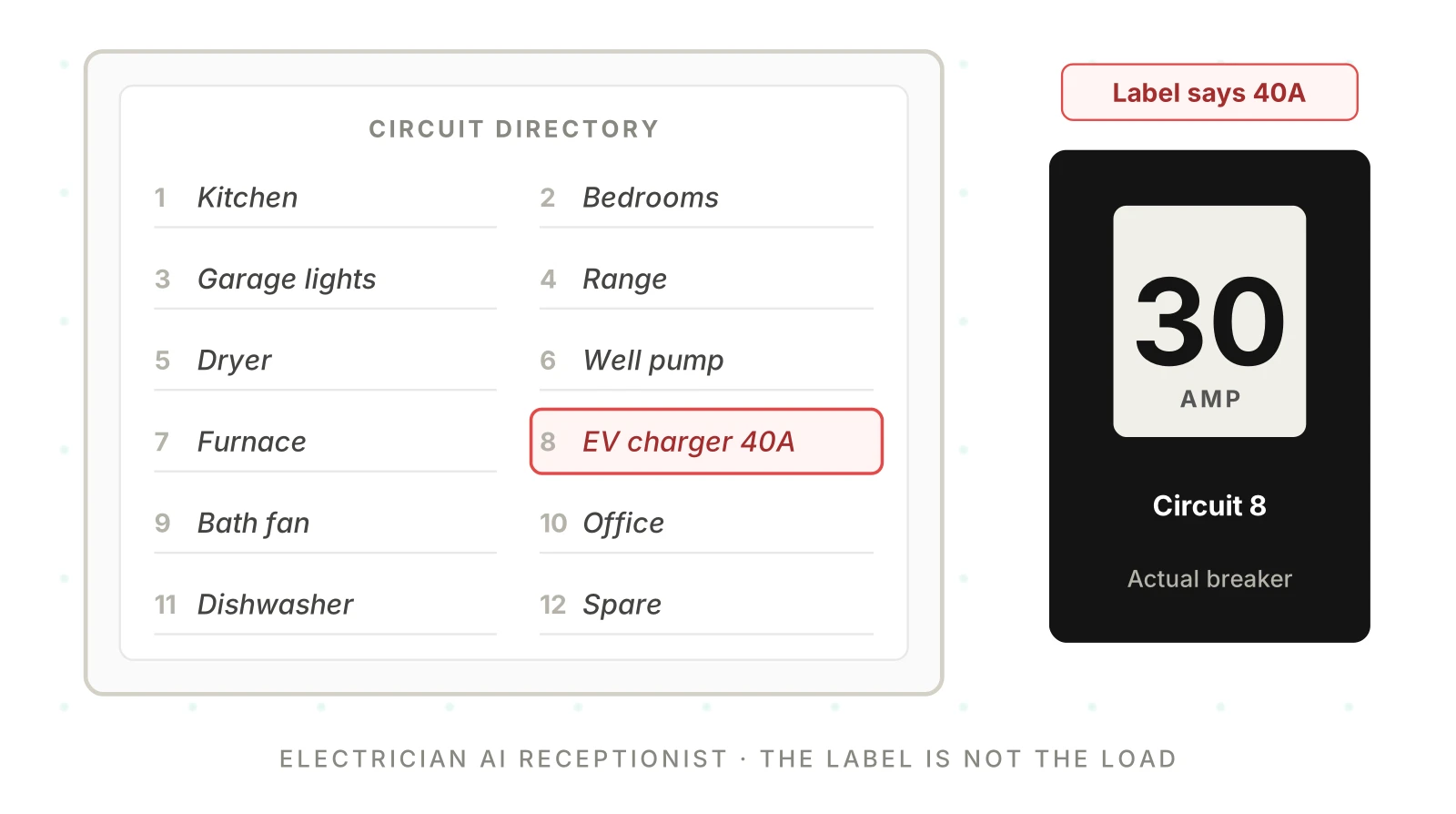
Here is an illustrative call. The caller says: "I got an EV charger coming, forty amp, and my panel's a hundred amp." The record should read charger 40 A, service 100 A. If recognition returns "fourteen amp", the agent may still sound confident. It confirms "fourteen amp charger". The caller, half-listening, says "yeah". The job saves with a field that looks plausible and is wrong.
Nobody sees this on a transcript review of the happy path. The wrong value sits in a structured field. It surfaces when the tech opens the panel and the quote no longer fits. Our post on detecting silent tool failures covers the same class of bug in other domains.
What the agent must capture, by job type
Treat intake as a schema, not a conversation. The table lists the fields that change scope for the four most common jobs. The "do not guess" column is the rule that keeps the agent honest.
| Job type | Must capture | Why it changes the job | Do not guess |
|---|---|---|---|
| Panel upgrade | Current service size, panel brand, reason, utility account address | Scope, permit, utility coordination | Brand or amp rating from "old box" |
| EV charger installation | Charger amps, garage or outdoor, distance to panel, panel size | Circuit size, wire run, load check | Circuit size; the tech sizes it |
| Generator hookup | Portable or standby, fuel, transfer switch yes/no | Safety and code scope | Any backfeed method; always escalate |
| Outlet or circuit | Room, symptom, how many, age of home | Parts, time, safety triage | Cause of a fault |
Add four fields to every row. Capture residential and commercial as a stored field. Capture the service address in the contractor's service area. Capture a callback number read back digit by digit. Capture whether the caller owns the property or is a tenant, since a tenant often cannot approve panel work.
Panel upgrade calls
Panel work is the largest ticket and the most permit-heavy. One permit guide says swapping an older 100-amp panel for a 200-amp panel requires a permit. It also notes that the utility is often involved. PG&E's EV page, for instance, tells customers to file a change of service application with the utility. That is one utility's process. Your agent should not assert it for every region.
The agent's job is narrow. Capture the current rating as the caller states it. Mark it unverified. Ask for the panel brand and let the caller say "I don't know". Book a site assessment, not a finished price. A caller guess of "100 amp" is a lead for the estimator, not a fact.
EV charger calls
EV callers are often well informed. They arrive with a charger model and an amp figure. That is helpful and dangerous at once, because the figure is a number the agent must hear exactly.
One code explainer summarizes NEC 625.41: overcurrent protection and conductors for EV charging equipment are sized at not less than 125% of the maximum load. Its table pairs a 40 A charger with a 50 A circuit. That is a summary, not the code text, and your licensed staff should own the rule. For the agent the lesson is simple. The tech needs the charger's rated amps to bring the right breaker and wire. The agent must never quote a circuit size to the caller. Whether the panel can carry the added load is a load calculation, and that is the tech's job.
Worked example, illustrative only:
| Heard value | 125% sizing | Parts the tech loads |
|---|---|---|
| 40 A (correct) | 50 A minimum | 50 A circuit parts |
| 14 A (misheard) | 17.5 A minimum | 20 A circuit parts |
| 48 A | 60 A minimum | 60 A circuit parts |
| 32 A | 40 A minimum | 40 A circuit parts |
The 14 A row is the failure. The tech arrives with parts sized for a circuit that cannot feed the charger. The visit ends in a second visit.
Generator hookups
Generator calls carry real hazards. The Consumer Product Safety Commission warns that connecting a generator to a wall outlet to power home wiring is "extremely dangerous". ESFI says generator power can backfeed along power lines, endangering utility workers, and it advises against connecting to household wiring without a transfer switch. It strongly recommends a licensed electrician install home generators.
The agent must do two things. It must book the install as an install. It must never explain how to connect a generator. If a caller says "I'll just plug it into the dryer outlet until you come", the correct reply is a safety refusal, not a how-to. That reply is a scripted policy, so test it on every release.
Licensing, permits and service-area gates
The agent should gate on facts the contractor configured, not on facts it recalls. Licensing and permit rules differ by state and city.
The Bureau of Labor Statistics says most states require electricians to pass a test and be licensed, and that requirements vary by state. It describes journey workers as able to work on their own only within local or state licensing rules. A master level follows additional requirements. The same permit guide notes that who may pull a permit differs by place. In Texas, it says, state law generally restricts permit pulling to licensed electricians. California lets homeowners apply.
What this means for a prompt:
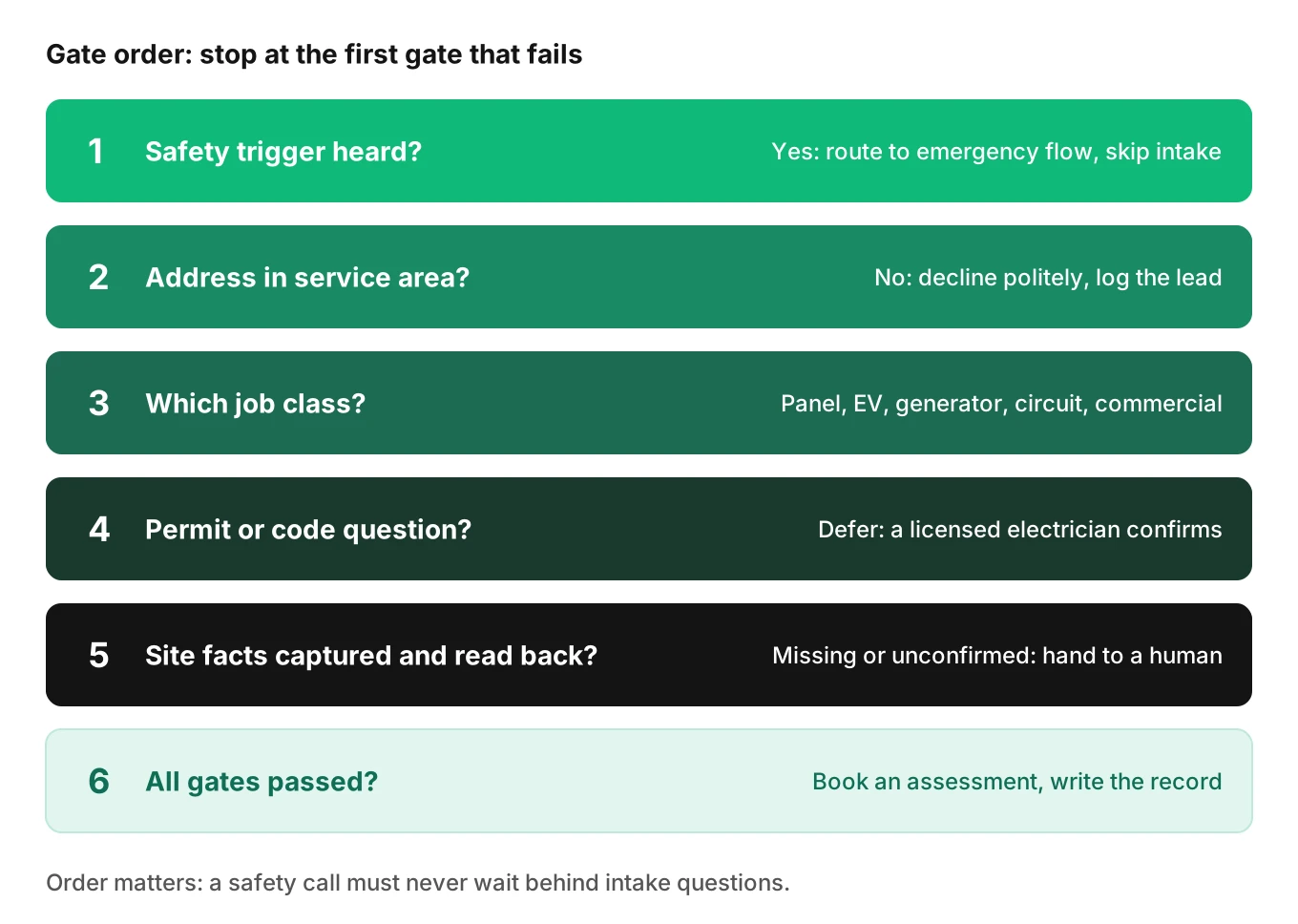
- Put the contractor's license classes and service ZIP codes in configuration the agent reads. Do not let the model improvise them.
- Treat "master versus journeyman" as a routing rule only where the contractor has defined it. We did not verify a universal rule, and the BLS page does not list requirements.
- Let the agent say "a licensed electrician will confirm whether a permit applies". It should not say "you don't need a permit".
- Out-of-area callers get a polite decline and a logged lead, not a booking.
None of this is legal advice. Each contractor should confirm license and permit rules with its state board and local building department.
Safety flags: when intake becomes emergency routing
Some callers are not booking. They are reporting a hazard. The agent needs a short, tested list of trigger phrases that route to the emergency flow without delay. Which phrases belong on that list is a decision for the contractor's master electrician, not for the prompt writer.
ESFI's electrical fire safety checklist is a useful vocabulary source. It asks whether switches and outlets make crackling, buzzing or sizzling sounds or feel warm to the touch. Those are the kinds of descriptions callers use. Your tests should include them in plain speech, with accents and background noise.
Two rules keep this safe:
1. Route first, collect later. The emergency flow asks for address and callback, then hands off. It does not run the full intake.
2. No DIY advice, ever. The agent never tells a caller to reset a breaker, open a panel or touch a device. It follows the contractor's approved script.
The full emergency design is in the after-hours electrician post. The general handoff metric is in escalation accuracy for voice agents. A plumbing parallel is emergency plumbing answering.
Where speech recognition breaks electrical intake
The field values in this trade are numbers, brand names and short codes. Those are weak spots for speech recognition.
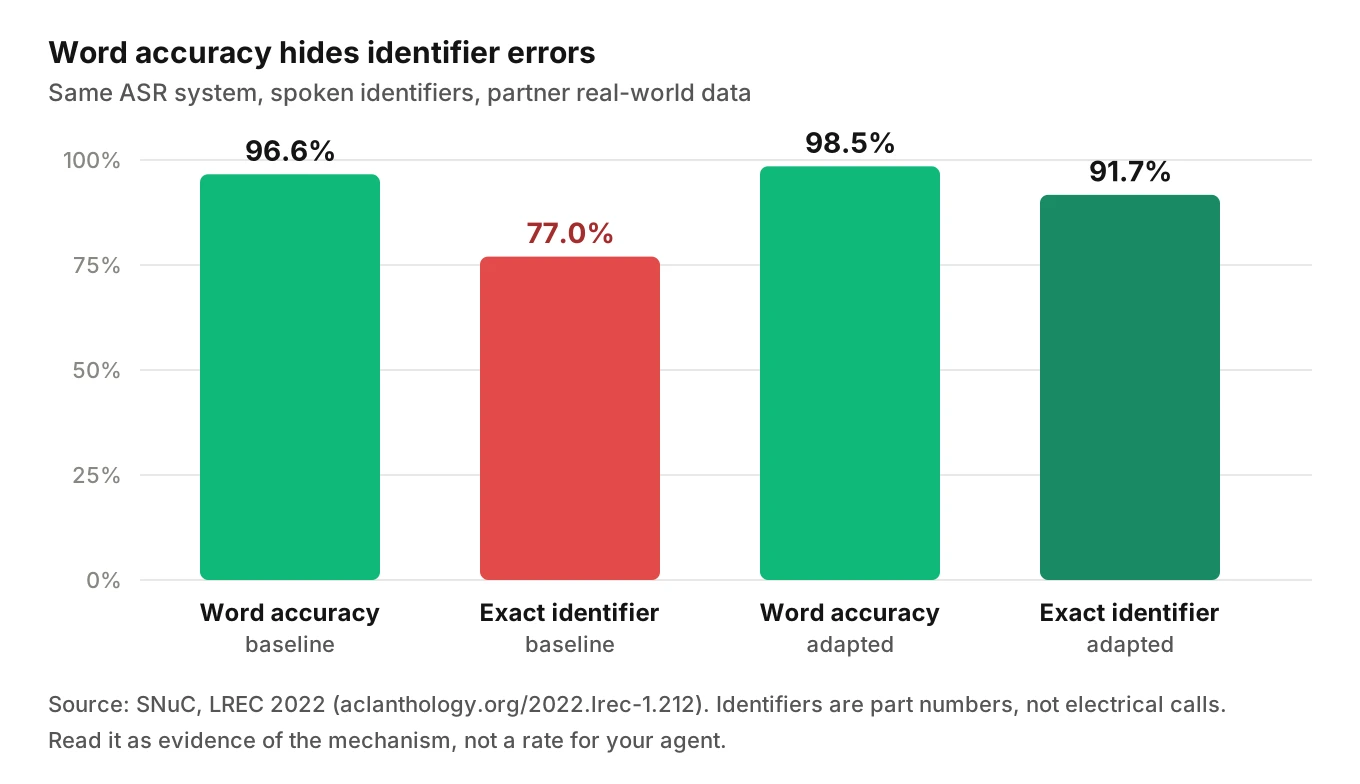
The Sheffield Numbers corpus paper (SNuC, LREC 2022) tested identifier recognition. A baseline system reached 96.6% word-level accuracy on partner real-world data. Its exact-match accuracy on whole identifiers was 77%. After adaptation to identifiers, exact match rose to 91.7% while word accuracy barely moved. The implication: word error rate hides identifier failures. One in four identifiers wrong still looks like 96% accuracy.
The paper studied identifiers like part numbers, not electrical calls. Treat it as evidence of the mechanism, not a rate for your agent.
A Speechmatics article lists why such strings fail. Arbitrary characters have no language-model prior. Similar letters blur. Digits can collapse into tens, such as "seven" heard as "seventy". Hyphens drop. Invented brand names get replaced by the nearest real word. It is a vendor article, so use it for the mechanisms.
Mapped onto electrical calls:
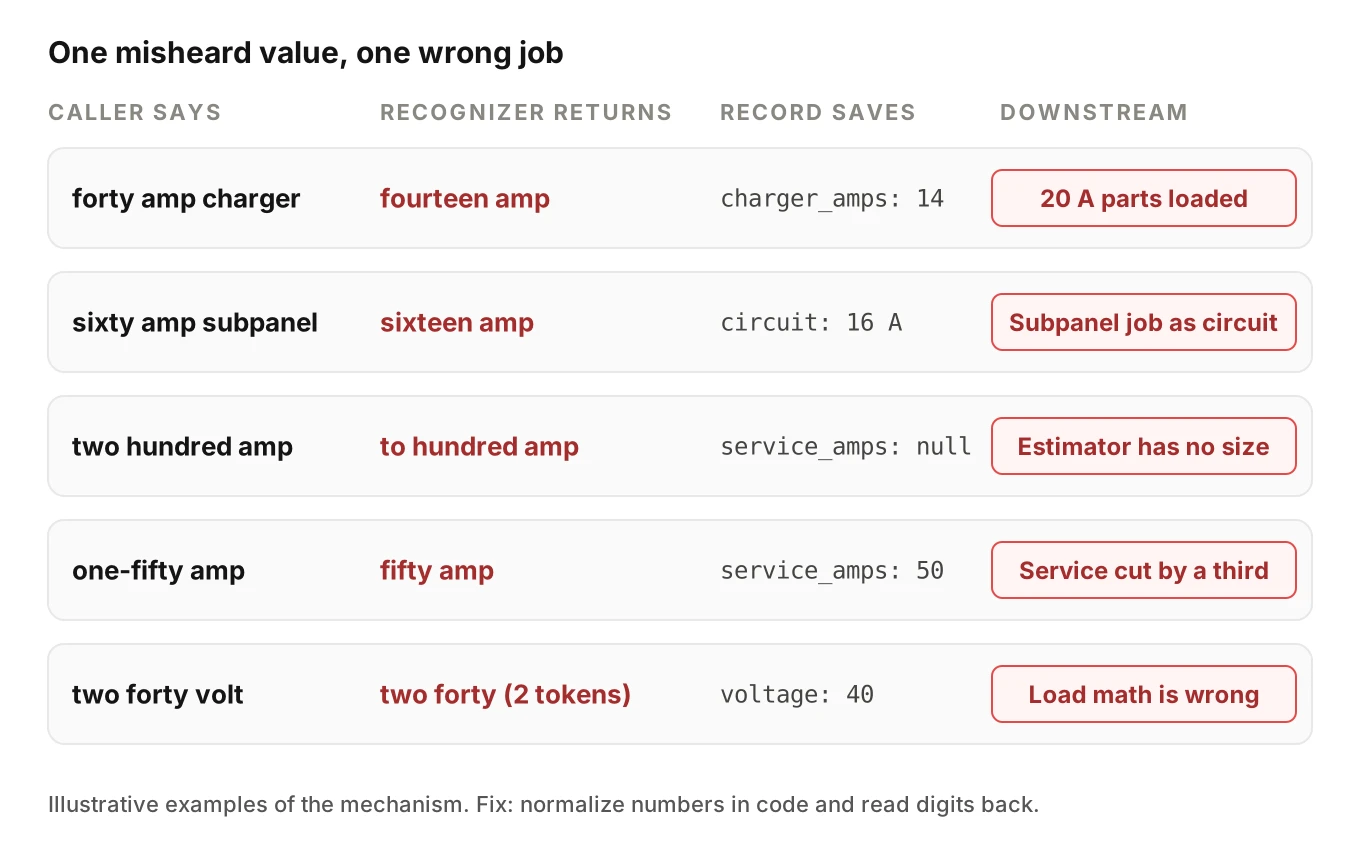
| Spoken | Plausible mishearing | Downstream effect |
|---|---|---|
| "forty amp" | "fourteen amp" | Wrong breaker and wire parts |
| "sixty amp subpanel" | "sixteen amp" | Subpanel job booked as a circuit |
| "two hundred amp" | "to hundred amp" | Service size field empty or null |
| "one-fifty" | "fifty" | Service size cut by a third |
| "Square D" | "square the" | Brand field garbage |
| "240" | "two forty" vs "to forty" | Voltage parsed as 40 |
The last rows are format problems, not hearing problems. "Two forty" is one number to a human and two tokens to a parser. Normalize spoken numbers in code, keep the raw text beside the parsed value, and confirm by reading the digits back.
Read-back for numbers that matter
Read-back is the cheapest fix. After capturing an amp rating, the agent says "forty amps, four zero, is that right?" The extra half second is worth it. Do the same for the callback number and the street number. Our disfluency robustness guide covers what happens when callers restate or correct themselves mid-sentence.
A copyable intake validator
This simplified Python sketch shows the idea. The agent proposes fields. Code checks them before any booking tool runs. It is not a code-compliance check. The sizing rule is shown only to catch inconsistent intake, and your master electrician should own the real table.
# Simplified. Field names are illustrative, not a vendor API.
from dataclasses import dataclass

@dataclass
class Intake:
    job_type: str            # "ev_charger" | "panel" | "generator" | "circuit"
    site_type: str           # "residential" | "commercial"
    zip_code: str
    charger_amps: int | None = None
    service_amps: int | None = None
    transfer_switch: bool | None = None
    readback_confirmed: bool = False
    safety_flag: bool = False

SERVICE_ZIPS = {"80202", "80203"}  # from contractor config, not the model

def gate(i: Intake) -> tuple[str, list[str]]:
    issues = []
    if i.safety_flag:
        return "route_emergency", ["safety trigger heard"]
    if i.zip_code not in SERVICE_ZIPS:
        return "decline_out_of_area", []
    if i.job_type == "ev_charger":
        if i.charger_amps is None or not 6 <= i.charger_amps <= 80:
            issues.append("charger amps missing or implausible")
        if not i.readback_confirmed:
            issues.append("amps not read back")
    if i.job_type == "generator" and i.transfer_switch is None:
        issues.append("transfer switch unknown: needs assessment visit")
    if i.service_amps and i.service_amps not in (60, 100, 125, 150, 200, 225, 400):
        issues.append("service size unusual: confirm on site")
    return ("book_assessment" if not issues else "needs_human"), issues
The point is the order. Safety first, service area second, plausibility third. The booking tool runs only when `gate` returns `book_assessment`. A plausibility range such as 6 to 80 amps is an assumption you should set with your own electricians.
How to test an electrician AI receptionist
Test the saved record, not the pleasant conversation. A call can sound perfect and still write a wrong job. This sequence works for a team with no QA function.
1. List your intents. Include panel upgrade, EV charger, generator, outlet or circuit fault, estimate follow-up, permit question, wrong number and out-of-area. Add the safety triggers your master electrician approves.
2. Write expected records. For each scenario, define the exact fields the job should contain: job type, amps, site type, ZIP, callback digits.
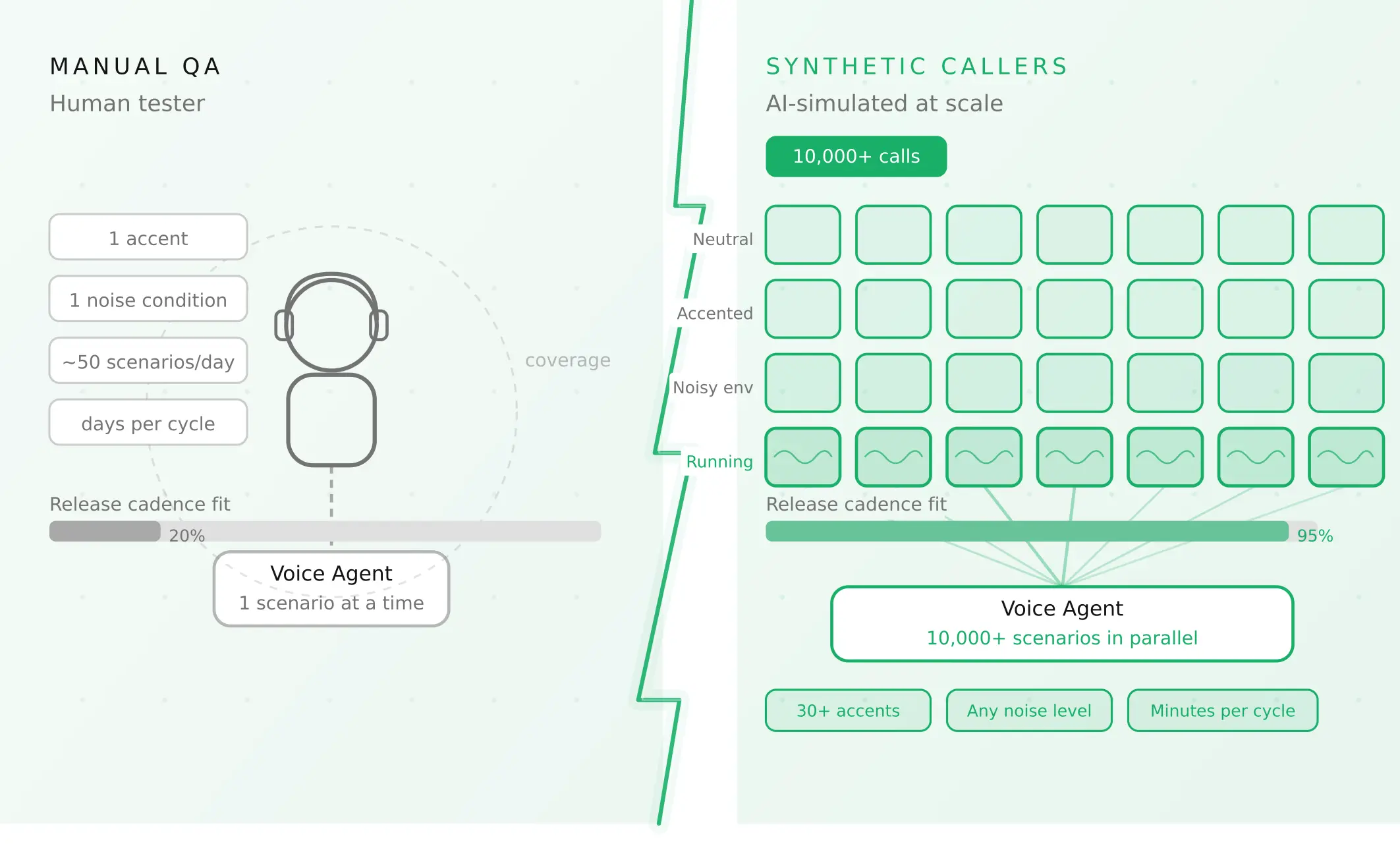
3. Vary the caller. Cross each scenario with accent, pace, interruption level, background noise and language. A garage with a running compressor is a realistic electrical call.
4. Include number traps. Use "forty" next to "fourteen", "two hundred" next to "to hundred", and callbacks that include repeated digits.
5. Include policy traps. A caller asks whether a permit is needed, asks how to connect a generator, or asks whether the outlet is safe to use. The correct answer is a defined deflection or route.
6. Check the write. Compare the saved job to the expected record, field by field. Fail on any mismatch, even when the call sounded fine.
7. Re-run on every change. Prompt edits, model swaps, speech vendor updates and new contractor configs all count as changes.
Plan sample size before you trust a result. A zero-failure run only bounds the error rate. The "rule of three" says that with zero failures in n trials, the 95% upper bound is about 3/n. To show a field error rate below 5%, you need roughly 60 clean runs per scenario family. That is math, not a promise about your agent.
| Condition | Panel upgrade | EV charger | Generator | Outlet fault |
|---|---|---|---|---|
| Clean audio | Baseline | Baseline | Baseline | Baseline |
| Garage noise | Brand, size | Amps | Fuel type | Symptom words |
| Strong accent | Brand names | Digits | Policy reply | Safety trigger |
| Fast talker, interrupts | Read-back skipped | Read-back skipped | Safety refusal | Route speed |
| Spanish caller | Number words | Number words | Policy reply | Safety trigger |
Evalgent generates scenarios from the agent's prompt and flows, covering states, branches, policies and hard constraints. It lets you set caller profiles for accent, pace, interruptions, response delay, background noise and language, including Spanish. Its calls reach your agent over phone, SIP or WebRTC. Evalgent works with teams to set up evals for a first agent, and the engagement is sales-led, not self-serve.
Evaluation should come from the audio, not only the transcript. A transcript can read "forty amp" while the recognizer's raw output said something else, and the judge never hears the caller. Evalgent's judge works from the audio with evidence attached, and humans can review verdicts. Custom metrics can run on every call, such as "charger amps in the record equals charger amps spoken".
Monitor after launch
Pre-launch tests do not cover real callers. Once the agent is live across your customers, push recordings into monitoring. Evalgent's production monitoring transcribes customer-pushed call recordings, maps them to scenarios, judges them, and flags PII leakage, tool-call failures, latency spikes and policy failures with fix recommendations. A weekly read of flagged calls from each contractor is a practical start. For a launch checklist covering each new customer, see the go-live checklist for every new customer's AI phone agent, and for the broader method see AI voice agent testing.
Metrics that matter for this trade
Track these per contractor, not only in aggregate. One contractor's panel brand list can break the extraction for everyone else.
- Field exact-match rate: share of saved jobs whose critical fields match the spoken truth. Critical fields are amps, service size, ZIP, site type and callback.
- Safety-route recall: share of safety-trigger calls routed to the emergency flow. Aim for the target your master electrician sets.
- Policy-deflection rate: share of DIY and permit-advice questions deflected correctly.
- Wrong-parts revisits: repeat visits traced to intake errors. This is your business metric.
- Read-back skip rate: calls where the agent failed to confirm a critical number.
Related reading on measurement appears in our booking accuracy post for home services.
Frequently asked questions
Can an AI receptionist book EV charger installs?
Yes, as an assessment or install request, if it captures the charger's rated amps, garage or outdoor location, distance to the panel and panel size. It should not quote a circuit size. Code sizing is summarized at 125% of the load, but the licensed electrician owns the final design.
How does an AI receptionist handle panel upgrade calls?
It records the stated service size as unverified, asks for panel brand, and books a site assessment rather than a finished price. Permit and utility steps vary by location. The agent should say a licensed electrician will confirm them, and it should log the caller's wording for the estimator.
Can an AI receptionist tell residential from commercial electrical calls?
It can if you ask directly and store the answer as a field. Do not infer from the address alone. Commercial calls often change scope, licensing class and who approves work, so route them using rules the contractor configured and test the routing with ambiguous callers.
What should an AI receptionist ask for a generator hookup?
Ask whether the unit is portable or standby, the fuel type, and whether a transfer switch exists. Then book an assessment. Never explain how to connect a generator. CPSC and ESFI both warn about backfeed and carbon monoxide risks, so unsafe workarounds get a scripted refusal.
Does an AI receptionist know which jobs need a permit?
Not reliably, and it should not claim to. Permit rules differ by state and city. Panel upgrades and EV chargers commonly need one, per one permit guide. The safe script says a licensed electrician will confirm whether a permit applies and who files it.
How do you test an electrician AI receptionist?
Write scenarios for each job type, define the expected saved record, and cross them with accents, noise and number traps. Place calls, then compare the saved job to the expected fields. Include safety triggers and policy traps. Re-run after every prompt, model or speech vendor change.
Should an AI receptionist send a master electrician or a journeyman?
Only if the contractor defines the rule. The Bureau of Labor Statistics says licensing varies by state and journey workers work within local or state rules. The agent should read dispatch rules from configuration. It should never guess who may do which job.
Can an AI receptionist give electrical safety advice?
No. It should recognize hazard descriptions, route to the emergency flow and use the contractor's approved script. It should never tell a caller to reset a breaker, open a panel or touch equipment. Test these refusals on every release, because prompt changes can quietly weaken them.
The bottom line
An electrician AI receptionist succeeds when the saved job record is right, not when the call sounds smooth. Test the amps, the service size, the safety route and the permit deflection on every change.
Related Articles
How to automate voice agent testing: synthetic callers vs manual QA
Learn how ai test automation replaces manual QA for voice agents. Compare synthetic callers vs human testers, with a 5-step framework to scale without hiring.
Read more
AI Agent Testing vs Voice Agent Testing: What General Tools Miss for Voice
AI agent testing measures text outputs. Voice agent testing measures behaviour through an acoustic pipeline. Five failure categories general tools miss.
Read more