Open door for builders.
How to Evaluate Disfluency Robustness in Voice Agents
# How to Evaluate Disfluency Robustness in Voice Agents
Quick answer
Disfluency robustness in voice agents is how well an agent handles messy caller speech: fillers, false starts, self-corrections, repetitions, and mid-sentence pauses. A robust agent transcribes through the mess and acts on the corrected meaning, not the first thing said. You evaluate it with a disfluency test set plus real disfluent calls.
Real callers do not talk like scripts. They say "um," they start a sentence and abandon it, they give a wrong number and fix it a beat later. A speech disfluency is any of these breaks in otherwise fluent speech, and research finds fillers alone can make up a large share of words in conversation. Your agent has to survive all of it. Most demos never test for it, so most teams ship agents that break the moment a caller hesitates.
This guide shows how to evaluate disfluency robustness directly. It defines the failure modes, separates speech-to-text robustness from understanding robustness, and gives you a test set, three metrics, and a step-by-step method. It sits under our voice agent evaluation pillar and pairs with our work on AI voice agent testing.
What disfluency robustness means
Disfluency robustness is the agent's ability to keep working when the caller's speech is not clean. It is a property of the whole pipeline, not one component. A robust agent hears the words. It waits for the caller to finish. It lands on the right meaning even when the path there was bumpy.
> Disfluency: a break or irregularity in fluent speech, such as a filler, a false start, a repetition, or a self-correction. It is normal, not a defect in the caller.
Callers produce disfluencies constantly, and they are not signs of a difficult or uncooperative caller. They are how spontaneous speech works. The problem is never the caller. The problem is an agent that assumes speech arrives in clean, complete sentences.
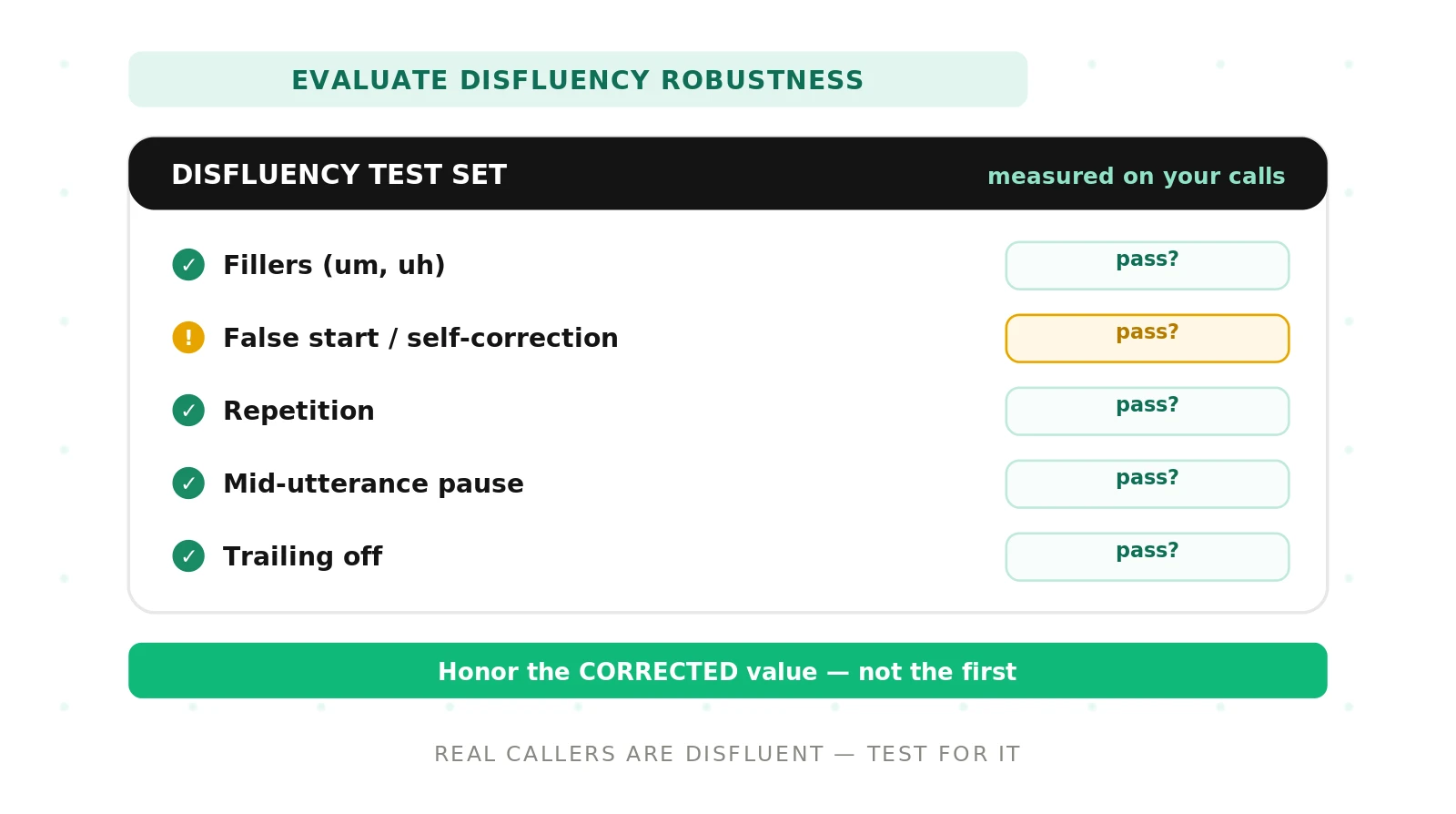
Six patterns cause most failures. Fillers like "um" and "uh." False starts and self-corrections, where the caller retracts a word and replaces it. Repetitions of a word or phrase. Mid-utterance pauses while the caller thinks. Trailing off, where a sentence fades without a clear end. And stutters or repeated syllables. Each one stresses a different part of the stack.
Why disfluency robustness matters
A brittle agent fails in four distinct ways, and each one is expensive.
First, it mis-transcribes. The speech recognition layer garbles the disfluent stretch and passes bad text downstream. A dropped digit in an account number is a failed call.
Second, it endpoints too early. Endpointing is the agent's decision that the caller has finished speaking. When a caller pauses mid-sentence to think, a trigger-happy agent treats the silence as the end of the turn. It cuts the caller off. This is one of the most common complaints about voice agents. It maps directly to a pause the agent could not tolerate.
Third, it misinterprets a self-correction. The caller says "send it to the old address — no, the new one," and the agent acts on "old." This is the single most damaging disfluency failure, and it gets its own section below.
Fourth, it loses intent. After a false start or a ramble, the agent extracts the wrong intent, or none. The conversation stalls or routes to the wrong place.
None of these show up in a scripted demo, because demo callers speak in clean sentences. They show up on day one in production, because real callers do not. That gap between demo speech and real speech is why disfluency robustness has to be measured on purpose.
STT robustness vs NLU robustness
Disfluency breaks two different layers, and you must measure them separately. Confusing the two leads to fixing the wrong thing.
STT robustness asks: did the agent transcribe correctly through the disfluency? A caller says "I need to, uh, reset my um password." The speech-to-text layer should produce "I need to reset my password," cleanly dropping the fillers, or at least transcribe them without corrupting the surrounding words. You measure this with transcription accuracy on disfluent audio, using word error rate weighted for the words that matter. Our WER vs CER guide explains why character-level errors on a digit string can matter more than the headline number.
NLU robustness asks: did the agent get the right meaning after the disfluency? This is a separate test. The transcript can be perfect and the agent can still act on the wrong value. NLU robustness covers intent extraction after a ramble and, above all, self-correction handling. You can pass STT and fail NLU. A robust agent needs both.
Keep the two apart in your scorecard. If transcription is clean but the agent still acts on the pre-correction value, the fix is in understanding, not recognition. If the transcript itself is garbled, the fix is in the speech layer. One number for "handled disfluency" hides which one to fix.
The self-correction trap
The self-correction trap is the failure that costs real money, so treat it as its own metric. A self-correction) is a repair: the caller states a value, then retracts and replaces it in the same breath. "Ship it to 500 Oak — no, wait, 1500 Oak." "My flight is the 3rd — sorry, the 13th." The corrected value is the real one. The first value is noise.
A brittle agent latches onto the first value it heard and confirms it. It books the 3rd, ships to 500 Oak, or transfers the wrong amount. The caller often does not catch the error until later. That turns a minor speech repair into a support ticket, a refund, or a lost customer.
The rule is simple to state and hard to guarantee: the agent must honor the corrected value, not the first one. A caller who says "the other address" or "no, make that" is issuing a retraction. The agent has to detect it and overwrite the earlier slot. Testing this is not optional for any agent that captures numbers, dates, names, or amounts. It is the highest-leverage disfluency test you can run.
Disfluency types and how each one breaks
The table below maps each disfluency type to what it breaks, how to test for it, and the signal that the agent passed. Use it as the backbone of your test set.
| Disfluency type | What breaks | How to test | Pass signal |
|---|---|---|---|
| Fillers ("um," "uh," "er") | STT inserts junk tokens or drops adjacent real words | Seed fillers before and inside key phrases and account numbers | Transcript keeps the real words; intent and entities intact |
| False start / self-correction | Agent acts on the first value, not the corrected one | Give a wrong value then correct it ("the 3rd — no, the 13th") | Agent captures and confirms the corrected value only |
| Repetition | Duplicated words inflate or confuse entity capture | Repeat digits or words ("four four, I mean, four zero") | Correct final value; no duplicated or merged entities |
| Mid-utterance pause | Agent endpoints early and cuts the caller off | Insert a 1.5–3 second pause mid-sentence | Agent waits; caller finishes without being interrupted |
| Trailing off | Agent treats a fade as a complete turn and guesses | End a turn with an unfinished, fading clause | Agent prompts to continue rather than acting on a fragment |
Building a disfluency test set
You cannot measure what you do not deliberately provoke. There are two ways to build the material, and the strongest programs use both.
The first is a seeded test set. Start from your clean scenarios and inject disfluencies programmatically. Add fillers before critical entities. Insert false starts that state a wrong value and correct it. Add repetitions, mid-utterance pauses, and trailing-off endings. Because you seeded them, you know the correct answer for every case, which makes scoring exact. Vary caller voice, pace, accent, and line quality so the disfluency is not the only variable. Our accent handling guide covers why voice variety matters here.
The second is mining real calls. Pull recordings from production and label the disfluent moments: where a caller paused, corrected, or rambled. Real disfluencies are messier than seeded ones and reveal patterns you would not think to script. They also ground the test set in the speech your actual callers produce, not a stereotype of it.
Seed for coverage and control. Mine for realism. Then run both against every version and vendor with the same scoring, so the numbers compare. Layer disfluency on top of noise where it is realistic, since callers hesitate in loud places too; our noise robustness guide and our piece on testing STT against background noise go deeper on that dimension.
What to measure
Three metrics turn the test set into a verdict. Keep each one separate on the scorecard.
Correct-intent-after-disfluency rate. Of the disfluent cases, what fraction end with the right intent and entities captured. This is the top-line NLU score. It answers whether the agent got there despite the mess.
Self-correction handling rate. Of the cases with a retraction, what fraction honor the corrected value and not the first. This is the trap metric. Report it on its own. A high overall score can hide a low correction score, and those failures cost the most.
Premature-endpointing rate. Of the cases with a mid-utterance pause, what fraction get cut off before the caller finishes. This is the STT-and-timing metric that maps to the "it interrupts me" complaint. Lower is better, and you want it near zero on pauses under three seconds.
Track transcription accuracy on disfluent audio alongside these, weighted for critical entities. Together they tell you whether a failure lives in recognition, understanding, or timing. That separation is what makes the result actionable rather than just a grade.
How to evaluate disfluency robustness in a voice agent
1. List the disfluency-prone tasks. Identify the flows where a caller states numbers, dates, names, or amounts — the places a correction or a dropped digit does real damage.
2. Build a seeded test set. Take clean scenarios and inject fillers, false starts, self-corrections, repetitions, pauses, and trailing-off endings, with the correct answer recorded for each.
3. Mine real calls. Pull production recordings and label genuine disfluent moments to complement the seeded cases with realistic ones.
4. Vary the caller. Run each case across voices, paces, accents, and line conditions, so disfluency is tested, not voice quality by accident.
5. Score the three metrics. Compute correct-intent-after-disfluency, self-correction handling, and premature-endpointing rates, plus transcription accuracy on the disfluent audio.
6. Separate STT from NLU failures. For each miss, check whether the transcript was wrong or the meaning was, so you fix the right layer.
7. Set thresholds and gate on them. Decide the minimum acceptable rates, and block release when a version regresses below them.
8. Re-run on every change. Repeat after prompt, model, or vendor updates, since disfluency handling regresses silently.
How Evalgent evaluates disfluency robustness
Evalgent is an independent, third-party evaluator, so the disfluency score comes from a party with no stake in the result. We build a disfluency test set against your real scenarios — seeded fillers, false starts, self-corrections, repetitions, and pauses — and we mine your production calls for genuine disfluent moments. Every case runs identically against each version or vendor you compare.
We score the three metrics that matter: correct-intent-after-disfluency, self-correction handling, and premature-endpointing rate, with transcription accuracy on the disfluent audio reported alongside. Reviews let your team replay any call to hear exactly where an agent honored the first value instead of the correction, or cut a caller off mid-pause. Because the scoring is fixed and neutral, the numbers compare across vendors. They stand up to a procurement or security review, and map to a recognized framework such as the NIST AI Risk Management Framework. This complements a full voice agent metrics scorecard. To evaluate your agent against real disfluent callers, book a demo.
The bottom line
Disfluency robustness is how well a voice agent handles fillers, false starts, self-corrections, and pauses — the way real callers actually speak. Measure it with a seeded test set and real calls, score correct-intent-after-disfluency, self-correction handling, and premature-endpointing, and make the agent honor the corrected value, never the first.
Frequently asked questions
How do you evaluate disfluency robustness in a voice agent?
Build a disfluency test set by seeding fillers, false starts, self-corrections, repetitions, and pauses into your scenarios, and mine real calls for genuine disfluent moments. Run every case against each version identically. Score correct-intent-after-disfluency, self-correction handling, and premature-endpointing rates, and check transcription accuracy on the disfluent audio to separate recognition failures from understanding failures.
How do voice agents handle filler words like um and uh?
A robust agent transcribes through fillers and drops them from the meaning, so "reset my, um, password" is understood as "reset my password." A brittle agent lets the filler corrupt nearby words or split the phrase, damaging intent and entity capture. Test it by seeding fillers before and inside critical phrases, then confirm the real words survive.
Why does a voice agent cut off callers who pause?
Because it endpoints too early. Endpointing is the agent's judgment that the caller has finished the turn. When a caller pauses mid-sentence to think, an aggressive endpointing setting reads the silence as the end and starts responding. Measure the premature-endpointing rate on mid-utterance pauses of one to three seconds; a robust agent waits rather than interrupting.
How do you test a voice agent for self-corrections?
Give the agent cases where the caller states a value, retracts it, and replaces it — "the 3rd, no, the 13th." Record the corrected value as the correct answer. Then score whether the agent captured and confirmed the correction, not the first value. Report this self-correction handling rate on its own, since it is the costliest disfluency failure to miss.
What is a disfluency test set for voice agents?
A disfluency test set is a collection of caller scenarios that deliberately contain fillers, false starts, self-corrections, repetitions, pauses, and trailing-off endings, each paired with the correct expected outcome. Some cases are seeded programmatically for control, and some are mined from real production calls for realism. It is what lets you measure disfluency robustness repeatably across versions and vendors.
Does a voice agent act on the first value or the corrected value?
A robust agent acts on the corrected value. When a caller says "500 Oak — no, 1500 Oak," the corrected value is the real one, and the first value is noise. A brittle agent latches onto the first value and confirms it, which causes wrong bookings, shipments, and transfers. Always test that retractions overwrite the earlier slot.
How do you measure premature endpointing?
Insert mid-utterance pauses of one to three seconds into test cases where the caller is still speaking. Score the fraction of cases where the agent starts responding before the caller finishes. That fraction is the premature-endpointing rate, and lower is better. It maps directly to the common complaint that voice agents interrupt callers who simply stopped to think.
Can a voice agent understand a caller who trails off?
It can if it is built and tested for it. Trailing off is when a sentence fades without a clear ending. A robust agent recognizes the fragment as incomplete and prompts the caller to continue, rather than guessing at an intent from half a sentence. Test it by ending turns with unfinished, fading clauses and checking that the agent asks rather than acts.
Related Articles
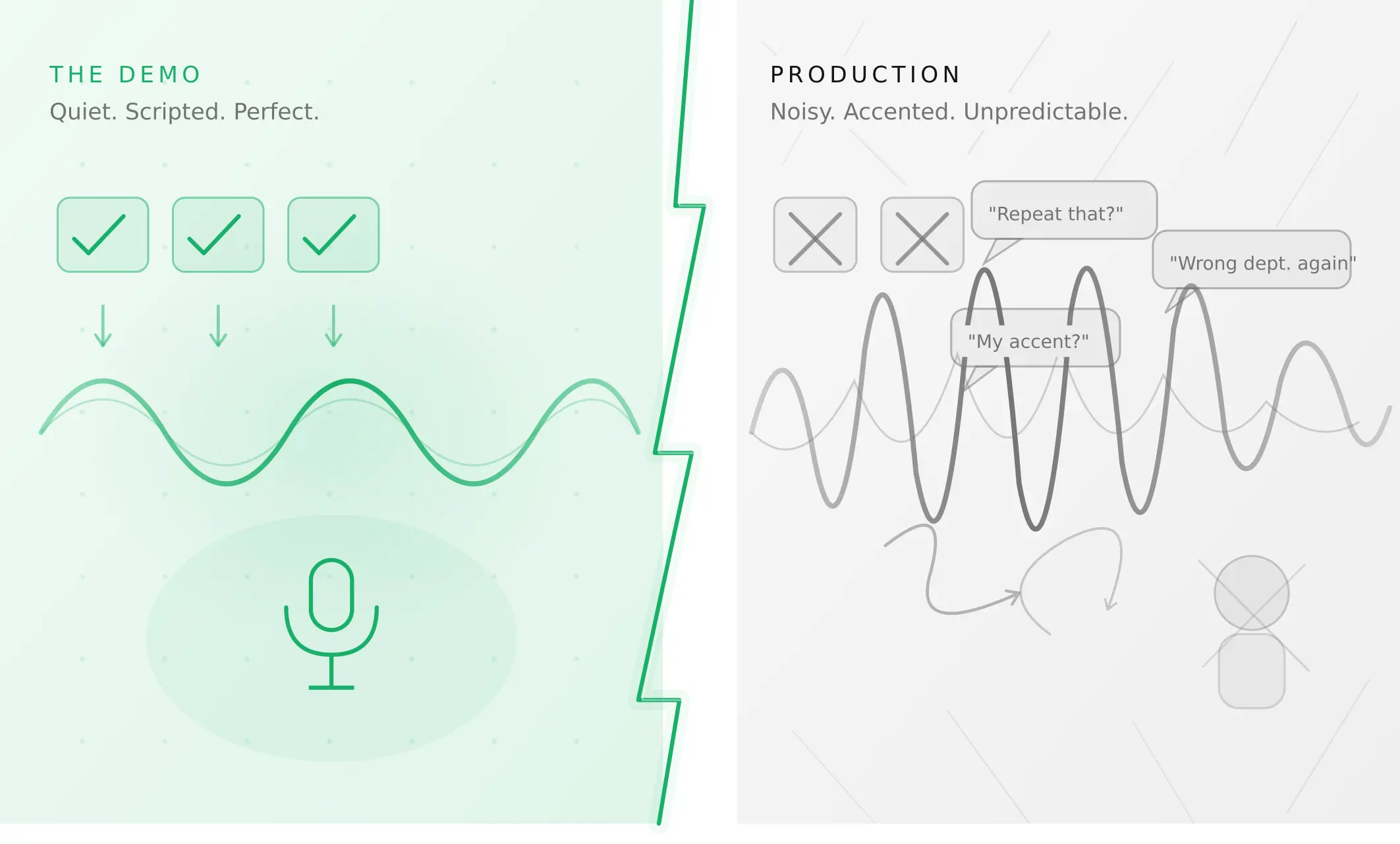
Why AI voice agents fail in production (and how to prevent it)
AI voice agents that ace demos still break in production. Learn the 5 root causes, how to test for each, and what production readiness actually means.
Read more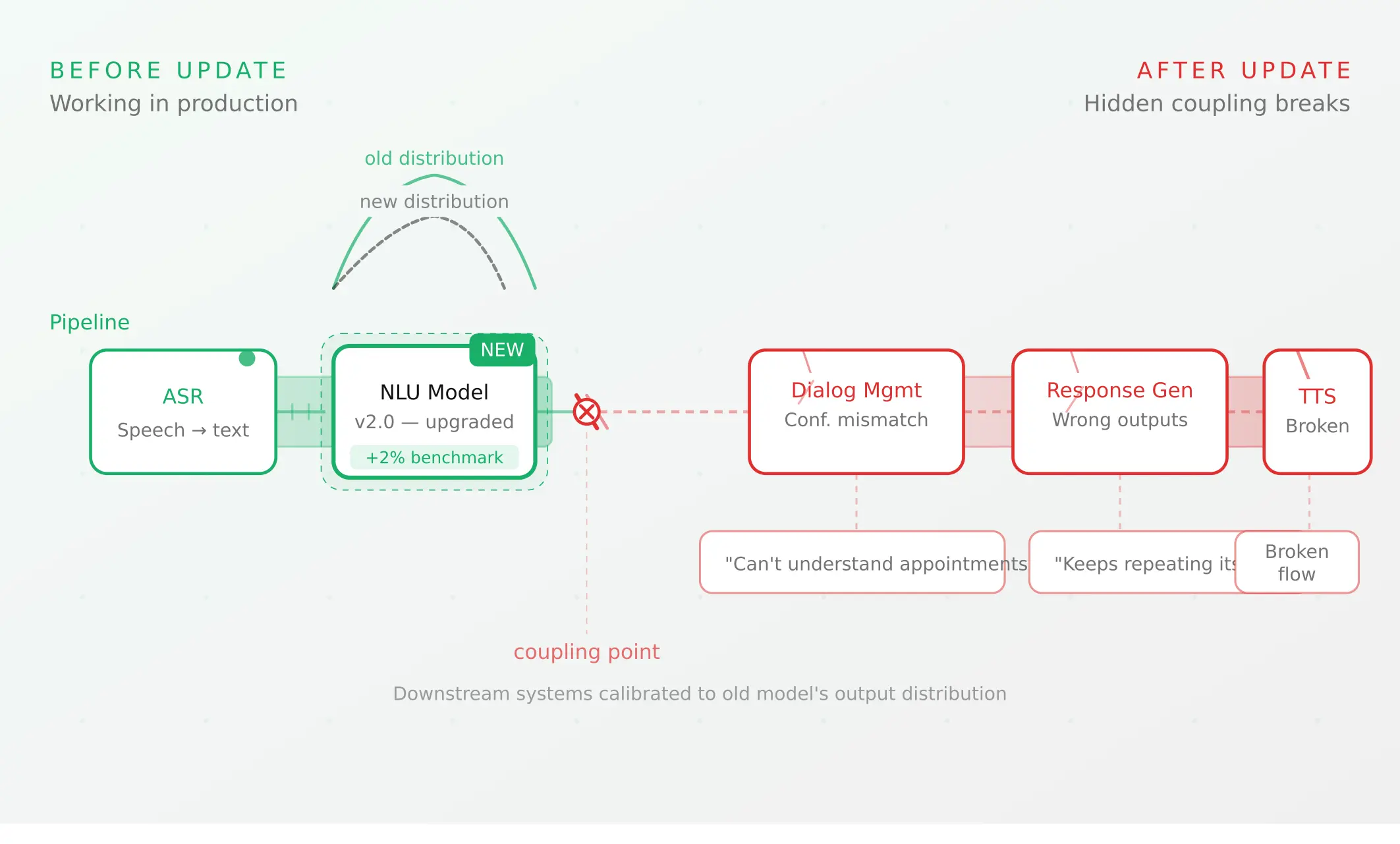
Voice agent regression testing: why LLM updates break production
LLM updates improve benchmarks but break voice agents in 5 predictable ways. How to detect and prevent regressions after every model or prompt change.
Read more