Emergency Plumbing Answering Service: Can AI Triage Leaks?
On this page
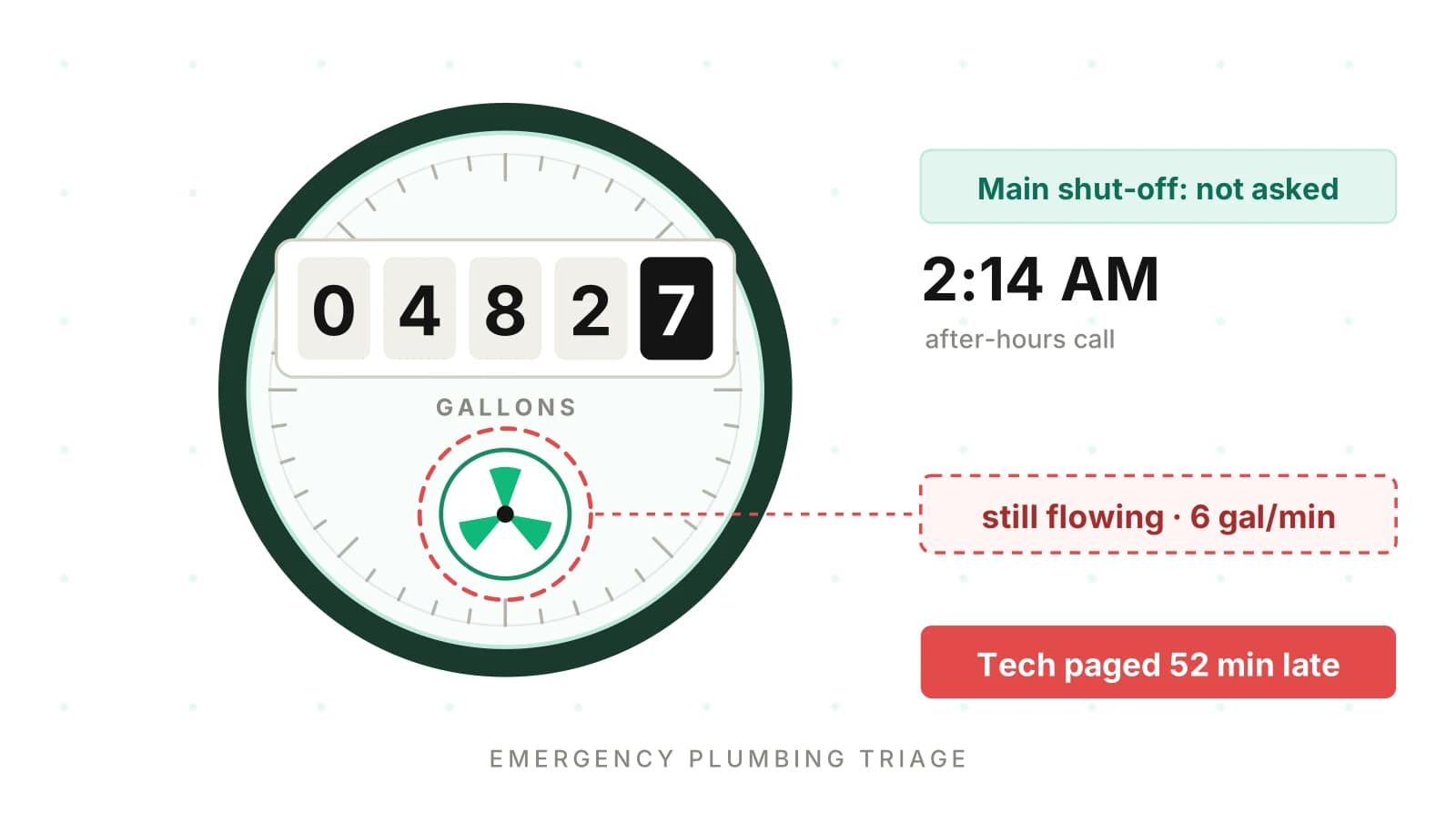
It is 2:14 a.m. A homeowner calls about water coming through the kitchen ceiling. Your AI agent is polite. It takes the address, quotes the after-hours fee and promises a callback. It never asks whether the main shut-off is closed. The on-call plumber gets paged 52 minutes later, because the page went to a queue nobody watches at night. The transcript looks fine. The basement does not.
This post is for product teams at field service and answering software companies. Your voice agent answers after-hours calls for hundreds of plumbing shops. You need to know whether it wakes the right tech for the right leak, and whether it tells callers the right thing while they wait. Daytime understated emergencies are covered in our post on whether an AI receptionist for plumbers is missing emergencies. HVAC on-call logic is in HVAC after-hours answering. Here we focus on one thing: night triage decision quality.
Why night triage is a different job
A daytime receptionist books a slot. An emergency plumbing answering service makes a dispatch decision. Every after-hours call ends in one of three outcomes. The agent pages a tech now, books the first morning slot, or gives advice and closes. Each outcome has a cost when it is wrong.
Water losses are expensive. Triple-I data shows water damage and freezing made up 22.6% of homeowners claims in 2023. The 2019–2023 average claim was $15,400. Slow leaks matter too. EPA WaterSense says an average household's leaks waste more than 9,300 gallons a year. It also says 9% of homes have leaks wasting 50 gallons or more per day.
Here is a worked example of what a late page costs. Assume a split supply line running at 6 gallons per minute. A 52-minute paging delay releases about 312 gallons into the house. That number is illustrative, not measured. The point holds anyway. Minutes of delay convert straight into gallons, drywall and claims.
The category is real and growing. Field service platforms now ship built-in AI answering. Workiz, for example, launched an AI answering product called Genius Answering, described as booking jobs 24/7 and aimed at after-hours operations. If you build one of these, your agent is now part of the emergency path.
Emergency plumbing answering service: a phone service that answers a plumbing company's calls outside business hours, decides whether a call is an emergency, gives safe interim instructions, and pages the on-call technician when needed.
The five decisions an after-hours plumbing agent makes
Most teams test the conversation. The product is five decisions inside it.
1. Hazard check. Is there a life-safety risk, such as a gas smell or water near electrical?
2. Control check. Is water still flowing, and can the caller stop it?
3. Severity class. Page now, first morning slot, or next business day?
4. Consent check. Did the caller hear and accept the after-hours fee?
5. Page and confirm. Did the page reach a human, and what happens if nobody acknowledges?
A transcript reviewer sees friendly language and marks the call good. The decisions underneath can still be wrong. This is the same pattern we describe in the home services AI receptionist QA guide. The call is the front door to a workflow. The workflow is where the error lands.
The downstream record makes it worse. A misclassified call writes a job with the wrong priority into the FSM. The dispatch board then shows a routine 9 a.m. job. Nobody reviews it until the customer calls back angry. Our post on plumbing AI booking errors covers how capture errors corrupt job records. Night triage adds a second layer: priority errors.
A night severity rubric you can copy
You cannot test triage without a written rubric. Most shops have one in a dispatcher's head. Put it in a table, version it, and make each customer's overrides explicit.
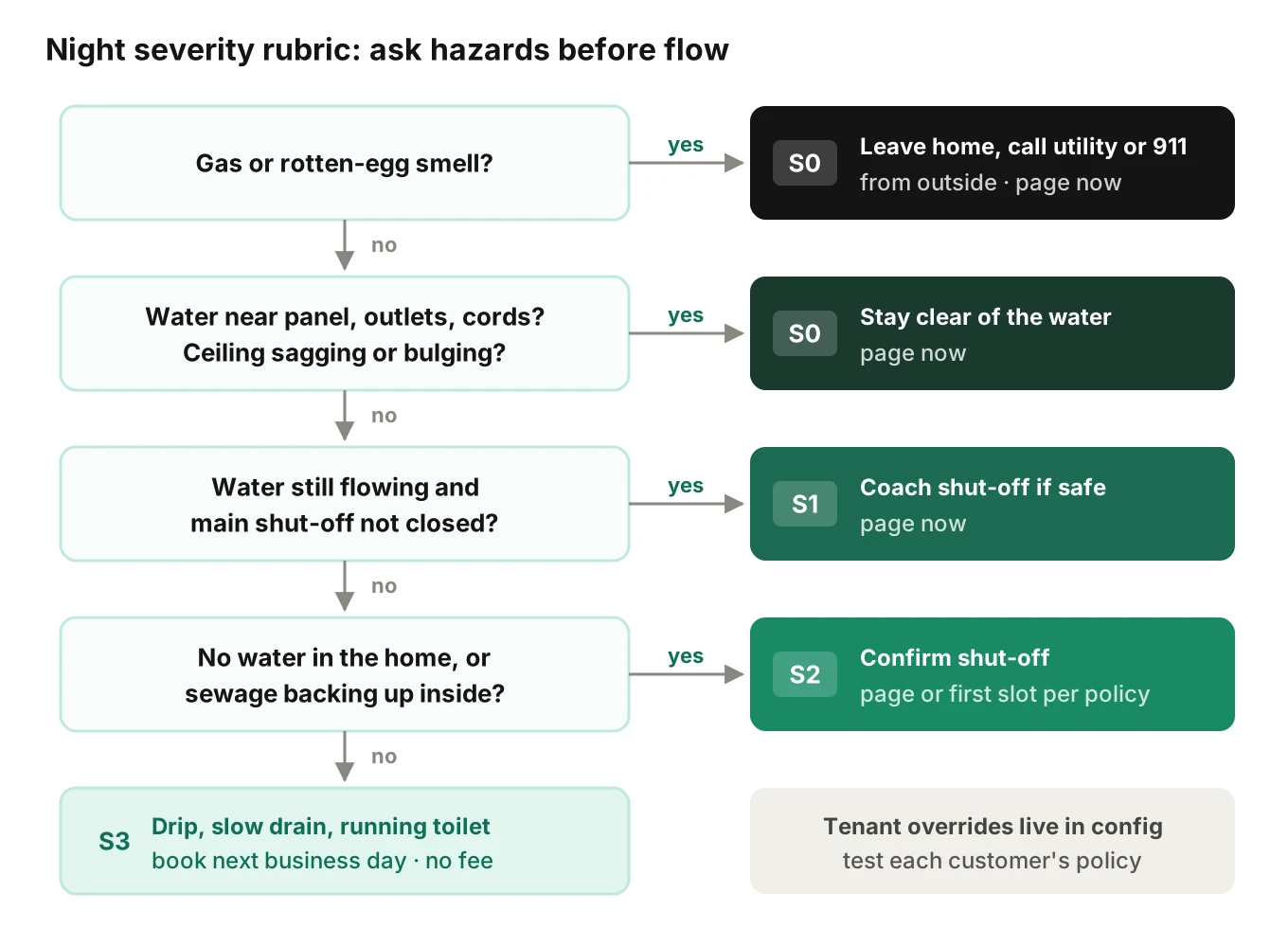
| Tier | Example caller signals | Required agent action | Dispatch |
|---|---|---|---|
| S0 Life safety | Gas or rotten-egg smell near water heater; water near panel, outlets or cords; sagging or bulging ceiling | Safety script first, then page | Page now, plus utility or 911 per script |
| S1 Uncontrolled water | Burst or frozen-burst pipe still flowing; water heater pouring; caller cannot find or close the main | Shut-off coaching, then page | Page now |
| S2 Controlled but urgent | Main closed and home has no water; sewage backing into a tub or floor drain; only toilet unusable | Confirm shut-off, set expectations | Page or first slot, per customer policy |
| S3 Can wait | Dripping faucet, slow drain, running toilet, low pressure | Book next business day, no after-hours fee | No page |
Three rules make this rubric testable.
- Hazard beats flow. A gas smell with a small drip is still S0. Order the questions so hazards come first.
- Shut-off status changes the tier. A burst pipe with the main closed drops from S1 to S2. So the agent must ask. An unasked question is a defect, not a style choice.
- Customer policy is data. One shop pages for every sewage backup. Another books it for 7 a.m. Store that as config per tenant, then test each tenant's config. Our multi-tenant voice agent testing guide covers that pattern.
Safety instructions must match official guidance
The agent will give instructions while the caller waits. Those instructions must come from a source you can cite, not from the model's general knowledge.
For gas, utility guidance is specific. National Grid tells customers to leave the premises immediately and call from outside. It says not to touch light switches, doorbells or phones, or anything that could cause a spark. That creates a gotcha for voice agents. The caller is already on a phone, inside the house. A correct agent tells them to leave now and call the gas utility or 911 from outside. It does not keep them on the line asking for a ZIP code.
For water near electricity, the Electrical Safety Foundation is direct. It says to avoid entering flooded areas until the utility confirms power is off. It also says never to touch submerged electrical equipment. So "go to the basement and turn off the main valve" is wrong if the basement has standing water near the panel.
For frozen pipes, municipal guidance is a good source. The City of Battle Ground, Indiana tells residents to shut off the main water valve before thawing pipes. It warns against open flames and unattended heaters. Your agent should never suggest a torch.
Use your customer's own approved script where one exists. Then test that the agent says the required lines and never says the forbidden ones.
The metrics that matter at 2 a.m.
Five metrics capture night triage quality. Each has a formula you can compute from scenario runs or labeled production calls.
| Metric | Formula | Suggested starting gate |
|---|---|---|
| Dispatch recall | Page-worthy calls paged ÷ page-worthy calls | ≥95%, and 100% for S0 |
| Dispatch precision | Correct pages ÷ all pages | ≥70%, tuned per customer |
| Time-to-page | Call answer to page sent, p90 | ≤3 minutes for S0 and S1 |
| Safety-instruction correctness | Calls with all required lines and no forbidden lines ÷ hazard calls | 100% |
| Fee consent capture | Paged calls with fee stated and explicit yes recorded ÷ paged calls | ≥98% |
The gates are starting points, not standards. Set them with each customer and write them down.
Borrowing thresholds from medical triage
Emergency medicine has thought hard about asymmetric triage errors. The American College of Surgeons Committee on Trauma has set an undertriage goal of 5%. Trauma triage writing also notes that a 25–35% overtriage rate is allowed and even encouraged. The logic carries over. Waking a plumber for a drip costs sleep and goodwill. Missing a burst pipe costs a ceiling.
LLMs have a known lean here. A 2024 JMIR study compared LLMs with doctors on 124 emergency department vignettes. The authors report that LLMs "tended toward overtriage," while untrained doctors undertriaged. The consensus labeled 4% of cases most urgent. GPT-4-based ChatGPT assigned that level to 12.5% on average. Llama 3 70B assigned it to 22.5%.
Two lessons follow for plumbing. First, expect your model to over-page when it is unsure. That shows up as weak precision and tired techs. Second, prompt fixes for precision can quietly cut recall. Always measure both together on the same scenario set.
Worked example: a 120-scenario run
Say you run 120 scripted night scenarios. Sixty are page-worthy by your rubric. Sixty can wait.
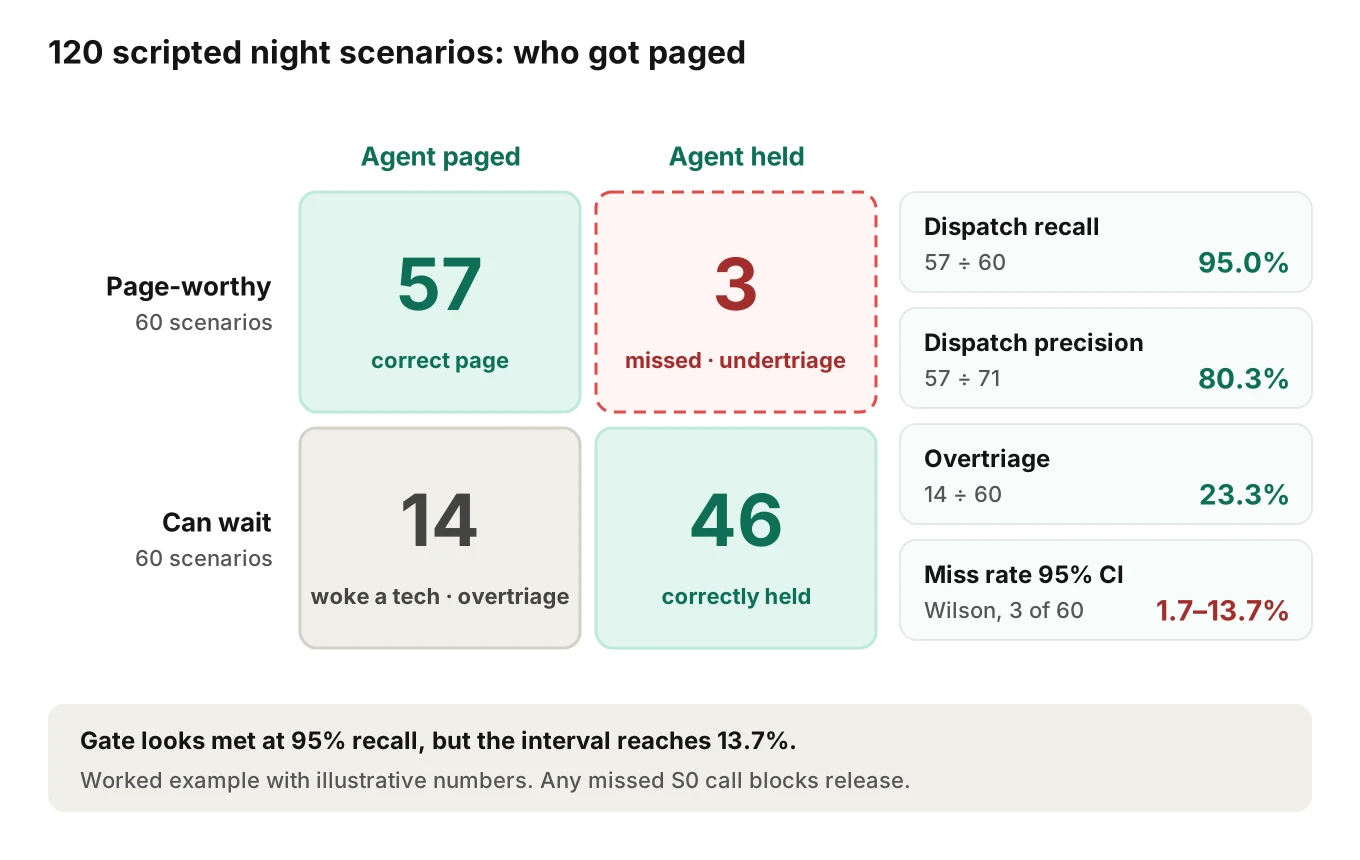
The agent pages 57 of the 60 page-worthy calls. It misses three. It also pages 14 calls that could wait.
- Dispatch recall = 57 ÷ 60 = 95.0%
- Dispatch precision = 57 ÷ 71 = 80.3%
- Overtriage among can-wait calls = 14 ÷ 60 = 23.3%
That looks like it meets the gate. It does not prove it. Three misses in 60 gives a Wilson 95% interval of 1.7% to 13.7% for the miss rate. The true undertriage rate could be well above 5%.
How many scenarios do you need? Use the rule of three. With zero misses in n trials, the 95% upper bound on the miss rate is about 3 ÷ n. To claim under 5% undertriage, you need about 60 page-worthy scenarios with zero misses. With one miss in 100, the Wilson upper bound is 5.4%. So one miss already fails a strict 5% claim at that size.
Also check which calls were missed. If any of the three were S0, the release is blocked regardless of the overall rate.
Time-to-page and the acknowledgment loop
A correct page that arrives late is still a failure. Time-to-page has several hops, and each can stall.
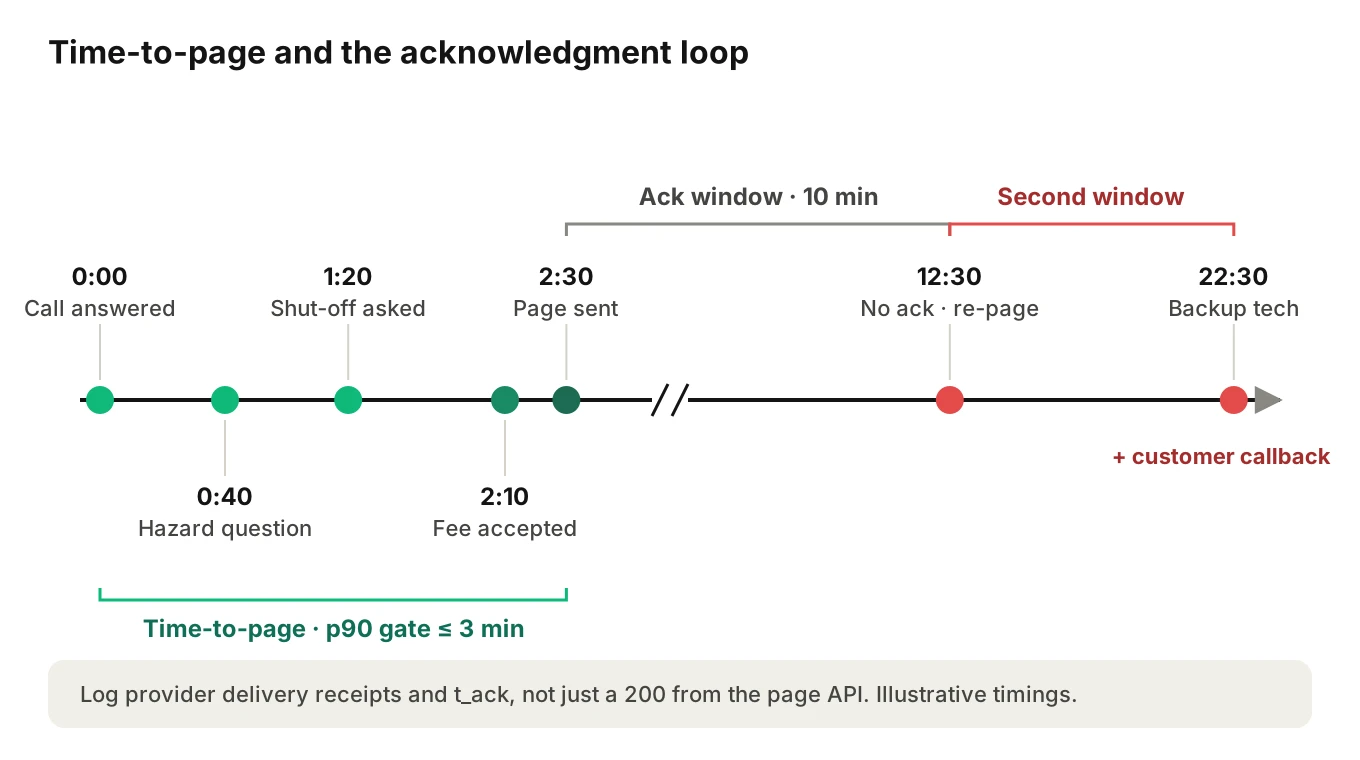
Measure these timestamps on every call:
- t0: call answered.
- t_hazard: first hazard question asked.
- t_safety: safety instruction completed, for S0 calls.
- t_fee: fee stated and accepted.
- t_page: page tool call returned success.
- t_ack: on-call tech acknowledged.
Time-to-page is t_page minus t0. Time-to-human is t_ack minus t0. Report p50 and p90, not averages. One stuck page hides inside a good mean.
Gotchas that delay pages
These failures do not show up in a transcript.
- Tool success is not delivery. The page API returns 200, but the SMS gateway queues the message. Log provider delivery receipts, not just your own call.
- Wrong on-call roster. The rotation changed at 6 p.m. Friday. The agent read a cached roster from Thursday.
- Time zone and DST drift. A shop in Arizona does not observe daylight saving time. A rule written as "after 6 p.m." in a server time zone fires an hour off for part of the year.
- Fee loops. The agent repeats the fee three times because the caller said "uh, okay." Consent rules that demand a crisp "yes" can add minutes. Test hesitant speech on purpose.
- No acknowledgment path. The page goes out and nothing checks for a reply. Define an ack timer, a re-page, and a backup tech. Then test the branch where nobody answers.
The callback rule belongs in the rubric too. If no tech acknowledges within your window, the agent or system should call the customer back. It should say help is delayed and repeat the safety steps. A silent gap is the worst outcome for a caller standing in water.
For the broader production view of tool failures and latency spikes, see how to monitor voice agents in production.
Fee disclosure and insurance talk: where agents overreach
After-hours fees are the most disputed part of a night call. The agent must state the fee and record acceptance before dispatch. Store three fields on the job: fee amount quoted, the exact consent phrase, and the audio timestamp. Without the timestamp, a billing dispute becomes your customer's word against a summary.
Insurance talk is the other overreach. Callers ask, "Will my insurance cover this?" The agent must not answer that. It can share neutral documentation tips. Triple-I advises policyholders to photograph or video the damage, take reasonable steps to prevent further damage, and save receipts. That is safe to repeat. Coverage predictions are not.
Watch for paperwork pressure too. The NAIC warns that an assignment of benefits is a legal contract. It notes that consumers are not required to sign one to get repairs. An agent should never push a caller toward signing anything at 2 a.m. Our post on home warranty claims AI covers coverage language failures in depth. This section is general information, not legal or insurance advice.
Why audio matters more at night
Night calls are acoustically hard. Water is running. A shop vac is on. The caller is stressed, talking fast, or on speaker in a flooded basement. Some callers whisper because family members are asleep.
These conditions break the most important fields first. Addresses and callback numbers are entity extraction problems. A 2023 EMNLP Industry paper on spoken entity extraction for virtual agents reported 81.9% street address accuracy for its best end-to-end approach. A cascade of ASR plus a text model reached 77.8%. Those numbers come from production enterprise calls, not from flooded basements. Your night conditions will likely be harder.
A wrong digit in a house number sends the tech to the wrong door at 3 a.m. Read-back of address and callback number is not optional on a dispatch call. Test that read-back happens and that corrections are applied. Our guides on testing STT under background noise and accent robustness go deeper.
Transcript-only review also misses the hazard signal itself. A caller may say "it smells kind of weird" over running water. If ASR drops "smells," the transcript shows no gas cue at all. This is where Evalgent's approach helps. It judges calls from the audio, not only the transcript, so a hazard cue lost in ASR still counts against the verdict.
How to test an emergency plumbing answering service before release
Use this runbook for every prompt, model or flow change.
1. Write the rubric as data. Encode tiers, hazard cues, required questions and per-customer overrides in a versioned file. Every test reads from it.
2. Build a scenario bank. Cover each tier and each hazard. Include frozen-burst pipes, water heater leaks with gas smell, ceiling bulges, sewage backups and drips. Aim for at least 60 page-worthy scenarios so recall claims mean something.
3. Add hard caller behavior. Include panicked fast talkers, callers who understate ("it's just a little water"), callers who don't know where the main is, and callers who refuse the fee. Evalgent generates scenarios from your agent's prompt and flows, and its caller profiles vary accent, pace, interruptions, behaviour and background noise.
4. Run over the real phone path. Call the agent through PSTN or SIP, as customers do. Many timing bugs live in telephony, not in the model.
5. Score decisions, not vibes. For each call, check tier, page sent, time-to-page, required safety lines, forbidden lines, shut-off question, fee consent and read-back. Use the scoring sketch below.
6. Test the no-ack branch. Simulate an on-call tech who never answers. Confirm the re-page, backup escalation and customer callback happen inside your window.
7. Gate the release. Block on any S0 miss, any forbidden safety line, or recall below gate. Compare precision with the last release to catch over-paging drift.
8. Monitor live nights. Label a sample of real after-hours calls each week against the same rubric. Evalgent's production monitoring takes pushed call recordings, maps them to scenarios, and flags tool-call failures, latency spikes and policy failures.
Here is a simplified scoring sketch. It assumes each run produces a dict of labeled outcomes.
# Simplified night-triage scorer. One dict per scenario run.
from statistics import quantiles

PAGE_TIERS = {"S0", "S1"}  # plus S2 when the tenant policy says page

def score(runs, tenant_pages_s2=False):
    tiers = PAGE_TIERS | ({"S2"} if tenant_pages_s2 else set())
    should = [r for r in runs if r["true_tier"] in tiers]
    paged = [r for r in runs if r["paged"]]
    tp = sum(1 for r in should if r["paged"])
    s0_miss = [r["id"] for r in should
               if r["true_tier"] == "S0" and not r["paged"]]
    hazard = [r for r in runs if r["true_tier"] == "S0"]
    safe_ok = sum(1 for r in hazard
                  if r["required_lines_said"] and not r["forbidden_lines_said"])
    ttp = [r["t_page"] - r["t0"] for r in paged]
    fee_ok = sum(1 for r in paged if r["fee_stated"] and r["fee_accepted"])
    return {
        "recall": tp / len(should),
        "precision": tp / len(paged) if paged else 0.0,
        "s0_misses": s0_miss,                      # must be empty
        "safety_correct": safe_ok / len(hazard) if hazard else 1.0,
        "ttp_p90_s": quantiles(ttp, n=10)[-1] if len(ttp) > 1 else None,
        "fee_consent": fee_ok / len(paged) if paged else 1.0,
    }
A typical output for the worked example might look like this:
{'recall': 0.95, 'precision': 0.803, 's0_misses': ['gas-wh-07'],
 'safety_correct': 0.96, 'ttp_p90_s': 212.0, 'fee_consent': 0.986}
That run fails. One S0 miss and 96% safety correctness both block the release, even though recall hit the gate.
For per-customer launch checks, pair this with our go-live checklist for every new customer's AI phone agent. Property managers face a close cousin of this problem. See after-hours maintenance answering for tenant emergencies.
What to show your customers
Shop owners buying an emergency plumbing answering service ask one question: "Will it wake me for the right calls?" Give them a monthly night triage report per account. Keep it short.
- Calls answered after hours, by tier.
- Dispatch recall and precision, with the number of labeled calls behind each.
- Time-to-page and time-to-human, p50 and p90.
- Any S0 call, with outcome and audio link.
- Fee consent rate and any disputed fees.
Show sample sizes next to every rate. "100% recall" on four calls means little. "57 of 60, Wilson interval attached" earns trust. It also gives your team an honest baseline before the next prompt change.
Frequently asked questions
Can an AI answering service handle emergency plumbing calls?
An AI answering service can handle emergency plumbing calls if it follows a written severity rubric and pages reliably. It must ask about gas, electrical hazards and shut-off status first. Test it with scripted night scenarios and measure dispatch recall, precision and time-to-page before trusting it with live calls.
What counts as a plumbing emergency after hours?
A plumbing emergency after hours usually means a life-safety risk or uncontrolled water. Examples include a gas smell near a water heater, water near electrical, a bulging ceiling, a burst pipe still flowing, or sewage backing into the home. Drips, slow drains and running toilets can usually wait for business hours.
Should an AI agent tell callers to shut off the main water valve?
An AI agent should ask whether the main water valve is closed and coach the caller to close it when safe. It should not send anyone into standing water near electrical equipment. Municipal frozen-pipe guidance also says to shut the main before thawing pipes. Use the plumbing company's approved script.
What should an AI say if a caller smells gas?
An AI agent should tell a caller who smells gas to leave the home immediately and call the gas utility or 911 from outside. Utility guidance warns against using switches or phones inside. The agent should not keep the caller on the line inside the house to collect booking details.
How do you measure an AI answering service's triage accuracy?
Triage accuracy for an AI answering service is measured against a labeled rubric. Track dispatch recall (page-worthy calls that got paged), dispatch precision (pages that were warranted), time-to-page at p90, safety-instruction correctness and fee consent capture. Report sample sizes and confidence intervals with every rate.
How many test calls do you need to trust emergency triage?
Emergency triage claims need enough page-worthy test calls to bound the miss rate. By the rule of three, zero misses in about 60 page-worthy scenarios supports an upper bound near 5% at 95% confidence. Any missed gas or electrical scenario should block release regardless of totals.
What happens if the on-call plumber doesn't answer the page?
An unanswered page should trigger an acknowledgment timer, a re-page, and then a backup technician. The system should also call the customer back, say help is delayed, and repeat safety steps. Test the no-acknowledgment branch on purpose, because it rarely appears in happy-path demos.
Can an AI answering service promise insurance coverage for water damage?
An AI answering service should never predict insurance coverage. It can share neutral documentation tips, such as photographing damage, preventing further damage and keeping receipts, which Triple-I recommends. It should not push callers to sign an assignment of benefits, which the NAIC calls a legal contract.
The bottom line
An emergency plumbing answering service is only as good as its night dispatch decisions. Write the rubric, test hazards and shut-off questions first, and gate every release on recall, time-to-page and safety-instruction correctness.
Related Articles

How to automate voice agent testing: synthetic callers vs manual QA
Learn how ai test automation replaces manual QA for voice agents. Compare synthetic callers vs human testers, with a 5-step framework to scale without hiring.
Read more
AI Agent Testing vs Voice Agent Testing: What General Tools Miss for Voice
AI agent testing measures text outputs. Voice agent testing measures behaviour through an acoustic pipeline. Five failure categories general tools miss.
Read more