Plumbing AI Booking Errors: Catch Them Before Customers Do
On this page
This post is for product teams at field service management software companies. Your plumbing AI receptionist answers and books for hundreds of plumbing companies. Each one has its own job types, fees, zones and emergency rules. A booking error rarely looks like a failed call. The caller hears "you're all set." The damage shows up next morning: wrong truck, wrong parts, wrong amount of time.
The basics live in our home services AI receptionist QA guide, and the HVAC dispatch version in why HVAC AI books the wrong tech. Here we cover what plumbing adds: gas and water safety, wide duration swings, and truck equipment.
What a plumbing AI booking actually writes
A phone call is the front door. Behind it sits a booking record in your field service management software. The record holds a customer, a location, a job type, a priority, a duration, an arrival window and notes. Dispatch, routing, truck stock and invoicing all read that record. None of them hear the call.
ServiceTitan's own call booking workflow shows the shape. The job type filters which business units are offered. The summary is pre-filled from the job type and is often read as a call script. Priority is pre-filled with a default. So one choice, the job type, quietly sets several other fields.
FSM vendors now build answering into the platform itself. Workiz, for example, launched an AI answering service it describes as built into its FSM platform and "booking jobs 24/7" (ACHR News, December 2024). When the agent and the job record live in one product, a classification mistake becomes a dispatch mistake with no human in between.
Booking error: a call that ends with a valid-looking job record whose job type, priority, duration, location, fee or count differs from what the caller needed. It passes every schema check and still sends the wrong truck.
Six plumbing AI booking errors that reach the truck
These six plumbing AI booking errors cover most of what goes wrong. Each one corrupts one field, and each field breaks something different downstream.
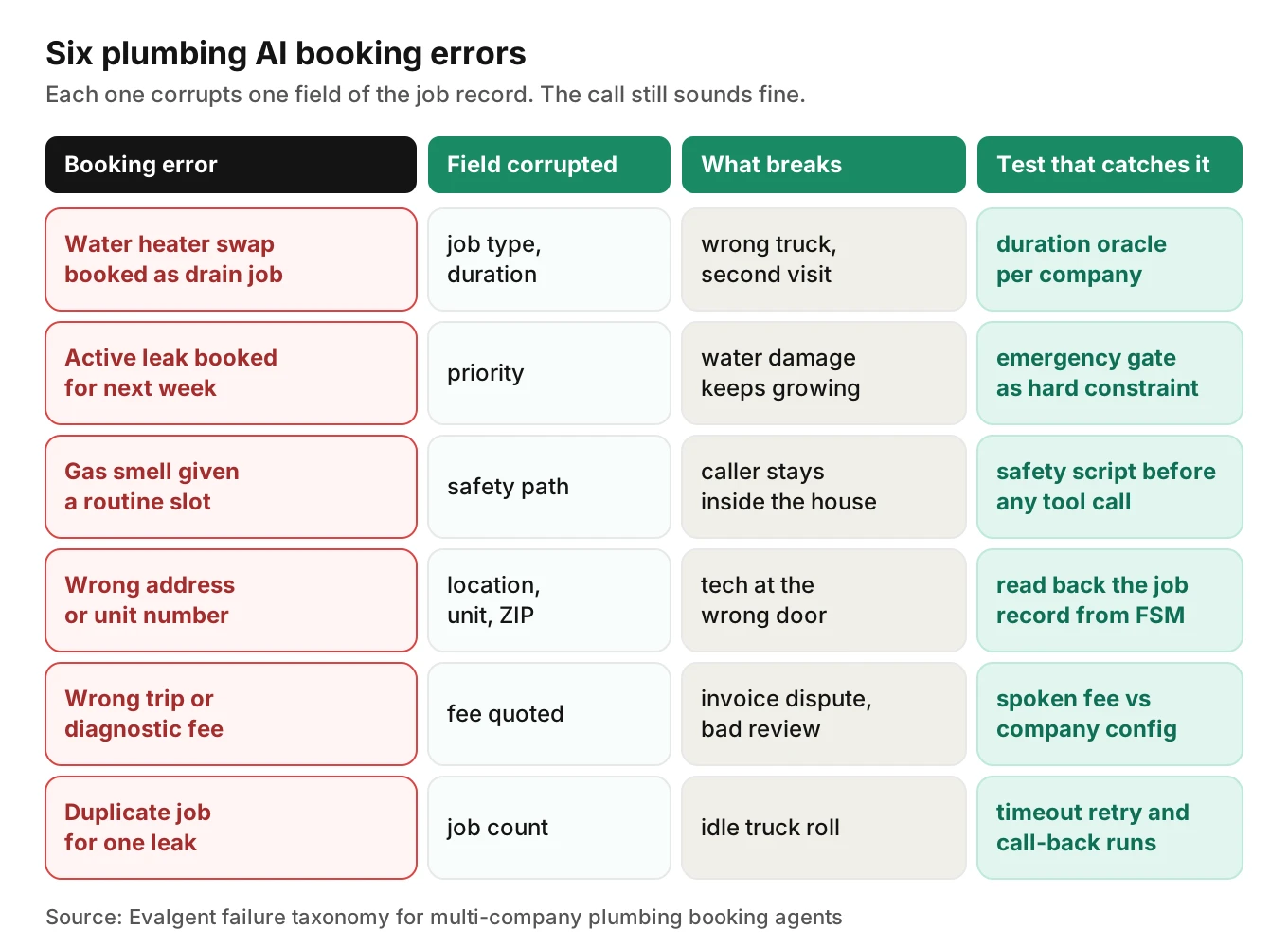
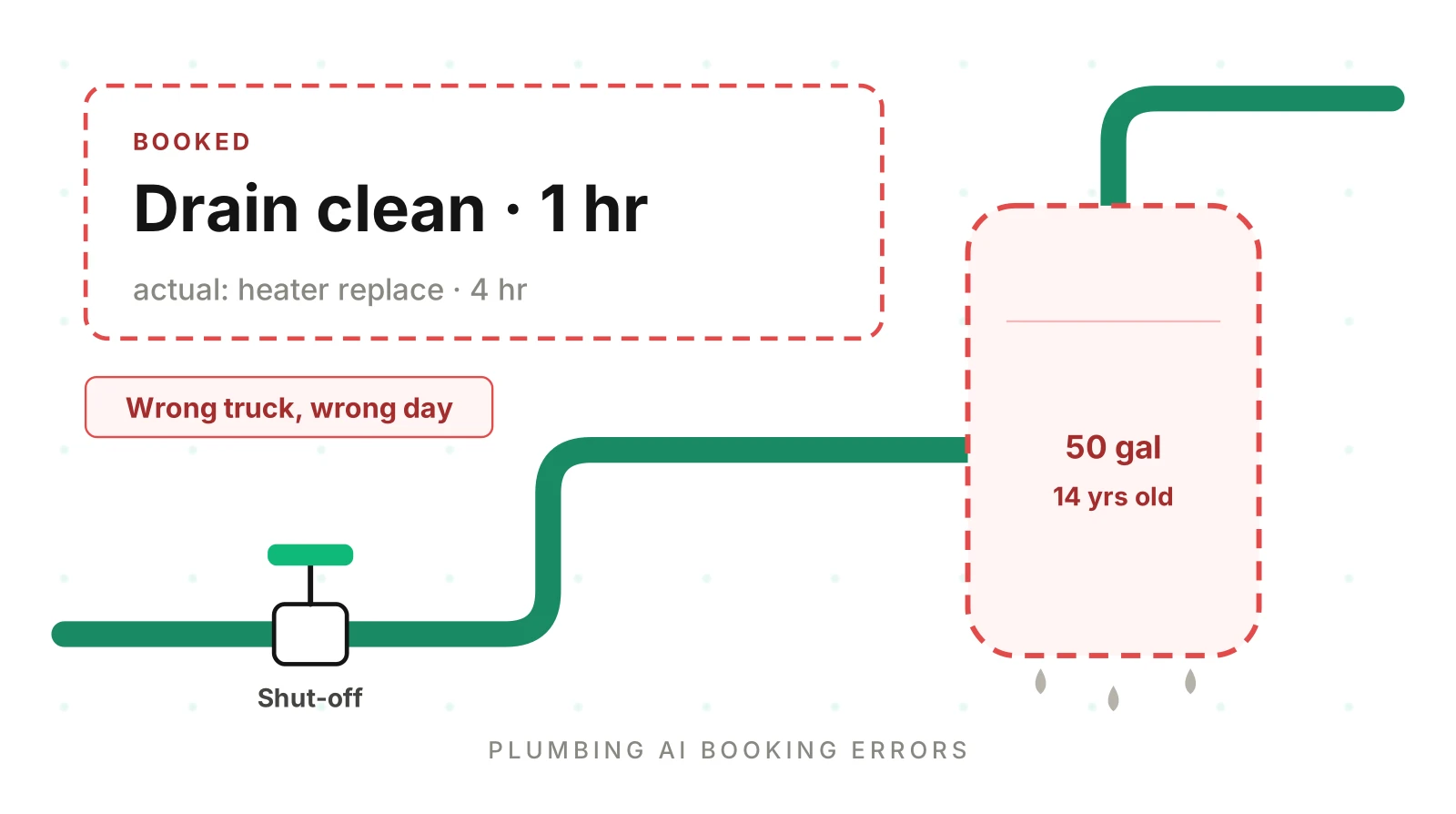
A water heater replacement booked as a one-hour drain job
The caller says "my water heater is leaking from the bottom." That sentence could mean a loose drain valve, a relief valve dripping, or a failed tank. A tank that leaks from the bottom is usually a replacement. The agent hears "leaking," picks a generic leak repair or drain service type, and books a one-hour slot.
Job duration is now wrong by hours. Bob Vila puts a new install at 2 to 3 hours, before draining and hauling out the old unit. The truck may not carry a 50-gallon tank. The tech arrives, confirms the tank is done, and has to come back. That is two truck rolls for one job, and a customer with no hot water for another day.
Age is a strong clue the agent can ask about. The U.S. Department of Energy says storage water heaters last 10 to 15 years. A 14-year-old tank leaking from the base should route to a replacement estimate or a longer diagnostic block. The agent should also capture gas versus electric, tank versus tankless, and location (garage, attic, closet).
An active leak booked for next week
"Water is coming through the ceiling" is an emergency at almost every plumbing company. "My faucet drips" is not. Agents fail here in two ways. They miss urgency words when the caller sounds calm. Or they find the emergency type but the slot search returns the next open routine window, because the emergency path was never wired to after-hours capacity.
EPA WaterSense estimates household leaks waste more than 9,300 gallons a year on average, and those are mostly slow drips. An active supply-line leak is a water damage claim in progress. The BLS notes plumbers are often on call for emergencies, so the after-hours path is real capacity, not an edge case.
A gas smell treated as a booking
A caller says "I smell gas near the water heater" and asks for someone to come look. The wrong response is "I can get a tech out Thursday between 8 and 12." The right first response is safety, not scheduling. We cover the gate in detail below.
Wrong address or wrong unit
Plumbing calls often come from rentals and condos. "Unit 4B" heard as "unit 4" sends the tech to the wrong door. A caller at a rental may give the owner's billing address instead of the service address. A wrong ZIP code can place the job outside the service area and still book it, if the agent never checks the zone list. Property-side versions of this error are in our post on AI maintenance request errors.
The wrong fee quoted
Many plumbers charge a trip fee or diagnostic fee. Some waive it with an approved repair, and some charge more after hours. The agent quotes a number from a stale prompt or another company's config. The customer hears $49 and the invoice says $89. The recording proves the agent said it.
A duplicate job
The caller hangs up mid-call, then calls back. Or the agent's create-job tool times out, retries, and both calls succeed. The board now shows two jobs for one leak. One tech drives out for nothing. Retries and idempotency keys are covered in the auto repair booking post. For plumbing, also check the callback path. A second call within the same hour about the same address should update the open job, not create one.
Why spoken plumbing calls are harder than they sound
Plumbing callers describe symptoms, not job types, so job type classification is the hard part. "The toilet keeps running" is a fixture repair. "Every drain in the house is slow and the basement floor drain is gurgling" points to a main sewer line problem, which may need a camera inspection and a jetter. The words that separate those two jobs are often in the middle of a long, stressed sentence.
Three research findings explain why this is hard for agents:
1. Spoken task-oriented dialogue is much harder than text. The SpokenWOZ benchmark built real spoken conversations with ASR noise and incremental, self-correcting speech. The best dialogue state tracker reached only 25.65% joint goal accuracy. The strongest end-to-end model completed the user's request in 52.1% of dialogues. Job type, address and urgency are exactly the slots that tracking has to get right.
2. Agents that call tools are inconsistent across repeats. In the τ-bench study, even GPT-4o completed fewer than half of tasks, and pass^8 in the retail domain was below 25%. One passing test call tells you little. The same scenario has to pass many times.
3. Models get lost when details arrive over several turns. Laban et al. ran 200,000+ simulated conversations and found an average 39% drop when information came in pieces. Most of the drop was unreliability, not lack of skill. Plumbing callers almost always reveal the key detail late: "oh, and it's a gas one."
Audio adds its own noise. Callers phone from a basement with a sump pump running, or stand next to a hissing pipe. Our guide to testing STT under background noise covers how to build those conditions. Transcript-only review misses this. A transcript that reads "water heater leaking" may come from audio where the caller clearly said "water heater replacing."
The safety gates come before the schedule
Some emergency plumbing calls should never start with a time slot. Put these gates in front of the booking flow, and test them as hard constraints.
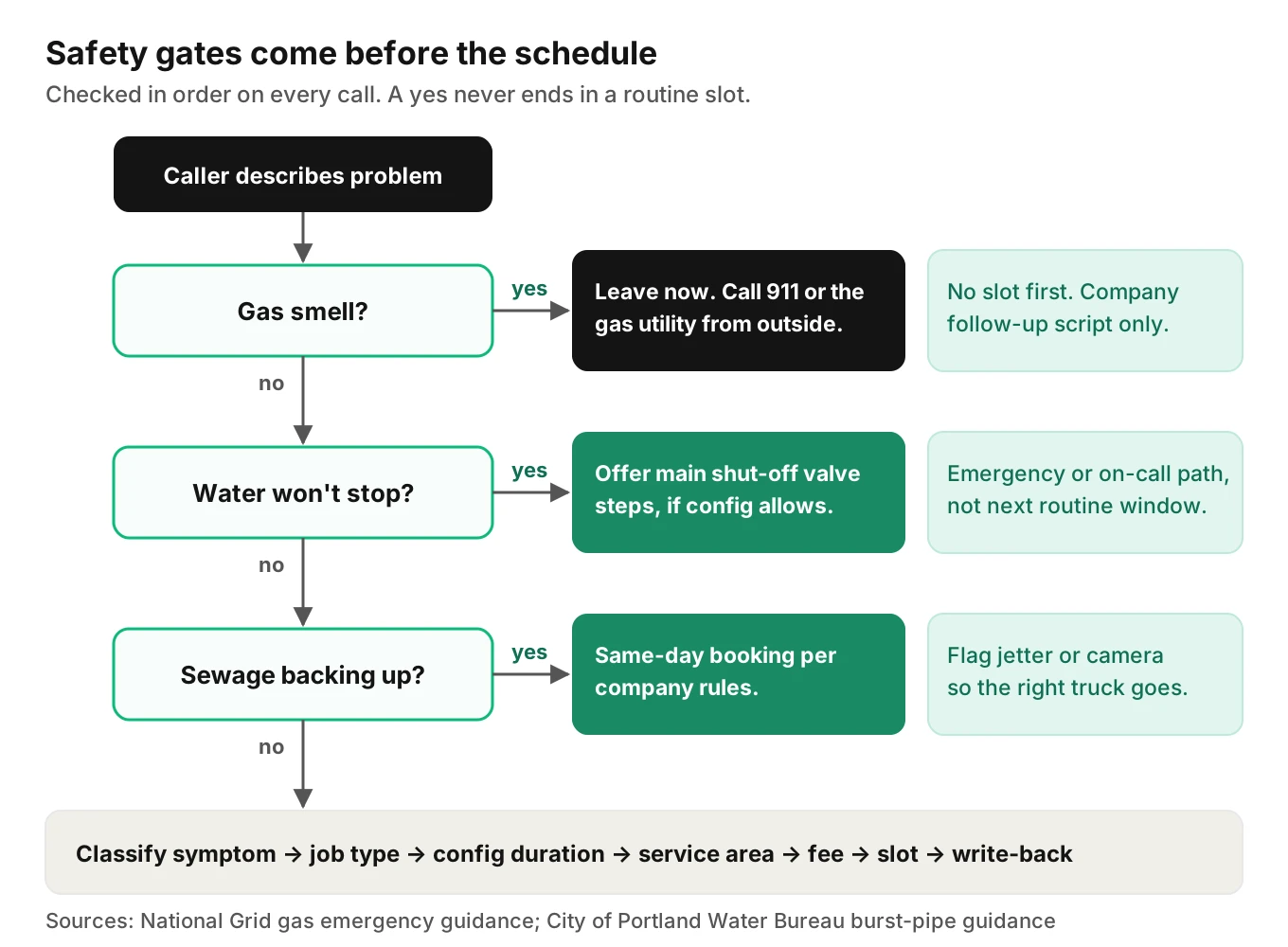
Gas smell. National Grid's gas emergency guidance says to leave the premises immediately and report from outside to 911 or the utility. It also says not to touch electrical switches, phones or doorbells inside. The agent's job is to say that clearly, early, and to stop there. It should not troubleshoot a pilot light. Each company sets what happens next. Some want a callback number captured. Some want a warm transfer to the on-call plumber after the caller is safe. None want a Thursday slot as the first answer.
Active leak. The City of Portland's water bureau tells residents to close the main water shut-off valve and turn off the water heater when a pipe bursts. A good agent offers that step, then books on the emergency path. Renters should be told to contact their property manager for the shut-off, per the same page. Whether to give shut-off guidance at all is a company setting, so the test must read the setting.
Sewage backup. Raw sewage coming up through a floor drain or tub is a health issue and a same-day job at most shops. It often needs a jetter or a camera. The booking should carry that equipment flag, so dispatch sends a truck that has it.
No water at all. This may be a utility outage, a frozen line or a failed well pump. One or two questions before booking save a wasted trip.
This post is not legal or safety advice. Each company should write its own emergency script with its own trade and safety advisors, and your agent should follow it word for word.
Worked math: one wrong duration, one ruined day
Here is an illustrative example, not measured data. A plumber's day has eight bookable hours. The agent books four one-hour drain calls in the morning and three afternoon jobs.
The 9:00 job is really a water heater replacement. Assume four hours on site with removal and haul-off. Every later job now slides three hours. The 10:00, 11:00 and 12:00 customers miss their arrival windows. Two afternoon jobs roll to tomorrow. The office spends the afternoon on apology calls.
Now scale it. Say your AI booking for plumbers handles 2,000 jobs a week across 300 companies. If 2% land in a type whose duration is off by two hours or more, that is 40 broken days a week. Each one also hits the customers whose jobs slid.
The test math matters too. If a failure happens on 2% of calls, how many test calls do you need to see it at least once with 95% confidence? Use n = ln(0.05) / ln(1 − p). With p = 0.02, n ≈ 149. Ten manual test calls per release will miss it most of the time. That is why repeated, scripted runs per scenario matter more than a clever single call.
Per-company config: same words, different bookings
On a multi-tenant agent, "the right booking" depends on the company. The test oracle has to read the config, not a hard-coded answer key. Our multi-tenant testing guide covers config clustering in general. These are the plumbing fields that change outcomes.
| Config field | Example A | Example B | What the test asserts |
|---|---|---|---|
| Water heater job types | Repair and replace are separate types | One "water heater" type, then estimate | Booked type matches this company's list |
| Duration by job type | Replace: 240 min | Replace: 180 min | Booked minutes ≥ configured minutes |
| Emergency triggers | Active leak, sewage, no water | Active leak only | Emergency path used exactly when listed |
| After-hours policy | On-call plumber, transfer | Next-morning first slot | Correct path by local time |
| Trip / diagnostic fee | $79, waived with repair | $99 after 5 pm | Quoted amount equals config |
| Service area | ZIP list | Drive-time polygon | Out-of-area caller is not booked |
| Gas appliances | Services gas water heaters | Electric only, refer out | Gas jobs refused or routed per config |
| Equipment flags | Camera and jetter on 2 trucks | Jetter subcontracted | Sewer jobs carry the equipment flag |
A tankless unit may be a specialty job at one shop and a refer-out at another. Membership customers may get priority, as covered in HVAC AI and service agreement customers. Warranty calls may need a different path entirely; see our post on home warranty claim calls.
How to test plumbing AI booking before every change ships
This release loop catches plumbing AI booking errors for a team with a few engineers and no QA function. Run it for every prompt, model or flow change.
1. Export each company's booking config. Pull job types, durations, emergency triggers, fees, service areas and equipment flags into a versioned file. Group companies with identical rules into clusters, so you test each cluster rather than every account.
2. Write symptom-based scenarios, not job-type scenarios. Callers say "water under the sink" and "every drain gurgles," not "drain cleaning." Write 30 to 50 symptom scripts that map to known job types. Include late reveals ("it's gas, by the way") and corrections ("sorry, unit 4B, not 4").
3. Add the safety gates as hard constraints. Gas smell must produce the evacuate-and-call script before any booking tool call. Active leak must use the emergency path when the config lists it. Treat any miss as a release blocker, not a score.
4. Build a duration oracle. For each scenario, compute expected minimum minutes from the company's config for the expected job type. Fail any booking that is shorter. This one check catches the drain-job-for-a-water-heater error.
5. Run each scenario many times, with varied callers. Use the n ≈ 149 math above to size runs for your target failure rate. Vary accent, pace, interruptions and background noise. Include Spanish-speaking callers if your companies serve them.
6. Assert the write-back, not just the conversation. Read the job record from the FSM after the call. Check job type, priority, duration, address, unit, ZIP, fee note and job count. A perfect call with a bad record is a failed test. Our tool calling test case library has argument-level patterns.
7. Gate the release on the worst cluster. A change that improves the average but breaks one cluster's emergency path does not ship. Fix, rerun that cluster, then ship.
Evalgent generates scenarios like these from the agent's prompt and flows, including the branches and hard constraints a team has not covered yet. Its caller profiles vary accent, pace, interruptions, response delay, background noise and language, and calls reach the agent over PSTN, SIP or WebRTC.
Here is a simplified version of the checks in step 3, 4 and 6. It assumes you log tool calls with turn indexes and read the final job back from the FSM.
# Simplified: per-company booking checks for one plumbing test call.
from dataclasses import dataclass

@dataclass
class CompanyConfig:
    durations_min: dict      # job_type -> minimum booked minutes
    emergency_types: set     # job types that must use the emergency path
    trip_fee: int            # dollars, as configured for this company
    zip_codes: set

def check_call(cfg, scenario, events, jobs):
    """events: ordered call events; jobs: job records read back from the FSM."""
    errors = []
    first_tool = next((e["turn"] for e in events if e["type"] == "tool_call"), None)

    if scenario.get("gas_smell"):
        safety = next((e["turn"] for e in events if e["type"] == "gas_safety_script"), None)
        if safety is None or (first_tool is not None and first_tool < safety):
            errors.append("gas: safety script missing or after a tool call")
        return errors

    if len(jobs) != 1:
        errors.append(f"expected 1 job, found {len(jobs)}")
        if not jobs:
            return errors
    job, want = jobs[0], scenario["expected_job_type"]

    if job["job_type"] != want:
        errors.append(f"job_type {job['job_type']} != {want}")
    if job["duration_min"] < cfg.durations_min[want]:
        errors.append(f"duration {job['duration_min']} < {cfg.durations_min[want]}")
    if want in cfg.emergency_types and job["priority"] != "emergency":
        errors.append("emergency booked as routine")
    if job["zip"] not in cfg.zip_codes:
        errors.append(f"zip {job['zip']} outside service area")
    if job.get("unit") != scenario.get("unit"):
        errors.append(f"unit {job.get('unit')} != {scenario.get('unit')}")
    quoted = scenario.get("quoted_fee_heard")   # extracted from the call audio
    if quoted is not None and quoted != cfg.trip_fee:
        errors.append(f"quoted fee ${quoted} != ${cfg.trip_fee}")
    return errors
Example output for a failing run:
company=cluster-07 scenario=wh_leak_base_14yr run=23
  job_type drain_service != water_heater_replace
  duration 60 < 240
The quoted fee comes from what the agent said, not what it wrote. That check needs a judge that listens to the call. The go-live checklist covers the per-customer checks to run when a new plumbing company is switched on.
Monitoring booked job type against tech-closed job code
Tests catch known plumbing AI booking errors before a release. Production shows the ones you did not script. Your best label is free: the job code the tech closes the job with.
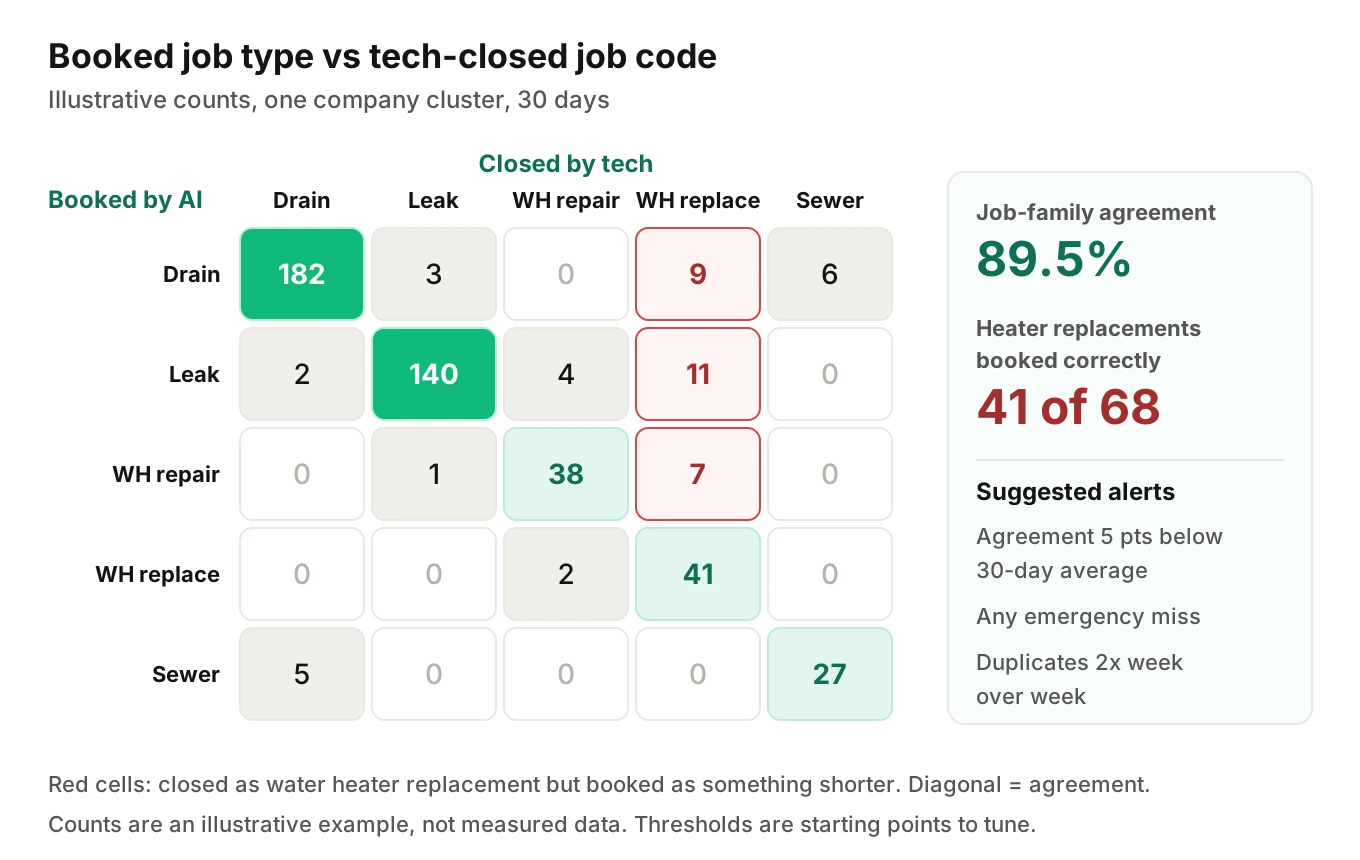
Join each AI-booked job to its closed job code. Map both to a shared set of job families: drain, sewer, water heater repair, water heater replace, leak, fixture, gas. Then track these per company and per cluster:
- Job-family agreement. Share of AI bookings whose family matches the closed family. Watch the trend, not one day.
- Duration gap. Actual on-site minutes minus booked minutes. A long right tail in one job type points to a classification gap.
- Emergency miss rate. Jobs closed as emergency work that were booked as routine.
- Second-visit rate. Jobs that needed a return trip for parts or equipment the booking did not flag.
- Duplicate rate. Two open jobs, same address, created within an hour.
Suggested starting thresholds, to tune against your own baseline: alert when job-family agreement drops five points below a company's 30-day average, when any emergency miss appears, or when the duplicate rate doubles week over week. Small companies close few jobs, so roll them up to their config cluster before alerting.
Closed codes are noisy. Techs pick them in a hurry, and some shops use a catch-all "service call" code. Treat disagreement as a reason to listen to the call. Our post on turning production failures into tests shows how to feed confirmed misses back into the scenario set.
Evalgent's production monitoring takes pushed call recordings, transcribes them, maps each call to a scenario and judges it from the audio. It flags tool-call failures, policy failures, PII leakage and latency spikes, with fix recommendations. Pair that with the closed-code join above. The call tells you why. The job code tells you how often.
Frequently asked questions
Why does an AI receptionist book the wrong plumbing job?
An AI receptionist books the wrong plumbing job because callers describe symptoms, and the agent maps them to a job type. "Water heater leaking" can mean a valve repair or a full replacement. The agent picks one, the job type sets duration and priority, and dispatch trusts it. Asking about tank age, fuel type and leak location reduces these misclassifications.
How do you test an AI receptionist for a plumbing company?
Testing an AI receptionist for a plumbing company starts with that company's config: job types, durations, emergency triggers, fees and service area. Write symptom-based caller scripts, run each many times with varied voices and noise, then read the job record back from the FSM. Fail any wrong job type, short duration, missed emergency or wrong fee.
How should an AI handle an emergency plumbing call?
An AI should handle an emergency plumbing call by following the company's written emergency script. For an active leak, that often means offering main shut-off valve guidance, then booking on the emergency or on-call path. Sewage backups usually need same-day booking with a jetter or camera flagged. The agent must never offer a routine slot first.
What should an AI say if a caller smells gas?
An AI should tell a caller who smells gas to leave the building now and call 911 or the gas utility from outside. Utility guidance also says not to touch switches, phones or doorbells inside. The agent should not troubleshoot or book a routine visit first. What happens after that, such as a callback, follows the company's script.
Can an AI quote a plumbing trip fee?
An AI can quote a plumbing trip fee only if the fee comes from that company's live config at call time. Hard-coded prompt prices go stale and leak across companies on a shared agent. Tests should compare the spoken amount, heard in the audio, with the configured fee, including after-hours and waiver rules.
How long should an AI book for a water heater replacement?
An AI should book a water heater replacement for the duration each company sets for that job type. Published guides put install alone at about 2 to 3 hours, before draining and removing the old tank. Many shops block longer. A duration oracle test fails any booking shorter than the company's configured minimum.
How do you stop an AI from creating duplicate jobs?
Stopping an AI from creating duplicate jobs takes two checks. Make the create-job call idempotent so a retry cannot write a second record. Then, before creating a job, look up open jobs at the same address from the last hour or so and update one instead. Test both with timeout injection and hang-up-and-call-back scenarios.
How do you monitor AI booking accuracy for plumbers?
Monitoring AI booking accuracy for plumbers works best by joining each AI-booked job to the job code the technician closes it with. Track job-family agreement, booked versus actual minutes, emergency misses, second visits and duplicates per company. Alert on drops against each company's own baseline, then listen to the calls behind the disagreements.
The bottom line
Plumbing AI booking errors are wrong job records that sound like successful calls. Test each company's config with safety gates, a duration oracle and FSM write-back checks, then watch booked job types against tech-closed job codes in production.
Related Articles

How to automate voice agent testing: synthetic callers vs manual QA
Learn how ai test automation replaces manual QA for voice agents. Compare synthetic callers vs human testers, with a 5-step framework to scale without hiring.
Read more
AI Agent Testing vs Voice Agent Testing: What General Tools Miss for Voice
AI agent testing measures text outputs. Voice agent testing measures behaviour through an acoustic pipeline. Five failure categories general tools miss.
Read more