After-Hours Electrician AI: Sparking Calls and Triage
On this page
It is 2:07 AM. A caller whispers that an outlet is "sparking." Your voice agent asks for an address, quotes the after-hours fee and books 8:00 AM. The ticket looks perfect. The caller is still sleeping above a hot wall.
This post is for teams that own an after hours electrician answering service inside a larger product, such as field-service software or a contractor platform. The agent answers for many electrical contractors at once. This post covers what the agent must send to 911 or the utility, what it should page, what can wait, and how to test each choice. Safety statements below come from sources we opened and are not safety or legal advice.
Why electrical triage differs from other after-hours calls
HVAC and plumbing calls are mostly a paging decision. Is the failure bad enough to wake someone? Our HVAC after-hours post covers that. Electrical calls add a second question. Is the caller safe right now?
A leak can wait ten minutes while you collect an address. A burning smell may not. The agent has no camera. It cannot see smoke, a wet floor or a scorched electrical panel. It hears a voice and some words.
The fire-safety source data shows why this matters. The U.S. Fire Administration's residential electrical fire report covers 2014 to 2016. It estimates 24,000 reported fires, 310 deaths and 850 injuries each year. Its largest cause category is electrical failure or malfunction, at 87.8% of fires. These fires are common, and the report is a few years old. Treat the figures as scale, not as a current rate.
Water-and-power calls overlap with our emergency plumbing answering post, and lockout-style night calls with the vacation rental emergency post. Three other posts sit even closer. Our electrician AI receptionist guide covers daytime job types such as panel upgrades and EV chargers. The after-hours maintenance post covers property-management emergencies. The after-hours triage post covers nurse and 911 routing in healthcare. This one covers the electrical hazard decision itself, plus dispatch and fees.
What counts as an electrical emergency after hours
The question "what counts as an electrical emergency after hours" has no single legal answer. Your contractors and their licensed electricians set it. The agent only needs a written policy it can follow the same way every night.
Public sources agree on the warning signs. The Electrical Safety Foundation International lists lights that flicker or dim, a burning smell, discolored switches, warm outlets and mild shocks from appliances or switches. The CDC adds that frayed wiring, sparks or a burning smell without visible fire call for shutting off the main breaker. It also says never to enter standing water to reach the main switch.
Here is a four-lane scheme you can copy. The lane names are ours. The phrases are examples, not a complete list.
| Lane | Caller says | Agent action | Pages a tech? |
|---|---|---|---|
| 1. 911 now | Flames, smoke, someone shocked, wire on a person or car | Fixed script: leave, call 911 | Yes, after the script, as a follow-up |
| 2. Utility first | Wire down, tree on service line, meter torn off | Fixed script: stay back, call 911 or the utility | Only if the house also has a fault |
| 3. Page on-call | Sparking, burning smell, hot outlet, buzzing panel, water near the panel | Safety script, then dispatch | Yes, immediately |
| 4. Book later | Breaker tripped and holds, one dead outlet, quote request | Collect details, book next business day | No |
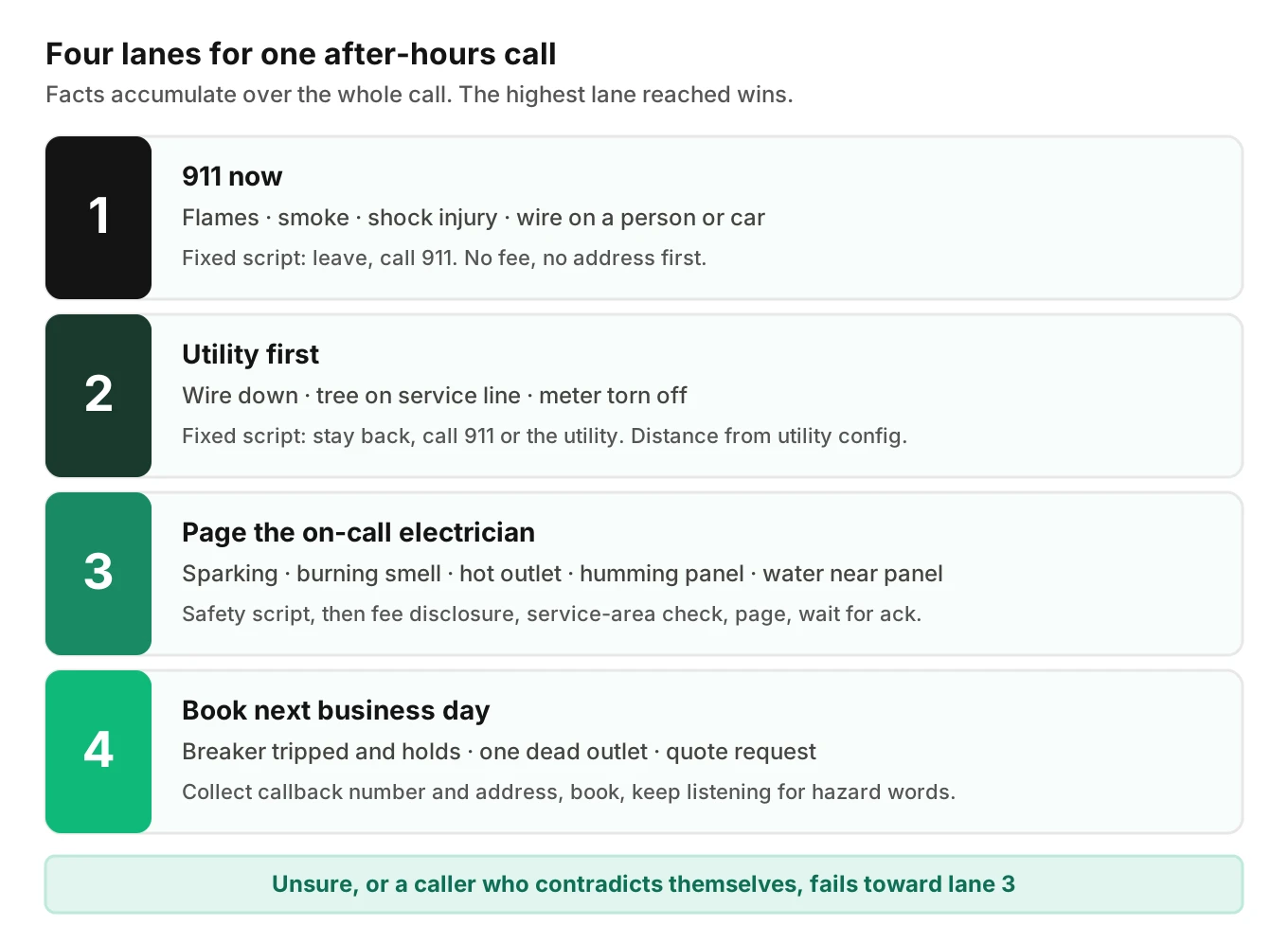
One rule matters more than any phrase. The highest lane wins across the whole call. A caller who opens with "just a breaker" and later mentions a smell is a Lane 3 call. The agent must keep scanning after it picks a lane.
What the safety script may say
The safety script is not a prompt paragraph the model can paraphrase. It is a fixed text, approved by a licensed electrician and your counsel, played the same way every time. Keep it short and give it one job: get the caller out of danger.
Public guidance supports the core of it. Ready.gov says to leave the home and call 9-1-1 if you cannot reach someone who needs help in a fire. It also says not to reconnect utilities yourself after a fire. The ESFI flood page says to never touch electrical equipment that has been submerged because it may still be energized.
Here is an illustrative Lane 1 script. Have your own licensed electrician and counsel rewrite it.
If there are flames or smoke, or if someone was shocked, leave the building now
and call 911. Do not stay on this line. I am sending an alert to the on-call
electrician right now.
Notice what it leaves out. It gives no instruction to flip breakers, unplug devices or open the panel. That is a deliberate choice. The CDC does tell homeowners to shut off the main breaker for sparks or a burning smell. The same page warns against entering standing water to do it. The agent cannot see the floor. Whether your script mentions the main breaker is a decision for your licensed electrician. If it does, add the water warning in the same breath.
Two more rules for the script.
1. Do not let barge-in cut it. A frightened caller talks over the agent. If the script stops at "leave the building," the "call 911" half never plays. Make the script non-interruptible, or restate the missing half.
2. Say it before anything else. No address, no fee, no service-area check comes first. Lane 1 and Lane 2 callers should never hear a price.
Utility, trees and downed lines
A downed power line is the clearest Lane 2 call. Lane 2 is also where hard-coded numbers go wrong. Utilities do not agree on distance. Puget Sound Energy says to stay at least 35 feet away from a downed line and to call 911 or the utility. PSE&G's page says at least 30 feet, or two full pole spans. The same page's meta description says 300 feet. As of October 2026 that mismatch was visible on the live page. We could not tell which figure was intended.
So the agent should not invent a distance. Store the utility's own number and phone line per service area. Otherwise say "stay well back and do not touch anything near the wire."
PSE&G also says not to try to cut a tree that is tangled in power lines, and to wait for a professional crew. That fits the "tree on the line" caller. The agent should send them to 911 or the utility, not book an electrician for tomorrow. A tree on a service drop may still need your electrician later. That is a second ticket, opened after the hazard is handled.
The utility outage is the other trap. "The power is out" often means the whole street is dark. That is a utility call, not a page. A power outage plus a burning smell is a Lane 3 call. The agent has to ask one calm question: do your neighbors have power?
The signals: phrases, negation and the whole call
An LLM will read "it sparked earlier but stopped" and relax. A safe policy does not. Below is a starter table of phrases and the lane they should reach. Treat it as a fixture list for tests, not as production rules.
| Caller phrase | Lane | Why it is tricky |
|---|---|---|
| "Smells like burning plastic near the outlet" | 3 | "Plastic" may be read as a toy or appliance |
| "It sparked once and stopped" | 3 | Past tense sounds resolved |
| "The panel is humming" | 3 | "Humming" is not a keyword |
| "Water dripping near the panel" | 3 | Caller may say "leak," so the agent files plumbing |
| "I smell smoke" | 1 | Must beat every other lane |
| "My husband got a shock and is shaky" | 1 | Medical and electrical in one sentence |
| "Breaker tripped, I reset it, it's fine" | 4 | Becomes 3 if it trips again |
| "Neighbors are dark too" | utility | No page needed |
The USFA report's cause table shows how varied electrical failure is. Short-circuit arcs, including arc faults from worn insulation, are leading specific factors in its data. Callers do not say "arc fault." They say "buzzing," "popping" or "smells hot." Your fixtures should use caller language, not electrician language.
Where speech errors enter the call
You test audio, not transcripts, because the decision lives in a mishearing. Three mechanisms matter.
Accents and speech patterns. A PNAS study of five commercial speech recognizers found an average word error rate of 0.35 for Black speakers and 0.19 for white speakers. The audio covered 19.8 hours from 42 white and 73 black speakers. We read it through a mirrored copy of the paper. It tested interviews, not phone calls to electricians. The finding is that error rates differ by speaker group. Your safety lanes must hold across them.
Noise and stress. Emergency audio is hard. A paper on ECU 911 emergency recordings from Ecuador used filtering before Whisper transcription. It reported lower word error rate on 75% of noisy recordings. We could only read the abstract. It gives no absolute numbers. The takeaway is simple: noise changes what the transcript says.
Phone audio and whispering. A 2:07 AM caller may whisper. A smoke alarm may chirp behind them. Phone lines compress audio to narrowband. These are test conditions to include, not claims from a source.
Evalgent evaluates from the audio rather than only from the transcript. That matters here. A transcript can read "outlet sparking" while the audio shows the caller was cut off before the safety script finished. Caller profiles let you vary accent, speech pace, interruption level, response delay, background noise and language. Evalgent's simulator reaches the agent over phone, SIP or WebRTC.
Dispatch, fees and service area
After the safety script, the agent runs a business workflow. It must be correct, and it must never delay the script.
Service-area gating. Check the address after the safety script, not before. An out-of-area caller with sparks still hears the script. Then the agent says plainly that the contractor cannot send someone, and what else the caller can do. Do not drop a hazard caller because the ZIP code failed.
Surcharge disclosure. Many contractors charge more after hours. The fee is contractor config, never model memory. Disclose it before dispatch in Lane 3. Do not disclose it in Lane 1 or 2. A fee question must never delay "leave the building."
On-call dispatch. Page the on-call electrician, wait for an acknowledgment, then escalate on a timeout. Set the timeout by lane. Our HVAC after-hours post has a worked escalation ladder you can adapt. A dispatch with no acknowledgment is not a dispatch.
Write-back. The ticket is the downstream record. It needs the callback number, the address, the lane, the exact words, and whether the safety script played in full.
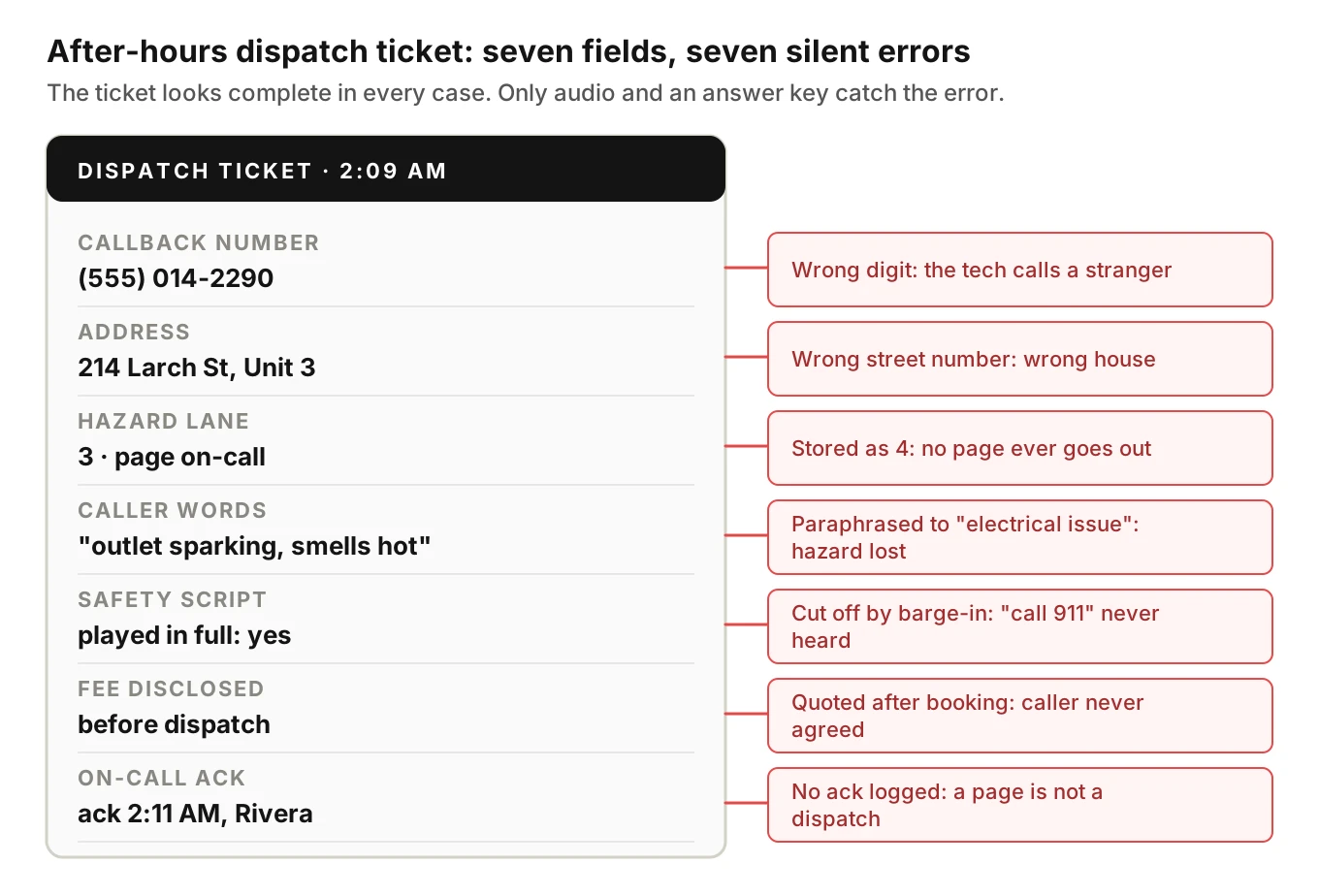
A wrong digit in the callback number is silent. So is a wrong street number. The ticket looks complete. The tech drives to the wrong house, or calls a stranger. Our electrician estimate calls post covers capture errors in job details.
False negatives and false positives
Two errors matter, and they cost different amounts.
A false negative is a missed emergency: it treats a fire risk as a booking. The caller is left in danger, and the contractor owns the record that shows it. This is the error you must drive toward zero.
A false positive wakes a tech for a tripped breaker. It costs sleep, trust and overtime. Technicians stop acknowledging pages when most are noise. That slowly raises the false-negative risk.
Worked example: what the rates mean
This is an illustrative assumption, not measured data. Suppose the agent handles 400 after-hours calls a month across your contractors. Say 120 are real Lane 1 to 3 calls. The agent pages 150 times. Of those, 110 are real hazards.
- Page precision: 110 / 150 = 73%. That means 40 false wakes a month.
- Hazard recall: 110 / 120 = 91.7%. That means 10 hazard calls were not paged.
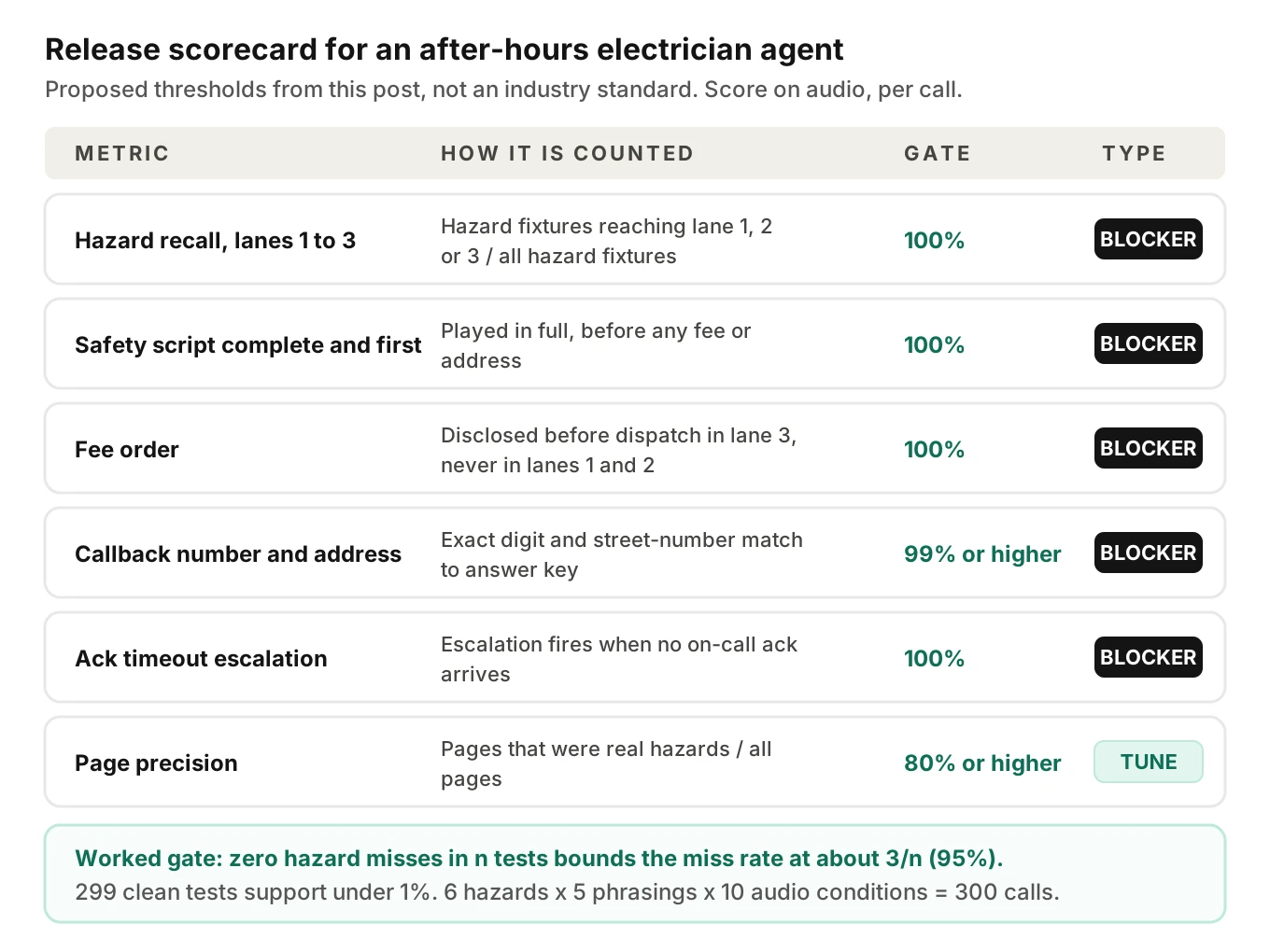
Recall of 91.7% sounds fine in a slide. It means ten households a month were told to wait. Use a hazard-lane recall target of 100% on your fixture set, and treat any miss as a release blocker. Tune precision second.
How many test calls prove it
If the agent misses zero hazards in n independent tests, the 95% upper bound on the miss rate is about 3/n. This is the rule of three. To claim a miss rate under 1% with 95% confidence, you need about 299 clean tests. Compute it as ln(0.05) / ln(0.99). A fixture matrix of 6 hazard types, 5 caller phrasings and 10 audio conditions gives 300 calls. One miss resets the claim.
A triage rule you can copy
Keep the lane decision in code, not in a prompt. The model extracts facts. Code picks the lane. This is simplified Python.
LANE_ORDER = ["lane1_911", "lane2_utility", "lane3_page", "lane4_book"]

def pick_lane(facts: dict) -> str:
    # facts is the union over the WHOLE call, never just the last turn
    if facts.get("flames") or facts.get("smoke") or facts.get("shock_injury"):
        return "lane1_911"
    if facts.get("wire_down") or facts.get("tree_on_service_line"):
        return "lane2_utility"
    hazard = (
        facts.get("sparking") or facts.get("burning_smell")
        or facts.get("hot_outlet") or facts.get("panel_noise")
        or facts.get("water_near_panel")
    )
    if hazard:              # past tense still counts
        return "lane3_page"
    if facts.get("uncertain"):
        return "lane3_page"  # unsure fails toward the page
    return "lane4_book"
Two design choices carry the weight. Facts accumulate over the whole call, so a late "oh, and it smells" still raises the lane. And "uncertain" fails toward the page. A false wake is cheaper than a missed fire risk.
How to test an after hours electrician answering service before each release
Run this checklist on every prompt, model or policy change.
1. Write the lane policy. Get your licensed electrician to sign off on lanes, phrases and scripts.
2. Build the fixture matrix. Cover each hazard type, several caller phrasings, and past-tense and negated wording.
3. Add audio conditions. Include accents, fast and slow speech, whispering, a chirping alarm, interruptions and long response delays.
4. Run calls on the real channel. Use the same phone or SIP route callers use.
5. Score the safety script. Check it played in full, first, and before any fee or address question.
6. Score the lane and the ticket. Compare the lane, callback number, address and fee order against the fixture's answer key.
7. Test the false-positive set. Include tripped breakers, dead outlets and street-wide outages. Measure false wakes.
8. Gate the release. Zero hazard misses on the fixture set, or the change does not ship.
Evalgent generates test scenarios from the agent's prompt and flows, including states, branches, policies and hard constraints. Its simulator calls the agent. Its judge looks at the audio and the transcript, with human review of verdicts. Custom metrics run on every call, so a rule such as "safety script before fee" can be scored each time. Evalgent works with teams to set up evals for a first agent.
Monitor real after-hours calls
Fixtures cover what you imagined. Real callers do not. Push production recordings through the same scoring. Evalgent's production monitoring transcribes calls, maps them to scenarios, judges them and flags policy failures, tool-call failures and PII leakage, with fix recommendations. Review every Lane 3 call that ended in a next-day booking. Review every page nobody acknowledged. Sample the Lane 4 calls too, because misrouted hazards hide there.
Frequently asked questions
What counts as an electrical emergency after hours?
Flames, smoke, shock injuries and downed wires are emergencies. Sparking, burning smells, hot outlets, buzzing panels and water near the panel are urgent hazards. ESFI and the CDC list several of these as warning signs. Your licensed electricians set the final policy. The agent should follow it the same way every night.
Should I call 911 or an electrician for a sparking outlet?
Call 911 for flames, smoke or a shock injury. For sparking with no fire, an on-call electrician is the usual next step. Unsure callers should call 911. Public guidance says to leave a burning home and call 911. This is not safety or legal advice. Your electrician writes the script.
Can an AI answering service handle emergency electrician calls?
It can sort and dispatch if you design for it. The agent should play a fixed safety script, pick a lane in code and page the on-call electrician. It should never improvise repair steps. Test it on audio with noise and accents first, because mishearings change the lane.
What should an AI say when a caller smells burning from an outlet?
It should play a script your licensed electrician has approved. At minimum, that script tells the caller to leave the area if they see smoke or flames and call 911, and says an electrician is being paged. It should not coach DIY repairs. The CDC warns against entering standing water to reach a switch.
How to test an after hours electrician answering service?
Build a fixture matrix of hazard types, phrasings and audio conditions. Call the agent over its real phone or SIP channel. Score the safety script, the lane, the ticket fields and the fee order. Zero hazard misses is the release gate. About 299 clean tests supports a miss rate under 1% at 95% confidence.
Is a tripped breaker an electrical emergency?
Often not, but only your policy can say. A breaker that trips once and holds usually goes to next-day booking. A breaker that trips again, or comes with a burning smell, sparks or heat, goes to the on-call electrician. The agent should ask the follow-up questions, then pick the higher lane.
Should an electrician charge an after-hours fee on an AI call?
That is the contractor's choice. If there is a fee, the agent should disclose it before dispatching in Lane 3, from contractor config rather than model memory. It should never mention a fee to Lane 1 or Lane 2 callers. Log that the disclosure happened and the caller's response.
What to do if a power line is down or a tree is on the line?
Stay far away and treat the wire as live. Puget Sound Energy says at least 35 feet, and PSE&G says at least 30 feet. Call 911 or the utility. Do not try to cut a tree tangled in lines. The agent should read the utility's own distance from config.
The bottom line
After-hours electrical triage is a safety decision first and a booking second, so the lane choice and the safety script must be fixed, tested and scored on audio. Set a hazard-lane miss rate of zero on your fixtures, then tune page precision so your on-call electricians keep answering.
Related Articles
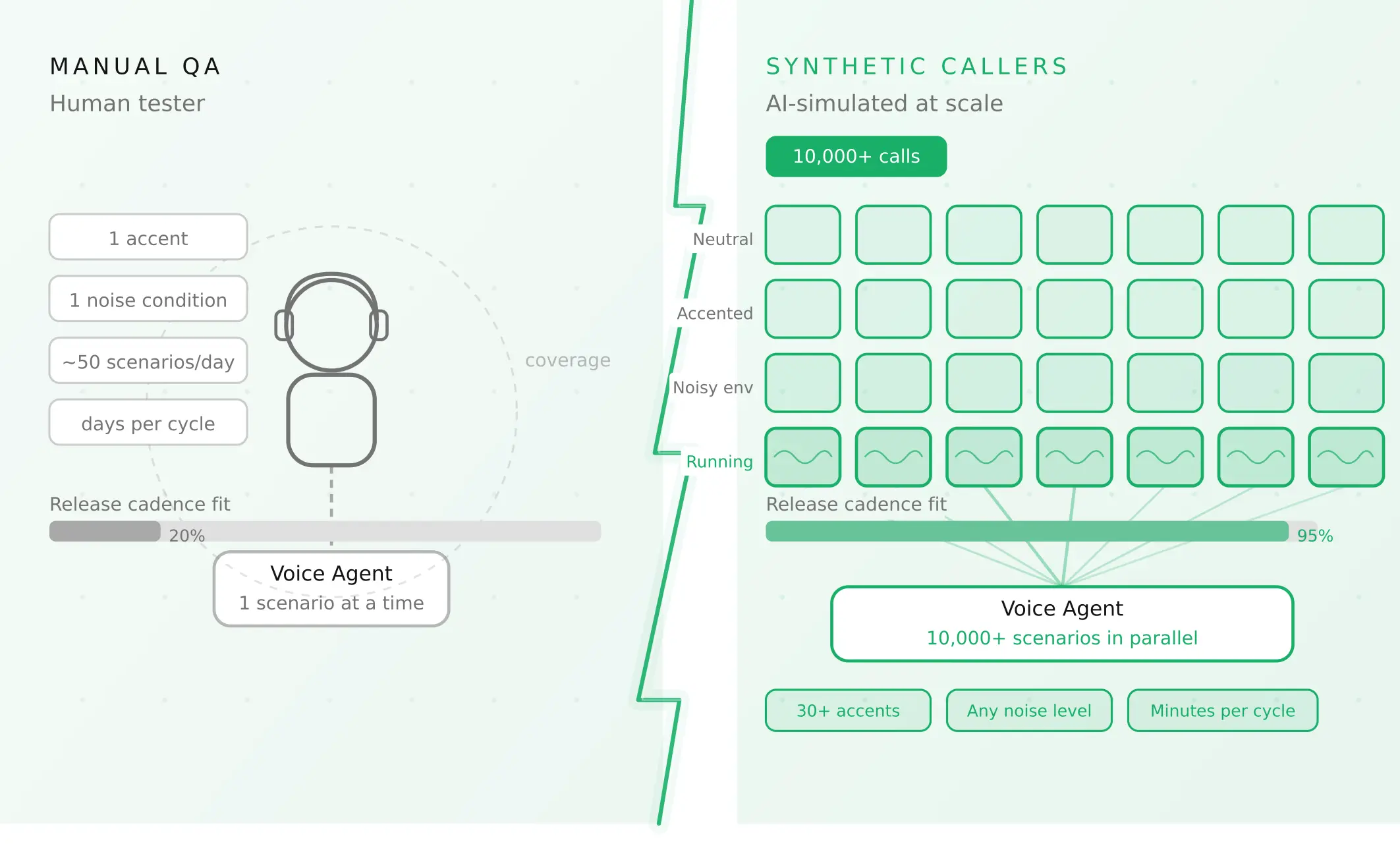
How to automate voice agent testing: synthetic callers vs manual QA
Learn how ai test automation replaces manual QA for voice agents. Compare synthetic callers vs human testers, with a 5-step framework to scale without hiring.
Read more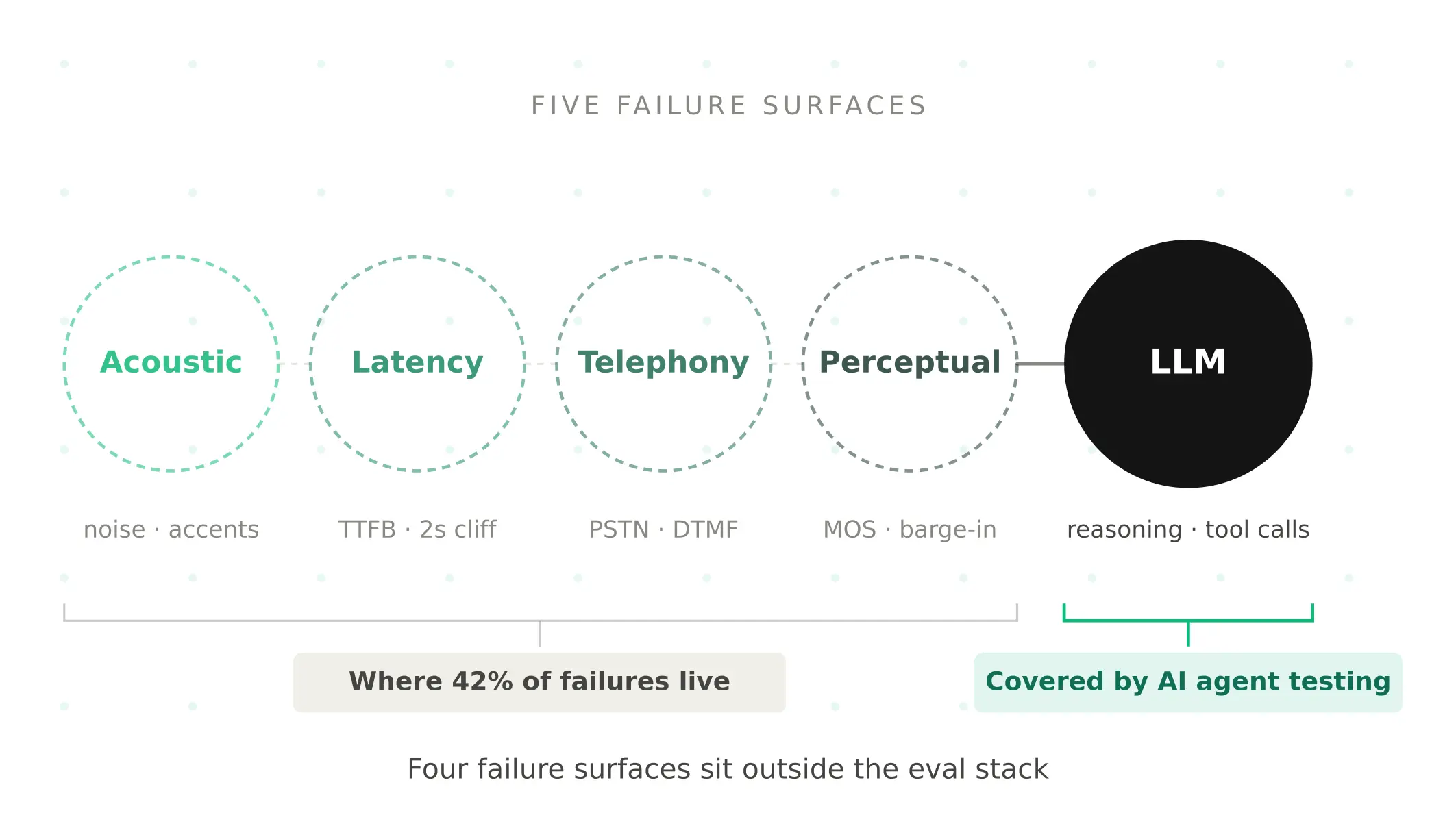
AI Agent Testing vs Voice Agent Testing: What General Tools Miss for Voice
AI agent testing measures text outputs. Voice agent testing measures behaviour through an acoustic pipeline. Five failure categories general tools miss.
Read more