Shift Confirmation AI Calls: Measuring No-Show Misses
On this page
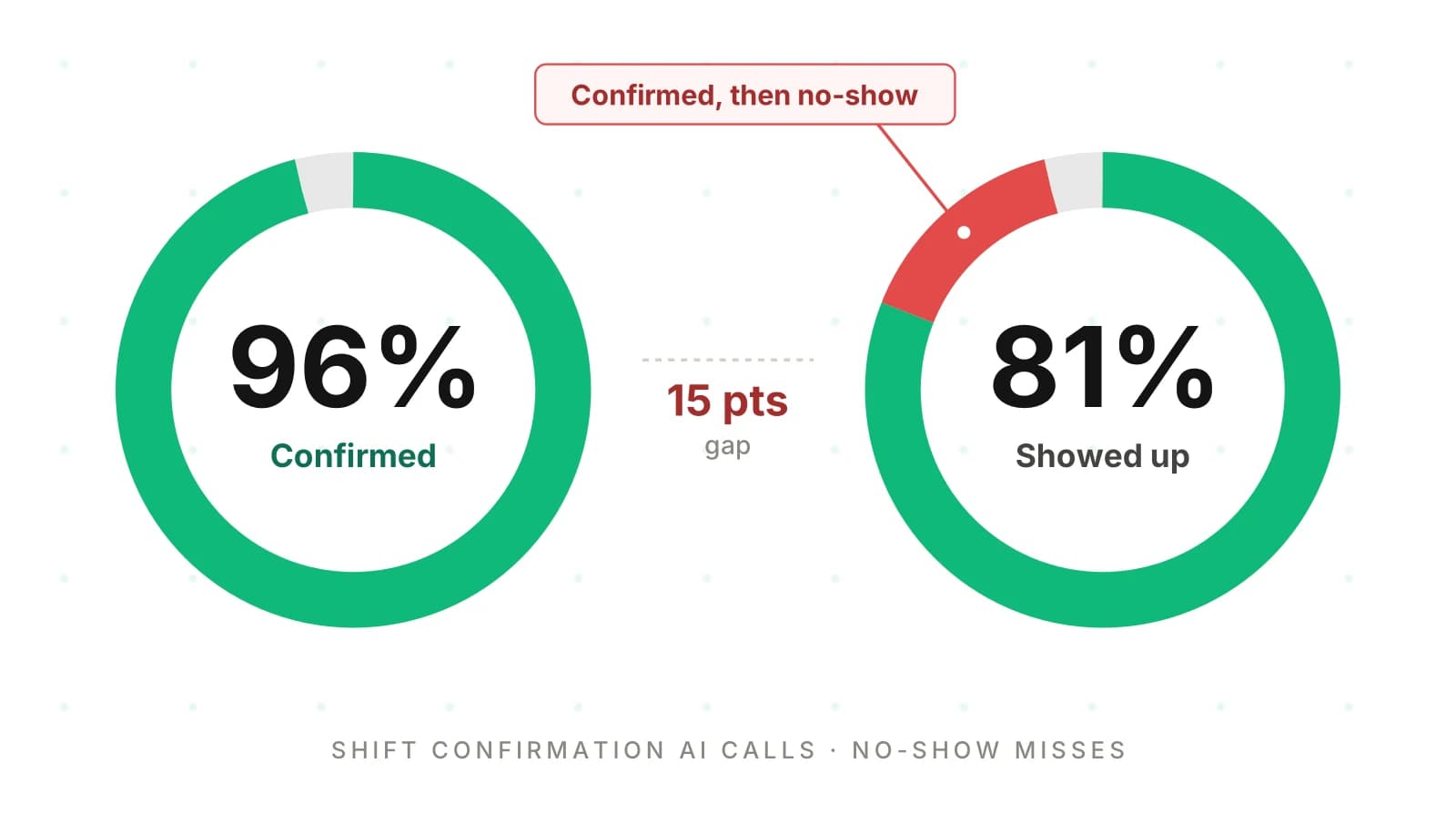
A confirm rate of 96% looks like a working product. It isn't, if 15 points of those confirmations walk away from the shift. This post is for product teams at workforce and staffing platforms whose voice agent calls hourly workers before shifts. Your agent confirms attendance for many employers at once: warehouses, per diem nurses, event crews, light industrial clients. One misread "maybe" leaves a dock short at 6 a.m., and nobody hears about it until the supervisor calls.
We cover what the call writes, where false confirmations come from, the metrics and math to catch them, the consent rules for calling workers, and a step-by-step audit you can run this week.
What a shift confirmation call actually writes
A shift confirmation call is a small agentic workflow. The agent dials the worker. It names the shift, asks if they're coming, and classifies the answer. Then it writes a status into the scheduling system. That status decides whether backfill fires.
Real products show the pattern. Instawork's help center describes an AI shift prep call that "confirms you plan to work that specific shift." If the worker misses the confirmation window, they "may be removed from the shift." Caresmartz, home care scheduling software, documents a Voice Bot for pending shift confirmation. It accepts "Yes" or "No," marks the shift Confirmed with the method "Voice Bot," and logs "Call Answered" separately.
Notice the stakes in both designs. The recorded status is an operational trigger, not a note. "Confirmed" stops recruiters from looking for a replacement. "Declined" or "missed" opens the shift to others. A wrong label doesn't crash anything. It just switches off the safety net.
Confirmation precision: the share of shifts your agent recorded as "confirmed" where the worker actually clocked in. It is the one number that tells you whether "confirmed" can be trusted.
The loop has four writes, and each can fail on its own:
1. Capture. What the worker said, as heard through a phone line, a speech-to-text model and a turn detector.
2. Classify. Which status the model mapped that speech to.
3. Write-back. Whether the scheduling API call succeeded, on the right shift ID, for the right employer.
4. Downstream action. Whether backfill, an open-shift offer or a recruiter alert fired in time.
If you've read our AI phone screening QA guide, this is the same shape. A voice front door feeds a record that people act on without listening to the call.
Why confirm rate is the wrong north star
Confirm rate counts how often the agent wrote "confirmed." It rewards the agent for saying yes on the worker's behalf. A model that maps every vague answer to "confirmed" pushes the number up and show rate down.
Take a worked example. These numbers are illustrative, not from any customer.
| Recorded status | Shifts | Clocked in | Show rate (95% Wilson CI) |
|---|---|---|---|
| Confirmed | 960 | 810 | 84.4% (81.9–86.5%) |
| Declined | 15 | 0 | 0% |
| Tentative | 0 | 0 | n/a |
| Unreached or voicemail | 25 | 0 | 0% |
| All shifts | 1,000 | 810 | 81.0% |
The dashboard shows 96% confirmed. Clients saw 81% of workers arrive. The 15-point gap is 150 shifts where the system stopped looking for a backfill. Look at the tentative row, too. Zero tentative outcomes in 1,000 calls is a symptom. Real people hedge. An agent that never records a hedge is folding hedges into "confirmed."
Treat "confirmed" as a classifier prediction and the actual clock-in as ground truth. Then you can use standard measures.
- Precision of confirmed = confirmed and showed / all confirmed. Here, 810 / 960 = 84.4%.
- Recall of confirmed = confirmed and showed / all who showed. Here, 810 / 810 = 100%.
- No-show miss rate = confirmed and no-show / all shifts. Here, 150 / 1,000 = 15%.
High recall with low precision is the classic signature of an over-eager agent. It never misses a real yes. It also hears yes where there wasn't one.
One caveat matters. Some confirmed workers no-show for honest reasons: a sick child, a dead car battery. Precision will never reach 100%. That's why you need the second half of the measurement: what the worker actually said.
Five outcome classes and a label contract
Start with a written contract between the call and the scheduling system. Every class needs example phrases, a system write and a downstream action. Without it, each prompt edit redefines "confirmed" without anyone noticing.
| Class | Typical worker phrases | System write | Downstream action |
|---|---|---|---|
| Confirmed | "Yes, I'll be there." "See you at six." | status=confirmed | None |
| Declined (callout) | "I can't make it." "I'm sick." | status=callout, reason | Backfill now, alert recruiter |
| Tentative | "I'll try." "Should be fine." "Running late, maybe." | status=at_risk, note | Re-call later, pre-stage backfill |
| Unreached | No answer, busy, failed dial | status=unreached | Retry, then SMS |
| Voicemail | Machine greeting, carrier message | status=voicemail_left | Never counts as confirmed |
Two rules make the contract work. First, only a clear, first-person yes for the named shift can become "confirmed." Second, a late arrival is its own field. "I'll be 20 minutes late" is a yes for attendance and a problem for the start time. Store an expected arrival so supervisors can plan.
The agent should also handle the extras the call invites. A worker who declines may want one of your other open shifts. A worker may want to cancel next Tuesday too. Each extra is another write that needs its own check. The record-level discipline is the same one we use for motivated seller AI calls: classify, write, then compare the label to the evidence.
Where false confirmations come from
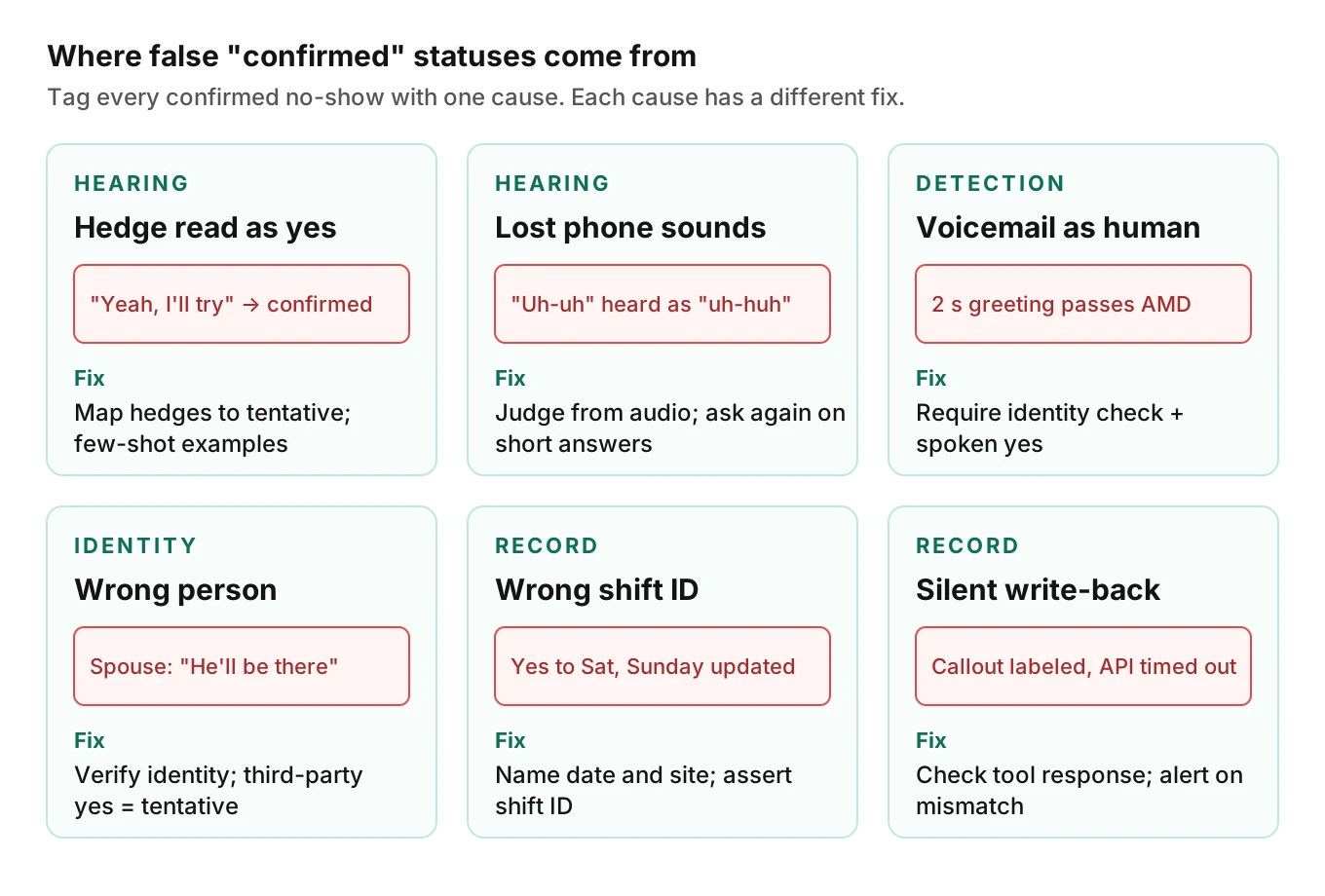
False confirmations have a handful of root causes. Each one has a different fix, so tag every bad confirmation with one cause.
Hedges and indirect answers
People rarely say a clean "yes." The Circa dataset collected 34,268 answers to yes/no questions. In its six-class paper, 3.6% of answers were "probably yes," 7.5% were "yes, subject to some conditions" and 1.9% were "in the middle." The paper's best model scored 82.8% on six classes when tested on unseen scenarios.
"Yeah, I'll try" sounds like yes and means maybe. Ruis et al. tested implicature resolution in LLMs. Humans averaged 86.2%. GPT-4 scored 81.8% zero-shot and 86.5% only with five-shot chain-of-thought. A short classifier prompt with no examples is the zero-shot case.
Lost sounds on a phone line
"Uh-huh" means yes. "Uh-uh" means no. On a narrowband call they differ mostly in a glottal stop and pitch, and a transcript can render them as near-identical tokens. A text-only judge reads the transcript and agrees with the agent. That's why we argue for audio-based scoring over transcripts.
Voicemail and machines that sound human
Answering machine detection is a timing heuristic, not a perfect test. Twilio's AMD docs say speech shorter than the 2,400 ms default threshold "may be interpreted as a human." The docs warn that a "very short two-second voicemail greeting" can read as a human. If your agent then asks "Can you make your 6 a.m. shift?" into a voicemail, a recorded "Hi, it's Maria" greeting can look like engagement. Our voicemail detection guide covers the framework side.
The wrong person answers
A spouse picks up and says "Yeah, he'll be there." A reassigned number reaches a stranger who says "sure" to end the call. Neither is the worker's commitment. The agent must confirm identity before the attendance question, and it should treat a third-party yes as tentative.
The wrong shift
Workers on flexible platforms often hold several shifts. "Tomorrow" asked at 11:50 p.m. is ambiguous. A yes to "your Saturday shift" can land on Sunday's record if the agent picked the wrong shift ID. The same date logic bites interview scheduling agents across locations.
Silent write-back failures
The worker says "I can't make it." The model labels it correctly. The scheduling API times out, and the shift keeps its earlier "confirmed" status from a previous call. Nothing errors in the transcript. Check the tool response, not the tool request, as explained in detecting silent tool failures.
The metrics, with worked math
You need four metrics. Compute them per employer, not just platform-wide.
1. Precision of confirmed, with a confidence interval.
2. Show rate by status, including tentative and voicemail.
3. Said-intent agreement: how often the recorded status matches a human label of the audio.
4. Callout lead time: hours between a decline and shift start, against the time backfill needs.
Confidence intervals that work at small counts
Use the Wilson interval, not "plus or minus 1.96 standard errors." Brown, Cai and DasGupta showed the textbook Wald interval has erratic coverage. They recommend Wilson or Jeffreys for small samples. This matters because most employers on your platform have small weekly counts.
Back to the example. Platform-wide, 810 of 960 confirmed shifts showed: 84.4%, with a 95% interval of 81.9–86.5%. Now take one warehouse with 45 confirmed shifts and 34 clock-ins. That's 75.6%, and the interval runs 61.3–85.8%. The point estimate looks alarming. The interval overlaps the platform rate, so one week is not proof.
Splitting confirmed by what was said
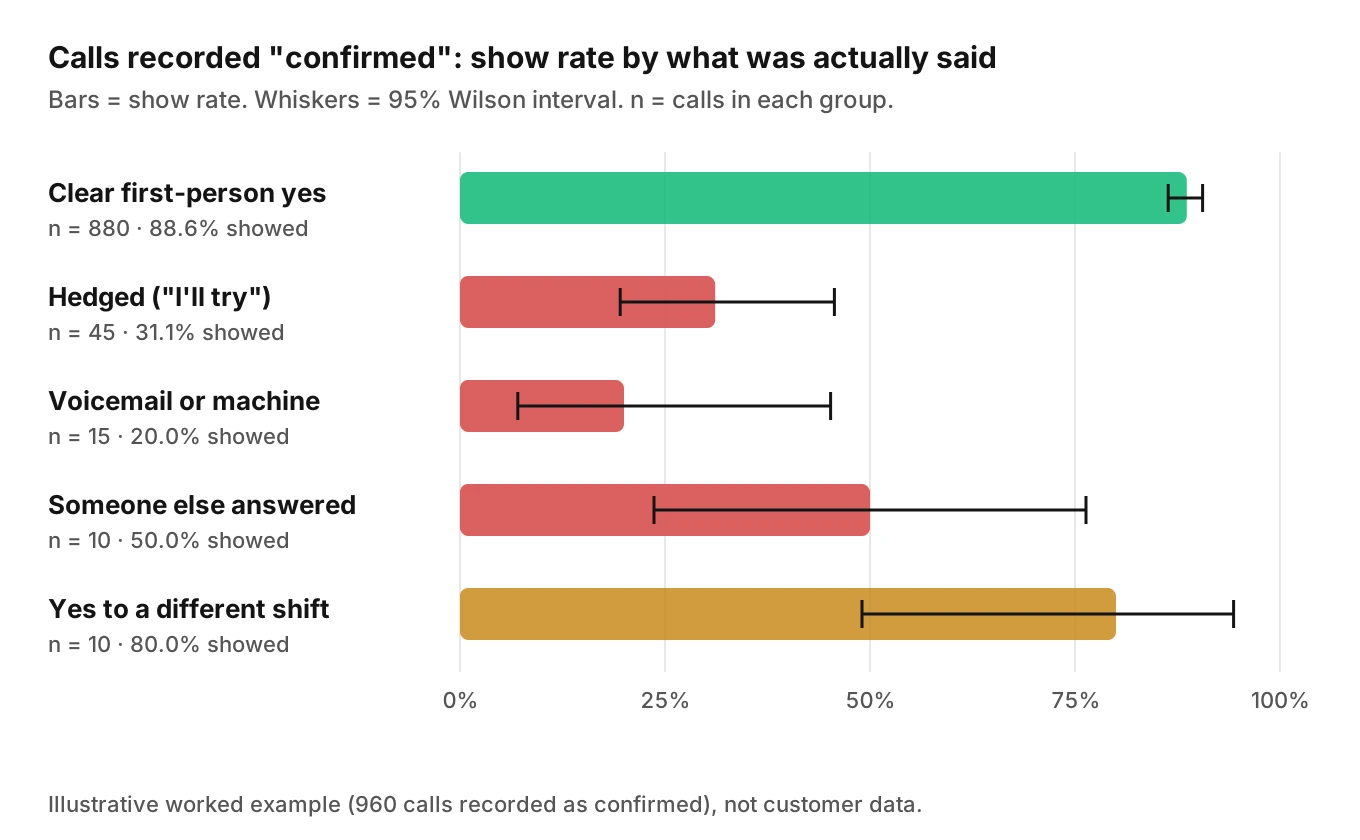
Suppose a reviewer labels the audio of all 960 confirmed calls. The illustrative split looks like this:
| Said intent (human label) | Calls | Showed | Show rate (95% Wilson CI) |
|---|---|---|---|
| Clear first-person yes | 880 | 780 | 88.6% (86.4–90.6%) |
| Hedged ("I'll try") | 45 | 14 | 31.1% (19.5–45.7%) |
| Voicemail or machine | 15 | 3 | 20.0% (7.0–45.2%) |
| Someone else answered | 10 | 5 | 50.0% (23.7–76.3%) |
| Yes to a different shift | 10 | 8 | 80.0% (49.0–94.3%) |
Relabel the hedged, voicemail and third-party calls correctly. "Confirmed" drops to 890 shifts, and precision rises to 88.5%. More important, 70 shifts become at-risk or unreached. Those trigger a re-call or pre-staged backfill instead of silence.
How many calls to audit
You don't need to label every call. To estimate a false-confirmation rate near 10% within ±3 points at 95% confidence, use n = 1.96² × p(1 − p) / 0.03². That gives 1.96² × 0.1 × 0.9 / 0.0009 ≈ 385 calls. At a 15% rate it is about 545. Stratify the sample by employer and shift type, or a big client will swamp it.
Code: precision and show rate by status
This simplified Python joins call outcomes to timeclock punches. Field names are placeholders for your own schema.
from collections import defaultdict
from math import sqrt

def wilson(k, n, z=1.96):
    if n == 0:
        return (None, None)
    p = k / n
    d = 1 + z * z / n
    c = (p + z * z / (2 * n)) / d
    h = z * sqrt(p * (1 - p) / n + z * z / (4 * n * n)) / d
    return (c - h, c + h)

def score(calls, punches):
    # calls: [{"shift_id", "employer_id", "status"}]; last call per shift
    # punches: set of shift_ids with a clock-in within the grace window
    by = defaultdict(lambda: [0, 0])          # (employer, status) -> [showed, total]
    for c in calls:
        key = (c["employer_id"], c["status"])
        by[key][1] += 1
        by[key][0] += c["shift_id"] in punches
    for (emp, status), (k, n) in sorted(by.items()):
        lo, hi = wilson(k, n)
        if lo is not None:
            print(f"{emp:>10} {status:<14} {k:>4}/{n:<4} {k/n:6.1%}  [{lo:.1%}, {hi:.1%}]")

    conf = [c for c in calls if c["status"] == "confirmed"]
    tp = sum(c["shift_id"] in punches for c in conf)
    showed = sum(c["shift_id"] in punches for c in calls)
    print(f"precision={tp/len(conf):.1%} recall={tp/showed:.1%}")
Two gotchas live in the join. Use the last status before shift start, not the first. And define "showed" with a grace window, such as a clock-in within 30 minutes of start. Otherwise late arrivals pollute no-shows.
Timing: when the call happens versus when backfill can work
A perfect label is useless if it arrives too late. Every shift has a backfill window: the time a replacement needs to accept, travel and badge in.
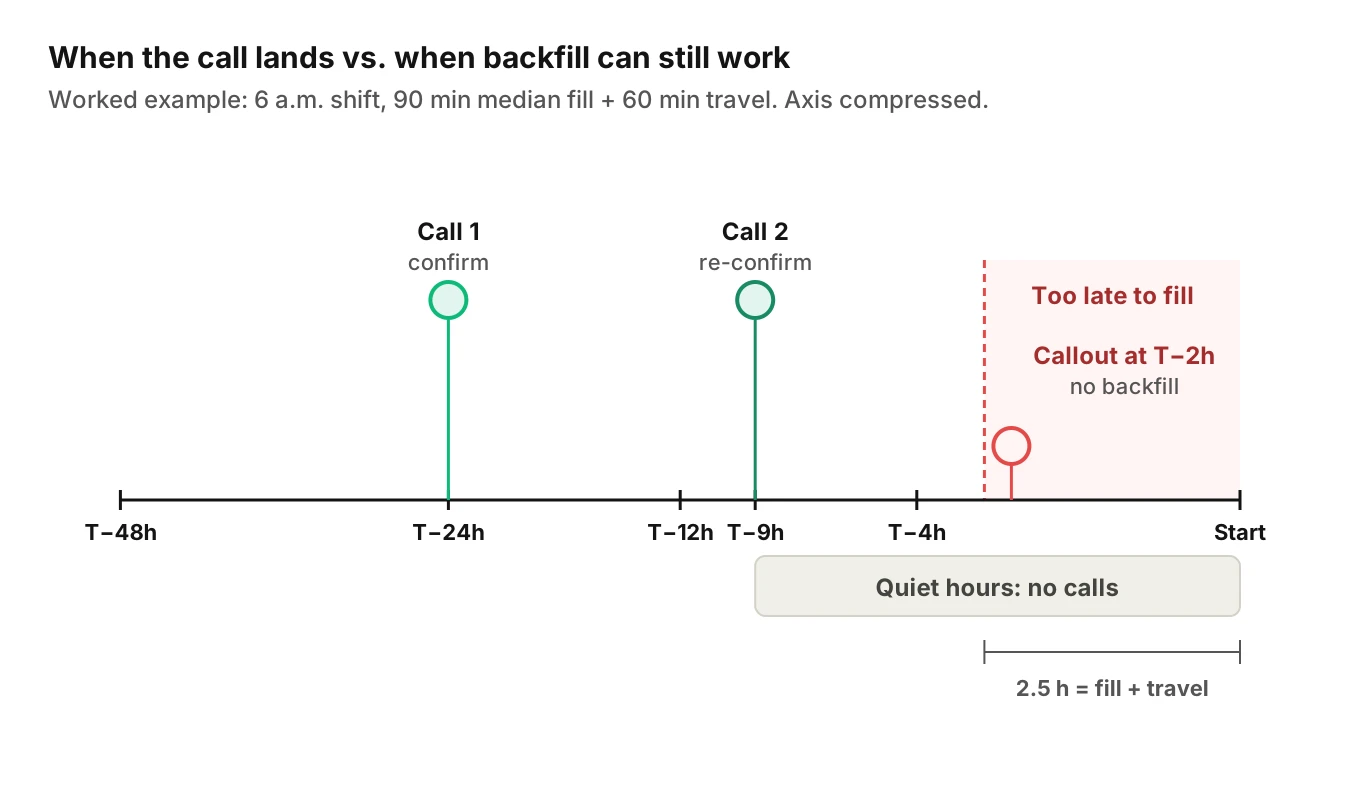
Here's a worked example with assumed numbers. Say your median time to fill an open warehouse shift is 90 minutes. Replacements need 60 minutes to travel. Any callout later than 2.5 hours before start is a likely no-fill. If your only call goes out at T−2h, every decline it captures is already too late.
Quiet-hours settings add a hidden constraint. If your platform blocks outbound calls overnight, a 6 a.m. shift's last call lands the evening before. That's 9 to 10 hours of drift where plans change. Track callout lead time per shift start hour. Early-morning shifts often need a second touch by SMS.
Measure three timing numbers per employer:
- Lead time of declines: median hours between a captured callout and shift start.
- Share of callouts inside the backfill window: callouts captured too late to fill.
- Re-confirm yield: how often a T−24h "confirmed" flips on a T−4h re-call.
Consent and scheduling rules for calling workers
AI calls to workers are still regulated calls. The FCC ruled in FCC 24-17 that AI-generated voices are "artificial" voices under the TCPA. Under 47 CFR 64.1200(a)(1)(iii), artificial-voice calls to cell phones need prior express consent unless an emergency applies. The same section requires the message to identify the business at the start and give a callback number.
For informational calls about a worker's job, a number supplied in connection with employment generally counts. In Dolemba v. Kelly Services (N.D. Ill. 2017), an application authorizing contact "for employment-related purposes" covered a staffing agency's autodialed recruiting call. The court also noted that consent can be revoked "through any reasonable means." Offering a worker extra paid shifts is still job-related, but keep it clearly distinct from marketing.
Revocation rules are moving. The FCC adopted FCC 26-67 on September 30, 2026. It lets callers scope an informational opt-out to that call category and name an exclusive opt-out method. It takes effect 30 days after Federal Register publication. As of October 8 reporting, it had not been published. The earlier "revoke-all" waiver ran to January 31, 2027. For your agent, "stop calling me" is a write too. Test that it lands in the consent record for the right worker.
State scheduling laws can attach to the open-shift offer. Oregon's predictive scheduling law covers large retail, hospitality and food service employers. It does not cover workers supplied by leasing or service businesses. Covered employers may run a voluntary standby list only if workers "requested or agreed in writing." Offers can go by phone. If your agent offers standby hours for an Oregon client, test that it only calls listed workers and records acceptance accurately.
This section is not legal advice. Have counsel review consent language, opt-out handling and state rules for your clients.
How to measure shift confirmation AI calls in 7 steps
1. Write the label contract. Define the five outcome classes, example phrases and the system write for each. Add "at risk" and expected arrival fields if your scheduling system lacks them.
2. Join status to ground truth. Pull the last pre-shift status and the timeclock punch for every shift. Compute precision and recall of "confirmed" and show rate by status, per employer, with Wilson intervals.
3. Audit the audio of confirmed calls. Label a stratified sample of about 400 calls by said intent. Listen to the audio, not just the transcript. Tag each false confirmation with one root cause from the grid above.
4. Build a pre-release test set. Script hedges, late arrivals, a spouse answering, short voicemail greetings, background noise and a worker holding two shifts. With Evalgent, you can generate these scenarios from the agent's prompt and flows. You can run them over PSTN with caller profiles for accent, pace, interruptions and noise.
5. Assert on the record, not the reply. For each test, check the status, shift ID and employer the scheduling API received. A polite "Thanks, see you then" proves nothing.
6. Gate every prompt and model change. Rerun the suite and compare said-intent agreement and the hedge-to-confirmed rate against the last release. Ship only if neither gets worse. Our guide to shipping prompt changes safely covers the release mechanics.
7. Monitor production weekly. Score live calls for status-versus-intent agreement and tool-call failures. Evalgent's production monitoring takes pushed call recordings, judges them from the audio against your scenarios and custom metrics, and flags tool-call failures. Review show rate by status per employer every week.
Platforms serving many employers should also run the suite per tenant configuration. Shift naming, site names and confirmation windows differ by client, as our multi-tenant testing guide explains.
What good looks like
There is no published industry benchmark for confirmation precision. Set your own baseline from the first audit, then hold the line. A healthy agent shows these signs:
- A non-zero tentative rate that tracks real hedging.
- Show rate for "confirmed" clearly above tentative, and tentative clearly above voicemail.
- Hedge-to-confirmed errors near zero in the audio audit.
- Most callouts captured before the backfill window closes.
- No employer whose confirmed show rate interval sits wholly below the platform interval.
If hiring is also on your roadmap, the same measurement mindset applies to hourly worker phone screens and to pay rate answers in staffing screens.
Frequently asked questions
How accurate are shift confirmation AI calls?
Shift confirmation AI calls are as accurate as their "confirmed" label. Measure precision: the share of recorded confirmations where the worker clocked in. Then audit the audio for hedges, voicemail and wrong-person answers. Raw confirm rate overstates accuracy, because an agent that turns every vague answer into "confirmed" scores well while show rate falls.
What is a good show rate for confirmed shifts?
No published benchmark exists for show rate among AI-confirmed shifts. Set a baseline from your own timeclock data and compare statuses. Confirmed shifts should show clearly more often than tentative ones, and tentative more than voicemail. Report each rate with a Wilson confidence interval per employer, so small sites don't trigger false alarms.
How do you measure no-show misses from AI confirmation calls?
A no-show miss is a shift the agent recorded as confirmed where the worker never clocked in. Join the last pre-shift status to timeclock punches with a grace window. Divide confirmed no-shows by total shifts for the miss rate. Divide confirmed shows by all confirmed for precision. Track both per employer, weekly.
Can an AI voice agent tell a voicemail from a worker?
Voice agents rely on answering machine detection, a timing heuristic. Twilio's documentation says speech under its 2,400 ms default may be read as a human, and short greetings can be misclassified. Never let a call count as confirmed without an identity check and a clear spoken yes. Test short greetings, carrier messages and call-screening assistants explicitly.
Do employers need consent to call workers with AI?
AI voices count as artificial voices under the TCPA, per FCC 24-17. Calls to cell phones need prior express consent. A number given for employment purposes usually supports informational job calls, as in Dolemba v. Kelly Services. Workers can revoke consent by reasonable means. This is not legal advice; confirm specifics with counsel.
How far before a shift should the confirmation call happen?
The confirmation call should land early enough that a decline still leaves time to backfill. Work backward from your median fill time plus travel time. If filling takes 90 minutes and travel 60, the call must happen well before T−2.5h. Consider a T−24h call plus a same-day re-confirm.
How many calls do you need to audit?
To estimate a false-confirmation rate near 10% within plus or minus 3 points at 95% confidence, you need about 385 labeled calls. At a 15% rate, you need about 545. Stratify the sample by employer and shift type so large clients don't dominate. Label from the audio, not only the transcript.
What should the agent record when a worker says maybe?
The agent should record a hedge such as "I'll try" or "should be fine" as tentative or at risk, never confirmed. That status should schedule a re-call and pre-stage backfill. Add a separate expected-arrival field for workers who say they'll be late, so supervisors see both attendance and timing.
The bottom line
Shift confirmation AI calls should be judged by how often "confirmed" means the worker shows up. Join every status to the timeclock, audit the audio of confirmed calls for hedges and voicemail, and gate every change on precision by employer.
Related Articles

How to automate voice agent testing: synthetic callers vs manual QA
Learn how ai test automation replaces manual QA for voice agents. Compare synthetic callers vs human testers, with a 5-step framework to scale without hiring.
Read more
AI Agent Testing vs Voice Agent Testing: What General Tools Miss for Voice
AI agent testing measures text outputs. Voice agent testing measures behaviour through an acoustic pipeline. Five failure categories general tools miss.
Read more