Answering Machine Detection for Voice Agents: How It Works, Where It Fails, How to Test It
On this page
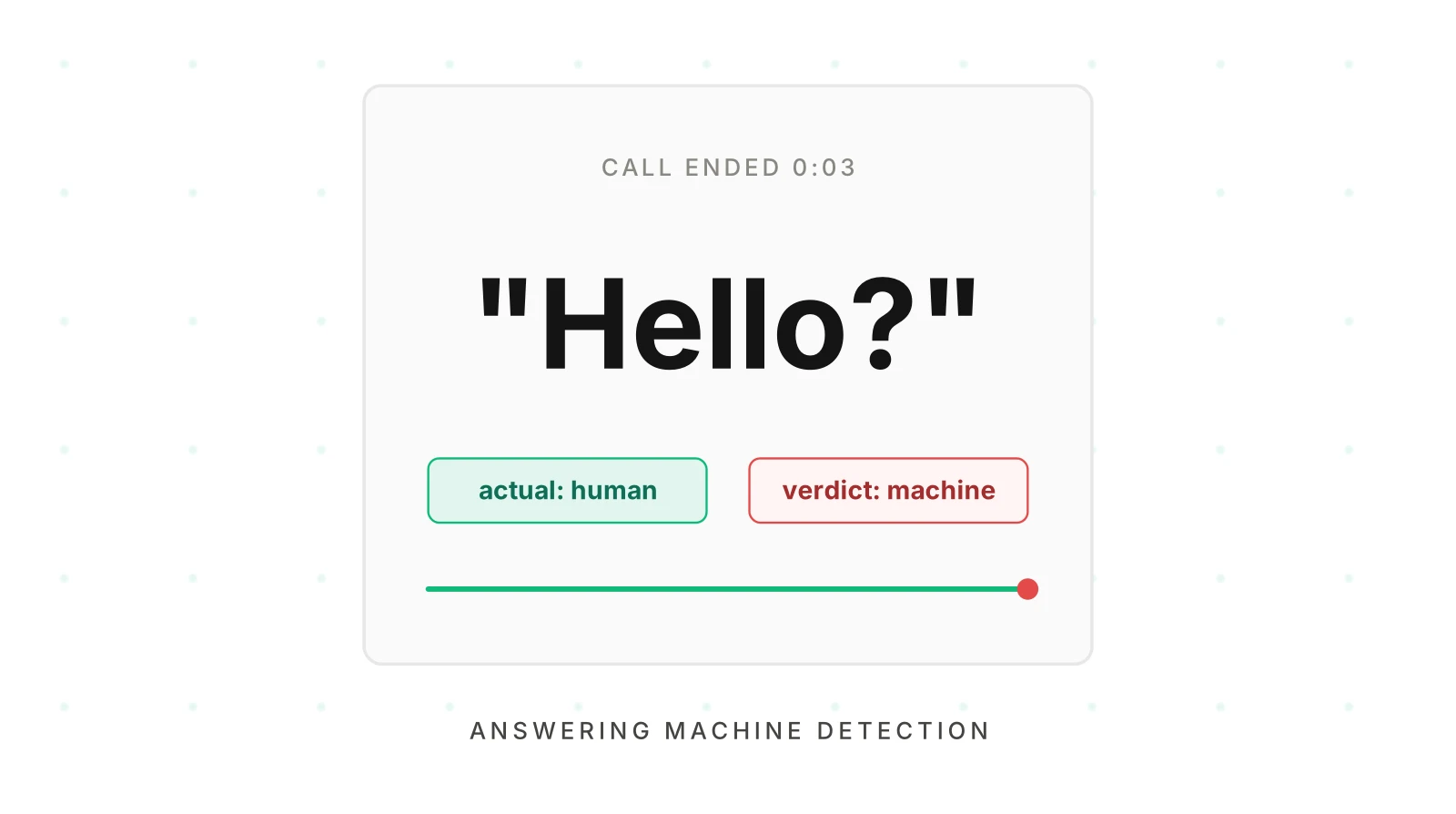
An outbound voice agent makes its riskiest decision before it says a word. A person picked up, or a machine did, and the agent has seconds to tell which. Guess wrong one way and a customer hears dead air or a hang-up. Guess wrong the other way and your agent pitches a mailbox for a minute.
This guide is the generic explainer. It covers how AMD works, why it fails and how to test it. It is not a framework tutorial. LiveKit and Pipecat setup is in our voicemail detection guide. Trunk wiring is in the LiveKit and Twilio outbound guide. The wider outbound plan is in outbound voice agent testing.
What is answering machine detection?
Answering machine detection: software that labels the callee of an answered call as human, machine, IVR, fax or unknown. Teams also call it voicemail detection, answer machine detection or, when sold as a product, answering machine detection software.
In short, AMD is a classifier plus timers. The classifier says who answered. The timers decide how long the callee waits.
Voicemail answers with the same signal a person does. The network only reports "answered." So the agent must infer the callee from audio.
Who can pick up
An AMD voice agent faces more than two classes. A binary human-or-machine view hides most bugs.
| Who answered | What it sounds like | What the agent should do |
|---|---|---|
| Person on a mobile | "Hello?" then silence | Speak within about a second |
| Person at a business | "Thanks for calling Acme, this is Dana." | Speak, not treat as machine |
| Default carrier voicemail | Stock phrase, then a tone | Wait, then leave the approved message |
| Personal voicemail greeting | 2 to 30 seconds, sometimes music, sometimes no beep | Wait for the recording to start |
| Mailbox full or not set up | Carrier announcement, no recording | End the call, retry later |
| IVR or auto attendant | "For sales, press 1." | Navigate or end, per policy |
| Call screener | Phone asks who is calling and why | Give a short, specific answer |
| Silent pickup | Line noise, or nothing | Probe once with a short prompt |
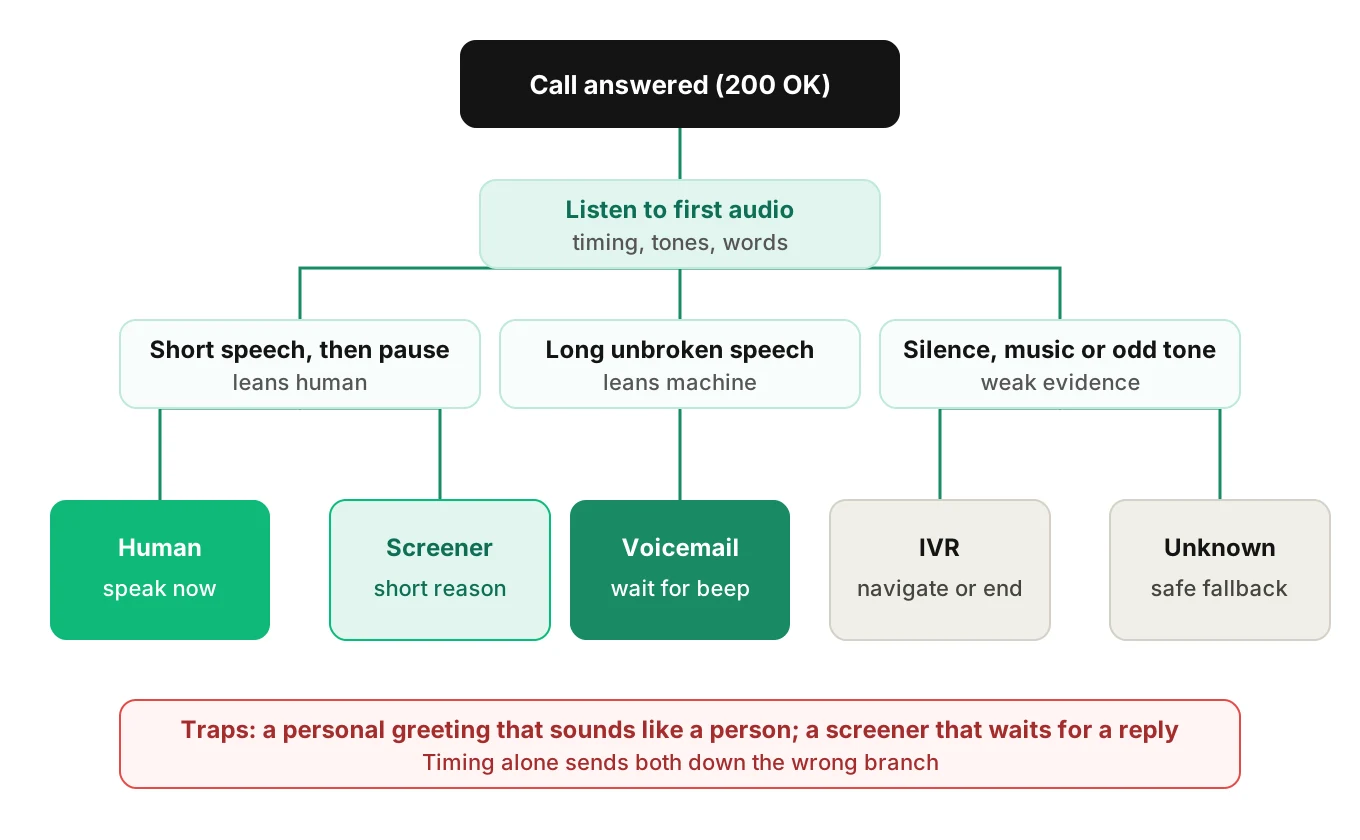
Two rows are traps. A personal greeting that sounds like a person fools timing rules. A screener waits for your reply like a person but speaks like a machine.
How answering machine detection works
Every detector combines three kinds of evidence. Production systems mix them.
1. Speech and silence timing. People say something short and stop. Machines talk longer. Twilio's FAQ gives reference durations. Personal greetings are "typically pretty short and less than 1800 ms." Business greetings run about 1,800 to 3,000 ms. Machine greetings are "typically longer, >3000 ms." The detector times the first speech block, waits for silence, and decides.
2. Tones. Beeps and fax tones are strong evidence when present. They are weak as the only signal. Twilio's FAQ says a machine beep "varies greatly between different calling destinations." Some beeps overlap standard call progress tones.
3. Words. A transcript makes "you've reached the voicemail of" unambiguous, even when timing looks human. The cost is speech-to-text plus a model call while a person waits. LiveKit's documented design runs a fast heuristic and an LLM classifier in parallel. The first to conclude sets the result.
What a verdict looks like
Providers return a small label set. Know it before you write a test.
- Twilio
Enable:human,machine_start,fax,unknown. It returns as soon as the callee is identified. - Twilio
DetectMessageEnd:human,machine_end_beep,machine_end_silence,machine_end_other,fax,unknown. For machines it returns only once the greeting ends. - LiveKit:
human,machine-ivr,machine-vm,machine-unavailable,uncertain. The docs say to treatuncertainas human.
Sources: Twilio AMD docs and LiveKit's AMD page, read November 17, 2026. Neither has a label for "screener."
Sync, async and the cost of waiting
Twilio's AMD is synchronous by default. The call is blocked until detection completes. With AsyncAmd=true the call connects at once and the result arrives on a callback. The docs add a limit: async AMD "consumes one forked audio stream from the per-call limit of four forked streams."
The FAQ puts typical result time near 4 seconds with defaults. Webhook round-trip latency is the most common cause of slow results. Four seconds of silence after "Hello?" is long enough for people to hang up.
What research says about accuracy
Treat vendor accuracy claims as claims. Twilio's FAQ says DetectMessageEnd is "close to 100% accurate in US destinations with default settings." It publishes no test set. It adds that international accuracy may drop, because voicemail tones differ by country.
Independent work is more useful. Saurav (2026) classifies 15 timing features from a voice activity detector. It reports 99.3% on a 140-call expert-labeled set but 95.4% on 624 held-out production calls. It also reports 0.3% false positives and 1.3% false negatives over 77,000-plus production calls. Altwlkany et al. (2024) report over 96% test accuracy for a recurrent model, above 98% with a silence detection step. These are other teams' results on their data. Yours will differ.
Where AMD fails
Failures cluster. Knowing the clusters lets you build a test for each.
AMD false positives: humans labeled as machines
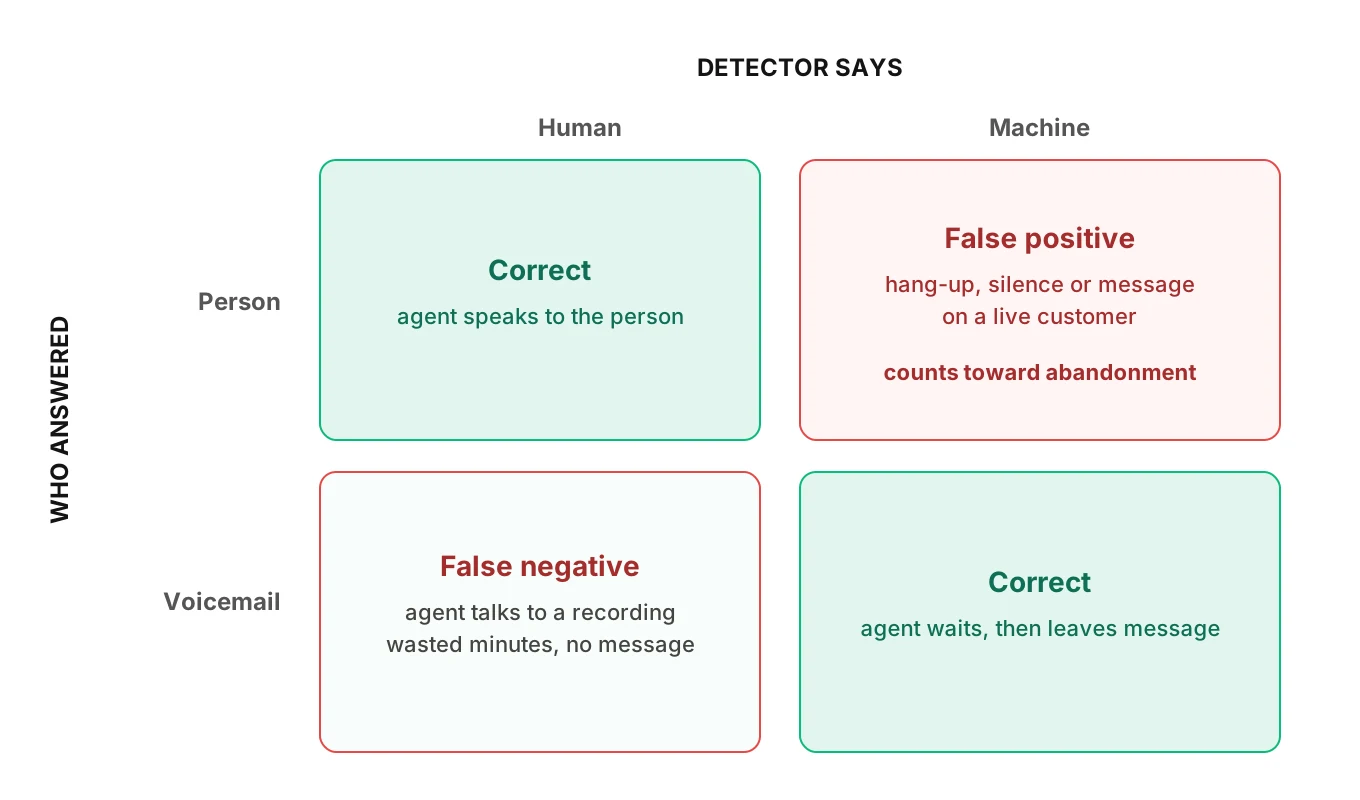
The AMD false positive is the costly one, so define it carefully. AMD false positive: a live person classified as a machine, so the agent hangs up, stays silent or leaves a message. Some vendors flip the naming. Write your own definition into the test plan.
Common causes:
- Long human greetings. A business line with a name, department and welcome runs 3 seconds or more. Twilio treats speech longer than
MachineDetectionSpeechThreshold(default 2,400 ms) as machine-leaning. - Slow or repeated hellos. "Hello... hello?" has a pause. Twilio's docs warn that lowering the speech end threshold makes pauses look like the end of speech.
- Screeners. Apple's "Ask Reason for Calling" asks unknown callers for a reason before the phone rings. Google's Call Screen answers and asks who is calling and why. A timing detector may read the screener as a person, or as a machine. If it reads a machine, the agent talks or hangs up and the phone never rings.
- Over-tuned timers. Twilio's FAQ warns that one configuration for every destination can be inaccurate. Aggressive timing also causes
unknownresults.
AMD false negatives: machines labeled as humans
A false negative means the agent talks to a recording. Causes:
- Short voicemail greetings. Twilio's docs say a very short two-second greeting may be interpreted as a human picking up.
- Pauses inside a greeting. A lower
MachineDetectionSpeechEndThresholdspeeds up human detection. It can also mistake a pause for the end of speech, sohumanreturns early. - Beep ambiguity. If the greeting ends in a tone the detector cannot place, Twilio can return
machine_end_other. Your voicemail drop may then start in the wrong place. - Silent greetings and music. No speech inside the silence timeout ends in
unknownoruncertain. What your agent does with that value is part of the test.
Integration failures that look like AMD failures
Some errors are plumbing:
- Trunk type. Twilio's FAQ states that "Elastic SIP trunking calls cannot utilize AMD." Teams dialing through SIP trunks need another detector. See the LiveKit and Twilio guide.
- Slow callbacks. A webhook that takes a second adds a second of silence for the callee.
- Verdict ignored. The detector says
machine_startand the agent keeps talking, because the handler listens to the wrong event. - Early speech. The agent speaks on connect, before any verdict. Time to first audio matters here.
- Load. Latency tails grow when servers saturate. See concurrency failures before trusting a quiet-hour result.
What each error costs
The two errors are not symmetric. A false negative wastes a minute of agent time. A false positive hangs up on a person who wanted to talk.
For US telemarketing calls, the rule puts a number on the second. Under 47 CFR 64.1200(a)(7), a call is abandoned if it is not connected to a live representative "within two (2) seconds of the called person's completed greeting." Callers may not abandon more than three percent of live-answered telemarketing calls over 30 days for a single campaign. A detector that hangs up on people spends that budget. The rule has more conditions, and it covers telemarketing only. This is not legal advice. Ask counsel how it applies to your calls. We left voicemail-drop law out, because we did not verify it.
For the compliance side, see outbound voice agent testing. For the funnel, see outbound sales voice agent metrics. Inbound lines use the word differently, as abandonment rate for voice agents explains.
A worked example (illustrative numbers)
Say you dial 10,000 numbers and 3,000 are answered by people. Assume the detector mislabels 1% of them as machines. That is 30 people hung up on or sent to voicemail. A 1% rate uses a third of a 3% abandoned-call budget before any other failure counts. These are assumptions for the arithmetic, not measurements of any detector.
What to measure
Score every test call against a label you set in advance. Then compute these.
| Metric | Formula | What it tells you |
|---|---|---|
| False positive rate | humans treated as machine / all human answers | Hang-ups and drops on people |
| False negative rate | machines treated as human / all machine answers | Agent talking to a recording |
| Unknown rate | unknown or uncertain / all answers | How often the detector punts |
| Unknown handling | correct action after unknown / all unknowns | Whether the fallback is safe |
| Decision latency | time from answer to verdict | How long the callee waits |
| Time to first word (human) | answer to first correct agent audio | Dead air on people |
| Message start accuracy | voicemail messages that start after the greeting / all drops | Clipped or early messages |
| Screener pass rate | screeners that ring through / screener calls | Lost connections |
Track by class, not just overall. A detector at 97% overall can fail every screener, because screeners are rare in the average mix.
Decision latency is two numbers
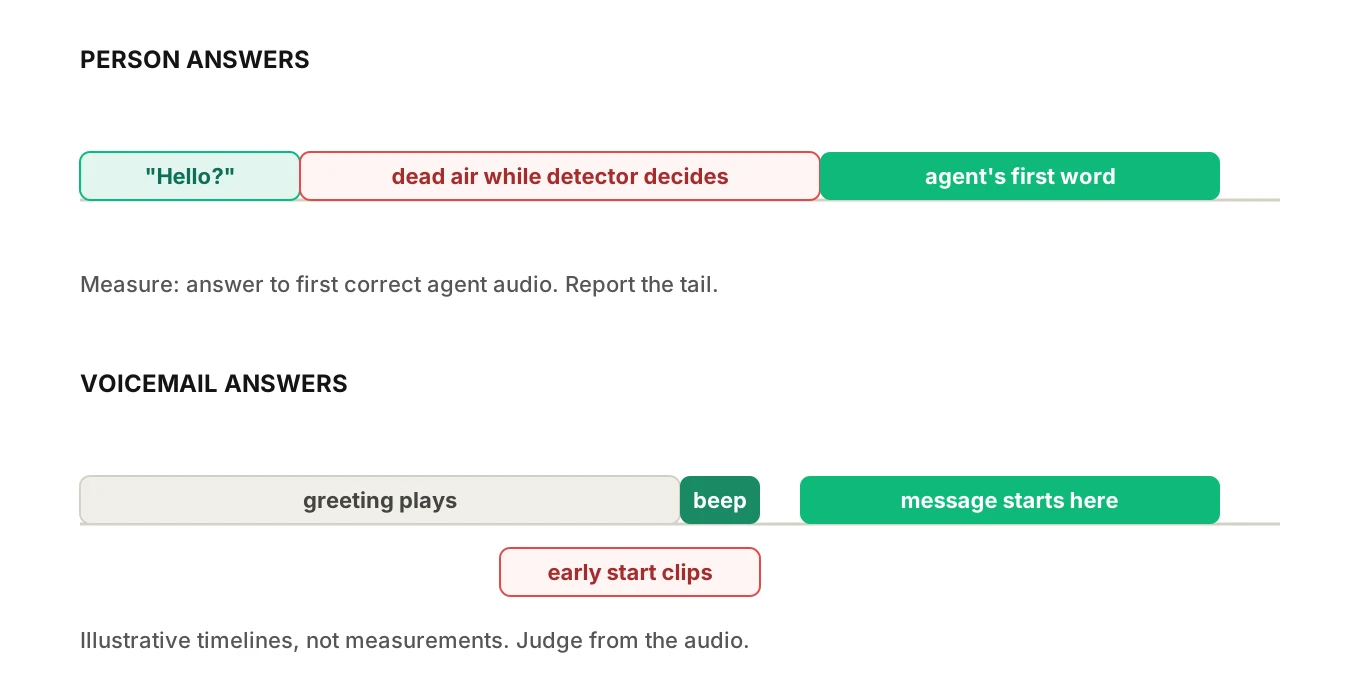
For a person, latency is felt as dead air. For a machine, the message must start after the greeting. Report both, and report the tail, not just the average. Twilio's FAQ quotes about 4 seconds for defaults. The slowest 5% of calls are the ones people hang up on.
How many calls you need
You need enough human answers to bound the false positive rate. With zero errors in n trials, the 95% upper bound on the true rate is about 3 divided by n. To show a rate below 1% takes about 300 human answers with no errors. Below 0.3% takes about 1,000. Use a Wilson interval when errors appear.
# Simplified: score AMD results against labels. Rows: (label, verdict)
from math import sqrt

def wilson(k, n, z=1.96):
    if n == 0:
        return (0.0, 0.0)
    p = k / n
    d = 1 + z * z / n
    c = p + z * z / (2 * n)
    m = z * sqrt(p * (1 - p) / n + z * z / (4 * n * n))
    return ((c - m) / d, (c + m) / d)

def score(rows):
    humans = [r for r in rows if r[0] == "human"]
    machines = [r for r in rows if r[0] == "voicemail"]
    fp = sum(1 for _, v in humans if v.startswith("machine"))
    fn = sum(1 for _, v in machines if v == "human")
    return {
        "false_positive": (fp, len(humans), wilson(fp, len(humans))),
        "false_negative": (fn, len(machines), wilson(fn, len(machines))),
    }
The AMD scenario set
A scenario set for AMD lists callee behaviors, each with an expected action and a pass rule. Start from the answerer table, then add the timing variants that break detectors.
| Scenario | Callee behavior | Expected agent action | Pass criteria |
|---|---|---|---|
| Human, quick hello | "Hello?" then waits | Speak and ask for the person | Agent speaks within your latency budget |
| Human, slow hello | Pause, then "Hello?", then pause | Speak, do not hang up | No machine verdict; no hang-up |
| Human, long business greeting | 3 to 5 second greeting | Speak after greeting | Not treated as machine |
| Human, wrong person | "Who?" then "Wrong number" | End politely | Correct end reason |
| Voicemail, carrier default | Stock phrase then tone | Wait, then leave message | Message starts after the tone, nothing clipped |
| Voicemail, short personal | 2 second greeting, pause, tone | Leave message | Not treated as human |
| Voicemail, long personal | 20 to 30 seconds | Wait for the recording | No speech over greeting |
| Voicemail, no beep | Greeting then silence | Leave message after silence | Message starts at a sensible point |
| Mailbox full | Carrier announcement, no recording | End the call, mark for retry | No message attempt |
| Silence on pickup | Nothing for 5 to 10 seconds | Probe once, then follow policy | Safe fallback, no endless wait |
| IVR menu | "Press 1 for sales" | Per policy | Correct branch, no script read to the menu |
| Screener | "State your name and reason" | Short specific answer | Call rings through; no pitch |
| Personal greeting that sounds like a person | "Hey, it's Sam. Go ahead." | Treat as voicemail if it records | Message is left, no conversation attempt |
| Greeting then human | Voicemail greeting cut off by a person | Switch to conversation | Agent handles the late human |
Run each under realistic conditions: different speech pace, accent, response delay and background noise. Clean synthetic audio passes detectors that fail on real handsets. Synthetic callers can play the human, IVR and scripted voicemail roles. Record carrier voicemails and screeners from real handsets, since their timing is hard to fake.
How to test answering machine detection before go-live
1. Write the label set — Fix the classes. Define false positive and false negative in one sentence each, before any call.
2. Build the corpus — Record carrier voicemails, personal greetings and screeners from several carriers and handsets. Script the human and IVR cases.
3. Add callee conditions — Vary pace, response delay, accent, noise and language. A clean "hello" is not enough.
4. Run over the real path — Use the same PSTN or SIP route and trunk type as production. A path that cannot run AMD shows up here.
5. Judge from the audio — Mark what the callee heard. Did the agent talk over the greeting? Did the message start after the beep? Transcripts miss this.
6. Score by class — Compute error rates and decision latency per class, with intervals.
7. Tune one timer at a time — Change one threshold and rerun the set. Twilio's FAQ recommends A/B testing configurations and avoiding over-tuning to one carrier or device.
8. Gate releases — Fail the build when false positives, unknown handling or the latency tail pass your limits. Rerun after every prompt, model or trunk change.
Why judging from audio matters
AMD errors are timing errors. A transcript shows the agent said "Hi, this is Acme calling." It does not show whether that landed over a voicemail greeting, or two seconds after a person said hello.
Evalgent is a testing and evaluation platform for voice agents. Its premise is that most tools judge calls from transcripts, so the judge is deaf to the audio where these failures live. Evalgent scenarios script the callee, caller profiles set accent, pace, interruption, response delay and noise, and the simulator reaches your agent over PSTN, SIP or WebRTC. Calls are judged from the audio, with latency and call end reason among the metrics, and humans review the verdicts. We cover the wider gap in transcript versus audio evaluation.
After launch, the same scenarios anchor monitoring. Production recordings can be mapped to them and judged, so a prompt change that slows the opener shows up in review, not in complaints. For vertical examples, see dental recall calls and leasing follow-up calls. Evalgent works with teams to set up evals for their first agent.
Frequently asked questions
What is answering machine detection?
Answering machine detection is software that listens to the start of an answered call and labels the callee as a person, voicemail, IVR, fax or unknown. It uses speech and silence timing, tones and sometimes transcripts. Outbound voice agents use it to decide whether to talk, wait for a recording or hang up.
How does answering machine detection work?
It measures the first speech block, then the silence after it. Short speech followed by a pause leans human; long continuous speech leans machine. Beep detection and transcripts add evidence. Twilio's reference lengths are under 1,800 ms for personal greetings and over 3,000 ms for machines. The detector returns a label and the agent acts on it.
How accurate is answering machine detection?
It depends on your call mix. Twilio says DetectMessageEnd is close to 100% accurate in US destinations with default settings, without a published test set. One academic detector scored 99.3% on an expert-labeled set and 95.4% on held-out production calls. Measure your own accuracy by class on real audio.
What is an AMD false positive?
An AMD false positive is a live person classified as a machine. The agent then hangs up, stays silent or leaves a voicemail. Definitions vary by vendor, so write yours into the test plan. It is usually the costlier error, because it wastes a live answer and can count as an abandoned call.
Why does AMD hang up on real people?
Common causes are long business greetings, slow or repeated hellos, call screeners and timers tuned too aggressively. Twilio treats speech longer than its speech threshold, 2,400 ms by default, as machine-leaning. Test each case with real callee timing, not just a clean "hello" from a script.
Does answering machine detection work with call screening?
Not reliably. Screening on iPhone and Pixel asks the caller for a reason before the phone rings. A detector may label the screener as a person or a machine. Either way, the agent must answer with one short, specific sentence. Test screeners from real handsets and treat them as their own class.
How long should answering machine detection take?
As short as accuracy allows. Twilio's FAQ puts typical results near 4 seconds with default settings, and says slow webhooks are the most common cause of delay. Set a latency budget for people and another for machines, then measure the tail. The slowest calls are the ones people abandon.
How do I test answering machine detection?
Build a labeled set of human, voicemail, mailbox-full, IVR, screener and silent answers. Place calls over the production route, judge the audio, and score false positives, false negatives, unknown handling and decision latency per class. Change one timer at a time, and rerun after every release.
The bottom line
Answering machine detection is a classifier plus timers, and its errors hit people first: a false positive hangs up on a customer, a false negative talks to a recording. Prove yours works the only way that counts, with labeled real-handset audio, per-class false positive and false negative rates, and a measured latency tail.
Related Articles

How to automate voice agent testing: synthetic callers vs manual QA
Learn how ai test automation replaces manual QA for voice agents. Compare synthetic callers vs human testers, with a 5-step framework to scale without hiring.
Read more
AI Agent Testing vs Voice Agent Testing: What General Tools Miss for Voice
AI agent testing measures text outputs. Voice agent testing measures behaviour through an acoustic pipeline. Five failure categories general tools miss.
Read more