Test your voice agent
Metrics for an Outbound Sales Voice Agent
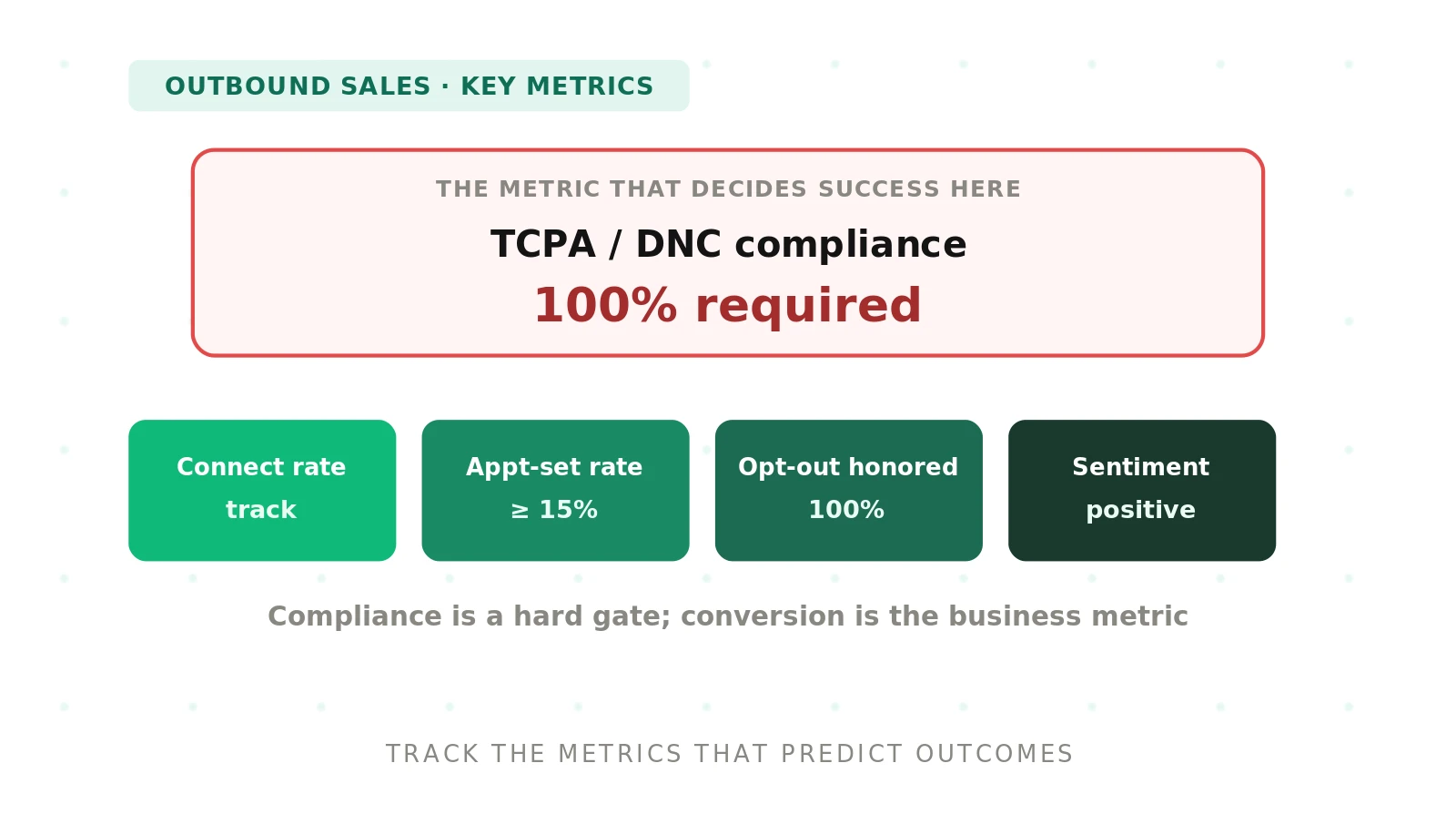
An outbound sales voice agent dials, pitches, handles objections, and books meetings. It runs at a scale no human team can match, which is exactly why the wrong metric compounds fast. A small conversion lift looks great until you learn the agent ignored opt-outs on thousands of calls. This post lays out the KPIs that matter for outbound sales, gives adaptable target ranges, and shows why compliance is a hard gate, not a nice-to-have.
Outbound is a different problem from inbound. Callers did not ask to hear from you, so consent, timing, and opt-out handling carry legal weight. This guide is deliberately distinct from our lead-qualification voice agent metrics post, which covers inbound intake. Here the focus is proactive dialing, funnel conversion, and staying inside the law on every single call.
Why outbound sales metrics are a funnel
Outbound performance is a funnel, and each metric measures one stage of it. Dials become connects, connects become conversations, conversations become conversions. A weak number at any stage caps everything downstream, so you cannot read one metric alone. A strong conversion rate on very few conversations is not a win. It is a small sample hiding a connect-rate problem upstream.
This funnel view also protects you from vanity numbers. Total dials looks impressive and means little. What matters is how efficiently dials turn into booked outcomes, and how cleanly they do it. Every stage below is a key performance indicator with its own target range, and each one segments by list, time of day, and caller profile.
The core outbound sales metrics
Connect and answer rate
Connect rate is the share of dials that reach a live person. It is the top of the funnel, and it gates every metric below. Low connect rates usually trace to bad list data, poor timing, or numbers flagged as spam. Answer rate is closely related, measuring the fraction of dialed numbers that pick up at all, including voicemail.
A reasonable target for a warm, well-scrubbed list is a 25% to 40% connect rate. Cold cold calling lists run lower, often 10% to 20%. If your connect rate sits below that floor, fix the list and dialing pattern before you touch the script. No pitch improves a number that never reaches a human.
Conversation rate
Conversation rate measures how many connects turn into a real exchange, not an instant hang-up. A connect where the person says one word and drops does not count. You want the agent to earn a few seconds, deliver a clear opener, and get the prospect talking. This is where voice quality, latency, and the opening line matter most.
Target a 40% to 60% conversation rate off connects for a competent agent. Below 40% suggests the opener is weak or the agent sounds robotic. Measuring this stage separately stops a good conversion rate from masking a bad first impression. It tells you whether people are willing to engage at all.
Conversion and appointment-set rate
This is the outcome metric: the share of conversations that produce the goal. For most outbound sales agents, that goal is a booked meeting or a qualified handoff. Define it precisely and hold it constant, since a loose definition inflates the number. An appointment that no-shows every time is not a real conversion.
Appointment-set rates vary widely by offer and list quality. A 5% to 15% conversion off conversations is a common working range. Track conversion rate optimization as an ongoing discipline, not a one-time target. Also track downstream show rate, because a booked meeting only counts once the prospect actually attends.
Talk-to-listen ratio
Talk-to-listen ratio captures how much the agent talks versus the prospect. Good human sellers listen more than they speak, and the same holds for agents. An agent that monologues loses the room and misses buying signals. The ratio is a strong proxy for whether the agent is having a conversation or reading a script at someone.
Aim for a talk-to-listen ratio near 43:57, meaning the agent talks less than half the time. Ratios above 60:40 usually mean the agent is not pausing for responses. This metric pairs with latency: an agent that responds too slowly, past the comfortable ITU-T G.114 one-way latency guidance of 150ms, feels like it is interrupting or lagging.
Sentiment
Sentiment scores the emotional tone of the prospect across the call. It tells you whether conversations end warm or hostile, which predicts both conversion and brand damage. A rising conversion rate paired with falling sentiment is a warning, not a win. It usually means the agent is pushing too hard and burning goodwill on your list.
Track average sentiment and the share of calls that end negative. Keep negative-ending calls under 15% as a starting bar. Sentiment also connects to customer satisfaction, which matters even in outbound, because every prospect is a future customer or a public complaint waiting to happen.
Objection handling
Objection handling measures how well the agent responds when a prospect pushes back. Outbound calls are full of objections: no budget, no time, no interest, already have a vendor. A strong agent acknowledges, responds, and either advances or exits gracefully. A weak one repeats its script or stalls, which tanks both conversion and sentiment.
Score objection handling as the share of objections met with a relevant, on-policy response. Target 80% or higher for a production agent. This metric is where scripted agents fail most visibly. It also feeds your escalation design for voice agents, since some objections should route to a human rather than a rebuttal.
Compliance is a hard metric, not a soft one
Here is the part teams underweight, and it is the most important one. In the United States, outbound calling is governed by law, and violations carry real penalties. The Telephone Consumer Protection Act sets rules on consent, calling hours, and automated dialing. Do-Not-Call registry rules restrict who you may call at all. These are not performance metrics you optimize. They are gates you must not fail.
Treat opt-out handling as pass/fail. When a prospect says "take me off your list," the agent must recognize it, honor it, and suppress the number immediately. A single missed opt-out is a failure, regardless of how the call converted. Measure opt-out recognition rate and target 100%, because anything less means the agent is breaking the rule at scale on some calls.
The same logic applies to calling hours, DNC scrubbing, and required disclosures. An outbound agent runs thousands of calls, so a 1% compliance defect is not a rounding error. It is potentially thousands of violations. This is why compliance belongs at the top of your scorecard, checked on every call, not sampled occasionally. A booking rate that comes from non-compliant calls is a liability, not revenue.
Compliance also protects the metrics you do want to optimize. Numbers that get reported for spam or DNC violations lose connect rate and answer rate over time. Clean, compliant dialing keeps your caller ID trusted and your funnel healthy. The compliant path and the effective path are the same path here, which is why the hard gate protects the soft KPIs.
Outbound sales voice agent metrics: targets at a glance
The table below summarizes adaptable starting targets. Treat them as defaults to tune against your offer, list, and risk tolerance, not universal numbers. Segment every one by list source and time of day.
| Metric | What it measures | Starting target | Type |
|---|---|---|---|
| Connect rate | Dials reaching a live person | 25–40% (warm), 10–20% (cold) | Funnel |
| Conversation rate | Connects becoming real exchanges | 40–60% | Funnel |
| Conversion / appointment-set | Conversations producing the goal | 5–15% | Outcome |
| Show rate | Booked meetings actually attended | 60–80% | Outcome |
| Talk-to-listen ratio | Agent speech vs prospect speech | ~43:57 | Quality |
| Negative-ending calls | Calls ending in poor sentiment | Under 15% | Quality |
| Objection handling | Objections met on-policy | 80%+ | Quality |
| Opt-out recognition | Opt-outs correctly honored | 100% | Compliance (hard) |
| DNC / hours compliance | Calls placed within the rules | 100% | Compliance (hard) |
How to build an outbound sales metrics scorecard
Follow these steps to turn the metrics above into a scorecard you can run on every release. The order matters: compliance first, funnel second, quality third.
1. Set the compliance gates first. Define opt-out recognition, DNC scrubbing, calling hours, and disclosures as pass/fail at 100%. Any failure blocks the launch, full stop.
2. Define each funnel stage precisely. Write exact definitions for connect, conversation, and conversion, so numbers stay comparable across runs and lists over time.
3. Set adaptable target ranges. Start from the table above, then tune each range to your offer, list quality, and risk tolerance before you begin testing.
4. Segment every metric. Break results down by list source, time of day, and caller profile, so a good average never hides a broken segment.
5. Test on realistic calls. Run scenarios with objections, accents, noise, and opt-out requests, so the scorecard reflects real prospects, not a happy path.
6. Run it as a regression suite. Re-run the full scorecard on every prompt, model, or vendor change, and keep the passing run as a baseline for drift.
7. Review the calls behind the numbers. When a metric moves, replay the actual transcripts, so a score change points to a real behavior you can fix.
A worked example
Consider an outbound agent working a warm list to book product demos. In one week it places 10,000 dials. At a 32% connect rate, that is 3,200 connects. At a 50% conversation rate, 1,600 become real exchanges. At a 10% conversion rate, the agent books 160 demos. That funnel looks healthy on its own terms.
Now check the hard gates. Suppose opt-out recognition ran at 98%, not 100%. Across 3,200 connects, that is roughly 64 prospects who asked to be removed and were not. Those 64 calls are potential TCPA and DNC violations, and they dwarf the value of any single booking. The scorecard verdict is a fail, despite the strong funnel.
The fix is not to accept the tradeoff. You raise opt-out recognition to 100% by improving intent detection and suppression, then re-run. Once compliance passes, you optimize the funnel: better list timing to lift connect rate, a stronger opener to lift conversation rate. The lesson is order. Compliance is the gate, and the funnel is what you tune once you are through it.
Adapting targets to your context
The ranges above are starting points, and your context should move them. A high-value enterprise offer tolerates a lower conversion rate, since each booking is worth more. A transactional consumer offer needs higher volume efficiency. Regulated industries raise the compliance bar further, adding scripting and disclosure requirements that widen what "pass" means on every call.
List quality shifts the funnel targets most. A referral or opt-in list should beat the warm-list ranges; a scraped cold list will trail them. Set your baseline on your own first clean run, then hold the agent to improvement against that baseline. This mirrors the approach in our voice agent metrics scorecard, which anchors targets to measured reality rather than aspiration.
Whatever you set, write the targets down before testing and get sign-off. That stops anyone renegotiating the bar after seeing a flattering conversion number. It also keeps the compliance gates non-negotiable, which is the whole point. For a broader launch bar, pair this with the voice agent production-readiness standard.
Frequently asked questions
What is the most important outbound sales voice agent metric?
Compliance is the most important, because it is a hard gate rather than a target. Opt-out recognition and Do-Not-Call handling must pass at 100% on every call. After that, conversion or appointment-set rate is the key outcome metric, since it measures whether the funnel actually produces booked results.
What is a good conversion rate for an outbound sales agent?
A common working range is 5% to 15% of real conversations producing the goal, such as a booked meeting. It varies widely by offer and list quality. Enterprise offers tolerate lower rates because each booking is worth more. Always track downstream show rate too, since a booked meeting only counts once attended.
Why is TCPA compliance a metric and not just a policy?
Because an outbound agent runs thousands of calls, so a small defect rate becomes many violations. Treating compliance as a measured, pass/fail metric on every call forces it into the scorecard. The Telephone Consumer Protection Act and Do-Not-Call rules carry real penalties, so a 1% miss is a liability, not a rounding error.
What is a good talk-to-listen ratio for a sales agent?
Aim for the agent talking less than half the time, near a 43:57 ratio. Strong sellers listen more than they speak, and the same holds for voice agents. Ratios above 60:40 usually mean the agent monologues, misses buying signals, and loses the prospect. The metric is a strong proxy for genuine conversation.
How is outbound different from lead-qualification metrics?
Outbound is proactive dialing, so consent, calling hours, and opt-out handling carry legal weight from the first second. Lead qualification is usually inbound intake, where the caller initiated contact. The funnel stages differ too: outbound starts with connect and conversation rates that inbound does not face. Compliance dominates outbound scorecards specifically.
How do you measure objection handling?
Score the share of objections the agent meets with a relevant, on-policy response. Target 80% or higher for production. Log each objection type, budget, time, interest, existing vendor, and check whether the agent advances or exits gracefully. This metric exposes scripted agents fastest, since they tend to repeat lines rather than truly respond.
Should sentiment matter in outbound sales?
Yes. Rising conversion paired with falling sentiment is a warning, not a win. It usually means the agent pushes too hard and burns goodwill across your list. Track average sentiment and the share of calls ending negative, keeping negative-ending calls under 15%. Every prospect is a future customer or a public complaint.
How often should I re-run my outbound metrics scorecard?
Run it before launch and again on every change: each prompt edit, model swap, or vendor update. Regressions creep in with every one, especially on compliance behaviors like opt-out recognition. Keep the passing run as a baseline so later drops are visible. In production, sample and score live calls continuously between full runs.
Testing outbound sales voice agents with Evalgent
Evalgent is an independent platform for testing and evaluating voice agents against the metrics that decide outbound success. It maps the funnel, the quality bar, and the compliance gates through five primitives.
- Scenarios define the dial, the pitch, and the objections, so connect, conversation, and conversion each have a clear target.
- Profiles simulate real prospects with different accents, moods, noise, and opt-out requests, so every metric segments properly.
- Metrics capture the funnel, talk-to-listen, sentiment, and objection handling, with compliance encoded as a hard pass/fail.
- Evaluations run the full scorecard as a regression suite on every change, before any prospect is dialed.
- Reviews let your team replay the calls behind a number, so a missed opt-out points to a real transcript.
Because Evalgent is independent, its scores are not tuned to flatter any vendor. To run your outbound scorecard against your own agent, book a demo. It also complements our guide to evaluating voice agent vendors and the broader voice agent evaluation framework.
The bottom line
An outbound sales voice agent lives or dies on its funnel, but it is disqualified by its compliance record. Measure connect, conversation, and conversion to grow, and treat opt-out and Do-Not-Call handling as hard gates you cannot fail.
Related Articles
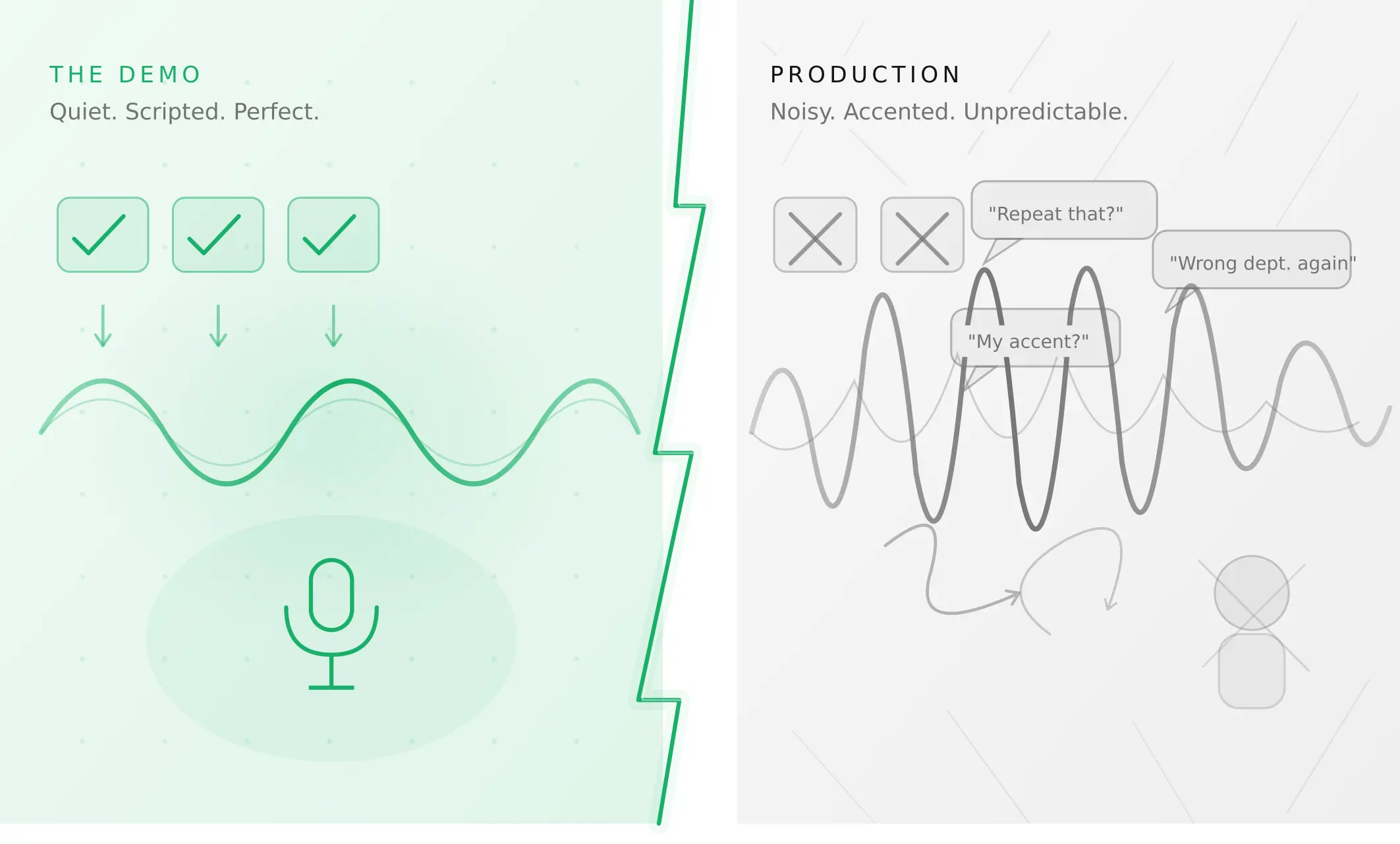
Why AI voice agents fail in production (and how to prevent it)
AI voice agents that ace demos still break in production. Learn the 5 root causes, how to test for each, and what production readiness actually means.
Read more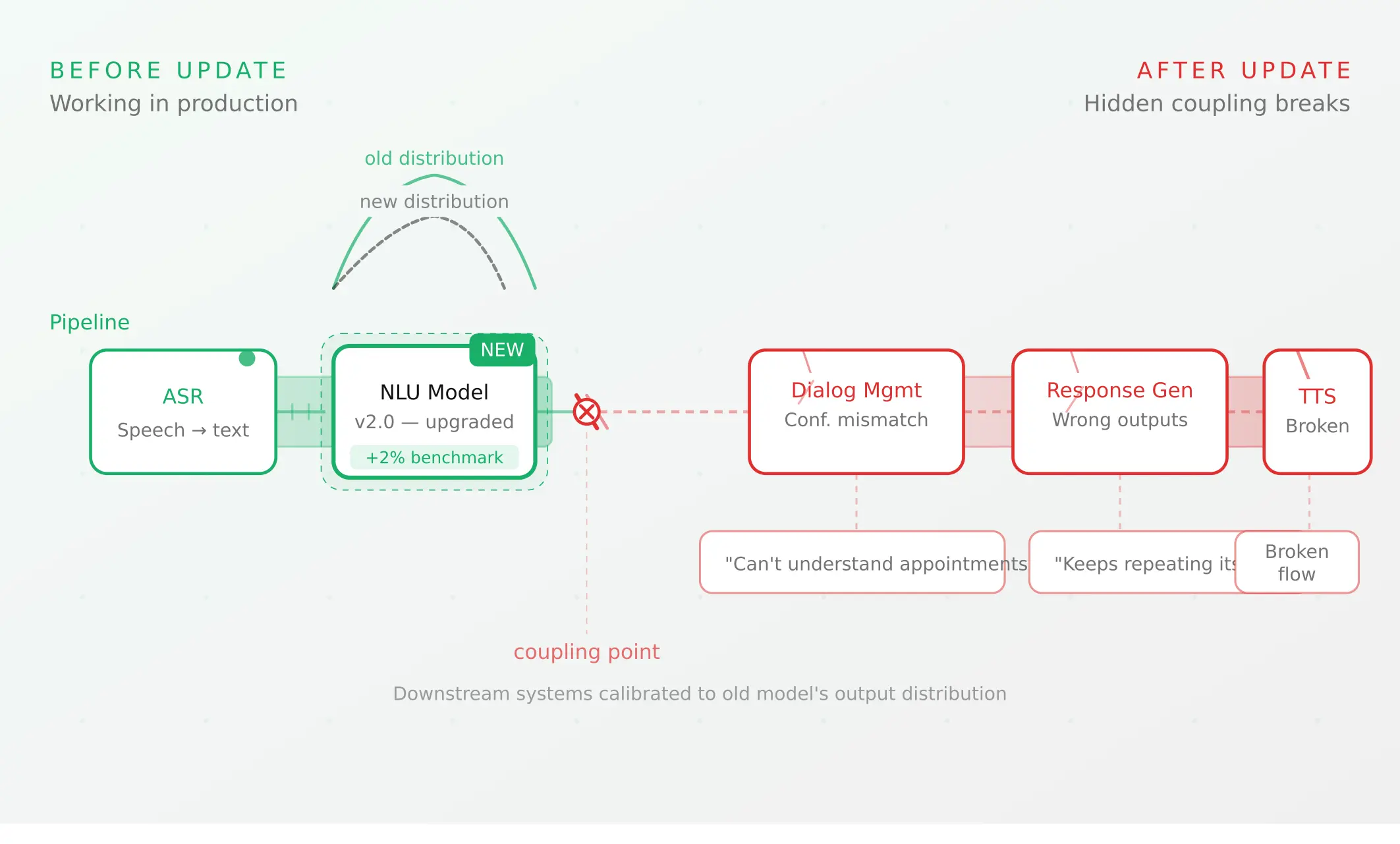
Voice agent regression testing: why LLM updates break production
LLM updates improve benchmarks but break voice agents in 5 predictable ways. How to detect and prevent regressions after every model or prompt change.
Read more