Test your voice agent
A VP of Engineering's Guide to Choosing a Voice Vendor
# A VP of engineering's guide to choosing a voice agent vendor
Quick answer
> Quick answer: A VP of engineering choosing a voice agent vendor should judge delivery, not demos: integration effort, reliability under load, observability, a regression and CI testing story, and incident support. Weigh how much of your team the vendor will consume, and insist on independent test evidence before you commit.
The CTO decides whether voice AI fits the strategy. You decide whether it ships, stays up, and does not quietly consume your best engineers for the next two years. That is a different question, and vendor sales decks are built to answer the first one, not yours. A polished demo call tells you nothing about integration effort or tail latency under load. It says even less about what happens at 2 a.m. when the agent starts hanging up on callers.
This guide is written for the delivery lens. It covers the engineering-delivery criteria that actually decide the choice. It gives you a scorecard of what to verify and the red flags to watch, a way to estimate the team cost of a vendor, and a step-by-step evaluation you can run. It sits alongside the CTO's strategy-lens guide and the shared pillar on how to evaluate voice agent vendors. It borrows the same core discipline: decide on measured evidence from your own traffic, not vendor claims.
Why the VP of engineering lens is different from the CTO's
The CTO's questions are about direction. Does this vendor's roadmap match ours? Is the commercial model sane? Does the platform lock us in? Those matter, and the CTO guide treats them properly.
Your questions are about delivery and operations. How many engineer-weeks to reach a working integration? Does the thing hold its numbers when call volume triples? When it breaks, can my team see why, and can I reach a human who can help? A vendor can be strategically perfect and still be an operational liability. It can burn your on-call rotation and miss every ship date.
That gap is where voice AI projects die. The strategy is approved and the budget is signed. Then delivery stalls because the API contract is undocumented, the logs are useless, and every incident turns into a guessing game. Your job is to catch that before the contract is signed, when you still have leverage.
The engineering-delivery criteria that decide the choice
Score every candidate vendor on the same delivery criteria, using your own environment rather than their sandbox. Weight them for your situation, but keep the list constant so the comparison is fair.
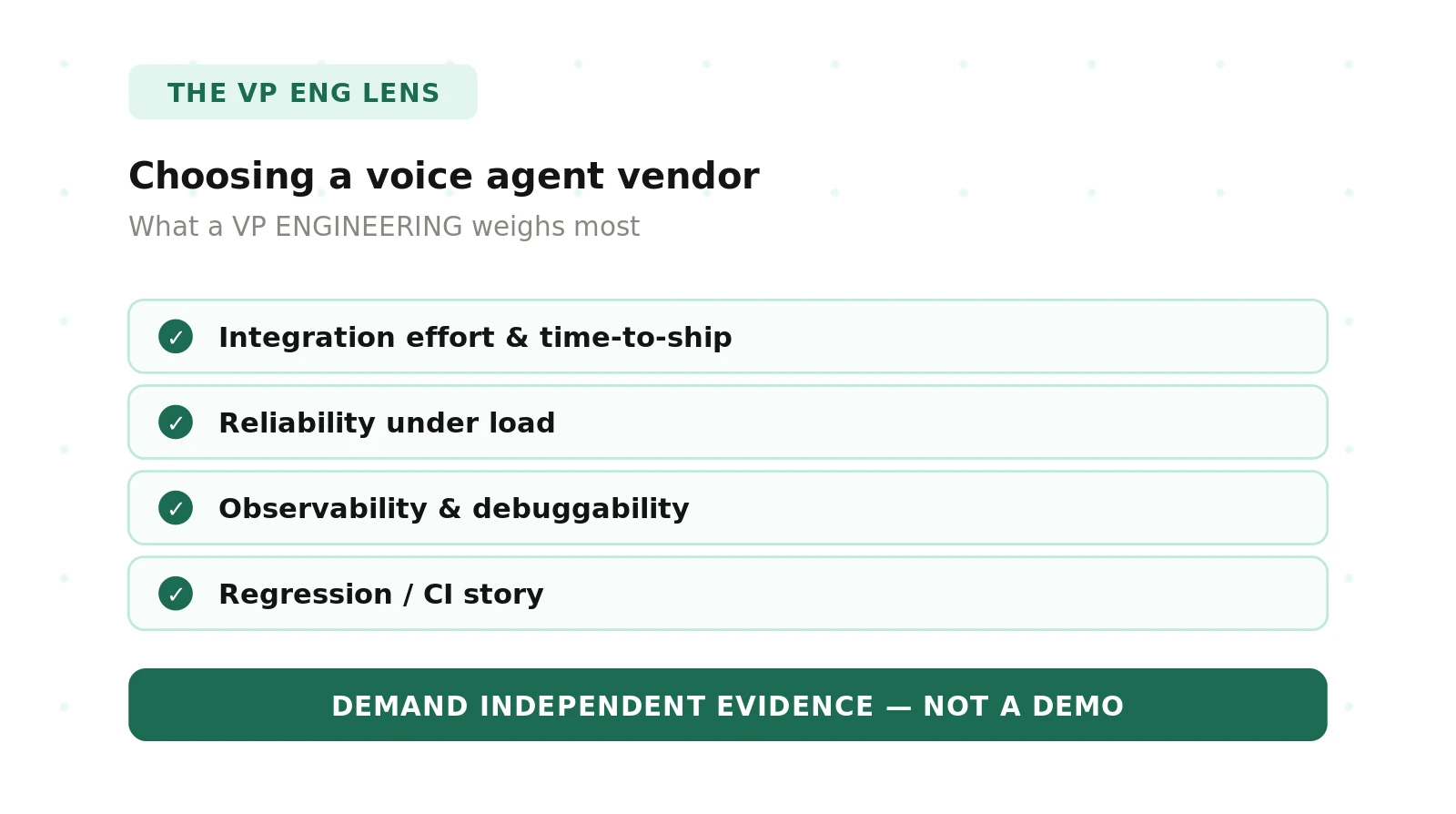
Integration effort and time-to-ship. How long from access to a working call in your stack? Read the API docs, not the sales deck. Look for stable, versioned endpoints and clear webhook semantics. You want sandbox credentials you can get the same day and SDKs in your languages. A vendor that hides its docs behind a sales call is telling you something.
Reliability under load. Demos run at concurrency of one. Production does not. You need evidence that accuracy and latency hold at your peak concurrency. The platform should degrade gracefully rather than fall off a cliff, with a published rate-limit and backpressure story. Treat this as a load testing exercise, and measure the tail, not the average.
Observability and debuggability. When a call goes wrong, how fast can your team find out why? Strong observability) means per-turn transcripts, timing traces, structured logs, and event webhooks you can pipe into your own stack. Weak observability means a black box and a support ticket. The difference is hours versus days on every incident.
Regression and CI testing story. Voice models change under you. A vendor-side model update can silently break a flow that worked last week. You need a way to run a fixed regression testing suite against every change. Wire it into CI/CD so you catch drift before your callers do. Ask how customers detect regressions today.
On-call and incident support. Read the support terms as an operations document. What are the response-time commitments by severity? Is there a real escalation path to an engineer, or only a ticket queue? Are there status pages, postmortems, and change notifications? Established on-call practices from site reliability engineering are a useful yardstick for what mature incident support looks like.
Latency you can feel. Callers notice pauses. Measure time to first audio and turn latency at p95 on your traffic, not the vendor's clean-audio number. Our guide to latency in voice agents breaks down where the milliseconds go and which ones the caller actually perceives.
Safety, escalation, and recovery. An agent that cannot hand off cleanly traps callers. Verify that escalation works and that recovery from errors is graceful. Safety behavior should map to a recognized framework such as the NIST AI Risk Management Framework. Our guide on escalation in voice agents covers the handoff patterns that matter.
Engineering-delivery scorecard: what to verify and the red flags
This is the table to bring to every vendor conversation. The middle column is what to ask for and measure. The right column is the pattern that should give you pause.
| Delivery criterion | What to verify | Red flag |
|---|---|---|
| Integration effort | Versioned API, same-day sandbox, SDKs in your languages, a working call in under a week | Docs behind a sales call; bespoke, unversioned endpoints |
| Reliability under load | Accuracy and p95 latency held at your peak concurrency; published rate limits and backpressure | Numbers only at concurrency of one; no load evidence |
| Observability | Per-turn transcripts, timing traces, structured logs, event webhooks into your stack | Black-box calls; debugging requires a support ticket |
| Regression and CI | A fixed test suite you can run on every change, wired into CI/CD, plus change notifications | No regression story; silent model updates |
| On-call and incident support | Response-time SLAs by severity, escalation to an engineer, status page and postmortems | Ticket queue only; vague, best-effort support |
| Latency | Time to first audio and turn latency measured at p95 on your audio | Averages on clean vendor audio; no tail numbers |
| Team consumption | Clear estimate of engineer-weeks to integrate and to maintain per quarter | Open-ended integration; heavy ongoing hand-holding |
| Independent evidence | Third-party results on your test set, scored by a neutral party | Only vendor-reported metrics and a curated demo |
Weight the rows for your use case. A regulated healthcare intake agent pushes safety and observability to the top, while an outbound flow may weight latency and reliability higher. The rows stay fixed so the scoring stays comparable across vendors, the same principle behind running every vendor through the same test cases.
How much of your team will the vendor consume?
The number that never appears on a pricing page is the one you care most about. How many of your engineers will this vendor absorb, and for how long? A cheap per-minute rate is expensive if it costs you two engineers for a quarter to integrate. Add a permanent slice of your on-call rotation to operate, and the real price climbs.
Break the cost into three buckets. Integration is the one-time engineer-weeks to reach production, including auth, webhooks, error handling, and your own test harness. Maintenance is the recurring load: keeping up with API changes, chasing regressions after model updates, and tuning prompts and flows. Operations is the on-call tax. It covers pages per week, mean time to diagnose, and how often an incident needs the vendor's help to resolve.
Ask existing customers for real figures, not the vendor's estimate. A vendor with strong docs, real observability, and a regression story can drop integration from months to weeks. It also keeps the operations tax near zero. A weak one turns every model update into an unplanned fire drill that eats your error budget and your team's focus. This is where a good vendor quietly earns its price and a bad one quietly destroys your roadmap.
How to evaluate a voice agent vendor as a VP of engineering
Run this process identically for every candidate. The decision should rest on evidence, not on which vendor gave the best demo. It is the delivery-focused version of the shared vendor evaluation method.
1. Write down your delivery requirements first. Before you talk to any vendor, define your target SLOs, peak concurrency, latency budget, and the flows that must not break. This is your yardstick, set before anyone can influence it.
2. Get real access, not a demo. Ask for sandbox credentials and API docs on day one. Time how long it takes your own engineer to place a working call. That number is your integration-effort signal.
3. Build one shared test set from your traffic. Assemble real scenarios, accents, noise, interruptions, and edge cases. Every vendor faces the identical set, the discipline behind benchmarking on your own data.
4. Stress-test under load. Drive the vendor to your peak concurrency and beyond, and watch whether accuracy and p95 latency hold. Our guide to stress-testing voice AI covers how to do this without fooling yourself.
5. Inspect observability and debuggability. Break something on purpose. See how fast your team can find the cause from transcripts, traces, and logs alone. Slow diagnosis here means slow diagnosis in production.
6. Wire in a regression check. Run your fixed suite, then ask how you would catch a vendor-side model change. If there is no answer, assume silent drift, covered in AI voice agent testing.
7. Read the support terms as an ops runbook. Map severities to response times and confirm there is a real escalation path. A ticket queue is not incident support.
8. Score, weight, and demand independent evidence. Fill in the scorecard, apply your weights, and require third-party results on your test set before you commit.
Where an independent test layer fits
The hard part of this process is that your own team is not neutral. The engineers who built the integration want it to succeed, the timeline is under pressure, and a favored vendor bends the scoring without anyone meaning to. That is structural, not a character flaw, and it is exactly why independent evaluation exists.
This is where Evalgent fits. Evalgent is an independent, third-party evaluation and auditing platform for AI voice agents. It runs your delivery criteria and your test set across every vendor, stresses them under load, and scores the results with no stake in which one wins. For a VP of engineering, that turns "the demo looked great" into a measured, comparable answer on reliability, latency, and regression behavior, the same rigor our voice agent evaluation pillar describes.
The payoff is de-risked delivery. You ship on a vendor you have measured, not one you were sold, and you keep the evidence for when the numbers are questioned later. It is also the artifact your peers can lean on: the procurement lead, the CX leader, the compliance officer, and the contact center manager all cite the same independent results. To see how independent testing plugs into your delivery process, book a demo.
Frequently asked questions
What should a VP of engineering look for in a voice agent vendor?
Look at delivery, not the demo. The signals that matter are integration effort and time-to-ship, reliability under load, observability and debuggability, a regression and CI testing story, and real incident support. Also estimate how much of your team the vendor will consume over a year, then insist on independent test evidence measured on your own traffic before committing.
How do you evaluate a voice agent vendor's reliability under load?
Drive the vendor to your peak concurrency and past it, then measure whether accuracy and p95 latency hold or collapse. Confirm the platform degrades gracefully, publishes rate limits, and has a backpressure story. Treat it as a load test on your own audio, not the vendor's clean sandbox, since demos always run at a concurrency of one.
What observability should a voice agent vendor provide?
A vendor should expose per-turn transcripts, timing traces, structured logs, and event webhooks you can pipe into your own stack. That lets your team diagnose a failed call in minutes rather than filing a support ticket and waiting. Weak observability makes every call a black box, which turns each production incident into slow, expensive guesswork.
How important is a regression testing and CI story for voice agents?
It is critical, because voice models change underneath you. A vendor-side update can silently break a flow that worked last week. You need a fixed regression suite you can run against every change and wire into CI/CD, plus change notifications. Without one, you find regressions the way your callers do, after they fail in production.
What on-call and incident support should you expect from a voice agent vendor?
Expect response-time commitments by severity, a real escalation path to an engineer, a status page, change notifications, and postmortems after major incidents. Read the support terms as an operations document. A ticket queue with vague, best-effort language is not incident support, and it will land on your own on-call rotation when calls start failing.
How much engineering effort does integrating a voice agent vendor take?
It varies widely, which is the point. Break it into integration effort, ongoing maintenance, and the on-call operations tax. A vendor with strong docs, real observability, and a regression story can drop integration to weeks and keep operations near zero. A weak one turns every model update into an unplanned fire drill. Ask existing customers for real figures.
Why does a VP of engineering need independent test evidence?
Because your own team is not neutral. The engineers who built the integration want it to succeed, and a favored vendor quietly bends the scoring. Independent, third-party evidence measured on your own test set removes that conflict and gives you comparable numbers on reliability and latency. It also protects you when the decision is questioned months later.
How is the VP of engineering's vendor decision different from the CTO's?
The CTO's lens is strategy: roadmap fit, commercial model, and lock-in. Your lens is delivery and operations: integration effort, reliability under load, observability, regression behavior, and incident support. A vendor can be strategically ideal and still be an operational liability that misses ship dates and burns your team. Both lenses matter, and they should be scored separately.
The bottom line
Choosing a voice agent vendor is a delivery decision, not a demo decision. Judge integration effort, reliability under load, observability, and incident support on your own evidence, then verify it independently before you commit.
Related Articles
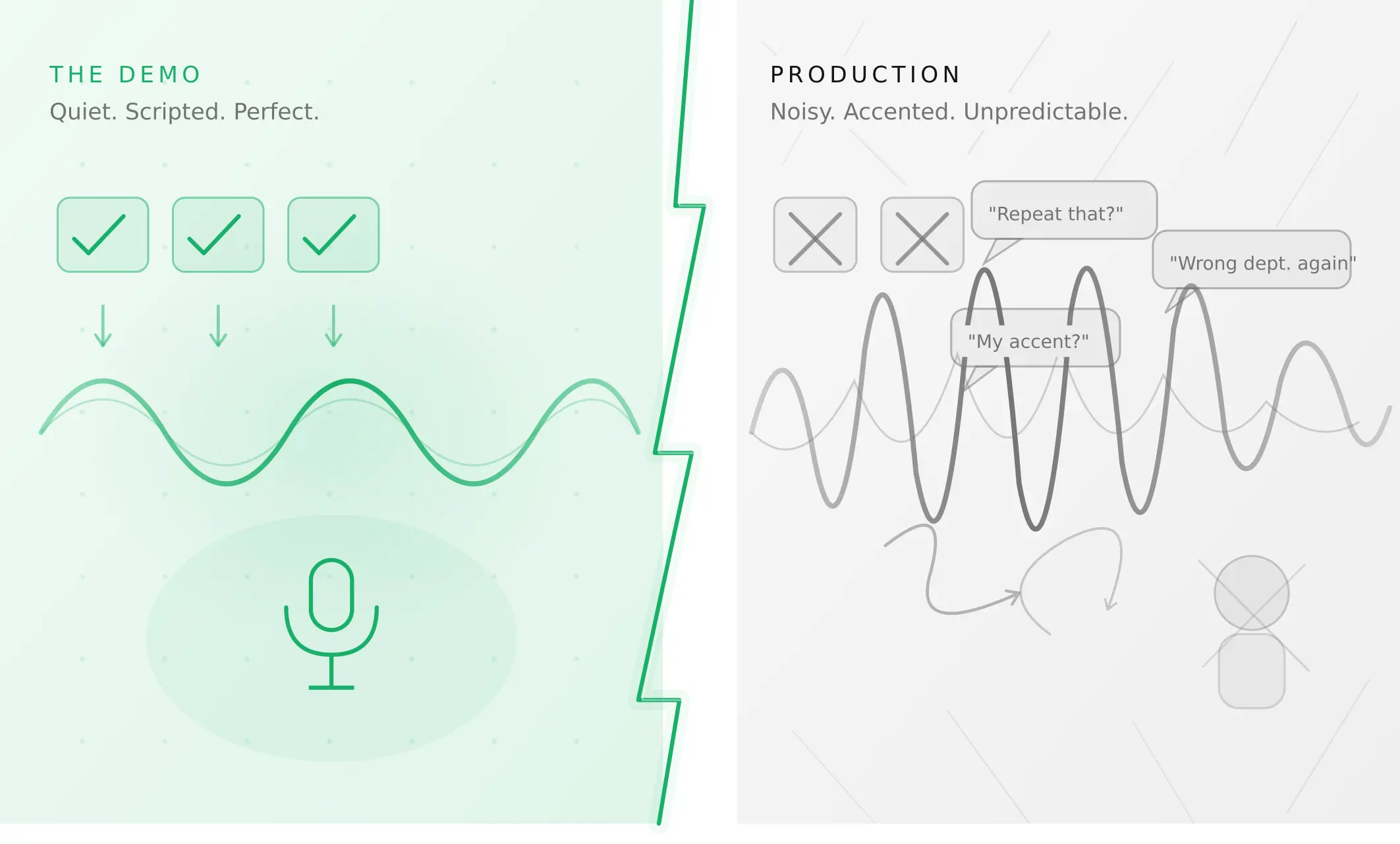
Why AI voice agents fail in production (and how to prevent it)
AI voice agents that ace demos still break in production. Learn the 5 root causes, how to test for each, and what production readiness actually means.
Read more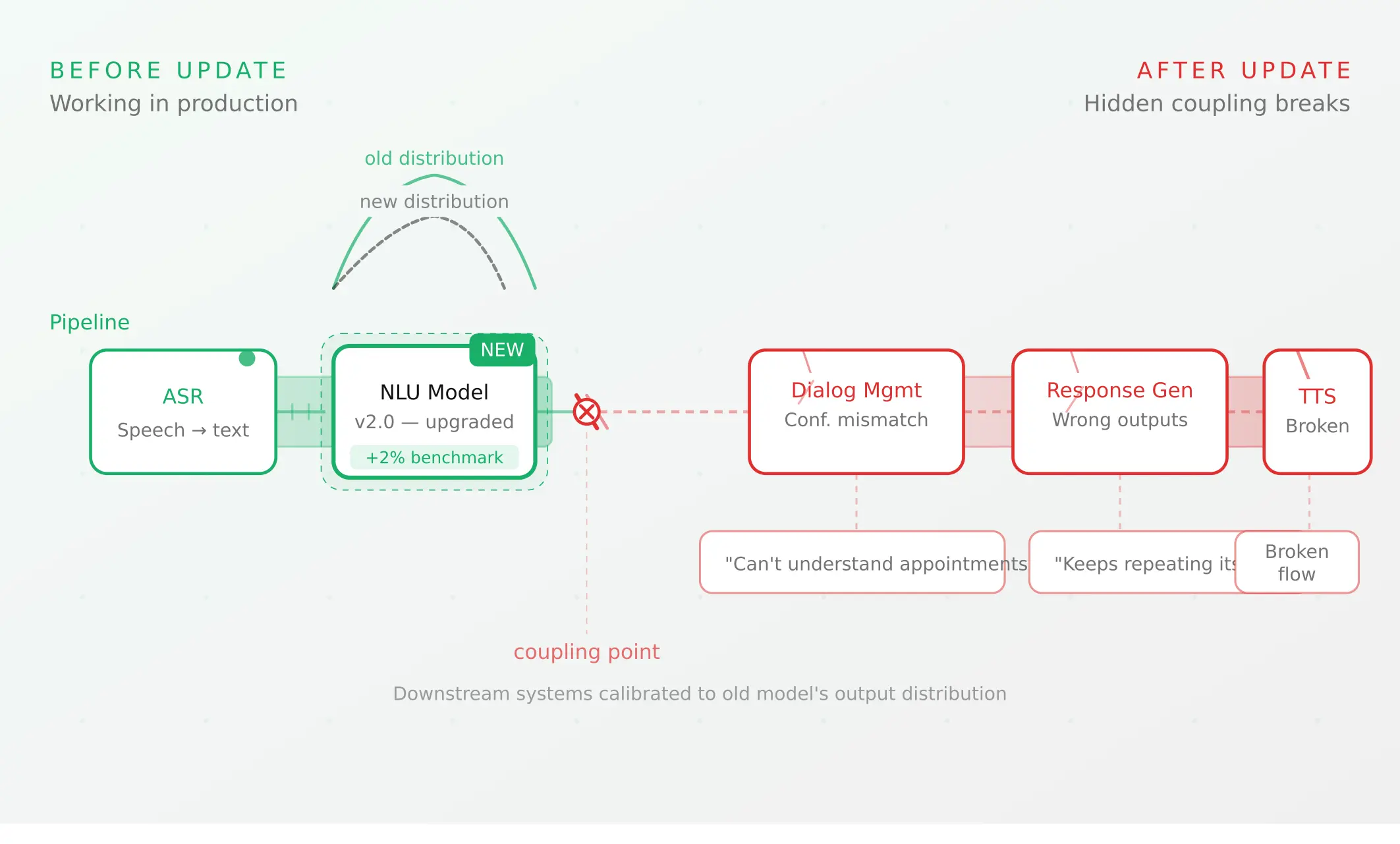
Voice agent regression testing: why LLM updates break production
LLM updates improve benchmarks but break voice agents in 5 predictable ways. How to detect and prevent regressions after every model or prompt change.
Read more