Test your voice agent
A CX Leader's Guide to Choosing a Voice Agent Vendor
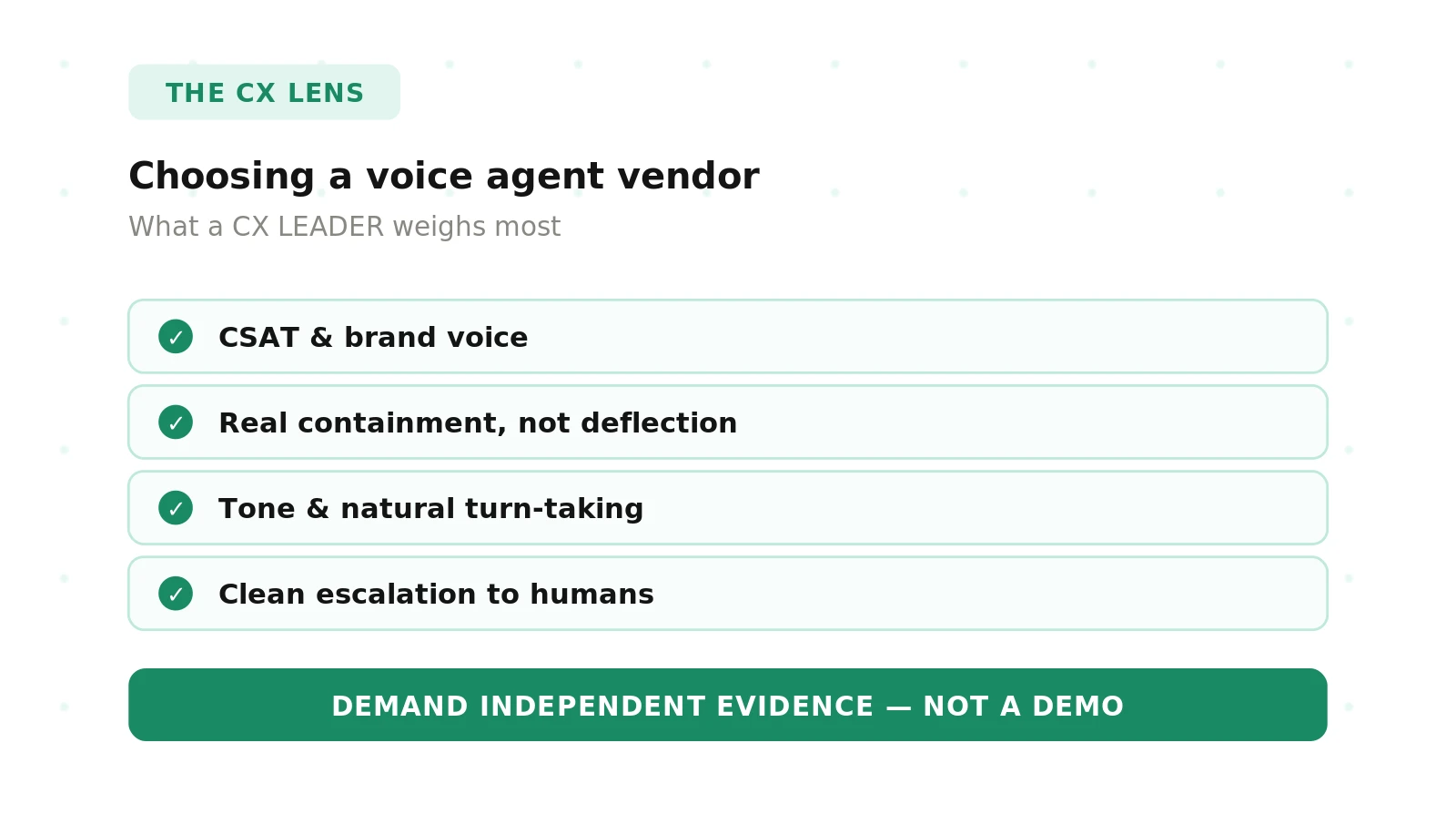
# A CX leader's guide to choosing a voice agent vendor
> Quick answer: A CX leader choosing a voice agent vendor should score the actual customer experience on recorded calls: real resolution, tone and empathy, natural turn-taking, clean escalation, and how the agent handles upset callers. Judge audio, not transcripts or demos, because that is what your customers will hear.
Your name is on customer satisfaction. When a voice agent mishandles a frustrated caller at 9 p.m., it is your CSAT score, your brand voice, and your escalation queue that absorb the damage, not the vendor's. Yet most vendor selection runs on evidence a CX leader would never accept for a human team: a scripted demo, a slide of self-reported metrics, and a transcript that hides the tone.
This guide reframes the decision around the customer experience. It walks through the CX criteria that actually predict production behavior, how to measure each one on real audio, and the red flags that separate a vendor who protects your brand from one who quietly erodes it. For the full cross-functional view, start with the pillar on how to evaluate voice agent vendors; this post is the CX lens.
Why the CX lens is different from every other buyer's
Six people around the table are choosing the same vendor for six different reasons. The CTO cares about architecture and latency. The VP of engineering cares about reliability under load. Procurement cares about total cost and contract terms. The compliance officer cares about disclosure and data handling. The contact center manager cares about staffing and handle time.
You care about something none of their dashboards capture: how the call feels to the person on the other end. It is why Net Promoter Score and customer effort score move for reasons a technical metric never explains. A vendor can win on latency, uptime, and price and still torch your CSAT because the agent sounds robotic, talks over people, or "resolves" tickets by refusing to help. The CX lens is the one that catches this, and it is the one most likely to get skipped when the loudest metrics are technical.
> Customer experience (CX): the sum of a customer's perceptions across every interaction with a brand. For voice agents, CX is shaped less by whether the agent completed a task and more by how it sounded doing it, including tone, patience, and whether the caller felt heard.
Containment vs deflection: the metric that hides the damage
The single most dangerous number in a voice agent pitch is "containment rate." Vendors report high containment as a headline win. But containment and resolution are not the same thing, and confusing them is how CX leaders get burned.
> Containment vs deflection: containment should mean the agent handled the call to a genuine resolution without a human. Deflection means the caller merely left the automated flow, by hanging up or giving up, without their problem solved. Both look identical in a "calls not escalated" metric.
A caller who abandons in frustration counts as "contained." So does a caller the agent talked in circles until they gave up. Your dashboard shows a clean 78 percent containment rate while your CSAT quietly drops and your repeat-contact rate climbs, because the same people are calling back the next day. Deflection is containment's evil twin, and it is invisible unless you measure the outcome, not the routing.
This is why first contact resolution matters more than containment for a CX leader. FCR asks whether the customer's actual need was met on that call. A vendor who cannot show you real resolution, as opposed to "the call ended without a transfer," is selling you deflection dressed as success. The deeper mechanics are in our guide on containment vs deflection.
Why audio beats transcripts for CX evaluation
Most evaluation tooling scores transcripts because text is cheap to process. For a CX leader, a transcript-only evaluation is close to worthless, because everything that shapes how a call feels lives in the audio.
A transcript says "I understand your frustration." It does not tell you the agent said it in a flat, robotic monotone that made the caller angrier. A transcript says the caller and agent exchanged fifteen turns. It does not tell you the agent interrupted the caller eight times, or left three-second dead-air gaps that felt like the line dropped. A transcript logs the words. It misses the tone, the pacing, the barge-in behavior, and the emotional temperature, which is the entire CX signal.
Consider what disappears in text:
- Tone and empathy. Warmth, condescension, and flatness are acoustic, not textual.
- Turn-taking. Interruptions and awkward pauses only show up in timing.
- Prosody under stress. Whether the agent's pacing changes when a caller escalates.
- Naturalness. Stilted delivery and mispronounced names read fine on the page.
An evaluation that scores only text is optimizing for the wrong customer. Your customers hear the call. Your evaluation should too. We cover this trade-off in transcript vs audio voice agent evaluation.
The CX criteria that actually predict CSAT
Here is the core of the CX lens: the criteria worth scoring, how to measure each on real audio, and the red flag that signals a vendor is weak on it. Weight these by your call mix. A healthcare intake line weighs empathy and escalation heavily; a simple order-status line weighs resolution and naturalness.
| CX criterion | How to measure it | Red flag |
|---|---|---|
| Real resolution (FCR) | Score whether the caller's need was met on recorded calls, and track repeat-contact rate on the same issue | Vendor reports containment but cannot show resolution; high "handled" rate with rising callbacks |
| Tone and empathy | Calibrated human review of audio for warmth, patience, and appropriate acknowledgment of emotion | Flat monotone; scripted empathy phrases delivered without matching prosody |
| Natural turn-taking | Measure interruption rate and dead-air gaps from call timing, not transcripts | Agent talks over callers, or long silences that make callers repeat themselves |
| Handling upset callers | Inject frustrated, confused, and angry personas in test calls; score de-escalation | Agent loops the same response; gets faster or more clipped as the caller escalates |
| Clean escalation | Time to offer a human, context passed to the agent, and whether the handoff is smooth | Caller must repeat everything to the human; agent hides or delays the escalation path |
| Brand voice fit | Review audio against your tone guidelines: formal vs friendly, verbosity, word choice | Generic default persona; cannot match your brand's warmth or formality |
| Naturalness | Listen for stilted delivery, robotic cadence, and name or term mispronunciation | Sounds obviously synthetic; mangles common customer names and product terms |
| Accessibility | Test with accented speech, older voices, and speech differences | Accuracy collapses outside a narrow "standard" accent band |
Notice that every "how to measure" column requires audio and real scenarios. None of them can be answered by a demo or a vendor slide. That is the point.
Escalation is a CX feature, not a failure
Many CX leaders inherit a bias that escalation is bad, that every transfer to a human is a "failure" of automation. The opposite is true. A clean, well-timed escalation protects CSAT, much like active listening protects a human conversation. A stubborn agent that refuses to hand off destroys it.
The CX questions about escalation are specific. Does the agent recognize when it is out of its depth, or does it keep trying and failing? Does it offer a human before the caller has to demand one three times? When it does hand off, does the human receive full context, including the caller's identity, the issue, and what was already attempted, or does the customer start over? A handoff that forces the caller to repeat everything is worse than no automation at all, because now they have spent five minutes and their patience before reaching help.
Score escalation as a positive capability. The best vendors make handoff smooth and fast; the worst treat it as an admission of defeat and bury it. Our guide on escalation for voice agents breaks down what a clean handoff looks like.
Testing vs evaluation: know which one you're buying
Vendors love to show you testing. Testing checks whether the agent does what it was built to do: the happy path and the scripted scenarios. Evaluation asks a harder question: how good is the experience across the messy reality of real callers?
> Testing vs evaluation: testing verifies expected behavior against known inputs. Evaluation measures quality and experience across realistic, adversarial, and edge-case interactions, including the upset callers and the accents the vendor did not design for.
A demo is testing at its most curated. It shows the agent handling the exact scenarios the vendor rehearsed. As a CX leader, you need evaluation: how does the agent sound when a caller interrupts, changes their mind, mumbles, or gets angry? The gap between a vendor's testing story and their evaluation evidence tells you how much they have actually stress-tested the customer experience. We unpack the distinction in testing vs evaluation for voice agents.
How to run a CX-first vendor evaluation
This is the process a CX leader can run to choose a vendor on experience, not on demos. It works whether you evaluate one vendor or compare several on the same test cases.
1. Define your CX scenarios from real calls. Pull 30 to 50 recordings from your current queue: the routine ones, the edge cases, and especially the frustrated and confused callers. These become your test set. Do not let the vendor supply the scenarios.
2. Write the personas that scare you. Build test callers who interrupt, who are angry, who have strong accents, who change their request mid-call. The demo will never show you these, so you must inject them.
3. Score on recorded audio, not transcripts. Have every test call recorded and reviewed for tone, turn-taking, resolution, and escalation. Text alone misses the CX signal entirely.
4. Run identical scenarios against every vendor. Same calls, same personas, same rubric. This is the only way to benchmark voice agents on your own data and compare fairly.
5. Separate real resolution from containment. For every "handled" call, verify the customer's actual need was met, and track whether they would have needed to call back.
6. Weight criteria by your call mix. An empathy-heavy line weights tone and de-escalation; a transactional line weights resolution and speed. Set weights before you look at scores.
7. Use an independent evaluator for the audio scoring. A neutral third party scoring the same rubric for every vendor removes the bias of a vendor grading its own experience. See independent voice AI evaluation.
8. Decide on the evidence, then re-score after launch. Choose the vendor whose real calls scored best, and keep scoring in production, because agents change with every model and prompt update.
The full scoring discipline, including the technical and cost criteria your peers care about, lives in the voice agent evaluation guide.
Red flags a CX leader should never ignore
Some vendor behaviors signal CX risk no matter how strong the rest of the pitch. If a vendor will only show you a scripted demo and resists testing on your own calls, that is a tell: they are hiding how the agent behaves off-script. If they report containment but cannot define resolution, they are selling deflection. If they evaluate only transcripts, they have no visibility into tone. If they treat escalation as a failure metric to minimize rather than a feature to perfect, your upset callers will pay for it. And if the agent has one generic persona with no way to match your brand voice, every call will sound like someone else's company.
The bottom line
A CX leader should choose a voice agent vendor on how real calls sound, not on how a demo reads. Containment without resolution is just deflection, so score tone, resolution, and escalation on recorded audio using a neutral evaluator.
Evalgent is the independent, third-party evaluator that scores the actual customer experience on your real calls, audio and not just transcripts, using the same rubric for every vendor you weigh. That is how you turn a CX gut feeling into evidence your whole buying committee can trust. Book a demo to see your candidate agents scored on the calls your customers will actually make.
Frequently asked questions
What should a CX leader look for when choosing a voice agent vendor?
A CX leader should look for real resolution, natural tone and empathy, smooth turn-taking, clean escalation to humans, and strong handling of upset callers. Score these on recorded audio from your own calls, not on a scripted demo. The vendor who welcomes testing on your hardest calls is usually the one who protects your CSAT.
What is the difference between containment and resolution?
Containment means a call ended without a human, which counts a frustrated caller who hung up as a success. Resolution means the customer's actual need was met. A vendor can report high containment while callers give up unsolved, so always verify resolution and track repeat-contact rate on the same issue.
Why should voice agent evaluation use audio instead of transcripts?
Audio evaluation captures what transcripts cannot: tone, empathy, pacing, interruptions, and dead-air gaps. These acoustic signals are the entire customer experience. A transcript logs the words but hides whether the agent sounded warm or robotic, or talked over the caller. Since customers hear the call, evaluation should score the audio too.
How do you measure customer experience for a voice agent?
Measure customer experience by scoring recorded calls for real resolution, tone and empathy, natural turn-taking, and escalation quality, then track CSAT and repeat-contact rate. Use realistic personas, including upset and confused callers, and run identical scenarios across vendors. A neutral evaluator scoring the same rubric keeps comparisons fair and removes vendor bias.
Is escalation to a human a failure for a voice agent?
Escalation is a CX feature, not a failure. A clean, well-timed handoff protects satisfaction, while a stubborn agent that refuses to transfer destroys it. Evaluate whether the agent recognizes its limits, offers a human early, and passes full context so the caller does not have to repeat everything.
How should a voice agent handle an upset caller?
A voice agent should acknowledge the emotion, avoid looping the same response, and offer a human path before the caller demands one. Evaluate this by injecting angry and confused personas into test calls and scoring de-escalation on audio. Watch for agents that get faster or more clipped as the caller escalates.
Will a voice agent hurt our brand voice and CSAT?
A voice agent can hurt brand voice and CSAT if it sounds robotic, talks over callers, or deflects instead of resolving. It protects them when it matches your tone, resolves real needs, and escalates cleanly. The way to know before you sign is to score candidate agents on your own recorded calls against your brand guidelines.
Do I need an independent evaluator to choose a voice agent vendor?
An independent evaluator is not required, but it removes the bias of a vendor grading its own experience. A neutral third party scores every vendor on the same rubric and the same real calls, so your comparison holds up when procurement, your board, or auditors ask how you decided. It turns a CX gut feeling into defensible evidence.
Related Articles
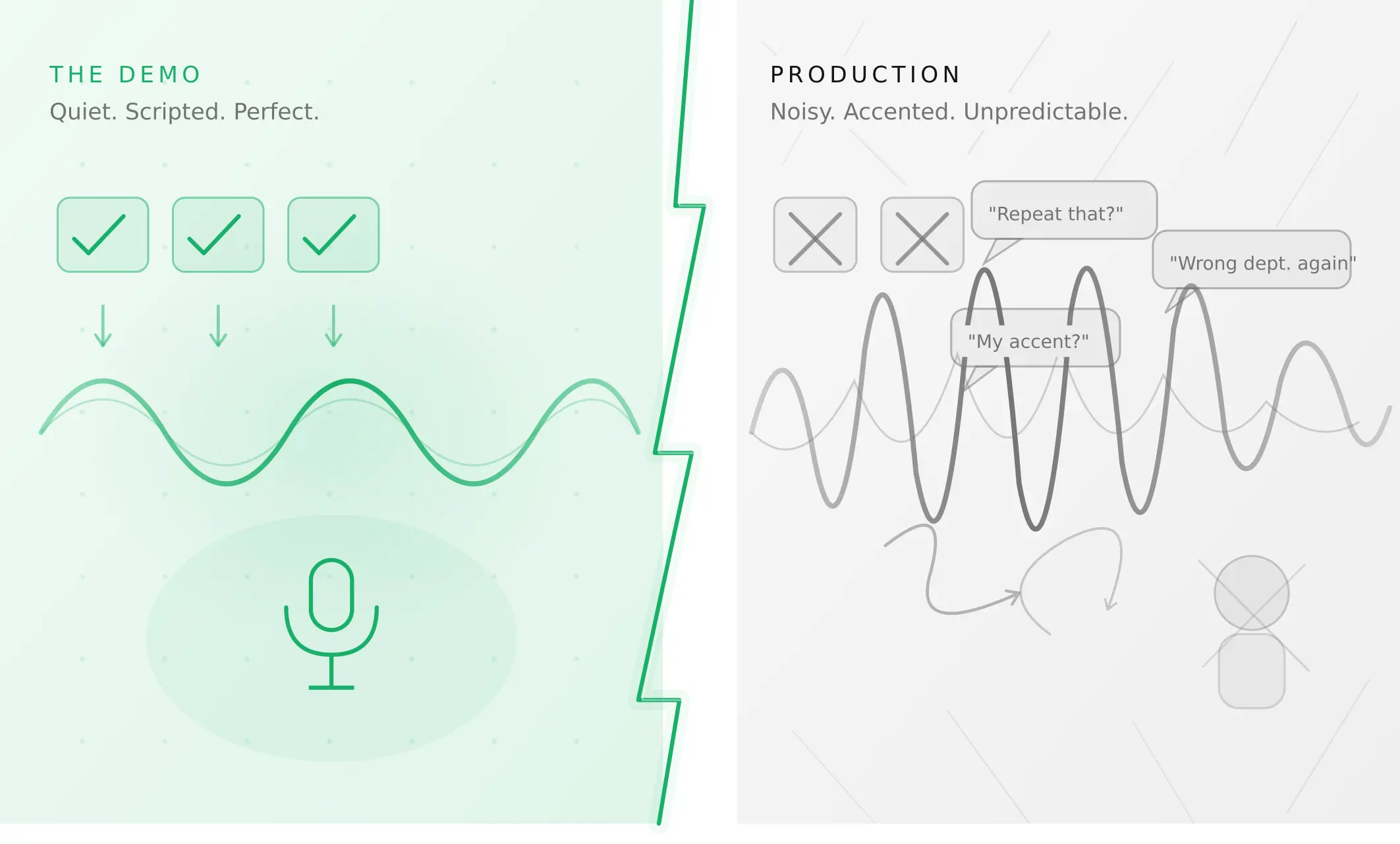
Why AI voice agents fail in production (and how to prevent it)
AI voice agents that ace demos still break in production. Learn the 5 root causes, how to test for each, and what production readiness actually means.
Read more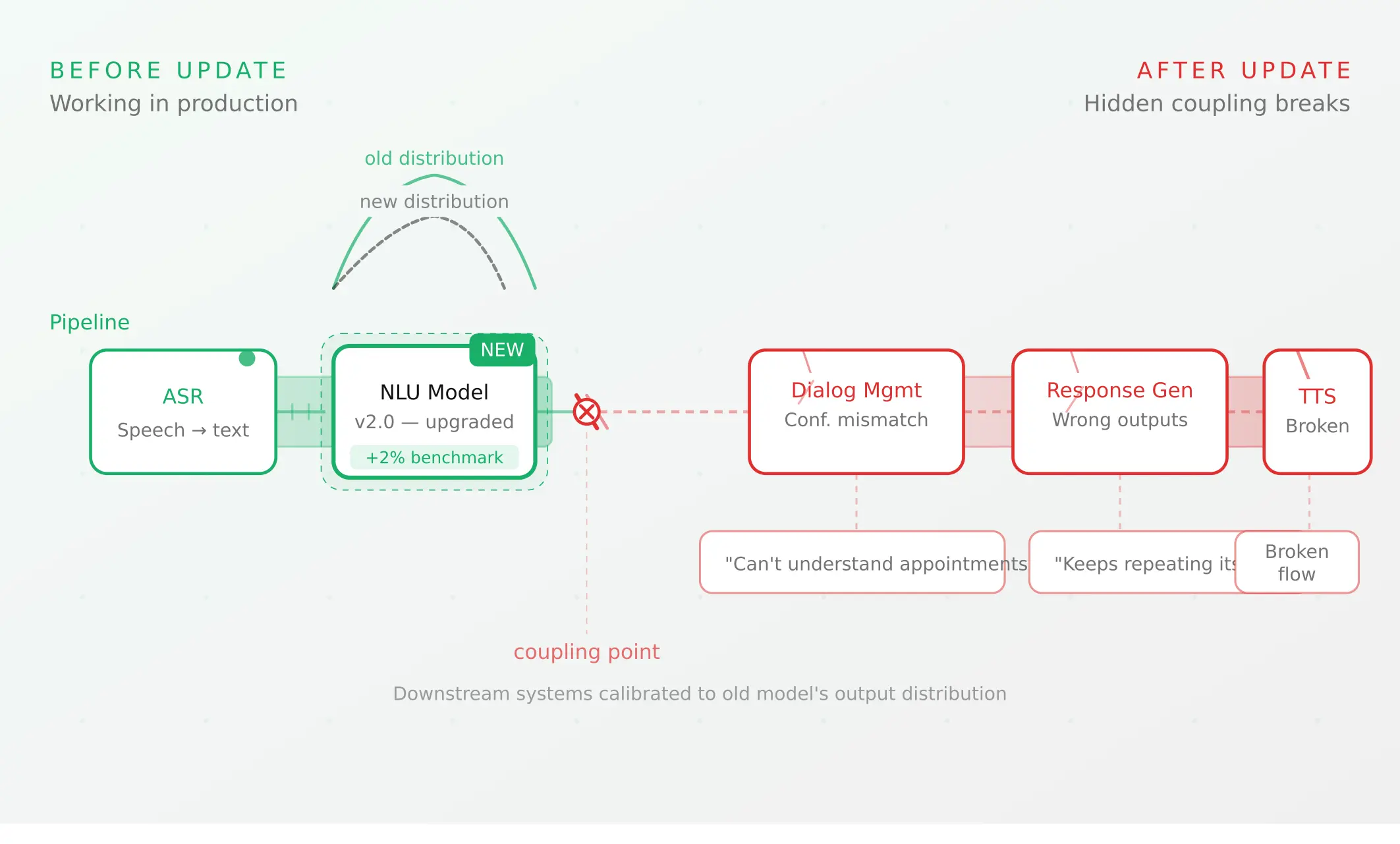
Voice agent regression testing: why LLM updates break production
LLM updates improve benchmarks but break voice agents in 5 predictable ways. How to detect and prevent regressions after every model or prompt change.
Read more