Test your voice agent
A CTO's Guide to Choosing a Voice Agent Vendor
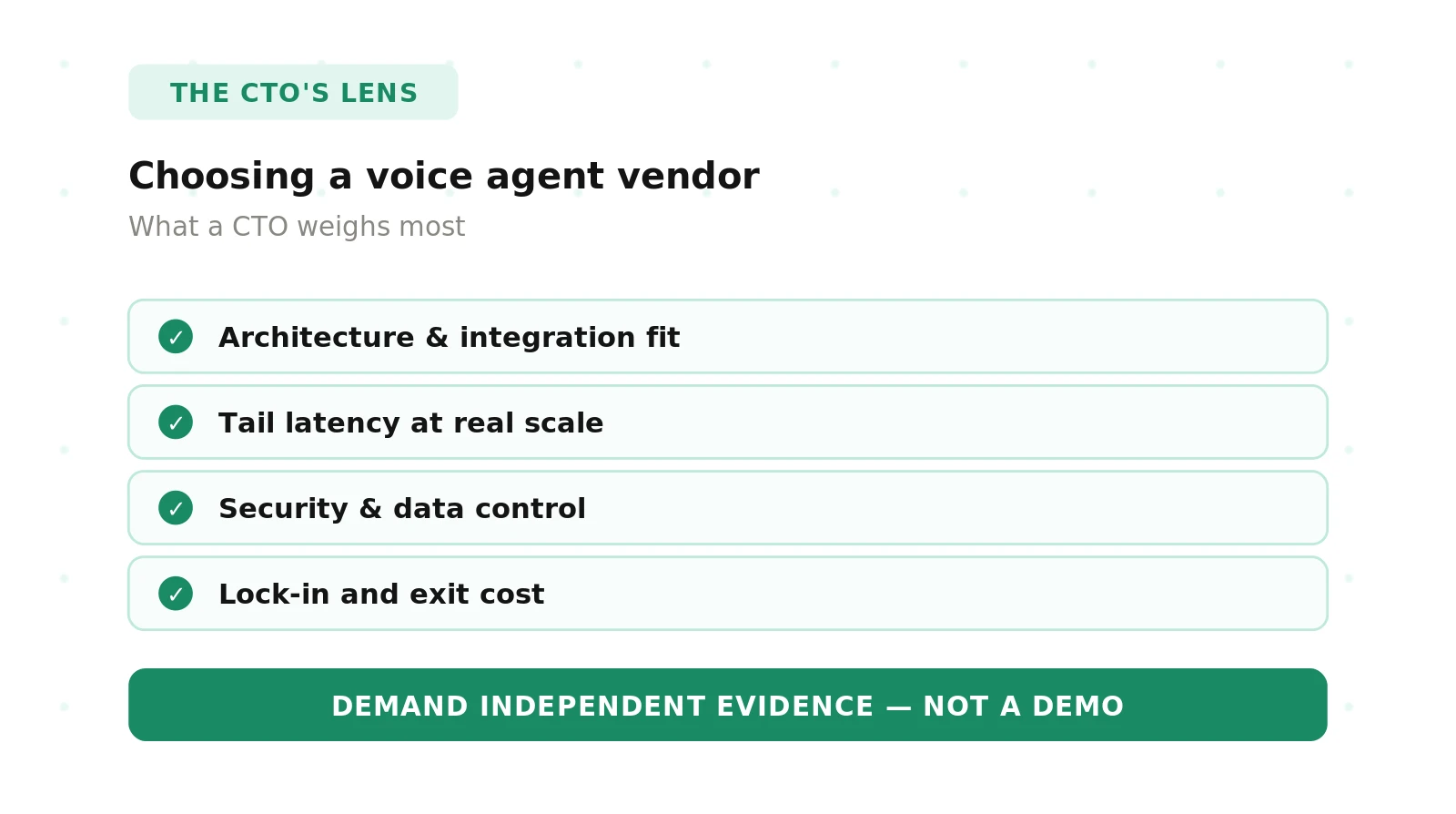
# A CTO's guide to choosing a voice agent vendor
> Quick answer: A CTO choosing a voice agent vendor judges architecture and integration fit, latency and reliability under real concurrency, security and data control, and lock-in cost. The demo is not evidence. Decide on independent test results run on your own traffic, then keep auditing after every model update.
Most voice agent decisions are pitched to the business as a feature and land on the CTO as a liability. You inherit the uptime pages, the security review, the integration debt, and the bill that grows with call volume. A vendor that dazzles the sales team can still be the wrong call for the system you have to run.
This guide takes the CTO lens deliberately. It is not a generic buyer's checklist. It focuses on the technical risks you own after the contract closes: architecture fit, latency at scale, reliability and observability, security and data control, model-update and roadmap risk, and vendor lock-in. Other roles weigh other things. The VP of Engineering cares about delivery velocity, procurement about commercial terms, the CX leader about caller experience, the compliance officer about regulatory exposure, and the contact center manager about staffing and handoffs. Your job is to make sure the thing runs.
Why the CTO lens is different
The business buys an outcome. You buy an operational dependency that speaks to customers in real time. That difference changes what counts as a good vendor.
A voice agent is not one model. It is a pipeline: speech-to-text, a language model, orchestration and tools, and text-to-speech, stitched to your telephony and your systems of record. Each stage adds latency and a failure mode. The vendor controls most of that pipeline, and you control almost none of it. So the questions that matter to you are the ones a demo is designed to avoid.
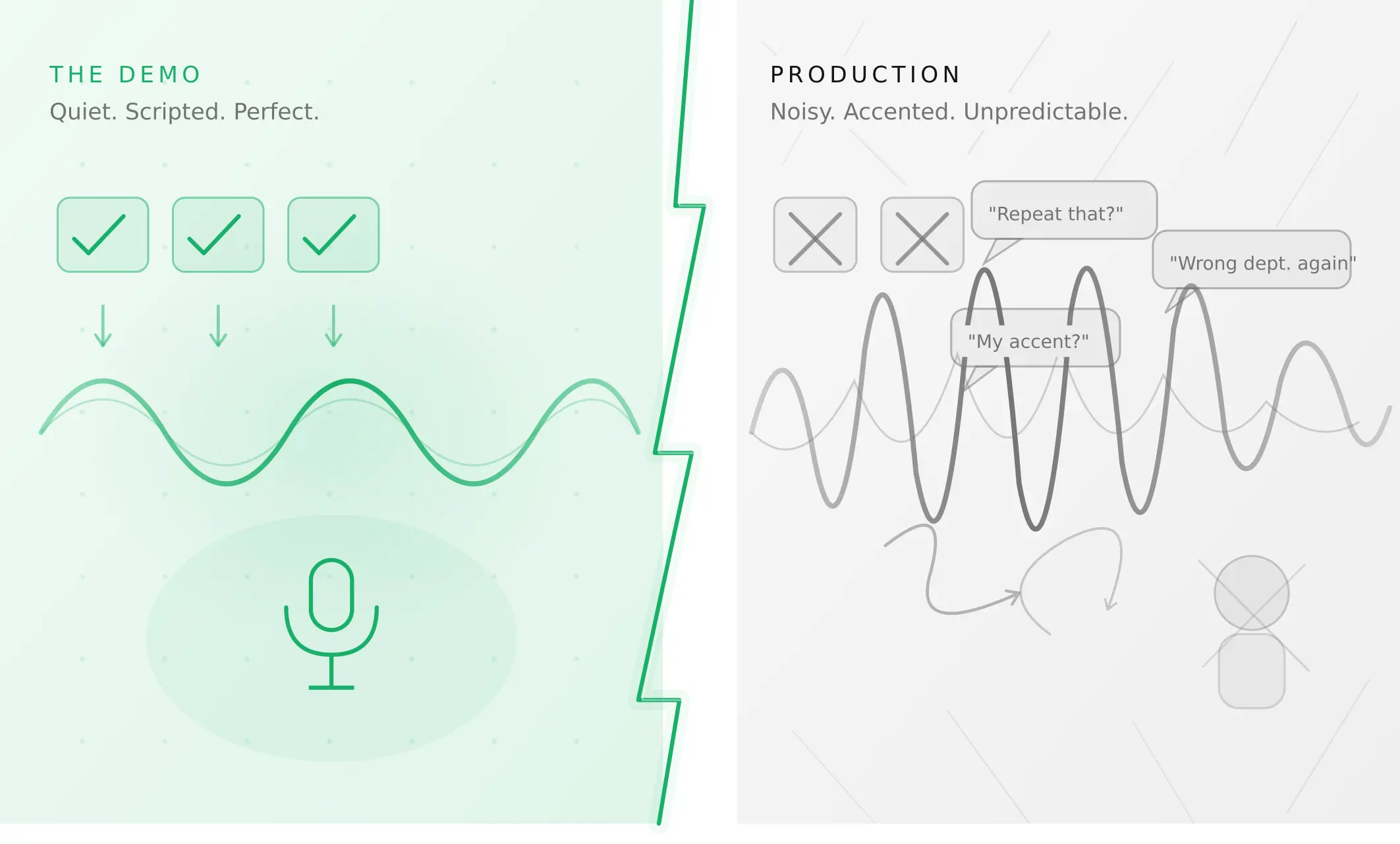
The demo runs on clean audio, a scripted path, and a single call. Production runs on accents, background noise, interruptions, malformed data, and hundreds of simultaneous callers. The gap between those two conditions is where your on-call rotation lives. Treating the demo as evidence is the single most expensive mistake a technical buyer makes.
The technical criteria that decide the vendor
Six criteria carry most of the CTO's risk. Score each one on evidence, not assurances.
Architecture and integration fit
Ask how the agent connects to your stack. A voice agent is only useful when it can read and write your systems of record mid-call, and that path is where most integration debt hides.
> Integration fit: How cleanly the vendor's agent connects to your telephony, CRM, and back-end services through documented, stable interfaces. Poor fit shows up as glue code you maintain forever and brittle webhooks that break on every vendor release.
Demand real API documentation, webhook contracts, and a sandbox. Ask what happens when your CRM is slow to respond mid-call. A vendor that cannot describe its timeout and retry behavior has not built for production.
Latency and scale under real concurrency
Latency is a first-class product requirement for voice, not a nice-to-have. Callers perceive delays over roughly a second as awkward, and turn latency compounds across the pipeline.
The number that matters is tail latency under load. Averages hide the problem. Ask for time-to-first-audio and turn latency at p95, measured at your expected peak concurrency — not at a single test call. Both accuracy and latency degrade under load, so a vendor that looks fast in a one-off demo can fall apart at 300 simultaneous calls. This is exactly what stress testing on your own traffic is for.
Reliability and observability
You cannot operate what you cannot see. When a call goes wrong at 2 a.m., you need to know why without opening a support ticket.
> Observability: The degree to which you can inspect the agent's behavior — transcripts, tool calls, latencies, and failures — from your own tooling in near real time. Without it, every incident is a black box you escalate to the vendor.
Ask about service-level agreements with real remedies, historical uptime, incident communication, and whether you get structured logs and traces you can pull into your own systems. A public status page and defined service-level objectives are table stakes. Verify the numbers rather than trusting the marketing page.
Security and data control
A voice agent handles live customer conversations, which are among the most sensitive data you hold. This is where your name goes on the incident report.
Map security to a recognized standard so the review is defensible. Ask whether the vendor's controls align with the NIST AI Risk Management Framework, whether an AI management system is certified to ISO/IEC 42001, and whether the vendor holds an information-security certification such as ISO/IEC 27001. Get specifics on encryption in transit and at rest, data residency, retention, and whether your call data trains the vendor's models. Vague answers here are a hard stop.
Model-update and roadmap risk
The vendor will change the model under you, and it may not tell you first. That is the quiet risk that separates voice AI from most software you buy.
A silent model update can regress accuracy, latency, or safety behavior overnight, with no code change on your side. Ask about the vendor's release process, version pinning, change notification, and deprecation timelines. Then plan to catch regressions yourself, because notification is not the same as protection. Continuous evaluation, not a one-time pass, is how you stay ahead of this. Understand the roadmap too: a vendor whose direction diverges from yours becomes an anchor.
Vendor lock-in and exit cost
Ask the exit question before you sign, not after the relationship sours. The cost of leaving is a design decision you make at selection time.
> Exit cost: The engineering effort, data-portability loss, and re-integration work required to move off a vendor. High exit cost turns a mediocre vendor into a permanent one because switching feels worse than staying.
Lock-in hides in proprietary prompt formats, non-portable conversation logs, custom tool schemas, and telephony bindings. Ask how you export your data and configurations, and how much of your integration would survive a migration. Running more than one vendor in parallel is one hedge; portable interfaces are another.
Build vs buy: the CTO's first fork
Before you compare vendors, decide whether you should buy at all. The build-versus-buy call sets everything downstream.
Building gives you control over latency, data, and roadmap, and no per-minute markup. It also gives you a standing team to own speech models, orchestration, telephony, and 24/7 reliability — a real, recurring cost that rarely appears in the initial estimate. Buying trades that control for speed and shifts the operational burden to the vendor, at the price of lock-in and a bill that scales with usage.
The honest framing is total cost of ownership, not license fees. For most teams, buying wins for time-to-market and undifferentiated plumbing, while building can pay off when voice is core to the product and volume is high enough to amortize the team. Whichever way you go, the evaluation discipline is the same: measure candidates on your own traffic before you commit.
The CTO decision matrix
Use this matrix to run each vendor. The point is to convert soft claims into evidence you can check, and to name the red flags that should end a conversation early.
| CTO decision criterion | What to demand as evidence | Red flag |
|---|---|---|
| Architecture and integration fit | API docs, webhook contracts, a sandbox, and documented timeout and retry behavior | "We'll build a custom integration for you" with no reusable interface |
| Latency at scale | p95 time-to-first-audio and turn latency measured at your peak concurrency | Only average latency on a single demo call |
| Reliability and observability | SLA with remedies, uptime history, and exportable logs, traces, and transcripts | No status page, no SLA teeth, support-ticket-only visibility |
| Security and data control | NIST AI RMF alignment, ISO/IEC 42001 or 27001 evidence, data-residency and training terms | "Your data is safe" with no standard, no residency answer, or opt-out training |
| Model-update and roadmap risk | Version pinning, change notification, deprecation policy, and a public roadmap | Silent model updates and "we push improvements automatically" |
| Vendor lock-in and exit cost | Data and config export paths and a portability assessment | Proprietary formats and no documented way to leave |
How to run a CTO-led voice agent evaluation
Run this process identically for every vendor, so the differences you see come from the agent and not the test. It is the pillar vendor evaluation process, tightened for the risks a CTO owns.
1. Write the technical requirements first — Define latency targets, peak concurrency, security controls, integration points, and data-handling rules before you look at any vendor, so the bar is fixed.
2. Screen architecture and security on paper — Eliminate vendors that fail integration fit, data residency, or standards alignment before you spend engineering time on a proof of concept.
3. Build one shared test set from real traffic — Assemble fixed scenarios and caller profiles — accents, noise, interruptions, and failure paths — and benchmark on your own data, not the vendor's samples.
4. Run the same calls on every vendor — Put each candidate through identical scenarios so you can compare on the same test cases rather than on different demos.
5. Measure tail latency at production concurrency — Re-run the critical scenarios at your expected peak load and record p95 latency and accuracy, because both degrade under load.
6. Probe security and observability directly — Test data handling, refusals, logging, and failure visibility against your own controls, not the vendor's slide deck.
7. Score independently and document it — Have an independent evaluator score the recorded calls, weight the criteria by your risk, and keep the audit trail for security and leadership review.
8. Decide on the total, then keep auditing — Choose on the weighted result and re-run the evaluation on a cadence, since a vendor that passes today can regress after a model update.
Why independent evidence beats the demo
Every number a vendor shows you was produced by the vendor, on data the vendor picked, under conditions the vendor controlled. That is not fraud; it is marketing. But it makes cross-vendor comparison meaningless, and it is exactly the kind of unverified claim a rigorous technical due diligence process is meant to catch.
Independent evaluation replaces vendor assurances with results you can defend. Evalgent is a third-party evaluation and auditing platform for voice agents: it runs your scenarios against every vendor identically, scores them on your own traffic, measures latency and accuracy under real concurrency, and produces an audit trail your security and leadership teams can inspect. The difference between testing and evaluation matters here — testing confirms a build works, while independent evaluation tells you which vendor to trust with production. For a CTO, that evidence is the artifact that turns a risky bet into a decision you can stand behind.
Frequently asked questions
How should a CTO evaluate a voice agent vendor?
A CTO should evaluate a voice agent vendor on architecture and integration fit, tail latency at real concurrency, reliability and observability, security and data control, model-update risk, and lock-in cost. Screen architecture and security on paper first, then run the same test set on your own traffic against every vendor, and score the recorded results independently rather than trusting demos or vendor-reported numbers.
How do you test voice agent latency under real concurrency?
Test voice agent latency by measuring time-to-first-audio and turn latency at p95, not on a single call but at your expected peak concurrency. Averages hide the tail, and both latency and accuracy degrade under load. Re-run your critical scenarios at production-scale concurrency, record the tail figures, and reject vendors that only show average latency from a clean, one-off demo.
What should a CTO ask about voice AI security and data control?
Ask whether controls align with the NIST AI Risk Management Framework and whether the vendor holds ISO/IEC 42001 or ISO/IEC 27001. Get specifics on encryption in transit and at rest, data residency, retention, and whether your call data trains the vendor's models. Vague reassurance without a named standard or a residency answer is a hard stop for a technical buyer.
How do you assess vendor lock-in and exit cost for voice agents?
Assess exit cost before signing by asking how you export conversation logs, prompts, and configurations, and how much integration would survive a migration. Lock-in hides in proprietary formats, custom tool schemas, and telephony bindings. Run a portability assessment, prefer documented and stable interfaces, and consider running more than one vendor in parallel to keep switching cost low and leverage high.
Should a CTO build or buy a voice agent stack?
Buying usually wins for time-to-market and undifferentiated plumbing, while building can pay off when voice is core to the product and volume justifies a standing team. Frame the choice as total cost of ownership, not license fees, and include the recurring cost of owning speech, orchestration, telephony, and 24/7 reliability. Either way, measure candidates on your own traffic first.
How do you manage model-update risk with a voice agent vendor?
Manage model-update risk by asking about the vendor's release process, version pinning, change notification, and deprecation timelines. A silent update can regress accuracy, latency, or safety with no change on your side. Notification is not protection, so run continuous evaluation on your own traffic to catch regressions early rather than relying on the vendor to tell you first.
Why isn't a vendor demo enough evidence for a CTO?
A demo runs on clean audio, a scripted path, and a single call, engineered to look good. Production runs on accents, noise, interruptions, malformed data, and hundreds of concurrent callers. The demo shows a vendor can succeed under ideal conditions; it says nothing about how the agent behaves at scale on the callers you cannot control. Independent evaluation on your own traffic closes that gap.
What observability should a CTO require from a voice agent vendor?
Require exportable transcripts, tool calls, latencies, and failure events that you can pull into your own tooling in near real time. You should be able to diagnose an incident without opening a support ticket. Also require a public status page, an SLA with real remedies, and historical uptime. Support-ticket-only visibility means every production incident becomes a black box you cannot debug.
The bottom line
A CTO chooses a voice agent vendor on evidence, not demos. Score architecture fit, latency at scale, security, and lock-in on your own traffic, then keep auditing after every model update.
Turn vendor claims into results you can defend, and keep the audit trail your security and leadership teams will ask for. Book a demo to see how Evalgent produces the independent evidence your voice agent decision can stand on.
Related Articles
Why AI voice agents fail in production (and how to prevent it)
AI voice agents that ace demos still break in production. Learn the 5 root causes, how to test for each, and what production readiness actually means.
Read more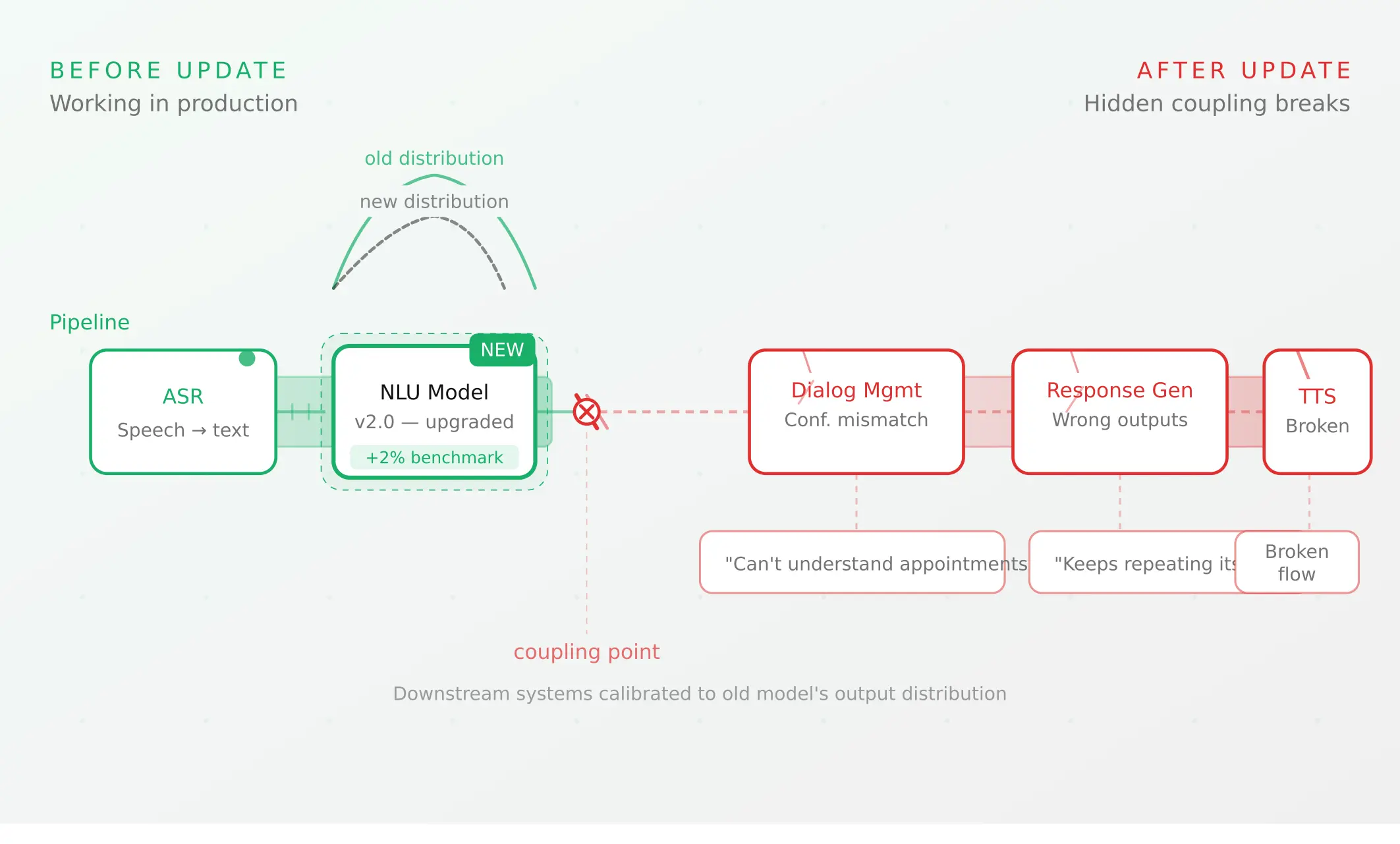
Voice agent regression testing: why LLM updates break production
LLM updates improve benchmarks but break voice agents in 5 predictable ways. How to detect and prevent regressions after every model or prompt change.
Read more