The ROI of AI Voice Agent Testing Isn't What You Think It Is
On this page
Every ROI calculator for ai voice agents tells the same story. Tally the cost of human QA on one side, tally the cost of synthetic calls on the other, divide. The synthetic side wins by an order of magnitude. The reader nods, closes the tab, and books a vendor demo three quarters later when the budget conversation comes around.
That is the boring layer of the roi of ai testing question. It is correct. It is also the least interesting argument for why proper voice agent testing matters. The teams already doing it well do not bring up cost-per-call in product reviews. They talk about what they are shipping that they could not ship before. This post is about the bigger story underneath the cost comparison. Six capabilities AI voice agent testing unlocks. What each one is worth. And why "cheaper than manual QA" is the smallest number in the picture.
The standard ROI calculation, and why it's the least interesting part
The standard roi of ai testing calculation goes like this. A complete voice agent regression — 40 scenarios × 5 caller profiles × 3 runs per scenario, the minimum coverage needed to ship with confidence — is 600 calls. Human QA running that matrix at industry-typical rates lands around $2,000 in labor per full regression testing cycle, with each cycle taking 4–5 working days. Automated ai evaluation using synthetic callers runs the same matrix for roughly $500 in compute and platform cost, completing in under an hour of wall-clock time.
Multiply by the number of regression cycles a real voice agent project needs to reach production. Human QA typically takes 10–12 iterations. AI-driven llm evaluation usually takes 2–3, because the matrix coverage is comprehensive each pass. Total project cost comes out around 25–30× cheaper with AI testing. The time-to-market gap is bigger still — roughly two months of QA work compressed into an afternoon, with an automated baseline comparison after every change.
If this were the only argument for the roi of ai testing, it would already be enough. It isn't. The cost comparison is the appetiser. The capability arguments are the meal.
Capability 1 — Ship every Friday instead of every quarter
Release velocity is the most under-counted ROI driver in voice agent development. Teams without an automated regression suite ship voice agent updates on long cycles. The engineering work doesn't take that long. The bottleneck is that every release requires manual regression — somebody listening through enough representative calls to gain confidence the new build is at least as good as the previous one. That listening work caps the cadence. Quarterly releases are not a strategic choice. They are what happens when QA capacity caps shipping velocity.
Teams that can run the full regression matrix in under an hour ship on a different cadence entirely. Weekly releases become routine. A/B testing in production becomes practical. Hot-fixing a failure mode the same day a customer reports it becomes possible. The team can confirm the fix didn't break anything else in twenty minutes. Engineers ship voice agents faster with confidence. They take more iterative bets. Smaller changes, more frequent ones. The cost of being wrong is one revert, not one delayed quarter. Prompt iteration cycles compress from days to minutes.
What this is worth: in voice agent products competing for enterprise contracts, release velocity is a moat. The competitor shipping monthly has a year of features ahead of the competitor shipping quarterly. The cost of slow shipping rarely sits on a P&L line. But it shows up everywhere — in churn, in lost deals, in roadmaps that slip. Eval-driven development pairs naturally with this cadence. See eval-driven development for why fast iteration loops are the core discipline shift. See ai agent evaluation for why voice raises the bar further.
Capability 2 — Swap models without prayer
The voice agent stack updates constantly. Deepgram releases a new STT model that's faster and more accurate. OpenAI ships a new realtime LLM with lower latency. ElevenLabs adds voices that sound noticeably more natural. Without a regression suite, each upgrade is a leap of faith. The team either freezes on a known-working stack and falls behind. Or upgrades and discovers production breakage two weeks later when complaints accumulate enough to be noticed.
This is the regression problem in voice agent model swaps, and it's structural. No benchmark on a model card predicts how that model will behave inside your specific pipeline. Your specific prompts. Your specific user base. The only way to know is to run the new model through the same scenarios the previous model passed. Use the same telemetry metrics. Verify the downstream state matches expectations. The voice agent regression testing benefits are bounded and measurable.
Teams with that capability operate on different terms. They adopt better, faster, or cheaper models within a week of release. They run multi-provider strategies — different STT models for different scenarios, or fallback chains across LLM providers. They negotiate with vendors from a position of optionality instead of lock-in. When a provider raises prices or changes terms they can pivot. The switching cost is bounded and the switching test is automated. This is one of the under-appreciated voice agent testing capabilities: optionality at the stack level.
The teams without it stay on yesterday's stack. Or they upgrade and ship a regression that nobody catches until the support tickets pile up.
Capability 3 — Expand to new accents, languages, and verticals without panic
The expansion problem is the hidden ROI driver most teams don't see until they're already trying to scale. The agent works in US English. The team wants to add UK English. Then Indian English. Then Hindi. Then Spanish for the LATAM contract sales has been chasing. Without behavioural coverage across accents, each expansion is a six-week QA project. Hiring testers in the target geography. Running through scenarios manually. Listening for failures. Iterating. Listening again. The team that wanted to expand to four markets gets to two before the quarter ends.
This is what becomes possible with automated voice testing. With a behavioural test matrix and configurable caller profiles, expansion is a configuration change instead of a project. Add a new accent variant to the profile set. Re-run the matrix against the existing agent. Look at the scenario success rate by profile. Fix the gaps. Ship. The same scenario library that gated the original launch gates the expansion. The work compounds. Every new market makes the next market faster. The test infrastructure that validated the last one validates this one.
The market expansion ROI is asymmetric. Teams that can expand fast win multi-region enterprise contracts they otherwise couldn't bid on. Teams that can't expand fast watch competitors take those contracts. The revenue funds further expansion. Voice agent acoustic conditions vary enormously across geographies — see stress testing voice agents for what proper expansion testing actually has to cover.
Capability 4 — Continuous monitoring catches drift before users do
Pre-launch testing is necessary but not sufficient. The biggest cost category in operating a voice agent is silent production drift after launch. Model behaviour shifts under provider updates. User populations change as the product scales. Edge cases emerge that nobody anticipated in the design phase. This is the answer to "why voice agent testing matters" once the agent is live. Teams without continuous evaluation discover drift in quarterly metrics reviews. Teams with it discover drift the day it starts.
The mechanism is simple. The same scenario library that validated the agent pre-launch runs continuously against production traffic patterns post-launch. The scenario success rate becomes a monitored signal, the same way uptime and latency are monitored signals. When SSR drops on a critical scenario, the team gets an alert — same day, before the support queue starts filling. Deloitte's 2025 Tech Trends report finds an 89% pilot-to-production failure rate across enterprise AI deployments, and MIT Sloan Management Review data shows production cost overruns averaging 380% versus pilot projections. The single biggest cause is the production drift that quarterly reviews never catch in time. This is also the failure mode documented in why voice agents fail in production. Drift compounds quietly until it becomes a quarterly fire drill.
What this unlocks goes beyond fast detection. Quantifying agent quality continuously means you can prove quality to enterprise procurement and regulated industries. You can sign SLAs that reference scenario success rate, not just call duration. You can answer the compliance question "how do you know your agent isn't drifting" with a dashboard instead of a story. The cost of not having it is drift that compounds for weeks before anyone notices. Then a fire drill to figure out when it started. And how many calls it affected.
Capability 5 — Statistical confidence in agent behaviour
Manual testing produces anecdotes. "I called it three times and it worked, ship it." AI testing produces statistics with statistical reliability you can defend. "Across 600 calls covering 40 scenarios and 5 caller profiles, scenario success rate is 87% with a 3-point confidence interval. The failure modes are concentrated in two specific scenarios under high noise conditions." One of those statements is defensible. The other is what teams ship voice agents on when they don't have eval infrastructure.
The roi of voice agent quality measurement matters in three places. First, release decisions get made on data. The release that improves SSR from 84 to 89 ships; the release that doesn't move SSR doesn't. Internal arguments about whether v2 is better than v1 resolve in the eval suite, not by whoever has the strongest opinion. Second, customer-facing reliability claims become credible. "Our agent handles 87% of customer inquiries end-to-end" is a quotable, verifiable claim. "Our agent works really well" is marketing. Enterprise procurement, especially in regulated industries, knows the difference.
Third, statistical confidence changes how teams handle the worst cases. The 13% of scenarios where SSR sits below target stop being a vague concern and become a prioritised backlog. The team knows exactly which scenarios fail, under which profiles, at which rates — and which fixes to attempt first based on impact. The work shifts from "make the agent better" (unmeasurable) to "improve SSR on the appointment-booking scenario under high-noise profiles from 71% to 85%" (specific, testable, time-bounded). Voice agent evaluation works because of this specificity, not despite it.
Capability 6 — An engineering culture that ships AI confidently
The softest capability and the highest leverage one. Teams that can test their voice agent build differently. They iterate faster, take bigger bets, expand into harder problems. The fear of breaking production silently disappears. That fear paralyses voice agent teams operating without proper testing. The eval suite catches the silent breakage before it ships.
This shows up in hiring. Engineers want to work on hard problems, not on regression babysitting. The team that runs the regression suite automatically attracts and retains engineers who otherwise wouldn't accept the role. It shows up in roadmaps. Teams with eval infrastructure ship roadmaps that match what they planned; teams without it slip ambitious work because every release creates new uncertainty. It shows up in language. The phrase "let's evaluate it" replaces "let's hope" in design reviews. Decisions get made on what the suite says, not what the most confident person in the room says.
The cost of not having this is harder to quantify but easy to recognise. It's a team that builds slowly because it ships nervously. It's a roadmap that converges to safe, small changes because anything bigger feels risky. It's an organisation where the voice agent product becomes a maintenance project instead of a product surface that gets actively expanded. The ROI of confident engineering culture is the difference between a voice agent that becomes the team's main product and one that becomes their legacy headache.
The ROI table that includes cost and capability together
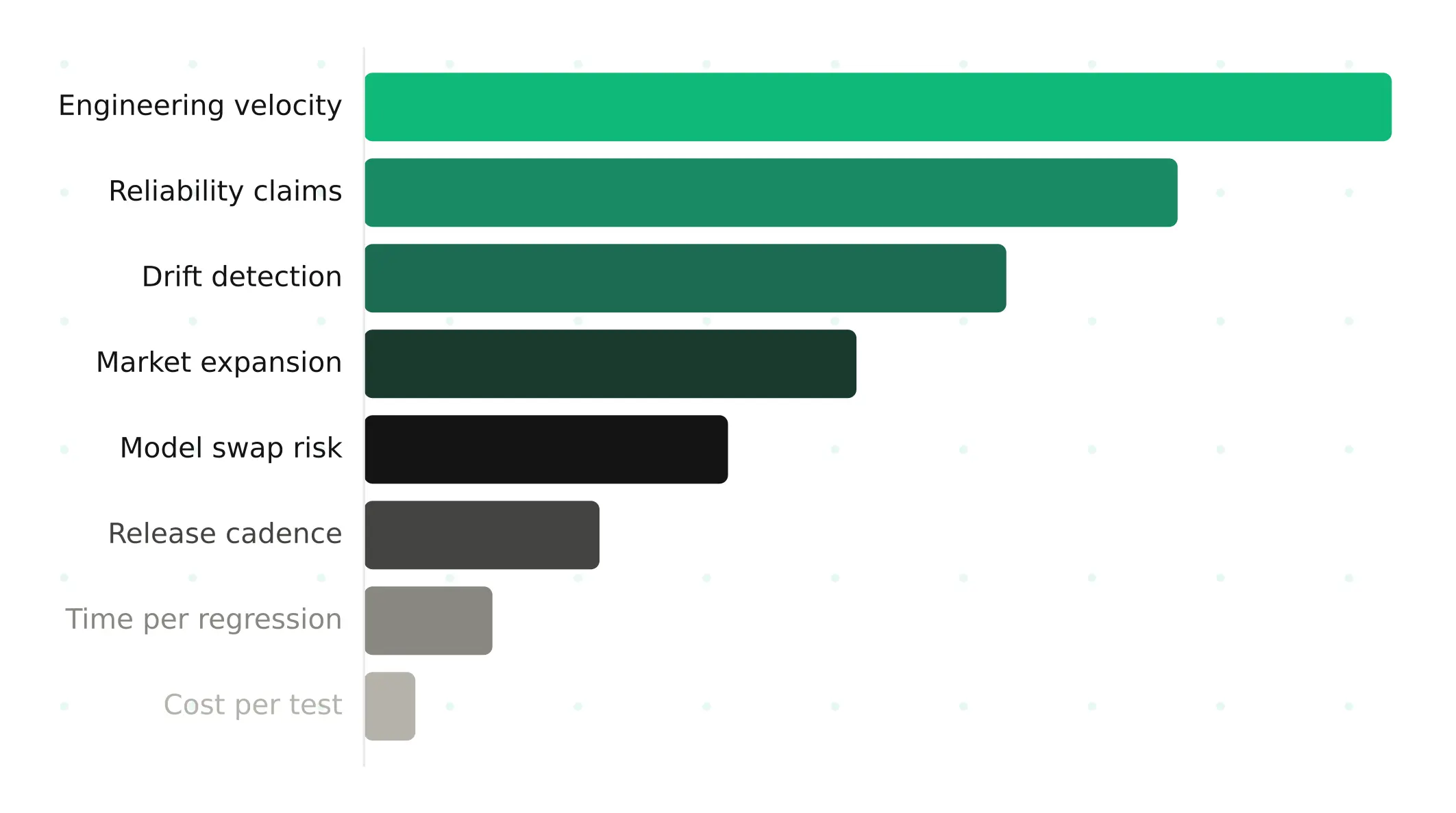
The cost comparison the standard ROI calculator produces is the first row of this table. The rows underneath it are the rest of the picture. Most ROI tools don't include them because they're harder to put a single number on — but they're where the actual returns sit.
| ROI dimension | Without AI testing | With AI testing | Impact |
|---|---|---|---|
| Cost per full regression | ~$2,000 in labor | ~$500 in compute | 4× cost reduction |
| Time per regression | 4–5 working days | Under 1 hour | ~50× faster |
| Release cadence | Monthly / quarterly | Weekly / continuous | 4–12× more shipping |
| Model swap risk | High; freezes upgrades | Low; bounded | Optionality preserved |
| Market expansion time | Quarters per new market | Weeks per new market | 6–12× faster expansion |
| Drift detection latency | Quarterly review | Same-day | Compound cost avoided |
| Reliability claims | Anecdotal | Statistical | Enterprise-credible |
| Engineering velocity | Cautious | Confident | Compounding effect |
The cost row is the smallest number on this table. Every row below it is bigger. A team comparing testing approaches purely on cost-per-test is optimising the cheapest dimension and missing the seven dimensions that matter more. This is exactly the gap that ai agent testing vs voice agent testing documents — general ai testing tools and ai testing platforms compete on the cost-per-call dimension while ignoring the failure modes that drive the bottom rows.
The right ai test automation question isn't "how cheap can we make our testing." It's "what could our team ship if testing stopped being the bottleneck." The roi of ai testing in voice is measured in shipped roadmap, not in saved labor.
Where AI testing doesn't replace human judgement
The capability framing isn't an argument that humans disappear from voice agent QA. Two specific roles for humans persist, and both are smaller than the manual regression cycles AI testing replaces.
The first is initial UX calibration. Before a voice agent ships, somebody — usually the product manager or a senior engineer — needs to call it and decide whether it feels right. Tone, pacing, personality, how it handles ambiguity. These are judgement calls the eval suite can't make because they're not failure-mode questions. They're design questions. A few hours of human listening early in the design cycle, not 50 days of manual regression, is what this role looks like.
The second is edge-case review. The eval suite flags scenarios as passed, failed, or ambiguous. The ambiguous bucket — calls where the LLM-as-judge gave a score the rubric couldn't fully justify — benefits from human review. A tester listens to the flagged calls, decides whether they were actual failures or rubric edge cases, and feeds the verdict back into the scoring model. The work is bounded, targeted, and high-judgement. It's not the 600-call grind manual QA is built around.
These roles are real and they don't go away. They also don't drive cost the way the regression cycle did. AI testing replaces the volume; humans keep the judgement.
How to think about ROI for your situation
The capability framing turns into an actionable ROI calculation when you stop asking "how much cheaper is AI testing than manual QA" and start asking four different questions about your team specifically.
What is your current release cadence, and what would weekly releases be worth? Translate slower shipping into delayed revenue, missed feature parity with competitors, and roadmap drift. For most voice agent products in growth-stage companies, the value of weekly releases is in the high six figures annually before any other ROI dimension factors in.
What is the cost of a missed regression that ships? Take the average cost of a customer complaint that traces back to a production voice agent failure — support time, customer churn risk, sometimes regulatory exposure in healthcare or BFSI contexts — and multiply by how many regressions a quarter you suspect ship undetected. The number is usually larger than the team thinks.
How many markets, accents, or languages are you delaying expansion into because of QA capacity? Each delayed market is a deal pipeline that doesn't exist, a customer base you can't bid on. The opportunity cost compounds — every quarter a market is delayed is a quarter a competitor is building lock-in there.
What is the expected value of the model upgrades you haven't made because you couldn't test them safely? Better models you didn't adopt because the upgrade risk seemed too high. Each one is forgone improvement — latency you could have reduced, accuracy you could have raised, cost you could have cut — that competitors with eval infrastructure will adopt and beat you on.
The numbers each team answers with will tell them their actual return on AI voice agent testing. They will be larger than the cost-per-call comparison ever suggested. That is the ROI question the standard production ai testing calculators don't ask, and the one teams shipping voice AI at the frontier already answer with their roadmaps.
Summary
The ROI of AI voice agent testing isn't the cost savings. It's the work that becomes possible once testing stops being the team's bottleneck.
Frequently asked questions
What is the roi of ai voice agent testing?
What does ai voice agent testing unlock goes beyond the cost-per-test comparison most ROI calculators produce. It is the combination of faster release cadence, lower model-swap risk, faster market expansion, same-day drift detection, statistically credible reliability claims, and an engineering culture that ships confidently. The cost saving is real but it is the smallest of the seven dimensions that matter.
Why is cost-per-test the wrong way to measure ROI?
Cost-per-test is technically correct and strategically incomplete. It captures the labor or compute spend of running a regression cycle but ignores release velocity, model optionality, market expansion speed, drift detection, statistical confidence, and engineering culture effects. Teams comparing testing approaches purely on cost-per-test are optimising the cheapest ROI dimension while missing the seven dimensions that drive larger returns.
How does AI voice agent testing affect release velocity?
AI voice agent testing changes release velocity by removing the manual regression bottleneck. Teams shipping voice agents on monthly or quarterly cadences are usually constrained by QA listening capacity, not engineering throughput. Running the full regression matrix in under an hour enables weekly releases, A/B testing in production, and same-day hot-fixes. Release velocity becomes engineering-bounded instead of QA-bounded.
What does continuous voice agent monitoring catch?
Continuous voice agent monitoring catches silent quality drift — model behaviour shifting under provider updates, user populations changing as the product scales, edge cases emerging post-launch that nobody anticipated. Deloitte's 2025 Tech Trends research reports an 89% pilot-to-production failure rate for enterprise AI deployments, with drift the dominant cause. Behavioural evaluation against production traffic patterns catches it the same day instead of in a quarterly review.
Can AI testing fully replace human QA for voice agents?
AI testing replaces the volume of manual regression, not all human judgement. Two human roles persist: initial UX calibration before launch, where a person decides whether the agent feels right, and edge-case review of evals flagged as ambiguous. Both are bounded, targeted, high-judgement tasks. They are smaller than the 600-call regression cycle manual QA is built around.
How does AI testing change model upgrade decisions?
Without a regression suite, every model upgrade is a leap of faith — adopt the new STT, LLM, or TTS model and discover production regressions weeks later. With one, upgrades are bounded experiments. Teams adopt better models within a week of release, run multi-provider strategies, and negotiate with vendors from optionality instead of lock-in. The capability shifts model upgrades from a risk to a routine.
What does statistical confidence in voice agent quality mean?
Statistical confidence means measuring scenario success rate across many runs and many caller profiles, not anecdotally validating that the agent worked in a few demos. It enables data-driven release decisions, verifiable reliability claims, and prioritised improvement backlogs based on which scenarios fail under which conditions. The work shifts from "make it better" to "raise SSR from 71% to 85% on this scenario."
How do I calculate ROI for my voice agent team?
Calculate ROI by asking four questions, not one. What is the value of weekly releases versus your current cadence? What is the cost of regressions that ship undetected? How many markets, accents, or languages is QA capacity delaying expansion into? What is the expected value of model upgrades you haven't made because the risk seemed too high?
Related Articles
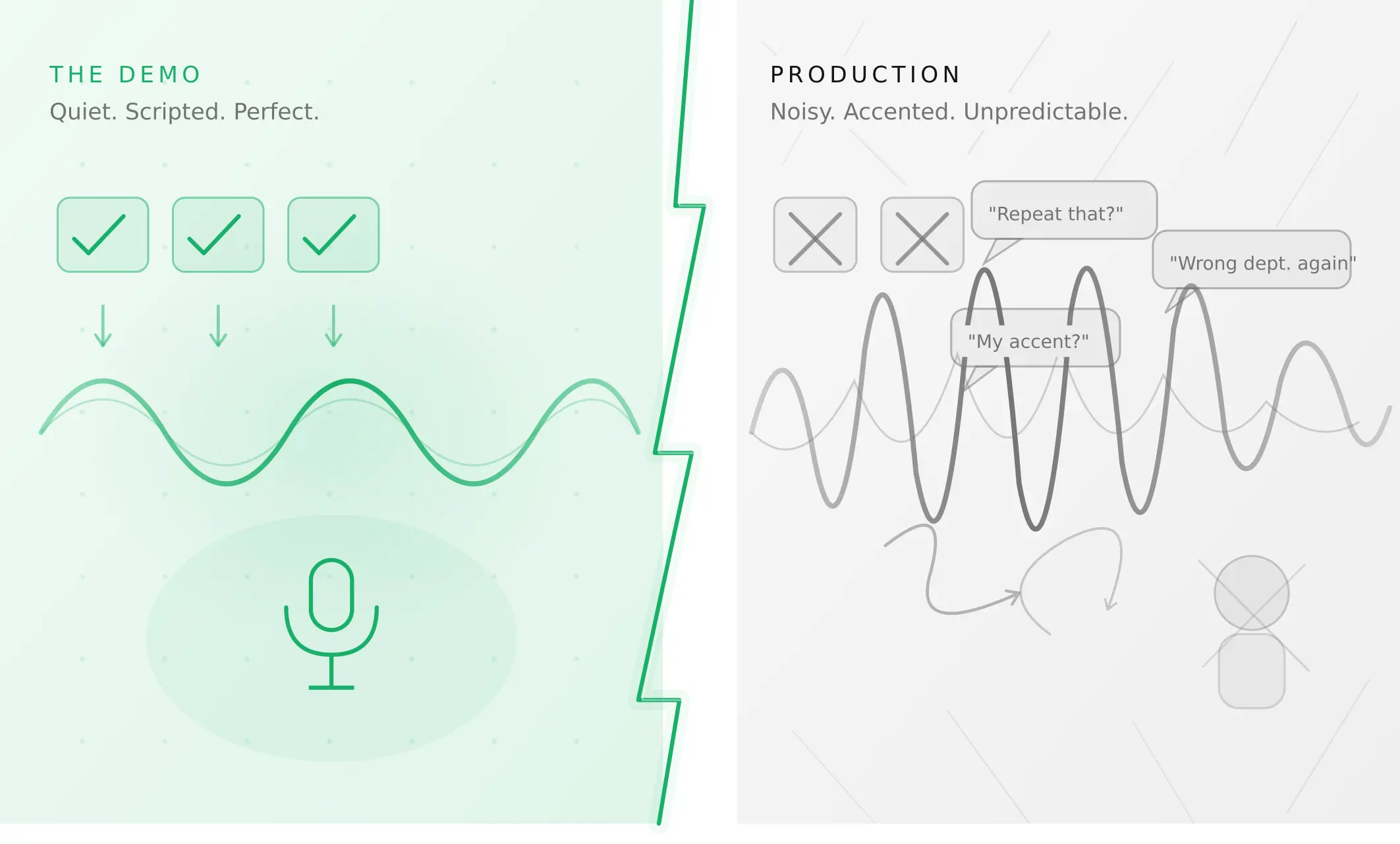
Why AI voice agents fail in production: 9 failure layers, how to detect each, and how to prevent them
Voice agents fail in production across 9 layers, from 8 kHz audio to silent tool errors. Symptoms, root causes, alerts, and fixes in one master table.
Read more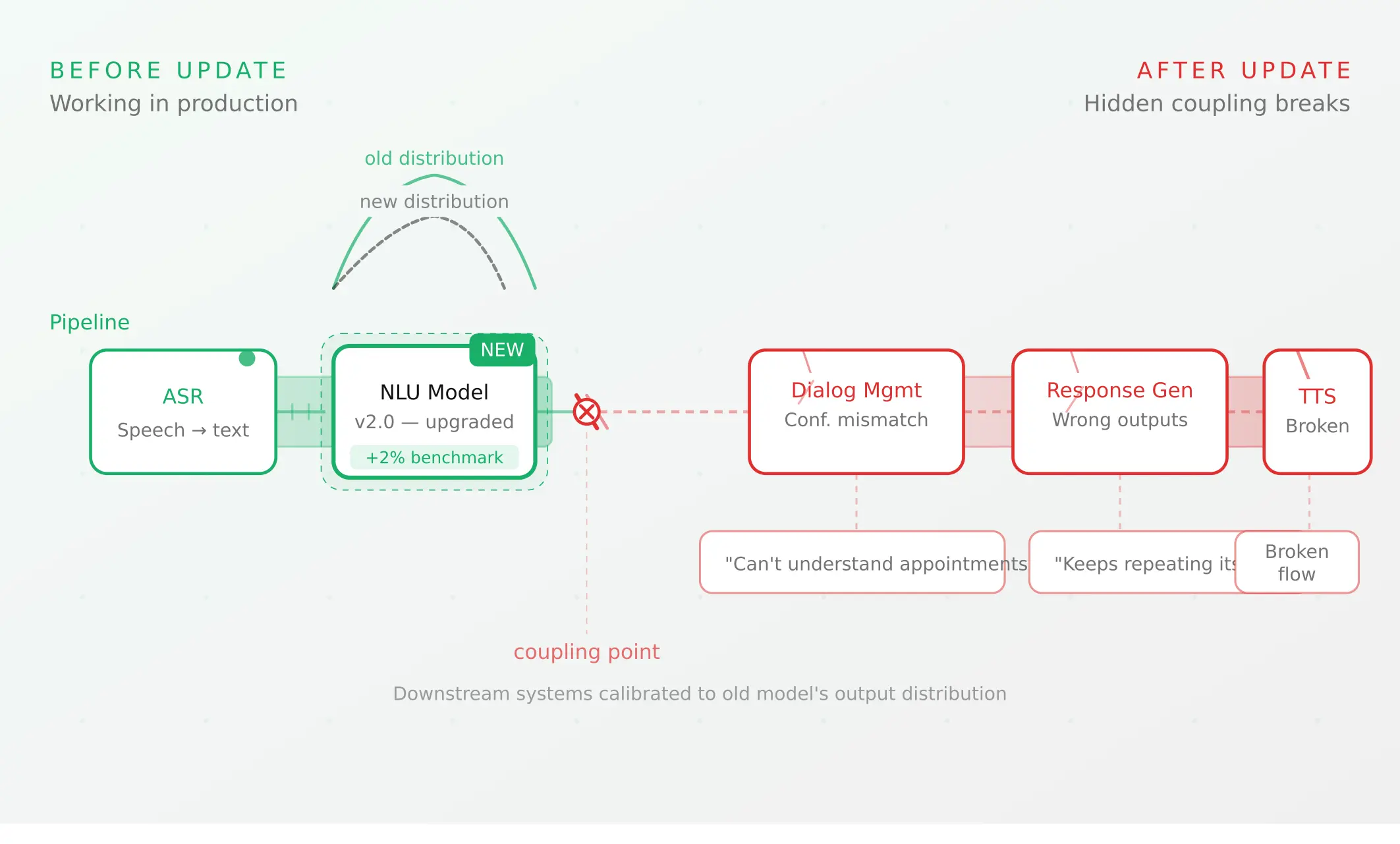
Voice agent regression testing: how to detect regressions from model updates you don't control
Voice agent regression testing for changes you don't control: pin each layer, run a nightly pinned-vs-latest canary, and use paired stats to detect drops.
Read more