Test your voice agent
Voice Agent QA Process and Workflow
# Voice agent QA process and workflow
Quick answer
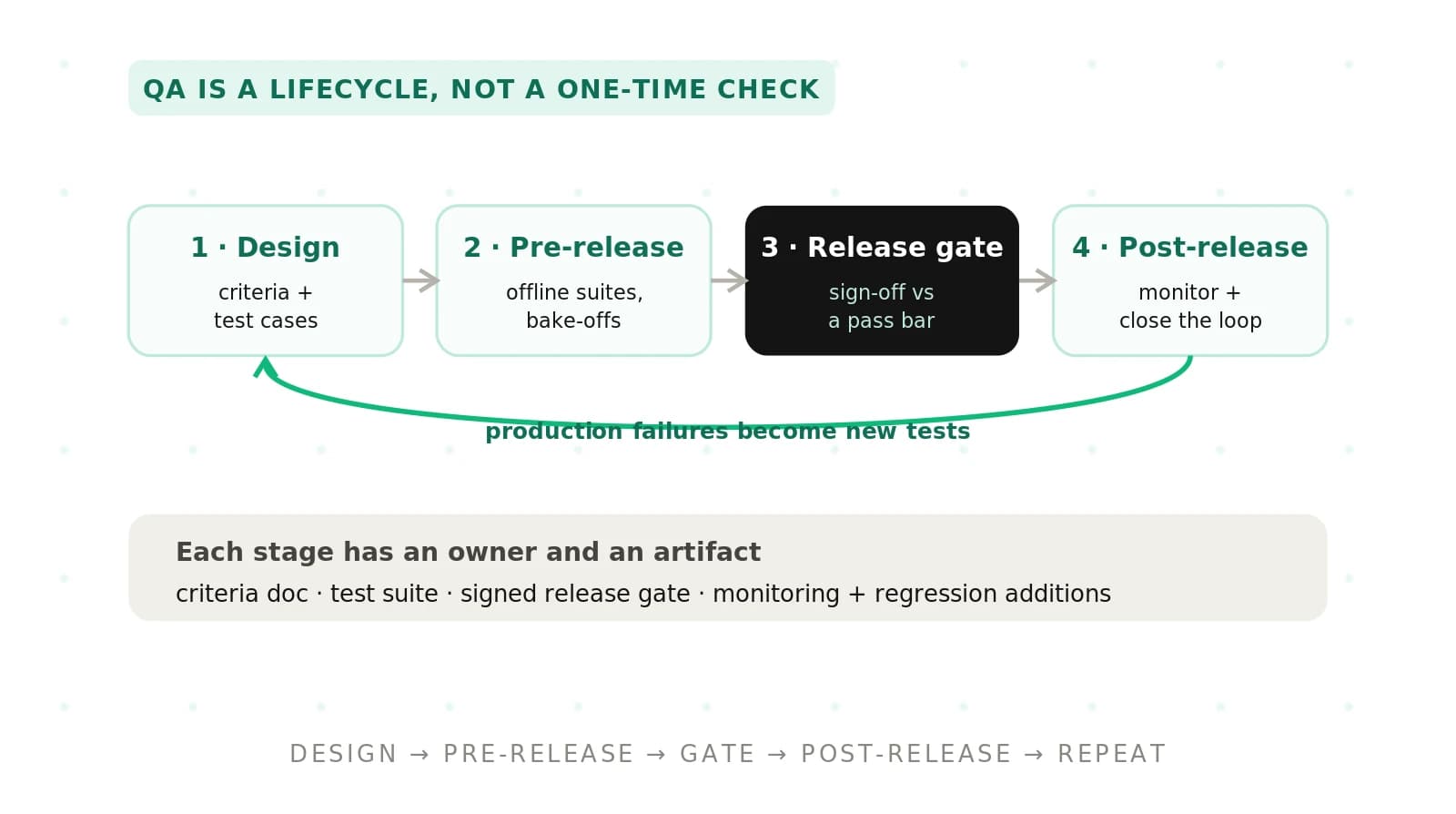
The voice agent QA process is the end-to-end workflow a team runs to keep a voice agent reliable. It has four stages: design success criteria and test cases, pre-release evaluation, a release gate for sign-off, then post-release monitoring that feeds failures back into tests.
Most voice agent teams do QA in fragments. Someone writes a few test scripts. Someone else listens to calls after launch. A prompt gets patched when a customer complains. None of it connects. The same bug ships twice because nothing captured it the first time.
A real QA process fixes that. It is a repeatable loop, not a launch checklist. This guide walks the full workflow, stage by stage, with the artifacts each stage produces and the owner accountable for it. It is the process itself, not one role's view of it. If you want the role lens instead, see how the work looks for a QA engineer or for a QA lead.
What the voice agent QA process actually covers
Quality assurance is the discipline of preventing defects, not just finding them. The Wikipedia entry on quality assurance frames it as process-focused work. That framing matters for voice. A voice agent is non-deterministic. The same caller can get different answers on two calls. So QA cannot mean "run it once and ship."
The voice agent QA process wraps the whole lifecycle. It defines what good looks like. It builds tests that check for good. It evaluates the agent before release. It gates the release on evidence. Then it watches production and turns real failures into new tests. Each pass makes the next release safer.
This is broader than testing. Testing asks whether the agent does what you built. Evaluation asks whether the agent is good enough for callers. Our guide on testing versus evaluation draws that line in detail. QA is the umbrella over both.
Voice agent QA process: the repeatable workflow that defines success criteria, tests and evaluates the agent, gates each release, and closes the loop from production failures back into the test suite.
The four stages of the voice agent QA workflow
The workflow has four stages. They run in order for a release, then repeat. The fourth stage feeds the first. That circularity is the point. A QA process that stops at launch is not a process. It is a one-time gate.
Stage 1 — Design: success criteria and test cases
Design is where you decide what "working" means. Vague goals produce vague tests. So the first artifact is a written set of success criteria. Name the tasks the agent must complete. Set thresholds for each. Task success above a target. Latency under a bound. Correct escalation when the caller needs a human.
From those criteria you build test cases. Each case pairs an input scenario with an expected outcome. The Wikipedia definition of a test case captures the shape. For voice, a scenario is a caller intent, an accent, a noise level, or an interruption pattern. Cover the happy paths first. Then add the messy ones.
Group these cases into a test plan. A test plan records scope, scenarios, and pass criteria in one place. Ground the plan in real calls where you can. Building tests from your own transcripts beats synthetic guesses. Our post on benchmarking with your own data explains why.
Stage 2 — Pre-release: offline suites and bake-offs
Pre-release is where you run the agent against the suite before anyone releases anything. This is offline evaluation. You replay recorded or scripted scenarios and score the results against the criteria from Stage 1.
Two activities live here. First, the offline suite: every test case runs, and each output gets scored. Wire this into your build so it runs on every change, the way continuous integration runs unit tests on code. A failing suite blocks the merge.
Second, the bake-off. When you compare two prompts, two models, or two vendors, you run all of them against the identical suite. The winner is the one that scores higher on the same cases. Holding the test set constant is what makes the comparison fair. Our voice agent evaluation primer covers scoring methods in depth.
Stage 3 — Release gate: sign-off and go/no-go
The release gate is a decision, not an activity. Someone looks at the pre-release scorecard and says go or no-go. That decision needs a rule, written in advance. Ship only if task success clears the threshold and no critical defect is open.
The artifact here is a sign-off record. It states which suite version ran, what the scores were, and who approved the release. This is your audit trail. If a regression ships, you can see exactly what evidence backed the decision. Treating releases this way is standard release management practice.
A gate only works if the bar is fixed before the results arrive. Set thresholds when you are calm, not when a launch date is looming. The production-readiness bar belongs in the plan, not in a last-minute argument.
Stage 4 — Post-release: monitoring and closing the loop
The agent is live. Now QA shifts to watching real calls. Sample production conversations. Score a slice of them against the same rubric you used offline. Flag drops. This is monitoring, and it differs from testing. Our guide on testing versus monitoring draws the distinction.
The critical move is closing the loop. When a real call fails, you do not just patch and forget. You capture that call. You root-cause it. Then you turn it into a permanent regression test, using the failing call as the fixture. Track the defect in a bug tracking system so nothing slips.
That new test joins the Stage 1 suite. The next release must pass it. This is how the same failure stops shipping twice. Our production feedback loop post walks the mechanics.
QA stages, activities, and owners at a glance
The table below maps each stage to its core activities, the artifact it produces, and the owner accountable for it. Owners vary by team size. On a small team, one person may hold several roles. The point is that every stage has a named owner and a concrete artifact.
| Stage | Core activities | Artifact | Owner |
|---|---|---|---|
| Design | Define success criteria; write test cases; build the test plan | Test plan and success criteria | QA lead with product |
| Pre-release | Run offline suite; run bake-offs; score outputs | Pre-release scorecard | QA engineer |
| Release gate | Review scores; apply go/no-go rule; record decision | Sign-off record | Release owner or eng lead |
| Post-release | Sample live calls; score; capture and convert failures | Regression tests and defect log | QA engineer with on-call |
How to stand up a voice agent QA workflow
Start small and make it repeatable. A workflow that runs on every change beats a perfect plan that runs once. Follow these steps in order.
1. Write success criteria for the top five caller tasks. State a measurable threshold for each. Keep it to one page.
2. Build ten to twenty test cases from real transcripts. Cover common intents first, then edge cases like interruptions and noise.
3. Assemble the cases into a versioned test plan. Store it in your repository so changes are tracked.
4. Automate the offline suite so it runs on every prompt or model change. A failing suite blocks the release.
5. Define the release gate rule in writing. Set the pass threshold and the list of blocking defects before results arrive.
6. Stand up production sampling. Score a fixed slice of live calls each week against the same rubric.
7. Close the loop. Convert every confirmed production failure into a regression test and add it to the suite.
Roles, handoffs, and cadence
The workflow needs owners and a rhythm. Confusion at the handoffs is where QA quietly breaks. Product owns the success criteria, because product owns what "good" means. QA engineers own the suite and the scoring. A release owner holds the gate. On-call and QA share post-release triage.
The handoffs matter as much as the work. Product hands criteria to QA at design. QA hands a scorecard to the release owner at the gate. The release owner hands a sign-off record to the audit trail. On-call hands a captured failure back to QA for conversion. Each handoff has a defined artifact, so nothing gets lost in a chat thread.
Cadence keeps the loop alive. Run the offline suite on every change. Review the gate at every release. Sample production weekly. Do a full criteria review each quarter, since caller behavior and business goals drift. Without a cadence, QA decays into firefighting.
Two rules keep the process honest. Score against a fixed rubric, not gut feel. And version everything, so a result always ties to a known suite and a known agent build.
Where independent evaluation fits
A team scoring its own agent has a blind spot. The people who built the prompt often write the tests, run the suite, and judge the results. That is not neutral. Rubrics drift toward what the agent already does well. Failures get explained away. This is the central risk of self-graded QA.
Independent evaluation removes that bias. A third party scores the agent against criteria the vendor cannot tune. It fits at two points in the workflow. At the release gate, an independent scorecard gives a check the builder did not grade. In post-release, independent sampling catches drift the internal team stopped noticing.
Evalgent is the independent evaluator for voice agents. It runs your suite as a neutral party and reports scores you can defend to buyers and auditors. That external check is why independent voice AI evaluation belongs in a mature QA process, not as a replacement for internal testing but as a second, unbiased read.
Use it when the stakes are real. A regulated deployment, a vendor selection, or a board-level launch all benefit from a score no one on the build team controls. For lower-stakes internal tools, internal QA may be enough.
Common failure modes in the voice agent QA process
Even teams with a process hit the same traps. Watch for these.
- No fixed threshold. The gate becomes a debate every release. Set the bar in advance and hold it.
- Tests that never see production. Synthetic-only suites miss how real callers actually behave. Seed the suite from transcripts.
- A loop that never closes. Failures get patched but never captured. The same bug returns after the next model update.
- Grading by the builder alone. Self-scored results drift optimistic. Add an independent read at the gate.
- Monitoring without conversion. Sampling live calls is useless if flagged failures do not become tests.
Avoiding these is mostly discipline, not tooling. The full voice agent testing checklist and the broader AI voice agent testing guide cover the specifics. Software teams have known this for decades; the software testing and regression testing disciplines built the playbook that voice QA now adapts.
Frequently asked questions
What is a voice agent QA process?
A voice agent QA process is the repeatable workflow a team runs to keep an agent reliable. It defines success criteria, builds and runs test cases, evaluates the agent before release, gates the release on evidence, then monitors production and turns real failures into new tests. It is a loop, not a one-time launch check.
How do you build a voice agent QA workflow?
Start with success criteria for the top caller tasks. Build test cases from real transcripts, then group them into a versioned test plan. Automate an offline suite that runs on every change. Add a written release gate rule. Finally, sample production calls and convert confirmed failures into regression tests that rejoin the suite.
What are the stages of voice agent QA?
There are four stages. Design sets success criteria and test cases. Pre-release runs the offline suite and any bake-offs. The release gate applies a go/no-go rule and records sign-off. Post-release samples live calls and closes the loop by converting failures into tests. Stage four feeds stage one, so the process repeats.
Who owns voice agent QA?
Ownership is shared but named per stage. Product owns success criteria. QA engineers own the test suite and scoring. A release owner holds the gate decision. On-call and QA share post-release triage. On small teams one person may hold several roles, but each stage still needs a single accountable owner and a defined artifact.
How often should you run voice agent QA?
Run the offline suite on every prompt or model change, like continuous integration. Review the release gate at every release. Sample production calls weekly against a fixed rubric. Do a full success-criteria review each quarter, since caller behavior and business goals drift over time. Cadence keeps QA from decaying into ad hoc firefighting.
What is a release gate for a voice agent?
A release gate is a go/no-go decision made before an agent ships. Someone reviews the pre-release scorecard against a rule set in advance, such as task success above a threshold with no open critical defect. The gate produces a sign-off record naming the suite version, the scores, and the approver, giving you an audit trail.
How do you close the loop from production failures?
Capture the failing call as a fixture. Root-cause why the agent failed. Convert that call into a permanent regression test with a clear expected outcome. Track the defect in a bug tracking system, then add the new test to the offline suite. The next release must pass it, so the same failure never ships twice.
Where does independent evaluation fit in voice agent QA?
Independent evaluation fits at the release gate and in post-release monitoring. A third party scores the agent against criteria the builder cannot tune, removing the bias of self-graded tests. Evalgent, the independent evaluator, provides scores you can defend to buyers and auditors. It supplements internal QA for high-stakes launches, vendor selection, and regulated deployments.
The bottom line
The voice agent QA process is a four-stage loop from success criteria to production monitoring. Each stage has an artifact and an owner, and the loop only works when production failures become tests.
Run this workflow on every release and the same bug stops shipping twice. To add a neutral, third-party score at your release gate and in production, book a demo with Evalgent.
Related Articles
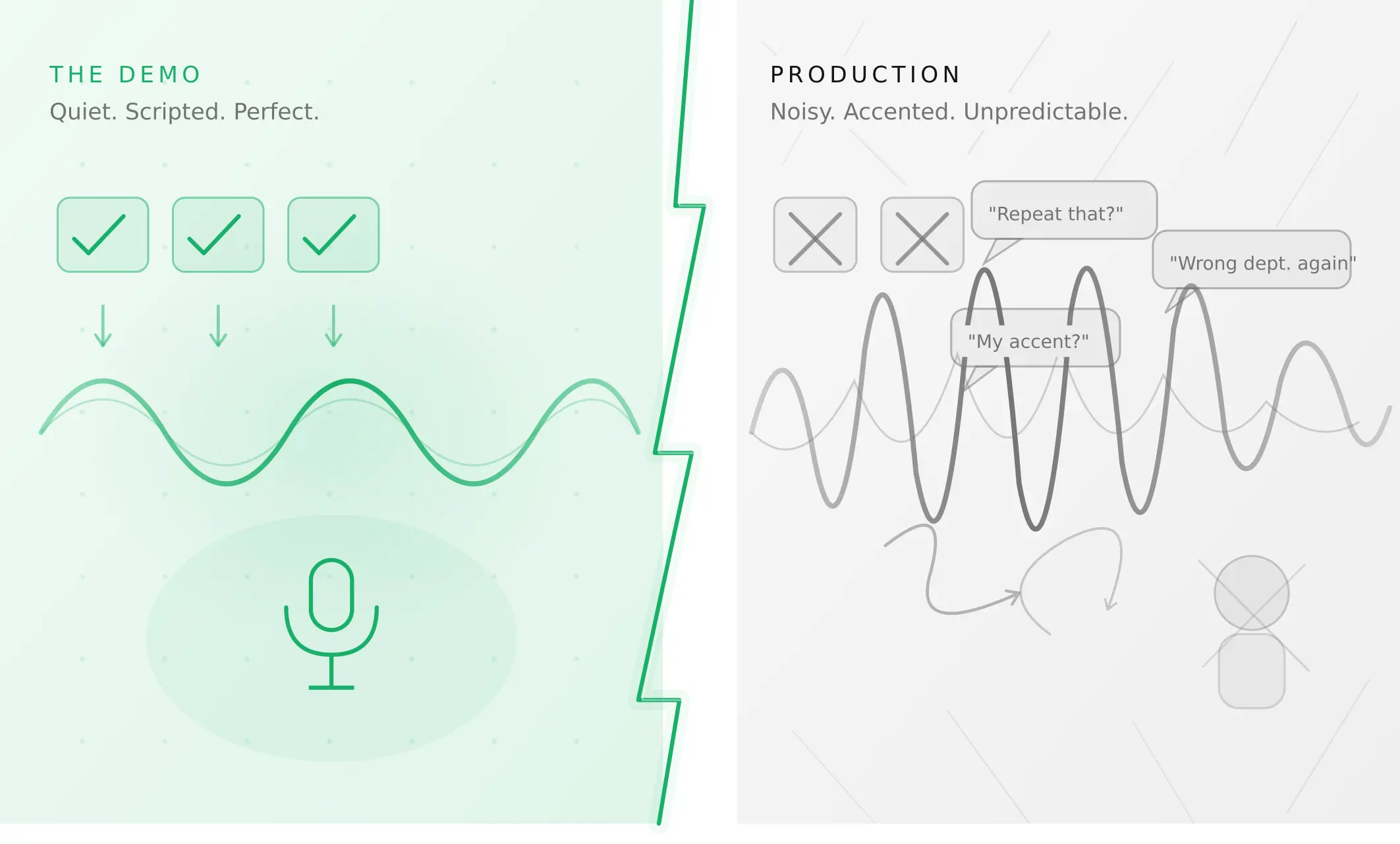
Why AI voice agents fail in production (and how to prevent it)
AI voice agents that ace demos still break in production. Learn the 5 root causes, how to test for each, and what production readiness actually means.
Read more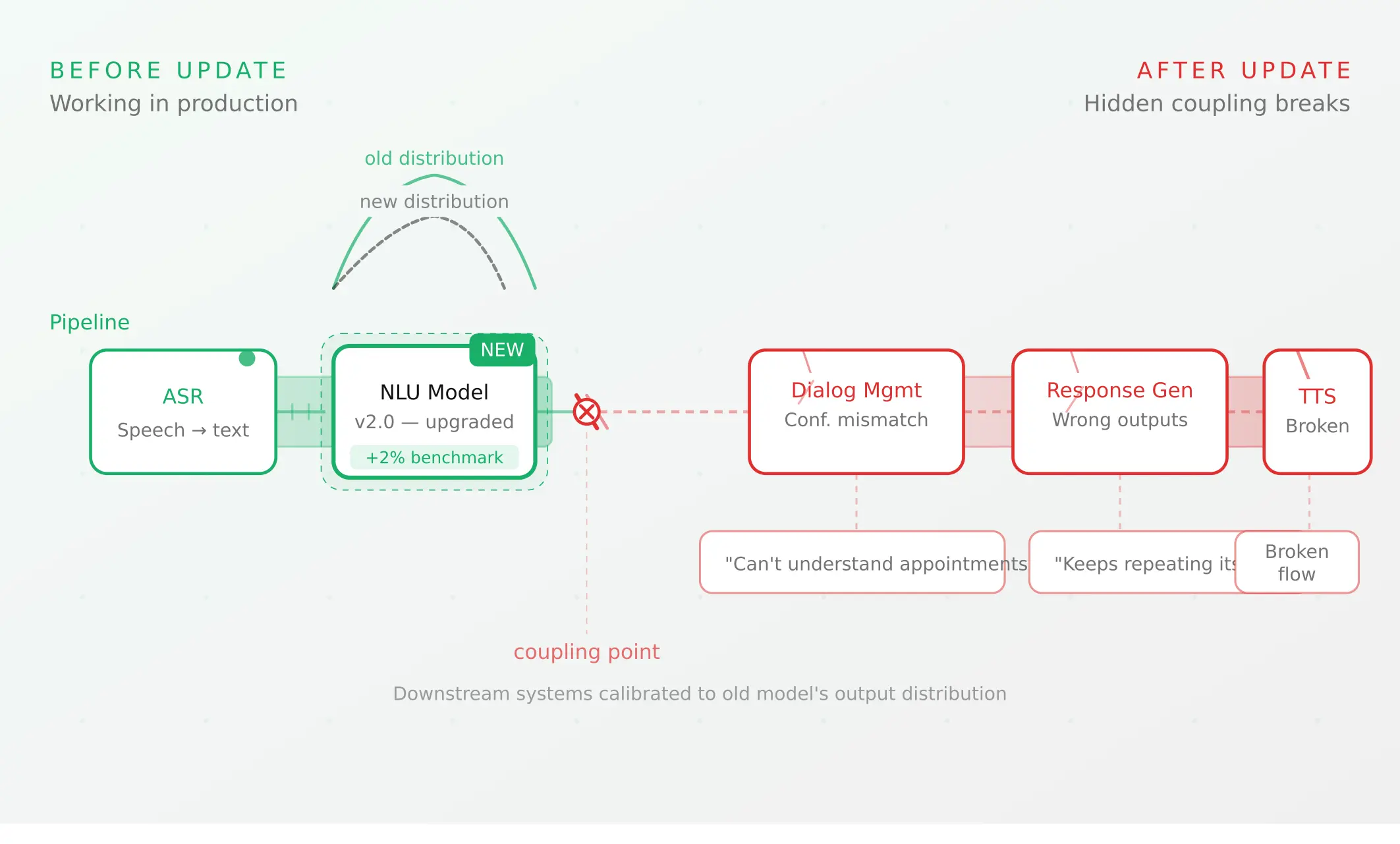
Voice agent regression testing: why LLM updates break production
LLM updates improve benchmarks but break voice agents in 5 predictable ways. How to detect and prevent regressions after every model or prompt change.
Read more