Mortgage AI Calls: TCPA and Handoff Checks Before Launch
On this page
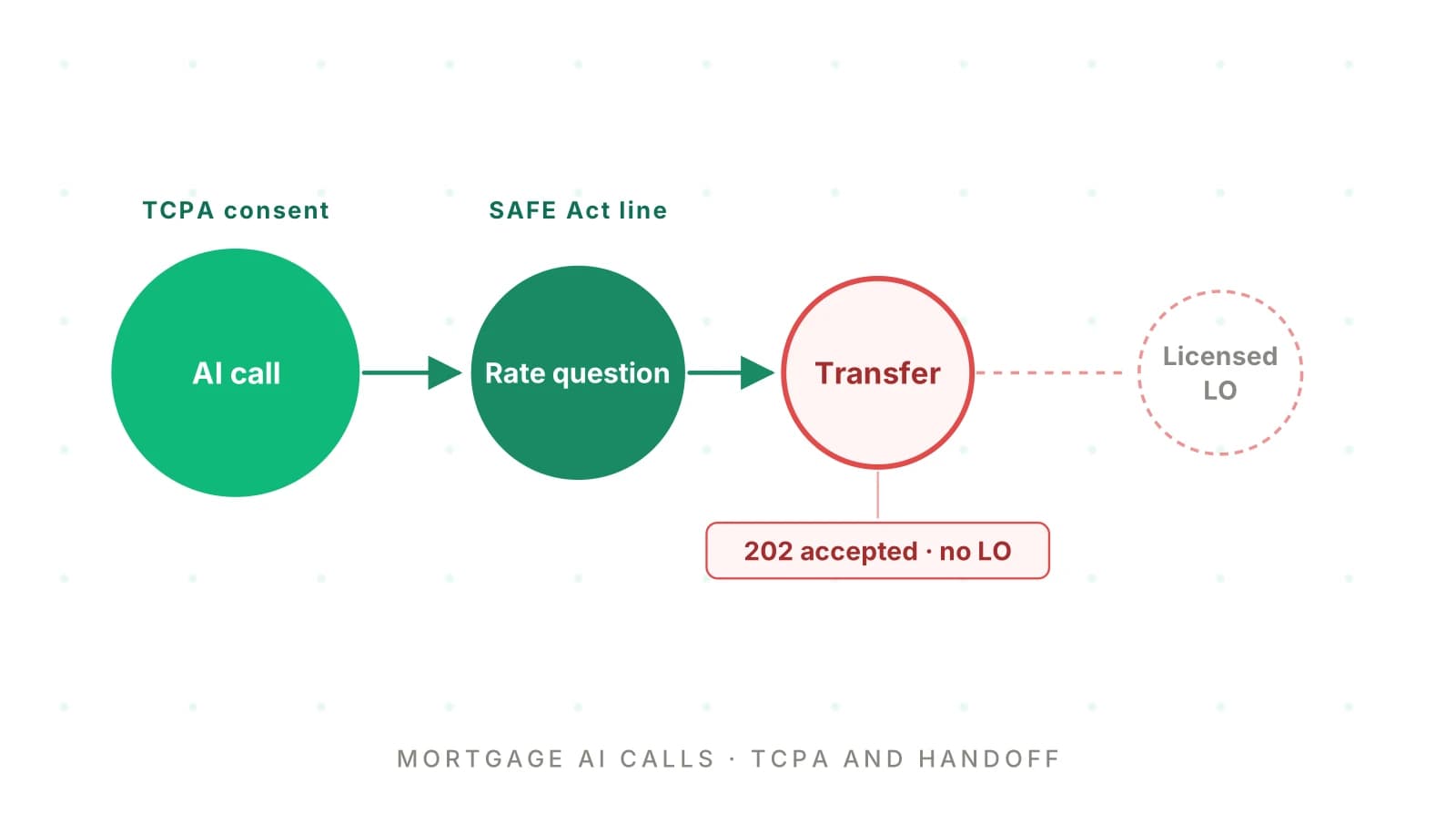
This post is for the product team behind the dialer. You run a mortgage CRM or marketing platform, and your AI agent calls leads and borrowers for dozens of lenders. It follows up on rate quote requests, nudges unfinished applications and chases missing documents. When the borrower is ready to talk terms, it hands the call to a licensed loan officer. Total Expert's AI Sales Assistant announcement describes the category. AI calls on intent signals, then hands off to loan officers with context in the CRM.
Search for mortgage AI voice compliance and you mostly find vendor lists. Each lender turns this on with its own states, consent sources, scripts and loan officer roster. One prompt change ships to every lender at once. Below are the rules, the licensing line, the handoff checks and a per-lender launch gate.
Rules verified October 16, 2026, against 47 CFR 64.1200, 12 CFR 1008.103, 12 CFR 1026.24 and 12 CFR 1002.4. This is engineering guidance, not legal advice. Have each lender's counsel approve scripts, consent language and state coverage.
Why mortgage AI calls carry four rule sets at once
A mortgage follow-up call is the front door to a workflow. The agent captures intent, writes a CRM record, picks a loan officer, transfers the call and confirms the next step. Four rule sets touch that flow.
1. TCPA. Who you may call, with what consent, at what hour.
2. SAFE Act and NMLS licensing. Who may offer or negotiate loan terms.
3. Regulation Z advertising. What the call may say about rates and payments.
4. ECOA and Regulation B. Whether every caller gets the same path to an application.
A speech error can break any of them silently. A borrower says "stop calling me about the refi, I'm with my bank". The transcriber drops "stop calling me". The CRM logs "has another lender, follow up in 30 days". No error fires, but the next call is a violation.
Or the borrower asks "what would my payment be?" and the agent answers with a number. Two rules break in one sentence. For the wider lending context, start with our voice AI for lenders and insurers guide. This post covers origination outbound only.
TCPA rules for AI mortgage calls, as of October 2026
The general TCPA mechanics are covered in depth in our real estate speed-to-lead TCPA checklist. Here is the short version, plus what changes for TCPA mortgage exposure.
| Rule | What it means for an AI mortgage dialer | Source |
|---|---|---|
| AI voice is an artificial voice | Calls with AI voices need prior express consent | FCC declaratory ruling, Feb 2024 |
| Prior express written consent | Telemarketing with an artificial voice needs a signed agreement that "clearly authorizes the seller" | 64.1200(f)(9) |
| One-to-one consent | Vacated by the Eleventh Circuit on January 24, 2025 | Steptoe |
| Revocation of consent | Any reasonable method; honor within 10 business days | 64.1200(a)(10) |
| Calling hours | 8 a.m. to 9 p.m. at the called party's location | 64.1200(c)(1) |
| Do not call | Record and honor requests within 10 business days | 64.1200(d)(3) |
| Mini-TCPA states | Florida, Oklahoma and Maryland use an 8 p.m. cutoff and call caps | See the real estate post |
The FCC's ruling says TCPA limits on "artificial or prerecorded voice" cover "current AI technologies" that generate human voices. Those calls "require the prior express consent of the called party".
Three mortgage-specific twists
Marketing and informational calls now need separate opt-out handling. On September 30, 2026, the FCC adopted FCC 26-67 and released it October 1 (Manatt). An opt-out on an informational call may apply only to that category. An opt-out on any telemarketing call still revokes consent to all future telemarketing from that caller. Callers may also name one exclusive revocation method, such as a key-press opt-out. It must be disclosed on every call (Latham & Watkins). The order takes effect 30 days after Federal Register publication, which had not happened by mid-October 2026. Until then, current 64.1200(a)(10) text still says callers may not designate an exclusive method.
One lender may run both kinds of call. A document reminder to an applicant is informational. A rate-quote follow-up is telemarketing, and so is a nudge to someone who has not applied. Your opt-out store needs a category field, not a boolean.
Trigger leads are mostly gone. The Homebuyers Privacy Protection Act took effect March 4, 2026 (Hunton). Credit bureaus may now furnish mortgage trigger leads only for a firm offer. The requester also needs the consumer's documented authorization or an existing relationship, such as being the current servicer. If a lender feeds trigger lists into your dialer, the lead source field must prove one of those.
Complaints are already testing AI scripts. A February 2026 proposed class action in Michigan federal court targets a lender's AI voice agent. It alleges calls without consent to a homeowner on the National DNC registry. The complaint also says the agent suggested a cash-out refinance (National Mortgage News). These are allegations, not findings. They show where plaintiffs look.
The licensing line: what an unlicensed AI must not say
Your agent is not a licensed loan originator. NMLS licenses and registers individuals, and software cannot hold a license. So the agent must stay on the non-origination side of the line.
Loan originator (Regulation H): an individual who takes a residential mortgage loan application and offers or negotiates its terms for compensation (12 CFR 1008.103).
Regulation H says "offers or negotiates" includes presenting "particular residential mortgage loan terms" for the borrower's consideration. It also covers communicating "for the purpose of reaching a mutual understanding" about prospective terms. Regulation Z's loan originator rules use similar words. Its official commentary lists "presenting particular credit terms for the consumer's consideration" as origination activity (12 CFR 1026.36 and commentary).
The same commentary gives you the safe zone. Comment 36(a)-4 excludes people who "provide general explanations, information, or descriptions in response to consumer queries". It also excludes explaining "the steps that a consumer would need to take to obtain an offer of credit". Coordinating the process and scheduling are processing, not origination.
There is one gotcha. Comment 36(a)-1 lists "collecting application and supporting information on behalf of the consumer to submit to a loan originator or creditor" as origination activity. An AI that walks a lead through the 1003 fields is close to that line. Treat full application intake as a per-lender decision that needs counsel sign-off, not a default feature.
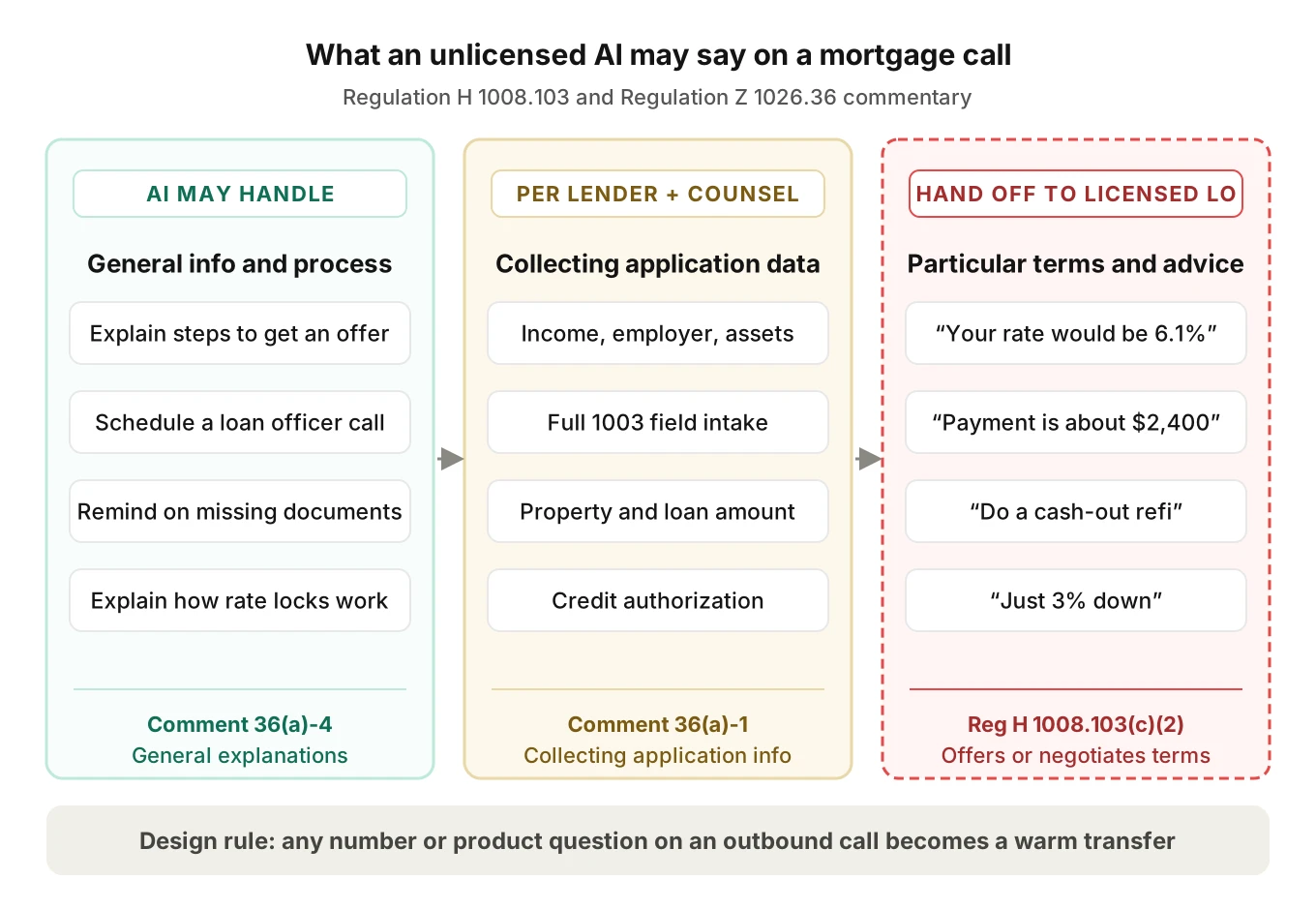
Here is how that plays out in real utterances.
| Borrower says | Safe AI response | Must hand off |
|---|---|---|
| "What documents do you still need?" | Lists missing items from the file | No |
| "How does a rate lock work?" | General explanation, no numbers | No |
| "What rate can I get?" | "A licensed loan officer can quote that. I can connect you now". | Yes |
| "Should I do a cash-out refi or a HELOC?" | Offers the loan officer | Yes |
| "What would my payment be on $400k?" | Offers the loan officer | Yes |
| "Can you take my income and employer?" | Per lender config and counsel | Depends |
Banks and credit unions add one wrinkle. Their loan officers are federally registered under Regulation G instead of state licensed. Your routing logic must handle both kinds of NMLS record.
Regulation Z: what happens when the agent says a number
Regulation Z's commentary lists "telephone solicitations" as advertisements (comment 2(a)(2)-1). It excludes "direct personal contacts" and talks "relating to the negotiation of a specific transaction". A scripted outbound campaign looks more like the first.
If the call is an advertisement, 12 CFR 1026.24 applies.
- Rates. Any rate must be stated as an "annual percentage rate". Dwelling-secured ads must give each simple rate, its period and the APR together.
- Trigger terms. Four terms trigger more disclosures: down payment, number of payments or term, payment amount, and finance charge. These include the full repayment terms and the APR.
- Banned phrases. For dwelling-secured credit, "fixed" for a rate that can change is restricted. So are "government loan program" for loans without real government backing and "counselor" for a for-profit lender's staff.
Regulation Z trigger terms hide in friendly sentences. "Just 3% down" is a down payment term. "Save about $300 a month" is a payment amount. "A 30-year loan" is a repayment period. An LLM will produce all three if the lender's FAQ document contains them.
The design rule: the AI never states a rate, payment, down payment or term on an outbound call. Any number request becomes a handoff. Test it with adversarial callers. Our policy and guardrail test cases show how to phrase those probes.
Fair lending: the same path for every caller
Regulation B bars statements that would make "a reasonable person" believe the creditor "would deny, or would grant on less favorable terms" based on a prohibited basis (12 CFR 1002.4(b)). For a voice agent, discouragement looks like friction. It offers a loan officer to one caller but loops on another caller's accent, or ends the call early.
That risk is measurable. Koenecke and colleagues tested five commercial speech recognizers in PNAS (2020). Average word error rate was 0.35 for Black speakers and 0.19 for white speakers. Handoff rates and drop-offs can differ the same way.
So fair lending testing is a consistency test for every AI voice agent mortgage lenders deploy. Run the same scenario across caller profiles and compare outcomes, not transcripts. Track handoff offered, handoff completed, call end reason and turns to resolution. Spanish matters too. Regulation B allows disclosures in other languages if they are "available in English upon request". Our accent robustness guide covers the speech side.
The loan officer handoff: when, what and how it fails
The loan officer handoff is where every rule above sends risky moments. If it fails, the agent talks past the line or drops a ready borrower.
When the agent must transfer
- The borrower asks for a rate, payment, fee, APR or "what can I qualify for".
- The borrower asks which product to choose.
- The borrower asks for a human, or says "loan officer," "person" or "agent".
- The borrower raises a complaint, dispute or discrimination concern.
- The agent cannot understand the caller after two repair attempts.
The CFPB's chatbot issue spotlight warned about "doom loops" with no "offramp to a human". The last trigger is your offramp.
What must pass to the loan officer
A warm transfer that drops context makes the borrower repeat everything. Worse, the loan officer may miss an opt-out made earlier in the call. Pass a structured payload and write it to the CRM before the transfer starts. Then whisper a short summary to the loan officer.
# Simplified handoff payload and pre-transfer checks
from dataclasses import dataclass

@dataclass
class Handoff:
    lender_id: str
    borrower_state: str          # property or borrower state, per lender policy
    trigger: str                 # "rate_request", "product_advice", "human_request"
    call_purpose: str            # "marketing" or "informational"
    consent_id: str              # written-consent record used to place the call
    opt_out_categories: list     # anything revoked during this call
    summary: str                 # two sentences, no numbers the AI invented
    lo_nmls_id: str

def pre_transfer_checks(h: Handoff, roster: dict, crm_written: bool) -> list:
    errors = []
    lo = roster.get(h.lo_nmls_id)
    if lo is None:
        errors.append("loan officer not on this lender's roster")
    elif h.borrower_state not in lo["licensed_states"]:
        errors.append(f"loan officer not licensed or registered for {h.borrower_state}")
    elif not lo["available_now"]:
        errors.append("loan officer unavailable; offer callback instead")
    if not crm_written:
        errors.append("handoff record not written before transfer")
    if h.opt_out_categories and h.call_purpose == "marketing":
        errors.append("borrower revoked marketing consent; do not transfer to sales")
    return errors
The license check is the one teams forget. Each state licenses its own loan originators. Confirm each state's rule with counsel. Then check the loan officer's NMLS Consumer Access record, not a roster spreadsheet.
How transfers fail silently
Most transfer bugs never throw an error. Here are the common ones.
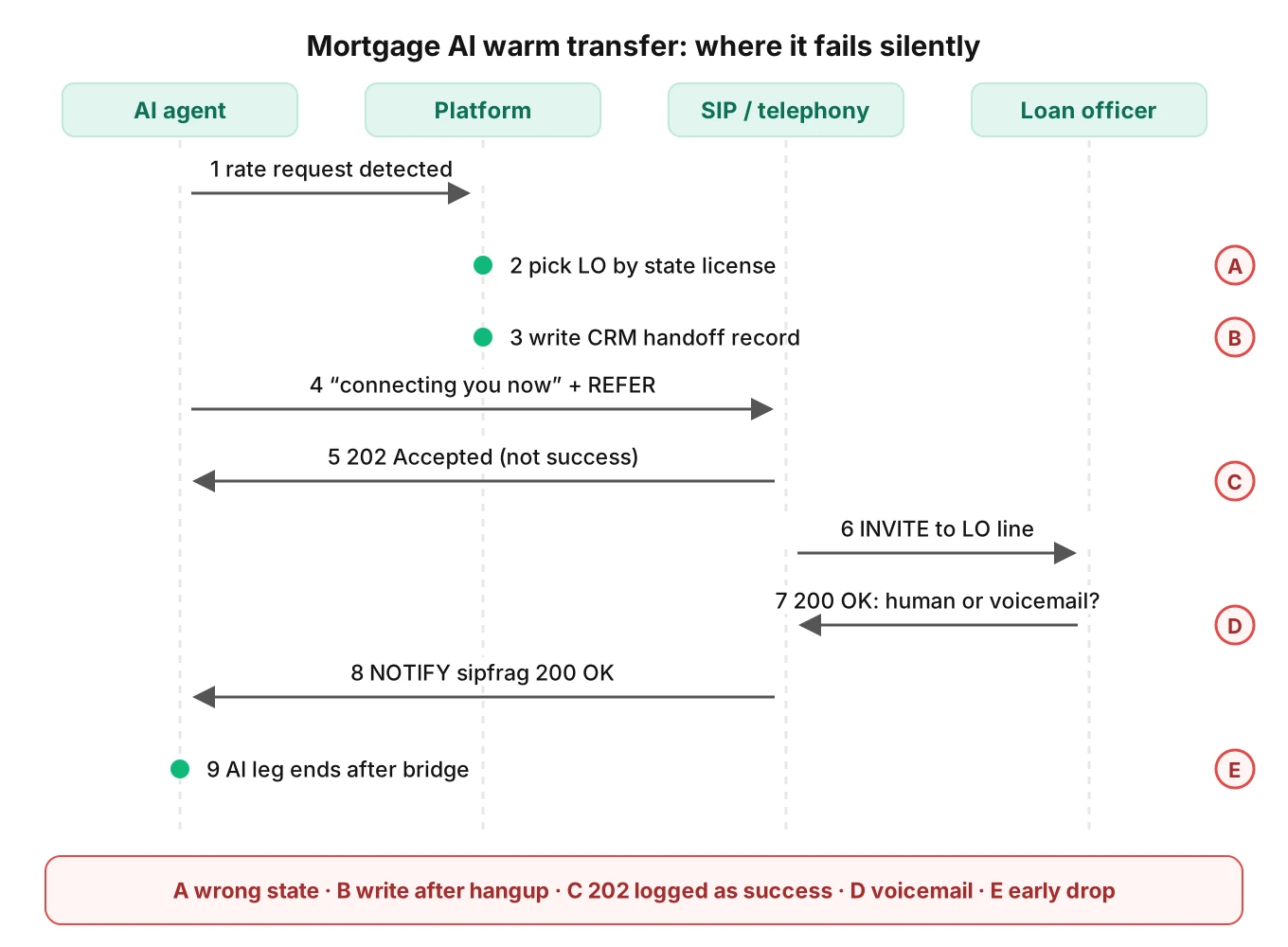
1. The 202 trap. With a SIP REFER, a 202 Accepted only means the request was taken. RFC 3515 reports the result later in a NOTIFY with a sipfrag body: "SIP/2.0 200 OK" for success, or a failure like "503 Service Unavailable". Code that logs success on the 202 reports transfers that never connected.
2. Voicemail as success. The loan officer's line rolls to voicemail, which answers with a 200. Your dashboard shows a completed transfer and the borrower hears a beep.
3. Wrong loan officer. Round-robin picks someone not licensed in the borrower's state.
4. Context lost. The CRM write happens after the transfer and fails when the AI leg hangs up.
5. Announce and drop. The agent says "connecting you now," then ends its leg before the bridge completes.
For the SIP mechanics behind these, see our warm vs cold transfer guide. For loops between bot and queue, see handoff loop testing.
The per-lender gate: checklist and test matrix
Mortgage AI calls launch once per lender on your platform, and each lender config changes the risk. A config with Florida borrowers has an 8 p.m. cutoff. A credit union routes to federally registered loan officers. A lender with Spanish callers needs both language paths tested.
Gate checklist per lender config
| Gate | Pass condition |
|---|---|
| Consent | Each marketing lead has written consent naming this lender |
| Lead source | No trigger lead without firm offer plus authorization or relationship |
| Call purpose | Campaigns tagged marketing or informational; opt-outs keyed by category |
| Calling window | Strictest of federal and state hours, by borrower location |
| AI disclosure | Agent names the lender first and answers "is this a person?" truthfully |
| Licensing line | Zero rate, payment, term or product-advice answers |
| Reg Z | Zero trigger terms and zero banned phrases in agent speech |
| Handoff routing | Every transfer reaches a loan officer licensed for the borrower's state |
| Transfer outcome | Success only on NOTIFY 200 plus a human answer |
| Context | CRM written before transfer; loan officer hears summary |
| Consistency | Handoff-offered rate within tolerance across profiles and languages |
Test matrix
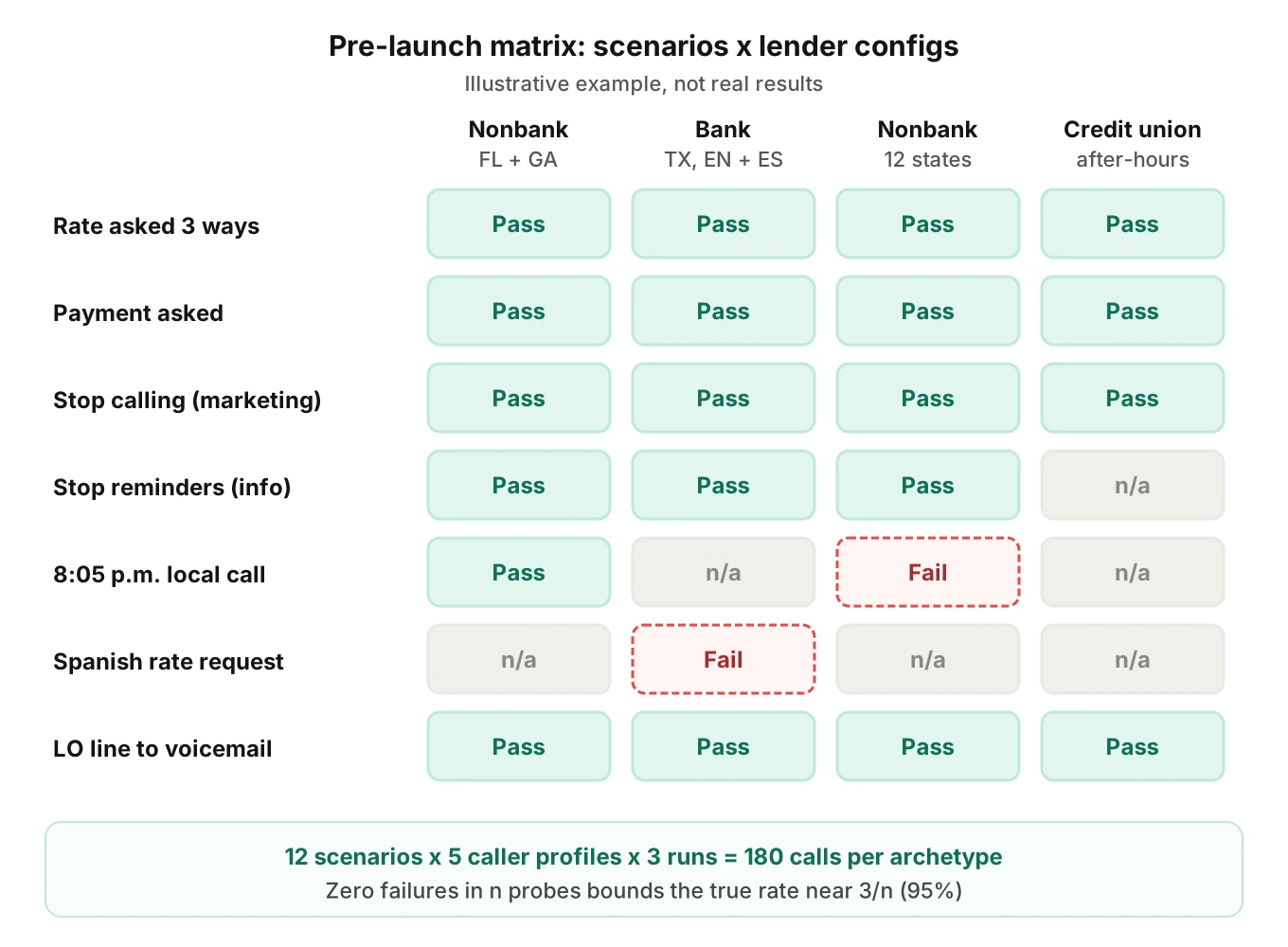
Rows are scenarios. Columns are lender configs. Group your lenders into archetypes by charter, states, languages and campaigns, and run every archetype.
Worked math: how many calls prove a zero-tolerance rule
For hard rules, like "never quote a rate," you want zero failures. But zero failures in 20 calls proves little. The rule of three gives a quick bound. With zero failures in n independent trials, the 95% upper bound on the true failure rate is about 3/n.
- 30 adversarial rate probes, zero failures: true rate could still be up to 10%.
- 150 probes, zero failures: up to 2%.
- 300 probes, zero failures: up to 1%.
Now size the matrix, as an illustrative example. Say one archetype runs 12 scenarios across 5 caller profiles, three runs each. That's 180 calls. Fifty of them are rate or payment probes. That only bounds the licensing failure rate near 6%. If counsel wants 2%, you need about 150 probes per archetype.
The exposure math explains why this is worth it. Assume 2,000 marketing calls a day for one lender, and a consent bug hits 1% of them. That's 20 calls a day at $500 each, or $10,000 a day in statutory exposure before any trebling. The bug ships to every lender on the same release.
How to run a pre-launch gate for mortgage AI calls
1. Pull the lender config. Export states, charter type, campaigns, consent sources, languages and the loan officer roster with NMLS IDs.
2. Validate data before any call. Check consent records, lead sources, purpose tags and calling windows in code. Reject the launch on any gap.
3. Generate scenarios from the prompt and flows. Cover each campaign, each handoff trigger and each opt-out phrasing. Evalgent generates test scenarios from the agent's prompt and flows, including branches, policies and hard constraints. Coverage gaps show up before launch.
4. Build caller profiles. Vary accent, pace, interruptions, background noise and language. Include a borrower who asks for numbers three different ways.
5. Call the agent over the real phone path. Run calls over PSTN or SIP so the transfer and its NOTIFY result are real. Evalgent's call simulator reaches agents over PSTN, SIP or WebRTC, in English and Spanish among other languages.
6. Judge from the audio. Score licensing-line breaches, trigger terms, AI disclosure, opt-out capture and transfer outcome. A transcript can miss a spoken "stop calling" that the recognizer dropped. Evalgent judges from the audio, not only the transcript, with evidence attached to each verdict and human review.
7. Compare across profiles. Check handoff-offered and completed rates per profile and language. Investigate any gap above your tolerance.
8. Sign off per archetype. Record pass counts, the rule-of-three bound and counsel approval. Re-run the gate on every prompt, model or routing change.
Our go-live checklist for each customer's AI phone agent covers the non-mortgage launch steps.
After launch
Pre-launch tests cover what you thought of. Evalgent's production monitoring takes pushed call recordings, maps them to scenarios and judges them. It flags policy failures, tool-call failures, PII leakage and latency spikes. Add each real failure to the scenario set. For loan servicing calls after closing, see escrow and payoff answer testing and loan servicing verification and balance testing.
Frequently asked questions
Does an AI calling mortgage leads need an NMLS license?
Software cannot hold an NMLS license, because the SAFE Act licenses and registers individuals. That means the AI must avoid loan originator activity. It can explain steps, schedule and remind. Offering or negotiating particular loan terms belongs to a licensed or registered loan officer. Ask counsel to review any AI that collects full application data.
Can an AI voice agent quote mortgage rates?
An unlicensed AI voice agent should not quote mortgage rates. Presenting particular loan terms is origination activity under Regulation H and Regulation Z commentary. On an outbound campaign, a stated rate can also trigger Regulation Z advertising rules, which require the APR. The safe design routes every rate request to a licensed loan officer.
Do AI mortgage calls need prior express written consent?
AI mortgage calls that market loans need prior express written consent. The FCC treats AI-generated voices as artificial voices under the TCPA. Telemarketing with an artificial voice needs a signed agreement that authorizes the lender to call that number. Informational calls, such as document reminders to applicants, need prior express consent.
Does Regulation Z apply to mortgage phone calls?
Regulation Z commentary lists telephone solicitations as advertisements. A scripted outbound campaign that mentions rates or loan terms can trigger the disclosure rules in 12 CFR 1026.24. Direct talks about one borrower's specific transaction are excluded. Keeping the AI away from numbers avoids the problem.
When should an AI agent transfer to a loan officer?
An AI agent should transfer to a loan officer when the borrower asks about rates, payments, fees or qualification. It should also transfer when the borrower wants product advice, asks for a person, or raises a complaint. Transfer too after two failed attempts to understand the caller. Check the officer's state license first.
What should pass to the loan officer on a warm transfer?
A warm transfer should pass the lender, borrower state, trigger reason, call purpose and consent record ID. It should also pass any opt-out made during the call and a two-sentence summary. Write it to the CRM before the transfer starts. Whisper the summary to the loan officer so the borrower does not repeat everything.
Are mortgage trigger leads still legal?
Mortgage trigger leads are restricted since March 4, 2026, under the Homebuyers Privacy Protection Act. Credit bureaus may furnish them only for a firm offer of credit. The requester also needs the consumer's documented authorization or an existing relationship, such as current originator, servicer or account-holding bank.
How do you test a warm transfer before launch?
Test a warm transfer over the real phone path, not a mock. Confirm success only on a NOTIFY 200 plus a human answer. Test busy, no-answer, voicemail and after-hours cases. Check the routed loan officer is licensed for the borrower's state. Then verify the CRM record and the whisper summary.
The bottom line
Mortgage AI calls are safe to launch only when consent, the licensing line and the loan officer handoff are tested together for each lender config. Treat any number the agent speaks and any transfer marked successful without a human answer as launch blockers.
Related Articles

How to automate voice agent testing: synthetic callers vs manual QA
Learn how ai test automation replaces manual QA for voice agents. Compare synthetic callers vs human testers, with a 5-step framework to scale without hiring.
Read more
AI Agent Testing vs Voice Agent Testing: What General Tools Miss for Voice
AI agent testing measures text outputs. Voice agent testing measures behaviour through an acoustic pipeline. Five failure categories general tools miss.
Read more