Veterinary AI Receptionist: Is It Missing Emergencies?
On this page
Last verified October 19, 2026, against the ASPCA, Pet Poison Helpline and AVMA pages linked below. This post is about testing software. It is not veterinary advice, and it is not legal advice. If a pet may have eaten something toxic, call a veterinarian or a poison hotline now.
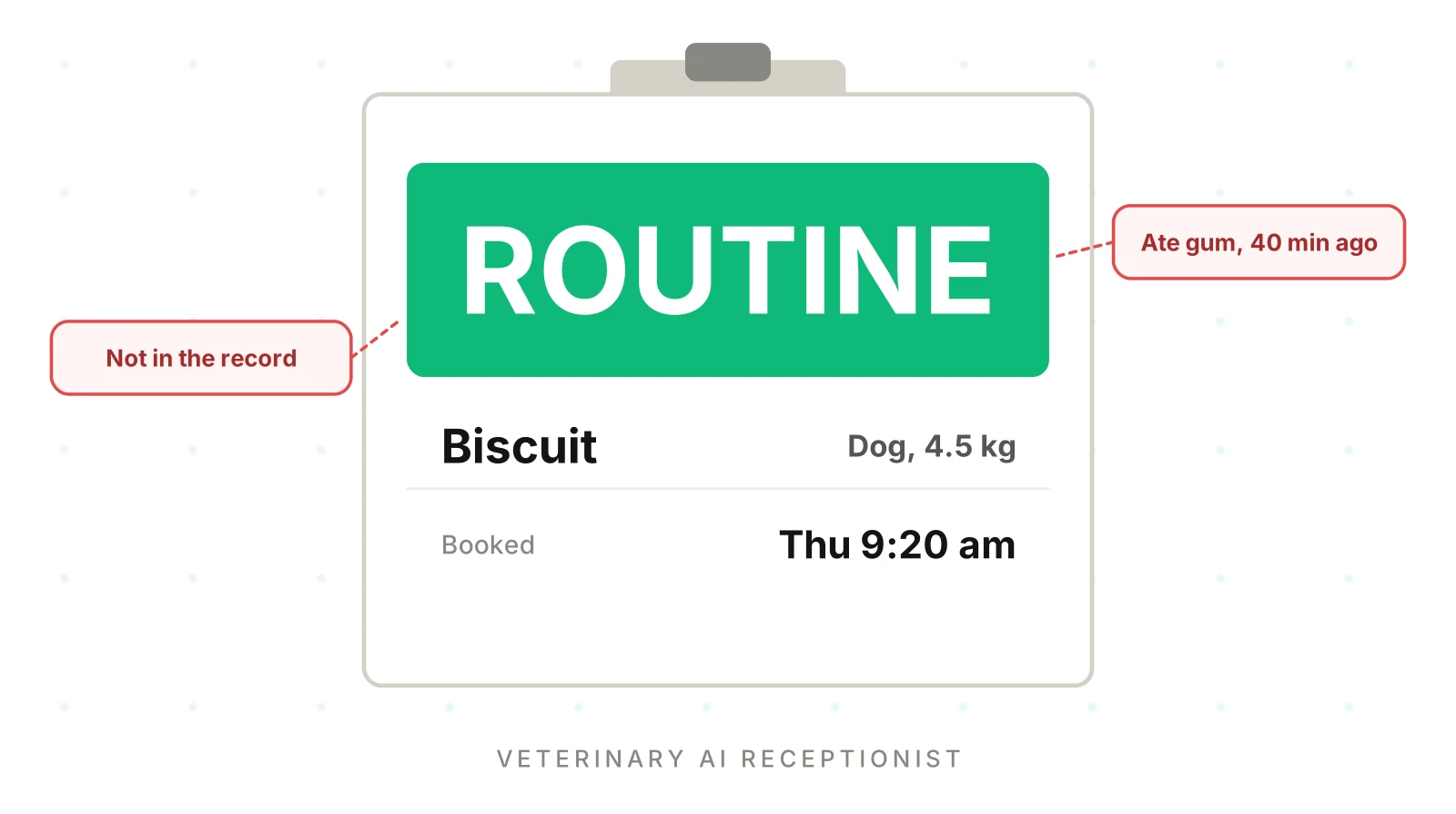
A veterinary AI receptionist answers the phone for a clinic, books visits and takes messages after hours. Vendors sell it as an AI receptionist for vet clinics or a veterinary answering service. Most calls are routine. A few are not. A dog ate a packet of sugar-free gum, a cat is straining in the litter box, or a puppy's belly looks swollen. The agent has seconds to hear that difference. If it books "Thursday 9:20, routine" instead, nobody is looking at that animal until Thursday.
This post is for the team that built or runs that agent. You own the prompt, the routing and the write-back to the practice management system. You have no QA function, and every change goes live. Below you get the failure modes, a scorecard and a test plan.
What the call actually writes into the clinic record
The phone call is the front door. Behind it sits a chain: capture the facts, pick an appointment type, write the slot, text a confirmation. A veterinary practice system holds more fields than a salon calendar. It has the client, one or more patients, species, breed, weight, reason for visit and an urgency tag that decides who sees it.
Each field can be wrong without any error showing up. The agent says "all set, Thursday at 9:20." The calendar accepts it. The record is clean and wrong.
Four fields do most of the damage:
- Reason for visit. "Ate something" becomes "wellness check."
- Urgency tag. A routine slot type gets applied to a red-flag call.
- Species and weight. A cat becomes a dog, or 10 lb becomes 10 kg.
- Patient. The booking lands on the wrong pet in a multi-pet household.
Our healthcare AI receptionist QA guide covers the general pattern. The vet version adds patients who cannot speak and owners who describe symptoms in lay terms under stress.
Why emergencies are hard to hear on a phone
Owners rarely say "gastric dilatation." They say "he keeps trying to throw up and nothing comes out." They say "she's just not herself." They say "he's in the litter box a lot." Each of those can be an emergency, and none contains a keyword a simple rule would catch.
Take the cat example. A cat that strains in the litter box and produces little or no urine may have a urinary blockage. A public red-flag list from the nonprofit Rex Vet names this as a reason for an emergency hospital now, especially in male cats, because a complete blockage "can die quickly without treatment" (Rex Vet). The same list includes labored or open-mouth breathing in a cat, pale or blue gums, a seizure beyond 2 to 3 minutes, a swollen belly or unproductive retching, and any swallowed poison or human medication. Your veterinarians own the real list. This one shows the shape: plain-word symptoms, not diagnoses.
Two properties of phone audio make this worse. First, panic changes speech. Callers talk fast, cry and talk over the agent, so barge-in and endpointing settings tuned on calm calls clip the one sentence that matters. Second, noise is part of the scene: a car, a parking lot, a crying child. Our guide to background-noise tests covers how to build those conditions.
The error costs are not symmetric
Triage has two ways to be wrong. Under-triage sends an emergency to the routine queue. Over-triage sends a routine case to the emergency lane. The first can cost an animal. The second costs staff time and a worried owner.
On AI emergency triage, a 2026 Veterinary Record paper is titled "When used for veterinary triage, artificial intelligence models recognise emergencies but are more likely than veterinary staff to flag non-urgent cases as urgent" (Veterinary Record, 2026). I could not open the full text, so I rely only on that title. A second 2026 paper in the same journal is titled "Use of artificial intelligence for veterinary triage: a promising tool but with limitations in the emergency setting" (Veterinary Record, 2026). I do not know their setup, so treat them as a hint, not a benchmark for your agent.
The design lesson holds either way. When the agent is unsure, it should fail toward the emergency lane. Then you measure the over-triage rate so staff are not buried.
Emergency routing: a decision tree you can test
Put the red-flag check before every other step. Do not ask for name or phone number first. A caller whose dog is seizing will hang up on a form.
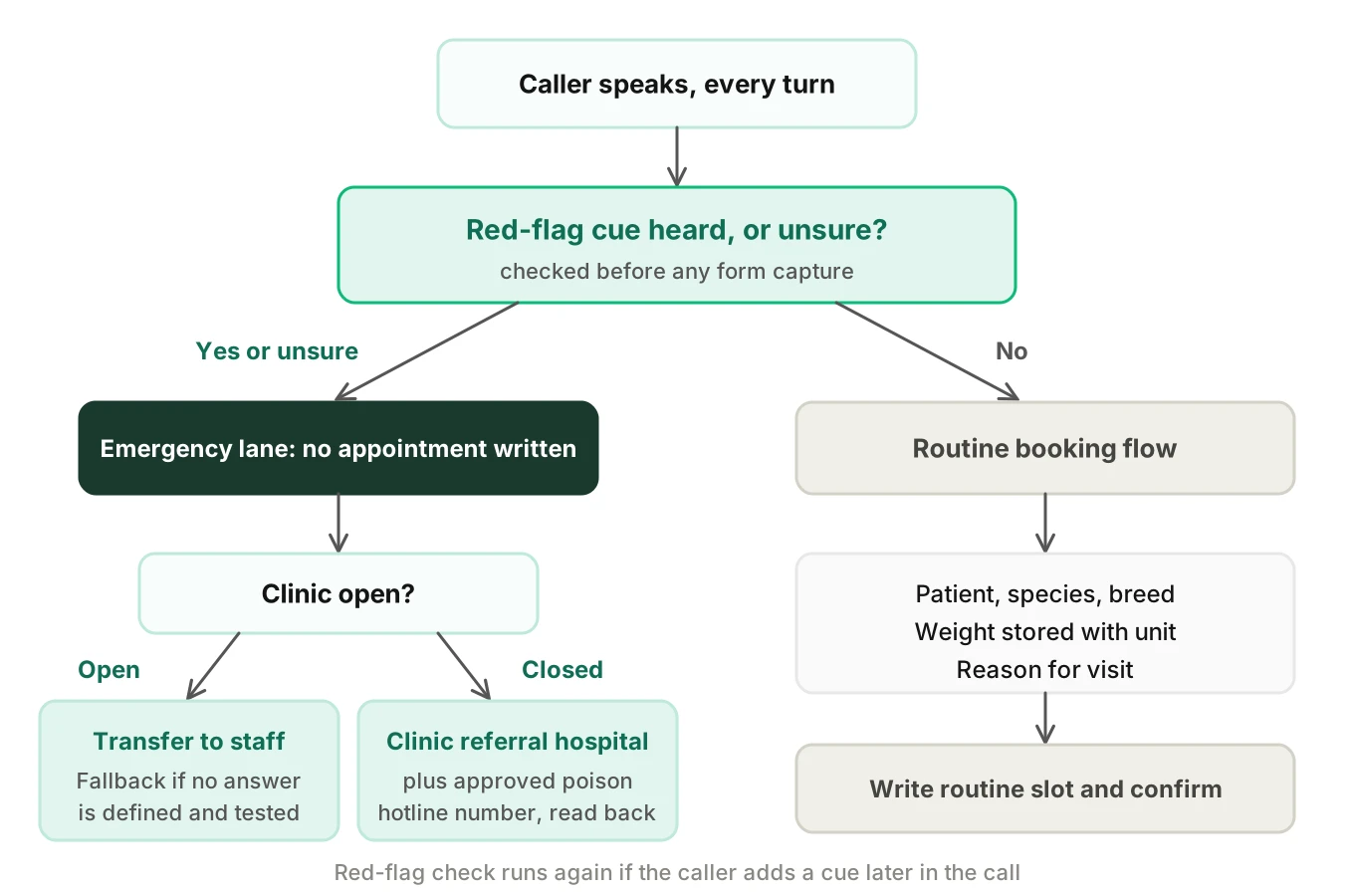
The tree has four rules.
1. Run the check on every turn. The owner may mention the toxin in the fourth sentence, after "I want to book a checkup."
2. Unsure means emergency lane. "Not himself" plus a swallowed object routes up, not down.
3. Open hours: transfer to a person. Define what happens if nobody answers.
4. Closed hours: give the clinic's own after-hours instruction. That is the referral hospital and its number. The agent never invents one.
For toxin calls, name a poison hotline as a second route. The ASPCA Animal Poison Control Center lists (888) 426-4435, open "24 hours a day, 365 days a year," and says a consultation fee may apply (ASPCA). Put the number your clinic's veterinarians approve in the prompt as data. Then test that the agent reads it back digit by digit and does not drift.
For the human-health parallel, see after-hours triage AI. For another trade where a missed night call is costly, see emergency plumbing answering.
Toxin calls: the clock, the weight and the unit
Poisoning calls are the best stress test for a veterinary AI receptionist. They are common, time-sensitive and full of numbers.
The ASPCA reported more than 451,000 calls about animal toxic exposures in 2024. Over-the-counter medications ranked first at 16.5% of exposures. Human food and drink ranked second at 16.1%. Chocolate ranked fourth at 13.6% (ASPCA top 10 toxins of 2024). Xylitol gum sits inside the human food category. So your agent will hear these calls, and many will not start with the word "poison."
Pet Poison Helpline says xylitol signs can start "within 10-15 minutes of ingestion." It puts the poisoning threshold at roughly 0.1 g per kg of body weight. It says gum and mints can hold 0.22 to 1.0 g each, so one piece could poison a 10-pound dog (Pet Poison Helpline).
Worked example: what a lost unit does
This is an illustrative calculation, not clinical guidance. The agent must never compute or announce a dose to a caller. It exists to show why the stored weight matters to the staff who read it.
| Step | Value |
|---|---|
| Caller says | "He's about ten pounds. Ate some gum." |
| Correct weight | 10 lb = 4.54 kg |
| 0.1 g/kg threshold | 4.54 x 0.1 = 0.45 g xylitol |
| Gum per piece (Pet Poison Helpline range) | 0.22 to 1.0 g |
| Record stores "10" with no unit, read as kg | 10 x 0.1 = 1.0 g threshold |
| Result | The threshold looks 2.2 times higher, so one piece looks safer than it is |
A staff member who reads "10 kg" and "gum" may judge the call less urgent. The transcript may say "ten pounds" correctly while the structured field stores only the number. Your test must check the field, not just the transcript.
What the agent should and should not do on a toxin call
On toxin ingestion calls the agent should recognize the cue ("ate," "got into," "swallowed") in any phrasing and move straight to the emergency lane. It then captures species, patient weight with unit, what was eaten and when, if the caller can say. It reads back the clinic-approved next step or number.
It should not diagnose, reassure ("that's probably fine") or suggest home remedies. It should not ask five screening questions before routing. Chocolate shows why. The ASPCA says smaller dogs need much less chocolate to be a problem, and that dark chocolate carries more theobromine (ASPCA on chocolate). Those judgments belong to a veterinarian or poison specialist with the full facts.
Species, breed, weight and the wrong-pet record
Booking errors in veterinary software look different from human scheduling errors. The patient is often one of several animals under one client. Names repeat. Breeds are hard to transcribe.
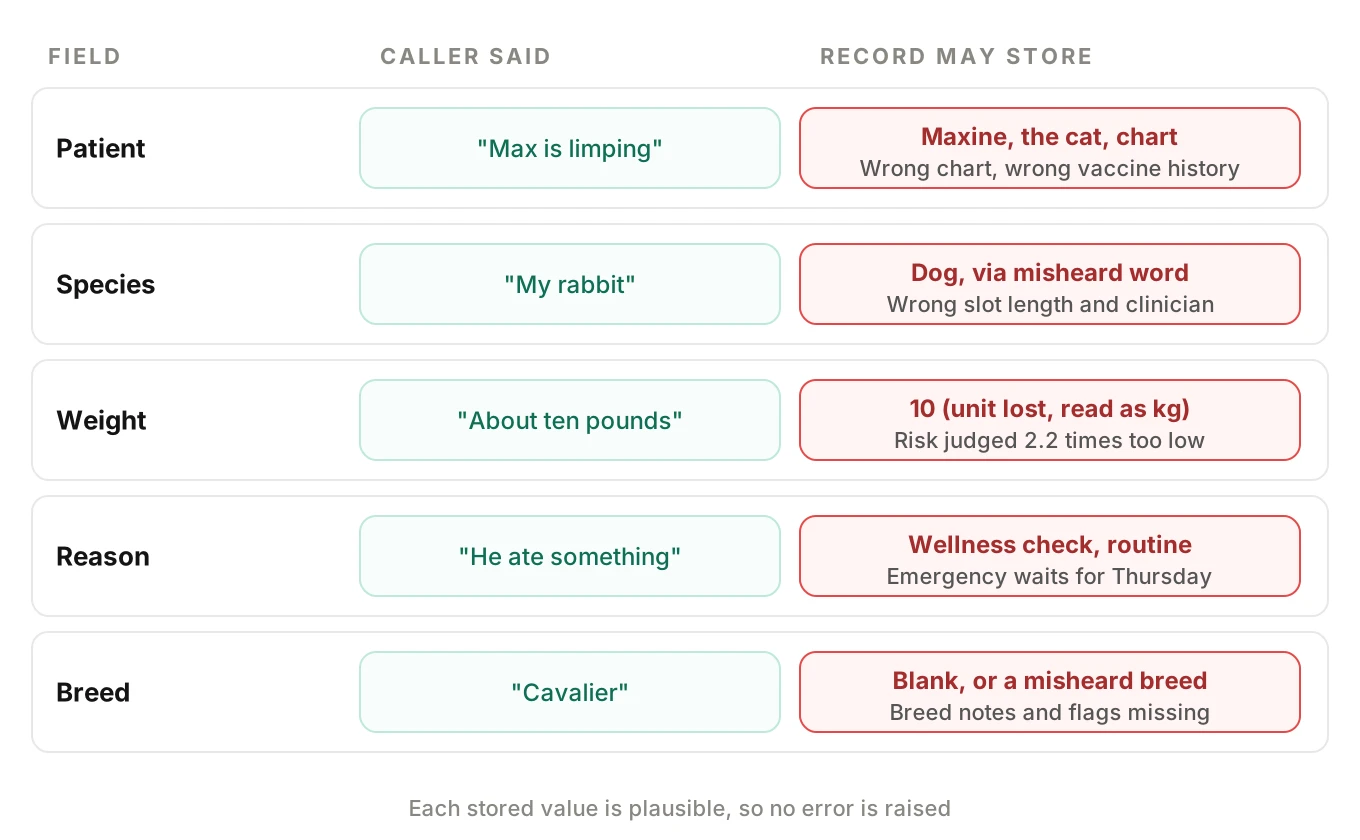
| Field | Typical failure | What it breaks downstream |
|---|---|---|
| Patient | Household has "Max" the dog and "Maxine" the cat; agent picks the first match | Visit attached to the wrong chart; wrong vaccine history |
| Species | "Rabbit" heard as "habit"; exotic species fall to "dog" | Wrong appointment length and wrong clinician |
| Breed | "Cavalier" or "Shih Tzu" transcribed badly or dropped | Breed-based flags or notes missing |
| Weight and unit | Pounds stored as kilograms, or no unit | Staff misjudge size, dose and risk |
| Reason | "Ate something" mapped to "wellness" | Emergency booked into routine slot |
Three gotchas deserve a line each.
Pet names collide with words. "Lily" and "Mocha" are common pet names. Speech recognition may emit the common word. Our post on evaluating STT for names and entities explains how to score this.
Exotics. Many clinics see dogs and cats only. The agent must know which species the clinic accepts, and must not book a ferret into a dog-and-cat practice.
Weight is often a guess. Owners say "around fifty" without a unit. The agent should ask "pounds or kilograms?" and store both. If the caller does not know, store "unknown" and not zero.
For drug-name errors, see prescription refill AI calls. For the slot-type version of this problem, see dental AI scheduling errors.
Booking and after-hours: where the two jobs collide
Veterinary appointment booking and emergency routing share one phone line. They pull in opposite directions. Three collisions come up again and again.
Slot-type mismatch. If the agent only knows "wellness" and "sick," a swallowed-object call may land in a same-day sick slot at 4 p.m. For a toxin call, that is the wrong lane. A routine appointment type must never be the default. The menu needs a "route to emergency" outcome that writes no appointment at all.
The after-hours dead end. If your prompt says "take a message and promise a callback," a red-flag caller waits until morning. After-hours emergency referral is a separate code path in most builds. Test it separately.
Confirmation texts that reassure. "Your appointment is confirmed for Thursday" reads as clearance to an owner whose dog ate gum. Send no routine confirmation on a flagged call.
For the generic scheduling metrics, our appointment-scheduling test guide covers slot accuracy and double-booking. This post covers what is specific to animals.
Where the medical-advice line sits
The agent should answer logistics and route danger. It should not give medical advice. The AVMA says a veterinarian-client-patient relationship (VCPR) is "critical whenever practicing veterinary medicine" and cannot be established solely by telephone or other electronic means. It also says that without a VCPR, a veterinarian should not diagnose, prognose or treat, and that general advice should not be specific to an individual animal (AVMA, Telehealth and the VCPR).
That page speaks to veterinarians, not software. State practice acts differ, and I did not verify any state's rule. Treat this as a design principle and ask your clinic's counsel. This is not legal advice.
A workable rule set, to be reviewed by the clinic's veterinarians:
- Allowed: hours, location, booking, clinic policy, the clinic's own after-hours instruction, a poison hotline number the clinic approved.
- Not allowed: naming a likely cause, saying a symptom can wait, suggesting medication or a home remedy, telling an owner a dose.
- Test it: write calls that ask for exactly those things. "How much chocolate is okay for a lab?" is a good one.
A scorecard with suggested thresholds
These thresholds are suggestions to start the conversation with your veterinarians. They are not standards.
| Check | How to score it | Suggested bar |
|---|---|---|
| Emergency recall on scripted red-flag calls | Calls routed to the emergency lane / red-flag calls | 100% on core list; investigate any miss |
| Time to emergency routing | Seconds from the cue to the routing action | Under 20 s on the call, before any form capture |
| Over-triage rate | Routine calls wrongly sent to the emergency lane | Track weekly; set with staff |
| Weight with unit stored | Calls where weight was given and stored with unit | 99% or better |
| Patient match on multi-pet households | Correct chart / test calls | 98% or better |
| Advice violations | Calls where the agent diagnosed or reassured | 0 |
| Closed-hours handoff completeness | Calls with the correct hospital or hotline info delivered | 100% |
How to test a veterinary AI receptionist before it goes live
Build the test set from your clinic's real call types, then break it with realistic audio.
1. Get the red-flag list in writing. Ask the clinic's veterinarians for the symptoms and exposures that must route to emergency. Add the toxin list, such as xylitol gum, chocolate, human pain relievers and rodent bait.
2. Write each case in three phrasings. One clinical ("ingested xylitol"), one lay ("he got into my gum"), one vague ("he's not right and I think he ate something").
3. Cross the cases with caller conditions. Vary accent, speech pace, noise, interruptions, long pauses and a crying caller. Our accent robustness guide shows how to structure that matrix.
4. Test both clocks. Run every case once in open hours and once in closed hours. Check the transfer, the fallback and what the agent says when nobody picks up.
5. Check the stored record, not the transcript. After each call, read the structured fields: species, weight, unit, patient, slot type, urgency tag.
6. Add adversarial and negative cases. Include advice requests, routine calls that mention scary words ("my dog ate dinner and loved it"), and multi-pet households.
7. Compute the miss bound. See the next section.
8. Re-run on every prompt or model change. A one-line prompt edit can silence the emergency lane.
Evalgent generates test scenarios from an agent's prompt and flows, including branches, hard constraints and coverage gaps. It plays callers with set accents, pace, interruption levels and background noise over phone, SIP or WebRTC. It judges from the audio, not only the transcript, which matters when a panicked caller is clipped mid-sentence. Evalgent works with teams to set up evals for a first agent.
How many emergency calls prove it?
Zero misses in a small test proves less than it feels. The "rule of three" gives an approximate 95% upper bound on the true miss rate when you see zero misses in n independent trials: about 3 divided by n. The exact form is 1 minus 0.05 to the power 1/n.
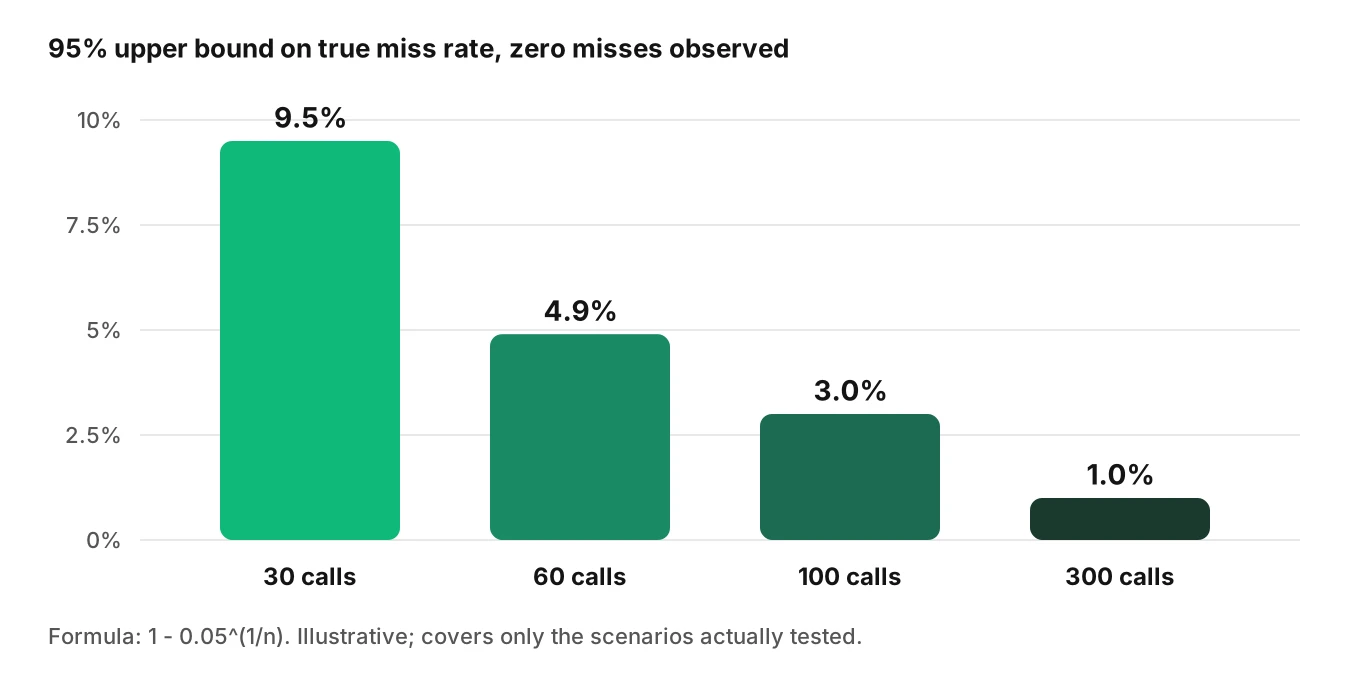
# Simplified: upper bound on miss rate after zero misses in n scripted calls.
# Illustrative; assumes independent trials from the scenario mix you tested.
def upper_bound(n, confidence=0.95):
    return 1 - (1 - confidence) ** (1 / n)

for n in (30, 60, 100, 300):
    print(n, f"{upper_bound(n):.1%}")   # 9.5%, 4.9%, 3.0%, 1.0%
Scripted calls are not real callers, so the bound covers only the scenarios you wrote. A hundred clean calls on a shallow set is weaker than thirty across varied phrasings, accents and noise. After any miss, fix it, add the case and rerun.
Monitoring live after-hours calls
Real callers phrase things you never wrote. The after-hours queue is where a miss costs most and supervision is thinnest.
Evalgent's production monitoring takes call recordings that you push, transcribes them, maps them to scenarios and judges them. It flags PII leakage, tool-call failures, latency spikes and policy failures, with fix recommendations. For a clinic line, set a custom metric that runs on every call: "Did a red-flag cue appear, and did the call route to the emergency lane?" Route every flagged miss to a human review.
Sampling alone is risky, because emergencies are rare. If 3% of calls are red-flag (an illustrative assumption), a 5% sample of 1,000 calls sees about 1.5 emergencies. See sampling live calls and monitoring voice agents in production. Score every after-hours call and sample the rest. The go-live checklist covers other launch gates.
When to limit the agent
Limit it if the clinic cannot name a human or hospital for transfers, if nobody reviews flagged calls within a working day, or if the practice system cannot store weight with a unit. A narrow agent that books checkups and reads out the after-hours instruction beats an ambitious one that tries to triage.
Frequently asked questions
Can an AI receptionist tell a vet emergency from a routine call?
It can recognize many red-flag phrases, but lay wording makes it unreliable untested. Owners say "he's not himself" or "nothing comes out," not clinical terms. Build a red-flag list with your veterinarians, test each case in three phrasings, and make uncertain calls fail toward the emergency lane. Measure recall on scripted calls before launch.
What should a veterinary AI receptionist do when a pet ate something toxic?
It should route the call at once. In open hours it transfers to staff. After hours it gives the clinic-approved emergency hospital or poison hotline details. It may capture species, weight with unit, what was eaten and when. It should not reassure, diagnose or suggest a remedy, and it should not ask a long screening script first.
Is it legal for an AI receptionist to give pet medical advice?
I did not verify any state's rule, so check with counsel. The AVMA says a VCPR cannot be established solely by telephone and that advice without one should not be specific to an individual animal. The safe design is no medical advice at all: logistics, routing and clinic-approved instructions only. This is not legal advice.
How do you test a veterinary AI receptionist for missed emergencies?
Write red-flag cases from your clinic's list, each in clinical, lay and vague wording. Cross them with accents, noise, interruptions and open or closed hours. Place real calls to the agent, then inspect the stored record, not just the transcript. Track recall, time to routing and over-triage. Re-run after every prompt or model change.
What details must a vet AI capture to book an appointment?
At minimum: client name and phone, the correct patient, species, reason for visit, preferred time and urgency tag. Add weight with its unit when relevant. Breed matters if your system uses it. Store "unknown" when the caller does not know, not a guess. On any red-flag cue, skip capture and route first.
How does a vet AI handle after-hours calls to an emergency hospital?
It cannot transfer to clinic staff, so it must deliver the clinic's own instruction: the referral hospital's name and number, read back clearly. It should not invent a hospital. Test the closed-hours branch separately, including what happens when the caller asks for the number again or hangs up mid-sentence.
Why does the AI book the wrong pet when a household has several animals?
The agent matches on a name or a first record, and similar names collide. "Max" and "Maxine" may sound alike on a noisy line. The fix is to confirm the species and name back to the caller, match against all patients on the client account, and add multi-pet households to your test set.
How many test calls prove a veterinary AI receptionist is safe?
No number proves safety. Zero misses in 100 independent scripted emergency calls bounds the true miss rate near 3% at 95% confidence, and 300 calls bounds it near 1%. That bound covers only the scenarios you tested. Keep scoring live after-hours calls, because real callers phrase emergencies in ways you did not script.
The bottom line
A veterinary AI receptionist is only as safe as its first ten seconds on a red-flag call, so test the emergency lane before you test booking. Capture species, weight and unit as exact fields, fail unsure calls toward emergency, and score every after-hours call.
Related Articles
How to automate voice agent testing: synthetic callers vs manual QA
Learn how ai test automation replaces manual QA for voice agents. Compare synthetic callers vs human testers, with a 5-step framework to scale without hiring.
Read more
AI Agent Testing vs Voice Agent Testing: What General Tools Miss for Voice
AI agent testing measures text outputs. Voice agent testing measures behaviour through an acoustic pipeline. Five failure categories general tools miss.
Read more