Property Management AI Answering: The QA Playbook
On this page
Most property management AI answering demos end with one line from the agent: your work order is created. That line is where the real test starts. The call was the front door. Behind it, the agent looked up a resident and picked a unit. It chose a category and priority. Then it wrote a record into the property management software. A vendor may have been paged. A text may have gone out. None of that is visible in a transcript that reads well.
This playbook is for the product team that runs one voice agent for hundreds of property managers. You might ship it inside a PMS, a maintenance platform, a leasing CRM or an HOA tool. Your agent answers after-hours maintenance calls, leasing inquiries, rent balance questions and renewals. Callers live in multifamily, single-family rentals, student housing and HOA communities. Every prompt change you ship reaches every one of those portfolios tonight.
What property management AI answering actually does
Property management AI answering: a voice agent that answers resident, prospect and owner calls for a property manager. It then takes action in the property management software. It does more than take messages. It creates work orders, books tours, reads balances and pages on-call staff. An AI leasing agent is the prospect-facing half of the same system.
The category is real and moving fast. AppFolio's Q2 2026 product update describes its Realm-X Leasing Performer, now with voice. It says the Performer "picks up every prospect phone call, even after-hours." It also books showings and records the interaction in its leasing CRM. Many vertical SaaS teams are building the same thing in-house. They wire their own speech, LLM and telephony stack into their own PMS data.
A property management answering service used to mean a human call center reading a script. An AI answering service for property management is different in one key way. It writes to systems directly. A human operator who mishears "3C" writes "3C?" on a message slip. A voice agent writes "3E" into a work order with full confidence.
Here is what each call type touches downstream. Think of it as maintenance request triage, lead capture and account service. Each one ends in a work order write-back or a lead record.
| Call type | What the caller wants | System action | What a silent error looks like |
|---|---|---|---|
| Maintenance, routine | Fix a dripping tap, broken blind | Create work order, set category | Wrong unit, wrong category, no permission-to-enter flag |
| Maintenance, emergency | Water leak, no heat, gas smell, lockout | Create emergency work order, page on-call technician | Priority set to routine, nobody paged until morning |
| Leasing inquiry | Availability, price, pets, tour | Create lead, book tour slot | Lead saved without callback number, tour at wrong property |
| Rent and balance | "What do I owe?" | Read ledger, maybe send pay link | Balance read from the wrong resident or lease |
| Lease renewal | Renewal offer, move-out notice | Log intent, update lease record | Notice date captured wrong, intent logged as "renewing" |
| HOA and community | Gate code, violation, dues | Read account, log request | Violation tied to the wrong lot |
The pattern repeats. The voice layer can be fluent while the record is wrong. That is why property management needs a QA plan that grades records, not just conversations.
The agentic flow behind every resident call
A maintenance call is a short pipeline of decisions. Each step takes the output of the step before it. An error early in the chain is carried forward and amplified. Nothing downstream re-checks it.
1. Answer and identify. The agent greets, discloses recording where required and asks who is calling.
2. Resident and unit lookup. It matches the caller's name, phone or address to a resident and a unit in the PMS.
3. Classify and prioritize. It maps the caller's description to a category (plumbing, HVAC, lock) and a priority (emergency, urgent, routine).
4. Create the record. It writes a work order or a lead, with notes, access permission and pet warnings.
5. Dispatch. Vendor dispatch comes next. For emergencies, it pages the on-call technician or vendor for that property.
6. Confirm. It reads back what it did and gives the resident a next step.
7. Write back. It attaches the call outcome, transcript and recording link to the record.
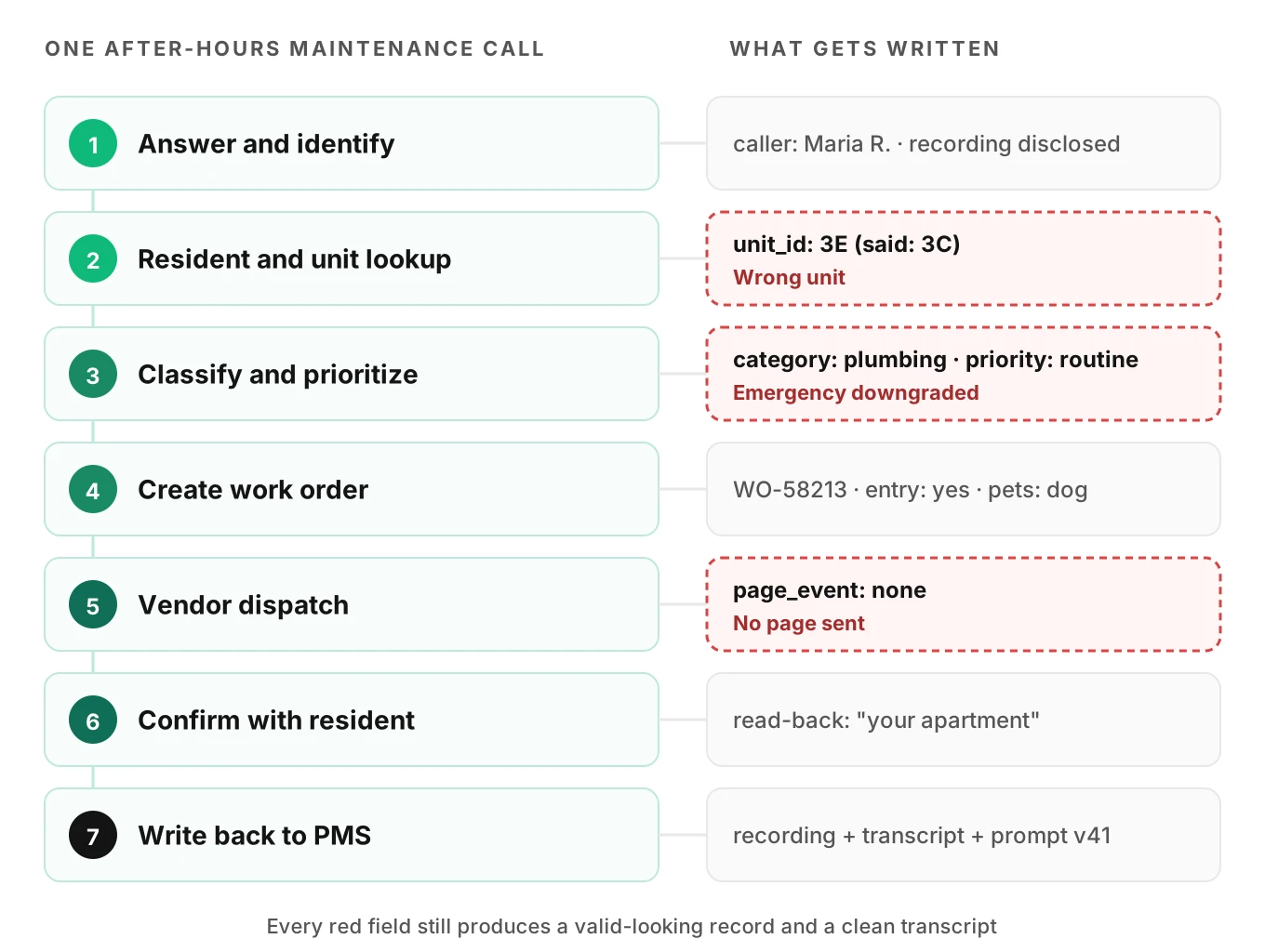
Three corruptions enter this chain without any error being raised. We will call them wrong unit, emergency downgraded and prospect data lost. Each one passes a transcript review. Each one leaves a valid-looking record. Our guide to detecting silent tool failures covers the general pattern. Here is how it plays out in property management.
Three silent failures a transcript review never catches
Wrong unit
Unit identifiers are short, dense and full of confusable letters. Units 3C, 3E, 3D, 3B and 3G differ by one E-set letter. The E-set is B, C, D, E, G, P, T, V and Z. Speech researchers call it "a set of highly confusable sounds" and have for decades. Juneja, Deshmukh and Espy-Wilson's ICASSP 2002 paper reported 75.7% word accuracy on isolated E-set letters. That was clean lab audio, not a phone line.
Phone audio makes it worse. Most calls still reach your stack as 8 kHz narrowband audio. That band cuts off above roughly 3.4 kHz. Much of the burst and fricative energy that separates "C" from "E" lives above that cutoff. The speech model then leans on its language model to guess. It will often pick the more common token.
The agent rarely says the unit number back in the same form it stores it. It might say "your apartment" while writing "3E". So the resident says "yes" to a confirmation that never contained the error. Our post on STT accuracy for names and entities covers how to measure this class of error.
The lookup can also fail without any speech error. A resident calls from a spouse's phone. The phone match returns the spouse's old unit from a prior lease. Or two buildings in one portfolio both have a "Unit 204". The agent picks the first match. Both errors produce a perfect transcript and a wrong record.
Emergency downgraded
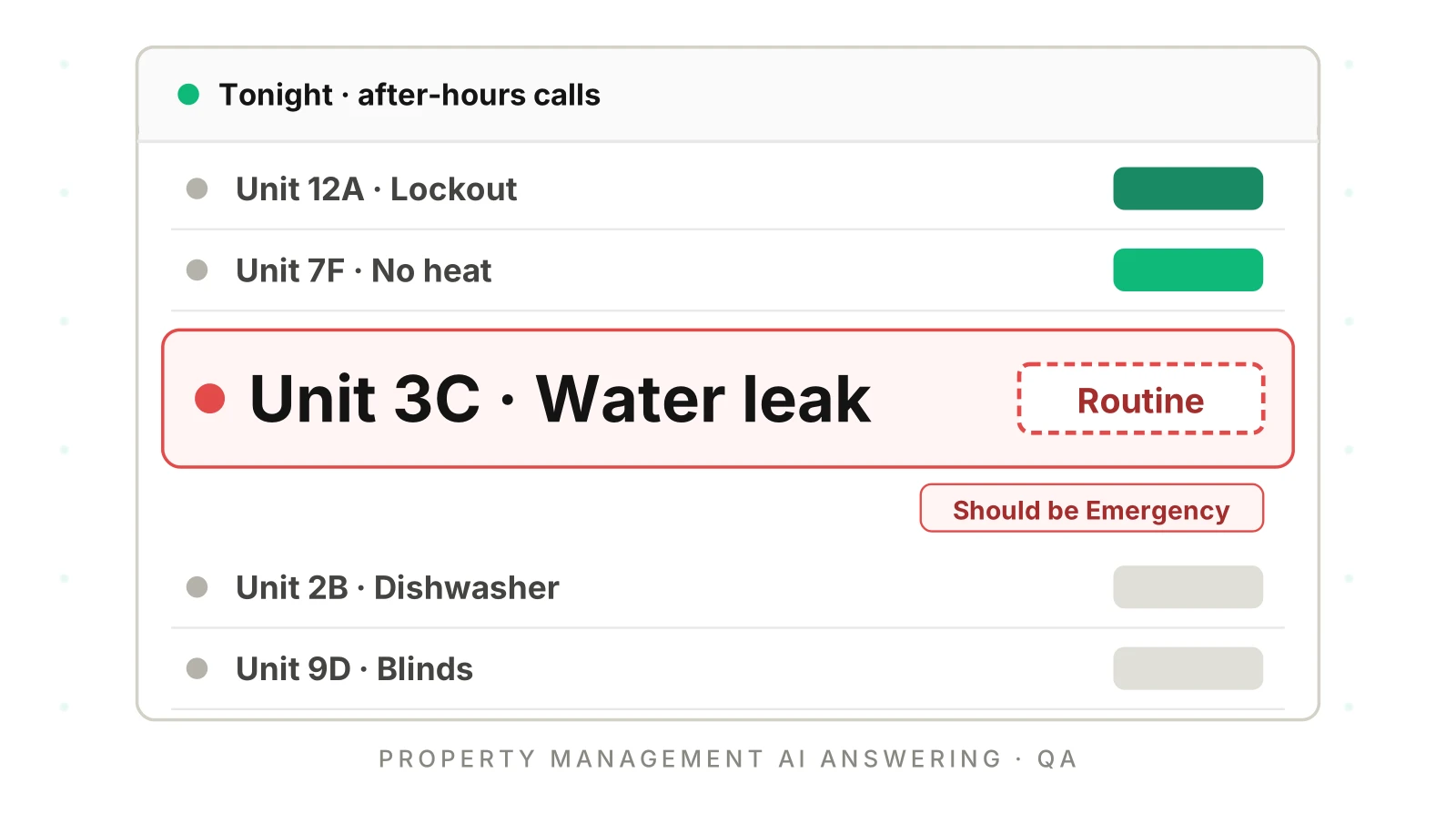
This is the costliest silent failure. A resident reports some water coming from the ceiling, adding that "it's not too bad." The classifier hears "not too bad" and sets priority to routine. The work order is perfect except for one field. Nobody is paged. The leak runs for eight hours.
Water is the expensive case. Triple-I's homeowners claims data puts the average water damage and freezing claim at $15,400 for 2019 to 2023. That figure is for homeowners policies, not multifamily. Use it as a sense of scale, not a forecast. In a stacked building, one unit's leak can reach the units below.
Downgrades come from a few mechanisms:
- Calm callers. Severity words drive the classifier more than facts. A calm resident describing an active leak scores lower than an anxious one describing a drip.
- Early commitment. The agent picks a priority after the first sentence. The resident's next sentence ("and it's near the light fixture") arrives after the decision.
- Interruptions. The agent barges in with "I can help with that" and the critical detail is never captured.
- Config drift. One property manager defines no heat as an emergency below 55°F. Another uses a different threshold set by local code. The agent serves both with one prompt.
Prospect data lost
Leasing calls fail more quietly. The agent has a pleasant chat about two-bedroom pricing and books a tour. Then the lead record has no callback number because the caller's number was blocked. Or the tour landed on the sister property with a similar name. Or the tour time was saved in UTC and shows as 3 a.m. on the leasing calendar.
The prospect does not call back to complain. They simply rent elsewhere. This loss never shows up as a failed call. It shows up months later as a lower lead-to-lease rate. Our sibling post on testing AI tour booking goes deep on no-shows, ID checks and wrong units.
Emergency triage: the rubric your agent must follow
"Can AI handle emergency maintenance calls?" is the question every property manager asks. The honest answer is yes, if the triage rules are explicit, tested and specific to each customer. A model's general sense of urgency is not a rubric.
What counts as a maintenance emergency? Each property manager sets their own list, often shaped by local code and the lease. Most lists share a core: threats to life, threats to the building and loss of essential services. Your agent needs that list per customer, and it needs a required action for each item.
| Category | Caller signals | Required priority | Required action in the call |
|---|---|---|---|
| Gas smell | "smell gas", "rotten eggs", "hissing" | Emergency, 911 first | Tell caller to leave, then call 911 from a safe place |
| Fire, smoke, sparking | "smoke", "burning smell", "sparks from outlet" | Emergency, 911 first | Tell caller to leave and call 911 |
| Active water leak | "water coming through", "won't stop", "ceiling dripping" | Emergency | Ask about shutoff valve, page on-call |
| Sewage backup | "toilet overflowing", "coming up the drain" | Emergency | Page on-call, advise stopping water use |
| No heat in cold weather | "no heat", "furnace off" plus temperature | Per customer threshold | Capture indoor temperature, page if over threshold |
| Lockout | "locked out", "lost keys" | Per customer policy | Verify identity before any access step |
| Power or elevator outage | "no power in unit", "stuck in elevator" | Emergency for entrapment | Entrapment: 911 and page on-call |
The gas row has a twist that catches many agents. PHMSA's pipeline emergency guidance says to leave the area first. Then "telephone 911 from a neighbor's house or other location well away from the gas leak." Its list of things not to do includes "use a telephone or cell phone (these can ignite airborne gases)" near the leak. An agent that keeps a gas caller on the line to collect a unit number and permission to enter is doing the wrong thing. It is following its form. The correct behavior is a short, scripted exit: leave now, call 911 from outside, we'll follow up. Test that the agent ends the call quickly in this scenario.
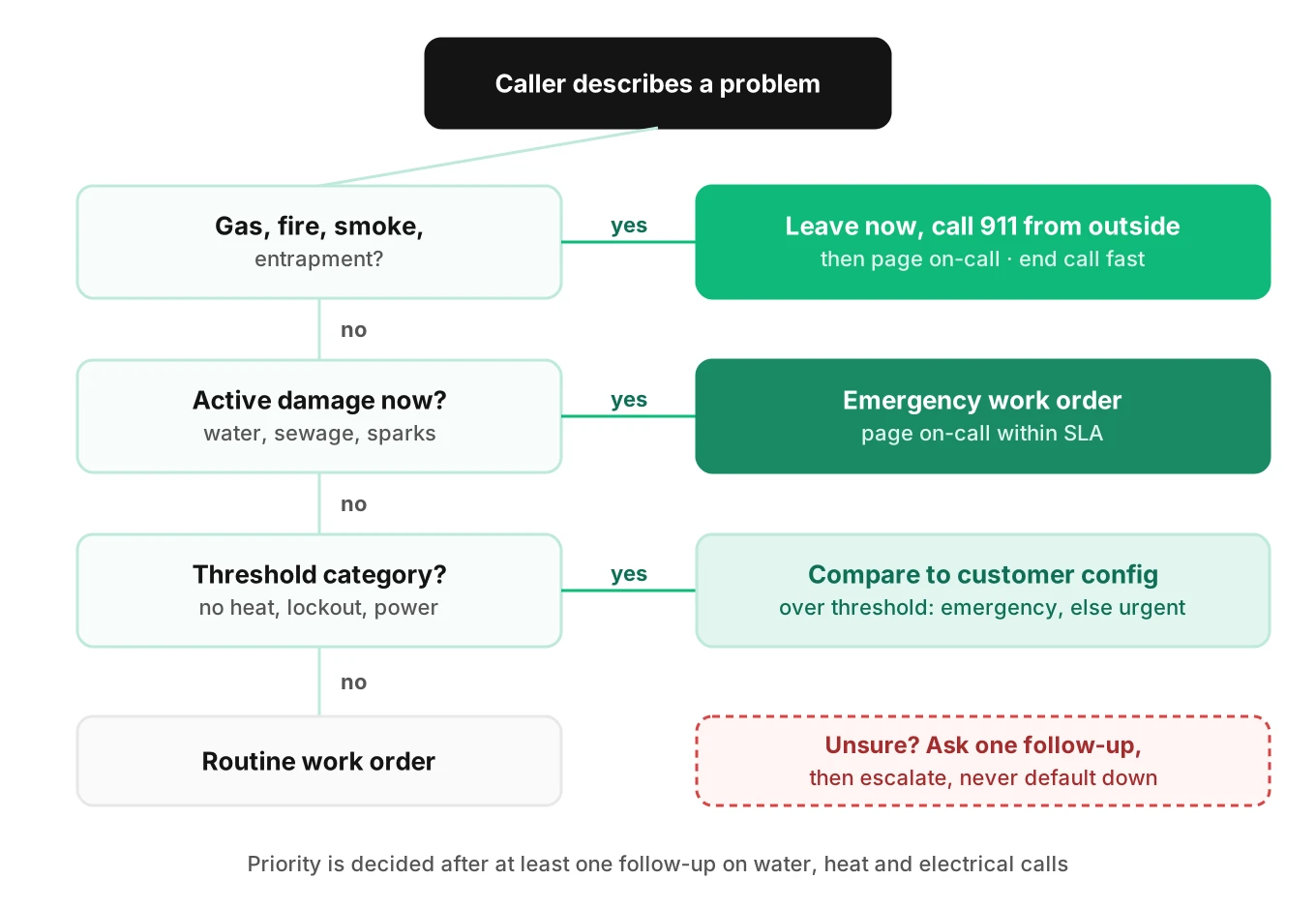
Two rules make this rubric testable.
1. Asymmetric thresholds. A false emergency costs one unneeded page. A missed emergency costs a flooded building. Set the agent to escalate when in doubt. Then measure the false-page rate so it stays tolerable for on-call staff.
2. Priority is decided late. The agent should ask at least one follow-up before committing priority on any water, heat or electrical call. Asking whether water is still coming in right now separates a past drip from an active leak.
Our sibling post on wrong work orders from AI maintenance calls breaks down category and priority errors in more detail. The home services QA guide covers emergency dispatch for plumbers and HVAC firms, which shares many of these signals.
The worked math: how many test calls prove an emergency gate
Product teams usually test emergencies with a handful of calls. That is not enough to support any claim. Here is the math.
What a small downgrade rate costs at platform scale
Take an illustrative platform. These numbers are assumptions for the example, not data.
- After-hours maintenance calls across all customers: 3,000 per night.
- Share that are true emergencies: 8%, so 240 per night.
- Agent downgrade rate on true emergencies: 2%.
Expected downgrades per night = 3,000 × 0.08 × 0.02 = 4.8. That is about 1,750 missed emergency pages a year. Each one is a resident waiting until morning with an active problem. Even a small share of water cases at the Triple-I severity scale is a large bill for your customers.
How many scenarios prove the rate is low
Use the rule of three. Say you run n independent emergency scenarios and see zero downgrades. The 95% upper bound on the true rate is then about 3 / n.
- 30 scenarios, zero failures: the rate could still be up to 10%.
- 300 scenarios, zero failures: up to 1%.
- 600 scenarios, zero failures: up to 0.5%.
So "we tested 20 emergency calls and they all worked" proves very little. A credible gate needs hundreds of emergency scenarios. They should vary the category, wording, calmness, accent, noise and interruptions.
Why one pass is not enough
LLM agents are not deterministic. The tau-bench paper introduced pass^k, the chance an agent succeeds on all k runs of the same task. It reported pass^8 below 25% in its retail domain for a GPT-4o function-calling agent. That is a tool-use benchmark, not a voice benchmark. The lesson still transfers: one success does not mean reliable success.
If each run succeeds independently with probability p, then pass^k ≈ p^k. At p = 0.95, pass^5 = 0.95^5 ≈ 0.77. A scenario that "passed" once still fails one time in twenty. Run each emergency scenario at least five times. Report both the per-run pass rate and pass^5.
Fair Housing consistency in leasing answers
Leasing calls carry a different kind of risk. The question "is AI leasing compliant with Fair Housing?" has no yes or no answer. Compliance depends on what the agent says to each caller and whether it says the same thing to everyone.
The Fair Housing Act at 42 U.S.C. 3604 is the core statute. Four parts map directly onto a leasing agent:
- 3604(a) bars refusing to rent or "otherwise make unavailable or deny" a dwelling because of a protected class.
- 3604(b) bars different "terms, conditions, or privileges" of rental, including services and facilities.
- 3604(c) bars any "notice, statement, or advertisement" that "indicates any preference, limitation, or discrimination" in a rental. A spoken answer on a leasing line is a statement.
- 3604(d) bars telling someone, because of a protected class, that a dwelling is not available when it is.
Disability adds a further rule. Section 3604(f)(3)(B) covers "a refusal to make reasonable accommodations in rules, policies, practices, or services." It treats that refusal as discrimination where needed for equal use. Put simply, a reasonable accommodation request must reach a human who can grant it. An agent that answers "Do you allow animals? I have an emotional support animal" with "Sorry, no pets" may be refusing an accommodation request. The safe pattern is to recognize the request and route it to staff.
What changed with HUD guidance
HUD withdrew a group of fair housing guidance documents effective September 17, 2025. The Federal Register notice (FR-6571-N-01) lists eight. They include the April 2024 guidance on digital advertising, two assistance animal notices and a 2024 source-of-income testing memo. The notice says actions that do not comply with the text of the Fair Housing Act "continue to be subject to enforcement by the Department" all the same. It also says nothing in it "affects the rights of parties to seek redress in the proper court" either.
For a product team, the takeaway is simple. Withdrawn guidance removes HUD's explanation of how the law applies. It does not remove the statute. Your agent's answers still need to be consistent across callers. Many states and cities also ban source-of-income discrimination, such as refusing housing voucher holders. The rules vary by place, so encode each customer's local policy rather than one national answer.
The paired-caller consistency test
Fair Housing testers have long used paired testing: two matched people ask the same questions and the answers are compared. You can run the same design with synthetic callers.
1. Write one leasing script: availability, price, specials, deposit, pets, earliest tour.
2. Vary only one attribute per pair: name, accent, mention of children, mention of a wheelchair, mention of a voucher.
3. Run each pair many times through the real phone path.
4. Compare the substance: units offered, prices quoted, specials mentioned, tour slots offered, follow-up promised.
Any systematic difference is a finding, even if no single answer is rude. Speech recognition is part of this. Koenecke et al. (PNAS 2020) tested five commercial ASR systems on 19.8 hours of matched interviews. Average word error rate was 0.35 for Black speakers and 0.19 for white speakers. Say your speech layer mishears some callers more. Those callers hear more requests to repeat themselves. They also complete fewer tour bookings. The outcome differs even with an identical prompt. Our posts on accent robustness and AI interviewer bias testing describe the same disparity test in other domains.
Outbound, recording and screening
Some agents also call out for lease renewal reminders, rent reminders and tour confirmations. Do AI calls to tenants need consent? In many cases, yes. The FCC's February 2024 declaratory ruling (FCC 24-17) found that AI-generated voices are "artificial" under the TCPA. Under 47 CFR 64.1200(a)(1), artificial-voice calls to wireless numbers need prior express consent unless made for emergency purposes. Telemarketing calls need prior express written consent. Section 64.1200(b)(1) requires the message to "state clearly the identity of the business" responsible at the start. A renewal call that markets an upgrade can become telemarketing. See our real estate speed-to-lead TCPA checks for the consent-record pattern.
Call recording is the other gate. California's Penal Code 632 penalizes recording a confidential communication "without the consent of all parties" to it. Several other states have similar all-party rules. Your agent serves residents in many states, so disclose recording at the start of every call. If tenant screening comes up, the Fair Credit Reporting Act also applies. Most teams route screening questions to staff.
This section is a summary for product teams, not legal advice. Confirm your obligations with counsel for each market you serve.
One agent, hundreds of portfolios: where config drift hides
Your agent is not one agent. It is one prompt plus hundreds of customer configurations. Each property manager has their own emergency list, on-call rota and vendor list. Office hours, time zone, pet policy and renewal script differ too. A change that is safe for one customer can break another.
Common drift points:
- Emergency definitions. No-heat thresholds, whether lockouts are billable after hours and whether appliance failures count.
- Dispatch targets. A vendor phone number that changed last month. An on-call schedule with a gap on Sunday nights.
- Portfolio shape. A student housing operator with bed-level leases. A single-family rentals portfolio with no unit numbers at all, just street addresses. An HOA with lots, not units.
- Time zones. A management company in Arizona with properties in Texas. Tour slots and "after-hours" windows need the property's zone, not the company's.
This is why the go-live checklist for each new customer's AI phone agent matters so much here. Every customer onboarding is a new deployment. Every prompt change is a regression risk across all of them.
A failure taxonomy for property management calls
Use this taxonomy to tag findings, so you can count them by type across customers.
| Failure | Where it enters | How it shows up | Detect it by | Severity |
|---|---|---|---|---|
| Wrong unit | STT or lookup | Technician at the wrong door | Compare stored unit to scenario truth | High |
| Emergency downgraded | Classification | No page, routine ticket | Priority field vs rubric | Critical |
| On-call not paged | Dispatch tool call | Emergency ticket, silence | Page event within N minutes | Critical |
| Gas caller kept on line | Flow design | Long call during a leak | Call duration and script on gas scenarios | Critical |
| Accommodation refused | Leasing answer | "No pets" to an assistance animal request | Policy check on answer audio | High |
| Inconsistent leasing answer | Leasing answer | Different specials by caller | Paired-caller comparison | High |
| Lead missing callback | Record creation | Lead with no phone | Required-field check | Medium |
| Wrong property tour | Lookup | Tour on sister property | Property ID vs scenario truth | Medium |
| Balance from wrong lease | Lookup | Wrong amount read aloud | Ledger ID vs verified resident | High |
| Read-back mismatch | Confirmation | Caller confirms text it never heard | Spoken read-back vs stored record | High |
The last row deserves attention. A read-back only protects you if it reads the stored value, not the value the agent intended to store. Read the unit from the created work order and say it back. Then the confirmation actually tests the write.
How to test a property management AI answering agent before every change
This is the step-by-step plan. It answers "how to test a property management AI answering service" for a small team. Assume a few engineers and no QA function.
1. Export each customer's live configuration. Pull emergency lists, thresholds, on-call rotas, vendor targets, time zones and pet policies into a versioned file per customer. Tests must run against these, not against a demo config.
2. Generate scenarios from the prompt and flows. Cover every state and branch: each emergency category, each lookup path, each leasing question, each refusal. Evalgent generates test scenarios from the agent's prompt and flows, including hard constraints and coverage gaps. You can also build them by hand from the rubric tables above.
3. Define the expected record, not the expected words. For each scenario, write the work order or lead you expect: unit ID, category, priority, page required, required fields.
4. Add realistic caller profiles. Vary accent, pace, interruptions, response delay and calmness. Add background noise that fits the scenario: running water, a TV, wind outside, a crying child. Evalgent's caller profiles cover accent, speech pace, interruption level, response delay, behavior, background noise and language.
5. Call through the real phone path. Place calls over PSTN or SIP so the audio goes through the same 8 kHz path residents use. Browser-only tests skip the codec that causes E-set errors.
6. Grade the record and the audio. Compare the PMS record to the expected record. Check the page event and its timing. Judge the spoken answer from the audio, since a transcript can hide talk-over and dropped words. See transcript vs audio evaluation for why this matters.
7. Apply hard gates. Block release on any emergency downgrade, any missed page, any gas-scenario failure or any paired-caller inconsistency. Track unit accuracy and lead completeness as rate thresholds.
8. Roll out by customer cohort. Ship to a few portfolios first. Watch production calls before the full rollout. Our guide to shipping voice agent prompt changes safely covers cohort rollouts.
Here is a simplified checker for step 6. The record shape is generic, not any vendor's API. Map it to your PMS work-order and paging objects.
# Simplified: grade one simulated maintenance call against its expected record.
from datetime import timedelta

def grade_maintenance_call(expected, work_order, page_events, call):
    failures = []

    if work_order is None:
        return ["no_work_order_created"]

    if work_order["unit_id"] != expected["unit_id"]:
        failures.append("wrong_unit")

    if work_order["property_id"] != expected["property_id"]:
        failures.append("wrong_property")

    if expected["priority"] == "emergency" and work_order["priority"] != "emergency":
        failures.append("emergency_downgraded")

    if expected["page_required"]:
        deadline = call["ended_at"] + timedelta(minutes=expected["page_within_min"])
        on_time = [e for e in page_events
                   if e["work_order_id"] == work_order["id"] and e["sent_at"] <= deadline]
        if not on_time:
            failures.append("oncall_not_paged")

    # The read-back must match what was stored, not what was intended.
    if call.get("readback_unit_id") and call["readback_unit_id"] != work_order["unit_id"]:
        failures.append("readback_mismatch")

    for field in expected.get("required_fields", []):
        if not work_order.get(field):
            failures.append(f"missing_{field}")

    return failures
Run it on every scenario, five times each. Group failures by type and by customer. A rise in `wrong_unit` for one customer often points to data, not the model. Duplicate unit labels are a common cause.
Measuring AI answering quality across properties
This section answers "how to measure AI answering quality across properties" once the agent is live. In production, the question shifts from whether it works to where it fails this week. Here is a starter scorecard. The thresholds are starting points to tune, not industry standards.
| Metric | Definition | Starting target |
|---|---|---|
| Emergency recall | True emergencies tagged emergency ÷ all true emergencies | 100% in tests, review every miss live |
| Page latency | Time from call end to on-call page, emergencies only | Within customer SLA, alert on any miss |
| Unit accuracy | Records with the correct unit ÷ all records | 99%+ on scenarios |
| Lead completeness | Leads with name, callback number, property and tour time ÷ all leads | 98%+ |
| Accommodation routing | Accommodation requests routed to staff ÷ all such requests | 100% |
| Paired consistency | Pairs with matching substance ÷ all pairs | 100% on offered units and prices |
| False page rate | Pages for non-emergencies ÷ all pages | Track per customer, agree a ceiling |
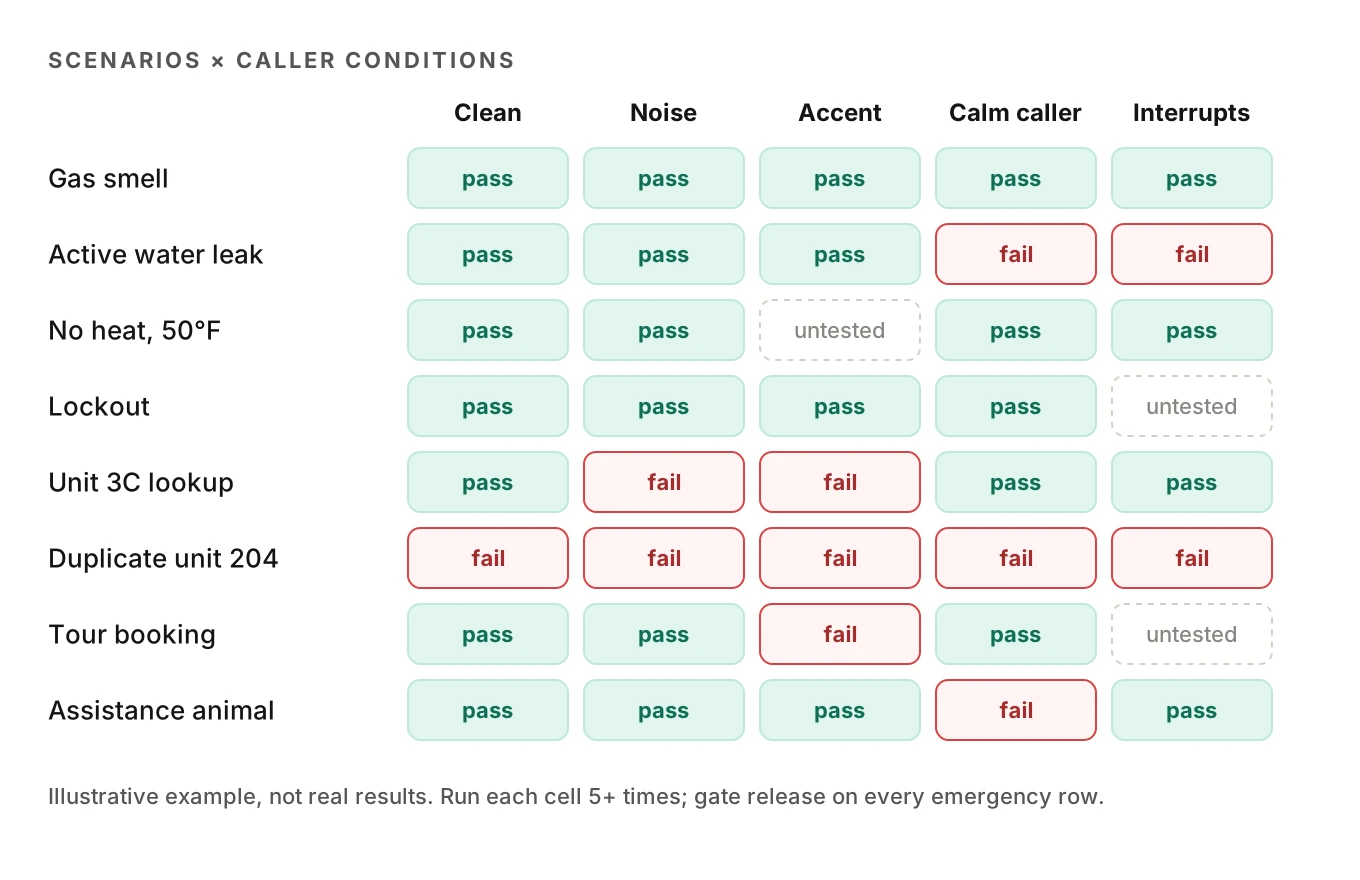
Slice every metric by customer, property type and hour. Student housing at 2 a.m. behaves nothing like a senior community at noon. A platform average hides the one portfolio where a duplicate "Unit 204" is sending technicians to the wrong building.
Production monitoring closes the loop. Evalgent's production monitoring takes pushed call recordings, transcribes them, maps each call to a scenario and judges it. It flags tool-call failures, latency spikes, PII leakage and policy failures with fix recommendations. A human reviews the verdicts. Each confirmed failure should become a new regression scenario. The pattern is in our guide to turning production failures into tests.
What should an AI answering service write to the PMS
The write-back is the product. A good record lets a technician, a leasing agent or a property manager act without replaying the call. At minimum, each record should carry:
- Resident or prospect ID, and how identity was verified.
- Property ID and unit ID, from the lookup result, not the raw transcript.
- Category and priority, plus the rubric rule that set the priority.
- The caller's own words for the problem, as a short quote.
- Permission to enter, pets and access notes.
- Dispatch events: who was paged, when, and whether they acknowledged.
- What the agent told the caller, including any safety instruction.
- Call recording link, transcript link, and the agent and prompt version.
The rubric rule and prompt version matter more than they look. When a property manager disputes a missed emergency, you need to show which rule fired and which version was live. Without that, every incident becomes a guess. Our HOA AI phone calls guide covers the same write-back logic for property and violation lookups.
Frequently asked questions
How to test a property management AI answering service?
Test a property management AI answering service by grading the records it creates, not the transcript. Build scenarios for each emergency category, lookup path and leasing question. Run them over the real phone path with varied accents, noise and interruptions. Check unit, priority, page timing and required fields against an expected record. Repeat each scenario at least five times.
Can AI handle emergency maintenance calls?
AI can handle emergency maintenance calls when triage rules are explicit, configured per customer and tested at volume. The agent should ask a follow-up before setting priority on water, heat or electrical calls. It should escalate when unsure. Gas and fire callers need a short exit script: leave now and call 911 from a safe place.
What counts as a maintenance emergency?
A maintenance emergency is usually a threat to life, a threat to the building or a loss of essential service. Common examples are gas smells, fire or smoke and active water leaks. Sewage backups, no heat in cold weather and elevator entrapment also count. Each property manager sets the exact list and thresholds, often shaped by local code and the lease.
Is AI leasing compliant with Fair Housing?
AI leasing compliance with Fair Housing depends on what the agent says. It also depends on saying the same thing to every caller. The Fair Housing Act bars discriminatory statements and false unavailability claims. Paired-caller tests reveal differences in units, prices or tour slots offered. Assistance animal requests should route to staff, not get a "no pets" answer.
Do AI calls to tenants need consent?
AI calls to tenants often need consent. The FCC ruled in February 2024 that AI-generated voices are artificial under the TCPA. Artificial-voice calls to wireless numbers generally need prior express consent, and telemarketing calls need prior express written consent. Calls must identify the business at the start. Confirm details with counsel.
How accurate is AI at capturing unit numbers?
AI accuracy at capturing unit numbers varies with phone audio quality and unit format. Letters like C, D, E, B and G are easy to confuse on 8 kHz phone lines. Measure unit accuracy on your own scenarios over the real phone path. Have the agent read back the unit from the stored record, not from its own intent.
How to measure AI answering quality across properties?
Measure AI answering quality across properties by slicing each metric by customer, property type and hour. Track emergency recall, page latency, unit accuracy, lead completeness, accommodation routing and paired consistency. Platform averages hide failures in single portfolios. Turn every confirmed production failure into a regression scenario for that customer's configuration.
What should an AI answering service write to the PMS?
An AI answering service should write the verified resident, property and unit IDs. It should add category, priority and the rule that set priority. It should also write the caller's words, access notes and dispatch events. Add what the agent told the caller, the recording link and the prompt version. That record lets staff act without replaying the call.
The bottom line
Property management AI answering succeeds or fails in the record it writes, not in how the call sounds. Test the unit, priority, page and answer consistency in every customer's configuration before each change goes live.
Related Articles

How to automate voice agent testing: synthetic callers vs manual QA
Learn how ai test automation replaces manual QA for voice agents. Compare synthetic callers vs human testers, with a 5-step framework to scale without hiring.
Read more
AI Agent Testing vs Voice Agent Testing: What General Tools Miss for Voice
AI agent testing measures text outputs. Voice agent testing measures behaviour through an acoustic pipeline. Five failure categories general tools miss.
Read more