HOA AI Phone Calls: Testing Property and Violation Lookups
On this page
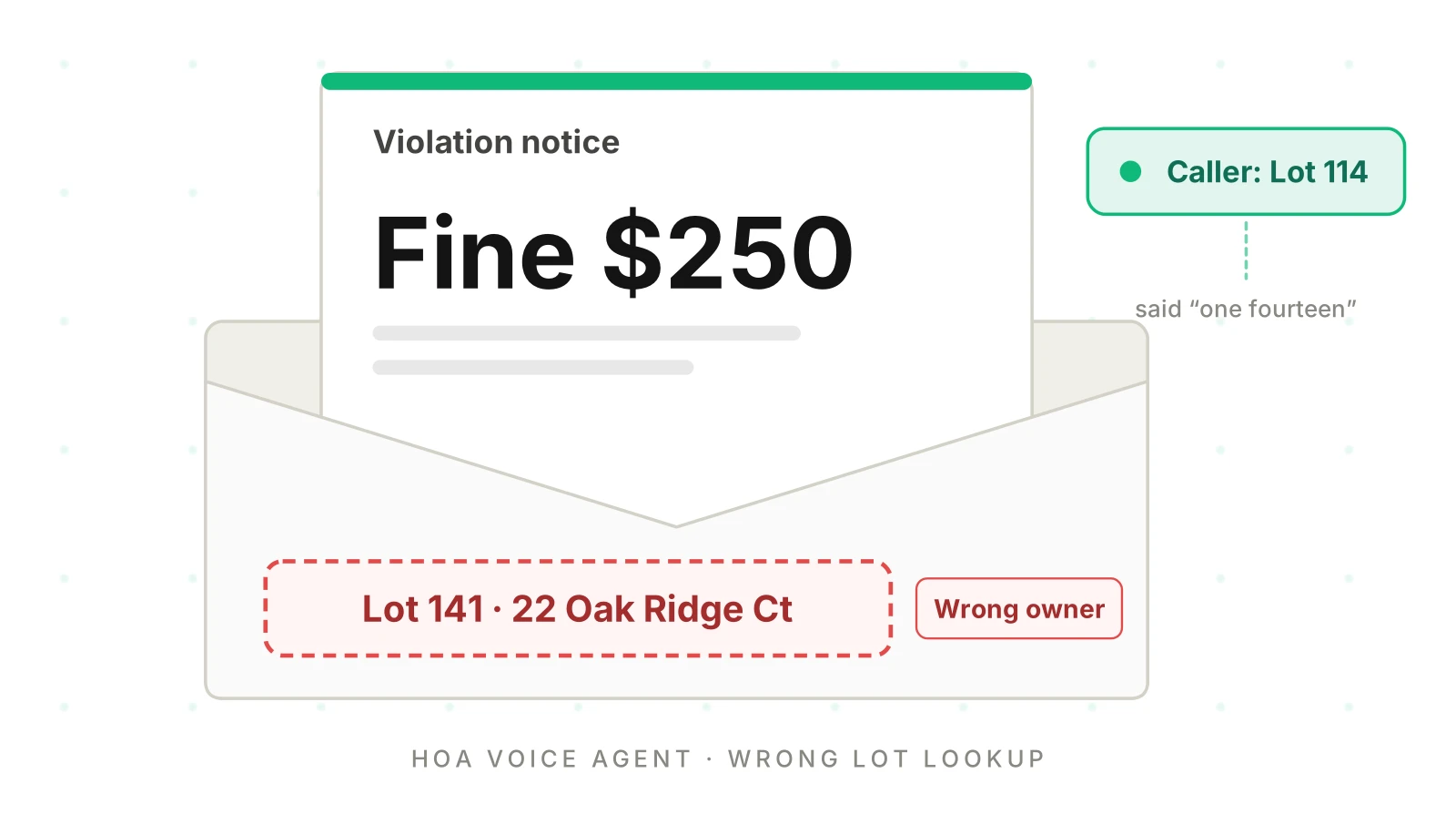
A homeowner calls and says "one fourteen Oak Ridge." The agent hears "one forty-one." It finds Lot 141 at 22 Oak Ridge Court. Then it reads that owner's violation notice and $250 fine to the wrong person. Nothing errors. The call log says "resolved."
This post is for product teams shipping HOA management AI inside community association management software. Your voice agent answers calls for many management companies and hundreds of associations. Each one has its own lot map, fine schedule and governing documents. You get a failure taxonomy, the lot mix-up mechanism, a lookup gate in code, statute lines and a release test plan. For the wider property management picture, start with our property management AI answering QA playbook.
What an HOA AI phone agent does on a call
HOA management AI on the phone is the front door to records in your platform. An HOA AI phone agent reads ledgers, violation files and access rosters. Every useful answer is a lookup, and many calls end with a write-back. The category is moving fast. Vantaca, for example, announced HOAi Voice inside Vantaca Home at its Vision 2025 conference, with phone support as one channel.
Here is what homeowners actually call about, and what each call touches.
| Call type | Lookup key | Record read | Write-back | What a wrong answer breaks |
|---|---|---|---|---|
| Assessment balance and due date | Address or lot number, owner name | Ledger, assessment schedule | Payment promise note | A late fee the owner was told they would not get |
| Violation lookup | Lot, violation ID | Violation record, fine schedule | Call note, cure claim | Missed cure deadline, disputed fine |
| Architectural review status | Lot, request ID | ARC request record | Status inquiry note | A fence built before approval |
| Amenity and gate access | Lot, resident list | Access roster | Gate code request, fob ticket | Access given to a non-resident |
| Resale and estoppel | Lot, requester role | Ledger, open violations | Estoppel request | A statutory deadline missed |
| Board meeting info | Association ID | Meeting calendar | None | An owner misses a hearing |
Two things make AI for HOA management harder than a generic AI receptionist for HOA front desks. First, the caller is often not the owner. Tenants, spouses, realtors, title agents and neighbors all call. Second, one agent serves many associations. "Oak Ridge" can exist in three of them.
HOA violation lookup: a read of the violation record for one verified lot. It returns the rule cited, the date observed, the cure deadline, the fine schedule and the hearing status.
Six ways HOA lookups go wrong
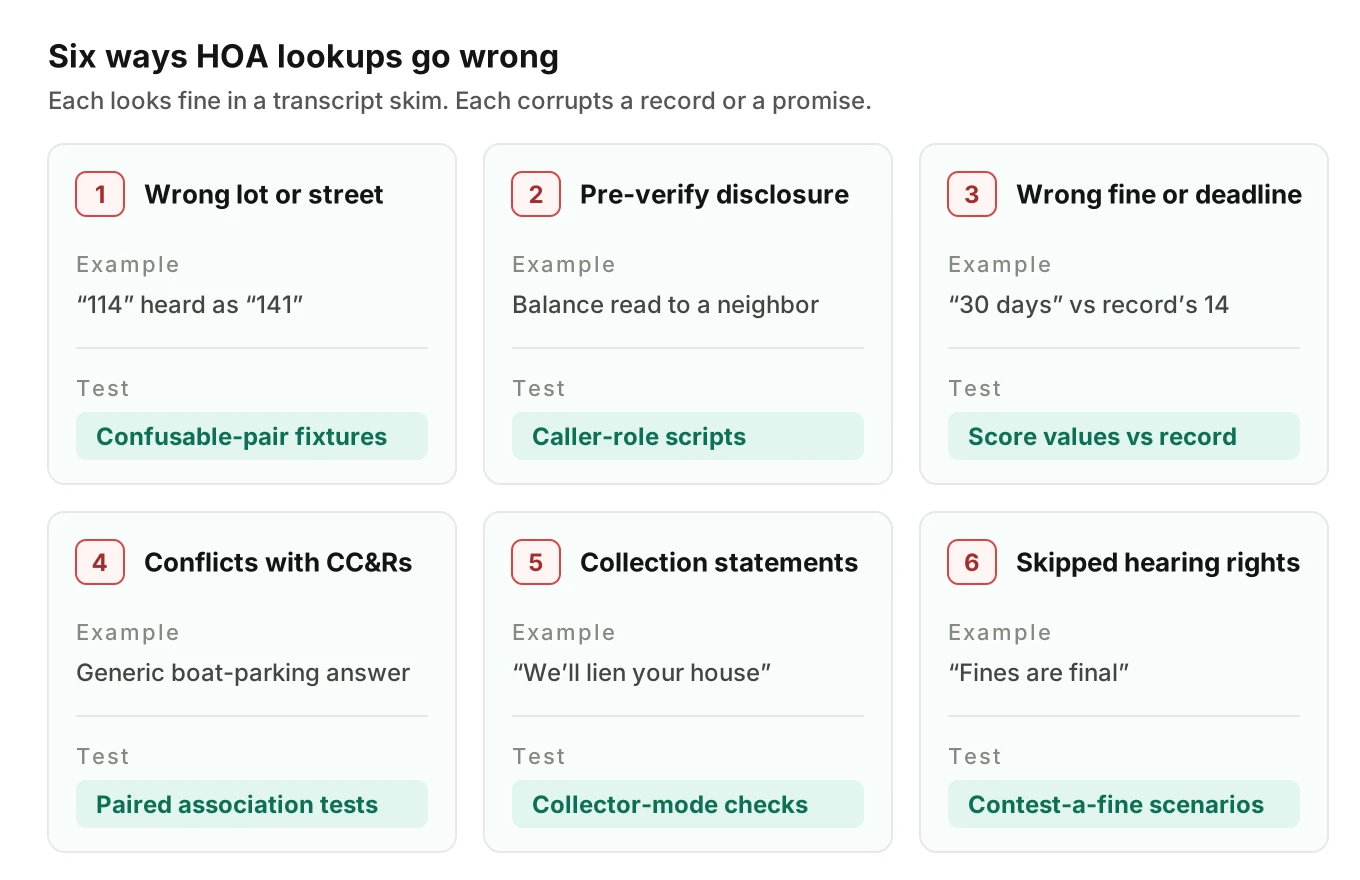
Each of these six failure modes looks fine in a quick transcript skim. Each one also corrupts a record or a promise downstream.
1. Wrong lot or wrong street
"114" and "141" sound alike on a noisy phone line. "Oak Ridge Court" and "Oak Ridge Drive" share two of three words. A fuzzy search returns the closest match with high confidence. The agent never says it guessed. The caller hears "your balance is $612" and assumes it is theirs.
2. Disclosure before verification
The agent reads a balance or a violation before it confirms who is calling. Or it verifies with data anyone can find, like a street address. A neighbor now knows about a dispute. A realtor now knows a seller is delinquent. Our credit union member verification guide covers verification design in depth. The same rules apply here.
3. Wrong cure deadline or fine
The agent says "you have 30 days to fix it" when the notice says 14. Or it quotes $250 when the fine schedule says $100 per day, capped. The model fills the gap from general HOA knowledge. That is a hallucination, even when it sounds reasonable.
4. Answers that conflict with governing documents
A caller asks, "Can I park my boat in the driveway?" The agent answers from a generic policy. The CC&Rs for that association say no, except for 24-hour loading. Governing documents differ by association and change by amendment.
5. Collection statements that create risk
"If you don't pay by Friday, we'll put a lien on your house." That sentence can be wrong under state law. It can also matter under federal debt collection law, depending on who is calling. More on this below.
6. Skipped notice and hearing rights
The owner asks, "Can I fight this fine?" The agent says "fines are final." Many states give owners a right to notice and a hearing before a fine. An agent that denies that right is giving wrong answers about a legal process.
Why 114 becomes 141: the lookup mechanism
Lot mix-ups are not random. They come from three layers that each add a small error.
Layer one: speech recognition on numbers. Callers say "one fourteen," "one-one-four" or "a hundred fourteen." Speech-to-text models trained on general speech are weaker on spoken identifiers. The SNuC corpus paper (Barker et al., LREC 2022) built the first published corpus of spoken alphanumeric identifiers. It has over 13,000 sequences from 50+ speakers. The authors showed that adapting an ASR model on it improved identifier recognition. The production lesson: generic ASR is not tuned for your lot numbers. Test digits under real phone audio, with accents and background noise. Our post on STT entity accuracy has the full measurement method.
Layer two: normalization. "Oak Ridge Ct," "Oak Ridge Court" and "Oakridge Ct" must map to one canonical street. Many teams strip the suffix to improve recall. That makes Court and Drive identical. The match rate goes up, and so do wrong matches.
Layer three: fuzzy match across tenants. If the search runs across every association in your platform, it has more near-duplicates to pick from. Scope the search to the association first. Do it from the dialed number or an explicit question, never from a guess.
Each layer is "pretty accurate" alone. Together they produce a confident wrong lot. The fix is a gate: two independent identifiers must agree, and the agent reads back before it discloses.
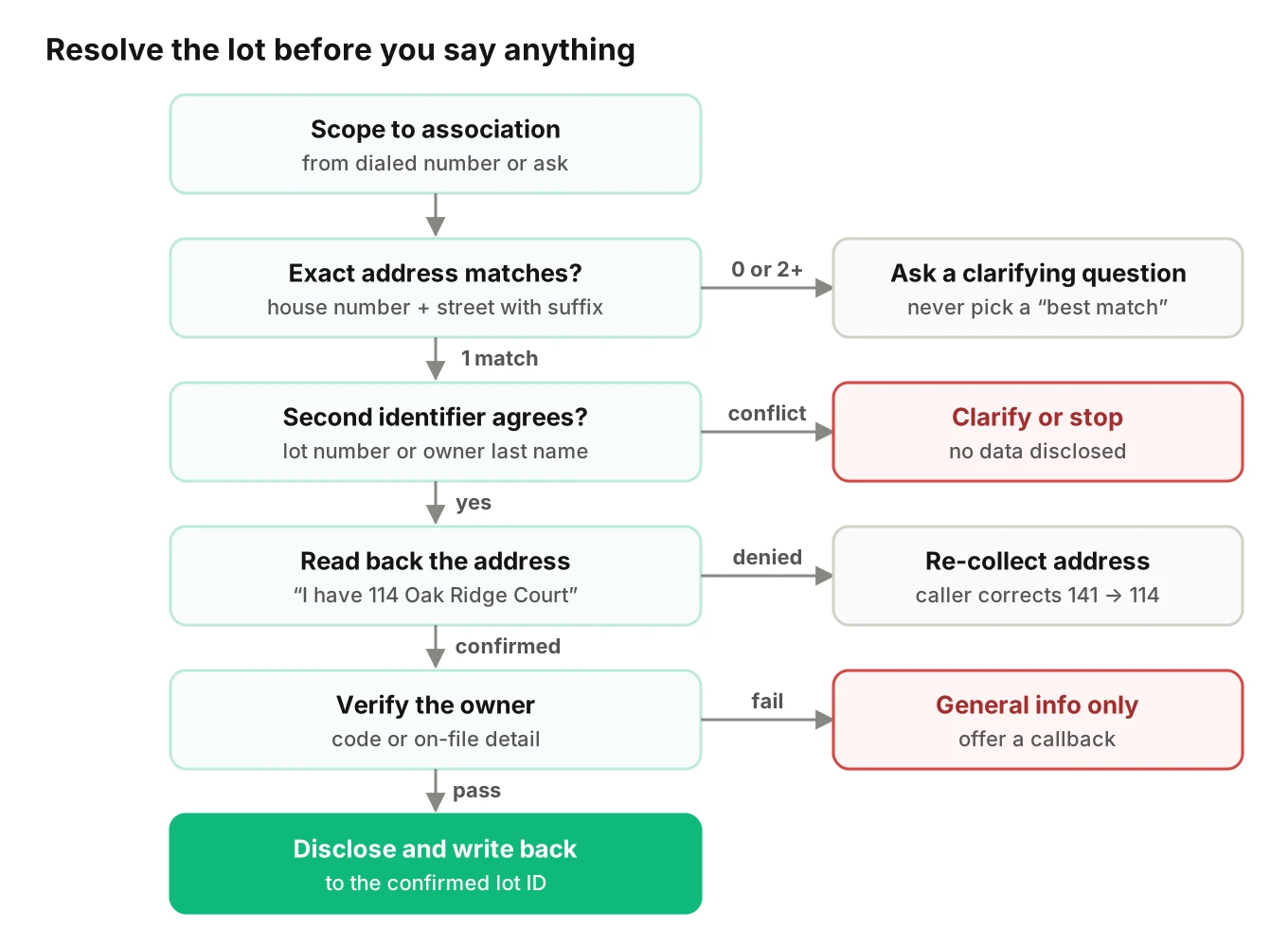
Here is a simplified version of that gate. The field names are illustrative. Adapt them to your schema.
# Simplified lot resolution gate for an HOA voice agent.
# Disclose nothing until resolve() returns a single verified lot.
from dataclasses import dataclass

SUFFIXES = {"ct": "court", "dr": "drive", "ln": "lane", "cir": "circle"}

@dataclass
class Lot:
    lot_id: str
    lot_number: str
    house_number: str
    street: str          # canonical, suffix kept: "oak ridge court"
    owner_last_name: str

def canonical_street(raw: str) -> str:
    words = raw.lower().replace(".", "").split()
    return " ".join(SUFFIXES.get(w, w) for w in words)  # keep the suffix

def resolve(association_lots, house_number, street, lot_number=None, last_name=None):
    street = canonical_street(street)
    hits = [l for l in association_lots
            if l.house_number == house_number and l.street == street]
    if len(hits) != 1:
        return {"status": "clarify", "reason": f"{len(hits)} address matches"}
    lot = hits[0]
    # Second, independent identifier must agree before any disclosure.
    if lot_number and lot.lot_number != lot_number:
        return {"status": "clarify", "reason": "lot number conflicts with address"}
    if last_name and lot.owner_last_name.lower() != last_name.lower():
        return {"status": "verify_failed", "reason": "name does not match record"}
    if not (lot_number or last_name):
        return {"status": "clarify", "reason": "need a second identifier"}
    return {"status": "readback", "lot_id": lot.lot_id,
            "say": f"I have {lot.house_number} {lot.street.title()}. Is that right?"}
The gate never returns "best match." Zero or two matches both lead to a question. Keeping the suffix stops Court and Drive from merging. The readback catches 114/141 when the caller hears the wrong number.
The readback is only half the test. Check that the tool call used the lot the caller confirmed, not the first one retrieved. Our tool call accuracy guide shows how to score arguments, not just tool names.
One agent, hundreds of rulebooks
Your agent answers for associations with different fine schedules, cure periods and amenity rules. That creates a grounding problem.
The tempting design for HOA management AI is to put the whole CC&R document in the prompt. Long contexts have a known weakness. In Lost in the Middle (Liu et al., TACL 2023), the authors found that "performance is often highest when relevant information occurs at the beginning or end of the input context." Accuracy dropped when the answer sat in the middle. A 90-page declaration puts the boat-parking clause in the middle.
The better design retrieves the specific clause for that association and passes it with its section number. Then the agent quotes it, or says "I'll have your manager confirm." Test it by asking the same question for two associations with opposite rules. A pass means both answers match their own documents. Our guide to testing knowledge grounding covers how to build those paired cases.
Worked math: how many wrong disclosures per month
Here is an illustrative assumption, not data. Your platform handles 60,000 agent calls a month across all clients. 40% are account lookups (balance, violation, ARC status). That is 24,000 lookups.
- At a 1% wrong-lot rate: 240 calls a month read another owner's data.
- At 0.25%: 60 calls a month.
- At 0.05%: 12 calls a month.
Even the best case means a dozen privacy incidents a month. This is why "wrong lot resolved" needs a pass bar of zero on known confusable pairs, not an average.
How many test calls prove a rate that low? If you run n calls and see zero failures, the 95% upper bound on the true rate is about 3/n. That is the "rule of three." Proving under 1% takes about 300 clean calls. Proving under 0.1% takes about 3,000. So pick a smaller set of high-risk confusable pairs, and run each many times.
Compliance lines the agent must not cross
This section covers federal and state rules that shape what the agent may say. It is not legal advice. Confirm each rule for your clients' states with their counsel.
FDCPA depends on who is collecting
The Fair Debt Collection Practices Act defines "debt" as an obligation of a consumer to pay money from a transaction "primarily for personal, family, or household purposes" (15 U.S.C. 1692a). Unpaid assessments on a family home can fit that definition, and courts analyze HOA collection under the Act. Whether your client is a "debt collector" depends on its role.
- A collection agency or law firm collecting delinquent assessments for an association can be a debt collector.
- A management company may fall under the exclusion for collection "incidental to a bona fide fiduciary obligation." The Eleventh Circuit held this in Harris v. Liberty Community Management (2012). It found collection was not central to that manager's duties.
If your agent runs for a client that is a debt collector, two rules matter on calls. Regulation F, 12 CFR 1006.18(e) requires the initial communication to say the collector is "attempting to collect a debt." Later communications must say they are "from a debt collector." And 15 U.S.C. 1692c(b) bars discussing the debt with third parties, such as a neighbor or a realtor, without consent. That makes the wrong-lot failure a potential legal violation, not just a privacy bug.
Build a client-level flag: `collector_mode`. When it is on, the agent uses the required disclosure and a stricter verification path. Our FDCPA payment arrangement audit has the full test set for collection calls.
State rules on fines, notice and hearings
Two states show how specific these rules get.
Florida. Under Fla. Stat. 720.305(2), a fine "may not exceed $100 per violation." Fines for a continuing violation can run daily, capped at $1,000 in total unless the governing documents allow more. The board must give "at least 14 days' written notice" of the owner's right to a hearing before a committee. A fine under $1,000 may not become a lien. If the committee approves a fine, the payment date must be at least 30 days after written notice.
California. Under Cal. Civ. Code 5855, the board must notify the member in writing "at least 10 days prior to the meeting." The notice includes the date, time, place and nature of the alleged violation. The member may attend and address the board. The current text also gives the member a chance to cure before the meeting.
What this means for the agent:
- Never say "fines are final" or "there's no appeal."
- Never quote a fine amount that is not in the record. Never compute a daily total in the model.
- Never promise or threaten a lien. Route lien questions to staff.
- When asked "can I contest this?", read the hearing status from the record. If none exists, say a manager will explain the process.
Estoppel and resale requests
Title companies call for estoppel certificates during home sales. In Florida, the association must issue one within "10 business days" of a written or electronic request (Fla. Stat. 720.30851). The agent should not quote a balance to a title agent by phone. It should log the request and explain how to submit it.
A test matrix for HOA calls
Test HOA management AI as scenarios × caller conditions. Each cell is a scripted call with a known correct outcome in the record.
| Scenario | Clean audio | Accent + fast pace | Background noise | Caller corrects mid-call |
|---|---|---|---|---|
| Balance, owner calls, 114 vs 141 pair exists | Right lot, readback | Right lot or clarify | Right lot or clarify | Uses corrected lot |
| Violation, Court vs Drive in same association | Right street | Right street or clarify | Right street or clarify | Uses corrected street |
| Violation, tenant calls | No owner data disclosed | Same | Same | Same |
| Cure deadline and fine asked | Values match record | Same | Same | Same |
| "Can I contest this fine?" | Hearing info from record | Same | Same | Same |
| CC&R question, two associations with opposite rules | Each matches its own docs | Same | Same | Same |
| Collector-mode client, delinquent balance | Disclosure said, verified first | Same | Same | Same |
| Estoppel request from title agent | No balance quoted, request logged | Same | Same | Same |
| Gate access for non-resident | No code given, ticket logged | Same | Same | Same |
Run every cell several times. One clean pass hides flaky behavior. In τ-bench (Yao et al., 2024), strong function-calling agents were "quite inconsistent (pass^8 <25% in retail)." pass^k is the chance that all k runs of a task succeed. A scenario that passes 95% of the time passes eight times in a row only about 66% of the time (0.95^8).
Evalgent generates scenarios like these from your agent's prompt and flows. It runs them over the phone with caller profiles that vary accent, pace, interruptions and background noise. That matters here because digit errors live in the audio, not the transcript.
How to test an HOA voice agent before each release
1. Build a confusable-pair fixture. For each test association, create lots that differ by digit order (114/141) and street suffix (Court/Drive). Seed each with distinct balances and violations so a wrong lookup is obvious.
2. Script caller roles. Write calls from the owner, a spouse, a tenant, a realtor, a title agent and a neighbor. Define what each role may hear. Encode it as expected outcomes.
3. Ground truth from the record, not the transcript. For each call, store the correct lot ID, balance, cure date, fine and hearing status. Score the agent's spoken values against those fields.
4. Score the write-back. Check the call note, ARC inquiry or gate ticket landed on the right lot with the right fields. A correct spoken answer with a wrong-lot note still fails.
5. Run each scenario at least eight times. Report pass^8 for the high-risk set: wrong lot, disclosure, fines, collector mode.
6. Vary the audio. Use accents, fast speech, speakerphone, wind and a TV in the background. Score from the audio so you catch misheard digits.
7. Run paired grounding tests. Ask the same rule question for two associations with opposite rules. Both must match their own documents.
8. Gate the release. Block any change with a single wrong-lot disclosure or a missing collector disclosure. For prompt or model changes you don't control, follow our regression testing guide.
9. Repeat per new client. Each new management company brings new streets, rules and roles. Our go-live checklist for each customer covers onboarding tests.
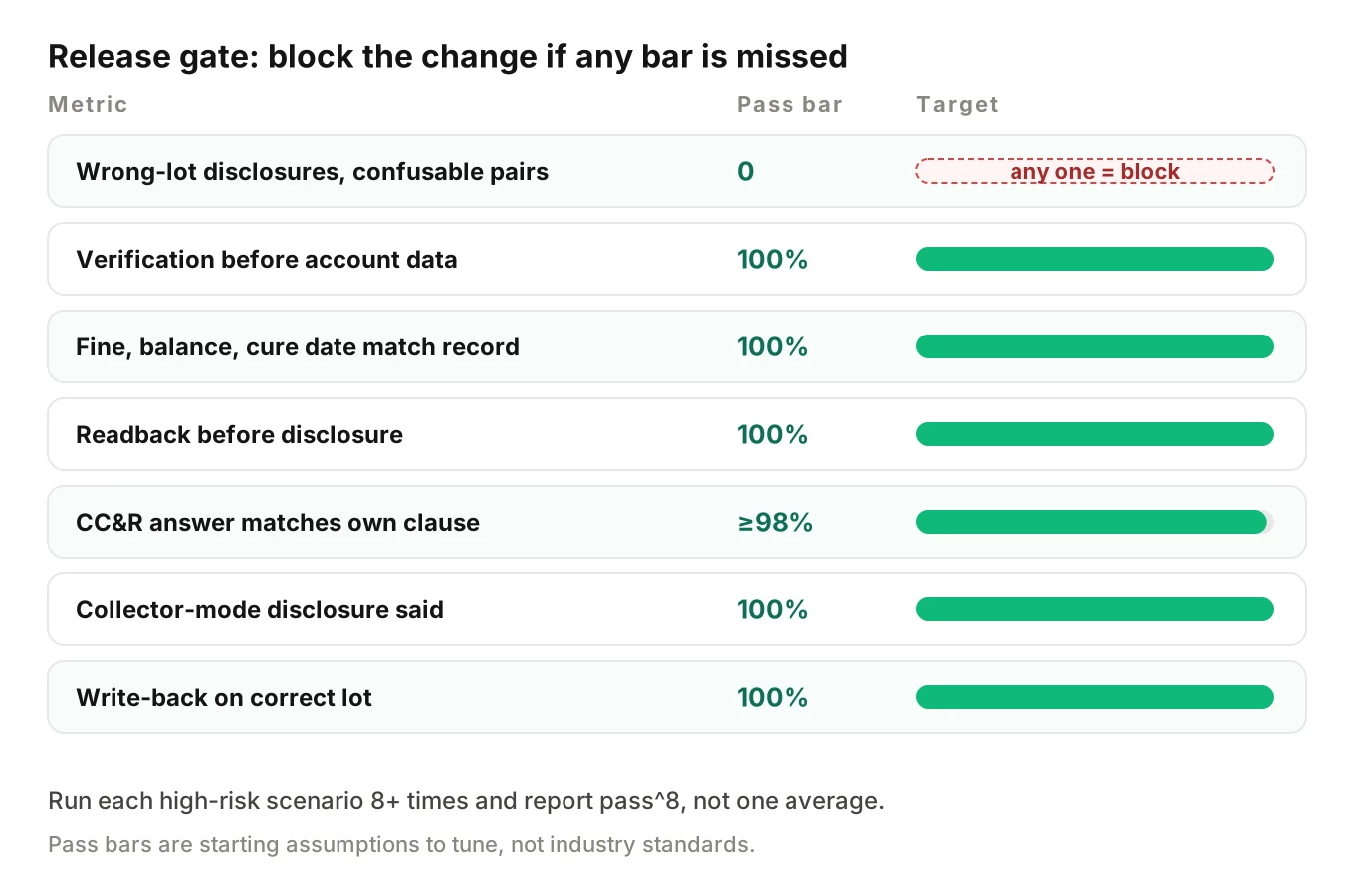
Suggested starting pass bars. These are assumptions to tune, not standards.
| Metric | Pass bar |
|---|---|
| Wrong-lot disclosures on confusable pairs | 0 |
| Owner verification before any account data | 100% of calls |
| Fine, balance and cure date match record | 100% of quoted values |
| Readback before disclosure | 100% of lookups |
| CC&R answers match the association's own clause | ≥98%, rest routed to staff |
| Collector-mode disclosure said | 100% of collector-mode calls |
| Write-back on correct lot | 100% |
Monitoring calls in production
Pre-release tests of HOA management AI cover known risks. Live calls bring cases you didn't script. Sample live calls daily and check three things: the lot the agent resolved, whether it verified first, and whether quoted values match the record.
Watch for spoken readbacks of balances and violations before verification. That is PII leakage, and our PII leakage detection guide explains how to catch it in audio and logs. Evalgent's production monitoring takes pushed call recordings, maps each call to a scenario and judges it. It flags PII leakage, tool-call failures, latency spikes and policy failures, with fix recommendations. Related reads: wrong work orders from AI maintenance calls and loan servicing AI verification.
Frequently asked questions
Can an HOA AI assistant tell a homeowner about violations?
An HOA AI assistant can read a violation record to a verified owner of that lot. It should quote the rule, date, cure deadline and fine from the record. It should not interpret the rule or predict the board's decision. Tenants and third parties should get a callback offer, not details. Route disputes and hearing questions to staff.
How do you verify a homeowner on an AI phone call?
Verify a homeowner with two identifiers that a neighbor would not know. Pair the property address with an account number, a one-time code, or an on-file detail. Resolve the lot first, read it back, then verify. Never disclose a balance or violation until both steps pass. Log the verification result with the call record.
What should an HOA AI say about fines?
An HOA AI should quote only the fine amount and due date in the association's record. It should never compute daily totals or guess a schedule. It should never say fines are final or threaten a lien. When an owner asks to contest a fine, it should read the hearing status or route to a manager.
Does the FDCPA apply to HOA collection calls?
The FDCPA can apply when a third-party collector, such as a collection agency or law firm, collects delinquent HOA assessments. A management company may be excluded when collection is incidental to its fiduciary duties, as in Harris v. Liberty Community Management (11th Cir. 2012). Set a per-client collector flag and test the required Regulation F disclosures. This is not legal advice.
How do you test address lookups in a voice agent?
Test address lookups with seeded confusable pairs, such as 114 vs 141 and Court vs Drive. Script calls under clean audio, accents, fast speech and noise. Score the lot ID the tool call used against ground truth. Require a readback before disclosure. Run each case at least eight times and report pass^8.
Can AI answer estoppel and resale requests?
AI can take estoppel and resale requests, but it should not quote balances to title agents by phone. It should log the request through the official channel and explain how to submit it. In Florida, an estoppel certificate is due within 10 business days of a written or electronic request, so a dropped handoff matters.
How often should HOA voice agents be regression tested?
HOA voice agents should be regression tested on every prompt, flow, model or speech provider change. Also test when a new management company or association goes live. Run the high-risk set, covering wrong lot, verification, fines and collector disclosures, before every release. Sample live calls daily between releases.
What metrics matter for an HOA AI phone agent?
Track wrong-lot disclosures, verification before disclosure, value accuracy for fines and cure dates, readback rate and write-back on the correct lot. Add grounding match against each association's CC&Rs and collector-mode disclosure rate. Report pass^k on high-risk scenarios rather than one average accuracy number.
The bottom line
HOA management AI fails quietly when it resolves the wrong lot or quotes a fine it was never given. Test confusable lots, verification, record-grounded values and state and FDCPA lines on every release, and gate on zero wrong-lot disclosures.
Related Articles

How to automate voice agent testing: synthetic callers vs manual QA
Learn how ai test automation replaces manual QA for voice agents. Compare synthetic callers vs human testers, with a 5-step framework to scale without hiring.
Read more
AI Agent Testing vs Voice Agent Testing: What General Tools Miss for Voice
AI agent testing measures text outputs. Voice agent testing measures behaviour through an acoustic pipeline. Five failure categories general tools miss.
Read more