Gym Cancellation and Freeze Calls by AI: What to Test
On this page
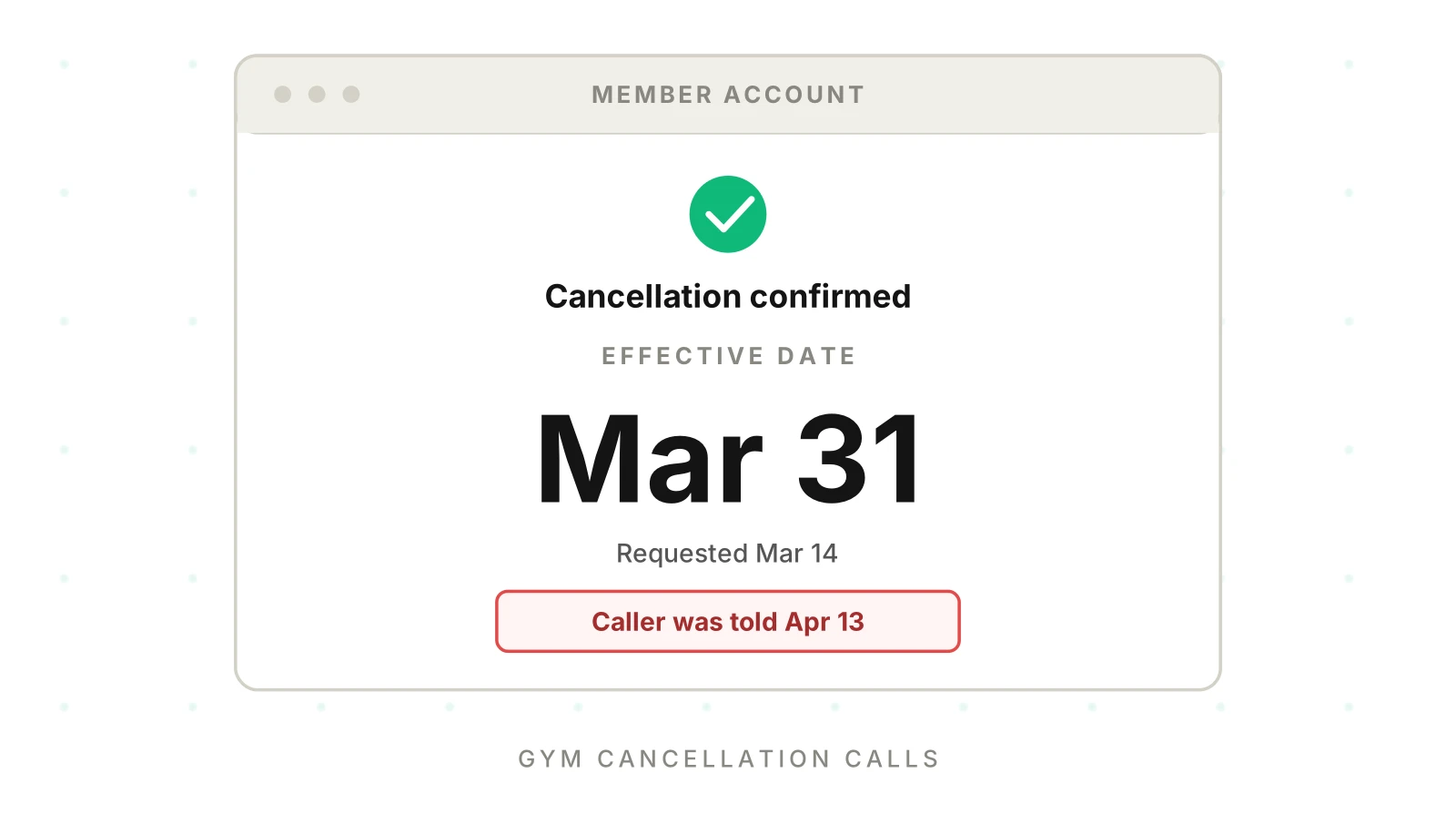
On gym membership cancellation AI calls, a caller says "cancel my membership." The agent says "done." Three weeks later the member is billed again, files a chargeback and posts a review. Nothing in the transcript looks wrong. The failure sat in one date, one fee or one field that was never written.
This post is for teams that built a voice agent into a gym or studio management product and run it across many clubs. It does not repeat class booking or waitlists. For those, see our gym AI receptionist guide. For billing failures, see failed gym payment calls. Here the focus is gym membership cancellation AI calls: the call where a member leaves, pauses or fights a charge.
Why gym membership cancellation AI calls are not booking calls
A booking call has a forgiving failure mode. A wrong class time gets noticed at the door. A gym membership cancellation AI call has a delayed failure mode. The member hangs up believing they are out. The system keeps drafting until someone looks.
Three things make this call risky.
1. The caller is not neutral. Some callers are annoyed, some are ready to be talked out of it, and some are mid-dispute. Tone shifts the right action.
2. The outcome is a legal and financial record. A date, a fee and a consent trail. Not just a friendly conversation.
3. Speech errors land on numbers. "March thirtieth" and "March thirteenth" differ by one syllable on a phone line. So do "fifteen" and "fifty" for a fee.
A gym cancellation AI agent also sits at the front of a workflow. The call captures intent, the system acts on the member record, the agent reads back a confirmation, and the result writes to billing. Every hop can drift. Our post on silent tool failures covers the pattern where the agent speaks success while the write fails.
Five intents hiding inside "I want to cancel"
Members rarely say the contract term they mean. Callers use "cancel" for at least five different requests. A good agent separates them before it touches the record.
| What the caller says | Real intent | Right action | Typical error |
|---|---|---|---|
| "I want to cancel." | Cancel membership | Verify, state terms, confirm date, file request | Treats it as a freeze |
| "I'm injured for two months." | Freeze or medical hold | Explain freeze terms, route if medical documentation applies | Cancels instead |
| "It's too expensive." | Downgrade or price relief | Offer allowed plan change, ask before acting | Cancels without asking |
| "You charged me after I left." | Billing dispute | Route to staff with the facts captured | Treats it as a new cancellation |
| "Cancel my wife's membership." | Third-party request | Do not act without the account holder | Cancels the wrong account |
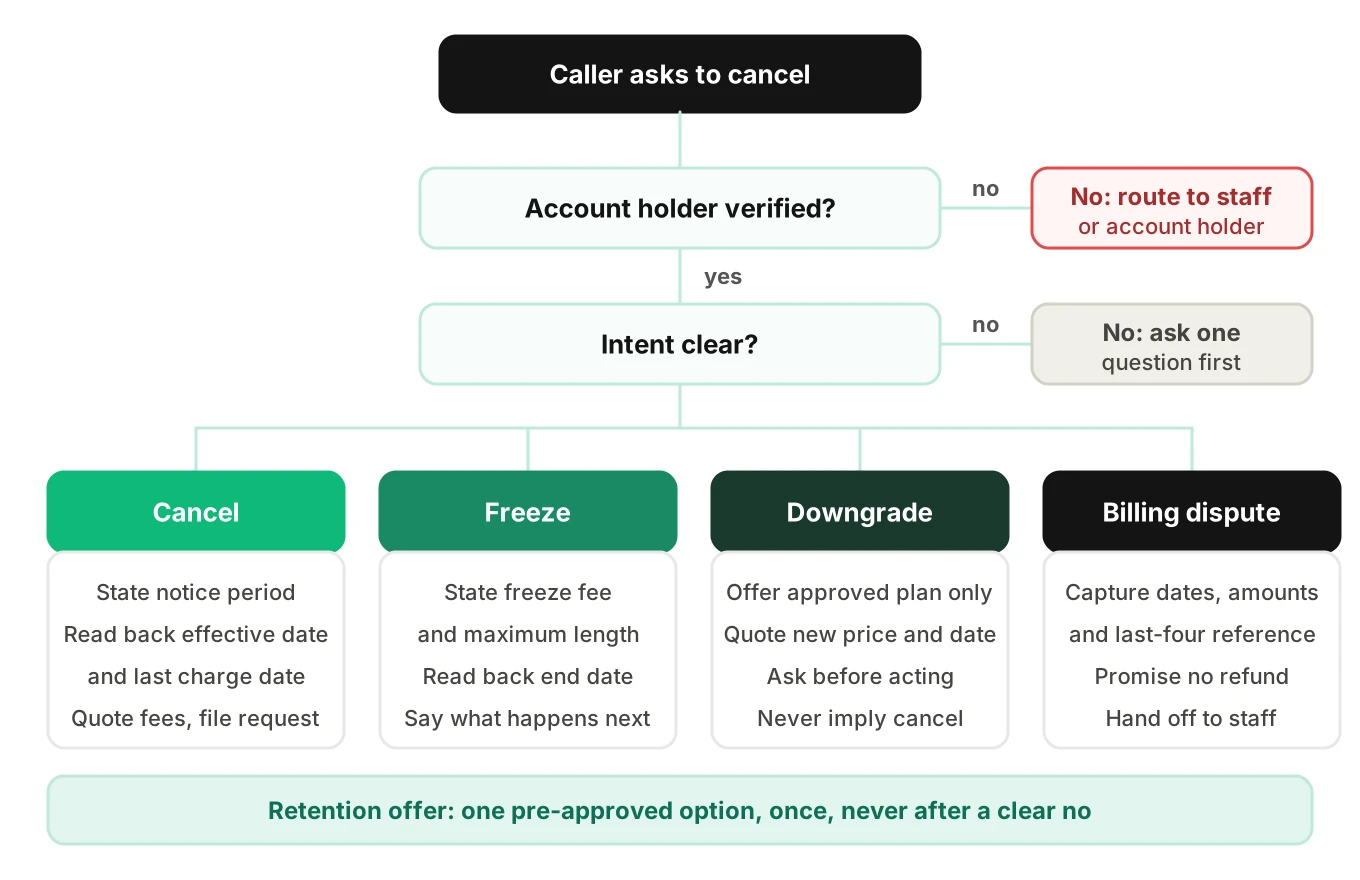
Two rules fall out of this table.
Ask one disambiguating question when intent is mixed. "Do you want to end the membership, or pause it and keep your rate?" Callers answer in four words. That beats a wrong write.
Never infer cancel from a complaint. "I hate this gym" is not a notice of cancellation. Test it. Stress prompts that include anger and sarcasm. Our synthetic callers guide covers building those profiles.
The date problem: effective date, last charge, next draft
Most disputes from gym membership cancellation AI calls are date disputes. The gym cancellation notice period comes from the contract, and the next billing date decides the last charge. Three dates matter, and the agent must keep them apart.
- Request date. The day the member asked.
- Effective date. The day the membership ends under the contract. Often request date plus a notice period.
- Last charge date. The final draft the member still owes, which depends on the billing cycle.
Here is a worked example. The terms are illustrative, not from any real club.
- Monthly dues of $39.99 draft on the 1st.
- The contract requires 30 days' notice. Cancellation takes effect when notice ends.
- The member calls on March 14.
Notice ends April 13. The April 1 draft still runs. The May 1 draft must not. A correct close reads: "Your membership ends April 13. You will still be charged on April 1. Nothing will be charged after that."
A wrong close can come three ways:
1. The agent says "ends March 31," assuming month-end. The member expects no April draft. The April 1 charge becomes a dispute.
2. The agent records the request date, March 14, as the effective date. Billing stops early, and staff later reverse it.
3. The agent says "ends April 13" but the write-back stores "end of billing cycle." The May 1 draft goes out.
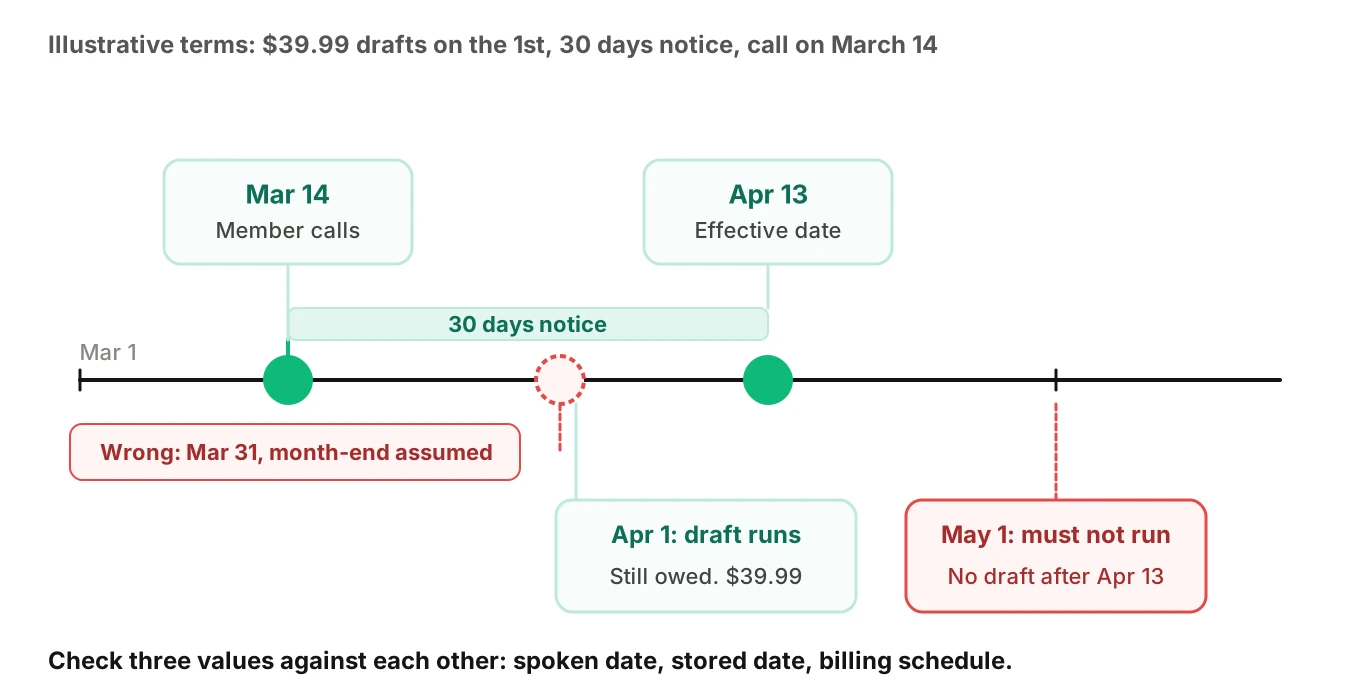
Check the agent's spoken date, the stored date and the billing system's next draft against each other. Three values, one truth. Our post on STT entity accuracy explains why dates and amounts are the entities most worth testing, and tool argument accuracy covers the write side.
A gotcha worth testing: members say relative dates. "Cancel it at the end of the month." "Cancel it next billing cycle." "Stop it before the annual fee." The agent must turn each into a concrete date, read it back and get a clear yes. Build a case for every phrase your members use.
Fees, freezes and what the agent may offer
The contract decides the money. The agent should quote, not improvise.
Fees to cover in tests: cancellation fee (often an early termination fee), annual or enrollment fee, freeze fee, balance owed, and any fee for add-ons such as childcare or personal training. The FTC's August 2025 complaint against LA Fitness alleged that add-on services were not clearly disclosed as separately cancellable. Those are allegations, not findings. The test lesson is real anyway: members cancel the plan and keep paying for the add-on, or the reverse.
Freeze versus cancel. AI membership freeze calls need the same date discipline. A membership freeze keeps the member and pauses dues, often with a fee and a maximum length. The agent must state the end date and what happens then. A freeze that silently rolls into billing is a cancellation failure in disguise.
Here is a simple split of what the agent may do and what stays with staff. Set it with your clubs, not by prompt guess.
| Situation | Agent may | Must route to staff |
|---|---|---|
| Standard cancel within contract terms | Verify, state date and fees, file request | Caller refuses the stated terms |
| Standard freeze | State terms, file request | Medical, military or relocation claims needing documents |
| Retention offer | Offer one approved, pre-priced option, once | Custom discounts, waived fees, price promises |
| Billing dispute | Capture dates, amounts and last-four reference | Any refund promise |
| Third party asks | Say it needs the account holder | Power of attorney or guardian claims |
| Caller mentions legal action, injury or complaint to a regulator | Capture and hand off | Always |
The offer rule. A gym retention offer AI flow may present a retention offer only if the offer is pre-approved, priced and not misleading. It must not hide the cancel path to keep the member on the line. It must not repeat the offer after a clear no. Test "no, just cancel" three times in a row. A good agent complies on the second turn.
Law check for gym membership cancellation AI calls, as of October 22, 2026
This section is not legal advice. Talk to counsel about your clubs' states. I opened each source below.
The federal click-to-cancel rule is gone for now. The Eighth Circuit vacated the FTC's amended Negative Option Rule on July 8, 2025, for procedural reasons (Crowell & Moring). The FTC then restarted the process. Its advance notice was announced March 11 and published in the Federal Register March 13, 2026, with comments due April 13, 2026 (Steptoe). The FTC's rule page shows that review continuing. For a click to cancel gym membership flow, the federal rule is not in force today. I found no final or proposed replacement rule in the sources I opened. Check again before you ship.
ROSCA still applies. Any AI phone agent cancel subscription flow, not only a gym's, sits under it. 15 U.S.C. 8403 bars charging for online negative option sales unless the seller discloses material terms, gets express informed consent and offers "simple mechanisms for a consumer to stop recurring charges." The FTC used ROSCA and the FTC Act in its August 20, 2025 complaint against LA Fitness. It alleged members could cancel only in person or by mail. The agency says the case is undecided.
States matter more for gyms. Three examples.
- New York. A February 2026 letter from New York City's consumer agency cites General Business Law 624(c): health clubs must accept cancellation by "website, electronic mail, telephone, mail, or in person." It also says that even for in-person sign-ups, businesses must accept cancellation by phone or online (NYC DCWP letter). A phone agent is therefore a cancellation channel the club cannot make harder than sign-up.
- California renewals. The state's automatic renewal law was changed by AB 2863, which took effect July 1, 2025. As summarized by law firms, it requires cancellation through the same medium used to sign up, an annual reminder, express affirmative consent and consent records kept three years (Barnes & Thornburg). Save offers are allowed if a "click to cancel" link is shown at the same time (Fenwick). How that applies to a voice call is a question for counsel.
- California health studios. Civil Code 1812.84 caps a termination notice period at 30 days. It lists cancelling "in person, via email from an email address on file with the health studio" or "via first-class mail." Phone is not listed in the text I saw. A call may not equal valid notice in that state. A safe design sends the member a confirmation email and a cancel link in the same call.
The engineering takeaway: build rules per state and per club, as data, not as prompt prose. Then test each rule. Our regulated policy test cases and policy adherence testing posts show how to write them.
The confirmation record: what the call must write back
A cancellation is only real when the record says so. The call should end with one structured write, and the agent should read back the same values it writes.
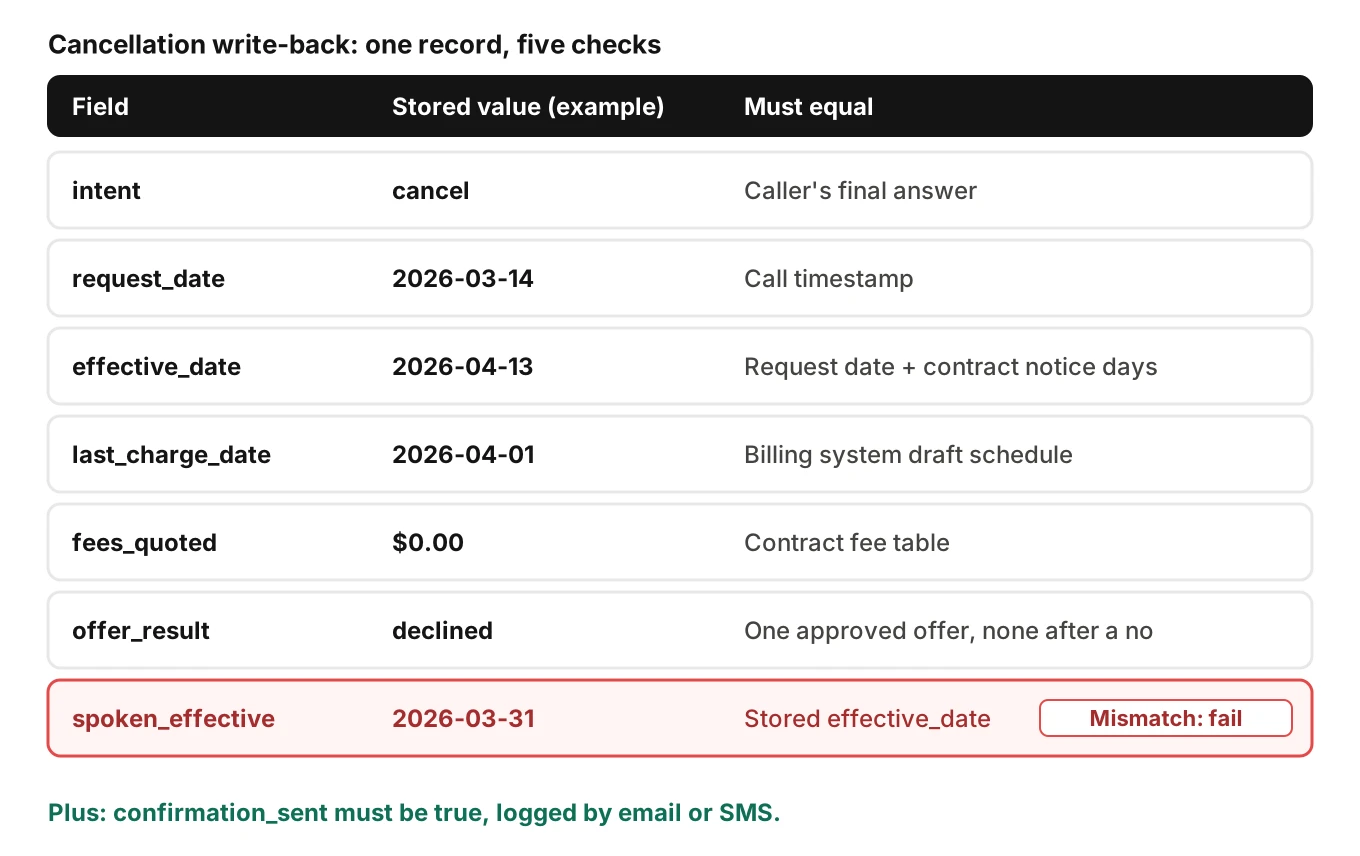
A minimal shape for the write, simplified:
# Simplified cancellation record. Field names are illustrative.
from dataclasses import dataclass
from datetime import date, timedelta

@dataclass
class CancelRecord:
    member_id: str
    intent: str              # cancel | freeze | downgrade | dispute
    request_date: date
    notice_days: int         # from club contract, not from the prompt
    effective_date: date
    last_charge_date: date
    fees_quoted_cents: int
    offer_made: str | None   # offer id, or None
    offer_result: str | None # accepted | declined | none
    confirmation_sent: bool
    spoken_effective: date   # parsed from the agent's own read-back

def effective_from(request: date, notice_days: int) -> date:
    return request + timedelta(days=notice_days)

def check(r: CancelRecord, next_drafts: list[date]) -> list[str]:
    errs = []
    if r.effective_date != effective_from(r.request_date, r.notice_days):
        errs.append("effective_date != request + notice")
    if r.spoken_effective != r.effective_date:
        errs.append("spoken date != stored date")
    if any(d > r.effective_date for d in next_drafts):
        errs.append("draft scheduled after effective date")
    if not r.confirmation_sent:
        errs.append("no confirmation sent")
    return errs
Note `spoken_effective`. Parse it from the audio read-back or transcript, then compare it with the write. That one comparison catches the "said April 13, stored March 31" class of bug. Run `check` against the billing system's real draft schedule, not a copy of it.
A five-field close-out check for every call
Use the same five checks on every gym membership cancellation AI call and every freeze call. Call it the close-out check.
| Field | Pass condition | Fail example |
|---|---|---|
| Intent | Stored intent matches caller's final answer | Freeze stored as cancel |
| Dates | Spoken, stored and billing dates agree | Month-end assumed |
| Money | Fees quoted equal contract fees | Annual fee omitted |
| Offer | At most one approved offer, none after a no | Third offer after refusal |
| Record | Write succeeded and confirmation was sent | Agent said "done," write failed |
Score each call pass or fail on all five. Report the rate per club and per contract type, because club terms differ. A fleet average hides a single club whose notice period the agent gets wrong.
How to test gym membership cancellation AI calls
1. Export your contract rules per club. Notice period, billing day, fees, freeze limits, allowed offers and states. Put them in data the test harness can read.
2. List the intents and the phrases members use. Include relative dates ("end of the month"), slang ("kill my membership") and mixed intents ("freeze or cancel, I don't know").
3. Build the scenario matrix. Cross intents with billing day, notice period, add-ons, offers and caller behavior. A short matrix is 5 intents by 3 billing situations by 3 caller styles, or 45 calls.
4. Add caller conditions. Fast speakers, accents, interruptions mid-date, background noise and non-English callers. Dates fail under noise first.
5. Judge from audio and the record. Check the spoken read-back and the stored write separately. Transcript-only judging misses a misheard "thirteenth" or "thirtieth." See transcript versus audio evaluation.
6. Gate releases on the close-out check. Set a pass bar before a prompt or contract change ships. Zero tolerance for a wrong write is a reasonable starting point for dates and fees. See shipping prompt changes safely.
7. Monitor live calls. Sample or score recordings after launch. Flag calls with a cancel intent but no confirmation, and compare stored dates to billing.
Evalgent generates test scenarios from the agent's prompt and flows, then runs them with caller profiles for accent, pace, interruption level and background noise over phone, SIP or WebRTC. It evaluates from the audio, with custom metrics you define, such as "spoken effective date matches stored date," on every call. For live traffic, teams push recordings and Evalgent transcribes, maps them to scenarios, judges them and flags tool-call failures and policy failures. Evalgent works with teams to set up evals for a first agent. It is sales-led, not self-serve.
Edge cases that break the happy path
These cases are cheap to test and costly to miss.
- Caller is not the account holder. A spouse, a parent of a minor member or an employer paying corporate dues. The agent must stop and offer a clean handoff to staff.
- Corporate or family plans. One cancel request can end several members.
- Frozen member asks to cancel. The freeze rules and notice period interact. The date can be wrong in both directions.
- Pending failed payment. Members cancel to avoid a balance. The agent must quote what is owed. Cross-check with failed payment calls.
- Caller reverses mid-call. "Actually, keep it." The agent must cancel the pending write.
- Caller hangs up before confirmation. No confirmation means no completed cancel. The record should say pending.
- Moves and medical holds. Documentation is staff territory. The agent captures and routes. See escalation accuracy.
- Second call about the same cancel. The agent should find the first request, not open a new one.
Compare this with another subscription-style call: salon rebooking and fee calls share the fee-quote problem but not the notice-period date math.
Frequently asked questions
Can an AI agent cancel a gym membership over the phone?
Yes, if your terms and state law allow it, and the call ends with a verified record and a sent confirmation. In New York, a city consumer-agency letter says health clubs must accept phone cancellation. In California, check whether a call counts as valid notice. Have counsel confirm per state.
How do you cancel a gym membership with a notice period?
The effective date is usually the request date plus the notice period, and dues drafted before that date are still owed. The agent should state the effective date, the last charge date and any fees, then get a clear yes. Test that spoken, stored and billing dates match.
Should an AI agent offer a discount to stop a cancellation?
Only a pre-approved, pre-priced offer, made once. It must never hide the cancel path or repeat after a clear no. Custom discounts, waived fees and refund promises go to staff. Test refusals three times in a row, and confirm the call still cancels on the second ask.
What is the difference between freezing and cancelling a gym membership?
A freeze pauses dues and keeps the member and rate, often with a fee and a maximum length. A cancellation ends the contract after notice. The agent must ask when intent is unclear and state what happens when the freeze ends. A silent roll into billing counts as a failure.
Is click-to-cancel still the law for gyms in 2026?
The federal rule is not in effect. The Eighth Circuit vacated it on July 8, 2025, and the FTC reopened rulemaking in March 2026. ROSCA and state laws still apply. This is not legal advice. Re-check status before each release, since the FTC process is ongoing.
How do you test an AI phone agent that handles cancellations?
To test gym membership cancellation AI calls, build scenarios from club contract data: intents, billing dates, notice periods, fees and offers. Run them with varied callers and noise. Judge the spoken read-back and the stored record separately. Score every call on intent, dates, money, offer and record, then gate releases on those results.
What should a gym AI agent send to staff instead of handling?
Billing disputes with refund requests, medical, military or relocation claims needing documents, third-party and legal-authority callers, custom discounts, and anyone mentioning legal action, injury or a regulator. The agent captures facts, hands off cleanly and tells the caller what happens next. Test that no facts are lost.
What should a cancellation confirmation include?
The member name, the intent, the effective date, the last charge date, fees owed, whether an offer was accepted, and how to reach staff. Send it in writing the same day. Compare it with the stored record. A mismatch between the email and the system is itself a defect.
The bottom line
Gym membership cancellation AI calls fail quietly on dates, fees and records, so test the spoken read-back, the stored write and the billing schedule together. Keep the rules per club and per state as data, route disputes and legal claims to staff, and gate every change on a five-field close-out check.
Related Articles
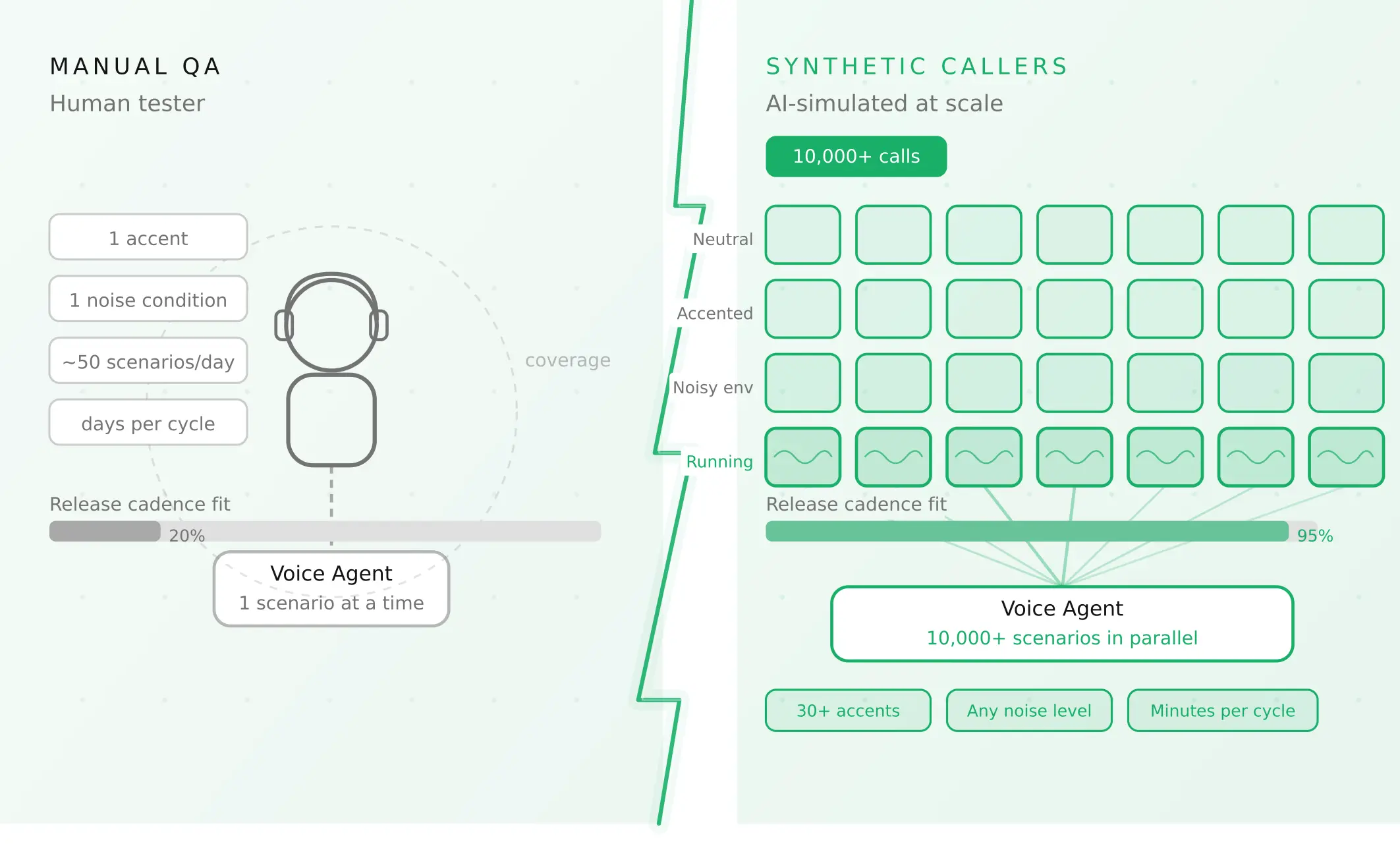
How to automate voice agent testing: synthetic callers vs manual QA
Learn how ai test automation replaces manual QA for voice agents. Compare synthetic callers vs human testers, with a 5-step framework to scale without hiring.
Read more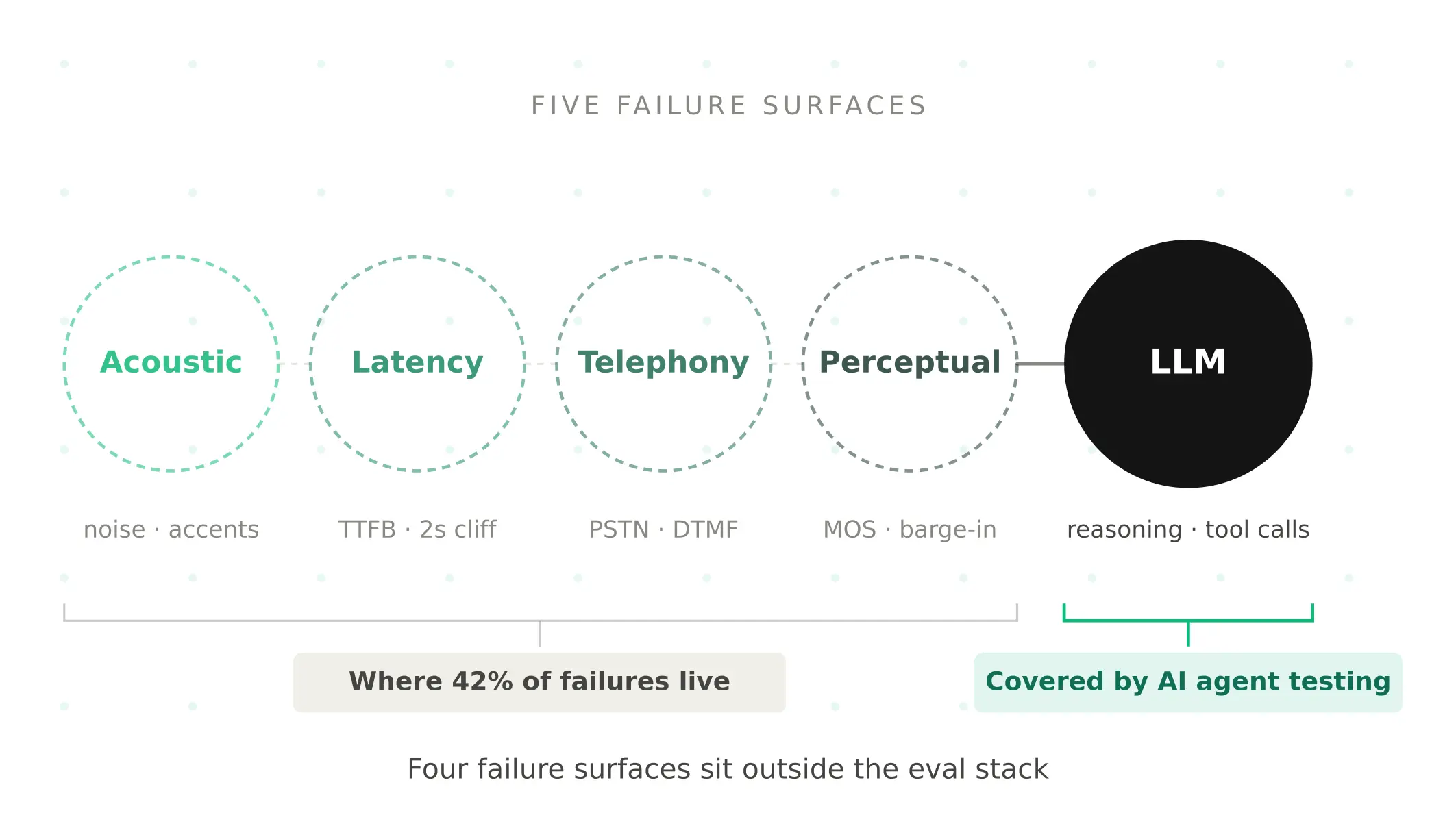
AI Agent Testing vs Voice Agent Testing: What General Tools Miss for Voice
AI agent testing measures text outputs. Voice agent testing measures behaviour through an acoustic pipeline. Five failure categories general tools miss.
Read more