How to detect repetition loops in AI voice agents
On this page
Few things frustrate a caller more than an agent that keeps asking the same question. A repetition loop turns a minor misunderstanding into a dead end. It is detectable and preventable. Evalgent tests for it. Here is why agents loop and how to catch it.
Repetition loop: a state where the agent repeats the same response or question across turns because the conversation is not progressing toward a resolution.
What a repetition loop sounds like
These are the symptoms on a real call:
- The agent asks the same question two or three times in a row.
- It repeats its greeting or a clarification verbatim.
- It gives the same fallback line to every input.
- It re-confirms a detail it already has, over and over.
- The call never advances, and the caller gives up.
The signal is a turn that does not move the conversation forward, repeated.
Why voice agents get stuck in loops
A loop happens when the state does not advance but the agent keeps responding. Usually a failed step retries with no limit. The table maps each cause to what you hear and how to fix it.
| Cause | How it shows on a call | Fix |
|---|---|---|
| No retry limit | Same fallback fires endlessly | Cap retries; change behavior after the limit |
| State not advancing | Re-asks a question already answered | Advance state once a slot is filled |
| Repeated intent failure | Same "sorry, I didn't get that" | Vary the reprompt and offer an alternative |
| No loop detection | Nothing notices the repetition | Track recent turns; flag repeats |
| Missing escalation | Loops instead of handing off | Escalate to a human after N failed attempts |
| Prompt echo | Restates the same line each turn | Fix the prompt or flow causing the echo |
How to detect repetition loops in AI voice agents
1. Force failure paths — Drive scenarios that repeatedly fail an intent or give ambiguous input.
2. Track repeated turns — Detect when the agent says the same thing across consecutive turns.
3. Set a repeat limit — Assert the agent never repeats the same prompt more than your allowed count.
4. Check for progress — Verify each turn advances state, or changes approach if it cannot.
5. Assert escalation — Confirm the agent hands off to a human after the retry limit, not loops.
6. Re-run on changes — Re-test after prompt or model updates, which commonly reintroduce loops.
A worked example
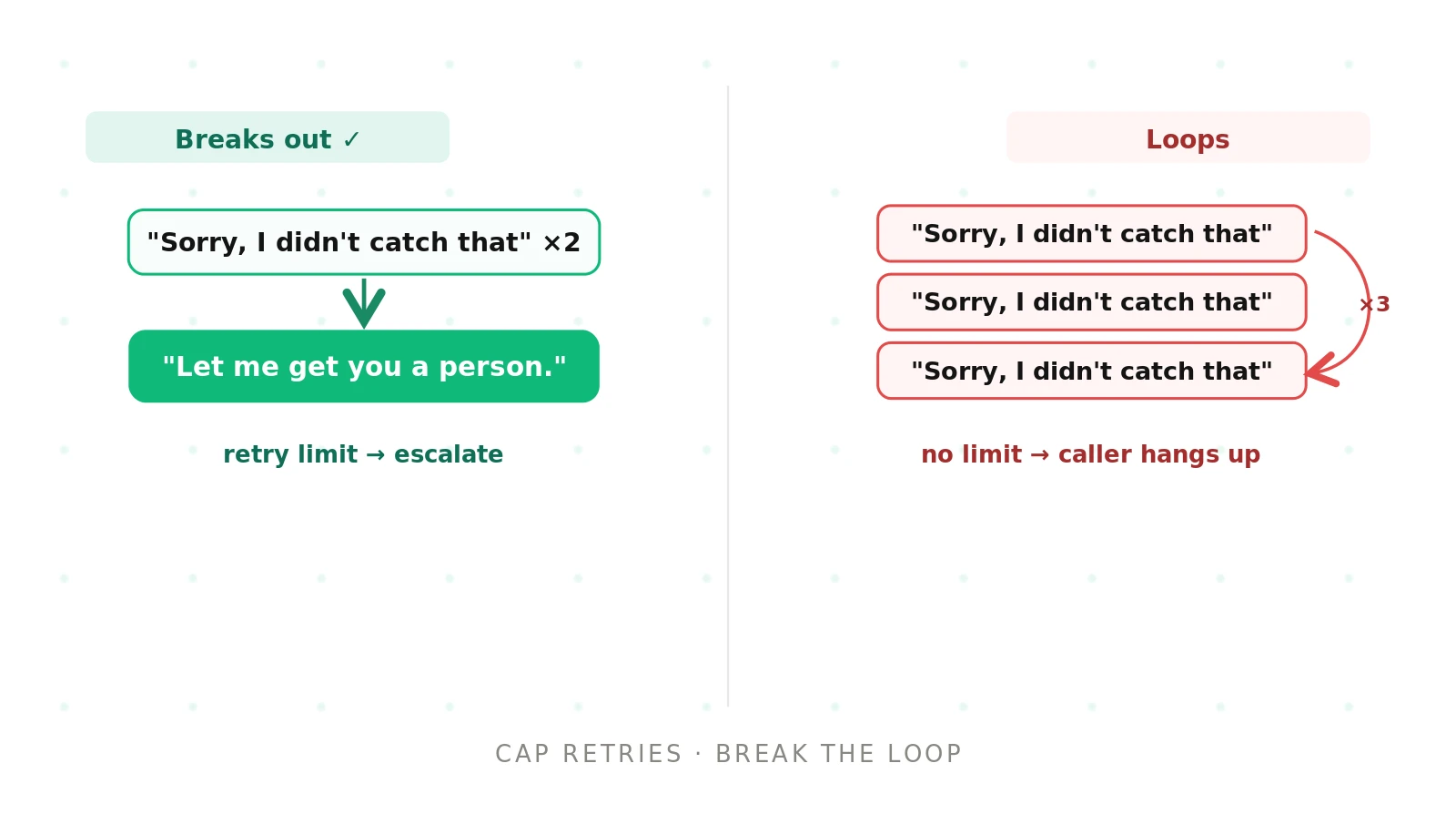
A caller's accent caused a misheard intent, and the agent replied, "Sorry, I didn't catch that — what would you like to do?" It then repeated that exact line five times, because the fallback had no retry counter and never varied. The caller hung up. The fix was a retry limit: after two failures, the agent offers options, and after three it escalates. A scenario now asserts the same prompt never fires more than twice.
Detecting repetition loops with Evalgent
Evalgent detects loops by driving the paths where they form. Scenarios repeatedly fail intents and feed ambiguous input, so loops surface instead of hiding. Profiles vary accent and phrasing, since mishearing is a common loop trigger. Metrics track repeated turns and flag any prompt that fires more than your allowed count, with thresholds you set. Evaluations run the suite as batches of synthetic callers before release. Reviews let you replay a looping call and see the exact turn where progress stopped. Breaking a loop usually means escalating — see the escalation and handoff guide — and loops often follow a change, as covered in LLM update regressions.
The bottom line
A repetition loop is a conversation that stops advancing while the agent keeps talking, and it usually traces to a failed step with no retry limit. Detect it by tracking repeated turns, and break it by capping retries, varying phrasing, and escalating after a set number of attempts.
Frequently asked questions
What is a repetition loop in a voice agent?
A repetition loop is when the agent gets stuck repeating the same line or question because the conversation is not advancing. It often happens on a misheard or failed intent that retries with no limit, so the same fallback fires again and again. To the caller it feels like the agent is broken, and many hang up.
Why does my voice agent keep repeating itself?
Usually because a step is failing and retrying with no cap, or the conversation state is not advancing after a slot is filled. A misheard intent triggers the same fallback each turn, and nothing detects the repetition. Without a retry limit and loop detection, the agent has no way to change course or escalate.
How do you detect repetition loops?
Drive scenarios that repeatedly fail an intent or give ambiguous input, and track whether the agent says the same thing across consecutive turns. Assert that no prompt repeats more than an allowed count, that each turn advances state or changes approach, and that the agent escalates after the retry limit instead of looping.
How do you stop a voice agent from looping?
Cap retries so the same fallback cannot fire endlessly, and change behavior once the cap is hit — vary the phrasing, offer options, or escalate. Make sure state advances once a detail is captured, so the agent does not re-ask it. Loop detection that tracks recent turns catches repetition that these rules miss.
What causes an agent to re-ask a question it already answered?
State that does not advance. When a slot is filled but the flow does not record it, the agent reaches the same step again and re-asks. It can also happen when context is lost across a turn or tool call. Storing filled slots and advancing state once they are captured prevents the re-ask.
How many times should an agent retry before escalating?
There is no universal number, but two to three attempts is common before offering alternatives or handing off. The goal is to try enough to recover from a genuine mishearing, without trapping the caller in repetition. Set a limit for your use case, and assert in testing that the agent escalates once it is reached.
Do repetition loops relate to escalation?
Closely. A loop is often a missing escalation — the agent should have handed off but kept retrying instead. Capping retries and escalating after the limit is the main way to break a loop cleanly. Testing repetition and escalation together ensures a stuck agent reaches a human rather than repeating until the caller gives up.
Can a model or prompt update cause loops?
Yes. A prompt or model change can alter how the agent handles failed intents or advances state, reintroducing loops that were previously fixed. Treat loop detection as a regression check: re-run the repetition scenarios after any prompt or model update, and assert the retry limits and escalation still hold before you ship.
Related guides
How to test tool calling in AI voice agents
Tool calling fails when a voice agent picks the wrong function, fills bad arguments, or acts silently. Learn how to test tool calling and catch it.
How to reduce latency in AI voice agents
Voice agent latency is the pause before the agent replies. Learn what drives it, what a good target is, and how to reduce latency without losing quality.