Test your voice agent
Running multiple voice agent vendors: how to choose between them
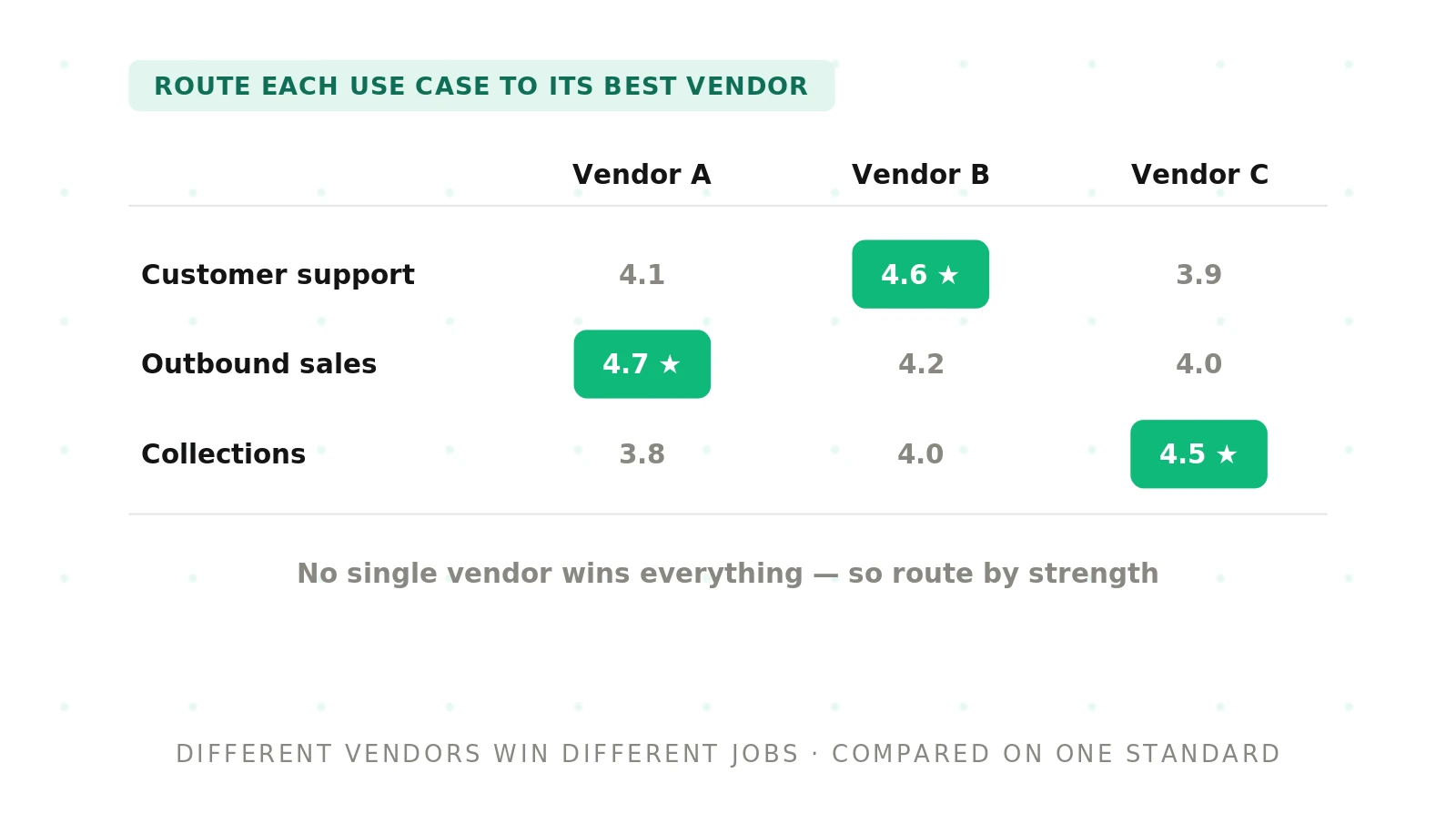
Most teams start with a single voice agent vendor. Then reality arrives. One vendor nails appointment booking but stumbles on billing disputes. Another handles Spanish beautifully but lags on latency. A third is cheaper but flakier at peak load. Before long, the org quietly runs four or five vendors at once.
This is not indecision. It is portfolio management. Running multiple voice agent vendors is an ongoing operational strategy, not a one-time procurement event. The hard part is not picking a winner. The hard part is deciding, week after week, which vendor should handle what.
This guide covers why enterprises run several vendors, how to allocate use cases, how to compare vendors on one continuous standard, how to route and fail over between them, and how to avoid the fragmentation that quietly eats the benefits.
Why enterprises run several voice agent vendors at once
Single-vendor simplicity is real, but it carries risk. When one provider owns every call, you inherit every weakness that provider has. A multi-vendor approach spreads that exposure. Three motives usually drive it.
Hedging risk. Concentrating every conversation on one provider is a single point of failure. If their models drift, their pricing spikes, or their region goes dark, your entire voice channel goes with it. Spreading load reduces that dependency and softens vendor lock-in.
Best-of-breed per use case. Voice quality is not uniform across tasks. A vendor that excels at empathetic support may be mediocre at fast transactional flows. Assigning each vendor the work it does best raises overall quality without forcing one provider to be good at everything.
Avoiding single-point failure. Availability matters. Running more than one vendor is a form of redundancy) that keeps calls flowing when a provider degrades. This deliberate spreading of sourcing across providers is often called multisourcing, and it is a mature discipline in enterprise IT.
The catch: every added vendor multiplies the surface you must manage. More dashboards, more contracts, more subtly different behaviors to keep track of. The strategy only pays off if you compare vendors on a single, consistent standard rather than trusting each vendor's own scorecard.
Single-vendor versus multi-vendor: the trade-offs
Before committing to a portfolio, it helps to see the trade-offs plainly. Neither model is universally right. The table below compares them across the dimensions that matter most in operations.
| Dimension | Single vendor | Multiple vendors |
|---|---|---|
| Operational complexity | Low; one integration, one dashboard | Higher; several integrations and contracts |
| Risk concentration | High; one point of failure | Lower; load spread across providers |
| Quality ceiling | Capped by one provider's strengths | Best-of-breed per use case |
| Negotiating leverage | Weak; hard to switch | Strong; credible alternatives on hand |
| Comparison overhead | Minimal | Needs a shared, neutral test standard |
| Failover options | Limited | Built in when routing is designed for it |
| Cost visibility | Simple | Requires per-vendor, per-use-case tracking |
The pattern is clear. Multi-vendor buys you resilience, quality, and leverage. It costs you complexity. That complexity is manageable, but only with a disciplined evaluation and routing layer sitting above the vendors. Without one, you get fragmentation instead of a portfolio.
How to run and choose between multiple voice agent vendors
Here is a repeatable process for managing a multi-vendor voice portfolio. Treat it as a loop you run continuously, not a checklist you complete once.
1. Map your use cases before your vendors. List the distinct conversation types you run: booking, billing, support triage, outbound reminders, and so on. Define what "good" means for each, including acceptable latency, resolution rate, and tone. This map becomes the basis for every allocation decision. A structured approach to vendor selection starts here, not with vendor demos.
2. Build one shared test suite. Create a common set of scenarios that every vendor faces identically. When you compare voice agents on the same test cases, differences reflect the agents, not the test. Vendor-supplied benchmarks flatter the vendor; your own suite does not.
3. Score every vendor on the same metrics. Decide which numbers matter, then apply them uniformly. Consistent vendor metrics let you rank providers per use case rather than in the abstract. Latency, containment, accuracy, and escalation rate should mean the same thing across all vendors.
4. Allocate each use case to its strongest vendor. Match the map from step one to the scores from step three. Route billing to whoever handles billing best, Spanish support to whoever handles Spanish best. Document why each assignment exists so the logic survives staff turnover.
5. Design routing and failover. Build a routing layer that sends each call to its assigned vendor and falls back to a second choice when the primary degrades or times out. Sound failover design keeps callers unaware that anything went wrong. Test the fallback path as rigorously as the primary.
6. Re-evaluate on a fixed cadence. Vendors ship model updates constantly. Last quarter's leader may slip this quarter. Re-run the shared suite monthly and reallocate when the numbers shift. Continuous benchmarking against your own data keeps allocation honest.
7. Watch production, not just tests. Test scores predict; live traffic decides. Pair your evaluation loop with voice agent observability so real-world drift surfaces fast, and feed those findings back into step two.
How to allocate use cases to vendors
Allocation is the heart of the strategy. It is where "we use several vendors" becomes "we use the right vendor for each job." Do it deliberately, not by accident of who signed first.
Start by segmenting calls along the axes that expose vendor differences: language, complexity, sensitivity, and volume. A vendor strong on scripted, high-volume reminders may be wrong for nuanced complaint handling. Sensitivity matters too. Regulated conversations often need the vendor with the best guardrails, even at higher cost.
Then rank vendors within each segment using your shared scores. The winner of a segment earns the primary slot; the runner-up becomes the failover. Avoid assigning a segment to a vendor simply because they are cheaper overall. Cheap on the wrong task produces expensive failures downstream.
Finally, size the allocation to capacity and cost. A vendor may win a segment on quality but lack the throughput for peak load. Split high-volume segments across two vendors when needed, keeping the split ratio tied to live performance rather than a fixed contract minimum.
Revisit allocations whenever a vendor ships a major update or your call mix shifts. Allocation is a living decision, and stale assignments quietly erode the quality you built the portfolio to protect.
How to compare vendors continuously on one standard
The single biggest failure mode in multi-vendor voice is comparing vendors on different yardsticks. Each provider offers its own dashboard, its own definition of "resolution," its own latency measurement. Trusting those numbers is like judging a race where every runner uses a different stopwatch.
The fix is a neutral, shared standard that lives outside any vendor. Run the same scenarios, apply the same metrics, and evaluate with the same rubric across every provider. Independent voice AI evaluation removes the marking-your-own-homework problem and makes rankings trustworthy.
Consistency matters across dimensions too. Latency is a good example. Human perception of conversational delay is well studied, and standards like ITU-T G.114 describe how one-way delay affects call quality. Measuring every vendor's latency the same way, against the same threshold, keeps comparisons fair.
Continuous comparison also means versioning your test suite alongside vendor updates. When a provider changes a model, re-run the suite immediately rather than waiting for the monthly cadence. Frameworks like the NIST AI Risk Management Framework encourage exactly this kind of ongoing measurement and governance. Treat evaluation as monitoring, not a gate you pass once.
The payoff is a live leaderboard per use case. When someone asks which vendor should handle refunds next month, the answer is a number, not an opinion. That is the difference between a managed portfolio and a pile of contracts.
How to route and fail over between vendors
Routing turns allocation decisions into live behavior. A good routing layer sits between your telephony and your vendors, reading each incoming call's attributes and dispatching it to the assigned provider.
Design routing rules around the segments from your allocation map. Language, intent, and customer tier are common routing keys. Keep rules readable and centrally owned, so a change in allocation is a config edit rather than a code rewrite spread across systems.
Failover is the safety net. When a primary vendor times out, returns errors, or breaches a latency threshold, the router should hand the call to the runner-up automatically. Set clear health checks and thresholds, and test them regularly. A failover path that has never been exercised is a failover path you cannot trust.
Guard against silent quality drops too. A vendor can be "up" yet degraded, answering calls while resolving fewer of them. Tie routing health to your live metrics, not just to whether the endpoint responds. When containment falls below a floor, shift traffic even if the vendor is technically online.
Finally, log every routing and failover event with enough context to reconstruct what happened. These logs feed your continuous comparison and let you tune thresholds over time. Systematic vendor benchmarking depends on this trail.
How to avoid fragmentation across vendors
The dark side of multi-vendor is fragmentation. Five vendors can become five silos, each with its own logging, its own metrics, and its own definition of success. When that happens, you lose the very visibility the strategy was supposed to give you.
Fragmentation shows up as questions you cannot answer quickly. Which vendor handled the most escalations last week? Why did resolution dip on Tuesday? If answering requires stitching together five dashboards by hand, you are fragmented.
The antidote is a single evaluation and observability layer that treats all vendors uniformly. Normalize every vendor's output into common metrics. Store all transcripts and scores in one place. Review failures with one workflow regardless of which vendor produced them. The vendors differ; your measurement should not.
Governance helps too. Keep one owner for the shared test suite, one owner for allocation logic, and one owner for routing config. When ownership is clear, the portfolio stays coherent as vendors come and go. When ownership is diffuse, each vendor's quirks leak into your operations and the standard erodes.
Done well, multi-vendor feels like one system with several interchangeable engines. Done poorly, it feels like five products duct-taped together. The difference is almost entirely in the measurement and governance layer, not the vendors themselves.
Frequently asked questions
How many voice agent vendors should an enterprise run at once?
There is no fixed number, but many enterprises run four or five. The right count matches your distinct use cases plus a failover option for each critical one. Fewer vendors mean less overhead; more vendors mean better best-of-breed coverage. Add a vendor only when it clearly wins a segment your current providers lose.
Why would a company use multiple voice agent vendors instead of one?
Three reasons dominate: hedging against a single point of failure, getting best-of-breed quality per use case, and preserving negotiating leverage. One vendor rarely wins every conversation type. Spreading work lets each provider do what it does best while reducing your dependence on any single company's roadmap, pricing, or uptime.
How do you allocate use cases across multiple voice agent vendors?
Map your conversation types first, then score every vendor on the same test suite. Assign each use case to its highest-scoring vendor and make the runner-up its failover. Segment by language, complexity, sensitivity, and volume. Revisit allocations whenever a vendor updates or your call mix shifts, because the strongest provider changes over time.
How can I compare voice agent vendors fairly when each reports different metrics?
Ignore vendor-supplied dashboards for comparison. Build one neutral test suite, run identical scenarios against every vendor, and apply the same metrics and rubric. Measure latency, containment, and accuracy the same way across all providers. Independent evaluation removes the marking-your-own-homework problem and produces rankings you can actually trust for allocation decisions.
What is failover between voice agent vendors and why does it matter?
Failover routes a call to a backup vendor when the primary times out, errors, or degrades. It matters because running several vendors is pointless if one outage still drops calls. Tie failover to live health checks and quality metrics, not just endpoint uptime, and test the fallback path as rigorously as the primary route.
How often should I re-evaluate my voice agent vendors?
Re-run your shared test suite at least monthly, and immediately after any vendor ships a model update. Vendors change constantly, so last quarter's leader can slip. Pair scheduled evaluation with production observability so real-world drift surfaces between test cycles. Treat evaluation as continuous monitoring rather than a one-time gate you clear during procurement.
How do I avoid fragmentation when running several voice agent vendors?
Normalize every vendor into common metrics and store all transcripts and scores in one place. Use a single review workflow regardless of which vendor produced a call. Assign clear owners for the test suite, allocation logic, and routing config. Fragmentation appears when answering basic questions requires stitching five separate dashboards together by hand.
Does running multiple voice agent vendors reduce lock-in?
Yes, meaningfully. Keeping credible alternatives live means you can shift traffic if a provider raises prices, changes terms, or degrades. It also strengthens negotiation, since your leverage comes from the ability to move volume quickly. Lock-in never disappears entirely, but a well-managed portfolio makes switching a routine config change rather than a painful migration.
Managing your voice agent portfolio with Evalgent
Evalgent is the independent standard that lets you compare every voice agent vendor on one neutral yardstick and decide continuously which vendor handles what. Five primitives make that possible. Scenarios define the conversations every vendor must handle identically. Profiles simulate the callers, accents, and edge cases your traffic really contains. Metrics score latency, containment, and accuracy the same way across all providers. Evaluations run the shared suite on a cadence so rankings stay current as vendors update. Reviews put failures in front of your team in one workflow, regardless of which vendor produced them. Together they turn a scattered set of contracts into a managed portfolio with a live, per-use-case leaderboard. To see it applied to your own vendors and call types, book a demo.
The bottom line
Running multiple voice agent vendors is a portfolio, not a purchase. The work is continuous, and the payoff comes from measurement, not from the vendors themselves.
Map your use cases, build one shared test suite, and score every vendor on the same standard. Allocate each conversation type to its strongest provider, design routing with real failover, and re-evaluate on a fixed cadence. Above all, keep one neutral measurement layer above the vendors so the portfolio stays coherent. Do that, and multi-vendor becomes a source of resilience and quality rather than fragmentation and overhead.
Related Articles
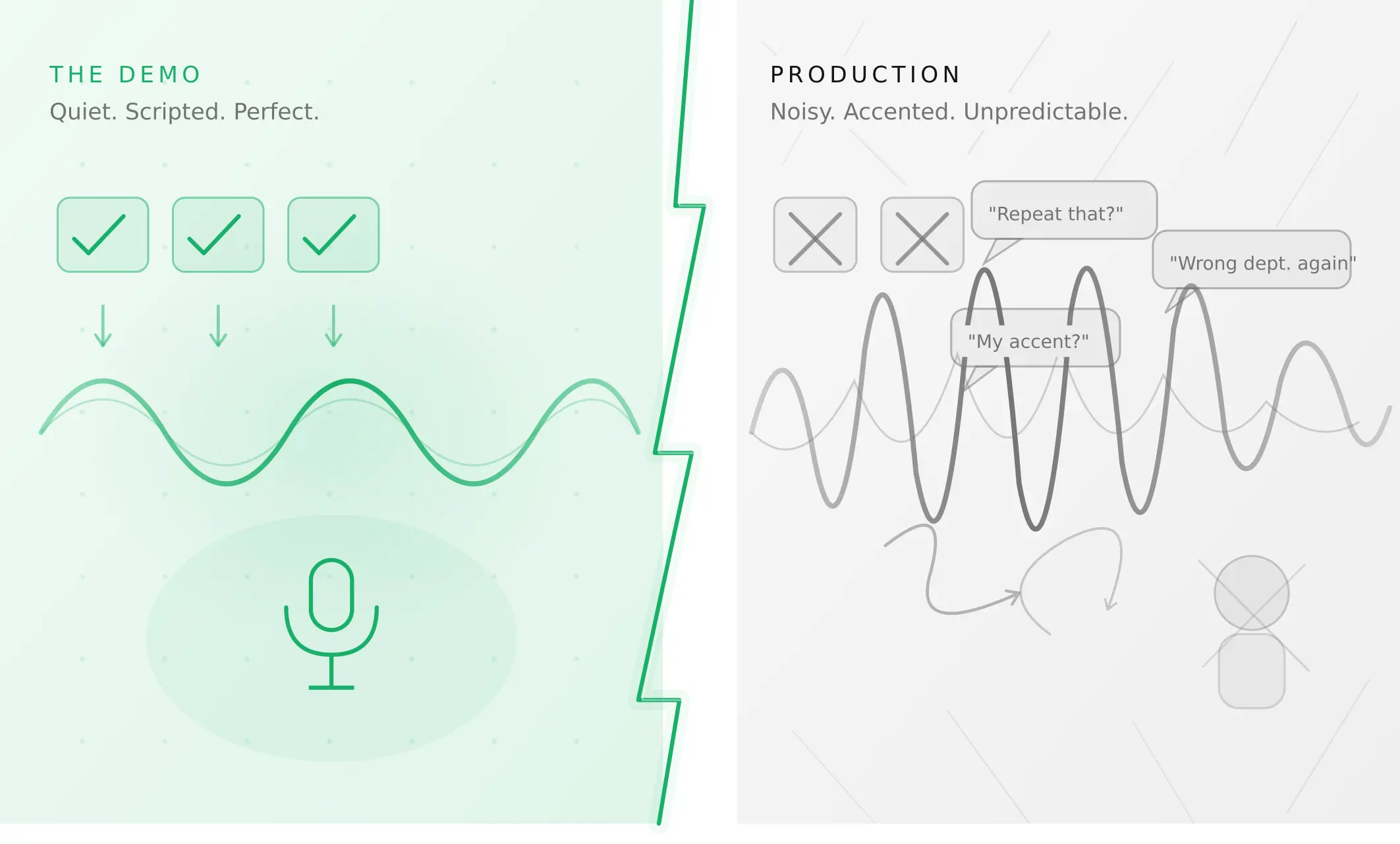
Why AI voice agents fail in production (and how to prevent it)
AI voice agents that ace demos still break in production. Learn the 5 root causes, how to test for each, and what production readiness actually means.
Read more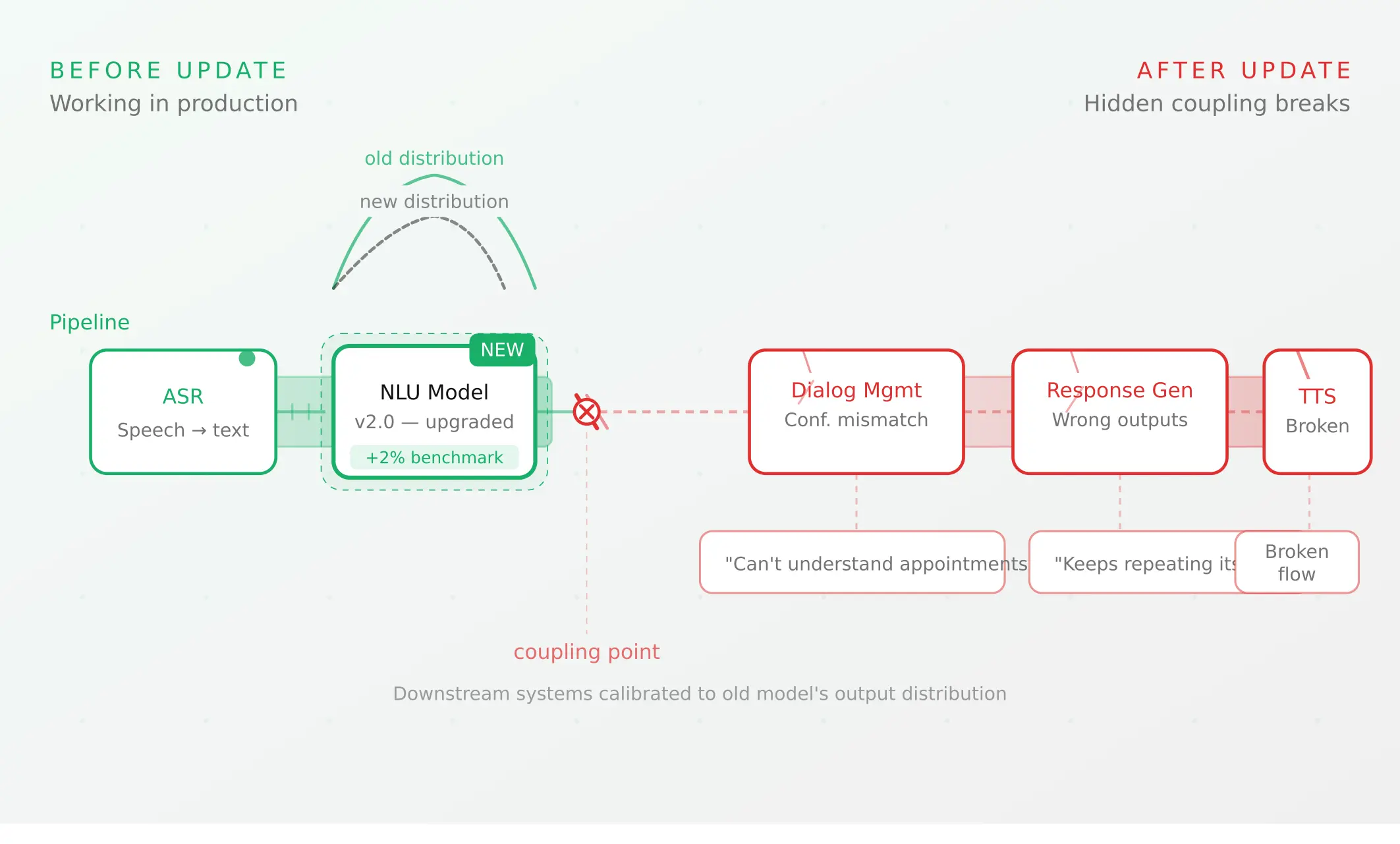
Voice agent regression testing: why LLM updates break production
LLM updates improve benchmarks but break voice agents in 5 predictable ways. How to detect and prevent regressions after every model or prompt change.
Read more