Open door for builders.
How to Evaluate Conversational Quality in Voice Agents
# How to evaluate conversational quality in voice agents
Quick answer
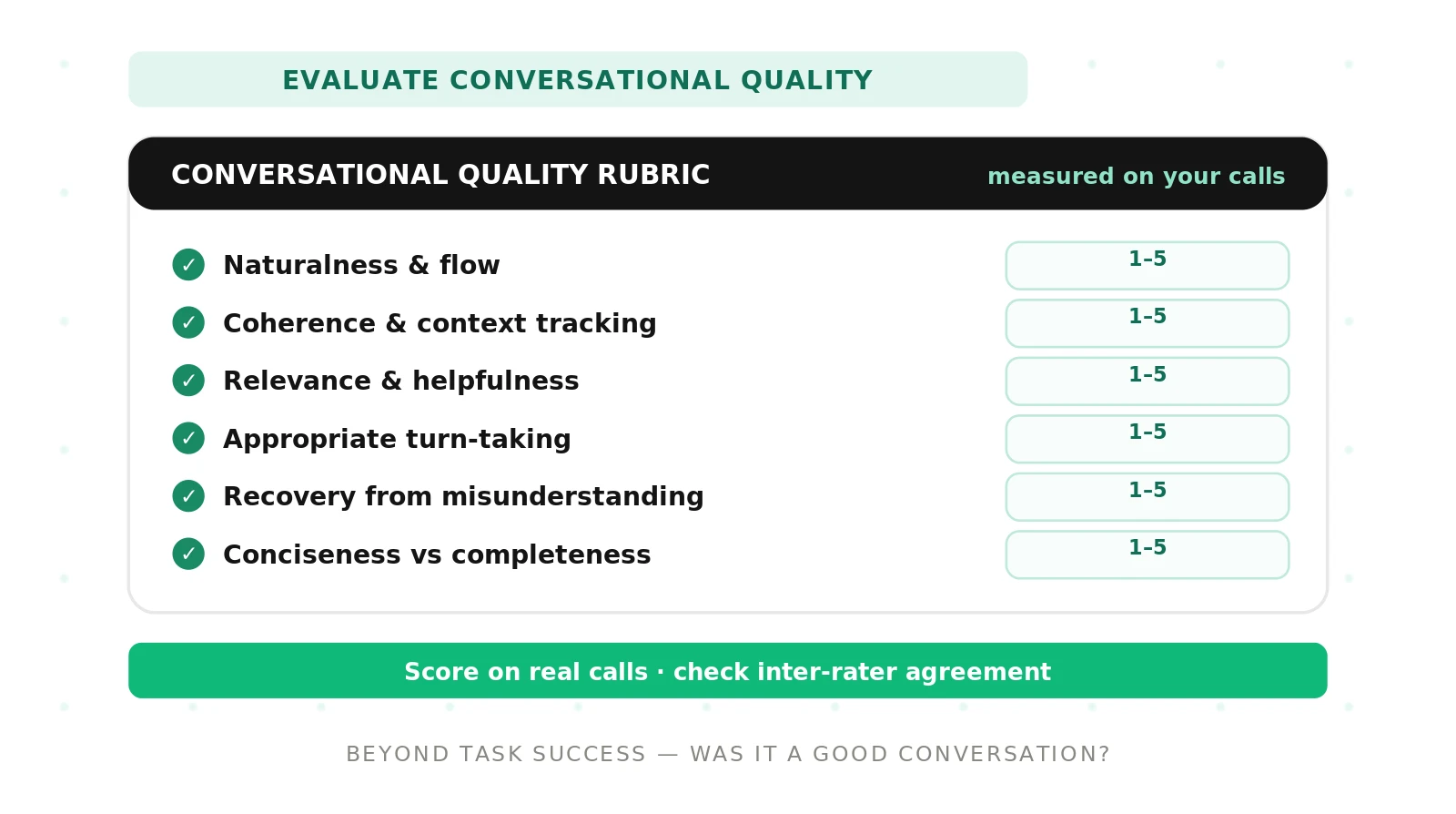
Conversational quality in voice agents is how natural, coherent, and helpful a call feels, apart from whether the task got done. Evaluate it with a rubric across sub-dimensions like flow, relevance, and recovery. Score real calls on a 1–5 scale, use several raters, and check their agreement before you trust the number.
A voice agent can close the ticket and still leave the caller annoyed. It can book the appointment while talking over the person twice. It can answer correctly in a flat, robotic voice. Task success says the job got done. It says nothing about whether the conversation was any good.
That second question is conversational quality. It is the subjective axis of a call. Did this feel like a competent, human-grade exchange? This article covers what that axis contains, how to score it without kidding yourself, and how it relates to task success and CSAT. It builds on the broader voice agent evaluation framework. Here we narrow in on the one part that resists easy measurement.
What conversational quality means in a voice agent
Conversational quality is a judgment about the shape of the interaction, not its outcome. A call can succeed on the task and score low here. A call can feel great and still fail the task. The two axes are related but distinct. You lose information when you merge them.
> Conversational quality: the subjective goodness of a voice interaction, measured across dimensions like naturalness, coherence, relevance, and turn-taking, independent of whether the caller's task was completed.
The academic roots run deep. Conversation analysis studies how human talk is organized. It examines how turns are exchanged, how repair happens after a misunderstanding, and how silence carries meaning. Voice agents live or die on these same mechanics. When an agent gets turn-taking wrong, callers notice within seconds. They rarely notice a clean database write.
So the goal is to make a fuzzy feeling measurable. You break "was this a good conversation" into named sub-dimensions. Each gets a definition, a scale, and a rule. That is what makes the judgment repeatable rather than a gut reaction.
Conversational quality vs task success and CSAT
Three things get confused constantly. It helps to separate them before you score anything.
Task success asks whether the caller reached their goal. Did the refund process, did the booking land, did the balance get read out. It is often binary and fairly objective.
Conversational quality asks how the interaction felt on the way there. It is graded, subjective, and scored by raters or calibrated models. A pleasant call that failed the task still scores well on quality and badly on success.
CSAT is what the caller says afterward, usually a survey score. It is a downstream outcome. It is shaped by quality, by success, and by things you do not control, like the caller's mood. Our guide on CSAT for voice agents unpacks that gap in full.
Here is the key relationship. Conversational quality is a leading indicator. CSAT is a lagging one. You can measure quality on every call, today, before any survey comes back. Good quality does not guarantee good CSAT. But poor quality reliably drags it down. Treat quality as the thing you can act on, and CSAT as the thing you are trying to move.
The sub-dimensions of conversational quality
A useful rubric names a handful of dimensions, each with a clear question. Too many and raters drift apart. Too few and the score hides real failures. The table below lists the sub-dimensions that matter most. It pairs each with what to look for, how to score it, and the failure signal that tells you it broke.
| Sub-dimension | What to look for | How to score it | Failure signal |
|---|---|---|---|
| Naturalness and flow | Human-paced speech, not read from a script | Audio rater, 1–5, MOS-style | Robotic cadence, awkward pauses, flat delivery |
| Coherence and context tracking | The agent remembers earlier turns and stays consistent | Transcript rubric, 1–5 | Contradicts itself, re-asks answered questions |
| Relevance | Replies address what the caller actually said | Transcript rubric, 1–5 | Generic answers, ignores the specific request |
| Helpfulness | The agent moves the caller toward a resolution | Rubric plus outcome check, 1–5 | Correct but unhelpful, no forward progress |
| Turn-taking | Clean handoffs, no talking over the caller | Audio rater, binary plus severity | Interrupts, long dead air, failed barge-in |
| Absence of repetition | No looping phrases or robotic filler | Automated pattern check plus rater | Same line repeated, "I understand" every turn |
| Recovery from misunderstanding | The agent notices and repairs errors gracefully | Scenario rubric, 1–5 | Doubles down on a wrong assumption |
| Conciseness vs completeness | Enough detail, no rambling | Rubric, 1–5 | Wall of text, or clipped and incomplete |
Two of these deserve a note. Naturalness draws directly on the idea of naturalness in speech), which measures how closely synthetic output resembles human delivery. Repetition is worth its own automated check because it is common and easy to detect. Our guide on repetition loops in voice agents covers the patterns to flag.
Notice that some dimensions need the audio and some do not. Coherence and relevance can be scored from a transcript. Naturalness and turn-taking cannot. Grade text for what was said, and grade audio for how it was said.
Scoring conversational quality: three methods
Scoring turns the rubric into numbers. Three methods matter, and most serious programs use all three together.
Human raters on a 1–5 scale. People are still the gold standard for subjective judgment. You give each rater the rubric, a short descriptor for every point, and a set of calls. A five-point Likert scale works well for graded dimensions like flow and relevance. The descriptors matter more than the numbers. "3 = stayed on topic but missed a detail" beats a bare 3.
MOS-style scoring for delivery. The mean opinion score comes from telephony and speech synthesis. Several listeners rate a sample from 1 to 5, and you average the ratings. It is the natural fit for naturalness and audio-level quality. Borrow the method, not just the name. Use multiple listeners, averaged, on a fixed scale.
Calibrated automated scoring. Human rating does not scale to thousands of calls. So you calibrate a model to the rubric, then let it score at volume. A per-dimension approach, like asking a Jev Score question for each sub-dimension, keeps the judgments legible and auditable. Our Jev voice agent metrics breakdown shows how a model can score one dimension at a time rather than emitting a single opaque number.
The order is deliberate. Humans define what good looks like. The model learns to match them. You never let the model set the standard on its own.
Why you score real calls, not scripted demos
This is the part teams skip, and it quietly invalidates everything else. Conversational quality has to be measured on real traffic. Scripted demos and happy-path scenarios do not surface the failures that matter.
A demo call is polite, clear, and predictable. Real callers mumble, interrupt, change their minds, and go off script. That is exactly where naturalness, recovery, and turn-taking get tested. An agent that sounds great in a demo can fall apart the moment someone talks over it. You only see that on production audio.
There is also a selection problem. Vendors demo their best calls. Scoring a curated set tells you the ceiling, not the floor or the median. This is why an independent voice AI evaluation on your own traffic beats any vendor reel. The distinction between running scripted tests and judging real behavior is drawn in full in our testing vs evaluation guide.
How to evaluate conversational quality in a voice agent
Here is the workflow, start to finish. Follow it in order, because each step depends on the one before.
1. Build a rubric. Name your sub-dimensions, cap the list at six to eight, and write a one-line descriptor for each point on the scale. Decide which dimensions need audio and which can use the transcript.
2. Sample real calls. Pull a representative set from production, not from demos. Stratify by intent, caller type, and outcome so the sample reflects real traffic, not just the easy calls.
3. Score with raters and calibration. Have trained humans score the sample against the rubric. Use MOS-style averaging for delivery dimensions. Write down every disagreement, because you will need it.
4. Check inter-rater agreement. Measure how often your raters land in the same place. Use Cohen's kappa for two raters and related inter-rater reliability statistics for more. Low agreement means the rubric is vague, not that the agent is bad. Fix the rubric and re-score.
5. Automate at scale. Once humans agree, calibrate a model to their scores. Validate it against a held-out human-scored set. Then run it on every call so quality is a continuous signal, not a quarterly audit.
6. Validate against outcomes. Confirm your quality scores actually track something real. Correlate them with CSAT, resolution, and repeat-contact rates. If high quality never moves any outcome, your rubric is measuring the wrong things.
That loop is the whole discipline. Define, sample, score, agree, automate, validate. Skip the agreement check and your numbers are noise. Skip the outcome check and you optimize a vanity metric.
Where inter-rater agreement fits
The agreement check is the step most programs underweight. A conversational-quality score is only as trustworthy as the consistency behind it. If two careful raters watching the same call give it a 2 and a 5, the number means nothing.
Cohen's kappa corrects for agreement that happens by chance. A kappa near 1 means raters agree far beyond luck. A kappa near 0 means they are effectively guessing. As a rough guide, teams treat 0.6 and up as usable and push higher on high-stakes dimensions. The point is not the exact threshold. The point is that you measured it at all.
When agreement is low, the fix is almost always the rubric, not the raters. Vague descriptors, overlapping dimensions, and missing edge-case rules all pull scorers apart. Tighten the language, add examples, and re-run. This human calibration is the foundation for any automated scorer. That is why our human-in-the-loop evaluation work treats it as step one, not an afterthought.
Where Evalgent fits
Evalgent is an independent, third-party evaluator. We do not sell you a voice agent, so we have no reason to grade one generously. We score conversational quality on your real calls, using rubrics calibrated against human raters and checked for agreement.
That neutrality is the product. A vendor scoring its own conversations is grading its own homework. We build the rubric with you, sample your production traffic, run calibrated per-dimension scoring, and report where quality holds up and where it breaks. The output slots into a full voice agent metrics scorecard alongside task success and latency. Quality becomes a tracked dimension, not an isolated vibe. Frameworks like the NIST AI Risk Management Framework push toward exactly this kind of independent, documented measurement.
Frequently asked questions
What is conversational quality in voice agents?
Conversational quality is the subjective goodness of a voice call, measured across dimensions like naturalness, coherence, relevance, turn-taking, and recovery from misunderstanding. It captures how the interaction felt, independent of whether the caller's task was completed. It is scored with rubrics by human raters or calibrated models, usually on a 1–5 scale.
How is conversational quality different from task success?
Task success asks whether the caller reached their goal, and it is often binary and objective. Conversational quality asks how the interaction felt on the way there, and it is graded and subjective. A call can succeed on the task while scoring poorly on quality, or feel great yet fail the task. Score both separately.
How do you measure voice agent naturalness?
Measure naturalness with MOS-style scoring. Several listeners rate call audio from 1 to 5 for how human the delivery sounds, and you average their ratings. Naturalness must be scored on the recording, not the transcript, because it depends on pacing, cadence, and tone. Flat delivery and awkward pauses are the common failure signals.
What metrics measure voice agent conversation quality?
Conversational quality metrics are rubric scores across sub-dimensions: naturalness and flow, coherence, relevance, helpfulness, turn-taking, absence of repetition, recovery from misunderstanding, and conciseness. Each dimension gets a 1–5 rating or a binary pass. You also track inter-rater reliability to confirm scores are consistent, and validate them against CSAT and resolution.
How many raters do you need to score conversational quality?
Use at least two raters per call so you can measure agreement, and three or more for high-stakes dimensions. The exact count matters less than checking inter-rater reliability with Cohen's kappa. If agreement is low, adding raters will not help. Tighten the rubric descriptors first, then re-score the same calls.
Does conversational quality predict CSAT?
Conversational quality is a leading indicator of CSAT, not a guarantee of it. Poor quality reliably drags satisfaction down, while good quality raises the ceiling without ensuring a high score. CSAT also depends on factors you do not control, like the caller's mood and the underlying policy. Measure quality on every call and validate it against CSAT.
Can you automate conversational quality scoring?
You can automate conversational quality scoring once human raters have defined and calibrated the rubric. Calibrate a model to their scores, validate it against a held-out human-scored set, then run it on every call. A per-dimension approach keeps judgments auditable. Humans set the standard; the model scales it. Never let the model define good on its own.
Why score conversational quality on real calls instead of demos?
Real calls surface the failures that demos hide. Scripted demos are polite and predictable, so naturalness, recovery, and turn-taking never get stressed. Real callers interrupt, mumble, and go off script, which is exactly where quality breaks. Vendors also demo their best calls, so a curated set shows the ceiling, not the median you actually ship.
The bottom line
Conversational quality is the subjective axis of a voice call, and it is distinct from task success and CSAT. Score it on real traffic with a calibrated rubric, verify rater agreement, and validate the scores against real outcomes.
Ready to hear how your agent sounds on your own calls? Book a demo and we will score conversational quality on your real traffic, independently.
Related Articles
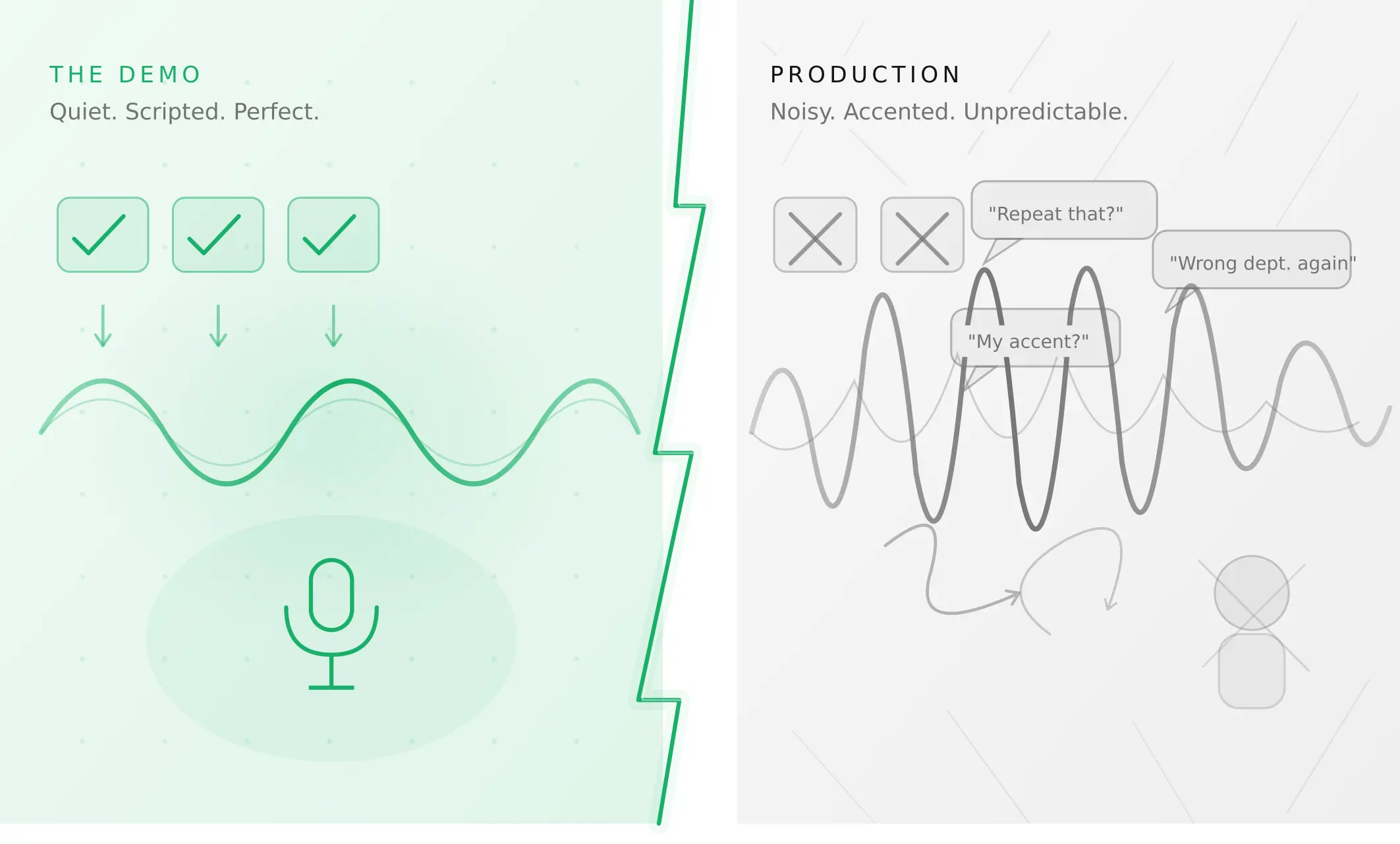
Why AI voice agents fail in production (and how to prevent it)
AI voice agents that ace demos still break in production. Learn the 5 root causes, how to test for each, and what production readiness actually means.
Read more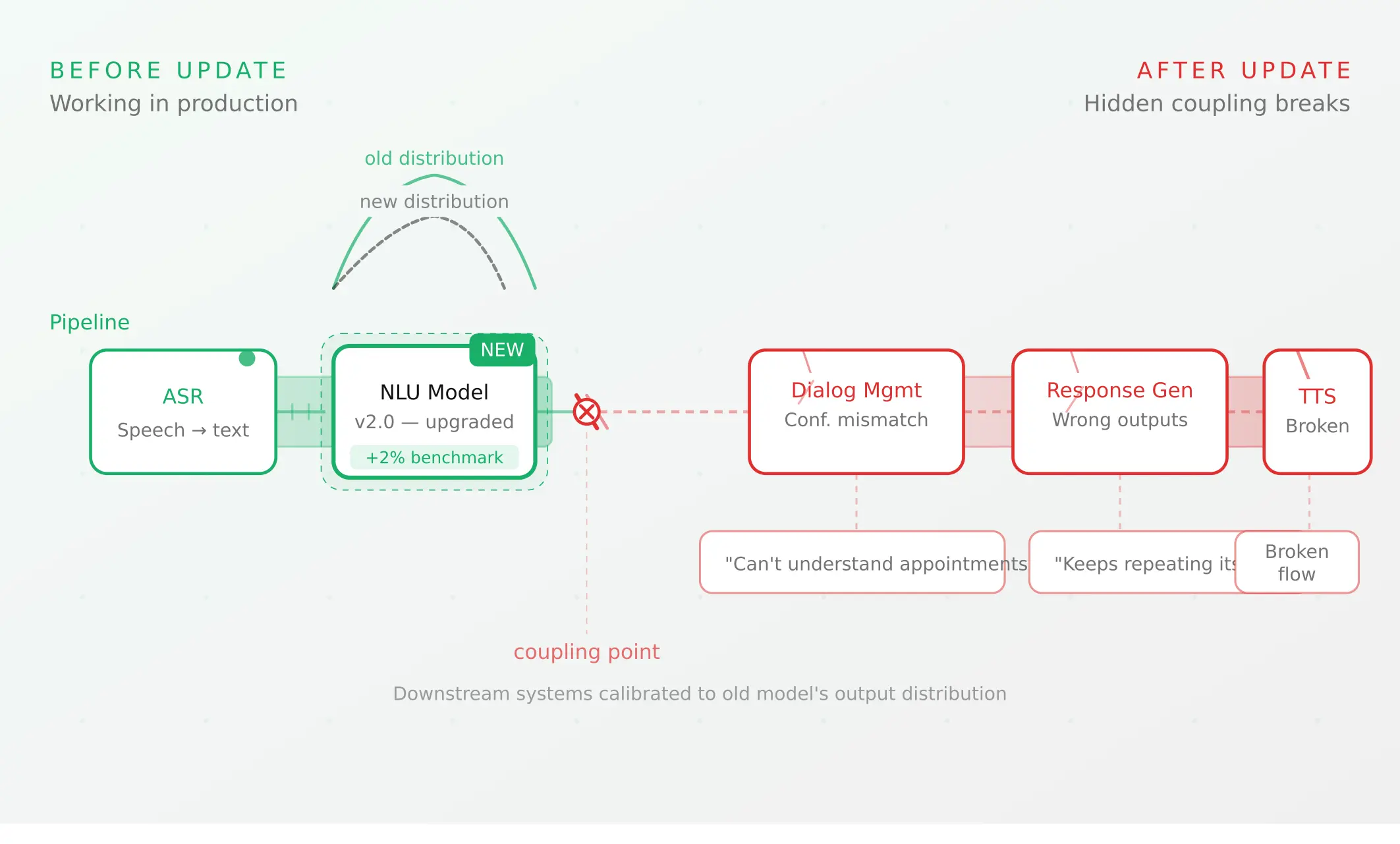
Voice agent regression testing: why LLM updates break production
LLM updates improve benchmarks but break voice agents in 5 predictable ways. How to detect and prevent regressions after every model or prompt change.
Read more