Test your voice agent
How to Measure CSAT for Voice Agents
# How to measure CSAT for voice agents
Quick answer
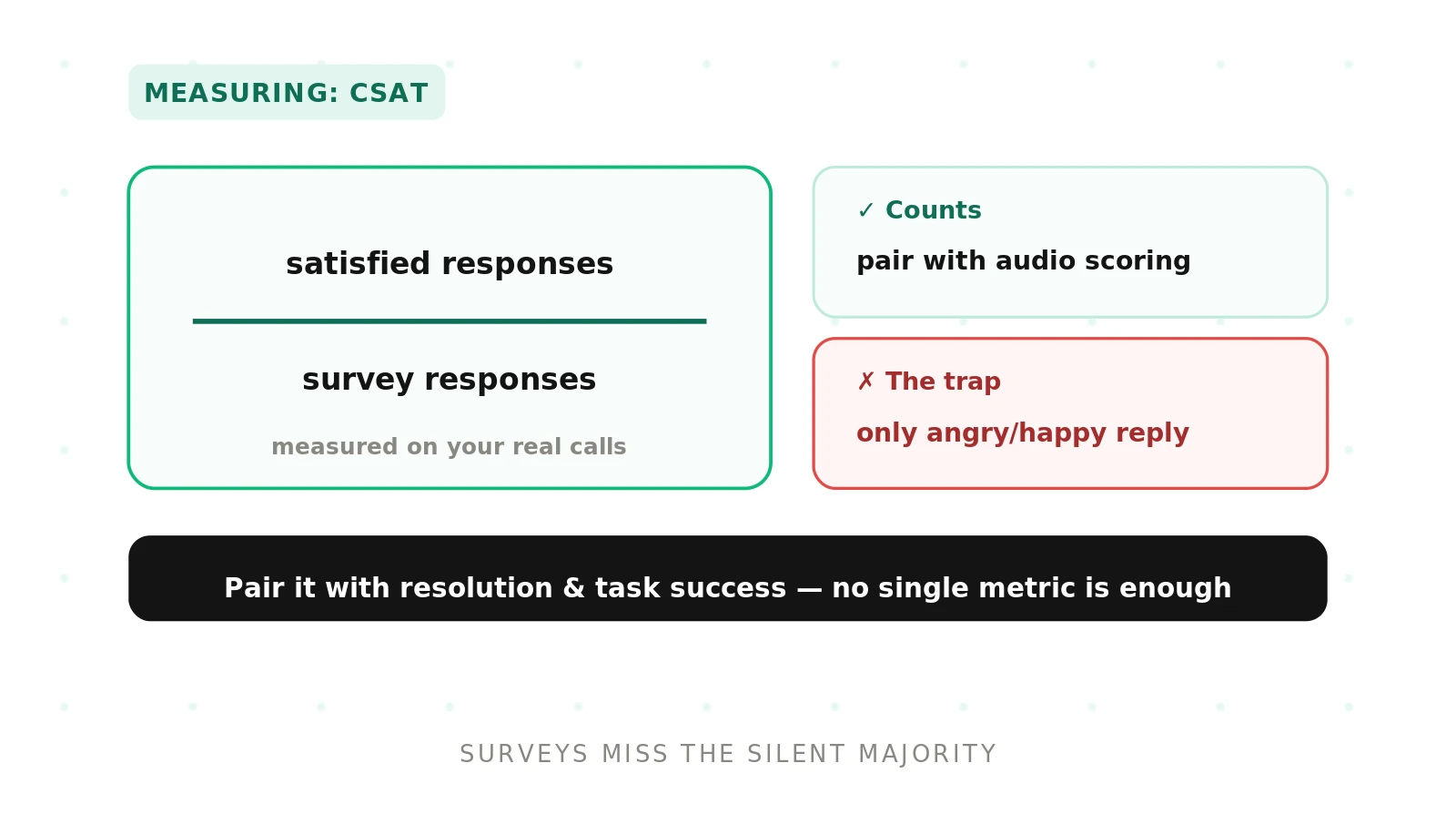
Measure CSAT for voice agents two ways. Run a short post-call survey with a clear rating scale and good timing. Then infer satisfaction from call audio and outcomes to cover the callers who never answer the survey. Pair both, because survey CSAT alone suffers from response bias and low response rates.
Customer satisfaction is the number your leadership already trusts. When a voice agent joins the phone line, that number does not go away. It gets harder to read. Most callers hang up without touching a survey. The ones who do answer are often the angry few or the delighted few. The quiet middle, the calls that went fine, barely show up in your data.
This article covers how to measure CSAT for a voice agent without fooling yourself. You will see how to design and time a post-call survey, why the scale matters, where survey CSAT breaks, and how to fill the gap with satisfaction inferred from the call itself. The goal is one honest read on how callers actually felt, backed by evidence you can show.
What CSAT means for a voice agent
CSAT is a direct measure of how satisfied a customer was with a specific interaction. It is usually a rating a caller gives right after the call.
> CSAT (Customer Satisfaction Score): the share of respondents who rate an interaction at or above a set threshold, expressed as a percentage. For a voice agent, it is a per-call read on whether the caller left happy.
The concept is not new. Customer satisfaction has been a standard business measure for decades. What changes with a voice agent is the source of the experience. A human agent adapts tone, hears frustration, and recovers a bad moment. A voice agent follows a script and a model. It can nail the words and still sound wrong. So the same CSAT question now measures a machine's delivery, not a person's.
That shift matters because CSAT is a proxy. It does not tell you what went wrong on the call. It tells you the caller's summary feeling about it. To act on a low score, you still need the call. That is why CSAT works best paired with per-call scoring that explains the number, which our guide on scoring a voice agent conversation walks through in detail.
Survey CSAT: design, scale, and timing
The most direct way to measure satisfaction is to ask. A post-call survey puts the question to the caller while the call is fresh. Done well, it is the cleanest signal you can get. Done poorly, it collects noise.
Three choices decide whether the survey is worth running.
The scale. Keep it simple and consistent. A 1-to-5 rating is common and easy to say out loud on a phone. This is a form of Likert scale, where each point maps to a labeled feeling from very dissatisfied to very satisfied. Do not switch scales between channels. A CSAT built on a 5-point scale cannot be compared to one built on a 3-point scale. Pick one and hold it.
The question. Ask about the interaction, not the company. "How satisfied were you with this call?" beats "How satisfied are you with our service?" The second question drags in billing, product, and every past experience. You want the caller rating the call they just had. Vague wording invites response bias, where the phrasing itself nudges the answer.
The timing. Ask right after the call, while the memory is sharp. A voice survey can offer a rating before hang-up. An SMS or email survey can follow within minutes. Wait a day and the rating drifts toward the caller's mood that afternoon, not the call. The longer the gap, the weaker the link between the score and the actual interaction.
One more design note. Offer an open comment field but do not require it. Required text fields cut completion. The rating is the number you track; the comment is the color you read when you have time.
Inferred CSAT from call audio and outcomes
Survey CSAT has a fatal gap. Most callers never answer. Whatever you learn, you learn from a slice. To measure the rest, you infer satisfaction from the call itself.
Inferred CSAT, sometimes called predicted CSAT, estimates how a caller felt using signals in the recording and the outcome. It does not ask the caller. It reads the evidence they left behind.
> Inferred CSAT: an estimate of caller satisfaction produced from call audio, transcript, and outcome data rather than a direct rating. It covers the calls a survey never reaches.
The signals fall into two groups. Outcome signals ask whether the call worked. Did the caller reach their goal? Did the agent resolve the issue, or did the caller call back an hour later? Repeat contacts, transfers to a human, and abandoned calls all point at dissatisfaction without a single survey. These outcome measures connect directly to the metrics in our voice agent metrics scorecard.
Experience signals ask how the call felt. This is where audio earns its place. A raised voice, a long silence, repeated requests to "talk to a person," the caller repeating themselves because the agent misheard, overlapping speech where the agent talks over the caller. These live in the sound, not the outcome flag. A call can succeed on paper and still frustrate the caller. Our comparison of transcript versus audio evaluation explains which failures only the audio reveals.
Inferred CSAT is an estimate, not a confession. It will be wrong on some calls. But it has one thing survey CSAT never will: full coverage. Every call gets a read, not just the ones a caller chose to rate.
Survey CSAT vs inferred CSAT
Neither method wins outright. They answer different questions and fail in different ways. The table below lays out the trade-off so you can decide when to lean on each.
| CSAT method | Strength | Weakness | When to use |
|---|---|---|---|
| Post-call survey CSAT | Direct, self-reported; the caller's own voice; trusted by leadership | Low response rates; response and selection bias; only covers callers who answer | Tracking a headline satisfaction number and hearing the caller in their own words |
| Inferred CSAT (audio and outcomes) | Full coverage of every call; catches silent dissatisfaction; no caller effort | An estimate, not a rating; needs a validated model; can misread sarcasm or context | Measuring the whole call population and finding bad calls a survey missed |
| Both, paired | Coverage plus ground truth; each checks the other | More to build and maintain; needs alignment between the two reads | Any serious program that has to defend its CSAT number to customers or auditors |
The pattern most mature teams land on is the third row. Survey CSAT gives the honest self-report on a subset. Inferred CSAT extends that read to every call and flags the failures the survey slept through. Used together, the survey validates the model and the model covers the survey's blind spots.
How to measure CSAT for a voice agent
Here is a practical sequence for standing up CSAT measurement on a voice agent from scratch. Work through it in order; each step depends on the one before.
1. Define what a satisfied call means. Write it down before you measure anything. Decide the rating threshold that counts as satisfied, usually a 4 or 5 on a 5-point scale. Agree on which outcomes count as a good call. This definition is the standard everything else is measured against.
2. Design the post-call survey. Pick one scale and one question about the interaction. Keep it to a single rating with an optional comment. Decide the channel: in-call voice rating, SMS, or email. Confirm the wording does not lead the caller toward a score.
3. Set the timing. Trigger the survey immediately after the call ends. For follow-up channels, send within minutes, not hours. Log the delay so you can check later whether timing is skewing results.
4. Capture the calls. Record and store the audio and transcript for every call, not just surveyed ones. You cannot infer satisfaction on a call you did not keep. This recording is the raw material for the inferred read.
5. Build the inferred CSAT read. Score each call on outcome signals and experience signals. Grade delivery on the audio, since a transcript hides tone and silence. Produce a per-call satisfaction estimate for the full population.
6. Validate the model against the survey. Compare inferred scores to real survey ratings on the calls where you have both. Measure agreement. If the model and the caller disagree often, fix the model before you trust it.
7. Correct for response bias. Check whether your survey respondents look like your full caller base. Weight or segment the results if the angry and delighted are overrepresented. Report the response rate alongside the score, always.
8. Report both numbers and act on the gap. Publish survey CSAT and inferred CSAT side by side. When they diverge, investigate. The divergence is where your most useful insight lives.
Why response bias and low response rates distort survey CSAT
Survey CSAT feels objective because a real person gave the rating. That feeling is the trap. The people who answer are not a random sample of your callers.
The first problem is a low response rate. Most callers skip the survey. Sound survey methodology treats a low response rate as a warning, because the fewer people who answer, the more each answer can swing the number. A CSAT built on five percent of calls is a rating of the five percent, not the hundred.
The second problem is who those respondents are. This is nonresponse bias. People with strong feelings answer surveys. The caller who was furious wants to vent. The caller who was delighted wants to praise. The caller whose call went fine just hangs up. So your survey overweights both tails and underweights the calm middle. The result can look bimodal, and the average can hide the shape.
There is a related effect worth naming. Some teams reach for Net Promoter Score as a satisfaction proxy, but NPS asks about likelihood to recommend the company, not satisfaction with one call. It answers a different question and carries its own sampling problems. For a per-call voice agent read, CSAT on the interaction is the tighter fit.
None of this makes survey CSAT useless. It makes it partial. The fix is not to survey harder. It is to stop treating a rating from a biased slice as the whole truth, and to cover the rest with a read that does not depend on who chose to answer. That coverage argument is the same one behind independent voice AI evaluation: a measurement is only as good as the population it actually reaches.
Where an independent evaluator fits
Measuring your own CSAT has a quiet conflict of interest. The team that ships the agent tends to set a satisfied threshold the agent can clear. Survey prompts get worded gently. Bad calls get explained away as edge cases. Over time the number drifts up while the experience does not.
Evalgent measures voice agent experience as an independent third party. We score the audio of your real calls, apply a consistent standard you can inspect, and produce a per-call experience read across your full call population, not just the surveyed slice. That read pairs with your survey CSAT: the survey gives the caller's self-report, and the audio-based scoring covers everyone who never answered and explains why a call felt bad.
Because the scoring is external, the bar does not move to flatter the agent. This is the same principle behind benchmarking on real traffic that we cover in benchmarking voice agents on your own data. An independent CSAT read is the difference between a satisfaction number you like and one you can defend to a customer, a regulator, or your own board.
Frequently asked questions
What is CSAT for a voice agent?
CSAT for a voice agent is a per-call measure of how satisfied a caller was with an automated phone interaction. It is usually collected as a rating right after the call, then reported as the percentage of respondents who scored at or above a satisfied threshold. It measures the agent's delivery and outcome, not the whole company.
How do you measure CSAT for a voice agent?
Measure CSAT two ways. Run a short post-call survey with one rating scale and good timing to capture the caller's self-report. Then infer satisfaction from call audio and outcomes to cover callers who never answer. Validate the inferred read against real ratings, report both numbers, and investigate wherever they diverge.
What is a good CSAT score for a voice agent?
A good CSAT score depends on your industry, call type, and how you define satisfied. Rather than chase a benchmark, set a clear threshold, track it consistently, and watch the trend. Always report the response rate beside the score. A high CSAT built on a five percent response rate is far weaker than a lower one built on broad coverage.
What is inferred or predicted CSAT?
Inferred CSAT, also called predicted CSAT, estimates caller satisfaction from the call recording, transcript, and outcome data instead of a direct rating. It reads signals like repeat contacts, transfers, raised voices, and long silences. Its main strength is coverage: every call gets a satisfaction estimate, including the many calls a post-call survey never reaches.
Why are voice agent survey response rates so low?
Voice survey response rates are low because answering costs the caller time and effort right when they want to hang up. Most people decline. The ones who stay tend to hold strong opinions, so the results skew toward the angry and the delighted. This is nonresponse bias, and it is why a survey-only CSAT rarely represents your full caller base.
How does response bias affect voice agent CSAT?
Response bias distorts CSAT because the callers who answer are not a random sample. Strong feelings drive responses, so both extremes are overrepresented and the calm middle is missing. The reported average can hide a bimodal shape. Check whether respondents match your full caller base, weight or segment when they do not, and always publish the response rate.
Should CSAT be measured on the transcript or the audio?
Measure outcome-based satisfaction from transcript and call data, since those signals are text and metadata. Measure experience-based satisfaction from the audio, because tone, pacing, silence, and interruptions never survive in a transcript. A call can look fine in text and sound frustrating in the recording. Grading delivery on the audio is what catches that gap.
How is CSAT different from a conversation score?
CSAT is the caller's summary feeling about a call, collected or inferred as one satisfaction read. A conversation score is a structured rating you assign against a rubric across dimensions like accuracy and resolution. CSAT tells you the caller was unhappy; the conversation score explains why. The two work together, with the score diagnosing the satisfaction number.
The bottom line
Survey CSAT captures the caller's own rating but reaches only the few who answer. Inferred CSAT from call audio and outcomes covers every call, so pairing the two gives you a satisfaction number you can actually defend.
Want an independent CSAT read on your real calls, graded on audio across your full call population? Book a demo and we will measure a sample of your live traffic.
Related Articles
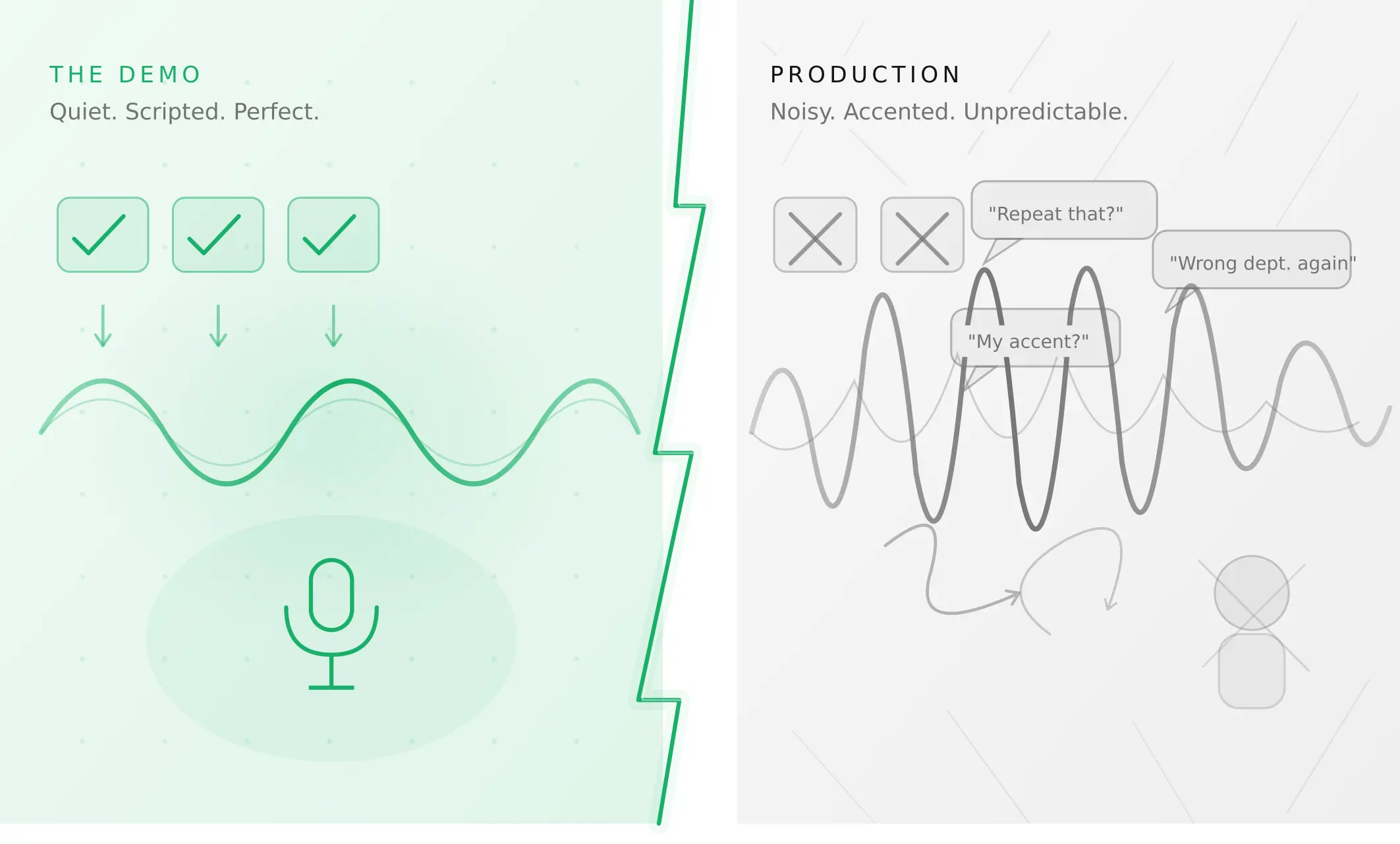
Why AI voice agents fail in production (and how to prevent it)
AI voice agents that ace demos still break in production. Learn the 5 root causes, how to test for each, and what production readiness actually means.
Read more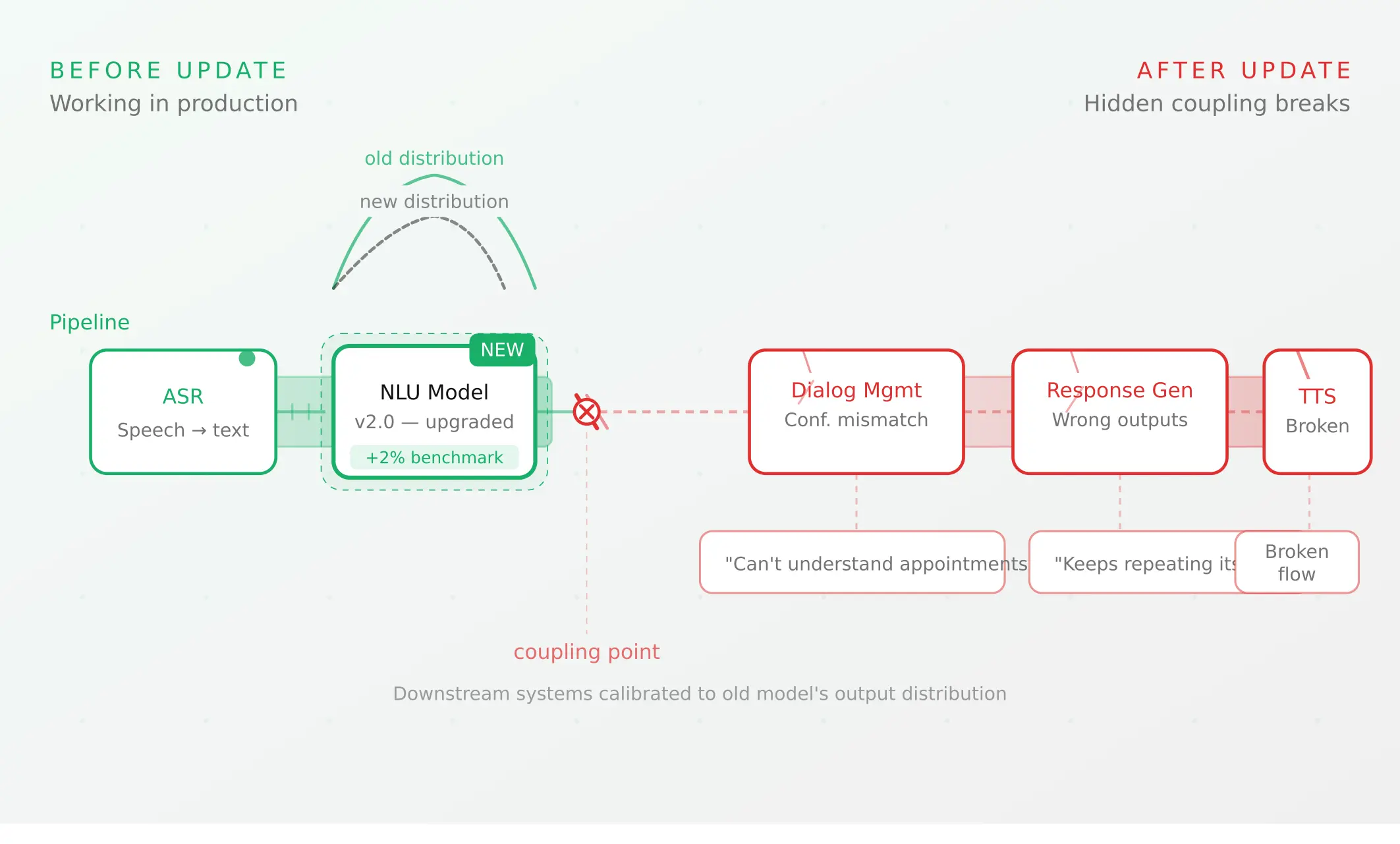
Voice agent regression testing: why LLM updates break production
LLM updates improve benchmarks but break voice agents in 5 predictable ways. How to detect and prevent regressions after every model or prompt change.
Read more