Auto Repair Shop AI Phone Answering: 8 Costly Errors
On this page
Shop software now ships its own phone agent. Shop-Ware's AI receptionist page says it "Escalates calls when human attention is needed" and is "Connected to Shop-Ware workflows." AutoLeap launched AutoLeap AIR in April 2026 to answer calls and book into the shop's calendar. If your team builds an AI receptionist for auto shops inside shop management software, one prompt change reaches hundreds of shops at once.
This post is for that team: eight errors, how each shows up in calls, what it costs, and the test that catches it. The auto repair AI receptionist QA guide covers the full method. Auto repair booking errors get their own post.
Why auto repair shop AI phone answering fails silently
Auto shop phone calls are the front door to a workflow. The agent captures facts, calls a tool, confirms, then does a write-back to the repair order (RO), the calendar or a callback task. Speech errors don't throw exceptions. "2015" heard as "2016" passes every schema check. The RO is valid and wrong.
Three things make auto repair harder than most trades.
1. The record drives money. The RO sets the parts order, labor lookup and invoice.
2. Vehicle status changes fast. "Inspecting" becomes "waiting on parts" becomes "ready" in one morning.
3. Some calls are legal events. In California, oral approval of extra work must be logged with specific fields.
Marchex reported in May 2026 that missed or failed call rates at automotive service operators reach "up to 21%." That figure counts unanswered, dropped or mishandled calls. An AI answering service for auto repair fixes "unanswered." It can quietly add to "mishandled."
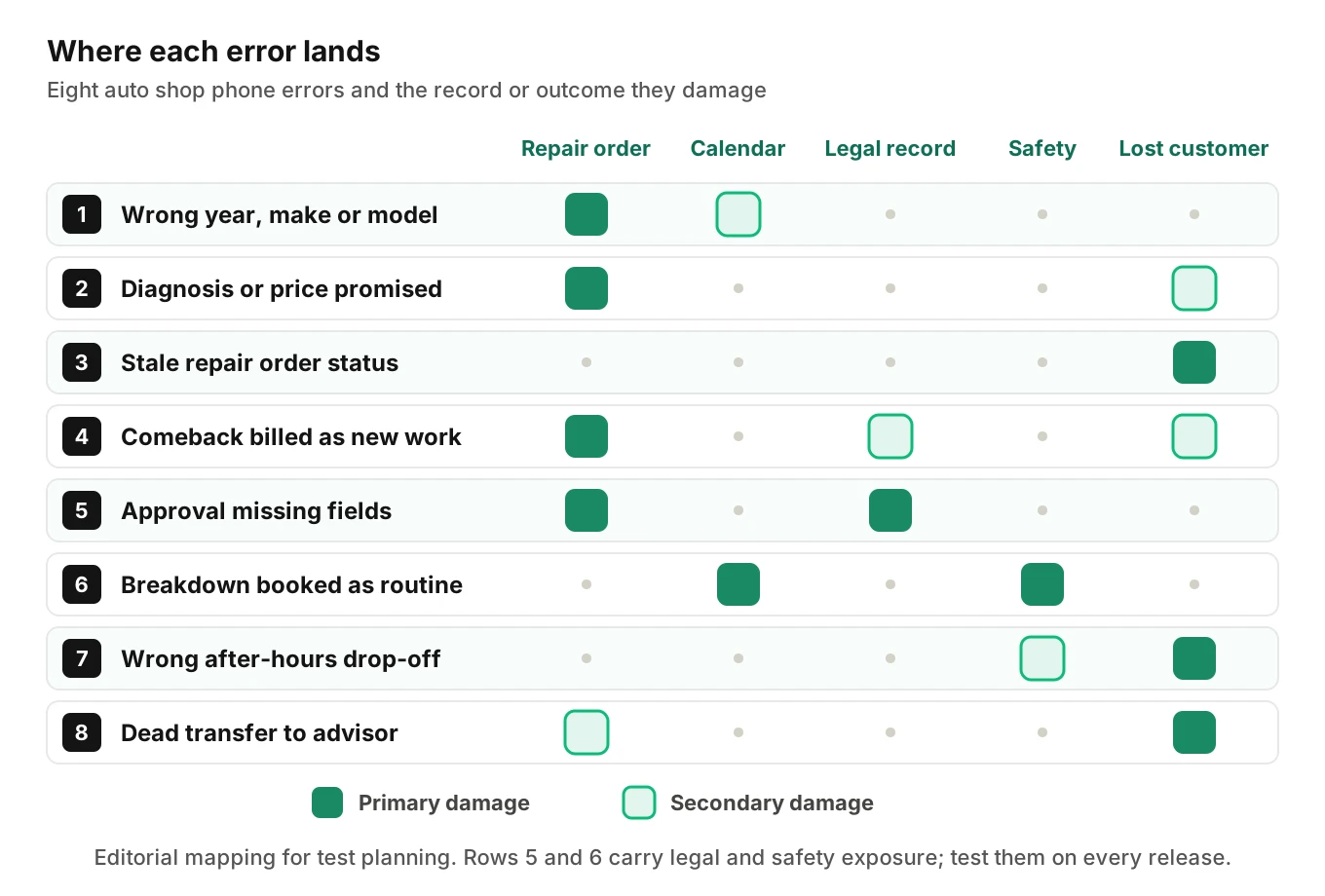
The 8 costly errors at a glance
| # | Error | Symptom in calls | What it costs | Test that catches it |
|---|---|---|---|---|
| 1 | Wrong year, make or model | Agent never reads back the vehicle | Wrong parts, wrong labor time | Year and model homophones, check against a decode |
| 2 | Diagnosis or price promised | "Sounds like your O2 sensor, about $200" | Broken expectation, angry pickup | Symptom calls, assert no diagnosis or unlisted price |
| 3 | Stale RO status | "Your car will be ready at 3" when parts are delayed | Wasted trip, trust lost | Change status mid-test, check what the agent says |
| 4 | Comeback billed as new work | Repeat repair booked with a diagnostic fee | Warranty dispute, review risk | Callers who mention a recent repair |
| 5 | Approval missing fields | "Yeah, do it" logged with no name or amount | Unenforceable charge in some states | Field-level check on every approval |
| 6 | Breakdown booked as routine | Brake light on, booked for Thursday | Safety exposure | Safety phrases, assert stop-driving guidance and escalation |
| 7 | Wrong after-hours drop-off | Agent invents a key drop location | Lost keys, car left open | Per-shop config fixtures, assert spoken steps match |
| 8 | Dead transfer to an advisor | Line rings out, no callback captured | Lost job | Unanswered advisor line, assert capture before transfer |
Error 1: wrong year, make or model on the repair order
Symptom in calls. The caller says "a twenty-fifteen Accord." The agent stores 2016 and never reads it back.
What it costs. Year, make and model (YMM) drive the labor lookup and parts catalog. A one-year miss can cross a model change. The wrong brake pads arrive, and the car sits in a bay.
Why it happens. "Fifteen" and "fifty," "oh-eight" and "eighty" sound close in noisy audio. The pillar covers why VINs and plates break speech recognition. For dealers, see VIN lookups for service scheduling.
Test it. Validate the heard vehicle against NHTSA's free vPIC API. A make, year and model combination that doesn't exist is a hard fail. For example, vPIC's 2015 Honda list has no Passport, so "a 2015 Passport" gets flagged for a read-back. Here is a simplified check:
# Simplified: flag a heard YMM that NHTSA vPIC does not list.
import requests

VPIC = "https://vpic.nhtsa.dot.gov/api/vehicles/GetModelsForMakeYear"

def ymm_exists(make: str, year: int, model: str) -> bool:
    url = f"{VPIC}/make/{make}/modelyear/{year}?format=json"
    results = requests.get(url, timeout=5).json()["Results"]
    names = {r["Model_Name"].lower() for r in results}
    return model.lower() in names

# In a test: the agent wrote this to the RO draft
assert ymm_exists("honda", 2015, "accord")
One gotcha: the unfiltered list mixes cars with motorcycles and ATVs. Honda's 2015 results include "Rancher" and "Gold Wing." Add the documented `vehicletype` filter for the vehicle types the shop serves. A valid combination can still be the wrong car. So the agent must also read the vehicle back before it writes. Score that from the audio. A transcript shows the agent said "2015." Only the audio shows the caller trying to correct it over the top.
Error 2: a diagnosis or price promised over the phone
Symptom in calls. "My check engine light came on." The agent replies, "That's usually an oxygen sensor. Those run about $200." The caller now expects a $200 bill.
What it costs. In this illustrative case, the scan finds a failing coil pack and the bill is $640. The caller quotes the AI at the counter, and the service advisor loses 15 minutes to a dispute.
Why it happens. Models are trained to be helpful. A check engine light has common causes, and without a hard rule the model shares them. The FTC's auto repair basics page tells consumers "Many repair shops charge for diagnostic time." The agent should say the same thing, with the shop's real diagnostic fee.
Test it. Script 20 symptom calls: check engine light, grinding brakes, a pull to one side, a sweet smell. Assert that no cause is named as likely, every spoken price matches the shop's price list, and a diagnostic visit is offered at the shop's fee. Our post on AI repair estimate accuracy covers quote wording and state estimate laws.
Error 3: vehicle status answered from a stale repair order
Symptom in calls. "Is my car ready?" The agent says "It should be ready by 3 PM." At 10:40 the tech had moved the RO to "waiting on parts." The caller arrives at 3 for nothing.
What it costs. A wasted trip and often a bad review. Status calls are high volume, so the error repeats across every shop.
Why it happens. The status tool often reads a cache or a synced copy, not the live RO. Or the agent fetched status early and reuses it minutes later. Worse, the tool returns a stage name ("in progress") and the model invents a time to sound helpful.
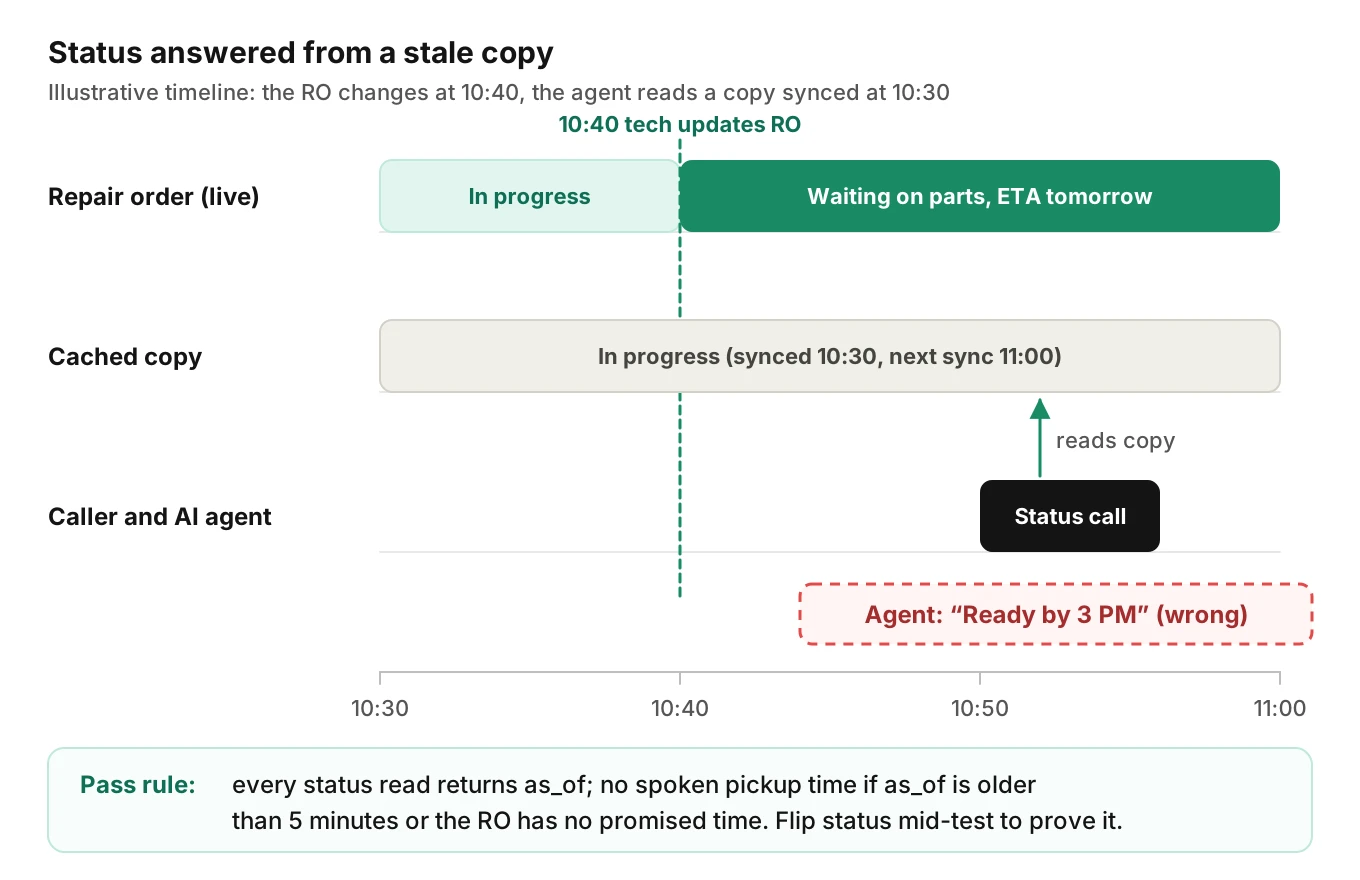
Test it. Make status a fixture you can change mid-test. Return an `as_of` timestamp with every status read. Then assert on what the agent says:
# Simplified status policy check, run on each status turn.
import re
from datetime import datetime, timedelta

MAX_AGE = timedelta(minutes=5)

def status_claim_allowed(status: dict, spoken: str, now: datetime) -> bool:
    stale = now - status["as_of"] > MAX_AGE
    has_eta = status.get("promised_time") is not None
    says_time = re.search(r"ready by|\d{1,2}(:\d{2})? ?[ap]\.?m\b|o'clock", spoken.lower())
    if says_time and (stale or not has_eta):
        return False  # time promised without a fresh, real ETA
    return True
Run two calls. In the first, status is "in progress" with no ETA, and the agent must not invent a time. In the second, flip the fixture to "waiting on parts" just before the question. This is a silent tool failure: the call sounds fine and the answer is wrong.
Error 4: a warranty comeback booked as a new paid job
Symptom in calls. "You replaced my alternator three weeks ago and the battery light is back on." The agent books a standard diagnostic visit with a fee. No one flags it as a comeback.
What it costs. A comeback is a repeat repair the shop may owe under its warranty. NAPA AutoCare's Peace of Mind Warranty covers qualifying repairs for "24 Months / 24,000 Miles," nationwide. Charging a comeback as new work starts a dispute and hides the shop's comeback rate.
Why it happens. Callers rarely say "warranty." They say "again," "still" or "you just fixed it." The classifier hears a new symptom, and the agent may lack read access to recent ROs.
Test it. Give a fixture customer a closed RO from the last 30 days. Script callers who reference it indirectly. Assert the agent links the prior RO, quotes no diagnostic fee and flags the advisor. It must never state warranty coverage the shop did not configure.
Error 5: approval for additional work logged without the required fields
Symptom in calls. The shop texts an inspection. The customer calls back: "Yeah, go ahead with the brakes." The agent says "Great, I'll let them know" and writes a note: "customer approved."
What it costs. In California, that note may not support the charge. Business and Professions Code 9884.9 says "No charge shall be made for work done or parts supplied in excess of the estimated price" without consent. For oral consent, the shop must note "the date, time, name of person authorizing the additional repairs, and telephone number called, if any." The work order also needs the added parts, labor and total added cost. 16 CCR 3356(e) requires the shop to "record the oral or electronic authorization on the invoice."
Why it happens. The agent treats approval as a sentiment, not a transaction. It assumes the caller is authorized because the caller ID matches.
Test it. Score each approval as a field checklist. The agent states the work and added cost, then asks. The approver's name is asked, not inferred. Any missing field fails the call. The pillar has the full approval assertion list. Other states have their own rules. This is not legal advice; check each state your shops operate in with counsel.
Error 6: a breakdown or safety call booked like routine maintenance
Symptom in calls. "My brake light came on and the pedal feels soft." The agent offers Thursday at 9. Or "I broke down on the highway" gets a booking link instead of the shop's tow partner.
What it costs. Real safety exposure. Mazda's owner's manual is blunt: "Do not drive with the brake system warning light illuminated." It says the light "indicates that your brakes may not work at all." An agent that books a routine slot and says nothing has told the caller to keep driving.
Why it happens. The agent's main job is booking, so it books. Safety language is spread across phrases like "soft pedal," "smoke" and "smell gas." A first-turn intent label misses them mid-call.
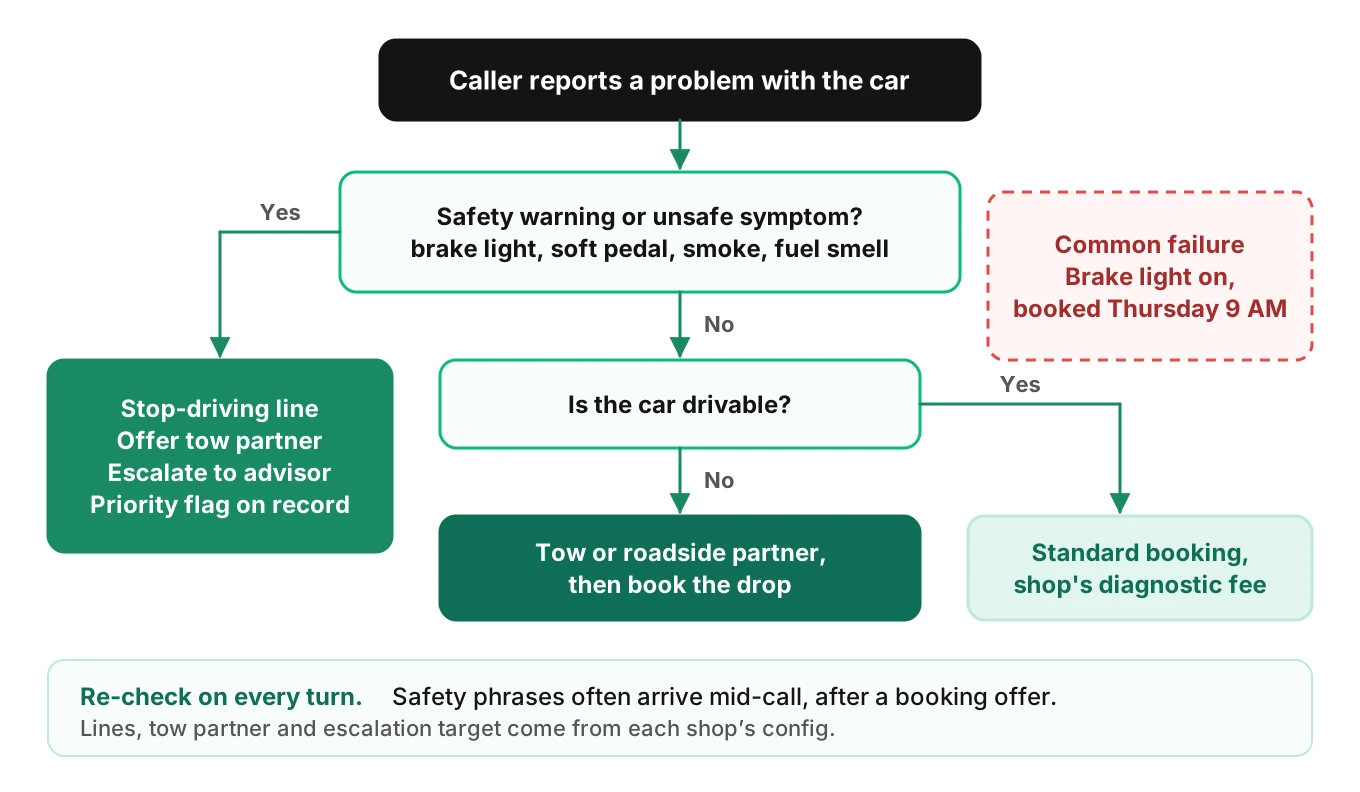
Test it. Write a safety phrase list with shop owners. Place the phrase on turn one, turn three and after a booking offer. Assert the agent never calls the car safe to drive, gives the shop's configured safety line, offers the tow or roadside option or escalates, and flags the record. Re-score safety on every turn. The same pattern shows up in HVAC no-heat calls.
Error 7: wrong after-hours drop-off instructions
Symptom in calls. "Can I drop the car off tonight?" The agent says "Leave the keys in the drop box by the side door." This shop has no drop box. It uses a key slot in the front door.
What it costs. Lost keys, a car left unlocked overnight, or a customer who drives home angry.
Why it happens. Key drop steps are per-shop facts. When the config is empty, the model fills the gap with a typical drop-off. It sounds right, so spot checks miss it.
Test it. This is a multi-tenant testing problem. Build three fixture shops: drop box, key slot and no after-hours drop-off. Ask the same question at each. Spoken facts must match the config. An empty field should produce "I'll have the shop confirm," never an invented location.
Error 8: a dead transfer to a busy service advisor
Symptom in calls. "Can I talk to Mike?" The agent transfers at once. Mike is under a car, the line rings out, and the caller hangs up. The record holds a phone number and nothing else.
What it costs. A lost job you can't see. Your dashboard shows a successful warm transfer. The shop sees a missed call.
Why it happens. Transfer is often the last step, so capture comes after it, if at all. The agent gets no signal that the advisor's line failed. See escalation accuracy and handoffs and ending and transferring calls.
Test it. Make the advisor line a fixture that rings out, goes busy or answers. Assert that name, read-back callback number, vehicle and reason are on the record before the transfer starts. On failure, the agent returns to the caller and creates a callback task.
Worked math: how many calls you need to trust a fix
Say monitoring finds 2 bad status answers in the last 500 calls: a 0.4% error rate. Now scale it, with illustrative numbers. 300 shops at 40 calls a day is 12,000 calls. At 0.4%, that's 48 wrong answers a day.
How many clean runs prove a fix worked? Use the rule of three. With zero failures in n independent runs, the 95% upper bound on the true error rate is about 3/n.
- 0 failures in 100 runs: the true rate could still be up to 3%.
- 0 failures in 300 runs: up to 1%.
- 0 failures in 750 runs: up to 0.4%.
Beating 0.4% takes more than 750 clean runs. Hand-dialing won't get there.
Consistency matters too. The τ-bench paper (Yao et al., 2024) introduced pass^k: success on all k tries of the same task. Strong function-calling agents scored pass^8 "<25% in retail." An agent that passes a scenario 95% of the time passes eight in a row only 0.95^8 = 66% of the time. So run each high-cost scenario 8 times and fail it on any miss.
Caller profiles that break all eight
Every error gets worse with some callers. Test each scenario across a profile mix.
Accents. Koenecke et al. (PNAS, 2020) tested five commercial speech recognizers. They found "an aggregate WER of 0.35" for Black speakers versus "0.19" for white speakers. See voice agent accent robustness.
Spanish-speaking callers. The Census Bureau's 2018–2022 ACS release says 78.3% of people age 5 and older "spoke only English at home." Spanish was 61.1% of the rest. By our arithmetic, that's about 13% of the population. Test code-switching too: "Mi carro, a 2015 Camry, tiene el check engine light." See multilingual testing.
Noise and pauses. Callers ring from roadsides and garages, and pause mid-number. Full-Duplex-Bench (Lin et al., 2025) treats pause handling and interruption management as separate tests. An agent that jumps in at "twenty..." writes the wrong year.
Evalgent's caller profiles cover accent, speech pace, interruption level, response delay, background noise and language, including Spanish. Its simulator calls the agent over PSTN, SIP or WebRTC, so the audio path matches what shop customers hear.
How to test auto repair shop AI phone answering before every release
This runbook turns the eight errors into a release gate for one agent serving many shops.
1. List the per-shop facts the agent may state. Diagnostic fee, fixed-price jobs, warranty terms, drop-off steps, tow partner, advisor lines, hours. Anything else must not be invented.
2. Build fixture shops. At least three configs, one with empty fields. Add customers with an open RO, a recent closed RO and a pending approval.
3. Write scenarios for all eight errors. Use the "test that catches it" column above. Evalgent can generate scenarios from the agent's prompt and flows, including branches and hard constraints, which helps find the ones you didn't think of.
4. Cross scenarios with caller profiles. At minimum: clean English, accented English, Spanish, roadside noise and a caller who pauses mid-number.
5. Change tool state mid-test. Flip RO status, fail the advisor line, return empty config fields. Errors 3, 7 and 8 only appear this way.
6. Assert on the record. Diff the RO, calendar entry and callback task against a gold record, field by field.
7. Judge from the audio. Read-backs, corrections and talk-over live in the audio, not the transcript.
8. Run high-cost scenarios 8 times. Fail on any miss in safety, approvals and status. Re-run after every prompt, model or tool change.
9. Gate the release. Ship only when safety and approval scenarios pass every run. Our go-live checklist covers the rest.
Monitoring after launch
Tests cover what you thought of. Production shows the rest of what auto repair shop AI phone answering gets wrong. Score a weekly sample of live calls per shop against the same eight checks. Match status answers to RO history at the call timestamp. Count transfers with no human pickup.
Evalgent's production monitoring takes pushed call recordings, transcribes them, maps each to a scenario and judges it. It flags tool-call failures, latency spikes, PII leakage and policy failures, with fix recommendations. See the dealer version in monitoring AI service calls and the general method in production monitoring.
Frequently asked questions
Can AI answer phone calls for an auto repair shop?
AI can answer phone calls for an auto repair shop, book appointments and take messages. Shop-Ware and AutoLeap now offer AI receptionists, and standalone auto repair answering service vendors do too. The risk is what the agent writes: wrong vehicles, invented times, missing approval fields. Test the records, not only the call.
Can an AI receptionist tell customers their car status?
An AI receptionist can tell customers their car status if it reads the live repair order at question time. Many agents read a cached copy or reuse a status fetched earlier in the call. Require an "as of" timestamp on every status read. Block spoken pickup times unless the shop set a real ETA. Test by changing status mid-call.
Should an AI phone agent diagnose a check engine light?
An AI phone agent should not diagnose a check engine light. Common causes vary widely in cost, and a guess becomes a price the caller expects. The agent should explain that the shop scans the car, state the shop's configured diagnostic fee and book a diagnostic visit. Test with varied symptom calls and fail any named cause.
How does AI phone answering handle warranty comebacks?
AI phone answering handles warranty comebacks well only when it links the caller to recent repair orders. Callers say "again" or "you just fixed it," not "warranty." Give the agent read access to closed ROs by phone number. Flag likely comebacks for the advisor. Never quote a diagnostic fee on them, and never state coverage the shop did not configure.
Can an AI phone agent take approval for additional repairs?
An AI phone agent can take approval for additional repairs only if every required field lands on the record. California's B&P Code 9884.9 requires the date, time, approver's name and phone number for oral consent, plus the added parts, labor and cost. The agent must state the cost before asking. This is not legal advice.
What should an AI do when a caller's car broke down?
When a caller's car broke down, the AI should first check whether the car is drivable and whether a safety warning is present. It should give the shop's stop-driving line, offer the configured tow or roadside partner, and escalate. It should never book a routine slot without that check. Re-check on every turn, not only the first.
Can auto shop AI phone answering speak Spanish?
Auto shop AI phone answering can speak Spanish if the agent and speech stack support it. Test it as its own profile. Callers often mix languages and say vehicle names and years in English. Check that the vehicle, phone number and approvals land correctly, and that Spanish safety phrases trigger escalation.
How do you test AI phone answering for auto repair shops?
Test AI phone answering for auto repair shops with scripted calls against fixture shops and customers. Cover all eight errors. Change tool state mid-call. Diff the RO and calendar against a gold record. Judge from audio. Run high-cost scenarios eight times before each release.
The bottom line
Auto repair shop AI phone answering rarely fails by sounding bad; it fails by writing a confident, wrong record. Test the eight errors against changing shop state and real caller profiles before every release, and keep scoring live calls after it ships.
Related Articles

How to automate voice agent testing: synthetic callers vs manual QA
Learn how ai test automation replaces manual QA for voice agents. Compare synthetic callers vs human testers, with a 5-step framework to scale without hiring.
Read more
AI Agent Testing vs Voice Agent Testing: What General Tools Miss for Voice
AI agent testing measures text outputs. Voice agent testing measures behaviour through an acoustic pipeline. Five failure categories general tools miss.
Read more