AI Receptionist for Auto Repair Shops: Step-by-Step QA Guide
On this page
This guide is for the product and engineering team inside shop management software, or dealership service software, that built a phone agent into the product. It now answers calls for hundreds of shops. Each shop has its own hours, labor rate, services, bays and loaner policy. Every prompt or flow change ships to all of them at once. Most teams still test by calling a demo shop and listening.
The question this guide answers is narrow. How do you know the receptionist works, step by step? Not "does it sound good", but "did it write the right vehicle, the right job and the right slot into the shop's system?"
What an AI receptionist for auto repair shops actually does
The pitch is "never miss a call". Marchex, which analyzes calls for large multi-location automotive service operators, reported in May 2026 missed or failed call rates of up to 21% across its customer locations. Even its best locations averaged nearly 10%. That figure is Marchex's own platform data; it does not publish call counts. It is still the clearest primary number on the problem.
Most auto repair shop AI phone answering products sell on that number. Answering is the easy half. The hard half is what happens after the greeting. A phone call at a shop is the front door to a workflow:
1. Capture. Who is calling, what vehicle, what problem, what they want.
2. System action. Look up the customer, decode the vehicle, check recalls, find a slot, price a job.
3. Confirmation. Read the key facts back and get a yes.
4. Write-back. Create or update the repair order, appointment or estimate in the shop system.
Repair order (RO): the shop's working record for one visit. It holds the customer, the vehicle (VIN, year, make and model, mileage), the concern, the jobs, parts, labor and authorizations. Technicians, service advisors and invoicing all read from it.
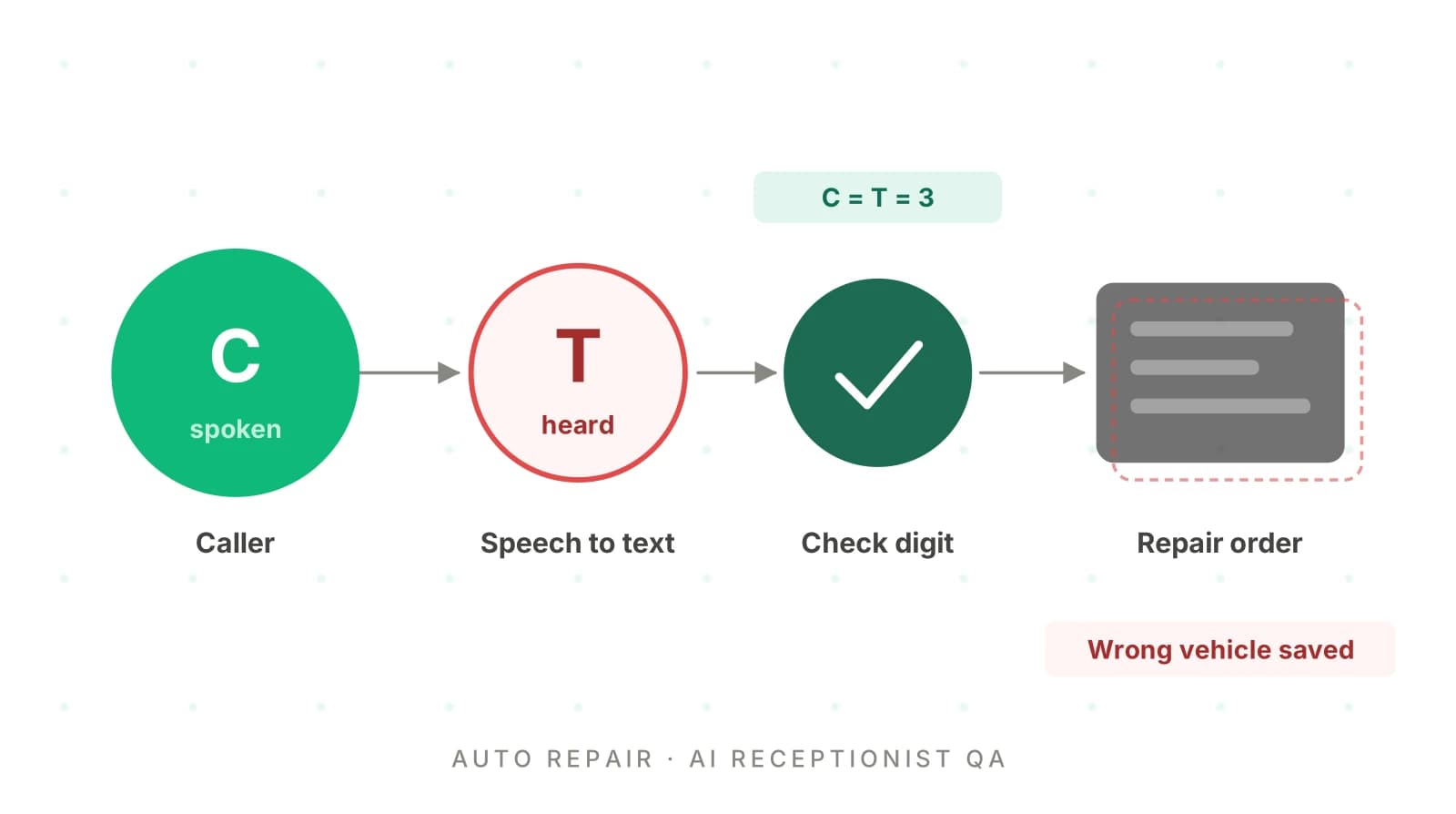
A speech error at step 1 does not crash anything. It flows into step 4 as a valid-looking record. The shop finds out when a tech pulls the wrong car's service history, or orders parts for the wrong engine. That silent corruption is what your QA has to catch.
So the unit of testing is the record, not the transcript. A test passes when the RO, appointment or estimate matches a gold record field by field. This is the same idea behind order-diff scoring for restaurant phone ordering, adapted to vehicles and bays.
The trade × use-case map
"Auto repair" covers three different businesses. They share a phone pattern but not a failure profile. Auto repair shops live on symptom intake and estimates. Dealership service lives on VIN data, recalls and advisor routing. Device and electronics repair lives on model numbers and ticket lookups.
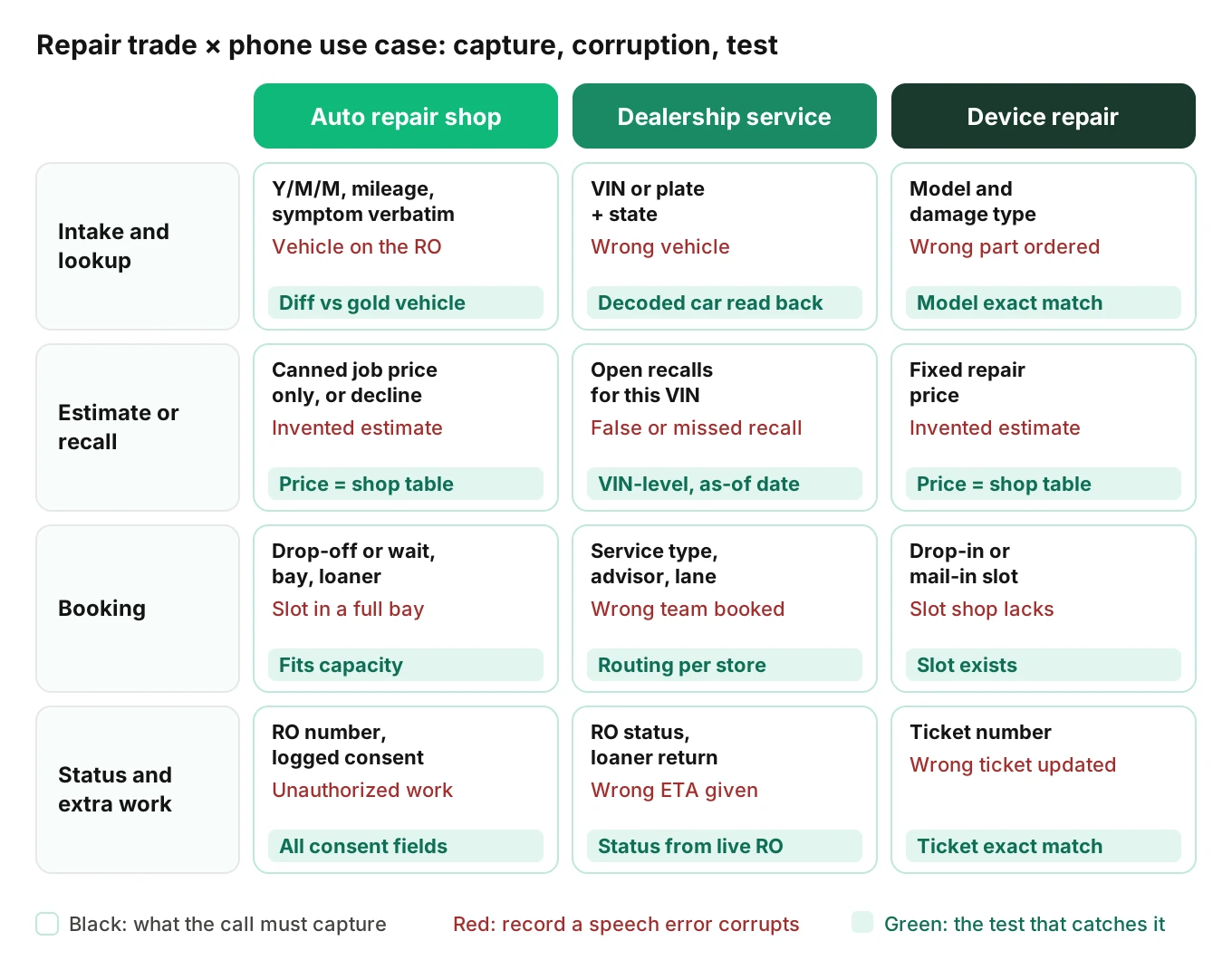
| Trade | Use case | What the call must capture | What a speech error corrupts | How to test it |
|---|---|---|---|---|
| Auto repair shop | Lead intake | Name, callback number, year, make and model, mileage, symptom in the caller's words | Customer and vehicle on the RO; wrong vehicle history pulled | Gold vehicle diff; symptom kept verbatim, not "diagnosed" |
| Auto repair shop | Estimate by phone | Job, vehicle, shop labor rate, whether a quote is allowed | A price the shop never set | Agent quotes only the shop's canned price or declines |
| Auto repair shop | Booking | Drop-off or wait, date, time, bay type, loaner or shuttle | Appointment in a full bay or a closed day | Slot exists in that shop's calendar and capacity |
| Auto repair shop | Status and extra work | RO lookup key, approval with name, time, number, amount | Unauthorized work on the RO | Approval logged with every required field |
| Dealership service | VIN or plate lookup | VIN or plate and state, decoded vehicle confirmed | Wrong vehicle on the RO | Read back decoded year, make, model, not 17 characters |
| Dealership service | Recalls | Open recalls for this VIN, not this model | False "you have a recall" or a missed one | VIN-level result vs model-level list |
| Dealership service | Advisor assignment | Service type, preferred advisor, express lane rules | Booking routed to the wrong team | Routing rule per store config |
| Device repair | Intake and tickets | Device model, damage type, ticket number | Wrong part ordered, wrong ticket updated | Model and ticket number exact match |
Auto repair shops
Independent shops get the widest calls. A caller says "it makes a grinding noise when I brake, maybe a 2017 Accord?" The agent must keep the symptom as the caller said it. It should not turn "grinding" into "needs brake pads" on the RO. A technician diagnoses; the receptionist records.
The vehicle is the second trap. "Twenty seventeen" and "twenty seventy" are close on a phone line. "Accord" and "Accent" are different brands. Year, make and model must be confirmed, ideally against the shop's existing customer record.
Status calls are where money moves. "Is my car ready?" needs an RO lookup. "The tech found a leaking water pump, do you want it done?" needs a logged approval. That second case has legal weight in some states, covered below.
Dealership service
Dealership service AI leans on structured lookups. The caller gives a VIN, a plate or just a name. The agent decodes the vehicle, checks open recalls, picks a service type and an advisor, then books. Each lookup is a tool call that can fail quietly. We go deeper on VIN capture and dealer scheduling in our dealership service scheduling guide.
An AI service advisor on the phone also has to respect store rules. Express lanes may take only oil changes and tire rotations. Some advisors handle only fleet or warranty work. Those rules live in config, so they differ per rooftop.
Device and electronics repair
Device repair shops follow the same pattern with smaller records. The call must capture the device model, the damage and, for status, a ticket number. "iPhone 13" versus "iPhone 13 mini" decides which screen gets ordered. A ticket number like "R-40815" is an alphanumeric string, so it inherits every problem VINs have, on a shorter scale.
Where a speech error lands in the shop system
The table above is the map. This section is the mechanism. Each stage of the call writes into a different field, and each field has its own failure.
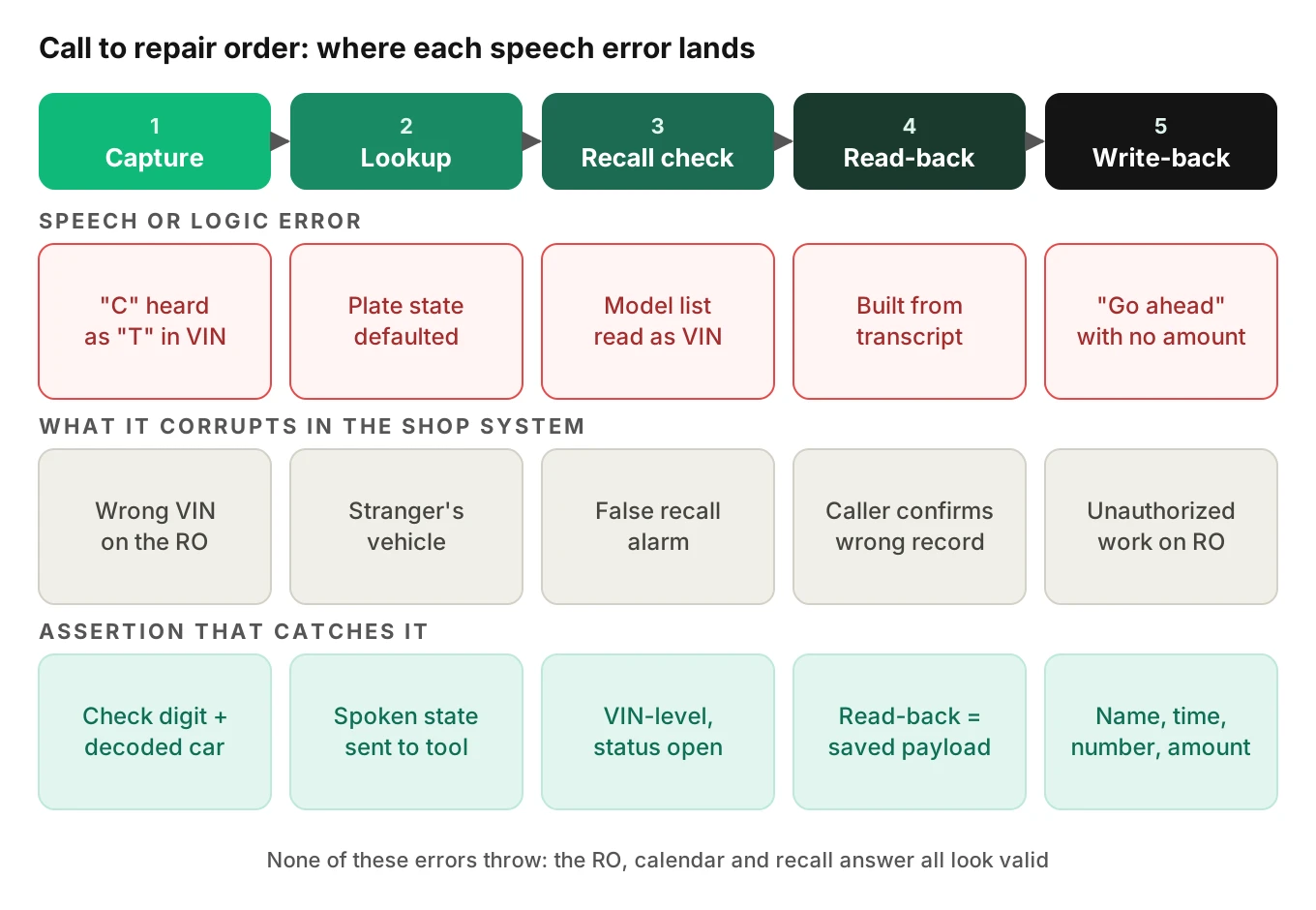
| Stage | Example speech error | Record it corrupts | Assertion that catches it |
|---|---|---|---|
| Capture | "C" heard as "T" in a spelled VIN | VIN field | VIN passes check digit and decode matches caller's vehicle |
| Lookup | Plate state defaulted to the shop's state | Vehicle on the RO | Lookup called with spoken state, not default |
| Recall check | Model-level list read as VIN-level | Customer told of a recall that is fixed | Recall source is VIN-level, status "open" |
| Read-back | Agent reads transcript, not stored record | Caller confirms the wrong thing | Read-back text equals the payload sent |
| Booking | "Tuesday the 4th" when the 4th is a Monday | Appointment on the wrong day | Date and weekday agree before write |
| Estimate | Agent invents a labor time | Price on the estimate | Price equals shop's canned job or is refused |
| Approval | "Sure, go ahead" with no amount stated | Authorization on the RO | Amount, name, time, number all logged |
Three patterns repeat. First, the transcript can be right while the tool argument is wrong, so score the arguments. Our guide to tool-argument accuracy from speech covers that layer. Second, a tool can fail and the agent can carry on as if it worked. That is the silent tool failure problem. Third, the read-back can come from the wrong source. A read-back built from the transcript proves nothing about what was saved.
Why VINs, plates and phone numbers break speech recognition
Shop calls are full of alphanumeric strings. VINs, plates, phone numbers, RO numbers and ticket numbers all share one property. They carry no language model help. In "I need an oil change", the model can guess a blurred word from context. In "one H G C M eight two", every character is independent.
What the research says
The problem is old and still open.
- Letters on the phone are hard. Fanty, Cole and Roginski built a telephone alphabet recognizer at NIPS 1991. It classified single spoken letters at 89% speaker-independent accuracy. Spelled names were retrieved correctly 91% of the time, but only by matching against a 50,000-name list. The list did the error correction.
- End-to-end models struggle with long numbers. Peyser and colleagues at Google studied numeric sequences in end-to-end ASR. On their longest tail test set, baseline WER was 92.7%. Better training brought it to 11.3%. The cause was data sparsity: long numeric strings rarely appear in training text.
- Whole-string accuracy is the metric that matters. Blau and colleagues at Google tested personal identifiers, including digit and alphanumeric sequences. Their baseline averaged 8.3% character error rate but only 75.3% sentence accuracy. Roughly one string in four had at least one wrong character.
- Alphanumeric data is scarce. The SNuC corpus from Sheffield was described by its authors as the first published corpus of spoken alphanumeric identifiers. It holds over 13,000 sequences from 50+ British English speakers. Adapting an ASR model on it improved accuracy on identifiers.
These are research systems, not your production speech-to-text vendor. The direction is the lesson. Character accuracy can look fine while whole-string accuracy fails often. A VIN is one string. One wrong character is a wrong vehicle.
Worked math: why per-character accuracy lies
Treat each character as an independent trial. This is a simplifying assumption, labeled as such.
- At 99% per-character accuracy, a 17-character VIN is fully right 0.99^17 = 84.3% of the time.
- At 98%, it is 0.98^17 = 70.9%.
- At the 1991 telephone letter rate of 89%, it is 0.89^17 = 13.8%.
A 10-digit phone number at 99% per digit is right 90.4% of the time. That is one wrong callback number in ten calls. Your dashboard may show a "word error rate" near 2% while one VIN in four is wrong. Score entities, not words.
The VIN check digit, and its blind spots
Federal rules give you a free validator. Under 49 CFR 565.13, every VIN has 17 characters. Letters come only from a set that leaves out I, O and Q. Position 9 is a check digit. 49 CFR 565.15 defines the math. Each character becomes a number, gets a position weight, and the sum is taken modulo 11. A remainder of 10 becomes "X".
Run this before any lookup. It is simplified, but the tables match the regulation.
# VIN validation per 49 CFR 565.13 and 565.15 (simplified)
TRANSLIT = {**{str(d): d for d in range(10)},
    "A": 1, "B": 2, "C": 3, "D": 4, "E": 5, "F": 6, "G": 7, "H": 8,
    "J": 1, "K": 2, "L": 3, "M": 4, "N": 5, "P": 7, "R": 9,
    "S": 2, "T": 3, "U": 4, "V": 5, "W": 6, "X": 7, "Y": 8, "Z": 9}
WEIGHTS = [8, 7, 6, 5, 4, 3, 2, 10, 0, 9, 8, 7, 6, 5, 4, 3, 2]

def vin_errors(vin: str) -> list[str]:
    vin = vin.strip().upper()
    errs = []
    if len(vin) != 17:
        errs.append(f"length {len(vin)}, expected 17")
    bad = sorted({c for c in vin if c not in TRANSLIT})
    if bad:
        errs.append(f"illegal characters {bad} (I, O, Q are never used)")
    if errs:
        return errs
    total = sum(TRANSLIT[c] * w for c, w in zip(vin, WEIGHTS))
    expected = "X" if total % 11 == 10 else str(total % 11)
    if vin[8] != expected:
        errs.append(f"check digit is {vin[8]}, expected {expected}")
    return errs

print(vin_errors("1M8GDM9AXKP042788"))   # []
print(vin_errors("1M8GDM9AXKPO42788"))   # illegal 'O'
print(vin_errors("1M8GDM9AXKP0427BB"))   # check digit is X, expected 2
The check digit catches every single-character swap between characters with different values. Because 11 is prime and no weight is a multiple of 11, any value change shifts the sum. Here is the gotcha. Several characters share a value. A, J and 1 are all 1. C, T and 3 are all 3. E, V and 5 are all 5. G, P and 7 are all 7. H and 8 are both 8.
Look at that list again. C/T, E/V and G/P are classic rhyming letter confusions on the phone. H and 8 ("aitch" and "eight") are close too. A and J rhyme. Those are among the most likely speech errors, and the check digit cannot see any of them. An error in position 9 itself also slips through if the new value happens to match.
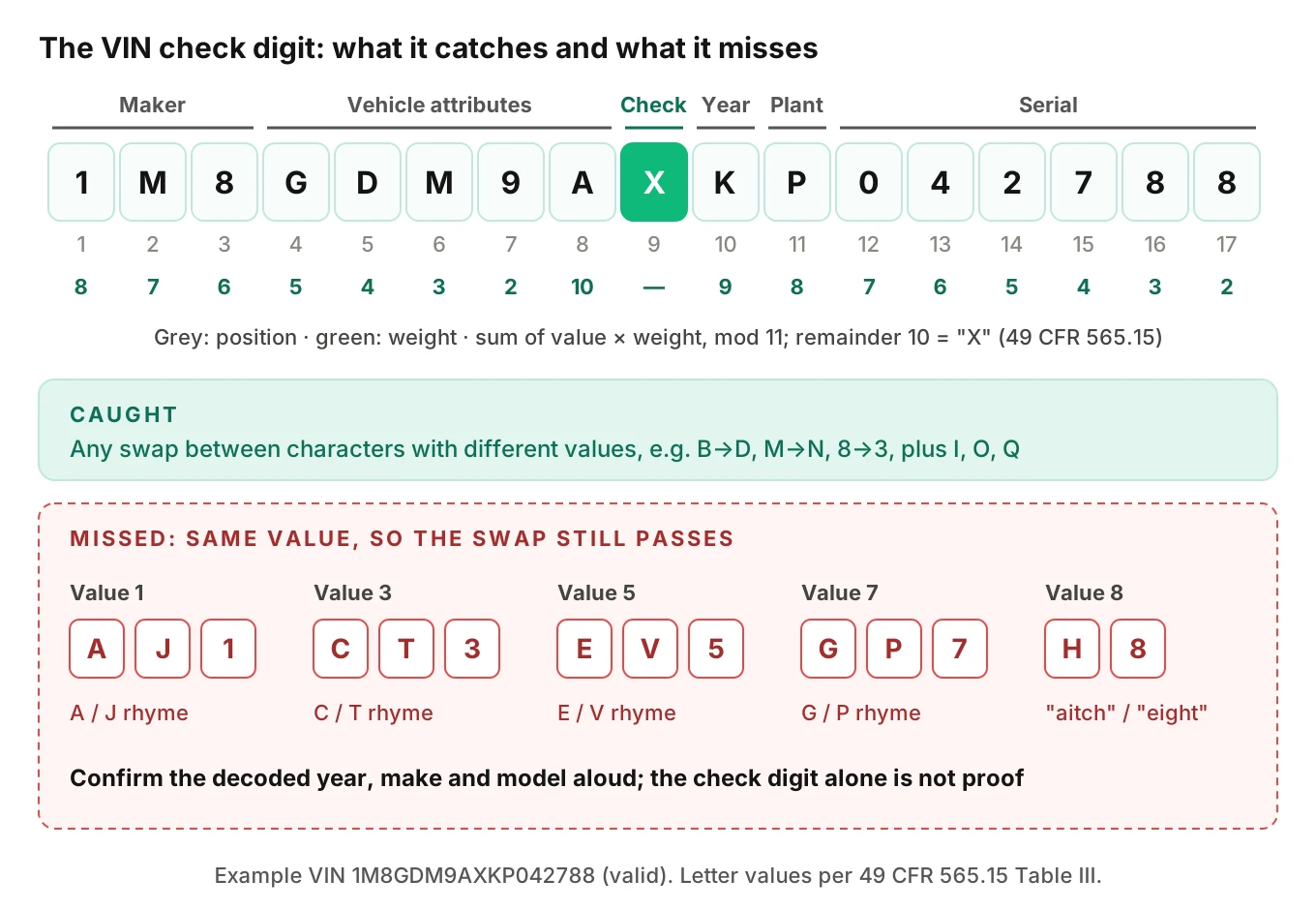
So the check digit is a floor, not a proof. The real confirmation is semantic. Decode the VIN with NHTSA's vPIC API or your data provider. Then read back the decoded vehicle: "That's a 2019 Honda Civic, right?" A caller cannot verify 17 characters by ear. They can verify their own car. vPIC also supports partial VIN decoding, with an asterisk for each unknown character, which helps when a caller has only part of the VIN.
Three more rules for alphanumeric capture:
1. Prefer lookups that avoid spelling. Match on caller ID first, then plate, then last 6 or 8 of the VIN, then full VIN.
2. Constrain the alphabet. If the agent hears "O" or "I" in a VIN slot, map it to 0 or 1 and confirm.
3. Chunk the read-back. Read in groups of three or four, never all 17 at once.
A license plate adds one more trap. It is unique only with its state. An agent that silently defaults to the shop's state will look up a stranger's car for every out-of-state caller.
Recalls by phone: model-level vs VIN-level
Recall questions are where a confident wrong answer does the most harm. There are two kinds of recall data, and agents mix them up.
Model-level recalls. NHTSA's public Recalls API takes make, model and model year, or a campaign number. Its documented calls do not take a VIN. It returns every recall for that model year, whether or not a given car was repaired.
VIN-level recalls. NHTSA's recall lookup shows unrepaired recalls for one VIN, for covered manufacturers. It excludes recalls older than 15 years, except where a maker offers more. Under 49 CFR 573.15, makers that sell 25,000 or more light vehicles a year must offer a free VIN lookup. It must be updated at least every seven calendar days and show the last update date.
The failure modes follow directly:
- False alarm. The agent reads a model-level list and says "your car has an open recall". The recall was completed last year.
- Missed recall. The agent says "no recalls" because the VIN was misheard and decoded to another car.
- Stale answer. A recall launched this week may not be in the VIN data yet. NHTSA itself says recent recalls may not be posted.
Test the wording as well as the data. "Our records show one open recall for this VIN as of last Tuesday" is correct. "Your car has no recalls" is a promise the data cannot back. Dealers usually pull recall status from the manufacturer, so the source differs from independent shops. Your test cases need both paths.
Repair estimates and approving extra work by phone
Two money moments happen on the phone: quoting a price and approving more work. Both need hard rules in the agent, not prompt suggestions.
Should the agent quote prices?
Most shops will let the agent quote fixed-price jobs only. An oil change, a tire rotation or a canned brake job has a set price per vehicle class. Anything diagnostic should get a diagnostic fee and an appointment, not a guess. The failure to test is the "helpful" estimate. A caller asks "how much for a timing belt on a 2012 Sienna?" and the agent invents a labor time. That number now sits in the call record as a quote.
Test it with a price table per shop. The pass rule is simple. Every price spoken must equal a canned job price for that shop and vehicle class, or the agent must decline. Multiply hours by the shop's labor rate only if the shop explicitly enabled that.
Approving additional work
The tech finds a second problem. The shop calls, or the customer calls in, and approves it. If an agent takes that approval, it must log it correctly.
California is a useful template because its rules are explicit. Under 16 CCR 3356, oral approval of additional work must be recorded with the date and time, the name of the person who approved, the phone number or email contacted, and a description and cost of the added parts and labor with the new total. The Bureau of Automotive Repair's 2023 workshop material lists the same fields under Business and Professions Code 9884.9 and 16 CCR 3354. Other states have their own rules. This is not legal advice; check each state your shops operate in with counsel.
For a voice agent, that turns into assertions:
- The agent states the added work and its cost before asking for consent.
- The caller's "yes" follows that statement, not an earlier question.
- The approver's name is captured and confirmed, not assumed from caller ID.
- The RO gets all required fields, with the call timestamp.
- Vague consent ("yeah, whatever it needs") does not authorize an unstated amount.
Treat any approval that lacks a field as a failed call, even if the conversation sounded fine. Can an AI phone agent approve additional repair work? Only if the shop enables it and every field lands on the RO.
Booking: drop-off vs wait, bay capacity and loaners
Booking looks like generic scheduling, and the basics are in our appointment scheduling test guide. Shops add four twists.
1. Drop-off vs waiter. A waiter appointment needs a short job and a specific start time. A drop-off needs a drop window and a pickup estimate. The agent must ask which, then book the right type.
2. Bay capacity. Slots are limited by bays and lifts, not just staff hours. An alignment needs the alignment rack. A 3-hour job cannot start 1 hour before close.
3. Loaners and shuttles. Loaner cars are a finite pool. Promising one that is already out is a broken promise at the counter.
4. Hours and holidays. "Saturday at 9" is valid for some shops and closed for others. Timezone matters for chains that span zones.
Test each against the shop's live calendar, not a mock. The assertion is that the appointment written exists, fits capacity, has the right type, and matches what was read back. Can an AI receptionist book auto repair appointments? Yes, when the booking tool enforces capacity and the agent cannot write around it.
Testing across hundreds of shops' configurations
This is where builders of a shop management software AI receptionist differ from a single shop's vendor. You do not test one agent. An AI phone agent for auto repair runs under every config you ship, so you test it once per config.
A shop's config includes hours, holidays, labor rate, enabled services, canned job prices, bay types and counts, loaner pool, quote policy, approval policy, language and transfer number. Most bugs come from combinations. A shop closed on Saturdays with a waiter-only express lane breaks different paths than a 6-bay shop open seven days.
Config fingerprints
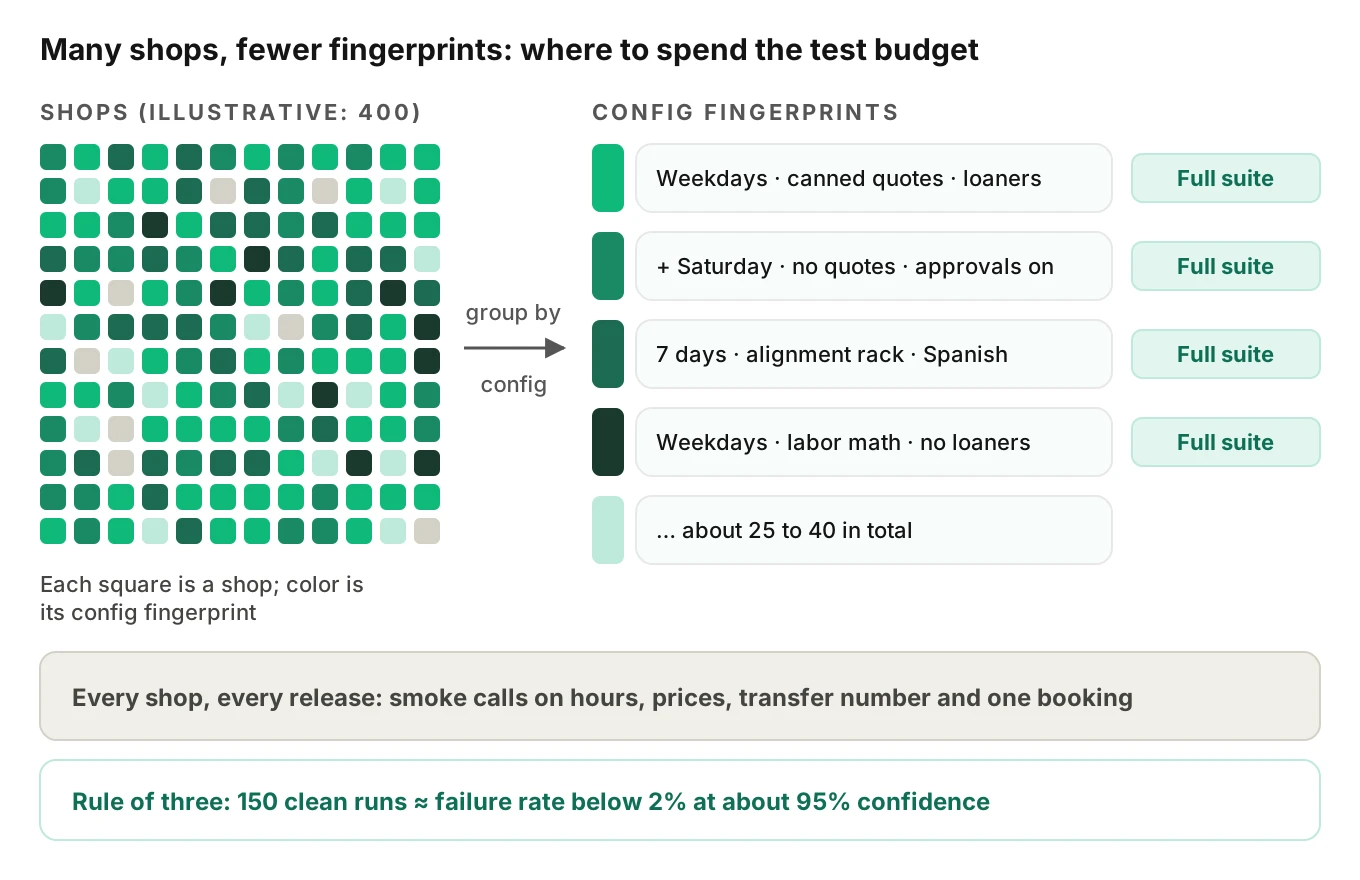
You cannot run a full suite on every shop. Group shops by the config fields that change agent behavior. Call each group a fingerprint.
Here is a worked example with illustrative numbers. Say you serve 400 shops. Bucket them on six fields:
- Hours profile (weekdays only, plus Saturday, seven days): 3 values
- Quote policy (none, canned only, canned plus labor math): 3
- Approval by phone (off, on): 2
- Loaners (none, pool): 2
- Alignment rack (no, yes): 2
- Language (English only, English and Spanish): 2
That is 144 possible fingerprints. In practice, real shops cluster. Perhaps 25 to 40 fingerprints cover all 400. Run the full scenario suite once per fingerprint, then run a short smoke test on every shop.
How many runs per scenario
Voice tests are noisy, so one pass proves little. If a scenario passes n times with zero failures, the "rule of three" says the true failure rate is below 3/n at about 95% confidence. To claim VIN capture fails less than 2% of the time, you need about 150 clean runs. For 5%, about 60. Spend that budget on the critical scenarios: VIN and plate capture, extra-work approval, booking writes and recall answers.
Gate every change
A prompt edit, a new speech-to-text model or a config schema change all ship to every shop. Gate them the same way:
1. Run config checks on every shop: hours parse, prices exist, transfer numbers dial.
2. Run the full voice suite per fingerprint.
3. Run smoke calls per shop.
4. Release to a small cohort, watch, then widen.
Our post on shipping prompt changes safely covers staged rollout. The go-live checklist for each new customer's agent covers the per-shop onboarding pass. The same per-location logic drives drive-thru QA across 500 stores.
A scenario test matrix for shop calls
Scenarios define what the caller wants. Conditions define how they sound. Cross them.
| Scenario | Clean line | Shop noise (impact gun, compressor) | Car cabin on speaker | Strong accent | Caller corrects mid-string |
|---|---|---|---|---|---|
| Spell full VIN | Required | Required | Required | Required | Required |
| Plate plus out-of-state | Required | Required | Optional | Required | Required |
| New customer, symptom as a sound | Required | Optional | Required | Required | Optional |
| Book waiter vs drop-off | Required | Optional | Required | Optional | Required |
| Ask price of non-canned job | Required | Optional | Optional | Optional | Optional |
| Approve extra work | Required | Required | Required | Required | Required |
| "Do I have a recall?" | Required | Optional | Optional | Required | Optional |
| Status by RO or ticket number | Required | Required | Optional | Required | Required |
Noise matters more here than in most verticals. Callers phone from the shop floor, from a moving car and from roadsides. See testing STT under background noise for building noise conditions. Accents and spelled letters interact badly, so pair the alphanumeric rows with accent robustness tests.
"Caller corrects mid-string" deserves its own row. "One H G... no, sorry, one H J" must replace, not append. Many agents keep both.
How to QA an AI receptionist for auto repair shops, step by step
1. List every write. Write down each record the agent can create or change: customer, vehicle, RO, appointment, estimate line, approval, ticket. Each is a test target.
2. Build gold records. For each scenario, write the exact record a correct call produces. Include VIN, decoded vehicle, job codes, slot, price and approval fields. Our golden dataset guide covers versioning these.
3. Add hard validators. Put the VIN check digit, the I/O/Q rule, plate-plus-state and date-weekday checks in code, before any tool call. Tests should assert they fire.
4. Script alphanumeric callers. Use real VINs with known decodes. Include strings with C/T, E/V, G/P, A/J and H/8 positions, since the check digit cannot catch those swaps.
5. Cross scenarios with conditions. Use the matrix above. Vary noise, accent, pace and interruptions. Run over a real phone path, because narrowband audio changes what the recognizer hears.
6. Score records, not transcripts. Diff the written record against gold, field by field. A call that sounds perfect and writes a wrong VIN fails.
7. Score read-backs against payloads. The confirmed text must equal what was saved. Flag any read-back built from the transcript.
8. Test policy refusals. Unenabled quotes, approvals without an amount, recall promises without VIN data. The pass is a clean refusal or handoff.
9. Run per fingerprint, smoke per shop. Full suite per config fingerprint; short suite on every shop before each release.
10. Repeat for confidence. Use the rule of three to size runs on critical scenarios. Track pass rates by fingerprint over releases.
11. Monitor production calls. Push real calls into the same scorer. Turn every production failure into a new test case.
Evalgent supports several of these steps. It generates test scenarios from the agent's prompt and flows, including branches and coverage gaps. Its caller profiles vary accent, pace, interruptions, noise and language, and its simulator calls over PSTN, SIP or WebRTC. Verdicts are judged from the audio, not only the transcript, with evidence attached.
Monitoring after launch
Pre-release tests cover the calls you imagined. Production covers the rest. Three signals matter most for an AI receptionist for auto repair shops.
- Lookup failure rate. VIN decode errors, plate misses and "customer not found" per shop. A spike often means a speech model change or a broken integration.
- Record correction rate. How often service advisors edit the VIN, vehicle or slot the agent wrote. This is your best proxy for silent errors.
- Approval completeness. Share of phone approvals with every required field. This should be 100%.
Transcript-only review misses a lot here, because the transcript can be right while the audio said something else. We explain that gap in transcript vs audio evaluation. Evalgent's production monitoring takes pushed call recordings, maps them to scenarios and flags tool-call failures, PII leakage, latency spikes and policy failures with fix recommendations. Wire the same signals into whatever you run; our production monitoring guide lists what to log. Teams comparing third-party receptionist options can reuse this rubric with our receptionist vendor evaluation.
Frequently asked questions
Can an AI receptionist book auto repair appointments?
An AI receptionist can book auto repair appointments when its booking tool enforces each shop's hours, bay capacity, job length and loaner pool. Test that the appointment written exists in the shop calendar, has the right type (drop-off or waiter), fits capacity and matches what was read back to the caller.
How accurate is speech recognition for VIN numbers?
Speech recognition for VIN numbers is weaker than word accuracy suggests. Google researchers found 75.3% whole-string accuracy on digit and alphanumeric sequences at baseline. At 99% per character, a 17-character VIN is fully right only 84% of the time. Validate the check digit and confirm the decoded vehicle with the caller.
Should an AI receptionist give repair estimates over the phone?
An AI receptionist should give repair estimates over the phone only for fixed-price jobs the shop has set, such as oil changes or canned brake jobs. Diagnostic work should get a diagnostic fee and an appointment. Test that every spoken price matches the shop's price table, or that the agent declines.
How do you test an AI receptionist across many shops?
Group shops into config fingerprints by fields that change behavior: hours, quote policy, approval policy, loaners, equipment and language. Run the full scenario suite once per fingerprint, then run short smoke calls on every shop before each release. Gate prompt, model and config changes the same way.
What should an auto repair AI receptionist capture on a call?
An auto repair AI receptionist should capture the caller's name and callback number, year, make and model or VIN, mileage, the symptom in the caller's own words, the requested service, and drop-off or wait preference. For status and approvals, it needs the repair order or ticket number and a logged consent.
Can an AI phone agent approve additional repair work?
An AI phone agent can take approval for additional repair work only if the shop enables it and the agent logs every required field. California's 16 CCR 3356 requires the date and time, approver's name, number contacted, parts and labor description and the revised total. Rules vary by state; this is not legal advice.
How does an AI receptionist check recalls?
An AI receptionist should check recalls by VIN, using the manufacturer's VIN lookup or NHTSA's VIN search, not the make and model list. NHTSA's public Recalls API returns model-level recalls, which include ones already repaired. Manufacturer VIN data can lag up to seven days, so answers should carry an as-of date.
What happens when an AI receptionist mishears a VIN?
When an AI receptionist mishears a VIN, it can decode a different vehicle and write it to the repair order. The shop then sees the wrong history, recalls and parts fitment. The check digit catches many errors but misses swaps like C/T, E/V and G/P, so confirm the decoded vehicle aloud.
The bottom line
An AI receptionist for auto repair shops fails in the records it writes, not in how it sounds. Test VINs, recalls, approvals and bookings against gold records, under real phone noise, across every shop configuration you ship.
Related Articles

How to automate voice agent testing: synthetic callers vs manual QA
Learn how ai test automation replaces manual QA for voice agents. Compare synthetic callers vs human testers, with a 5-step framework to scale without hiring.
Read more
AI Agent Testing vs Voice Agent Testing: What General Tools Miss for Voice
AI agent testing measures text outputs. Voice agent testing measures behaviour through an acoustic pipeline. Five failure categories general tools miss.
Read more