Auto Repair AI Booking Errors: Test Before Bays Overbook
On this page
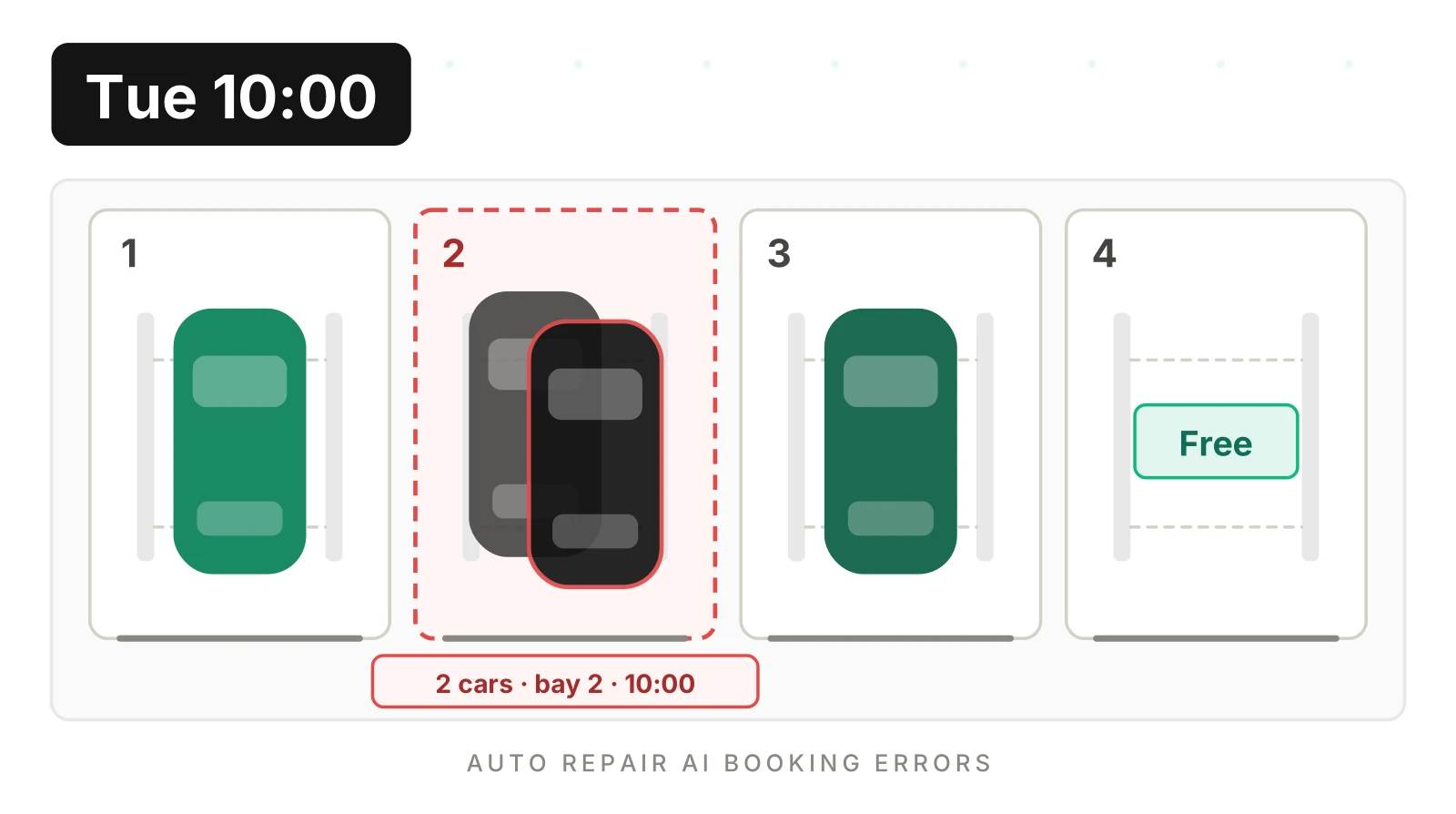
A voice booking in a repair shop is not a calendar entry. It is a promise of a bay, a lift, a qualified tech and parts, on a given day. When your agent gets one of those wrong, nobody hears an error on the call. The caller says thanks and hangs up. The damage shows up at 10:00 on Tuesday, when two cars wait for bay 2.
This post is for product teams at shop management software companies that ship auto repair AI scheduling to many independent shops. Shop-Ware, for example, markets an AI receptionist that "understands appointments, services, and shop workflows." AutoLeap describes AutoLeap AIR with "booking and rescheduling appointments." If you build in this category, the failures below are yours to catch. For the full receptionist QA scope, start with our auto repair AI receptionist QA guide.
Why a slot is not capacity in a repair shop
A dentist books a chair for 30 minutes. Service bay scheduling books four resources at once. Each one can run out on its own, so bay capacity alone never tells the full story.
1. Bay or lift. An alignment needs the alignment rack. A one-ton diesel pickup needs the heavy-duty lift.
2. Tech hours with the right skill. Technician skills matter: diesel, EV/hybrid, diagnostics and transmission work go to specific people.
3. Time on the clock. A drop-off can sit until 3 p.m. A waiter needs the job done while they sit in the lobby.
4. Parts. Parts availability gates the start time. A job with parts on order is not bookable for this morning, however empty the bay looks.
Booking contract: the set of fields a booking must carry so the shop can actually do the job: service code, labor hours, bay type, skill tag, drop-off or wait, transport (loaner or shuttle), parts status, day, start time, customer ID and vehicle ID.
Most shop-management software already tracks the hours side. Shop-Ware's Capacity feature shows "live billable and available hours" per tech and a daily load gauge. A human service advisor reads that gauge before saying yes. Your agent has to read the same numbers, through a tool call, while a caller talks over road noise.
The voice call is only the front door. The real workflow is capture, check, commit, confirm and write back. A speech error at capture becomes a wrong labor estimate. That wrong estimate becomes a wrong capacity commit. Then the confirmation text repeats the mistake politely. Our auto repair estimate accuracy post covers the price side of the same chain. This post covers the schedule side.
Six auto repair AI booking errors that break the schedule
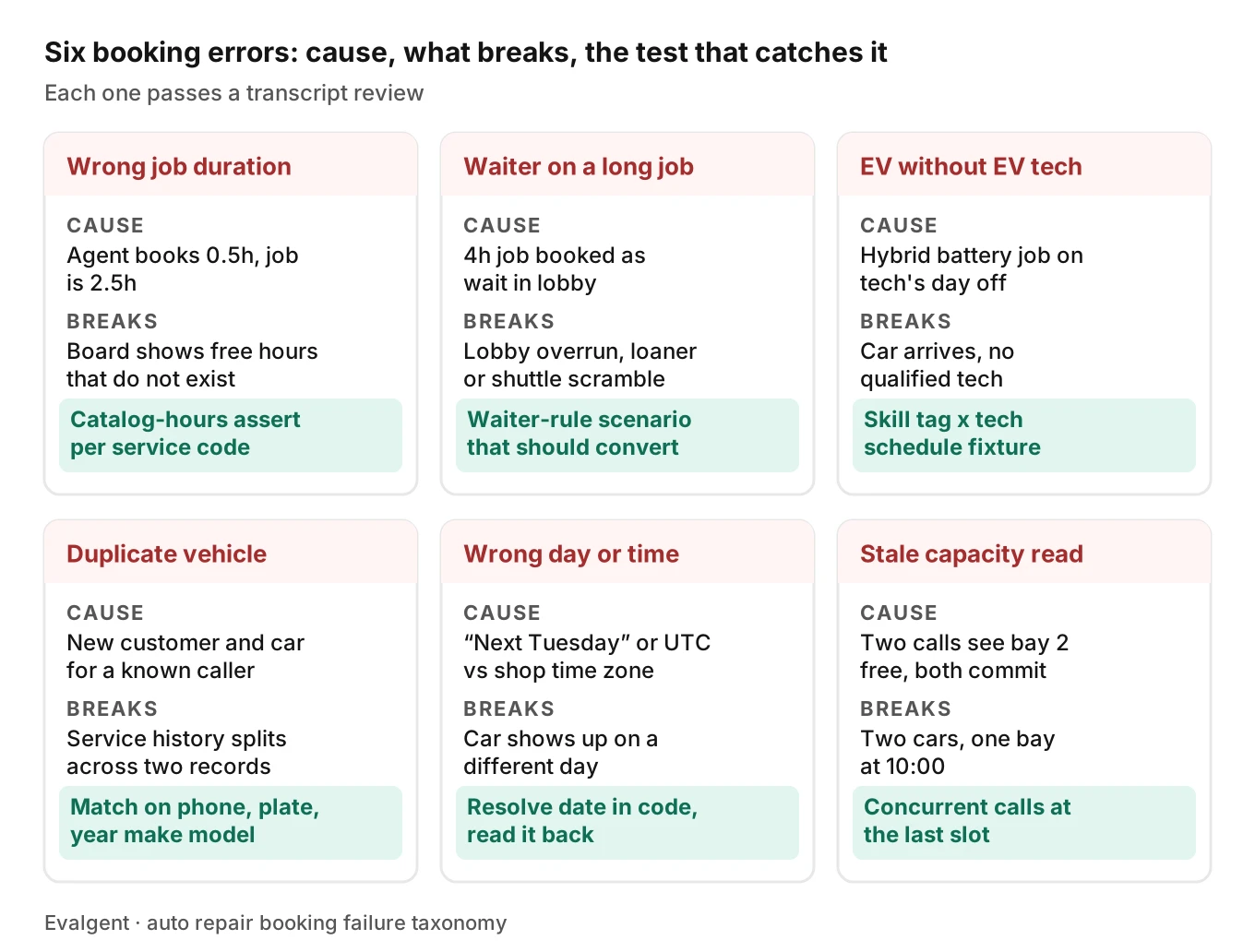
These six AI booking errors come from the booking contract above. Each one passes a transcript review. Each one breaks something in the shop.
Wrong job duration overbooks the bays
The caller says "my brakes are grinding." The agent maps that to a generic "brake inspection" at 0.5 labor hours. The shop's own catalog prices a front and rear pad and rotor job at 2.5 hours. The day now holds two hours of work the board never saw.
Job duration is the most common silent error because the agent has to guess intent. "Check engine light" might be a 1.0-hour diagnostic or a 4-hour repair after diagnosis. The safe pattern is to book the diagnostic code with its own hours and never book the repair until a tech has seen the car.
A waiter booked for a four-hour job
Shops often cap waiter appointments by job length and start time. A timing belt is not a waiter job. If the agent books one anyway, the customer sits in the lobby for half a day. Then the advisor apologizes, and the shop scrambles for a loaner or shuttle.
This error usually comes from a missing rule check, not from speech. The agent asks "will you wait or drop off?" and records the answer. It never compares the answer with the job's labor hours.
An EV or hybrid booked without EV capability
Not every shop works on high-voltage systems, and not every tech does. ASE's L3 Light Duty Hybrid/Electric Vehicle Specialist test requires passing both the A6 electrical and A8 engine performance tests first. It covers diagnosis of "the battery system, internal combustion engine (ICE), drive system." The BLS notes some technicians now focus mainly on EVs.
The agent books a battery cooling concern at a shop with no qualified tech on Thursday. Or it books it at the right shop, on a day that tech is off. The appointment looks fine until the car arrives. Skill-tag routing is the same logic as dispatching a furnace job to an AC-only tech, which we break down in why HVAC AI books the wrong tech.
Duplicate customer and vehicle records
A caller gives a phone number that differs from the one on file, or says "my wife's Camry." The agent fails to match and creates a new customer and a new vehicle. Service history now splits across two records. The next agent call can't see the open recommendation from last visit.
A duplicate vehicle record is worse than a duplicate customer. Declined-work follow-ups, fleet billing and warranty history hang off the vehicle. Match on more than one field: phone, last name, plate with state, and year, make and model. Read the candidate back to the caller before you write. Dealer agents that decode VINs face a related problem, covered in our dealership VIN lookup QA guide.
Wrong day or wrong time
"Next Tuesday" on a Sunday call is ambiguous. So is "first thing" at a shop that opens at 7:30. Language models are known to stumble on temporal reasoning; the Test of Time benchmark was built because these errors persist. Add server clocks in UTC and a multi-shop rollout across four US time zones, and the agent can confirm "Tuesday at 10" while writing Tuesday at 13:00 Eastern.
Resolve dates in code, not in the model. Pass the shop's IANA time zone and use Python's zoneinfo, which handles DST offsets explicitly. Then read the resolved weekday and date back to the caller.
Booking against stale capacity
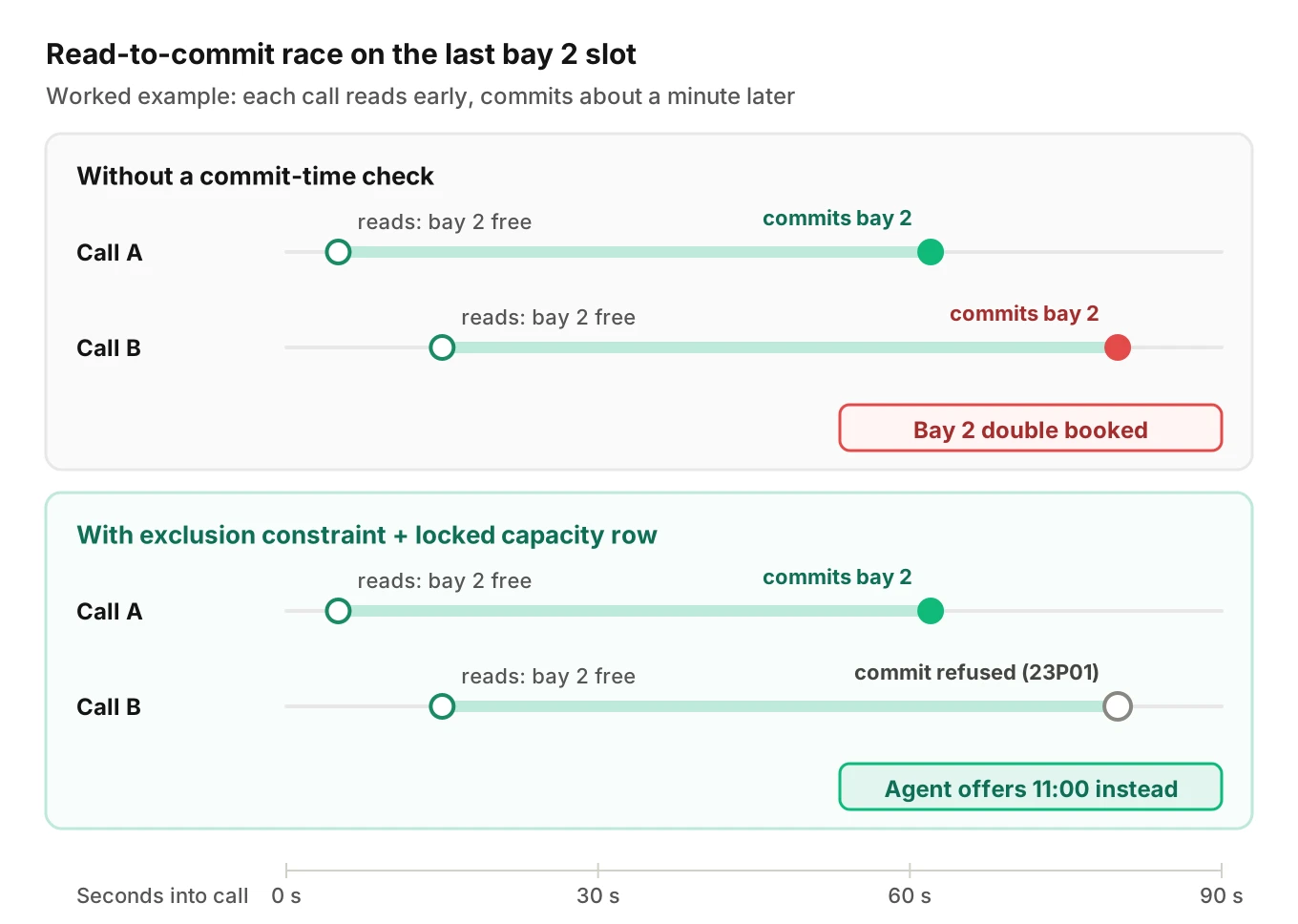
This one is a race condition. Call A checks availability and sees bay 2 free at 10:00. Call B, at the same shop, checks ten seconds later and sees the same thing. Both callers spend a minute giving names and vehicles. Both commit. Two cars, one bay.
The agent did nothing wrong in either transcript. The bug lives between the read and the write. It is the most common route to double booking in a "calendar-aware" agent.
What the research says about agents that book
Three findings matter for scheduling agents.
| Study | Setup | Finding | What it means for bookings |
|---|---|---|---|
| tau-bench (Yao et al., 2024) | Simulated users, tool APIs, domain policies in retail and airline | gpt-4o succeeds on "<50% of the tasks"; pass^8 "<25% in retail" | One passing test call proves little. Run each scenario many times. |
| LLMs Get Lost in Multi-Turn Conversation (Laban et al., 2025) | 200,000+ simulated conversations, six tasks | "Average drop of 39%" from single-turn to multi-turn | Callers who change the service mid-call are a separate test class. |
| Test of Time (Fatemi et al., 2024) | Synthetic temporal reasoning datasets | LLMs remain error-prone on temporal reasoning | Resolve "next Tuesday" in code, then confirm it aloud. |
The tau-bench result is the one to take to your roadmap meeting. Pass^k measures whether an agent succeeds on every one of k tries at the same task. A booking flow that works seven times in eight still double books someone every day at scale.
The per-shop rules your agent has to read
Every shop sets these differently. That is why one prompt cannot carry them. Put them in config, load them per shop at call start, and test against them.
| Config field | Example value | Error it prevents |
|---|---|---|
| Service catalog with labor hours | `brake_pad_rotor_fr: 2.5h` | Wrong job duration |
| Bay inventory and types | `bay1: alignment_rack`, `bay4: heavy_duty_lift` | Truck booked to a light lift |
| Tech skill tags and schedules | `tech_3: [ev_hv, diag]`, off Thu | EV booked with no qualified tech |
| Waiter rule | max 1.0h labor, start before 14:00 | Waiter on a long job |
| Transport | 2 loaners, shuttle 8:00–10:00 | Promising a loaner that's out |
| Parts gate | no same-day booking if parts on order | Car arrives, parts don't |
| Daily capacity rules | bookable hours = 75% of tech hours | Overbooked board |
| Shop time zone and hours | `America/Denver`, open 07:30 | Wrong day or time |
Your platform probably holds 500 versions of this table, one per shop. Testing all of them is a multi-tenant problem, and our guide to QA across 500 customer setups covers sampling and config drift in depth.
Worked math: how small duration errors fill a day
These numbers are an illustrative assumption, not data from any shop.
A shop has four bays and four techs on 8-hour shifts. That is 32 tech-hours. The owner keeps 25% for walk-ins and comebacks, so the capacity rule says 24 bookable hours a day.
The agent books ten brake calls in a morning as 0.5-hour inspections. The board shows 5 hours used and 19 free. The real work is 10 × 2.5 = 25 hours. The shop is already one hour over its whole bookable day, and the board still invites more bookings.
Now the race. Say one shop gets 12 booking calls in its busiest hour. Each call reads availability early and commits about 90 seconds later. The chance that another commit lands inside that window is:
P(overlap) = 1 - exp(-λ × w)
λ = 12 calls / 3600 s,  w = 90 s
P = 1 - exp(-0.30) ≈ 0.26
So about one peak-hour booking in four has another commit racing it. Most of those races are harmless, because they want different bays. They bite on the last alignment slot, the only EV tech or the last loaner. Across hundreds of shops, that is a daily incident, not an edge case.
Making capacity writes safe under concurrency
You can't fix a race with a better prompt. Fix it at the write. Two mechanisms do most of the work.
First, let the database refuse overlapping bay bookings. PostgreSQL range types support an exclusion constraint. With the `btree_gist` extension, it rejects overlapping ranges only when the room, or here the bay, is the same.
Second, give every commit an idempotency key built from the call ID and the booking intent. The IETF Idempotency-Key draft (draft 07, still a work in progress) says a server SHOULD return the earlier result for a repeated key. It also suggests `422` when the same key arrives with a different payload. That stops a retried tool call from booking twice.
Here is a simplified sketch with psycopg 3. Table and column names are illustrative.
CREATE EXTENSION IF NOT EXISTS btree_gist;

CREATE TABLE bay_booking (
  shop_id  bigint    NOT NULL,
  bay_id   text      NOT NULL,
  during   tstzrange NOT NULL,
  appt_id  bigint    NOT NULL,
  EXCLUDE USING gist (shop_id WITH =, bay_id WITH =, during WITH &&)
);

CREATE TABLE booking_request (
  idempotency_key text PRIMARY KEY,
  appt_id         bigint NOT NULL
);
# Simplified: commit a booking only if bay time AND daily hours are still free.
import psycopg
class BayTaken(Exception):
pass
def commit_booking(conn, shop_id, day, bay_id, start, end, hours, key, appt_id):
with conn.transaction():
cur = conn.cursor()
cur.execute("SELECT appt_id FROM booking_request WHERE idempotency_key = %s", (key,))
row = cur.fetchone()
if row:
return {"status": "duplicate", "appt_id": row[0]} # retry, not a new booking
# Lock the day's capacity row so two calls can't both spend the last hours.
cur.execute(
"SELECT booked_hours, cap_hours FROM day_capacity "
"WHERE shop_id = %s AND day = %s FOR UPDATE",
(shop_id, day),
)
booked, cap = cur.fetchone()
if booked + hours > cap:
return {"status": "no_capacity"}
try:
cur.execute(
"INSERT INTO bay_booking (shop_id, bay_id, during, appt_id) "
"VALUES (%s, %s, tstzrange(%s, %s), %s)",
(shop_id, bay_id, start, end, appt_id),
)
except psycopg.Error as e:
if e.sqlstate == "23P01": # exclusion_violation: bay already taken
raise BayTaken(bay_id, start)
raise
cur.execute(
"UPDATE day_capacity SET booked_hours = booked_hours + %s "
"WHERE shop_id = %s AND day = %s",
(hours, shop_id, day),
)
cur.execute("INSERT INTO booking_request VALUES (%s, %s)", (key, appt_id))
return {"status": "booked", "appt_id": appt_id}When `BayTaken` fires, the raised exception rolls back the transaction. The agent then has to say so out loud and offer the next real slot. Test that recovery line too. An agent that says "you're all set" after a failed commit is one of the silent tool failures that never shows in logs.
How to test auto repair AI scheduling before every change ships
Use this sequence to test auto repair AI scheduling for each prompt, flow or model change. It assumes you already have the basics from our appointment scheduling testing guide.
1. Export each shop's config as test input. Pull service catalog hours, bays, skill tags, waiter rules, transport and time zone. Store a hash so you know which config each run used.
2. Generate scenarios from config, not from imagination. For every rule, write a call that should pass it and one that should trip it. A waiter asking for a 3.5-hour job. A hybrid battery concern on the EV tech's day off. A diesel pickup when bay 4 is booked.
3. Load capacity-state fixtures. Run each scenario against at least four states: empty day, near-full day, full day, and "hours free but the needed bay type is full." The last one catches agents that check hours but not bays.
4. Vary the caller. Mix accents, road noise, speakerphone and callers who change the service mid-call ("actually, just the oil change"). Per Laban et al., that mid-call change deserves its own suite.
5. Assert on the written record, not the transcript. Compare service code, labor hours, bay, tech, wait flag, day, start time, customer ID and vehicle ID against expected values. Our tool-argument accuracy post shows how to score each field.
6. Run concurrent-booking tests. Fire two or more simulated calls at the same shop and the same last slot within the read-to-write window. Pass means one booking plus one spoken alternative, never two bookings.
7. Repeat every scenario. Following tau-bench's pass^k idea, run each scenario 5–8 times. Gate on the worst run, not the average.
8. Gate the release. Block the change if any hard rule fails once: capability mismatch, waiter over limit, bay overlap or duplicate vehicle. Ship through a staged rollout, as in our prompt change playbook.
A compact test matrix for one shop looks like this:
| Scenario | Empty | Near-full | Full | Bay type full |
|---|---|---|---|---|
| Brake grinding, drop-off | Book 2.5h | Book 2.5h or next day | Offer next day | Book any general lift |
| Oil change, waiter | Book waiter | Book waiter | Offer next day | Book waiter |
| Timing belt, asks to wait | Convert to drop-off | Convert to drop-off | Offer next day | Convert to drop-off |
| Hybrid battery warning | Book EV tech day | Book EV tech day | Offer EV tech's next day | Book EV tech day |
| Diesel pickup, brakes | Book bay 4 | Book bay 4 | Offer next day | Offer next bay 4 opening |
Evalgent fits steps 2, 4 and 5. It generates scenarios from the agent's prompt and flows, including hard constraints and coverage gaps. It runs caller profiles with accent, pace, interruptions and background noise over PSTN, SIP or WebRTC. It judges from the audio, not only the transcript, with evidence and human review of verdicts. You still own the capacity fixtures and the database assertions, because only your platform knows each shop's board.
Monitoring bookings against repair order actual hours
Pre-launch tests catch rule breaks. Production tells you whether auto repair AI scheduling gets the hours right. The best ground truth you have is the repair order. Every booking eventually becomes an RO with clocked labor hours.
Join each agent-made booking to its RO and track these signals per shop and per service code:
- Booked versus actual hours. The ratio of booked labor hours to RO actual hours. A drift below 1.0 on one service code means the agent books it short.
- Waiter overrun rate. Waiter appointments where the car left more than an hour after the promised time.
- Capability mismatches. Bookings whose skill tag no scheduled tech had. Target zero.
- Duplicate vehicle rate. New vehicle records later merged into an existing one.
- Capacity conflicts. Commits refused by the bay constraint, and any overlaps that got through.
- Wrong-slot rate. Bookings the shop moved within 24 hours because the day or time was wrong.
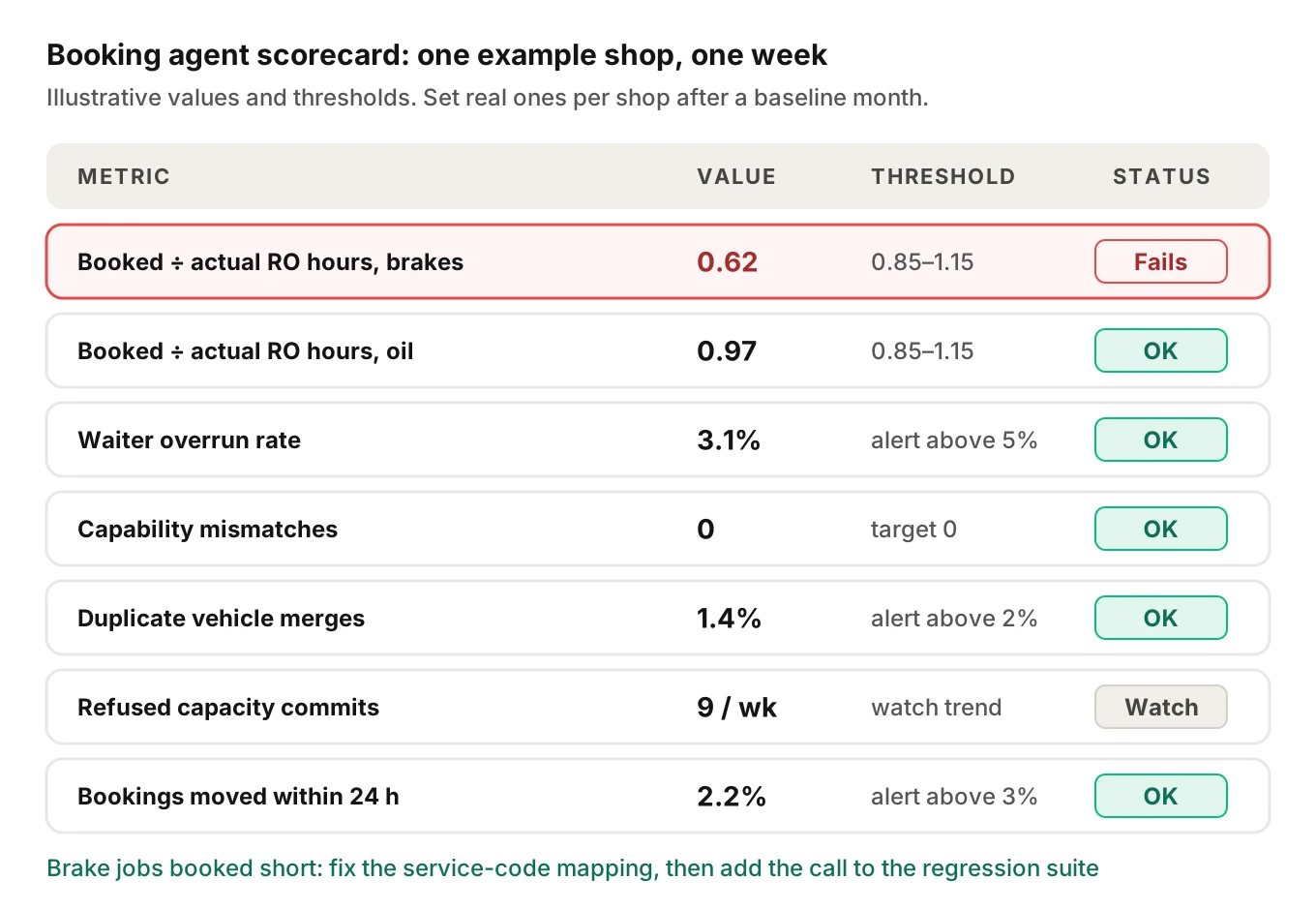
Thresholds depend on the shop, so set them per shop after a baseline month. Our scheduling metrics guide covers how to define each metric cleanly.
Evalgent's production monitoring takes the call side. You push call recordings. Evalgent transcribes them, maps each to a scenario and judges it. It flags tool-call failures, policy failures, latency spikes and PII leakage, with fix recommendations. Pair that with the RO join, and you can tell a speech error from a catalog error. Feed every confirmed failure back into the suite, as in our production feedback loop guide.
Frequently asked questions
Why does an AI receptionist double book a repair shop?
An AI receptionist double books a repair shop when it commits against stale availability or checks hours but not bay type. Two calls read the same free slot, then both write. Prevent it with a database exclusion constraint per bay, a locked daily capacity row and an idempotency key on every commit.
How do you test AI appointment booking for auto repair?
Test auto repair AI booking by generating scenarios from each shop's config, running them against capacity fixtures, and asserting on the written booking record. Vary caller accents, noise and mid-call changes. Fire concurrent calls at the last slot. Repeat each scenario five to eight times and gate on the worst run.
Can an AI agent know how long a car repair takes?
An AI agent can know how long a repair takes only if it reads the shop's service catalog and labor hours through a tool. It should not guess. For vague concerns like a check engine light, book a diagnostic code with its own hours. Leave the repair unbooked until a tech inspects the car.
How do you stop an AI from booking a waiter for a long job?
Stop waiter mistakes by enforcing the shop's waiter rule in code after the job is mapped. A typical rule caps waiter jobs by labor hours and start time. If the job exceeds it, the agent should offer a drop-off with a loaner or shuttle instead. Test it with callers who insist on waiting.
How do you prevent duplicate customer and vehicle records?
Prevent duplicate customer and vehicle records by matching on several fields: phone, last name, plate with state, and year, make and model. Read the matched vehicle back to the caller before writing. Create a new record only after a confirmed miss. Track merges after the fact as a quality metric.
What causes race conditions in AI booking?
Race conditions in AI booking come from the gap between reading availability and writing the booking. A voice call can spend a minute or more in that gap collecting details. Another call can take the slot meanwhile. Lock or constrain at commit time, and have the agent offer the next real slot when refused.
How should an AI booking agent handle EV and hybrid repairs?
An AI booking agent should route EV and hybrid repairs by skill tag. It needs to check that the shop works on high-voltage systems and that a qualified tech is scheduled that day. If not, it should offer that tech's next working day. Test this with battery and charging concerns on the tech's day off.
What should you monitor after an AI booking agent goes live?
After an AI booking agent goes live, monitor booked versus actual repair order hours by service code. Also track waiter overruns, capability mismatches, duplicate vehicle merges, refused capacity commits and bookings moved within a day. Judge recordings for tool-call and policy failures, then turn each confirmed failure into a regression test.
The bottom line
Auto repair AI scheduling fails when the agent books a slot instead of capacity, and the caller never hears it. Test each shop's rules, capacity states and concurrent calls before release, then check every booking against the repair order's actual hours.
Related Articles

How to automate voice agent testing: synthetic callers vs manual QA
Learn how ai test automation replaces manual QA for voice agents. Compare synthetic callers vs human testers, with a 5-step framework to scale without hiring.
Read more
AI Agent Testing vs Voice Agent Testing: What General Tools Miss for Voice
AI agent testing measures text outputs. Voice agent testing measures behaviour through an acoustic pipeline. Five failure categories general tools miss.
Read more