Open door for builders.
Voice Agent Vendor Evaluation Timeline
# Voice agent vendor evaluation timeline
Quick answer
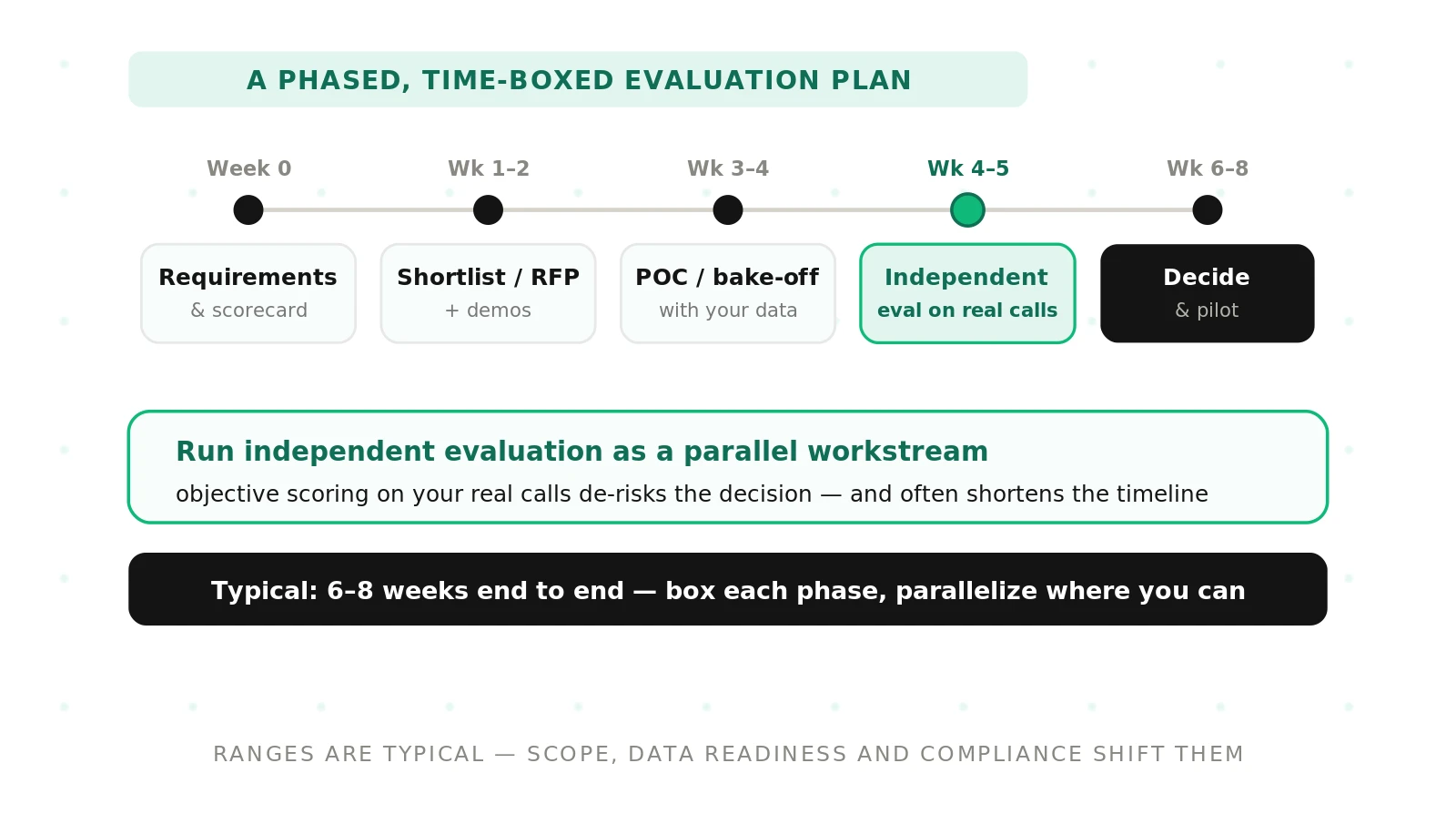
A voice agent vendor evaluation timeline is a phased, time-boxed plan for choosing a voice AI vendor. Most teams need roughly 8 to 16 weeks from requirements to a signed contract, plus a 4 to 8 week pilot. Parallel workstreams and independent evaluation on your own calls can shorten it.
Buying a voice agent is not like buying software you can return. Once callers hit it, the failures are public. So the evaluation deserves a real timeline, not a rushed two-week dash.
This post answers the "how long does it take" question. It maps each phase, gives typical duration ranges, and shows what speeds things up or slows them down. It sits beside our pillar on how to evaluate voice agent vendors, which covers what to evaluate, and our guide on how to run a voice agent bake-off, which covers the POC mechanics. This piece is about sequence and time.
Why a timeline matters
Vendor evaluation is a project. Like any project, it has phases, owners, and dependencies. Treat it that way and it stays on track. Skip the plan and it drifts for months.
Two failure modes are common. The first is the rush. A team runs a scripted demo, likes the voice, and signs. Three months later the agent mishandles real callers. The second is the stall. The evaluation sprawls across quarters with no clear owner or exit criteria.
A time-boxed plan avoids both. It borrows from standard project management practice. Each phase gets a duration, an owner, and a defined output. You can even draw it as a Gantt chart to see where phases overlap.
The other reason to plan is risk. The NIST AI Risk Management Framework treats governance and testing as ongoing work, not a single gate. Your timeline should reserve real time for evaluation and review, not treat them as afterthoughts.
The voice agent vendor evaluation timeline at a glance
The table below shows a typical end-to-end plan. Durations are ranges, not guarantees. Your numbers will shift with scope, risk, and how many vendors you compare.
| Phase | Typical duration | Key activities | Owner / output |
|---|---|---|---|
| 0. Requirements & scorecard | 1–2 weeks | Define use cases, success metrics, weighted criteria, pass bars | Product / CX lead → requirements doc + scorecard |
| 1. Shortlisting & RFP | 1–3 weeks | Market scan, issue RFP, collect responses | Procurement → shortlist of 3–5 vendors |
| 2. Scripted demos | 1–2 weeks | Vendor-led demos, first-cut screening | Evaluation team → demo notes, narrowed field |
| 3. POC / bake-off setup | 1–2 weeks | Provision access, load your data, script scenarios | Engineering + vendors → configured test bench |
| 4. Independent evaluation | 2–4 weeks | Run identical scenarios on real audio, objective scoring | Independent evaluator → comparable scorecard |
| 5. Scoring, red-team & compliance | 1–2 weeks | Aggregate scores, adversarial tests, policy checks | Evaluation + risk → ranked, defensible results |
| 6. Reference checks & security review | 1–3 weeks | Customer references, SOC 2, pen test, DPA review | Security / legal → security sign-off |
| 7. Decision & contracting | 2–4 weeks | Select vendor, negotiate SLA, MSA, pricing | Legal / procurement → signed contract |
| 8. Pilot | 4–8 weeks | Limited production traffic, monitor, expand | Operations → go / no-go for full rollout |
Add the ranges and the picture is clear. Decision takes roughly 8 to 16 weeks. The pilot adds another 4 to 8 weeks. Well-run evaluations overlap phases, so the real elapsed time lands near the low end.
Phase-by-phase breakdown
Phase 0: Requirements and scorecard (1–2 weeks)
This phase sets everything downstream. You define the use cases, the caller journeys, and the metrics that decide success. Then you turn them into a weighted scorecard with clear pass bars.
Skip this and every later phase gets fuzzy. Vendors demo their strengths, not your needs. Our voice agent metrics scorecard shows how to weight criteria like containment, accuracy, latency, and escalation. Include escalation early. Our guide on escalation in voice agents explains why handoff quality often decides caller trust.
This phase compresses when you already know your top use cases. It extends when stakeholders disagree on what "good" means.
Phase 1: Shortlisting and RFP (1–3 weeks)
Now you scan the market and cut to a shortlist. A request for proposal gathers structured answers on features, security, pricing, and support. Aim for three to five vendors on the shortlist.
More than five wastes evaluation time. Fewer than three weakens your comparison. This phase runs faster when you reuse an RFP template. It slows when procurement and the technical team are not aligned.
Phase 2: Scripted demos (1–2 weeks)
Vendors demo their agents on their own scripts. Treat this as screening, not proof. A polished demo tells you the vendor can build a good happy path. It does not tell you how the agent handles your callers.
Use demos to drop weak options before the costly POC phase. Keep notes against your scorecard so the screening stays objective.
Phase 3: POC and bake-off setup (1–2 weeks)
Here the work gets real. A proof of concept puts each shortlisted vendor on the same test bench. You provision access, load representative data, and script the scenarios every vendor must handle.
The key rule is identical conditions. Same scenarios, same audio, same scoring. Our voice agent bake-off guide covers the mechanics in depth. This phase extends when data access or security approvals lag.
Phase 4: Independent evaluation (2–4 weeks)
This is the heart of the timeline. You run the identical scenarios against each vendor on real audio and score the results. This is where testing becomes evaluation. Our guide on testing versus evaluation for voice agents draws the line clearly.
Run it well and you get comparable, objective numbers. Vendor-reported metrics do not survive this phase. Independent voice AI evaluation removes the bias of self-scoring. This is also the phase most teams underestimate, and where good tooling saves the most time.
Phase 5: Scoring, red-team, and compliance (1–2 weeks)
Now you aggregate the scores and pressure-test the leaders. Red-team scenarios probe for prompt injection, unsafe advice, and privacy leaks. Compliance review checks the agent against your policy rules.
The output is a ranked, defensible result. That defensibility matters when leadership asks why you chose one vendor. See defensible voice AI vendor selection for how to document the trail.
Phase 6: Reference checks and security review (1–3 weeks)
You call the vendor's existing customers and ask about failures, not just wins. In parallel, security reviews SOC 2 reports, penetration test results, and the data processing agreement. This phase runs alongside earlier phases, so it rarely adds full weeks on its own.
Phase 7: Decision and contracting (2–4 weeks)
You pick the winner and negotiate terms. The service-level agreement is the part to slow down for. Tie uptime, latency, and support response to real penalties.
Legal review of the master agreement often drives this phase. Start contracting with your frontrunner before the final decision to save a week or two.
Phase 8: Pilot (4–8 weeks)
The pilot routes a slice of real traffic to the chosen agent. You monitor closely, catch surprises, and expand gradually. Keep the ability to fall back to humans. Our post on AI voice agent testing covers the monitoring that keeps a pilot honest.
What compresses or extends the timeline
Several factors move the total. Knowing them lets you plan realistically.
What compresses it:
- A clear scorecard defined up front
- A shortlist of three, not eight, vendors
- Data access and security approvals arranged early
- Parallel workstreams instead of strict sequence
- An independent evaluator running the scoring
What extends it:
- Stakeholders who disagree on success criteria
- Slow data access or security sign-off
- Too many vendors in the POC
- Legal negotiation with no template
- Rebuilding evaluation tooling from scratch
Where parallel work saves weeks
The biggest time savings come from overlap. A strict phase-by-phase march is slow. Smart teams run several tracks at once.
Security review and reference checks can run during the POC. Contracting can start with the frontrunner before final scoring ends. Requirements can be refined while the RFP is out.
The independent evaluation phase is where overlap pays most. When an outside evaluator runs objective scoring on your own calls, it removes the back-and-forth of vendor self-reporting. Evalgent runs this phase as a parallel workstream. We score every shortlisted vendor on identical scenarios using your real audio, with objective metrics, not vendor claims.
That does two things. It de-risks the choice, because the scores are comparable and honest. And it often shortens the timeline, because the scoring runs alongside your security and reference work instead of after it. The result is a defensible decision, faster.
How to build your voice agent vendor evaluation timeline
Follow these steps to turn the phases above into your own plan.
1. List your use cases and success metrics. Write down the caller journeys that matter and the numbers that define success. This becomes your scorecard.
2. Set pass bars per criterion. Decide the minimum acceptable score for accuracy, containment, latency, and escalation. Weight them by business impact.
3. Fix your shortlist size. Cap the POC at three to five vendors. More slows every later phase.
4. Draw the phases on a calendar. Assign each phase a duration, an owner, and an output. Mark dependencies so you can see what blocks what.
5. Identify parallel tracks. Flag work that can overlap, such as security review during the POC. Move it off the critical path.
6. Book the independent evaluation early. Reserve the evaluator and data access before the POC starts, so scoring is not the bottleneck.
7. Start contracting on your frontrunner. Begin legal review before the final decision to save a week or two at the end.
8. Time-box the pilot with exit criteria. Define the go / no-go metrics up front so the pilot ends on schedule.
Frequently asked questions
How long does it take to evaluate a voice agent vendor?
A thorough voice agent vendor evaluation usually takes 8 to 16 weeks from requirements to a signed contract. A pilot adds another 4 to 8 weeks. Overlapping phases and using an independent evaluator can pull the total toward the low end. Rushing below eight weeks tends to skip real-audio testing.
What are the phases of voice AI vendor evaluation?
The typical phases are requirements and scorecard, shortlisting and RFP, scripted demos, POC setup, independent evaluation, scoring with red-team and compliance, reference and security review, decision and contracting, and a pilot. Each phase has an owner and a defined output that feeds the next.
How long should a voice agent POC take?
POC setup usually takes 1 to 2 weeks, and the independent evaluation that follows takes 2 to 4 weeks. The setup covers access, data loading, and scenario scripting. The evaluation runs identical scenarios on real audio. Access delays and security approvals are the most common reasons a POC runs long.
What can compress a voice agent vendor evaluation timeline?
A clear scorecard, a short vendor list, early data and security approvals, parallel workstreams, and an independent evaluator all compress the timeline. The largest single saving is overlap. Running security review, reference checks, and objective scoring at the same time removes weeks from a strictly sequential plan.
How long does voice agent vendor contracting take?
Contracting typically takes 2 to 4 weeks. Most of that time goes to legal review of the master agreement and negotiating the service-level agreement. Starting contract review with your frontrunner before the final decision can save a week or two. Tie latency, uptime, and support terms to real penalties.
Who owns each phase of voice AI vendor evaluation?
Ownership shifts by phase. Product or CX leads own requirements. Procurement owns the RFP and shortlist. Engineering owns POC setup. An independent evaluator owns scoring. Security and legal own the reviews and contract. A single program owner should track the whole timeline and keep phases from stalling.
How do you build a voice agent vendor evaluation timeline?
Start by listing use cases and success metrics, then set pass bars and cap your shortlist. Map each phase to a calendar with owners and outputs, mark dependencies, and flag parallel tracks. Book the independent evaluation early so scoring is not the bottleneck, and time-box the pilot with clear exit criteria.
How long is a voice agent pilot before full rollout?
A voice agent pilot usually runs 4 to 8 weeks. It routes a slice of real traffic to the chosen agent while you monitor closely and expand gradually. Keep a human fallback throughout. The pilot ends when the agent meets the go metrics you set, or fails them and returns to the shortlist.
The bottom line
A voice agent vendor evaluation typically runs 8 to 16 weeks to a signed contract, plus a 4 to 8 week pilot. Overlapping phases and an independent evaluation on your own calls de-risk the choice and often shorten the whole timeline.
Ready to make the evaluation phase faster and more objective? Book a demo to see how Evalgent scores every shortlisted vendor on your real calls.
Related Articles
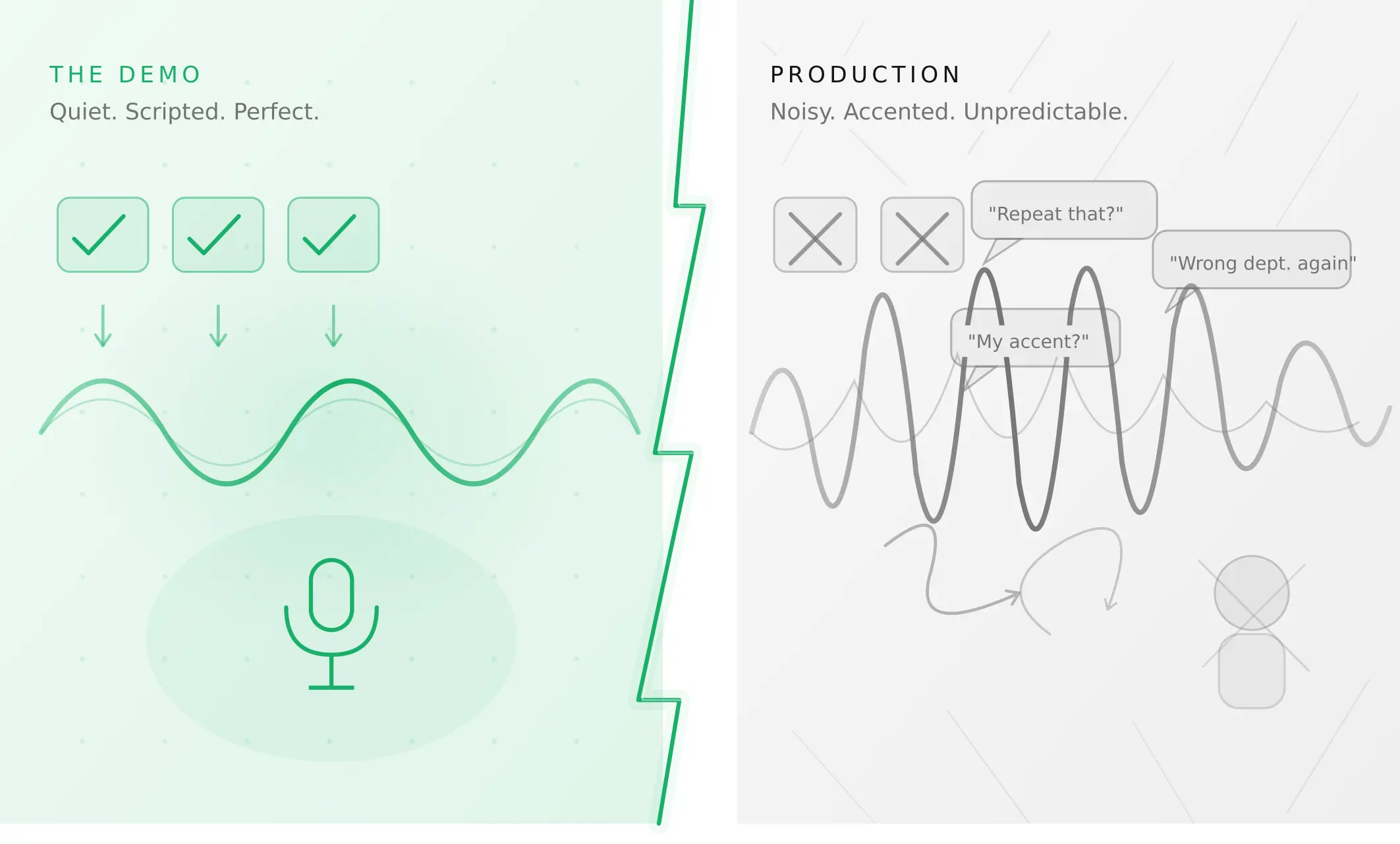
Why AI voice agents fail in production (and how to prevent it)
AI voice agents that ace demos still break in production. Learn the 5 root causes, how to test for each, and what production readiness actually means.
Read more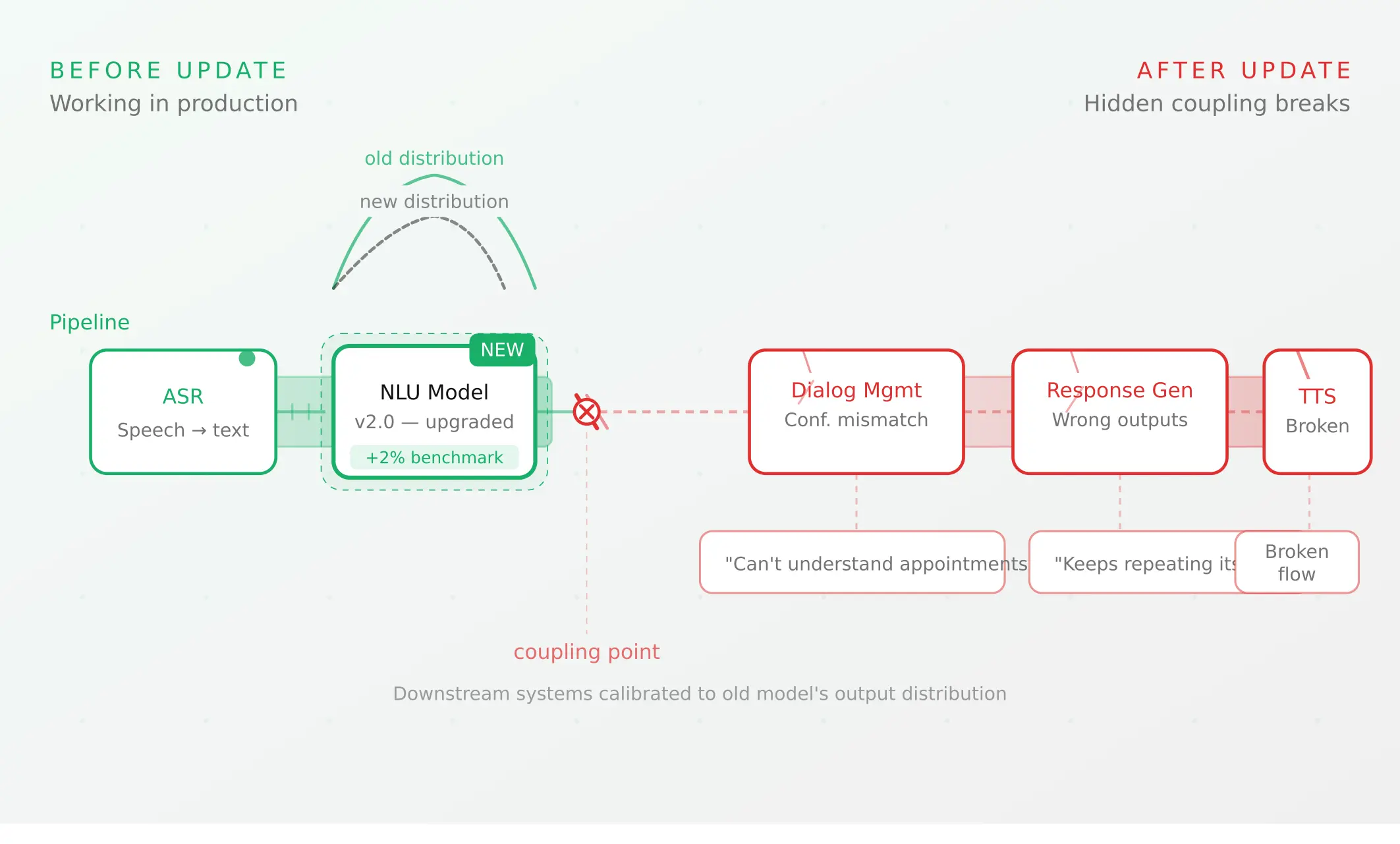
Voice agent regression testing: why LLM updates break production
LLM updates improve benchmarks but break voice agents in 5 predictable ways. How to detect and prevent regressions after every model or prompt change.
Read more