Test your voice agent
What a Defensible Voice AI Vendor Decision Looks Like
# What a defensible voice AI vendor decision looks like
> Quick answer: A defensible voice AI vendor selection is a decision you can justify later with evidence. You set the criteria before testing, run the same test set across every vendor, score the results independently, and write down the rationale. An audit trail ties the choice to the numbers, so your board, procurement, and auditors can verify it.
Most voice agent decisions feel confident on the day they are made. Few survive the question that comes six months later. That question is simple. "Why did we pick this vendor over the others?"
If the honest answer is "the demo was impressive" or "the team liked them," the decision is not defensible. It rested on impressions, not evidence. When the agent underperforms in production, there is nothing to point to. No criteria. No comparison. No record.
A defensible decision is different. It can be explained, checked, and stood behind long after the sales cycle ends. This post breaks down what that looks like in practice. It covers the difference between a defensible and an indefensible choice, the evidence a good decision rests on, and how to build the decision record that makes it hold up.
What makes a voice AI vendor decision defensible
Defensible does not mean correct. Even a careful process can pick a vendor that later disappoints. Defensible means the process was sound and documented. You made the best call available on the evidence you had, and you can show your work.
> Defensible decision: A choice supported by criteria set in advance, evidence gathered the same way for every option, independent scoring, and a written rationale. Anyone reviewing it later can retrace the steps and reach the same conclusion.
Five things separate a defensible decision from a lucky guess.
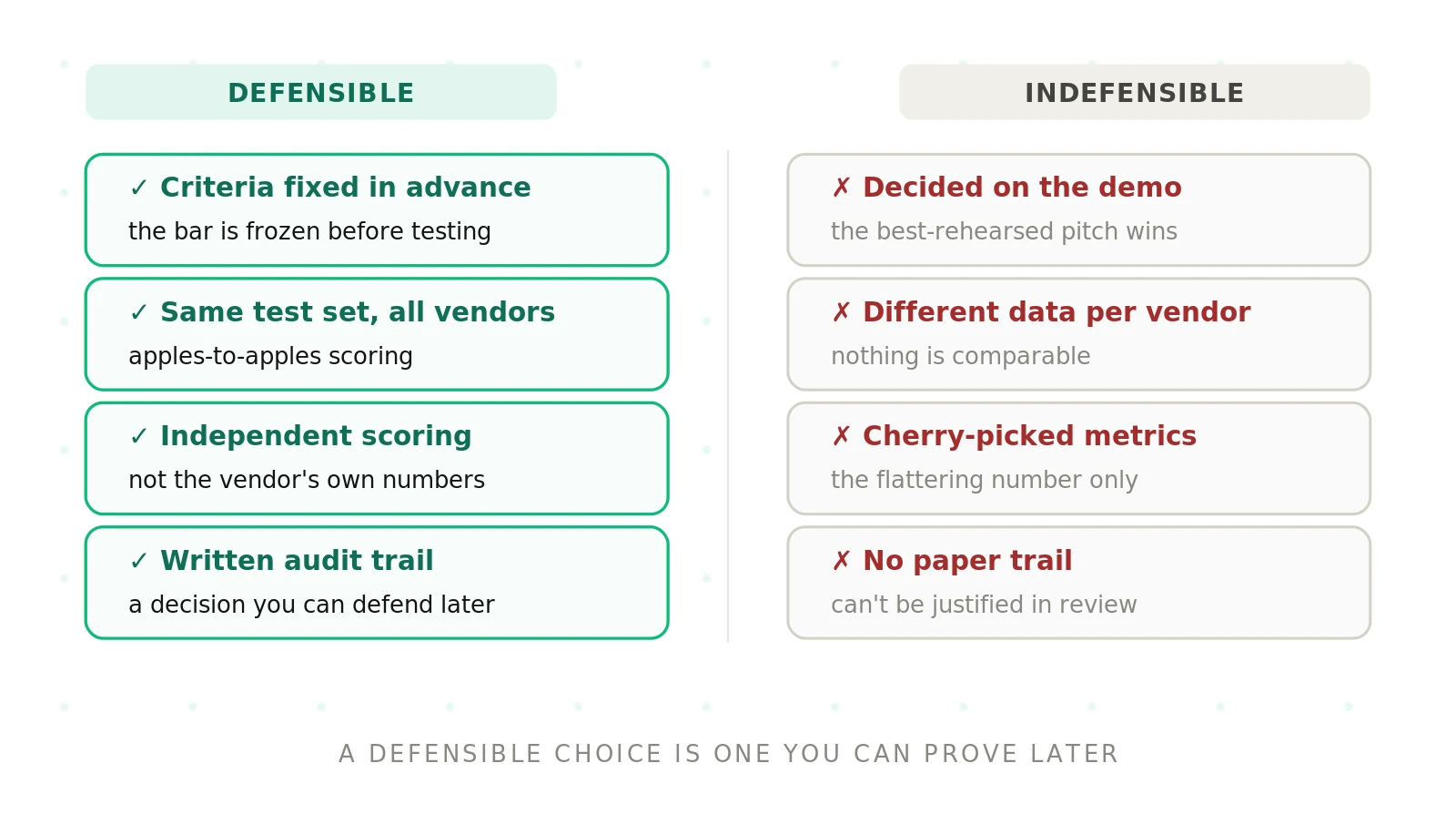
Criteria set before testing. You define what "good" means first. Accuracy targets, latency limits, task success rates, safety thresholds, and cost per resolution are written down and weighted. The bar exists before any vendor is measured against it.
Evidence, not impressions. The decision rests on scored results from real test cases. It does not rest on a polished demo or a confident sales engineer.
Independence. The scoring is done by a party with no stake in the outcome. The vendor does not grade its own agent, and neither does the internal champion who already picked a favorite.
Repeatability. Every vendor faces the same test set under the same conditions. If you ran the process again, you would get the same ranking. This is the reproducibility that separates a fair test from a demo.
Auditability. There is a trail. Criteria, test cases, raw results, scores, and the final rationale are all recorded. A reviewer can follow the chain from decision back to data.
These five map directly onto how procurement and auditors already think. Formal buying processes rely on due diligence and a documented audit trail. A defensible voice AI selection simply applies those norms to a new kind of purchase.
Defensible vs indefensible: where they diverge
The gap between the two is easiest to see side by side. The same decision can be made two ways. One holds up under scrutiny. The other collapses the moment someone asks a hard question.
| Dimension | Defensible decision | Indefensible decision |
|---|---|---|
| Criteria | Written and weighted before any vendor is tested | Invented after the demo to fit a favorite |
| Evidence | Scored results on real, shared test cases | Vendor slides and a good sales call |
| Independence | Graded by a neutral third party | Graded by the vendor or an internal champion |
| Repeatability | Same test set run across every vendor | Different demos, different scripts each time |
| Auditability | Full trail others can re-check | No record beyond a gut call |
Read the right-hand column carefully. Each item feels normal in the moment. Demos are persuasive. Champions are enthusiastic. Criteria written after the fact feel like a formality. None of that is malicious. It is just how decisions drift when no structure holds them in place.
The left-hand column takes more work up front. It pays that work back later. When the CFO asks why you chose this vendor, you have an answer that is not "trust me."
Why gut feel and vendor demos fail the test
Three habits produce indefensible decisions. They are common, and they feel reasonable while you are inside them.
Gut feel. A senior person likes a vendor and the room follows. The instinct might even be right. But instinct cannot be handed to an auditor. It cannot be compared against alternatives. When the agent fails, "it felt right" is not a defense.
Vendor demos. A demo is a performance. The vendor picks the scenarios, the script, and the happy path. It shows the agent at its best on cases the vendor chose. It tells you almost nothing about how the agent handles your hardest calls. Basing a decision on a demo is like hiring based on the resume alone.
Cherry-picked metrics. Every vendor reports numbers. The problem is that no two vendors measure the same way. One counts a transfer as a success. Another counts it as a failure. Word error rate on clean audio looks great and predicts nothing about a noisy call center. Comparing self-reported metrics across vendors is comparing numbers that were never comparable. We cover why in independent voice AI evaluation.
The common thread is that none of these can be re-checked. They live in someone's head or on a vendor's slide. A defensible decision moves the basis of choice out into the open, where it can be examined.
The evidence a defensible decision rests on
Evidence is the heart of the matter. A defensible decision produces a body of it that a stranger could review. Four pieces do most of the work.
A fixed criteria set. Before testing, agree on what matters and how much. This is a decision matrix: the dimensions you care about, each with a weight. Accuracy might carry more weight than latency for a healthcare intake line. Latency might dominate for a food-ordering agent. The weights encode your priorities, and they are locked before any vendor sees them.
One shared test set. Every vendor is measured on the same calls. The set should reflect your real traffic, including the edge cases that break agents: accents, interruptions, background noise, angry callers, and policy questions. Running the same test cases across vendors is what makes the comparison fair. Build the set from your own data, not the vendor's samples.
Independent scoring. Someone neutral grades the results against the criteria. The scores are not adjusted to fit a preferred outcome. This is the same logic behind an external financial audit. The party checking the books cannot be the party that wrote them.
A written rationale. The final document states which vendor won, on which dimensions, by how much, and why. It names the trade-offs. It records the vendors that lost and where they fell short. This rationale is the artifact that survives the sales cycle and answers the question later.
Together these four pieces form the substance of the decision. The process that turns them into a defensible record is the next step. If the difference between checking and grading still feels fuzzy, our guide on testing versus evaluation draws the line.
How to build a defensible voice AI decision record
A decision record is the document that holds all the evidence in one place. It is what you hand to procurement, your board, or an auditor. Build it in order, and do not skip steps.
1. Define the criteria and weights first. List the dimensions that matter: accuracy, task success, latency, safety, compliance, and cost. Assign a weight to each. Get sign-off from the stakeholders who will live with the decision. Lock this before you contact vendors.
2. Build one representative test set. Assemble real call scenarios from your own traffic. Include the hard cases on purpose. Keep the set identical for every vendor. Document what each case tests and what a passing result looks like.
3. Shortlist vendors against fixed requirements. Screen candidates on non-negotiables like data handling, region support, and integration fit. Use a written RFP so every vendor answers the same questions. This mirrors formal government procurement practice.
4. Run the same test set across every vendor. Execute the identical scenarios under the same conditions. Capture raw transcripts, audio, and outcomes. Do not let any vendor supply their own results. Managing multiple vendors on one test set keeps the comparison honest.
5. Score independently against the criteria. Grade each vendor on the weighted dimensions. Use a neutral party so the scoring cannot be steered. Align the work to a recognized framework like the NIST AI Risk Management Framework where risk and safety are in scope.
6. Write the rationale and record the trail. State the winner, the margins, and the trade-offs. Attach the criteria, the test set, the raw results, and the scores. This bundle is the decision record. Store it where reviewers can find it.
7. Set a re-evaluation trigger. A decision made today does not stay valid forever. Models update. Traffic shifts. Record when you will re-test and what would force an earlier review. For the full selection method, see how to evaluate voice agent vendors.
Follow these steps and the record almost writes itself. Each step produces an artifact, and the artifacts add up to proof.
Where an independent evidence layer fits
The hardest step to do yourself is the independent one. Your team built the test harness, has a preferred vendor, or is under pressure to close the deal fast. That is not a character flaw. It is structural. The people running a selection are rarely neutral about its outcome.
This is where Evalgent fits. Evalgent is an independent, third-party evaluation platform for voice agents. It runs your criteria and your test set across every vendor, scores the results with no stake in which vendor wins, and produces the documented trail. The output is the evidence layer your decision rests on.
The value is not just better scores. It is defensibility. When procurement asks for justification, you have a third-party report. When your board asks how you know the agent is safe, you point to independent results, not a vendor deck. When an auditor reviews the purchase, the trail is already there. For a deeper treatment of the whole discipline, start with our pillar on voice agent evaluation, and see how a formal third-party audit turns evidence into a signed report.
The point of independence is not distrust of vendors. It is that a decision graded by an interested party cannot be defended as neutral, no matter how careful it was.
Frequently asked questions
What is a defensible voice AI vendor selection?
A defensible voice AI vendor selection is a decision you can justify later with evidence. Criteria are set before testing, every vendor faces the same test set, scoring is independent, and a written rationale plus an audit trail record the choice. Anyone reviewing it can retrace the steps and reach the same conclusion.
How is a defensible decision different from a good decision?
A good decision picks the right vendor. A defensible decision can be proven sound regardless of how it turns out. The two often overlap, but not always. Defensibility is about process and evidence, not luck. A careful process can still pick a vendor that later disappoints, yet the decision stays defensible.
Why are vendor demos not enough to justify a choice?
A demo is a performance the vendor controls. They choose the scenarios, the script, and the happy path, and they show the agent at its best. It reveals little about your hardest calls. Basing a purchase on a demo leaves you with no comparable evidence and nothing to point to when the agent underperforms.
What evidence should a voice AI decision rest on?
Four pieces: a fixed criteria set with weights, one shared test set built from your real traffic, independent scores graded against the criteria, and a written rationale naming the trade-offs. Together they form a record a stranger could review. This body of evidence is what makes the decision hold up under later scrutiny.
Who asks to see a defensible decision later?
Procurement, finance, security, compliance teams, and boards all ask. So do external auditors and, in regulated sectors, regulators. Each wants proof that the choice was sound and neutral. A demo memory or a champion's enthusiasm does not satisfy them. A documented decision record with independent scoring does.
Why does independence matter in vendor scoring?
Independence removes the conflict at the center of any selection. A vendor grading its own agent, or an internal champion grading a favorite, cannot produce a neutral result. It mirrors financial auditing, where the party checking the books cannot be the party that wrote them. Independent scoring is what lets you call the decision fair.
What goes into a voice AI decision record?
The criteria and weights, the shared test set with documented cases, raw results including transcripts and audio, the independent scores, and the written rationale stating the winner and trade-offs. Add a re-evaluation trigger. Stored together, this bundle lets a reviewer follow the chain from the final choice back to the underlying data.
How often should a voice AI vendor decision be re-evaluated?
Set a trigger rather than a fixed calendar. Re-test when the model updates, when traffic patterns shift, or when performance drops below your thresholds. A yearly review is a reasonable floor for most teams. A decision made today rests on today's evidence, and that evidence goes stale as the agent and your callers change.
The bottom line
A defensible voice AI vendor decision is one you can prove was sound, not just one that felt right. It rests on criteria set in advance, one test set run across every vendor, independent scoring, and a documented trail.
Build the decision record before the sales cycle closes, and use an independent evidence layer so the scoring holds up when your board, procurement, or auditors ask. Book a demo to see how Evalgent produces the evidence your voice AI decision can stand on.
Related Articles
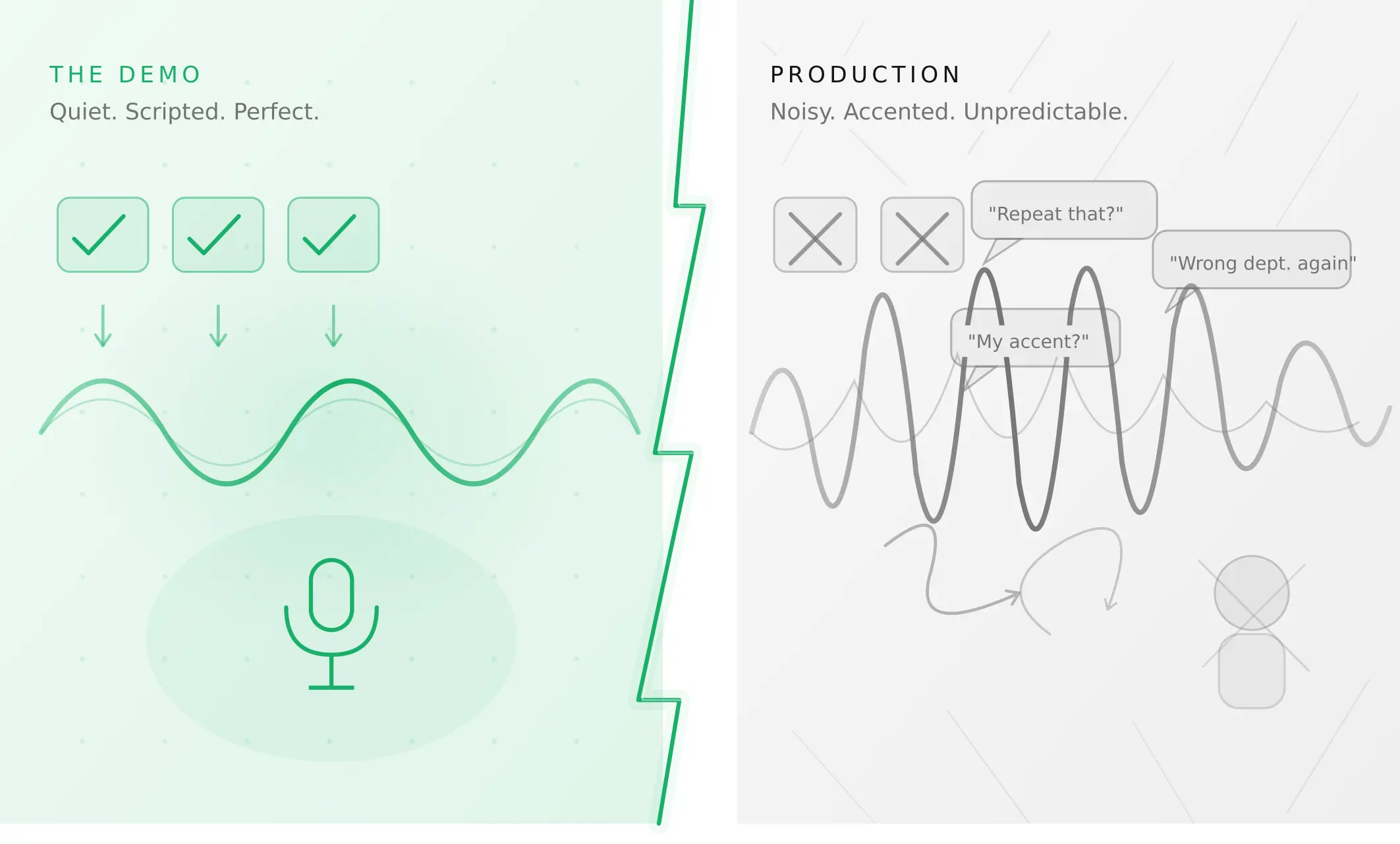
Why AI voice agents fail in production (and how to prevent it)
AI voice agents that ace demos still break in production. Learn the 5 root causes, how to test for each, and what production readiness actually means.
Read more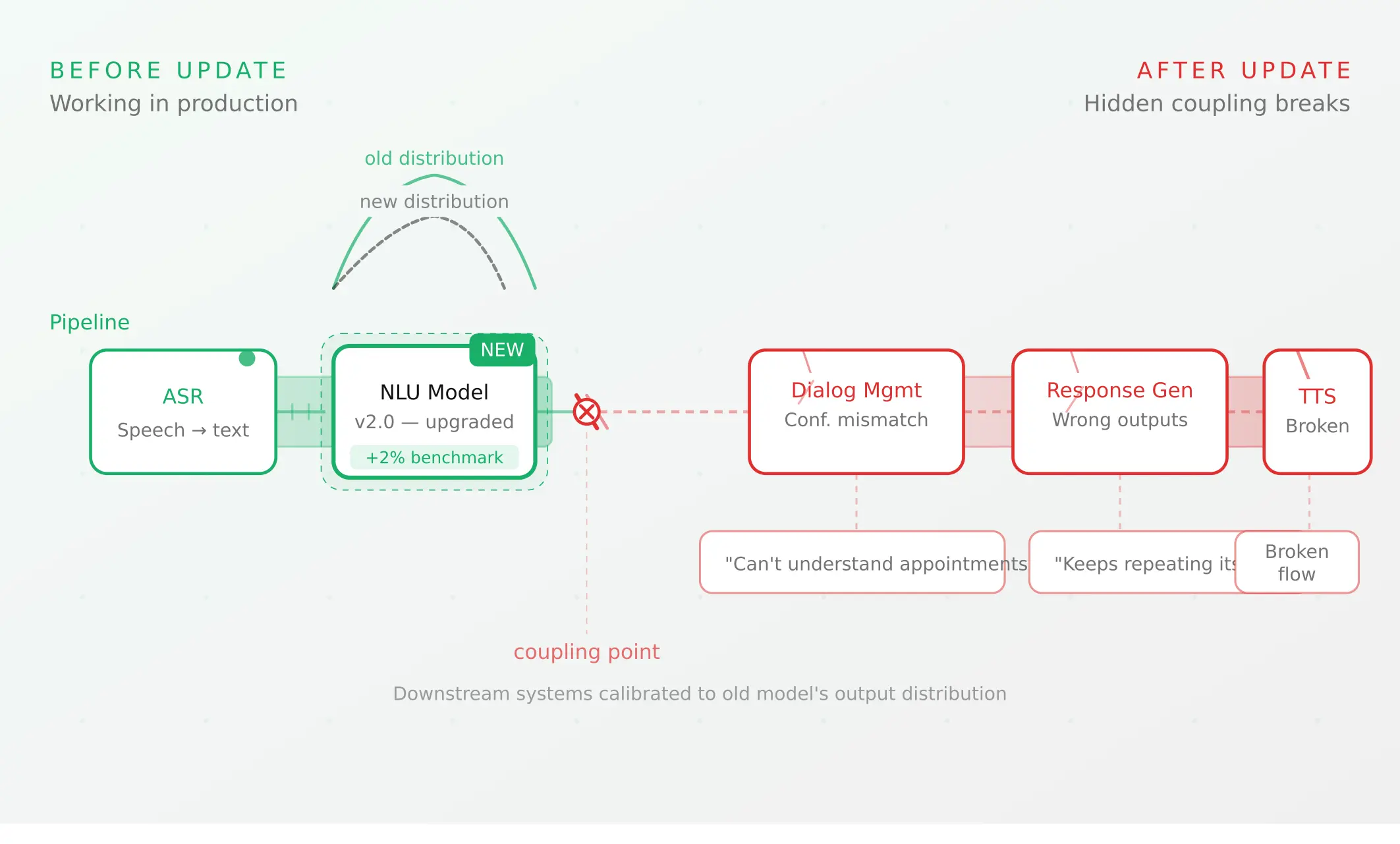
Voice agent regression testing: why LLM updates break production
LLM updates improve benchmarks but break voice agents in 5 predictable ways. How to detect and prevent regressions after every model or prompt change.
Read more