Test your voice agent
Designing a Voice Agent POC That Produces a Decision
# Designing a voice agent POC that produces a decision
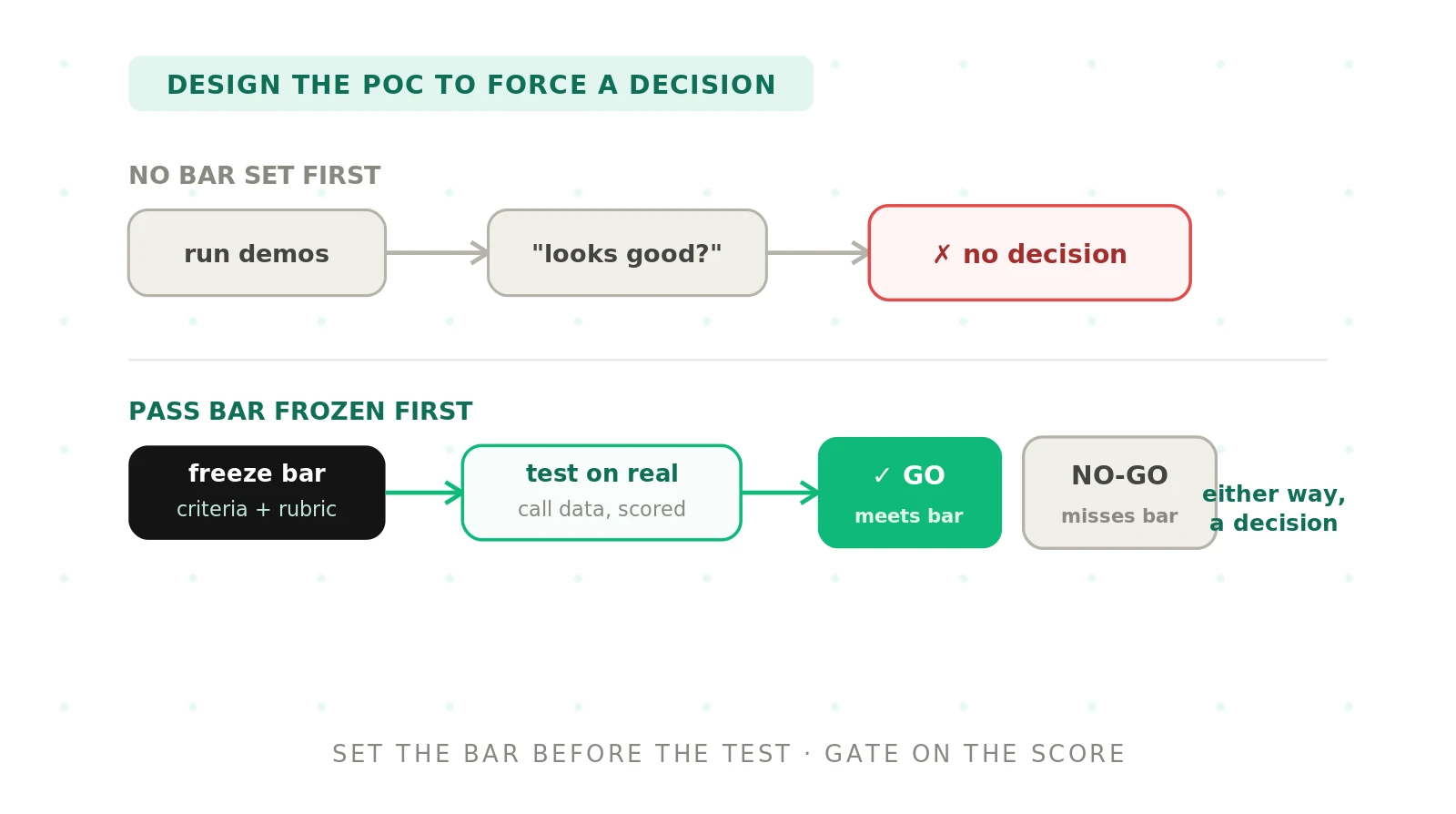
Most voice AI proofs-of-concept end without a verdict. The trial runs for a few weeks, the agent "seems fine," a champion likes it, and the contract gets signed on a feeling. Nobody agreed what "good enough" meant before the trial started. So the POC proved nothing. It just gave the loudest opinion a stage.
A well-designed POC is different. It is built to answer one question: does this agent clear the bar we set, on our data, under our rules? This post covers how to design that POC. We will define what "produces a decision" means, then walk the design steps that force one.
Why most voice agent POCs never reach a verdict
A proof of concept fails as a decision tool for predictable reasons. The failures are about design, not the agent.
No success criteria are set in advance. So "did it pass?" becomes an opinion, and opinions favor whoever demos best. The goalposts drift mid-trial, because a vendor's strengths quietly reshape what the team decides to value. The POC runs on scripted demos and cherry-picked calls, not real traffic, so it measures the easy path. And there is no gate: no moment where someone reads the numbers and commits to go or no-go.
The common thread is that the POC was never designed to produce a verdict. It collected impressions. Impressions do not survive a procurement review. This is the same failure that lets a strong demo hide a weak production agent. A decision-grade POC closes each of these gaps by design.
> Decision gate: A pre-agreed checkpoint where the POC result is read against a fixed pass bar and turned into a go or no-go. The gate is scheduled before testing starts, so the decision is mechanical, not political.
What "produces a decision" actually means
A POC produces a decision when the result maps to an action without a debate. The bar was set first. The data was representative. The score is computed the same way for every candidate. So the outcome is a go/no-go, not a discussion.
This is the core of good voice agent evaluation: the criteria come before the results. A criterion set after you see the numbers is not a criterion. It is a rationalization dressed up as one.
Designing for a decision means making five things true before the first test call. The success criteria are frozen. The scoring rubric is written. The data is representative of real calls. A pass bar and a gate exist. The run is timeboxed and owned. Miss any one and the POC drifts back toward vibes.
Freeze your success criteria before you test
The single highest-leverage design step happens before any agent is touched. Write down what success means, as numbers, and freeze it. These are your acceptance criteria. They convert the POC from a beauty contest into a test.
Set a threshold for each dimension that matters. Define a task-success or resolution floor. Set a latency ceiling at p90 and p95, judged against a limit like the ITU-T G.114 150ms one-way comfort mark. Add an accuracy floor on your critical entities, an escalation-accuracy floor, and a safety pass rate. For regulated work, map the safety criteria to a framework such as the NIST AI Risk Management Framework.
Agree these thresholds with everyone who signs off. Include procurement, security, and the operations lead who owns the phone line today. Get the numbers in writing before the trial. That way nobody relitigates the bar after seeing which vendor it favors.
The rubric matters as much as the thresholds. A scoring rubric) states each dimension, how it is measured, and what a pass looks like. Analytic rubrics score each dimension separately, which is what you want here. Write it once, and score every candidate against the same page.
Use representative real call data, not demos
A POC scored on demo scripts measures the demo, not the job. Design the data set before you design the tests.
Pull a sample from your real call logs. Cover your actual scenario mix: the common tasks, the edge cases, the angry callers, the accents, the background noise, the interruptions. This is a sampling) problem, so weight the sample toward what your line actually handles, not toward what is easy to test. If 20% of your calls are billing disputes, roughly 20% of the test set should be billing disputes.
Two data designs work, and the strongest programs use both. An offline set of recorded and transcribed real calls gives you a fixed, repeatable shared test set that every candidate faces identically. A live slice routes a small, contained share of real traffic to the agent under trial. Score both on your own data, never on vendor-reported numbers. Vendor metrics come from the vendor's test conditions, and you cannot take them at face value.
How to design a voice agent POC that produces a decision
Design the POC as a fixed procedure before any vendor is contacted. Follow these steps in order.
1. Write and freeze the success criteria. Set numeric thresholds for task success, latency, accuracy, escalation, and safety. Get sign-off from procurement, security, and operations before testing.
2. Build the scoring rubric. State each dimension, how it is measured, and what a pass looks like. Assign a weight to each dimension so the total reflects business priority.
3. Assemble representative data. Sample real calls to match your live scenario mix. Prepare an offline test set, a live traffic slice, or both.
4. Set the pass bar and the decision gate. Define the minimum weighted score that clears the trial. Schedule the gate meeting and name who decides.
5. Give every candidate identical conditions. Same calls or same traffic slice, same integrations, same rubric. Only the agent should differ.
6. Timebox the run. Fix a start and end date long enough to cover your real scenario mix, not a quiet afternoon.
7. Score on your own data at the gate. Compute each candidate's weighted score against the frozen criteria, then read it against the pass bar.
8. Make the go/no-go call. The candidate that clears the bar wins. If none clear it, the honest outcome is no-go, and that is still a decision.
A weighted POC scorecard template
Score every candidate with the same weighted rubric. Weights force the trade-offs you already care about into one number, using a simple weighted average. Below is a template you can adapt. Set your own weights and pass bars from your risk profile.
| Criterion | Weight | Pass bar (example) | Data source |
|---|---|---|---|
| Task success / resolution | 30% | ≥ 85% of in-scope calls resolved | Scored real-call transcripts |
| Escalation accuracy | 20% | ≥ 95% of out-of-scope calls escalated | Labeled escalation events |
| Latency (p95) | 15% | ≤ 1.2s response, ≤ 150ms one-way audio | Call timing logs |
| Critical-entity accuracy | 15% | ≥ 98% on names, dates, dollar amounts | Field-level transcript check |
| Safety / policy adherence | 15% | 100% on red-line policy tests | Safety test suite |
| Containment | 5% | ≥ 70% without human handoff | Call disposition data |
Each candidate gets one weighted score out of 100. The pass bar is the minimum total plus any non-negotiable floors, such as the safety row scoring 100%. A candidate that fails a floor fails the POC, whatever its total. That rule stops a strong task-success number from papering over a safety gap.
Set a pass bar and a decision gate
A rubric without a bar still ends in debate. Design the threshold in.
The pass bar is the minimum weighted score, plus any hard floors that cannot be traded away. Write it next to the rubric. Then schedule the decision gate as a real calendar event, with the deciders named before the trial runs. When the gate arrives, the group reads the scores against the bar and commits. No new criteria are introduced at the gate. That is the whole point.
Design for the no-go case too. A POC that can only say yes is not a test. If no candidate clears the bar, the design should make that a clean, defensible outcome, not a failure someone has to explain away.
Timebox the POC and assign an owner
Two design choices keep the POC from sprawling into an open-ended pilot: a timebox and an owner.
Timeboxing fixes a start and end date up front. A common shape is two to four weeks, long enough to cover your scenario mix and catch the failures that only show up under real load, short enough to force a call. Without a timebox, POCs drift for months and quietly become the production system by default.
An owner makes the decision someone's job. Name one person accountable for running the trial and bringing the scored result to the gate. A responsibility assignment matrix helps here: one owner, clear approvers, informed stakeholders. Diffuse ownership is how a POC ends with everyone assuming someone else will make the call.
Where an independent evaluator fits
The hardest part of POC design is staying honest under pressure. The team that built the shortlist wants a winner. The vendor wants to pass. Whoever scores the calls is under quiet pressure to nudge the result. That is the case for independent evaluation.
Evalgent is a third-party evaluator that runs the POC scoring for you. We help you freeze the criteria and the rubric before testing, score every candidate on your representative call data with the same rules, and deliver a result mapped to your pass bar. Because the scoring party has no stake in which vendor wins, the go/no-go holds up in a procurement review and to your security team. That independence is what makes the decision defensible, and it is where the ROI of structured testing shows up: fewer months lost to a POC that proved nothing. It complements, rather than replaces, your own pre-launch testing and containment goals.
Frequently asked questions
What is voice agent POC design?
Voice agent POC design is how you structure a proof of concept so it ends in a clear decision. You freeze success criteria and a scoring rubric before testing, use representative real call data, set a pass bar and a decision gate, timebox the run, and assign one owner. Good design produces a verdict instead of an impression.
How do you design a voice agent POC that produces a decision?
Write numeric success criteria and freeze them. Build a weighted scoring rubric. Assemble a representative sample of real calls. Set a pass bar and schedule a decision gate with named deciders. Give every candidate identical conditions, timebox the run, and score on your own data at the gate. The candidate that clears the bar wins.
What success criteria should you freeze before a voice agent POC?
Freeze numeric thresholds for the dimensions that matter: a task-success or resolution floor, latency ceilings at p90 and p95, an accuracy floor on critical entities, an escalation-accuracy floor, and a safety pass rate. For regulated work, map safety to the NIST AI Risk Management Framework. Get sign-off from procurement, security, and operations first.
How much call data does a representative voice agent POC need?
Enough to match your real scenario mix, not a fixed number. Sample from your call logs so the proportions mirror live traffic: common tasks, edge cases, hard accents, noise, and interruptions. If billing disputes are 20% of calls, they should be about 20% of the test set. Cover your hard cases, not just the easy path.
What is a decision gate in a voice agent POC?
A decision gate is a scheduled checkpoint where the scored POC result is read against the fixed pass bar and turned into a go or no-go. It is set before testing starts, with the deciders named. No new criteria are introduced at the gate. The design makes the decision mechanical rather than political.
How long should a voice agent POC run?
Long enough to cover your real scenario mix and catch failures that appear under load, short enough to force a call. Two to four weeks is a common timebox. Fix the start and end dates before you begin. Without a timebox, a POC drifts for months and becomes the production system by default.
Who should own a voice agent POC?
One named person should own the trial: running it, keeping conditions identical, and bringing the scored result to the decision gate. Use a responsibility assignment matrix to separate the owner, the approvers, and informed stakeholders. Diffuse ownership is a top reason POCs end with no one willing to make the call.
Why should a third party score the POC?
The team that built the shortlist and the vendor both want a pass, which pressures whoever scores the calls. An independent evaluator has no stake in the winner, so it scores every candidate on the same frozen rubric and your own data. That neutrality makes the go/no-go defensible to procurement and security.
The bottom line
A voice agent POC produces a decision only when the criteria, rubric, pass bar, and gate are frozen before testing starts. Everything after that is measurement, not opinion.
Ready to run a POC that ends in a defensible yes or no? Book a demo and we will design and score it with you as your independent evaluator.
Related Articles
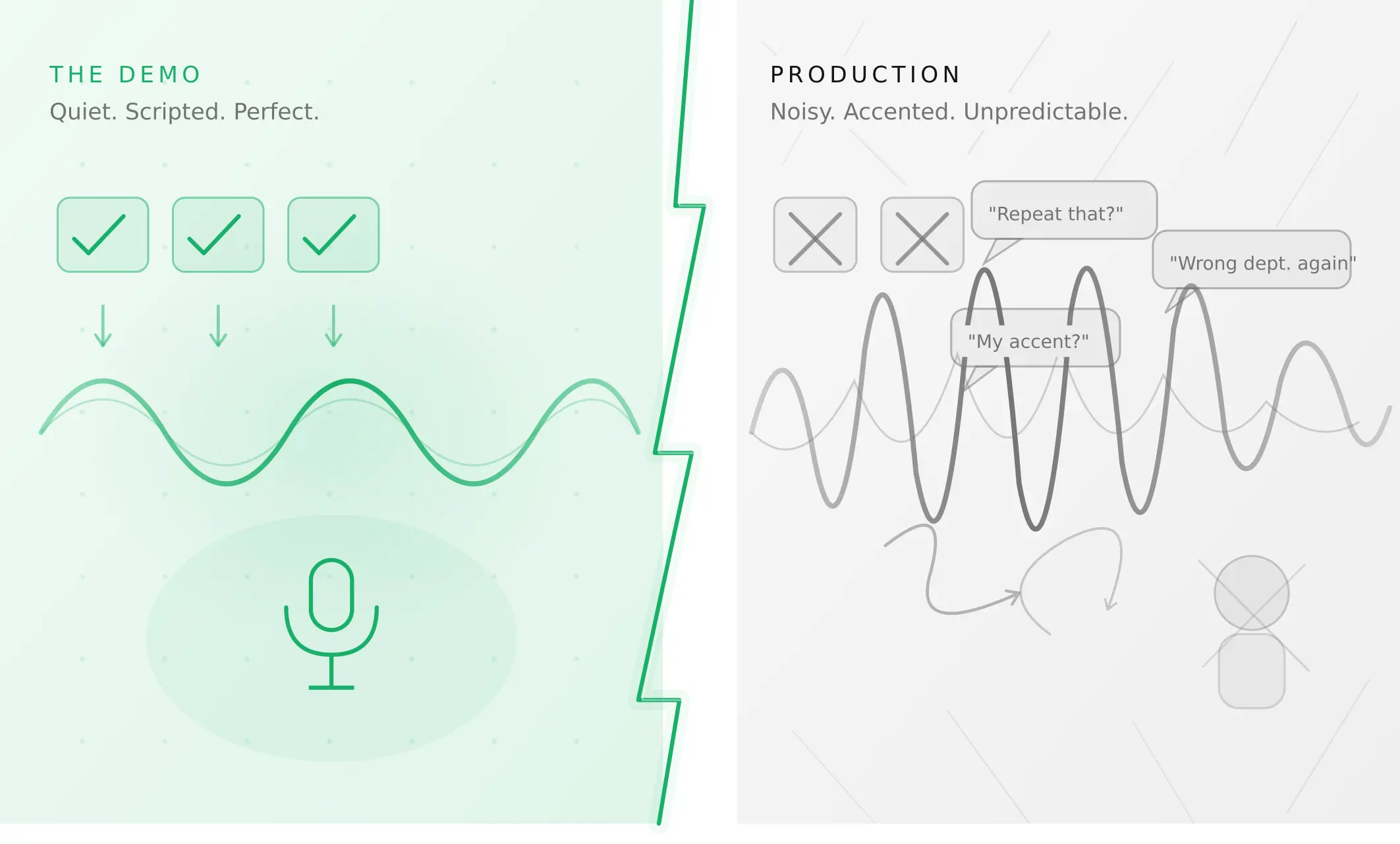
Why AI voice agents fail in production (and how to prevent it)
AI voice agents that ace demos still break in production. Learn the 5 root causes, how to test for each, and what production readiness actually means.
Read more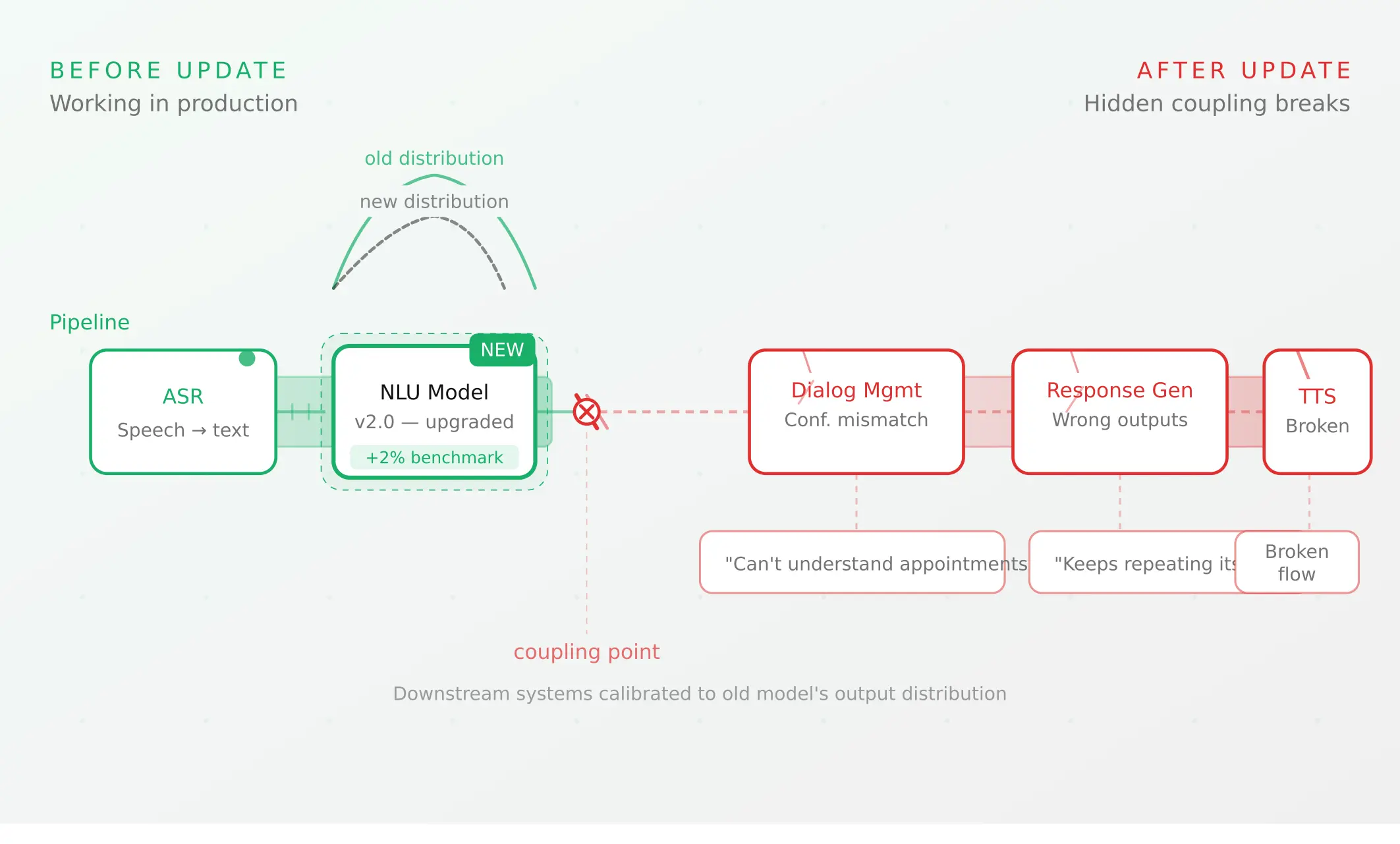
Voice agent regression testing: why LLM updates break production
LLM updates improve benchmarks but break voice agents in 5 predictable ways. How to detect and prevent regressions after every model or prompt change.
Read more