How to fix endpointing errors in AI voice agents
On this page
Endpointing is the agent's sense of timing — knowing when it is its turn to talk. Get it wrong and the agent either interrupts the caller or leaves an awkward silence. Both wreck the conversation. Evalgent tests turn-taking on real calls. Here is why endpointing fails and how to fix it.
Endpointing: the detection of when a caller has finished their turn, so the agent knows when to stop listening and start responding.
What broken endpointing sounds like
These are the symptoms on a real call:
- The agent cuts in while the caller is still mid-sentence.
- It responds to half a sentence, missing the second half.
- It leaves a long, awkward gap after the caller clearly finished.
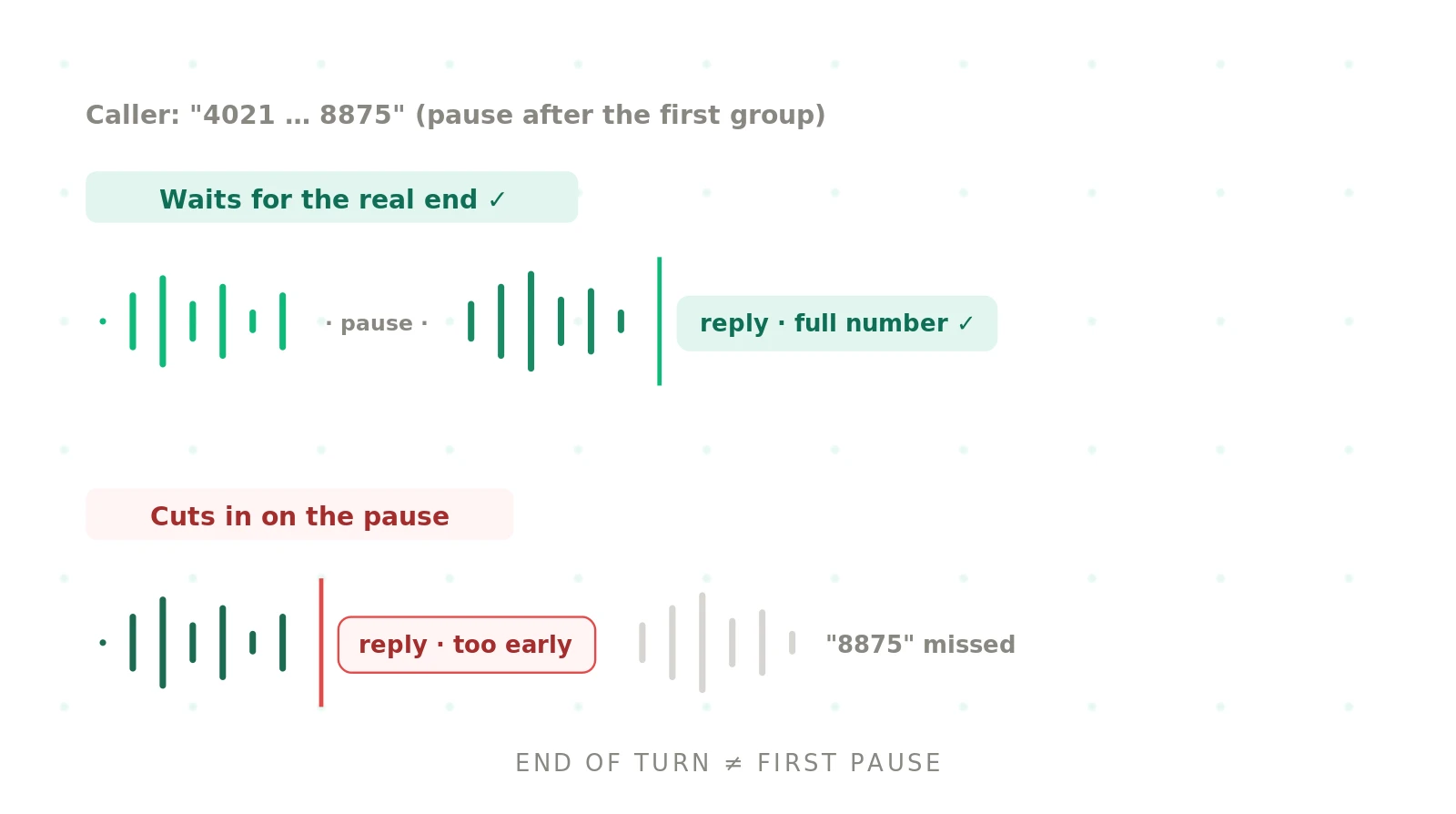
- It trips on natural pauses while someone reads a number or spells a name.
- It struggles with slow speakers, cutting them off on every breath.
The failure is a mistimed turn. The agent either grabs the turn too early or holds it too long.
Why endpointing fails
Endpointing is a timing decision under uncertainty. A pause might mean "I'm done" or "I'm thinking," and a fixed rule cannot tell them apart. The table maps each cause to what you hear and how to fix it.
| Cause | How it shows on a call | Fix |
|---|---|---|
| Silence threshold too short | Cuts the caller off on a pause | Lengthen the threshold; add context-aware detection |
| Silence threshold too long | Awkward gap after the caller finishes | Shorten the threshold for clear endings |
| No semantic signal | Treats a thinking pause as the end | Use the words so far to judge if the turn is complete |
| Fixed, non-adaptive timeout | Fails slow and fast speakers alike | Adapt the wait to the caller's pace |
| Numbers and spelling | Cuts off mid-sequence on natural pauses | Detect list and digit patterns; wait for completion |
| Noise fooling VAD | Ends the turn on background sound | Tune voice-activity detection for the line's noise |
How to test endpointing in AI voice agents
1. Script mid-sentence pauses — Include natural hesitations and assert the agent waits, not cuts in.
2. Test numbers and spelling — Have callers read digits and spell names, and assert the agent waits for the full sequence.
3. Vary pace — Run slow and fast speakers, and check the agent adapts instead of cutting off.
4. Measure both errors — Track premature-cutoff rate and end-of-turn latency together.
5. Add noise — Run background noise and assert the agent does not end the turn on it.
6. Tune and re-run — Adjust thresholds, then re-test cutoffs and gaps together, since fixing one worsens the other.
A worked example
A caller read a sixteen-digit card number, pausing naturally after each group of four. The agent's silence threshold was 500 milliseconds, so it cut in after the first group and captured only four digits. Shortening the pause was not the fix — that would break slow speakers. The fix was context-aware endpointing that recognized an in-progress number and waited for it to finish. A digit-reading scenario now asserts the agent holds its turn.
Fixing endpointing with Evalgent
Evalgent tests turn-taking on realistic calls, both failure modes at once. Scenarios include mid-sentence pauses, digit and spelling sequences, and slow and fast speakers, so cutoffs and gaps surface together. Profiles vary caller pace and line noise, since endpointing behaves differently across them. Metrics track premature-cutoff rate and end-of-turn latency with thresholds you set. Evaluations run the suite as batches of synthetic callers before release. Reviews let you replay a mistimed turn and hear exactly where the agent grabbed it. Endpointing pairs with interruption handling — see the barge-in and interruptions guide and full-duplex voice agents.
The bottom line
Endpointing fails in two opposite directions: cutting the caller off on a pause, and pausing too long after they finish. Tune silence thresholds, add context-aware end-of-turn detection, and test pauses, digits, and slow speakers so fixing one direction does not break the other.
Frequently asked questions
What is endpointing in a voice agent?
Endpointing is how a voice agent detects that the caller has finished their turn, so it knows when to stop listening and reply. It usually combines voice-activity detection with a silence threshold, and better systems also use the words spoken so far. Good endpointing is the basis of natural turn-taking on a call.
Why does my voice agent cut me off?
Its silence threshold is likely too short, so a natural mid-sentence pause looks like the end of the turn. Reading numbers, spelling names, or simply thinking all produce pauses that trip a short threshold. Lengthening it helps, but the real fix is context-aware endpointing that judges whether the sentence is actually complete.
Why does my voice agent pause so long before replying?
Its silence threshold is set too long, so it waits well past the point the caller clearly finished. That produces an awkward gap and adds to overall latency. Shortening the threshold for clear, complete endings helps, ideally combined with a semantic signal so the agent responds promptly without cutting anyone off.
How do you test endpointing on a voice agent?
Script scenarios with mid-sentence pauses, digit sequences, and spelled names, and assert the agent waits for the full turn. Run slow and fast speakers to check it adapts, and add background noise to confirm it does not end the turn on sound. Measure both premature cutoffs and end-of-turn latency together.
What is the difference between endpointing and barge-in?
Endpointing decides when the caller has finished so the agent can take its turn. Barge-in handles the caller interrupting while the agent is already speaking. Endpointing is about detecting the end of the caller's turn; barge-in is about yielding the agent's turn. Both are parts of natural turn-taking and both need testing.
How do you stop a voice agent cutting off numbers?
Recognize digit and list patterns and wait for the sequence to complete, rather than ending the turn on the natural pause between groups. Simply lengthening the silence threshold hurts normal conversation and slow speakers. Context-aware endpointing that detects an in-progress number is the reliable fix, and a digit-reading scenario should assert it.
What is semantic endpointing?
Semantic endpointing uses the meaning of what has been said, not just silence, to decide if the turn is over. If the sentence is grammatically incomplete or clearly mid-thought, the agent waits even through a pause. Combined with voice-activity detection, it cuts both premature interruptions and long gaps, because it judges completeness rather than timing alone.
Does endpointing affect latency?
Yes, directly. The silence the agent waits through before deciding the turn is over is pure added latency. Too long a wait feels sluggish; too short cuts callers off. Good endpointing minimizes the wait for clear endings while still holding through real pauses, which is why it is tuned alongside overall response latency.
Related guides
How to test tool calling in AI voice agents
Tool calling fails when a voice agent picks the wrong function, fills bad arguments, or acts silently. Learn how to test tool calling and catch it.
How to reduce latency in AI voice agents
Voice agent latency is the pause before the agent replies. Learn what drives it, what a good target is, and how to reduce latency without losing quality.