Test your voice agent
How to Test for VAD Misfire in Voice Agents
# How to test for VAD misfire in voice agents
Quick answer
To test for VAD misfire in voice agents, play labeled audio with noise, crosstalk, coughs, hold music, and soft speech. Then count two error types: false triggers, where VAD reacts to non-speech, and missed speech, where VAD ignores the caller. Score both against ground truth, and keep it separate from endpointing.
Why VAD misfire deserves its own test
Voice activity detection sits at the front of every voice agent. It decides, moment by moment, whether the audio contains speech or not. When that decision is wrong, everything after it inherits the error. A misfire is not a rare edge case. It is a routine failure on real phone lines.
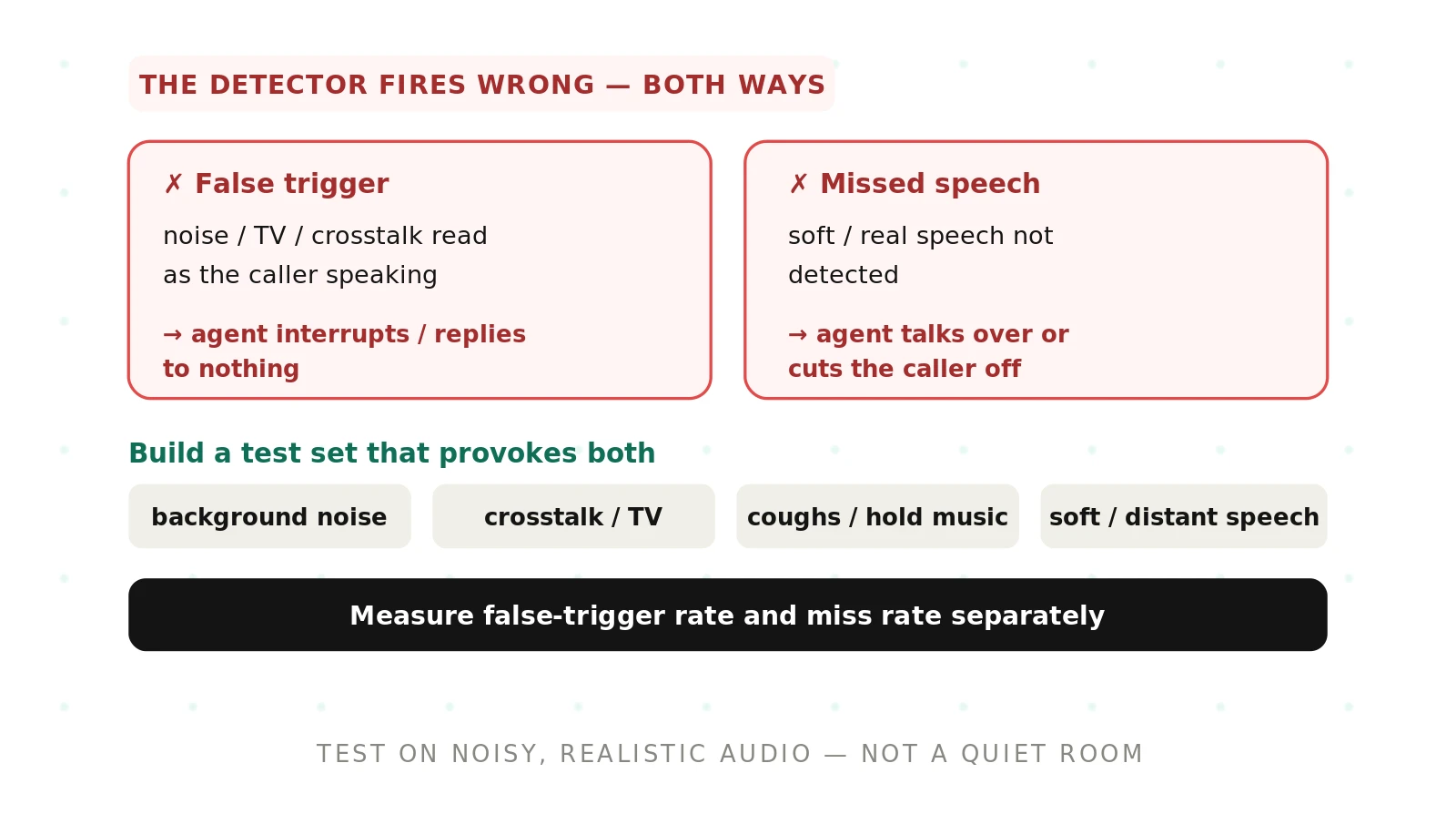
A VAD misfire has two directions. In one, the detector fires when nobody is speaking. A door slams, a TV plays, a second person talks nearby, and the agent reacts as if the caller spoke. In the other, the detector stays quiet while the caller is actually speaking. The agent talks over them or cuts them off.
Most teams never test this failure directly. They test the whole agent end to end. That hides the root cause. A dropped word or a rude interruption gets blamed on the language model or the prompt. Often the real culprit is the voice activity detection layer firing wrong. This post shows how to isolate and measure that specific failure.
We define VAD and endpointing in depth in our VAD vs endpointing guide. This post assumes you know the terms. It focuses on one job: detecting the misfire.
What a VAD misfire is
> VAD misfire: a voice activity detection error where the speech-or-silence decision is wrong. It fires on non-speech, or it fails to fire on real speech.
There are two error classes, and they map to a well-known pair in detection theory. A false trigger is a false positive. The detector claims speech is present when it is not. Missed speech is a false negative. The detector claims silence when the caller is talking.
> False trigger: VAD reports speech during noise, background talk, or media audio. The agent then interrupts or answers something the caller never said.
> Missed speech: VAD reports silence while the caller speaks. The agent keeps talking, ignores the caller, or drops part of the turn.
Both errors are worse in low signal-to-noise ratio conditions. A caller on a busy street, in a car, or near a TV gives the detector a hard input. Soft speakers and fast talkers make it harder still. Your test set has to include these conditions on purpose.
VAD misfire versus endpointing timing
VAD misfire and endpointing problems look similar from the caller seat. Both can cut a caller off. But they are different failures, and they need different fixes. Mixing them up wastes tuning effort.
> Endpointing: the decision that a turn has finished so the agent can respond. It is a form of speech segmentation built on top of VAD.
VAD answers a narrow question. Is there speech in this audio frame right now? Endpointing answers a later question. Has the caller finished their turn? A VAD misfire is a wrong frame-level decision. An endpointing error is a wrong turn-level decision, often with correct VAD underneath.
Here is the practical split. If the agent reacts to a slammed door, that is a VAD false trigger. If the agent waits two seconds after a clear sentence ends, that is endpointing latency. Test the frame decision first. Then test the turn decision. Our endpointing guide and our post on the best endpointing for voice agents cover the turn-level work.
The four misfire types and what callers feel
The two error classes split into four practical types on a call. Each has a distinct caller experience and a distinct test. Use this table to design coverage.
| Misfire type | What the caller experiences | How to test for it |
|---|---|---|
| False trigger | The agent interrupts or answers when the caller said nothing. It reacts to noise, TV, or a bystander. | Play non-speech clips: street noise, hold music, coughs, a second voice. Count any VAD activation as an error. |
| Missed speech | The caller speaks and the agent ignores it or talks over them. The turn feels one-sided. | Feed soft, short, or accented speech under noise. Count each real utterance the VAD fails to flag. |
| Clipped start | The first word or two of the caller is lost, so the transcript begins mid-sentence. | Send clips with fast onsets and low lead-in. Check whether leading phonemes reach the transcript. |
| Late release | VAD holds the speech state after the caller stops, adding dead air before the agent replies. | Send clean utterances with trailing noise. Measure how long VAD stays active past speech end. |
Clipped start and late release are timing-adjacent, but they start in the VAD layer. Clipped start is a slow attack. Late release is a long hangover. Both are frame-level, so they belong in the VAD test, not the endpointing test.
How to test for VAD misfires
Follow these steps to build a repeatable VAD misfire test. The goal is a labeled set, a clean harness, and two headline numbers you can track over time.
1. Collect real audio conditions. Gather samples of the environments your callers actually use. Include quiet rooms, cars, streets, call centers, and speakerphone. Add hold music, TV audio, coughs, and crosstalk from a second speaker.
2. Label ground truth. For each clip, mark where speech starts and stops in milliseconds. Mark non-speech segments explicitly. This ground truth is what every score compares against, so label it carefully.
3. Include hard positives and hard negatives. Add soft speech, short words like "yes" and "no," and heavily accented speech as positives. Add background talk, laughter, and music as negatives. These are the cases that expose misfires.
4. Isolate the VAD layer. Feed audio into the VAD component alone, not the full agent. Capture its raw speech-active decisions with timestamps. This keeps the language model and prompt out of the result.
5. Run every clip and log decisions. Play each clip through the harness. Record when VAD flags speech, when it clears, and the exact frame timing. Store the log next to the ground truth for that clip.
6. Score false triggers and misses. Compare decisions to ground truth. A speech flag during a labeled non-speech segment is a false trigger. A missing flag during labeled speech is a miss. Count each event.
7. Segment results by condition. Break the numbers down by noise type, signal-to-noise ratio, and speaker. A detector may pass on clean audio and fail on street noise. The average hides that.
8. Set thresholds and re-test. Pick target rates for false triggers and misses. Tune VAD sensitivity, then run the whole set again. Treat the set as a regression suite for every future change.
Metrics: false-trigger rate and miss rate
Two rates carry most of the signal. Report both, and never collapse them into one score. They trade off against each other, so a single number hides the tuning choice.
The false-trigger rate counts VAD activations on non-speech. Express it per minute of non-speech audio, or per call. A rising false-trigger rate means the agent will interrupt callers and react to noise. The miss rate counts real speech events the VAD failed to flag. A rising miss rate means the agent will talk over callers and drop words.
These map to the precision and recall framing used across detection systems. High false triggers hurt precision. High misses hurt recall. You cannot maximize both at once, so pick the balance your use case needs. A medical intake line should minimize misses. A noisy retail line may accept more misses to cut false triggers.
Track clipped-start and late-release timing as separate distributions. Report the median and the tail. Illustrative example: a detector might clip the first 80 ms on 3 percent of utterances, and hold 250 ms of hangover on average. Those numbers are illustrative, not measured, and yours will differ. The point is to measure them per condition.
Report every number with its condition attached. "Two false triggers per minute on street noise at low SNR" is useful. "Low error rate" is not. Precise, conditioned numbers are what let you compare builds and vendors fairly.
Building the misfire test set
The test set is where most of the work lives. A weak set makes a bad detector look fine. Build coverage across four axes: noise type, signal-to-noise ratio, speaker profile, and utterance shape.
For noise type, include street traffic, cafe babble, car cabin, keyboard clatter, and household TV. Add hold music, since agents often handle transfers and callbacks. Add coughs, throat clears, and door slams as short transient sounds. These transients are classic false-trigger bait.
For speaker profile, include soft speakers, fast speakers, and a range of accents. Soft speech near background noise is the hardest positive case. It is where misses cluster. For utterance shape, include one-word answers, long sentences, and mid-sentence pauses. Mid-sentence pauses test whether VAD holds through a natural breath.
Layer negatives deliberately. Record clips that contain only noise, only music, or only a second person talking away from the phone. Every VAD activation on these clips is a false trigger by definition. This is the cleanest way to measure the false-positive direction.
Keep the set version-controlled and stable. When you change VAD settings, run the same set. That is how you separate a real improvement from a lucky sample. Our guide on benchmarking voice agents on your own data covers building durable test sets that reflect your real traffic.
Where an independent evaluator fits
Vendors tune VAD on their own audio and report their own numbers. That is a conflict of interest. A vendor has no incentive to publish a high false-trigger rate on the exact noise your callers face. This is why independent evaluation matters for a layer this easy to misreport.
Evalgent is an independent, third-party evaluator for voice agents. As the independent evaluator, we build noisy test sets, isolate the VAD layer, and score false triggers and misses against labeled ground truth. We report results by condition, not as one flattering average. That neutral view is the point of our independent voice AI evaluation approach.
Testing VAD misfire is one slice of a broader program. It sits next to interruption rate, endpointing, and turn-taking. Our voice agent evaluation overview shows how these pieces connect, and our AI voice agent testing guide covers the full workflow. For the barge-in side of the problem, see our barge-in vs turn-taking guide.
Common gotchas when testing VAD misfire
A few traps recur. First, testing only clean audio. A detector that passes in a quiet room can fail badly on a street, and clean-only sets never reveal it. Second, judging on transcripts alone. Transcripts hide false triggers that produced no words, so score on the audio timeline and VAD logs.
Third, mixing VAD and endpointing in one number. A blended score cannot tell you which layer to fix. Fourth, forgetting the two directions trade off. Tuning down false triggers usually raises misses, so you must watch both rates at once, framed as a sensitivity and specificity balance rather than a single target.
Frequently asked questions
How do I test for VAD misfire in a voice agent?
Testing for VAD misfire means playing labeled audio through the voice activity detection layer alone. Include noise, crosstalk, coughs, hold music, and soft speech. Compare VAD decisions to ground-truth speech timing. Count false triggers on non-speech and missed speech on real utterances. Report both rates by condition, and keep endpointing out of this test.
What is a VAD false trigger in a voice agent?
A VAD false trigger is a false positive from voice activity detection. The detector reports speech when the audio holds only noise, music, or a bystander's voice. The agent then interrupts the caller or answers something no one said. False triggers rise in low signal-to-noise conditions, so a strong test set loads noise and background talk on purpose.
How is VAD misfire different from an endpointing problem?
VAD misfire is a frame-level error: the speech-or-silence decision is wrong. An endpointing problem is a turn-level error: the agent misjudges when a turn ended, often with correct VAD underneath. A slammed door triggering the agent is a VAD misfire. A long pause after a clear sentence is endpointing latency. Test the frame decision first, then the turn.
How do I build a VAD test set with noise?
Build a VAD test set by collecting real caller environments and layering negatives on purpose. Add street noise, car cabin, cafe babble, hold music, coughs, and crosstalk. Include soft, fast, and accented speech as positives. Label speech start and stop times in milliseconds. Keep the set version-controlled so every VAD change runs against the same audio.
How do I measure VAD false-trigger rate?
Measure the false-trigger rate by playing non-speech clips through the isolated VAD layer and counting every activation. Express the count per minute of non-speech audio, or per call. Break it down by noise type and signal-to-noise ratio. A single average hides the conditions where the detector fails. Report the rate alongside the miss rate, since the two trade off.
Why does my voice agent respond to background noise?
A voice agent responds to background noise when its VAD false-triggers. The detector reads the noise as speech and passes it downstream, so the agent replies to nothing. This is common on speakerphone, in cars, and near a TV. Fix it by testing VAD on noise-only clips, measuring the false-trigger rate, and tuning sensitivity while watching the miss rate.
Can I detect VAD misfire from transcripts alone?
Transcripts alone miss most VAD misfires. A false trigger can fire without producing any words, so it leaves no transcript trace. A clipped start may only drop a phoneme, which the transcript smooths over. Score VAD misfire on the audio timeline and the raw VAD logs, compared to labeled ground truth. Use transcripts as a secondary signal, not the primary one.
How do false triggers and misses trade off in VAD tuning?
False triggers and misses trade off directly. Lowering VAD sensitivity cuts false triggers but raises missed speech. Raising sensitivity does the reverse. This is the precision and recall balance seen in any detector. Pick the side that fits your use case: minimize misses on medical intake, and accept more misses to cut false triggers on a noisy retail line. Always report both.
The bottom line
VAD misfire is a frame-level failure with two directions: false triggers on non-speech and missed real speech. Test it on labeled noisy audio, score both rates by condition, and keep it separate from endpointing timing.
Ready to see how your agent handles noise, crosstalk, and soft speech? Book a demo and get an independent VAD misfire audit on your own call conditions.
Related Articles
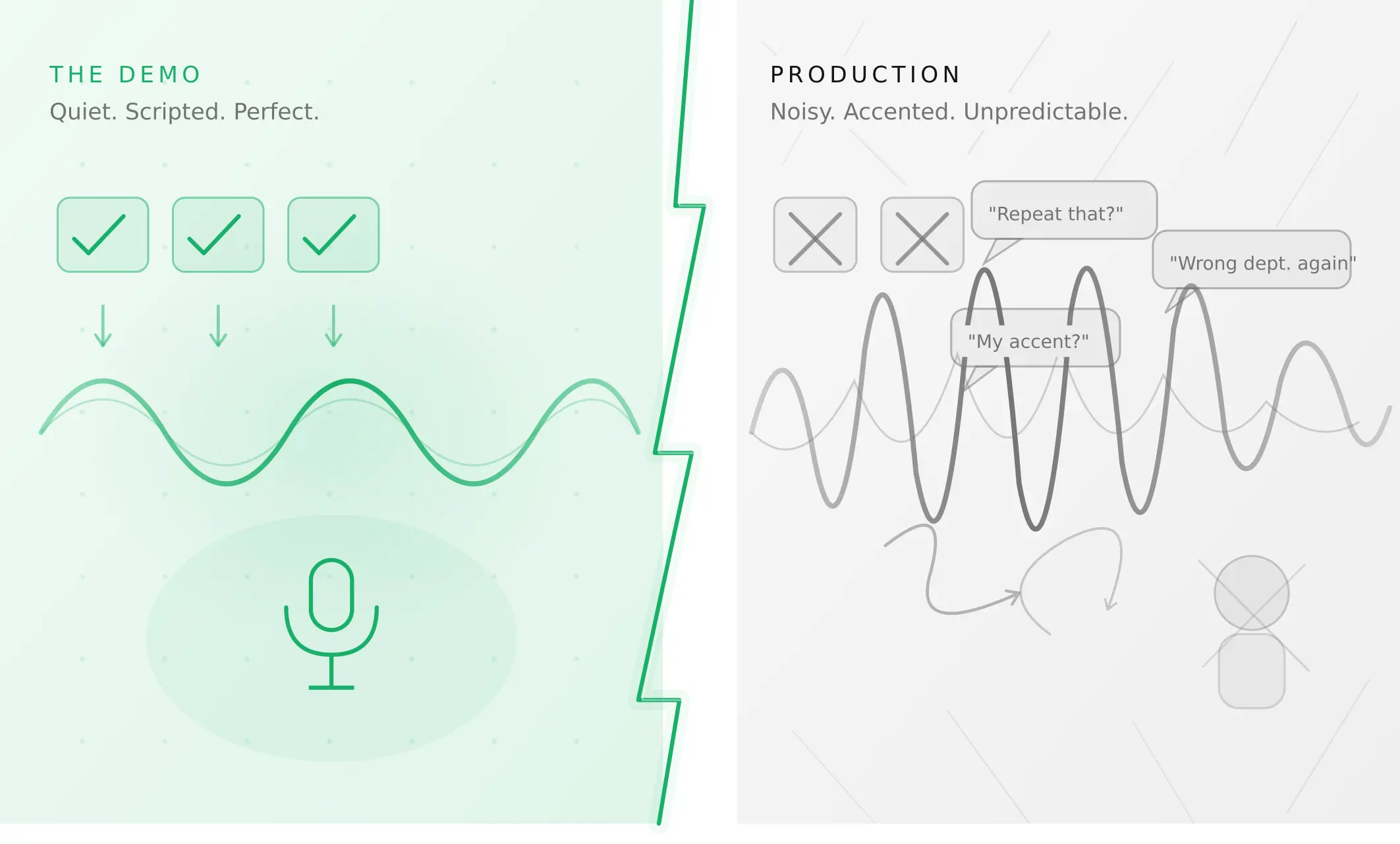
Why AI voice agents fail in production (and how to prevent it)
AI voice agents that ace demos still break in production. Learn the 5 root causes, how to test for each, and what production readiness actually means.
Read more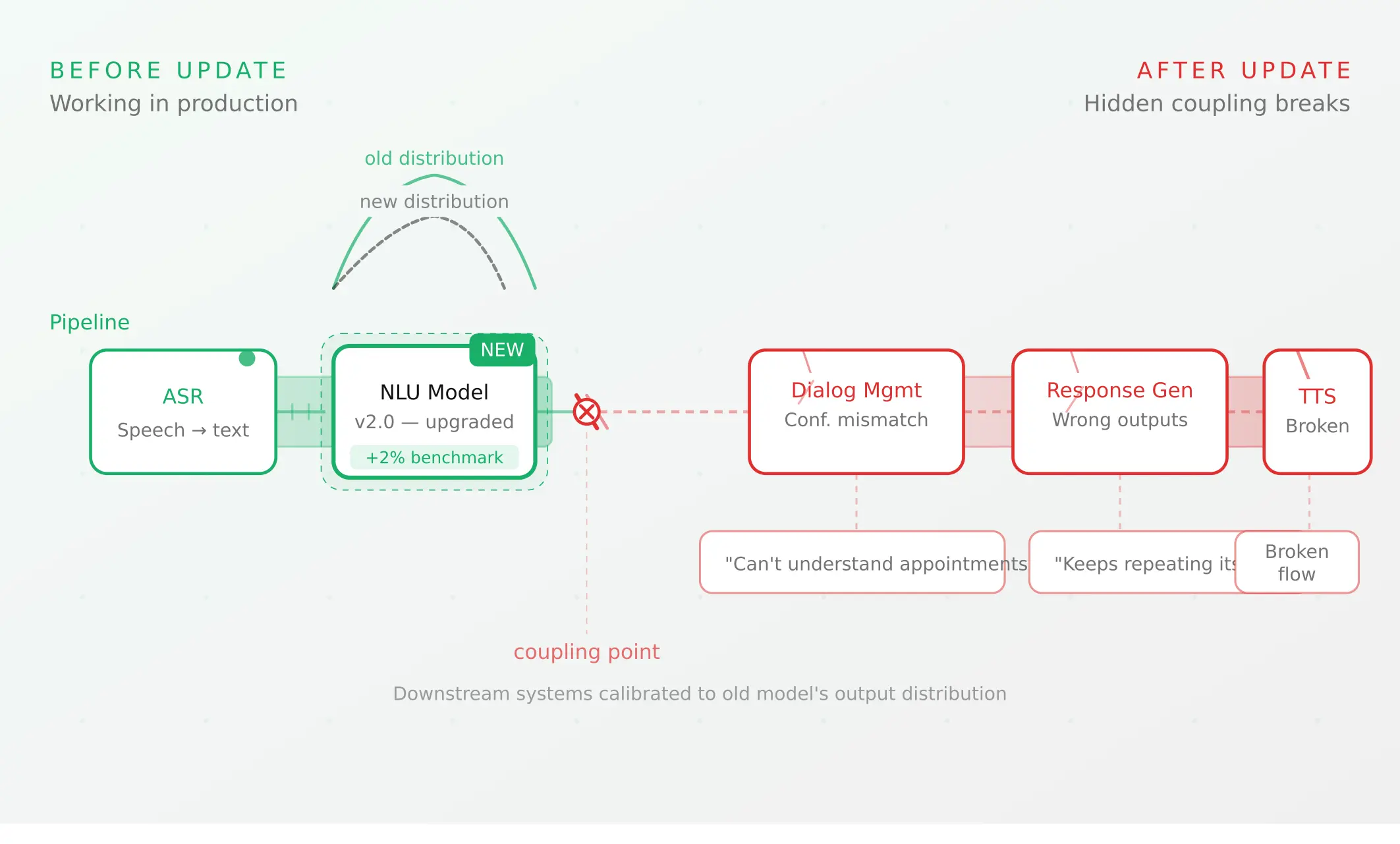
Voice agent regression testing: why LLM updates break production
LLM updates improve benchmarks but break voice agents in 5 predictable ways. How to detect and prevent regressions after every model or prompt change.
Read more