Test your voice agent
How to Choose Endpointing for Voice Agents (2026)
# How to choose endpointing for voice agents (2026)
Quick answer
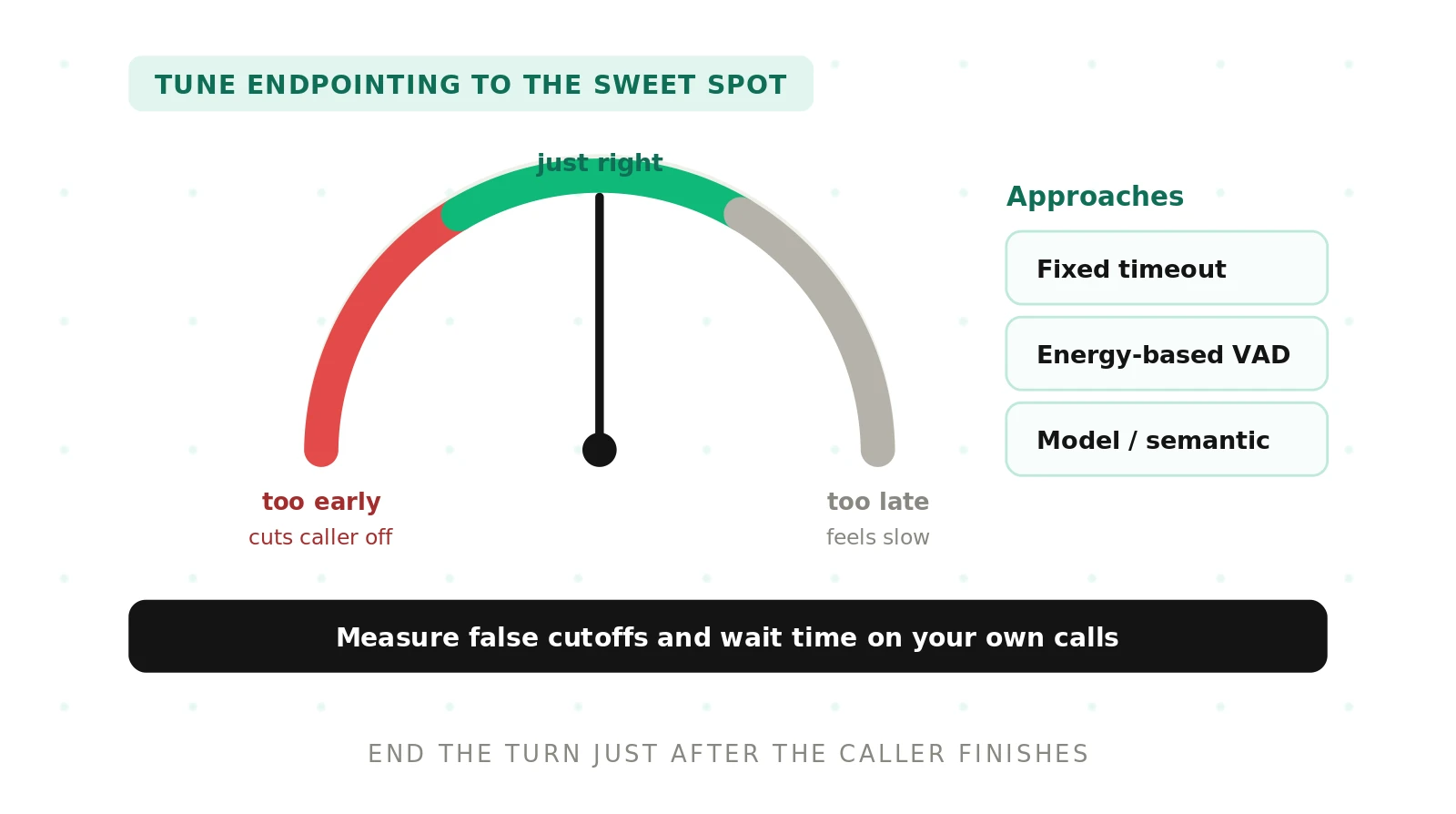
The best endpointing for voice agents in 2026 is the approach that ends turns fast without cutting callers off. Semantic, model-based endpointing usually beats fixed silence timers on natural speech. But the right choice depends on your use case, so tune thresholds and measure false cutoffs and wait time on your own calls.
Why endpointing decides how human your agent feels
Every phone conversation runs on a single question. Has the other person finished speaking? Humans answer it without thinking. Voice agents have to be told how. That decision is endpointing, and it shapes every turn.
Get it right and the agent replies at the natural moment. Get it wrong in one direction and the agent cuts the caller off mid-sentence. Get it wrong in the other and the caller waits in silence, unsure if anyone is there. Both feel broken. Both drive callers to hang up or ask for a human.
Most teams pick an endpointing approach on the wrong evidence. They accept a vendor default. They tune it once on a quiet demo call. They never measure it on real traffic. This guide gives you a neutral way to choose and tune endpointing instead. It covers the trade-off, the approaches, and how to test each on your own calls.
What endpointing is, and how it differs from VAD
> Endpointing: the detection of when a caller has finished speaking so the agent can respond. It decides the exact moment a turn ends.
Endpointing is a form of speech segmentation. It draws the boundary between one turn and the next. That boundary is where the agent decides to stop listening and start thinking.
People confuse endpointing with voice activity detection. They are related but not the same. Voice activity detection, or VAD, only tells you whether speech is present right now. Endpointing uses that signal, and often more, to decide that a turn is complete.
> VAD: a lower-level check for whether the current audio contains speech or silence. It is an input to endpointing, not a replacement for it.
We keep the full definitions in two concept guides. Read our guide to endpointing for voice agents and our VAD vs endpointing guide if you need the mechanics. This post assumes you know the terms and focuses on selecting and tuning the right approach.
The core trade-off: early cutoffs versus waiting too long
Endpointing is a balance between two failures. You cannot fully avoid both. Every tuning choice moves you along that line.
The first failure is the early cutoff. The agent decides the caller is done too soon. It jumps in while the caller is still forming a thought. This happens most with slow talkers, people reading a number aloud, or anyone who pauses to think. The caller feels interrupted and unheard.
The second failure is the long wait. The agent holds too long after the caller stops. The silence stretches. Latency) climbs, and the caller starts to repeat themselves or asks if the line dropped. A voice agent is a real-time system, and dead air past roughly a second reads as failure.
You can frame this like precision and recall. Aggressive endpointing is fast but cuts people off. Cautious endpointing is patient but slow. The goal is not to pick one extreme. The goal is to find the setting that fits how your callers actually speak.
Human turn-taking tolerates gaps of a few hundred milliseconds. That is your target zone. Too far under and you interrupt. Too far over and you stall. Where you land inside that zone depends on the use case.
Fixed timeouts versus semantic endpointing
The oldest approach is the fixed silence timeout. The agent waits a set number of milliseconds of silence, then assumes the turn is over. It is simple and predictable. It is also blunt. A fixed timer cannot tell a finished sentence from a mid-thought pause. Set it short and you cut people off. Set it long and every turn feels sluggish.
Semantic, or model-based, endpointing is smarter. It looks at what was said, not just whether sound stopped. It reads grammar, intent, and rhythm to judge whether a thought is complete. "My account number is" clearly is not done. "My account number is four four seven" might be. A model can tell the difference. A timer cannot.
The catch is cost and complexity. Semantic endpointing is heavier to run and needs tuning against real data. It can still be fooled. But on natural, open-ended conversation, it usually beats a fixed timer by a wide margin. For scripted flows with short, predictable answers, a well-tuned timer may be enough.
Most production agents in 2026 use a hybrid. VAD gates the audio cheaply. A fixed floor prevents absurd early cuts. A semantic model makes the final call on ambiguous pauses. This layering is where the best endpointing for voice agents in 2026 tends to land.
Endpointing approaches compared
Each approach has a place. The right one depends on your audio quality, your callers, and how natural the conversation needs to feel. Use this table to shortlist, then test the finalists on your own calls.
| Endpointing approach | Strength | Weakness | Best fit |
|---|---|---|---|
| Fixed silence timeout | Simple, predictable, cheap to run | Cannot tell a finished sentence from a thinking pause | Short, scripted flows with brief, expected answers |
| Energy-based VAD gating | Fast, lightweight, runs offline | Fooled by noise and fillers; ignores meaning entirely | Clean audio; quick gating before speech recognition |
| Model or semantic endpointing | Reads intent and grammar; handles natural pauses | Heavier to run; needs data and careful tuning | Open-ended, conversational agents with varied callers |
| Hybrid (VAD floor plus semantic) | Balances speed and accuracy; degrades gracefully | More moving parts to tune and monitor | Production agents on messy, real-world phone lines |
Notice that no row is best for everything. A collections agent handling short confirmations can live with a timer. A support agent taking open-ended questions needs semantic judgment. Match the approach to the conversation, not to the spec sheet.
How to choose and tune endpointing for your agent
The only reliable way to choose is to test candidates on your own calls and tune against real speech. Here is the sequence we use. Work through it in order.
1. Define your use case and its tolerance. Decide which failure hurts more for this agent. A crisis line must never interrupt, so favor patience. A quick order line values speed, so favor faster endpointing. Write this down before you touch a setting.
2. Pick a baseline approach from the table. Choose the row that matches your audio quality and conversation style. Start hybrid for open-ended calls. Start with a tuned timer for short, scripted flows. This is your starting point, not your answer.
3. Set your silence and endpoint thresholds. Configure the minimum silence before the agent considers a turn done. Add a maximum wait as a safety cap. Use two thresholds, not one, so you can shift the balance without breaking either edge.
4. Handle thinking pauses and fillers. Real callers say "um," pause to find a number, and trail off. Tune so these do not trigger an early cutoff. Semantic endpointing helps here. Test with recordings of people who actually hesitate.
5. Tune barge-in separately. Ending a turn and letting a caller interrupt are different problems. Configure barge-in on its own so callers can cut the agent off cleanly. Our barge-in vs turn-taking guide explains why these need separate settings.
6. Segment tuning by scenario. One global setting rarely fits every call type. Tune number capture, open questions, and yes-or-no confirmations separately. Store the settings per scenario so each flow gets the balance it needs.
7. Measure false cutoffs and wait time on real calls. Replay recorded traffic and score two numbers. How often did the agent cut the caller off? How long did callers wait after finishing? Track both together, because improving one usually worsens the other.
8. Re-tune on a schedule. Callers, accents, and traffic mix drift over time. A setting that fit last quarter may not fit now. Re-measure on fresh calls regularly and adjust. Endpointing is not a one-time configuration.
For the latency side of this work, our latency for voice agents guide shows how to measure each stage of the response budget. Endpointing delay is one slice of that total.
Measuring endpointing behavior on your own calls
You cannot tune what you cannot see. Endpointing quality lives in two measurable numbers, and both need real calls to be meaningful.
The first is the false cutoff rate. Count the turns where the agent started speaking while the caller was still going. Listen to the audio to confirm each one. A transcript alone will miss the moment the agent talked over the caller.
The second is post-speech wait time. Measure the gap between the caller finishing and the agent responding. Watch the distribution, not just the average. A good average with a long tail means some callers still hit painful silence.
Both numbers depend on who is calling. Fast talkers and slow talkers pull them in opposite directions. So do accents, phone noise, and speakerphone use. Measure across the range of callers you actually serve, not one clean voice in a quiet room. Related speech recognition errors can also confuse a semantic endpoint, so watch them together.
This is where owned testing matters. When you benchmark endpointing on your own recorded calls, no default and no vendor demo can hide the truth. See our guide to benchmarking voice agents on your own data for the method, and our overview of voice agent evaluation for the wider picture.
Why vendor demos hide endpointing problems
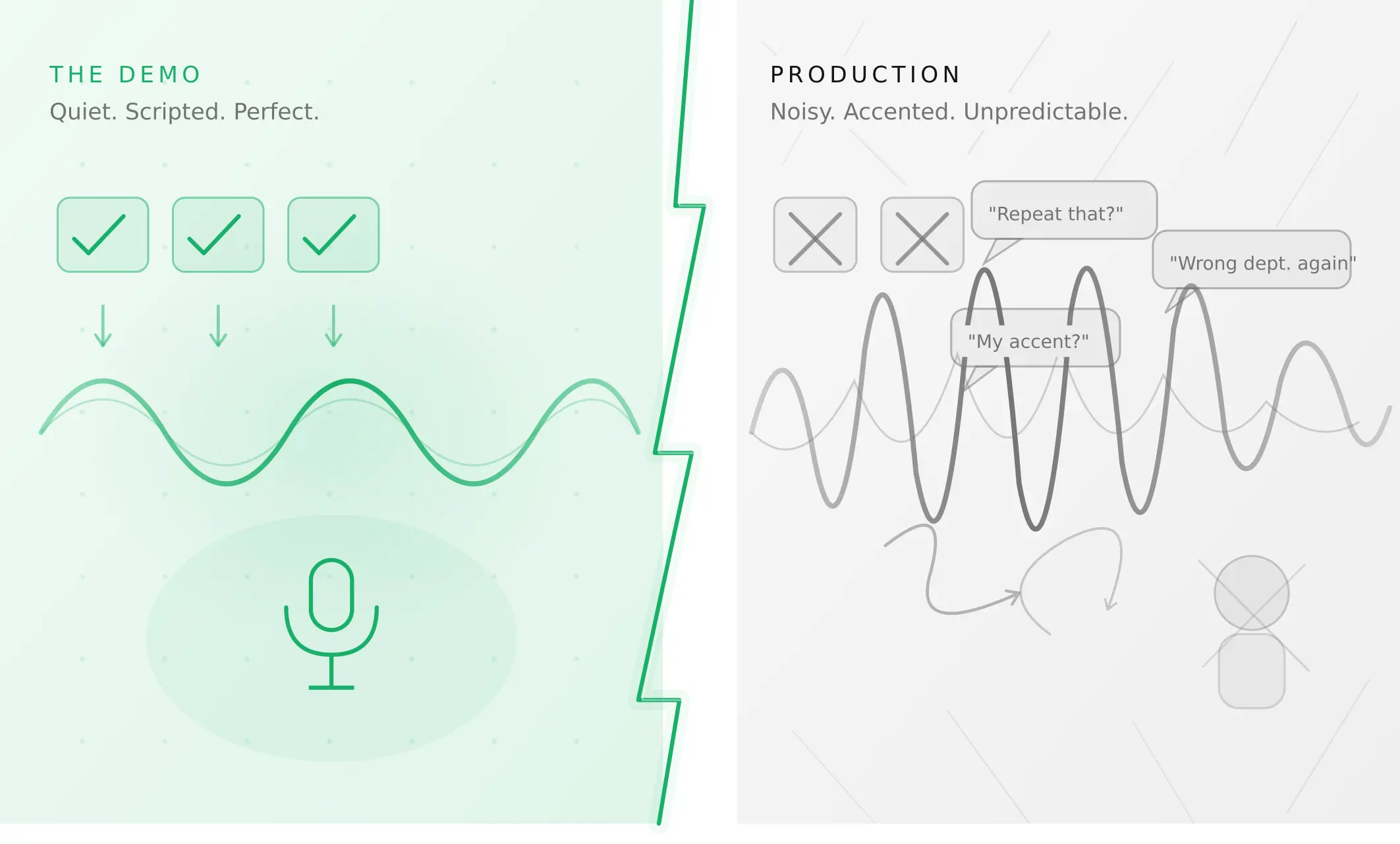
Endpointing is the setting vendors tune hardest for the demo. The demo call uses a clean line, a cooperative speaker, and short scripted turns. Under those conditions almost any approach looks fine. That tells you nothing about your traffic.
Your callers pause, ramble, and read numbers slowly. Your lines carry noise and lag. A setting that shines on a scripted demo can cut off half your real callers. This is why a feature grid or a demo cannot decide the choice for you.
The fix is an independent, owned evaluation. When the test suite belongs to you, no endpointing solution can tune to it in advance. You replay the same real calls through every candidate and score them the same way. This is the core of independent voice AI evaluation, and it is how careful teams run the whole vendor selection process. If endpointing latency is your concern, our guide to reducing STT latency in voice agents covers the recognition side of the same budget.
Choosing endpointing with Evalgent
The endpointing decision is only safe if you can measure every candidate on equal terms. Evalgent is the independent evaluator we use to do exactly that. It gives you a yardstick you own, held apart from any endpointing approach or platform. Scenarios capture your real calls as a fixed, versioned suite, including the slow talkers, the thinking pauses, and the number readbacks that break naive timers. Profiles vary caller accent, pace, and line quality, so every setting faces the same range of speech. Metrics score each run against pre-defined expected outcomes, so false cutoffs and wait time are counted the same way every time. Evaluations replay the identical suite against any endpointing configuration or version, so you can compare a fixed timer against a semantic model on the same calls. Reviews let your team hear the exact turn behind any score, which is the only way to confirm a cutoff was real. Because the suite is yours and runs against anyone, you can tune settings, compare approaches, or switch platforms and prove that turn-taking held. For the orchestration layer around all of this, see our guide to the best orchestration for voice agents in 2026. To put a neutral evaluation between you and every endpointing choice, book a demo.
Frequently asked questions
What is the best endpointing for voice agents in 2026?
The best endpointing for voice agents in 2026 is the approach that fits your callers and your use case. For natural, open-ended conversation, a hybrid that pairs VAD gating with semantic detection usually wins. For short, scripted flows, a well-tuned silence timer can be enough. Test the finalists on your own recorded calls before deciding.
What is endpointing in a voice agent?
Endpointing is the detection of when a caller has finished speaking so the agent can respond. It marks the boundary between one turn and the next. Get it too aggressive and the agent interrupts. Get it too cautious and callers wait in silence. It is one of the biggest drivers of how natural an agent feels.
What is the difference between VAD and endpointing?
VAD, or voice activity detection, only tells you whether speech is present in the audio right now. Endpointing uses that signal, and often the words themselves, to decide that a whole turn is complete. VAD is a low-level input. Endpointing is the higher-level decision built on top of it and other cues.
How do I stop my voice agent from cutting callers off?
Lengthen the minimum silence threshold and add a floor that prevents very early cuts. Use semantic endpointing so thinking pauses and filler words do not end the turn. Tune with recordings of slow talkers and number readbacks. Then measure your false cutoff rate on real calls and adjust until interruptions are rare.
How much silence should trigger end of turn?
There is no single correct value. Human turn-taking tolerates gaps of a few hundred milliseconds, so that is the zone to aim for. Shorter interrupts people; longer feels sluggish. The right number varies by scenario, so tune number capture, open questions, and confirmations separately and measure the result on your own traffic.
Is semantic endpointing better than a fixed timeout?
Semantic endpointing usually wins on natural, open-ended conversation because it reads meaning, not just silence. It handles pauses a timer cannot. The trade-off is higher cost and more tuning. For short, predictable, scripted answers, a well-set fixed timeout may perform just as well at lower complexity. Match the approach to the conversation.
How do I measure endpointing quality?
Track two numbers on real calls. First, the false cutoff rate, meaning how often the agent talks over a caller who was not finished. Second, post-speech wait time, meaning the gap between the caller stopping and the agent replying. Watch the wait-time distribution, not just the average, and listen to the audio to confirm cutoffs.
Should endpointing be tuned per use case?
Yes. A crisis or healthcare line should favor patience so it never interrupts. A quick order or lookup line can favor speed. Number capture needs different thresholds than open-ended questions. A single global setting rarely fits every flow, so segment your tuning by scenario and store the settings per call type.
The bottom line
Choose endpointing on how your real callers speak, and tune for the two failures that matter: cutting people off and making them wait. Measure false cutoffs and wait time on your own calls, because a demo default will not survive real traffic.
Ready to test endpointing on your real calls? Book a demo and see it on your own traffic.
Related Articles
Why AI voice agents fail in production (and how to prevent it)
AI voice agents that ace demos still break in production. Learn the 5 root causes, how to test for each, and what production readiness actually means.
Read more
Voice agent regression testing: why LLM updates break production
LLM updates improve benchmarks but break voice agents in 5 predictable ways. How to detect and prevent regressions after every model or prompt change.
Read more