Test your voice agent
How to Measure Interruption Rate for Voice Agents
# How to measure interruption rate for voice agents
Quick answer
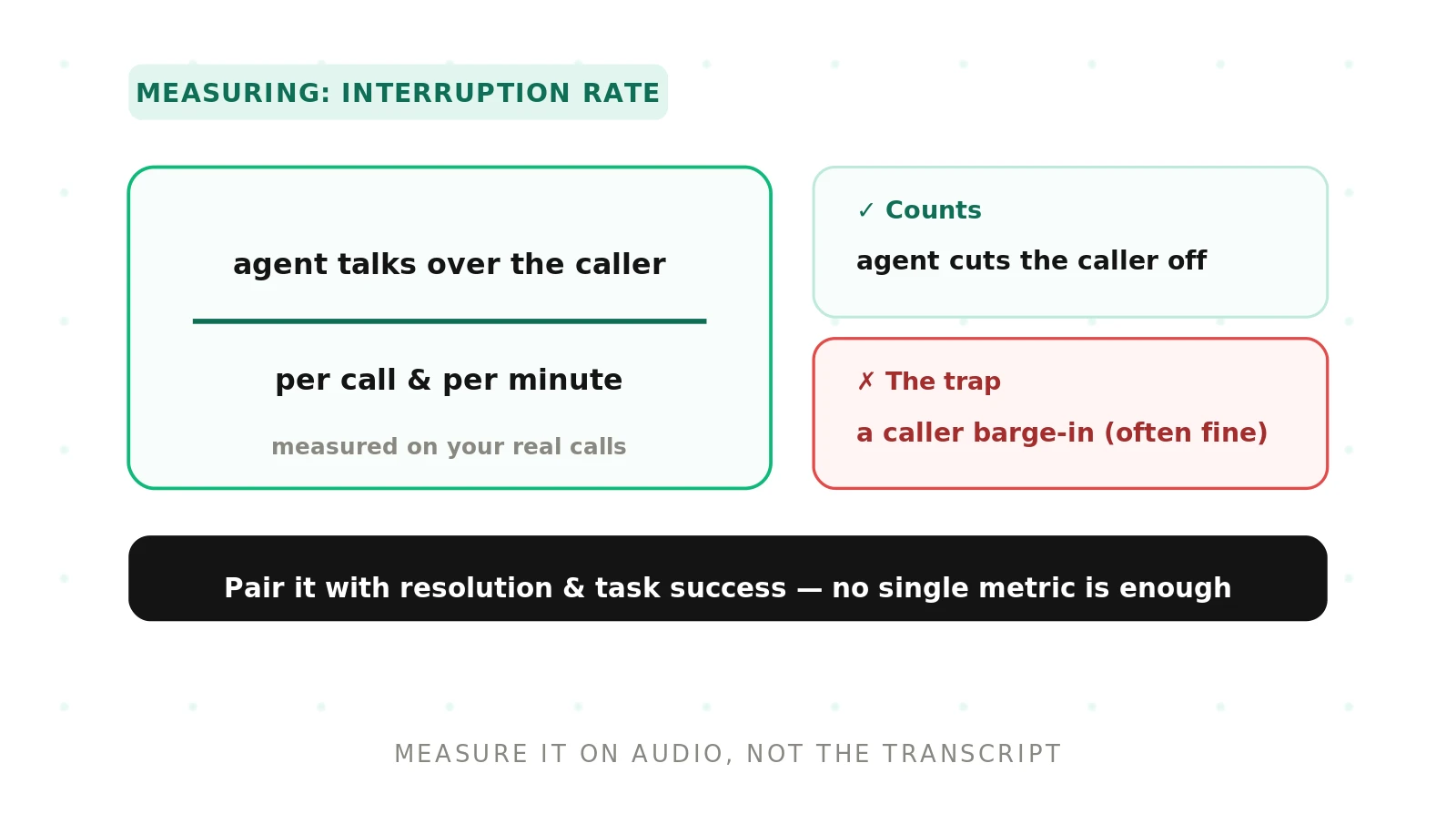
> Quick answer: Interruption rate for voice agents is how often the agent starts speaking while the caller is still talking, beyond a small allowed overlap. Measure it on the audio, not the transcript. Count agent-over-caller events separately from caller barge-in, report them per call and per minute, and record whether the agent yields.
An agent that talks over callers feels rude, even when its words are correct. The caller loses their train of thought. Trust drops on the first collision. Yet most dashboards never measure it, because the transcript hides it.
This post is a measurement how-to for one specific metric: interruption rate. It is not a definition of the behavior. Our barge-in versus turn-taking guide draws that distinction, and our barge-in guide explains the behavior in depth. For overall conversational timing, see our turn-taking evaluation post. Here we focus on one number and how to compute it honestly.
Evalgent is an independent evaluator. We measure interruption rate on your own call recordings, using rules you can defend to product and compliance at once.
What interruption rate actually measures
> Interruption rate: the frequency with which a voice agent begins speaking while the caller still holds the floor, past a small overlap tolerance. It is reported as a count per call and a rate per minute of speech.
Interruption rate answers a blunt question. How often does the agent cut the caller off? It sits inside the study of turn-taking, the system that governs who speaks when in a conversation. An interruption) happens when one party breaks in while another still holds the floor.
Not every overlap is an interruption. People talk over each other constantly without offense. A short "mm-hm" while the other speaks is support, not a cut-off. So the metric needs a clear rule for what counts.
The rule has three parts. The agent must start its turn. The caller must still be mid-utterance. And the overlap must exceed a small tolerance, so brief, harmless collisions do not inflate the count.
Why interruption rate lives in the audio, not the transcript
Most teams try to measure interruptions from the transcript. That approach fails. A transcript is a cleaned, ordered record of words. It throws away the exact timing that defines an interruption.
Transcripts serialize speech. Two people talking at once get flattened into two neat, sequential lines. The overlap that made it an interruption disappears in the formatting. You cannot recover it from text.
Timestamps in a transcript are often turn-level, not word-level. They mark when a turn was logged, not when each voice actually started and stopped. The real collision may be half a second wide. The transcript cannot see it.
> Why audio wins: interruptions are defined by overlapping speech in time. Only the audio carries the two timelines you need to compare. The transcript is a downstream summary that has already discarded them.
Audio keeps both timelines. You can mark exactly when the caller's speech starts and ends, and exactly when the agent's speech starts. Overlap becomes measurable to the millisecond. We cover this text-versus-sound split in our transcript versus audio evaluation post.
To build those timelines, you need two things. First, a way to detect when each party is speaking, using voice activity detection. Second, a way to attribute each speech segment to a speaker, using speaker diarization. Together they give you a labeled timeline per channel.
Stereo recordings make this far easier. When the caller and the agent sit on separate channels, attribution is nearly free. Mono recordings force you to diarize, which adds error. Ask your provider for two-channel audio before you start.
The four types of overlap, and which ones count
Overlapping speech is not one thing. Conversation analysis has long treated different overlaps as different acts. Some are rude. Some are normal and even helpful. Your metric has to tell them apart, or the number is meaningless.
The table below sorts the four common overlap types. It marks whether each is a problem, and how to measure it on the audio timeline.
| Overlap type | What happens | Is it bad? | How to measure it |
|---|---|---|---|
| Agent over caller | Agent starts a full turn while the caller is still mid-utterance | Yes — this is the rude interruption you are hunting | Flag agent-speech onsets that begin during caller speech and exceed the overlap tolerance |
| Caller barge-in | Caller starts speaking while the agent is talking | Usually fine — often a correction or a hurry | Flag caller onsets during agent speech; then check whether the agent yields |
| Backchannel | Short listener tokens like "uh-huh" or "right" during the other's turn | No — these signal attention, not a takeover | Exclude short, low-content overlaps below a duration threshold |
| Crosstalk | Both start at almost the same instant near a natural turn boundary | No — timing accident, not a takeover | Ignore near-simultaneous onsets inside a small boundary window |
The distinction that matters most is the first two rows. Agent-over-caller is the real defect. Caller barge-in is often the caller taking control, which a good agent should welcome. A backchannel) is neither.
Collapsing these into one "interruptions" number is the most common mistake. It punishes an agent for letting callers barge in, which is the opposite of what you want. Keep the categories separate from the start.
How to measure interruption rate for voice agents
Follow these steps in order. Each one narrows raw overlap down to a defensible count.
1. Collect stereo audio. Pull call recordings with the caller and agent on separate channels. If only mono exists, run diarization first and note the added error in your report.
2. Build two speech timelines. Run voice activity detection on each channel. Produce a list of speech segments with start and end times for the caller and for the agent.
3. Set an overlap tolerance. Choose a threshold, for example 300 milliseconds, below which an overlap does not count. This absorbs harmless collisions near turn boundaries. Label the value as illustrative until you tune it.
4. Find every overlap event. Compare the two timelines. Mark each region where caller speech and agent speech occur at the same time and exceed the tolerance.
5. Classify who started. For each overlap, check which party began speaking while the other already held the floor. Agent-first is an agent interruption. Caller-first is a barge-in.
6. Drop backchannels and crosstalk. Remove short, low-content overlaps and near-simultaneous onsets at natural boundaries. These are not takeovers and must not inflate the count.
7. Count agent interruptions. Total the agent-over-caller events that survived the filters. This is your core numerator.
8. Normalize to a rate. Divide by call count for interruptions per call, and by minutes of caller speech for interruptions per minute. Report both.
9. Check yielding on barge-in. For each caller barge-in, measure how fast the agent stopped talking. A prompt stop is good behavior; a refusal to yield is a separate defect.
10. Validate with human review. Have raters label a sample by ear. Compare their labels to the automated ones, and report agreement before you trust the pipeline.
Separating rude interrupts from acceptable barge-in
The direction of the overlap changes its meaning. When the agent barges in, it silences a paying customer. When the caller barges in, they are steering the call. Treat these as two different metrics with two different targets.
Agent-over-caller should trend toward zero. Every event is a caller who got cut off. This is the number to put in front of product owners, because it maps directly to a bad moment on the call.
Caller barge-in is not a failure by itself. A caller who interrupts to say "no, the other account" is being efficient. The question is not whether it happened. The question is what the agent did next.
That is why barge-in feeds a second measurement. Count how often callers barge in, then measure the yield. An agent that keeps talking through a barge-in has a worse problem than one that interrupted once.
Measuring whether the agent yields when interrupted
A good agent stops quickly when the caller starts speaking. This is the yield. It is the recovery half of the interruption story, and it deserves its own number.
Measure yield as the gap between the caller's barge-in onset and the moment the agent's audio stops. A short gap means the agent noticed and gave way. A long gap means the agent talked over the caller's attempt to take the floor.
Set a target you can defend, such as stopping within a few hundred milliseconds. Report the distribution, not just the average. A good median with a long tail still means some callers had to fight for the floor.
Yield failures often trace back to the same timing systems as interruptions. If the agent cannot detect caller speech quickly, it both interrupts more and yields slower. Measuring both together points at the root cause. Our turn-taking evaluation post covers the wider timing picture.
Turning raw counts into a trustworthy rate
A count on its own is hard to compare. A five-minute call and a one-minute call cannot share a raw total. Normalization fixes this, and it is where per-minute reporting earns its place.
Report two figures side by side. Interruptions per call shows the caller's felt experience across a whole interaction. Interruptions per minute of caller speech controls for length, so a chatty caller does not look worse than a terse one.
Treat the pipeline itself as a classifier. Every flagged interruption is a prediction that can be right or wrong. Borrow precision and recall to score it. Precision asks how many flagged events were real. Recall asks how many real events you caught.
You cannot trust those scores without a human baseline. Have raters label a shared sample, then measure agreement between them using a chance-corrected statistic such as Cohen's kappa. Low agreement means your definition is fuzzy, not that the agent is fine.
This is also where independence matters. A vendor grading its own interruption rate can pick a generous tolerance and a lax definition. An independent evaluator holds the definition fixed across every system, so the numbers compare. We explain the case for outside review in our independent voice AI evaluation post.
Common mistakes that corrupt the number
The first mistake is measuring on the transcript. It cannot see overlap, so it reports near-zero interruptions on an agent that talks over people constantly. Always start from audio.
The second is merging directions. Counting agent-over-caller and caller barge-in as one number rewards a passive agent and hides the rude one. Keep them apart.
The third is no tolerance. With a zero-millisecond threshold, every boundary collision and backchannel becomes an interruption. The rate balloons and stops meaning anything. Set and tune a tolerance.
The fourth is skipping validation. An automated count nobody checked by ear is a guess. Sample, label, and report agreement before anyone acts on the metric. Interruption rate belongs beside your other timing and quality numbers in a full voice agent metrics scorecard.
Frequently asked questions
What counts as an interruption in a voice agent call?
An interruption is when the agent starts a full turn while the caller still holds the floor, past a small overlap tolerance. Brief backchannels like "uh-huh" and near-simultaneous starts at natural turn boundaries do not count. The rule needs three parts: the agent starts, the caller is mid-utterance, and the overlap exceeds the threshold.
Why measure interruptions on audio instead of the transcript?
Interruptions are defined by overlapping speech in time. Transcripts serialize speech into neat sequential lines and discard the exact timing, so the overlap vanishes. Turn-level timestamps mark when a turn was logged, not when each voice started. Only the audio carries the two timelines you need to compare, down to the millisecond.
How do I calculate interruptions per minute for a voice agent?
Count the agent-over-caller events that survived your filters. Then divide by the minutes of caller speech in the call, not total call duration. Per-minute reporting controls for length, so a long call and a short call compare fairly. Report interruptions per call alongside it, since that reflects the caller's felt experience.
Is caller barge-in a problem I should count against the agent?
Caller barge-in is usually not a defect. A caller interrupting to correct or redirect the agent is being efficient, and a good agent should welcome it. Count barge-in separately from agent interruptions. The metric that matters is the yield: how quickly the agent stops talking once the caller takes the floor.
What overlap tolerance should I use for interruption rate?
A common illustrative starting point is around 300 milliseconds, below which overlaps do not count. This absorbs harmless collisions near turn boundaries and short backchannels. The right value depends on your audio quality and detection accuracy. Treat any figure as illustrative until you tune it against human-labeled recordings and check the effect on precision and recall.
How do I measure whether the agent yields when interrupted?
Measure the gap between the caller's barge-in onset and the moment the agent's audio actually stops. A short gap means the agent gave way; a long gap means it talked over the caller. Report the full distribution, not just the average, because a long tail means some callers had to fight for the floor.
Do I need stereo audio to measure interruption rate?
Stereo audio makes measurement far more reliable. With the caller and agent on separate channels, attributing each speech segment to a speaker is nearly free. Mono recordings force you to run diarization, which adds error to every overlap you detect. Ask your provider for two-channel recordings before you build the pipeline, and note the error if only mono exists.
How do I know my interruption pipeline is accurate?
Treat the pipeline as a classifier and validate it against human ears. Have raters label a shared sample of calls, then score the automated flags with precision and recall. Measure agreement between raters using a chance-corrected statistic like Cohen's kappa. Low agreement means your definition is fuzzy and needs tightening before anyone trusts the number.
The bottom line
Interruption rate is a timing metric, so measure it on audio and never the transcript. Count agent-over-caller separately from caller barge-in, normalize per minute, and always check whether the agent yields.
Getting this number right is hard to do on your own systems without bias. Book a demo and Evalgent will measure interruption rate on your real calls, with a fixed, defensible definition.
Related Articles
Why AI voice agents fail in production (and how to prevent it)
AI voice agents that ace demos still break in production. Learn the 5 root causes, how to test for each, and what production readiness actually means.
Read more
Voice agent regression testing: why LLM updates break production
LLM updates improve benchmarks but break voice agents in 5 predictable ways. How to detect and prevent regressions after every model or prompt change.
Read more