Test your voice agent
How to Test Multi-Agent Orchestration in Voice Agents
# How to test multi-agent orchestration in voice agents
Quick answer
To test multi-agent orchestration in voice agents, run real calls end to end and check five things: correct routing, context survives each handoff, no loops, one clear task owner, and total success across agents. Measure latency per hop. Score against expected outcomes you defined in advance, not vendor claims.
Many voice systems are no longer one agent. They are several agents that pass work to each other on a live call. A router or supervisor decides who should handle a request. Specialist agents take over for billing, scheduling, or returns. Work moves between them mid-conversation. This design is powerful. It is also where new failures hide.
A single-agent test suite will miss most of these failures. The agent can sound perfect in isolation. The seams between agents are what break. A request goes to the wrong specialist. Context drops on the way. Two agents pass the caller back and forth. The task ends with no owner. This guide shows you how to test those seams on your own calls.
We will define the pattern, name the failure modes, give you a table that maps each failure to a symptom and a test, and walk a full end-to-end procedure. The goal is a repeatable suite you own. It is the only way to prove a multi-agent voice system works before it faces real callers.
What multi-agent orchestration means in a voice system
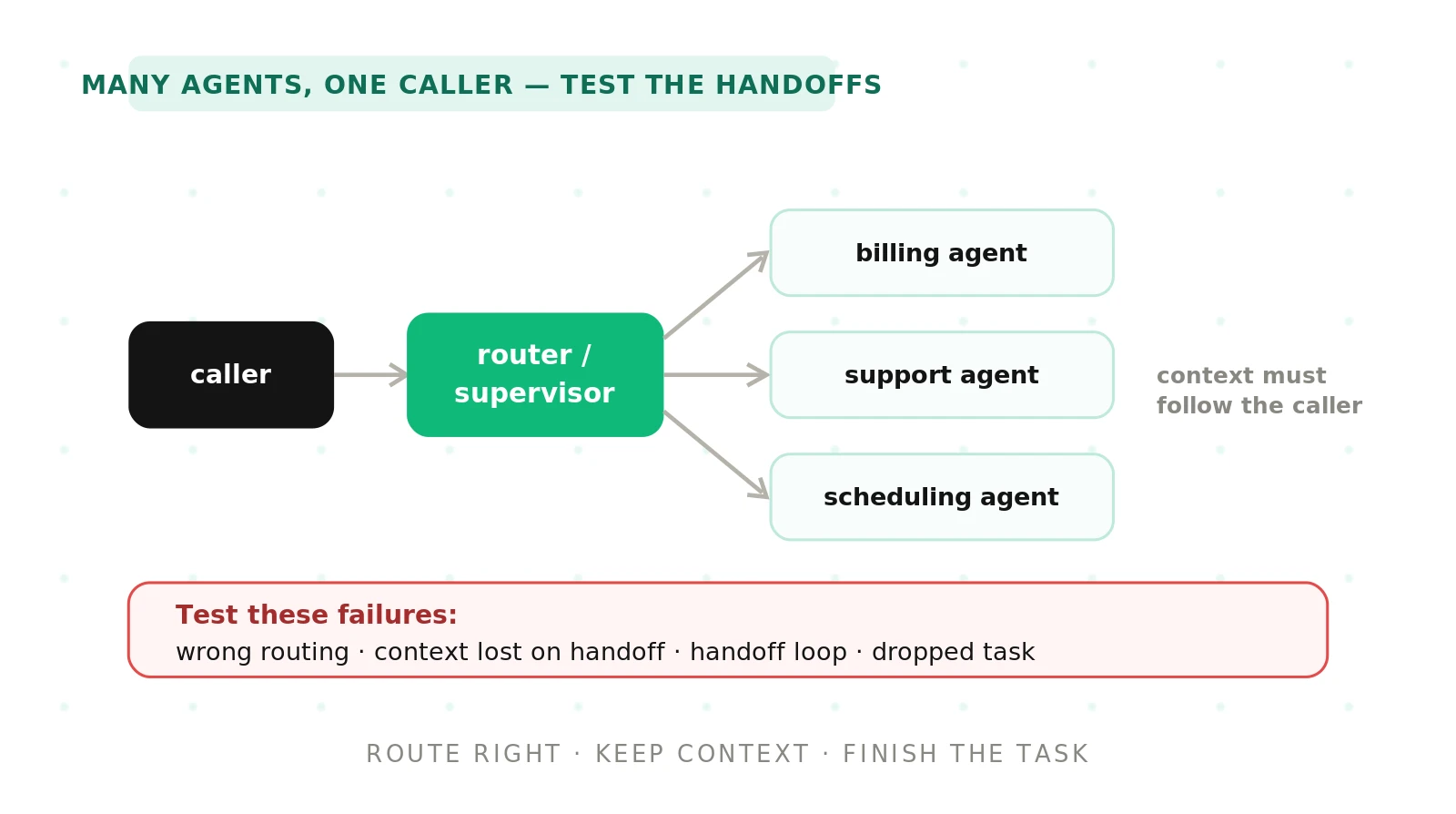
A multi-agent system is a set of agents that coordinate to reach a goal. In a voice product, that goal is handling one caller's request. Instead of one model doing everything, the work is split. Each agent owns a narrow job. A control layer decides who acts and when.
> Multi-agent orchestration: the runtime pattern where a router or supervisor agent routes a live call to specialist sub-agents, passes context on handoff, and tracks which agent owns the task until it is done.
The most common shape is a router plus specialists. The router reads intent and picks an agent. A billing agent, a scheduling agent, and a returns agent each handle their lane. Some systems add a supervisor that can interrupt or reclaim the call. This is a form of orchestration) applied to real-time speech.
Under the hood, routing often runs as a finite-state machine or a policy the supervisor evaluates each turn. The system is effectively a small distributed system. State lives in more than one place. Messages cross boundaries. That is why it fails in distributed ways, not just conversational ones.
This is different from two adjacent topics. It is not about picking an orchestration platform, which we cover in choosing a voice agent orchestration platform. It is also not human escalation, where the agent hands off to a person, covered in our guide to escalation in voice agents. Here the handoff is machine to machine, between AI agents.
Why multi-agent voice systems fail
Each extra agent adds a boundary. Each boundary is a place where something can drop. The failures below rarely show up in a scripted demo. They show up on messy, real calls with interruptions and mid-topic switches.
Wrong routing is the first. The router misreads intent and sends the caller to the wrong specialist. The caller asks about a refund and lands with the scheduling agent. Nothing crashes. The conversation just goes sideways.
Context loss on handoff is the second. The first agent gathered an account number and a reason for the call. The receiving agent never sees it. The caller has to repeat everything. Trust drops on the spot.
Handoff loops are the third. Agent A thinks the request belongs to agent B. Agent B sends it back to A. The caller is bounced in a circle with no resolution. This is the voice version of a routing loop in a distributed system.
Dropped tasks are the fourth. During a handoff, no agent takes final ownership. The call ends politely, but the refund was never filed. This overlaps with silent tool failures, which we cover in detecting silent tool failures in voice agents.
Latency from extra hops is the fifth. Every handoff adds a routing decision and a context transfer. Each one costs time. Three hops can turn a snappy agent into one that pauses awkwardly before every reply.
Multi-agent failure modes, symptoms, and how to test each
Use this table to build your suite. Each row is a failure mode, the symptom a caller or reviewer hears, and the test that catches it. Keep it as a checklist while you design scenarios.
| Failure mode | Symptom on the call | How to test it |
|---|---|---|
| Wrong routing | Caller reaches the wrong specialist agent | Feed tagged-intent scenarios; assert the agent that answered matches the expected agent |
| Context loss on handoff | Caller must repeat details already given | Plant facts before the handoff; assert the receiving agent uses them without asking again |
| Handoff loop | Caller bounced between two agents, no progress | Track handoff count per call; flag any call with repeated A-to-B-to-A transfers |
| Dropped task, no owner | Call ends but the action never happened | Cross-check the system of record after the call; assert the task exists and is correct |
| Latency from extra hops | Long pause after a topic switch | Measure time added at each handoff; assert total turn latency stays in budget |
| Duplicate work | Two agents perform the same action twice | Assert each tool action fires once; check the record for duplicate entries |
How to test a multi-agent voice system end to end
Treat this like integration testing for a distributed system. You are not testing one agent. You are testing the whole flow and every seam in it. Follow these steps in order.
1. Map the agent graph. List every agent, the router or supervisor, and each allowed handoff. Draw who can pass to whom. This map is your source of truth for what correct routing looks like.
2. Define expected ownership per scenario. For each test call, write down which agent should answer, which handoffs should happen, and which agent should own the final action. Decide the outcome before you run anything.
3. Build multi-intent scenarios. Real calls switch topics. Script calls that start with one intent and pivot to another. These force routing and handoffs, which is exactly what you want to stress.
4. Plant context before each handoff. Have the caller give an account number, a name, or a date early. Then trigger a handoff. Assert the receiving agent already knows those facts and does not ask again.
5. Assert on the routing decision, not just the words. Capture which agent answered each turn. Compare it to your expected owner. A friendly reply from the wrong agent is still a failure.
6. Count handoffs and detect loops. Log every transfer. Any call with more than the expected number of hops, or a repeated back-and-forth, is a loop to investigate.
7. Cross-check the system of record. After each call, query your backend. Confirm the task was created once, owned by the right agent, and correct. This catches dropped and duplicated tasks.
8. Measure latency per hop. Time each handoff separately from model and speech latency. Add the hops to your total budget. Flag any handoff that pushes a turn over your limit.
9. Vary caller conditions. Replay the same scenarios with different accents, pace, and line quality. Routing that works on a clean voice can misfire on a noisy one.
10. Rerun as a fixed regression suite. Freeze the scenarios and expected outcomes. Replay the whole suite on every change to any agent, prompt, or the router. Compare results across versions.
What to measure across agents
End-to-end task success is the metric that matters most. Did the caller's goal get met, across every agent involved? Score it against the expected outcome you wrote in step two. A call can pass every single-agent check and still fail this one.
Routing accuracy comes next. For each scenario, did the right agent answer at the right time? Report it as a rate across the suite. A drop here after a prompt change is an early warning that the router regressed.
Handoff success is its own metric. Count how often context survived the transfer intact. Then count loops and dropped tasks separately. These three numbers tell you whether the seams hold under load.
Latency needs a per-hop view. Report total turn latency, and break out the time each handoff adds. If you only watch the average, a slow router hides inside a healthy-looking number. Break it out so you can see the machinery.
For the full metric set and how to define expected outcomes, see our guide to tool calling in voice agents and our overview of voice agent evaluation. The core idea is constant: score against a definition you set in advance.
Where an independent evaluator fits
A multi-agent system is easy to fool with a demo and hard to prove in production. The seams are invisible until a real caller hits them. That is why the test suite should belong to you, not the vendor. When the suite is yours, no platform can tune to it in advance.
Evalgent is the independent evaluator we use for exactly this. It is third-party by design, held apart from any voice platform. Scenarios capture your real multi-intent calls as a fixed, versioned suite. Profiles vary caller accent, pace, and line quality, so routing faces the full range. Metrics score each run against the expected agent, the expected handoffs, and the expected final owner, on one fixed definition. Evaluations replay the identical suite against any version of your agent graph at concurrency. Reviews let your team hear the call behind any score.
Because the suite is yours and runs against anyone, you can compare architectures, add a new specialist agent, or change your router, and prove at every step that routing, handoffs, and task ownership still hold. This is the heart of independent voice AI evaluation, and it pairs with benchmarking voice agents on your own data. For the broader testing picture, start with AI voice agent testing and our testing versus evaluation guide. To put a neutral evaluation between you and your multi-agent design, book a demo.
Frequently asked questions
What is multi-agent orchestration in a voice agent?
Multi-agent orchestration is a design where several AI agents handle one call together. A router or supervisor agent decides which specialist agent takes each request. Context passes between agents on handoff. One agent owns the task until it is done. It splits work by lane instead of using a single agent for everything.
How do you test routing between agents in a voice system?
Test routing by running scenarios with a known intent and a known expected agent. Capture which agent actually answered each turn. Assert it matches the expected owner. Include multi-intent calls that switch topics mid-conversation, since those force routing decisions. Report routing accuracy as a rate across the whole suite, not per call.
What causes context loss when voice agents hand off a call?
Context loss happens when the receiving agent does not get the facts the first agent gathered. The account number, name, or reason for the call is not passed across the boundary. To test it, plant those facts before a handoff. Then assert the receiving agent uses them and never asks the caller to repeat.
How do you detect a handoff loop between voice agents?
Detect handoff loops by logging every transfer on a call. Count the hops. Compare that count to the number your scenario expects. Any call with repeated back-and-forth transfers between the same two agents is a loop. Flag it automatically. Loops usually mean two agents each believe the request belongs to the other one.
How much latency does each agent handoff add?
Each handoff adds a routing decision plus a context transfer, so the exact cost depends on your stack. Measure it directly rather than guessing. Time each hop separately from model and speech latency. Add every hop to your total turn budget. Report the per-hop numbers so a slow router does not hide inside a healthy-looking average.
How do you test end-to-end task success across multiple agents?
Test end-to-end success by defining the caller's goal and the expected final outcome before the call. Run the full scenario across every agent. After the call, cross-check the system of record. Confirm the task was completed once, owned by the right agent, and correct. Score it against your predefined outcome, not against how the transcript sounded.
What is the difference between multi-agent orchestration and human escalation?
Multi-agent orchestration is machine-to-machine: one AI agent hands the call to another AI agent. Human escalation hands the call to a person. Both are handoffs, but they test differently. Escalation checks the trigger and the transfer to a human, covered in our escalation guide. Orchestration checks routing, context, and task ownership between AI agents.
Can you test a multi-agent voice system without vendor access?
Yes. You can test a multi-agent voice system from the outside by placing real calls and scoring the results against expected outcomes. Assert on which agent answered, whether context survived, and whether the backend task was correct. An independent evaluator does this without internal access, which keeps the test neutral and prevents any platform from tuning to your suite.
The bottom line
A multi-agent voice system fails at the seams, not inside a single agent. Test routing, handoffs, loops, task ownership, and end-to-end success on your own calls, and rerun the suite on every change.
Ready to prove your multi-agent design holds up on real traffic? Book a demo and test it on your own calls.
Related Articles
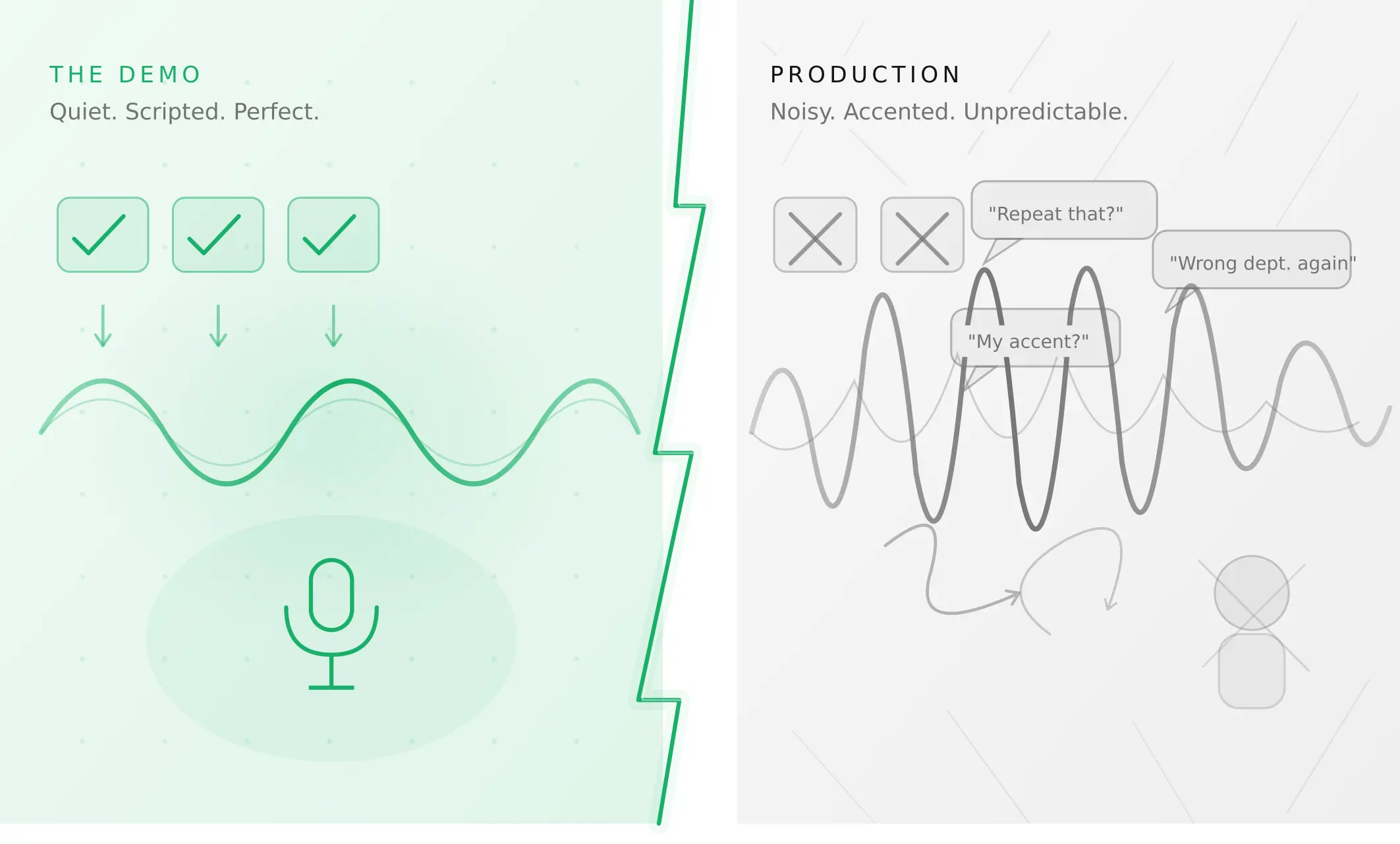
Why AI voice agents fail in production (and how to prevent it)
AI voice agents that ace demos still break in production. Learn the 5 root causes, how to test for each, and what production readiness actually means.
Read more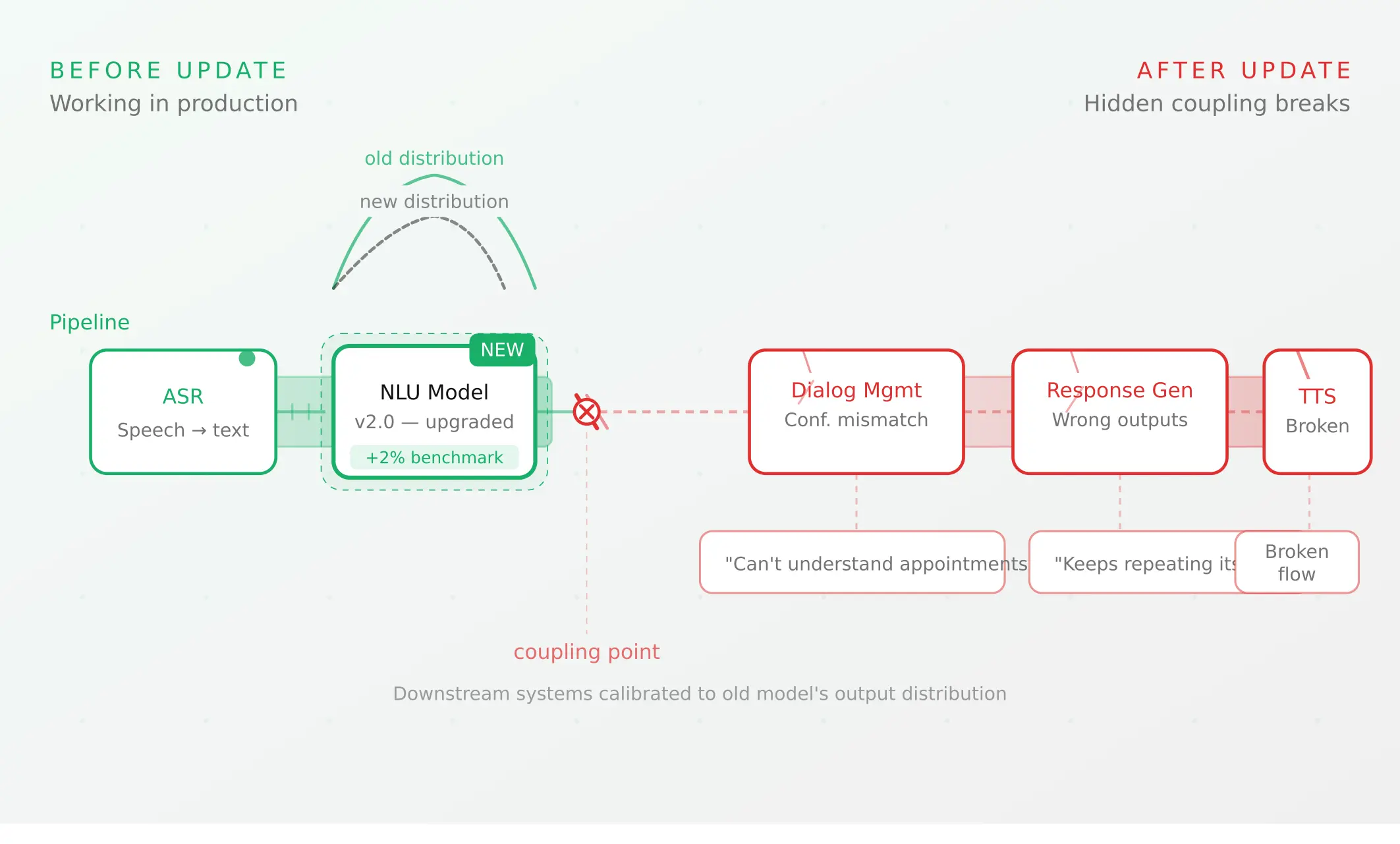
Voice agent regression testing: why LLM updates break production
LLM updates improve benchmarks but break voice agents in 5 predictable ways. How to detect and prevent regressions after every model or prompt change.
Read more