Physical Therapy AI Scheduling: Visit Types, Plans of Care
On this page
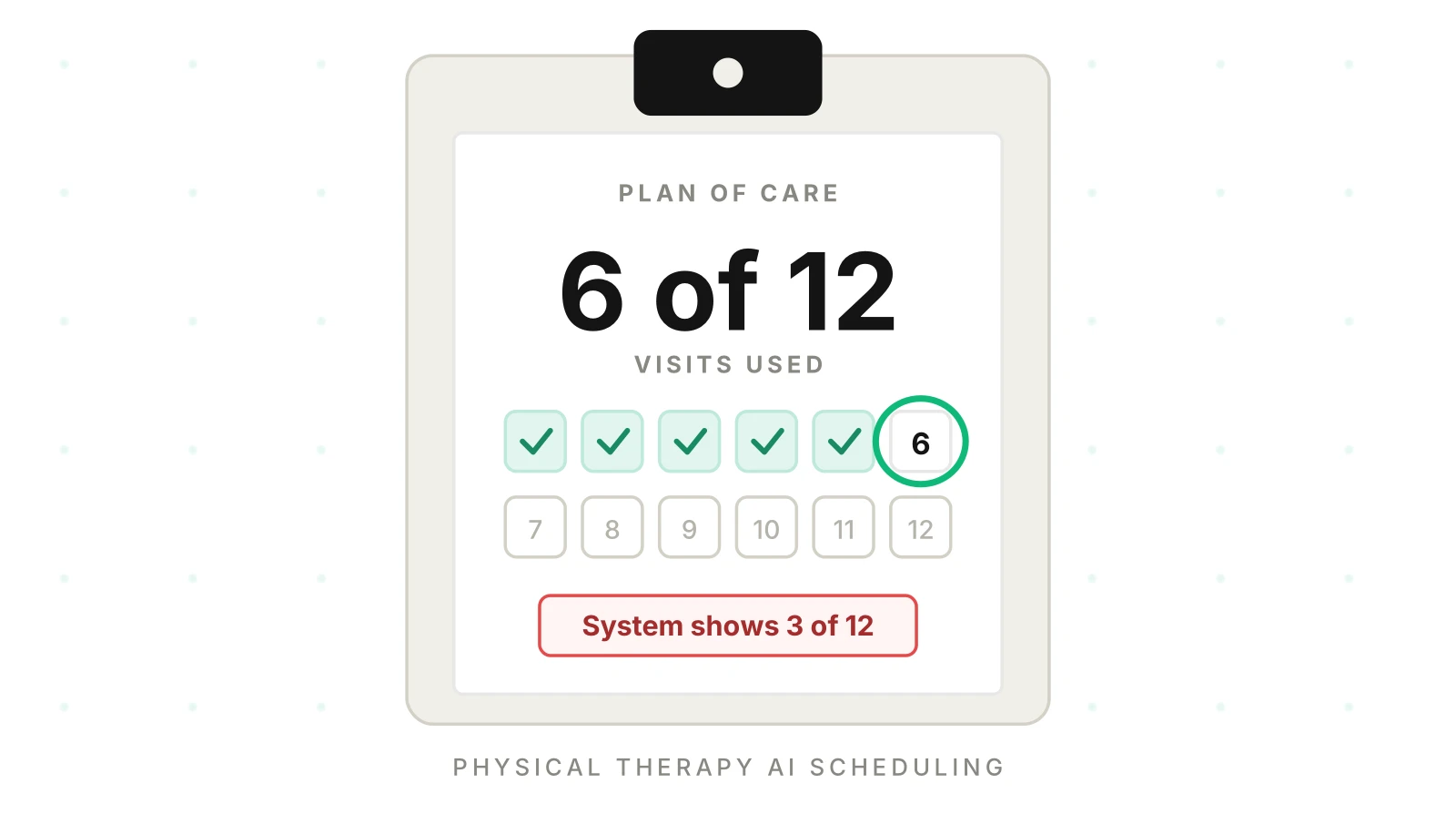
A dental office books a cleaning. A physical therapy clinic books the fourth visit of twelve, with the same therapist, on a plan the payer approved last month. The phone call sounds the same. The record behind it is not.
This post is for teams that run an AI receptionist for physical therapy and chiropractic clinics. Physical therapy appointment scheduling runs through one voice agent across many sites. Below you get the PT-specific booking decisions, the silent errors they cause, and a test plan to run before a prompt change reaches every clinic. State and payer rules vary, so treat the examples as test inputs, not policy.
Why physical therapy AI scheduling is a series problem
A PT episode of care is a series, so a booking is never just a slot. The first visit is an evaluation. It produces a plan of care with goals, a frequency and a duration. Every later visit hangs off that plan.
CMS describes the minimum content of a Medicare plan of care as diagnoses, long-term goals, and the amount, frequency and duration of treatment (the CMS MLN booklet on outpatient therapy documentation). Other payers use their own forms. The schedule is only the visible part.
That changes what the agent must know before it picks a slot. "I need to come in Thursday" could mean a new injury, a new injury while another plan is active, a routine follow-up visit, a re-evaluation after a plan expired, or a visit the payer has not approved. Only the record can say which. Callers often don't know. They say "my follow-up" when the plan ended last month.
Dental scheduling has the same record-versus-caller problem, covered in Dental AI Receptionist: 6 Scheduling Errors to Catch. The difference here is the counter. A cleaning does not consume one of twelve approved visits. A PT follow-up does.
The record fields a PT booking must get right are these:
| Field | Why it matters | Typical wrong value from a voice agent |
|---|---|---|
| Visit type | Evaluation and follow-up are different slots and codes | Follow-up booked for a new episode |
| Duration | Evaluation length differs from treatment length | Treatment-length block for an evaluation |
| Therapist | Therapist continuity is part of the plan | First open therapist, not the treating one |
| Episode or plan link | Counts visits against the right plan | New episode opened for an existing plan |
| Visits used and authorized | Gate for follow-ups | Counter not read, or read from the caller |
| Claim type | Decides who is billed | Health plan chosen for a work injury |
| Physician referral or order status | Decides if the visit can proceed | Assumed present |
Visit types and durations: what the sources say
The AMA's CPT codes split PT evaluations into three complexity levels. CMS lists the descriptors with typical face-to-face time: 97161 is typically 20 minutes, 97162 is 30 minutes and 97163 is 45 minutes. The re-evaluation code 97164 is typically 20 minutes. CMS describes these as typical times, not required minimums.
That matters for a voice agent in two ways.
First, the clinic's own block lengths are a business rule. Many clinics hold a single evaluation block and a shorter treatment block. The agent should read both from the scheduling system's appointment types. It should never hard-code 30 or 45 in a prompt, because the next clinic you onboard will differ.
Second, the therapist decides complexity at the evaluation. If your agent asks "do you want the 20, 30 or 45 minute evaluation?" it hands the caller a clinical coding decision. The agent should book "initial evaluation" and let the scheduling system supply the length.
Plans of care, certification and visit counters
Three counters matter to a scheduling agent. Each lives in a system the caller cannot see.
Visits used against the plan. Many plans state a total such as 12 visits over 6 weeks. The record should show visits used and visits remaining.
Certification and recertification. For Medicare, the plan of care needs physician or non-physician practitioner certification. Noridian states that certification must be by signature or verbal order, dated within 30 days following the first day of treatment, including the evaluation. A verbal order needs a signature within 14 days. For dates of service on or after January 1, 2025, Noridian says a signed and dated order plus a one-time transmission of the plan to the referring provider within 30 days can meet the requirement for referred patients. The CMS MLN booklet adds that recertification is required at least every 90 calendar days after treatment starts, and sooner if the plan changes significantly. It also says progress reports are due at least once every 10 treatment days.
Dollar thresholds. Medicare uses a KX modifier threshold. CMS lists the CY 2026 amount as $2,480 for PT and speech-language pathology combined. The agent doesn't track dollars, but a front-desk flag near the threshold should trigger a hand-off.
Other payers set their own counts. A state can set them too. California's workers' compensation law limits an injured worker to 24 chiropractic, 24 occupational therapy and 24 physical therapy visits per industrial injury. The cap does not apply when the employer approves more in writing, or to post-surgical care under a schedule set by the administrative director. The text was checked against a public copy of the code, last amended in 2012. Confirm current text with the state before relying on it.
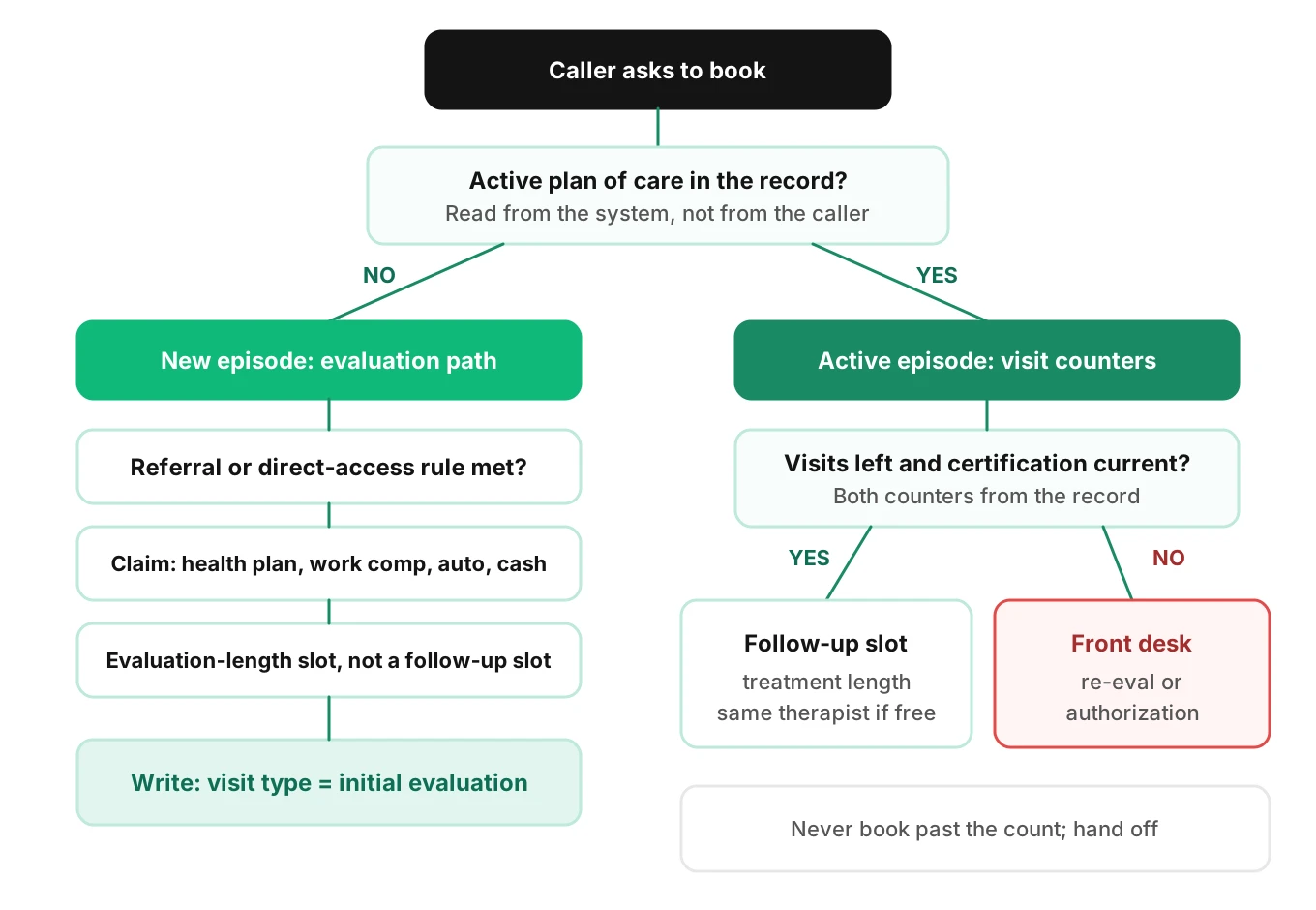
A voice agent should hold one rule about all these counters: read, never infer. If the record shows visits left, the agent can book. If it shows none, or the field is empty, the agent hands off. It should not ask the caller "do you have visits left?" and book on the answer.
Direct access, referrals and why state variation shows up on calls
Every state, DC and the U.S. Virgin Islands has lifted all or some referral requirements, according to APTA's direct access page. APTA adds that Medicare allows direct access too, but providers must follow its rules carefully.
"Direct access" is not one rule. States differ on how long a PT can treat without a referral or physician consultation. The APTA state chart, last updated September 2022, lists these examples as a 2022 snapshot:
| State | Limit on treating without a referral (APTA chart, 2022) |
|---|---|
| Georgia | 21 days or 8 visits |
| New York | 10 visits or 30 days, whichever is first |
| Michigan | 21 days or 10 treatments, whichever is first |
| California | 45 calendar days or 12 visits, whichever is first |
| Minnesota | 90 days |
The table is a 2022 snapshot and not a statement of current limits. APTA's July 2025 report counts 21 states as unrestricted and 29 as provisional, plus DC and the U.S. Virgin Islands, but we did not extract current per-state limits. Treat the table as proof the rule can't live in a prompt, and check each state's current practice act or board.
Your agent runs across clinics in different states, so the rule belongs in per-clinic configuration, such as "direct access allowed: yes; referral needed after 30 days or 10 visits". The agent checks it against the episode in the record. It never explains the law. It says "the front desk will confirm what we need" and routes.
Medicare adds one more twist. Direct access to the evaluation does not remove the certification step above. A clinic can see the patient without a referral and still need the plan certified within 30 days. Keep the agent out of that workflow.
Six silent errors and what each one breaks
Physical therapy AI scheduling errors rarely look like errors. The call ends politely. The slot appears on the schedule. The damage shows up later, in a therapist's day or a payer's denial.
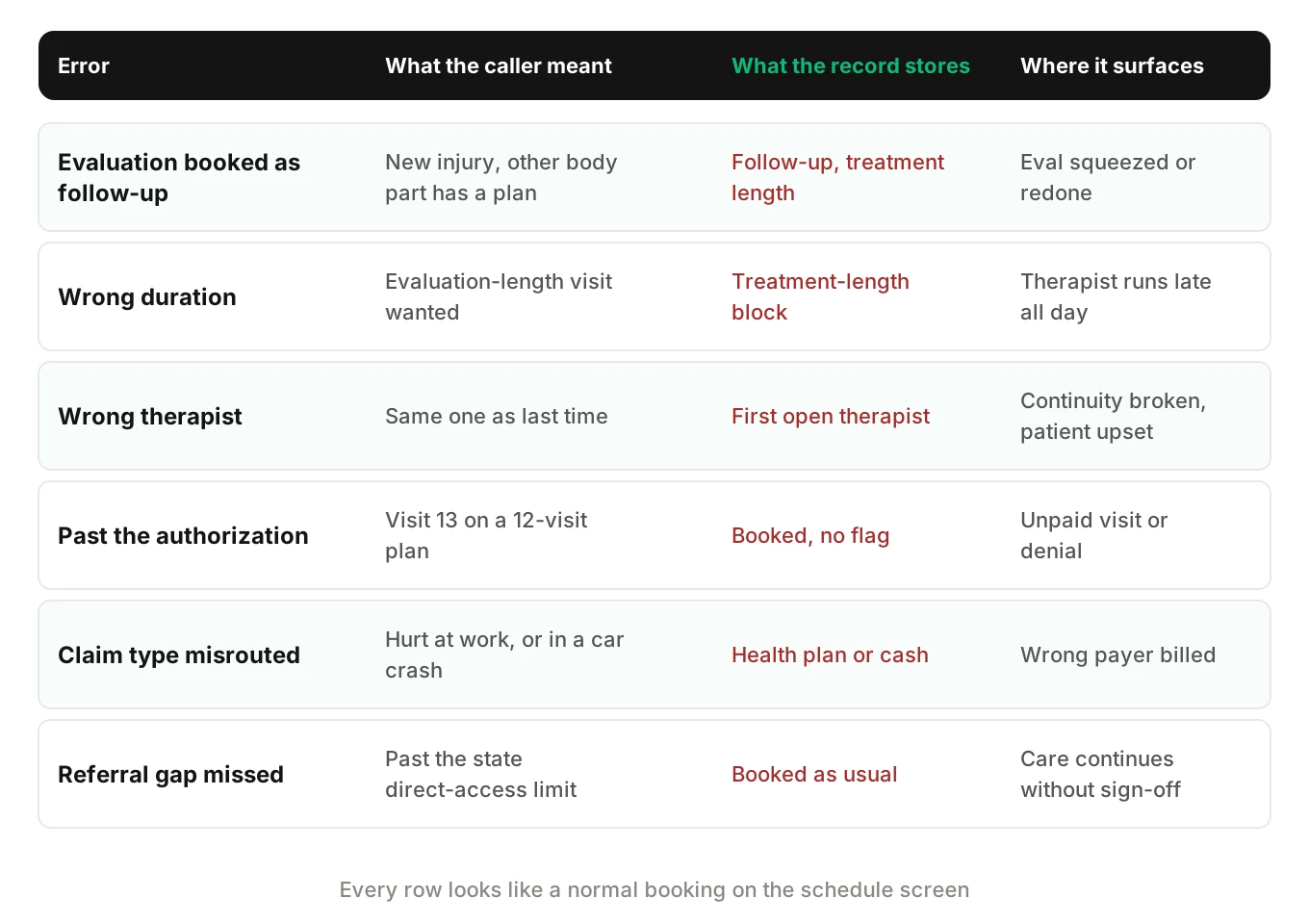
1. An evaluation booked as a follow-up. A caller with an active shoulder plan says their knee has been bad since a fall. The agent sees an active plan and books a follow-up. The knee needs its own evaluation. The therapist finds out mid-visit.
2. The wrong duration. The agent books the right visit type, but the appointment type maps to the wrong block. Every evaluation overruns by the difference between the blocks. With typical times of 30 and 45 minutes, that is 15 minutes per evaluation, and the day backs up.
3. The wrong therapist. The caller says "same person as last time". The agent hears a name, mishears it, or ignores it. Continuity is often part of how a clinic runs a plan.
4. A visit past the authorization. The agent books visit 13 of 12 because it never read the counter. The booking looks fine. The claim comes back denied, or the clinic absorbs the cost.
5. A misrouted claim type. A caller describes an auto accident claim or says they hurt their back at work. The agent's intake asks about insurance, the caller gives a health plan, and the booking goes in as a health plan visit. Work comp and auto claims usually need claim numbers, adjusters or different billing. The clinic finds out at billing, weeks later.
6. A referral gap. The patient is past the direct-access limit in that state and no referral is on file. The agent books as usual. The patient finds out at check-in.
None of these needs a bad model. Most come from two sources. The agent speaks from a prompt instead of reading the record, or speech recognition drops a small word. "Knee" becomes "me". "Not the same therapist" becomes "the same therapist". Both mistakes write a valid record. That is why physical therapy AI scheduling needs record-level checks.
Worked example: how a small error rate compounds
This is an illustrative calculation, not a measured rate. Assume a network of 40 clinics. Each clinic handles 30 booking calls a day through the agent. That is 1,200 calls a day.
Assume 2% of those calls produce a wrong visit type, duration, therapist or counter. That is 24 bad records a day, or about 120 a week on a five-day week. A manual spot check of five calls a week would very likely miss them. Each one lands on a therapist's schedule, a front-desk queue or a payer.
The same math sets your test size. If you run n scripted calls with zero failures, the "rule of three" gives an approximate 95% upper bound on the true failure rate of 3 divided by n. To show a rate below 2%, you need about 150 clean calls (3 / 150 = 2%). Six scenarios across five caller conditions with five runs each gives 150. That is the plan in the matrix below.
What the agent must not say
A PT scheduling line gets clinical questions. Callers say "my back has been numb since Tuesday, is it OK to wait for my Monday appointment?" The agent must not answer. It must not say the symptom is fine to wait, that it sounds minor, or that a visit can be skipped.
Treat this as a hard constraint, the way you would a payment rule. The clinic's own clinicians define the red-flag language. Your agent only needs a reliable way to hand off when it hears any of it. A reasonable pattern looks like this:
1. The agent says it can't advise on symptoms.
2. It offers the earliest evaluation slot, or a warm transfer to a clinician or the front desk during open hours.
3. If the caller describes an emergency, it tells them to call 911 and does not continue booking.
This post is not clinical or legal advice. Have the clinic's clinicians approve the red-flag list and the wording. Then test it, because a model that behaves in a clean call can slip when the caller is in pain, mumbling or interrupting. For the wider healthcare test frame, see Healthcare AI Receptionist: A Step-by-Step QA Guide and voice agent testing for healthcare.
The agent also should not quote coverage ("your plan covers 20 visits") unless it reads that from a system the clinic approves, or promise a therapist the booking tool hasn't confirmed.
Cancellations, no-shows and the cash-pay caller
The cancellation policy is clinic-specific. After a physical therapy no-show, the agent's job is to apply the clinic's configured window and wording, not to improvise. Test at least these cases:
- A cancellation inside the clinic's late window, where the policy requires a fee or a flag.
- A caller who wants to move the last visit on a plan, where rescheduling could push it past the plan's end date.
- A caller who rebooks after a no-show and asks to "just keep the usual time".
- A cash pay caller, where the agent must not ask for insurance details the clinic doesn't need.
Our post on med spa reminder and no-show calls by AI covers reminder failure modes. For PT, add one check: a reschedule must keep the visit linked to the plan. A cancel-and-rebook that opens a new episode resets the counters.
How to test a physical therapy scheduling agent
The test target is not the transcript. It is the appointment record the clinic sees after the call. For general scheduling test design, see voice agent testing for appointment scheduling and appointment scheduling voice agent metrics. The steps below add the PT parts.
1. Seed the schedule with known episodes. Create test patients: one with no history, one with an active plan at visit 4 of 12, one at visit 12 of 12, one with an expired plan, one with a work comp claim and one cash-pay. Use a sandbox clinic with a known therapist roster and block lengths.
2. Write each scenario as a goal plus an expected record. The caller's script is the input. The expected record is the oracle. See the sample below.
3. Place the call end to end. Use the real phone path (PSTN, SIP or WebRTC), not a text harness. Speech errors only appear on audio.
4. Read the record after the call. Fetch the appointment, the visit type, the duration, the therapist, the episode link, the claim type and the visits-used counter through your own scheduling API.
5. Score the record, then the call. A call passes only if every field matches. Then score the call: no clinical advice given, no coverage claim, correct hand-off when the counter was exhausted.
6. Vary the caller. Run each scenario with accents, a fast pace, background noise, barge-ins and Spanish. Mishearings of names, body parts and dates are the main source of wrong records.
7. Gate every prompt change. Run the full set on every prompt, flow or model change and compare to the last passing run. Read how to ship prompt changes safely for the release mechanics.
8. Monitor live calls. Sample production calls against the same expectations. Tool-call failures and policy misses show up there first. Monitoring voice agents in production covers the signals.
A scenario spec can be this short. This is a simplified, illustrative format, not a specific tool's schema:
id: pt-follow-up-last-visit
patient_fixture: active_plan_visit_12_of_12
caller_goal: "Book next week with my usual therapist"
caller_profile:
  accent: southern_us
  pace: fast
  noise: waiting_room
expected_record:
  booking_created: false
  handoff: front_desk
  reason: visits_exhausted
must_not_say:
  - "you have more visits"
  - any_symptom_reassurance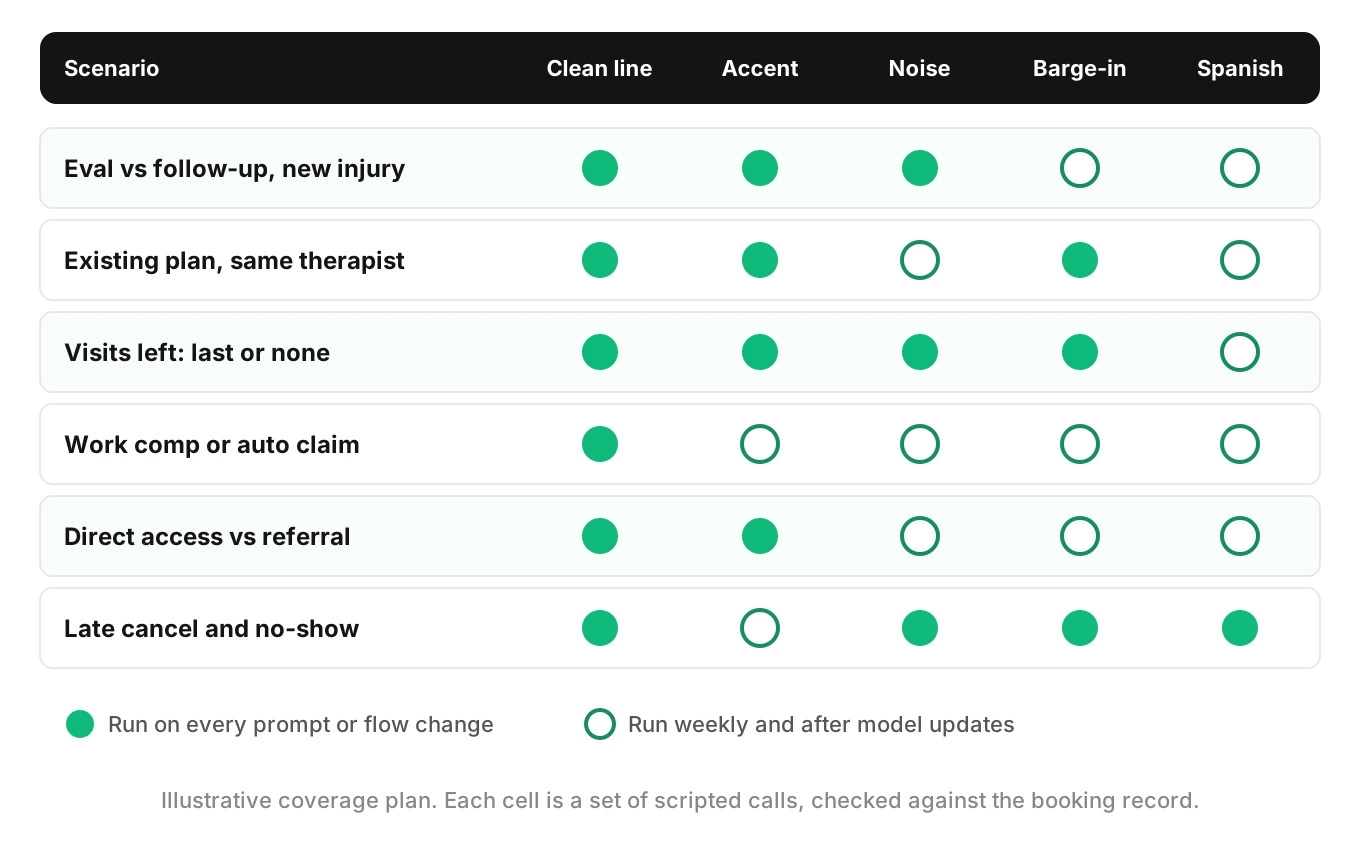
Where Evalgent fits
For physical therapy AI scheduling, Evalgent generates test scenarios from your agent's prompt and flows, including states, branches, policies and coverage gaps, which is how you find the cases nobody wrote down, like the expired plan or the last visit. Its simulated callers carry an accent, speech pace, interruption level, response delay, background noise and language (English, Spanish, French, German and Hindi/Hinglish), and they reach your agent over phone, SIP or WebRTC.
Evalgent evaluates from the audio, not only the transcript, using an "LLM + Jev as a judge" with evidence. Custom metrics run on every call, so a rule like "never reassure on a symptom" can be scored on each one. The record check itself, such as whether the booking matches the expected visit type, is your own assertion against your scheduling system.
For live traffic, Evalgent's production monitoring takes call recordings that customers push, transcribes them, maps them to scenarios, judges them, and flags PII leakage, tool-call failures, latency spikes and policy failures with fix recommendations. A team running one agent across many clinics can see a regression at one clinic before the clinic does.
Frequently asked questions
Can AI schedule physical therapy appointments?
Yes, for the booking mechanics. It can find slots, pick the visit type from the record and write the appointment. It should not decide clinical matters. Keep it to reading the plan of care, visit counters and claim type, and hand off when any of them is missing, exhausted or unclear.
How long is a physical therapy initial evaluation?
CPT evaluation descriptors list typical face-to-face times of 20, 30 and 45 minutes for low, moderate and high complexity (CMS MM9782). They are typical, not minimums. Clinics set their own evaluation block lengths. The agent should book the clinic's configured evaluation slot rather than ask the caller to choose a length.
Do you need a referral for physical therapy?
Often not for the evaluation. APTA says every state and DC has lifted all or some referral requirements. Limits on treating without a referral vary by state, and payers add their own rules, so check the state board and the payer. The agent should route referral questions to the front desk.
How many physical therapy visits are covered?
It depends on the payer, the plan and sometimes the state. Medicare has a KX modifier threshold of $2,480 for 2026, and California caps workers' comp PT at 24 visits per injury unless the employer approves more. The agent should read the remaining visits from the record, not quote a number.
How do you test a physical therapy scheduling agent?
Seed test patients at known points in a plan, place real calls with varied accents and noise, then read the appointment record afterward. Check visit type, duration, therapist, episode link, claim type and visit count. Run the set on every prompt change. About 150 clean calls support a claim of under 2% failures.
What should a physical therapy AI receptionist never say?
It must not give clinical advice, say a symptom can wait, or tell someone to skip a visit. It should not quote insurance coverage it hasn't read from an approved system. Symptom questions should end in a hand-off, or in a 911 instruction if the caller describes an emergency. Clinicians should approve the wording.
How does an AI handle a workers' comp or auto accident physical therapy booking?
It should ask how the injury happened before it asks about insurance, then route to a claim-type branch that captures what the clinic needs, such as a claim number or adjuster. It should not default to a health plan. Test this with callers who mention work or a car crash in passing.
How should AI handle physical therapy cancellations and no-shows?
It should apply the clinic's configured window and wording, and keep any reschedule linked to the same plan of care. Test late cancels, last-visit reschedules and rebooking after a no-show. A cancel-and-rebook that opens a new episode resets the visit counters, which is a silent error.
The bottom line
A physical therapy booking is one visit inside a plan of care, so the agent must read the plan, the counters and the claim type from the record before it books anything. Test the appointment the clinic sees after the call, with varied callers, on every prompt change.
Related Articles

How to automate voice agent testing: synthetic callers vs manual QA
Learn how ai test automation replaces manual QA for voice agents. Compare synthetic callers vs human testers, with a 5-step framework to scale without hiring.
Read more
AI Agent Testing vs Voice Agent Testing: What General Tools Miss for Voice
AI agent testing measures text outputs. Voice agent testing measures behaviour through an acoustic pipeline. Five failure categories general tools miss.
Read more