OpenAI TTS Shutdown: A Dated Migration Plan and Swap Test for Voice Agents
On this page
The OpenAI TTS shutdown is a dated deadline, not a trend piece. If your voice agent calls /v1/audio/speech with tts-1, tts-1-hd or gpt-4o-mini-tts, those calls stop on January 6, 2027. The replacement OpenAI names is not a drop-in swap. It is a different API with a different architecture, so the OpenAI TTS shutdown is a test project, not a find-and-replace.
This post is the migration plan. It quotes what OpenAI's pages say, counts the days left, lays out three paths, and gives a swap test you can run before the deadline. It does not rank TTS vendors. For that, read our TTS provider comparison and Cartesia alternatives. For the general swap discipline, see how to swap voice agent providers.
What OpenAI's pages say about the OpenAI TTS shutdown, as of November 18, 2026
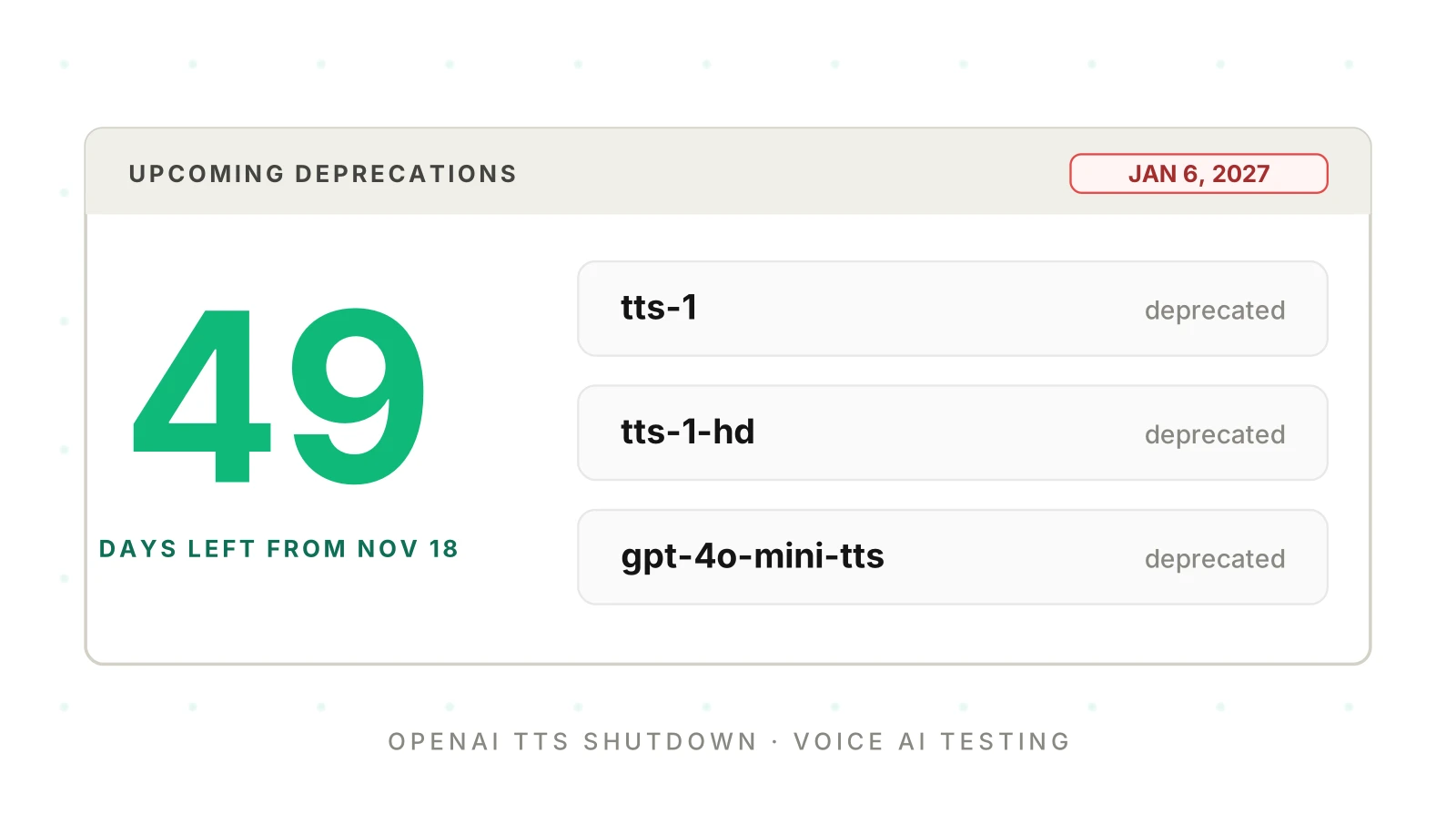
We read two OpenAI pages on November 18, 2026. The deprecations page lists the three models under "Upcoming deprecations." Each row shows status "Deprecated," shutdown date "Jan 6, 2027," notice date "Oct 1, 2026" and replacement gpt-realtime-2.1-mini.
| Affected model | Shutdown date | Notice date | Listed replacement |
|---|---|---|---|
tts-1 | Jan 6, 2027 | Oct 1, 2026 | gpt-realtime-2.1-mini |
tts-1-hd | Jan 6, 2027 | Oct 1, 2026 | gpt-realtime-2.1-mini |
gpt-4o-mini-tts, gpt-4o-mini-tts-2025-03-20, gpt-4o-mini-tts-2025-12-15 | Jan 6, 2027 | Oct 1, 2026 | gpt-realtime-2.1-mini |
The page adds two general notes. One says: "Fine-tuned versions of the models listed above follow the same shutdown schedule as their underlying base models." The other says: "For speech migrations, see the Realtime API guide and the transcription guide." It lists no tts-1 snapshots beyond the base names.
The text-to-speech guide is more specific. It says the tts-1, tts-1-hd and gpt-4o-mini-tts models "are deprecated and will shut down on January 6, 2027." It says to "Migrate to gpt-realtime-2.1-mini using the Realtime API." Then it adds: "This is a change of API workflow: gpt-realtime-2.1-mini isn't a supported model for /v1/audio/speech." It also says existing integrations can keep using the Speech API workflows until the shutdown date.
Read that carefully. Every tts-1 deprecation search result will tell you to "just move to the new model." The guide says the new model does not run on the old endpoint. That one sentence turns a model-string change into an architecture decision.
What we did not find
We found no second replacement for these three models. The deprecations page names only gpt-realtime-2.1-mini. We found no text-only speech endpoint that replaces /v1/audio/speech. If OpenAI adds one, its pages will say so. Check both pages again before you commit, because deprecation tables get edited.
What 49 days means for the OpenAI TTS shutdown
The count is simple arithmetic. From November 18, 2026 to January 6, 2027 is 12 days left in November, 31 in December and 6 in January: 49 days. The notice window was 97 days, from October 1.
That is the calendar. The working calendar is shorter. Many teams slow down changes in late December. A voice agent that changes on a holiday week has fewer people watching it. So treat the real deadline as mid-December, and plan backwards.
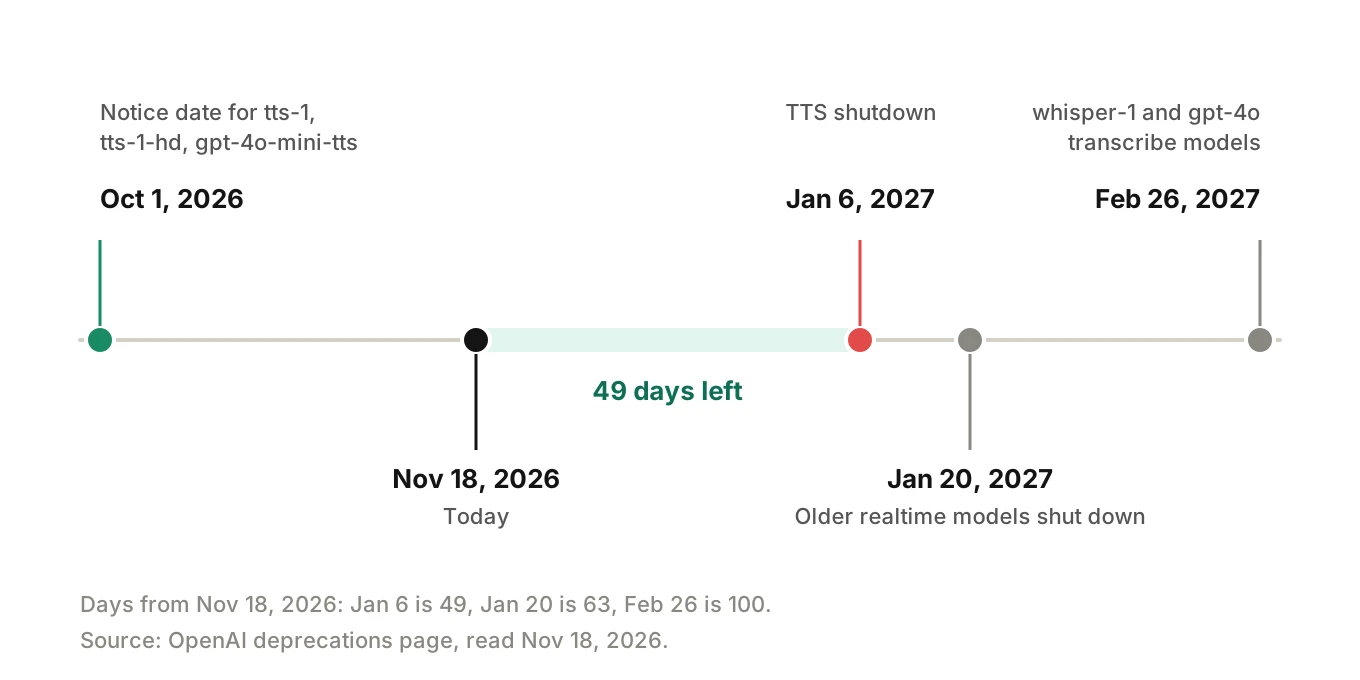
Two other dates sit close behind. The same deprecations page lists January 20, 2027 for gpt-realtime, gpt-realtime-mini and gpt-4o-realtime, which move to gpt-realtime-2.1 or gpt-realtime-2.1-mini. It lists February 26, 2027 for whisper-1, gpt-4o-transcribe and gpt-4o-mini-transcribe, which move to gpt-live-transcribe or gpt-transcribe. From November 18, those are 63 and 100 days away.
This matters for cascaded agents. If your pipeline uses OpenAI for speech recognition and TTS, you may face two migrations, not one. Inventory every OpenAI audio model string, not only the TTS one.
Is your agent affected? Inventory first
Before choosing anything, find every place the OpenAI TTS shutdown touches your stack. Do it in one afternoon.
- Code and config. Search for
tts-1,tts-1-hd,gpt-4o-mini-ttsandaudio/speech. Include environment variables, prompts-as-config and old branches. - Frameworks and no-code layers. A voice framework or platform may call OpenAI TTS for you. Check each provider setting. Ask the vendor which model string it sends and whether it has a migration date.
- Voice names. Note which voices you use. The guide lists 13 built-in voices. It lists a smaller set for
tts-1andtts-1-hd: alloy, ash, coral, echo, fable, onyx, nova, sage and shimmer. - Fine-tunes. The deprecations note says fine-tuned versions follow the base model's schedule.
- Other OpenAI audio models. Note any
gpt-realtime,gpt-realtime-minior transcription models in the same pipeline. - Fallbacks. A secondary voice that is also OpenAI TTS is not a fallback after January 6.
One gotcha is easy to miss. Your agent may use OpenAI TTS only on a rare path, such as an error message or a hold prompt. The deadline hits that path too. Rare paths are the ones nobody tests.
Three ways to replace OpenAI TTS in a voice agent
Teams that must replace OpenAI TTS voice agent traffic have three realistic paths. Each changes what you must re-test.
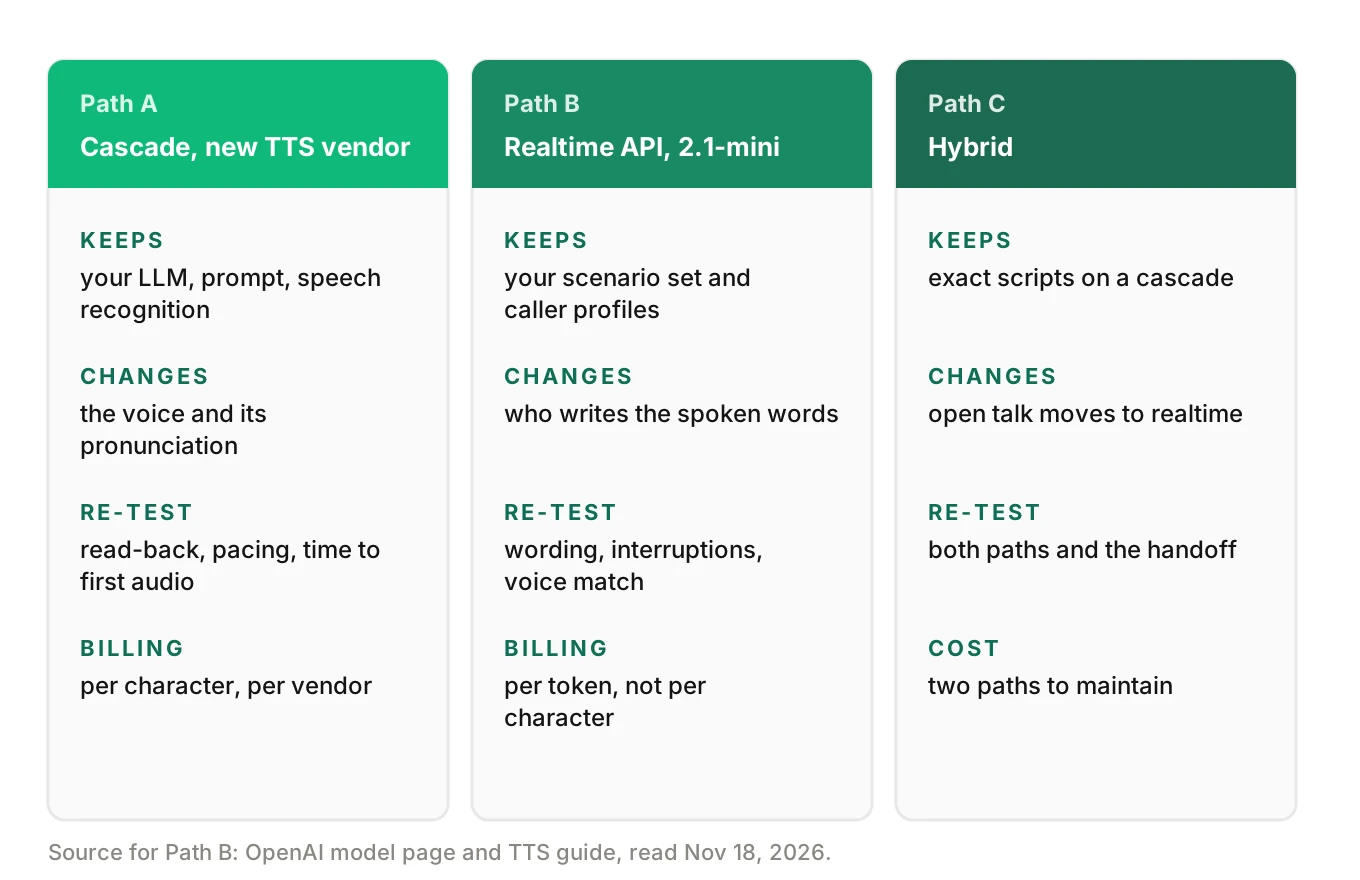
Path A: keep the cascade, change the TTS vendor
You keep your speech recognition, LLM and prompt. You replace only the voice. This is the smallest change to the agent's behaviour, and the largest change to how it sounds. Pick it if you rely on exact wording control, because your own LLM still writes every word the TTS speaks.
Vendor facts and prices for this path are in our Cartesia alternatives post and the TTS provider comparison. For selection criteria, use best TTS for voice agents. For latency measurement, use time to first audio.
Path B: move to the Realtime API with gpt-realtime-2.1-mini
This is OpenAI's named replacement. It runs on the Realtime API, which connects over WebRTC in the browser or WebSocket on the server. The model page describes it as "a distilled reasoning model for faster, lower-cost realtime voice interactions." It says the model "supports audio and text inputs over WebRTC, WebSocket, or SIP connections." Its modalities are text, audio and image in, and text and audio out.
This is not a TTS. It is a model that reasons and speaks. If your agent today sends scripted text to a TTS, Path B changes who decides the wording. The Realtime conversations guide says you "Choose one output modality: audio produces audio with its transcript, and text produces text only." It does not describe both in one response.
So a Path B move can change:
- Wording. The model, not your cascade LLM, now produces spoken words.
- Turn-taking. Interruption and endpointing move into the Realtime session.
- Voices. The guide lists alloy, ash, ballad, coral, echo, sage, shimmer, verse, marin and cedar. In the list we read, fable, onyx and nova are absent. They are on the
tts-1list. It also says that once the model has emitted audio, the voice cannot be modified for that session. - Billing. The model page lists token pricing, with audio tokens at $10.00 per 1M input and $20.00 per 1M output as of November 18, 2026. That is not per character. Your cost model changes.
- Audio format. One format applies per session. The Realtime WebSocket guide for GPT-Live lists PCM at 24 kHz by default and G.711 mu-law and A-law at 8 kHz. Confirm the formats for your model and connection before you rely on them.
For the architecture trade-off, read cascading vs speech-to-speech and building voice agents with GPT-Live. For a test plan on realtime APIs, see how to evaluate a realtime voice API.
We make no claim about how Path B sounds or performs. We ran no tests. That is the point of the swap test below.
Path C: hybrid
Some teams keep a cascade for the paths where wording must be exact, such as payment, consent or legal lines. They use speech-to-speech for open conversation. This doubles the surface you test. Pick it only if one path cannot meet your needs.
A decision table
| If this is true | Lean toward | Test first |
|---|---|---|
| Scripts must be read word for word | Path A | Digit, name and abbreviation read-back |
| You want one vendor and fewer hops | Path B | Wording drift and interruption recovery |
You depend on a tts-1 voice such as fable, onyx or nova | Path A, or check Path B voices | Voice match on long turns |
| Cost per call drives the decision | Compare A and B on your own call mix | Token cost versus per-character cost, per call |
| You have two weeks, not eight | Path A, smallest behaviour change | Latency on slow runs |
These are hypotheses. The swap test decides.
Why a TTS swap breaks calls the transcript cannot see
A TTS swap forced by the OpenAI TTS shutdown changes only the sound. The text going in may be identical. So a transcript check passes while the call fails.
The failures sit in the audio. A phone number is read with different grouping. A last name is stressed wrongly. "Dr" becomes "Doctor" where it should be "Drive." A first syllable is clipped after a barge-in. A pause grows by half a second, and callers start talking over the agent.
Each of these corrupts something downstream. The caller confirms a wrong digit, and the booking is written with it. The record looks clean, because the transcript looked clean. Our TTS evaluation guide covers why mean opinion scores do not predict this, and why 8 kHz phone audio can reverse a ranking made on 24 kHz clips.
That is the case for judging from the audio. A grader that reads only the transcript cannot hear any of the failures above.
The regression test for a TTS swap
The method is the same as any provider change, applied to one component. The wider playbook is in migrating between voice agent vendors. Here is the TTS-specific version.
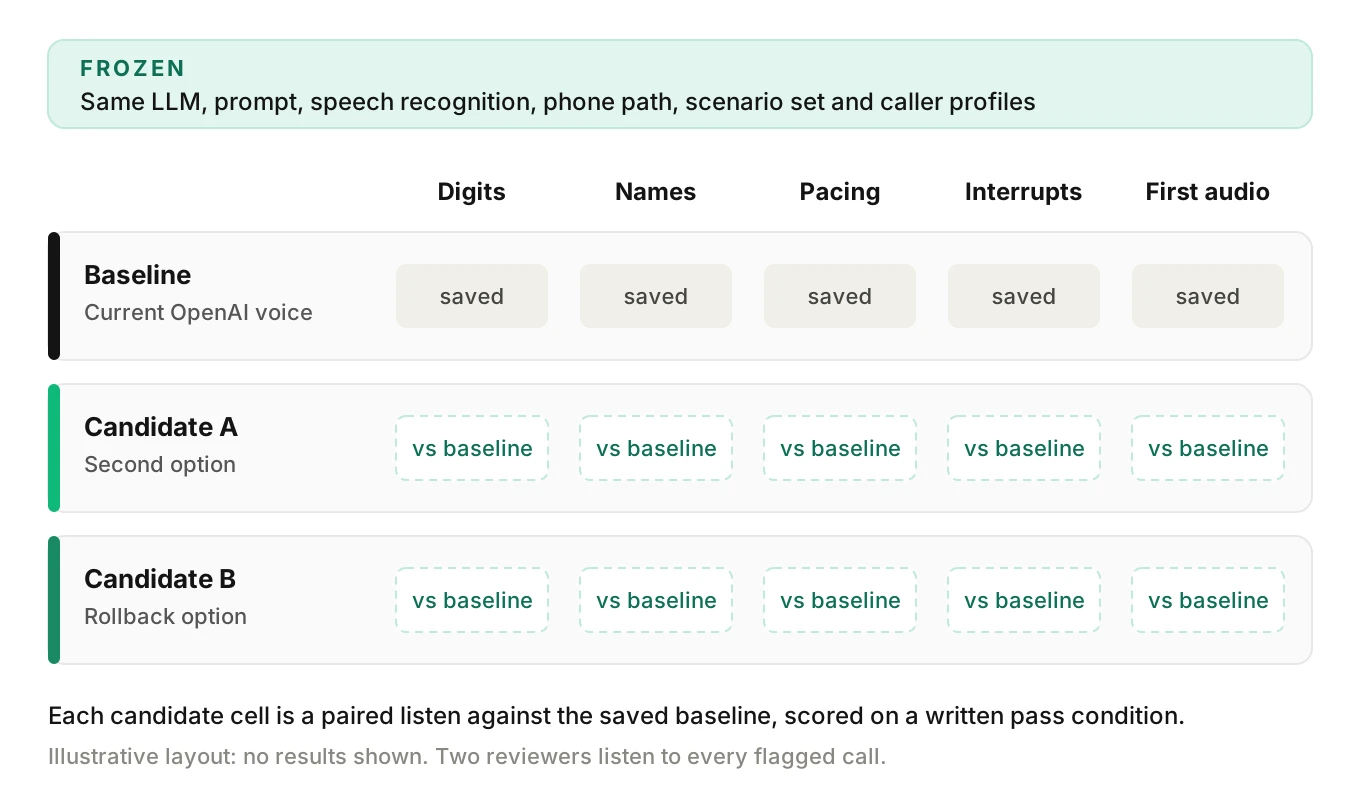
The core rule: change one thing. Freeze the LLM, prompt, speech recognition and phone path. Pin versions. If the prompt changes between runs, you have measured the prompt. Our post on LLM update regression applies the same rule to models.
The pieces of the test
A fixed scenario set. Eight to twelve calls from real flows. Booking, status lookup, payment, transfer and one hard failure path. Write them once and reuse them for every candidate.
Entity read-backs. Include digits, names, addresses, emails and dates. Use names from your customer base. "John Smith" tells you nothing.
Caller profiles. Hold these constant: accent, speech pace, interruption level, response delay and background noise. See accent robustness and interruption detection.
Pairwise review. For each scenario, a person listens to the baseline and the candidate side by side. They mark which is worse, not which is nicer.
What to score, and what passes
| Check | Starting pass condition | Failure it catches |
|---|---|---|
| Digit read-back | Every digit audible, in order, grouped as before | Transposed or merged digits |
| Names and addresses | Caller repeats them back correctly; abbreviations expand as before | Wrong stress, wrong expansion |
| Pronunciation | Product and brand terms match the baseline | Brand mispronounced |
| Pacing | No new run-ons, stalls or rushed endings | Callers talking over the agent |
| Interruption recovery | Audio stops quickly; the next reply starts clean | Clipped or doubled words |
| Time to first audio | Within your budget on slow runs, not only the median | Dead air |
| Voice consistency | Same voice from first turn to last | Drift on long turns |
These thresholds are a starting proposal. Set your own from your recordings and write them down before anyone listens.
Why the baseline has to be recorded now
This is the most time-sensitive point in the post. After the OpenAI TTS shutdown on January 6, tts-1 and its siblings will not run. You can no longer produce a "before" recording. If you have not recorded a baseline by then, you will compare the new voice to memory.
So run the full scenario set on your current OpenAI voice this week. Save both channels of every call. Keep the scenario files and the version string. The recordings are your before side for the rest of the project.
How to regression-test a TTS swap before the shutdown date
1. Inventory every use — List each model string, voice, endpoint, fine-tune and fallback path that touches OpenAI audio, including rare paths.
2. Choose the path and a shortlist — Pick Path A, B or C. Keep two candidates, so you have a second option if the first fails.
3. Freeze the rest of the stack — Pin the LLM, prompt, speech recognition and telephony path. Change only the voice layer.
4. Record the baseline on the current voice — Run the whole scenario set, with caller profiles, while tts-1 still works. Save both channels.
5. Run the same set on each candidate — Repeat each cell several times, because output and network timing vary. Record on the real phone path.
6. Score from the audio — Check read-back, pronunciation, pacing, interruption recovery and time to first audio against the written rubric.
7. Review pairs with a human — Two reviewers listen to every flagged call and a sample of passes. Resolve disagreements, then tighten the rubric.
8. Canary, then cut over — Send a small share of live calls to the winner and watch the same metrics. Keep the second candidate warm as the rollback.
9. Keep the set and rerun it — Rerun it for any later model change, price change or deprecation notice.
Step 8 has a trap. After January 6, rolling back to OpenAI's old TTS is impossible. Your rollback target must be your second candidate, tested and ready. Plan that before cutover, not during an incident. Our post on provider outage failover covers the runtime side.
Migration plan with dates and owners
The dates below are illustrative. They count back from the January 6 shutdown, with a buffer for the end-of-year slowdown. Adjust the owners to your team.
| Target date | Task | Owner (example) | Done when |
|---|---|---|---|
| Nov 20 | Inventory every OpenAI audio model string and voice | Engineering lead | List reviewed, fallbacks included |
| Nov 25 | Record the baseline on the current voice | AI PM with QA support | Full scenario set saved, both channels |
| Dec 2 | Choose a path and two candidates | Head of AI | Decision written, budget noted |
| Dec 11 | Run the swap test on both candidates | Engineer plus reviewers | Scored from audio, pairs reviewed |
| Dec 14 | Go or no-go gate | Head of AI | Winner and rollback named |
| Dec 15 to Dec 22 | Canary on a small share of live calls | Engineering lead | Metrics match the baseline |
| Dec 23 | Full cutover, then a change freeze | Engineering lead | All traffic off OpenAI TTS |
| Jan 6 | Shutdown date; confirm no calls to the old models | Engineering lead | Zero calls in logs |
| Jan 20 | Check other OpenAI realtime models on the same page | Engineering lead | Model strings updated |
| Feb 26 | Check OpenAI transcription models, if used | Engineering lead | Model strings updated |
From the December 14 gate to the shutdown date there are 23 days. That is the buffer if something fails.
Where Evalgent fits
Evalgent is a testing, evaluation and monitoring platform for voice agents. It does not provide a TTS, and it claims no integrations with TTS vendors. You bring the agent and the voice. Evalgent tests the result.
For a swap test, Evalgent generates test scenarios from your agent's prompt and flows. Its caller profiles cover accent, speech pace, interruption level, response delay, behaviour, background noise and language. The call simulator reaches your agent over phone, SIP or WebRTC. It judges the call from the audio, not only the transcript, and human review checks the verdicts. Latency and interruptions are among the metrics, and you can add custom metrics, such as a digit read-back check.
Evalgent works with teams to set up evals for their first agent. It is not self-serve. After the OpenAI TTS shutdown and your swap, production call monitoring can score customer-pushed recordings against the same scenarios. That helps catch drift when a vendor changes a model later.
If you run the test by hand, the method above still works. The cost is the time to play and score every call.
Frequently asked questions
When does OpenAI TTS shut down?
OpenAI's text-to-speech guide says tts-1, tts-1-hd and gpt-4o-mini-tts shut down on January 6, 2027. The deprecations page lists a notice date of October 1, 2026. From November 18, 2026, that leaves 49 days. Existing integrations can keep working until the shutdown date.
Which models does the tts-1 deprecation cover?
The deprecations page lists tts-1, tts-1-hd, and gpt-4o-mini-tts with its snapshots gpt-4o-mini-tts-2025-03-20 and gpt-4o-mini-tts-2025-12-15. It also says fine-tuned versions follow the same shutdown schedule as their base models. We did not find other snapshots listed for the tts-1 family.
Is gpt-4o-mini-tts deprecated too?
Yes. OpenAI lists gpt-4o-mini-tts as deprecated with the same January 6, 2027 shutdown date, even though its guide calls it the current model for the speech endpoint. The same shutdown applies to both of its listed snapshots. Plan to replace it, not only the older tts-1 models.
What is the gpt-realtime-2.1-mini replacement?
OpenAI names gpt-realtime-2.1-mini as the replacement. It is a realtime model that takes audio and text input and gives text and audio output. It is not a drop-in TTS: the guide says it is not a supported model for /v1/audio/speech. Migrating means using the Realtime API.
How do I migrate from OpenAI TTS?
First inventory every use. Then record a baseline on the current voice while it still works. Choose a path: another TTS vendor in a cascade, the Realtime API, or both. Run one fixed scenario set against each candidate, score the audio, review pairs with a person, canary a small share, then cut over.
How do I replace OpenAI TTS in a voice agent without changing behaviour?
Keep the cascade and change only the voice. That leaves your LLM, prompt and speech recognition untouched, so wording stays the same. Then test read-back, pronunciation, pacing, interruptions and time to first audio. Moving to the Realtime API changes who writes the spoken words.
Can I still use the old models until January 6?
OpenAI's guide says existing integrations can keep using the Speech API workflows until the shutdown date. That is your window to record a baseline. After January 6 you cannot produce a "before" recording from these models, and you cannot roll back to them.
Do I need to test again after the OpenAI TTS shutdown swap?
Yes. Keep the scenario set and rerun it after any model, price or deprecation change. A swap is not a one-time event. The same deprecations page lists realtime and transcription changes in January and February 2027, so a cascade built on OpenAI audio may need more than one test cycle.
The bottom line
The OpenAI TTS shutdown ends tts-1, tts-1-hd and gpt-4o-mini-tts on January 6, 2027, and the named replacement needs a different API. Record a baseline on the current voice now, then test each candidate on the same scenarios, scored from the audio.
Related Articles

How to automate voice agent testing: synthetic callers vs manual QA
Learn how ai test automation replaces manual QA for voice agents. Compare synthetic callers vs human testers, with a 5-step framework to scale without hiring.
Read more
AI Agent Testing vs Voice Agent Testing: What General Tools Miss for Voice
AI agent testing measures text outputs. Voice agent testing measures behaviour through an acoustic pipeline. Five failure categories general tools miss.
Read more