Test your voice agent
How to Choose a TTS for Voice Agents in 2026: A Buyer's Guide
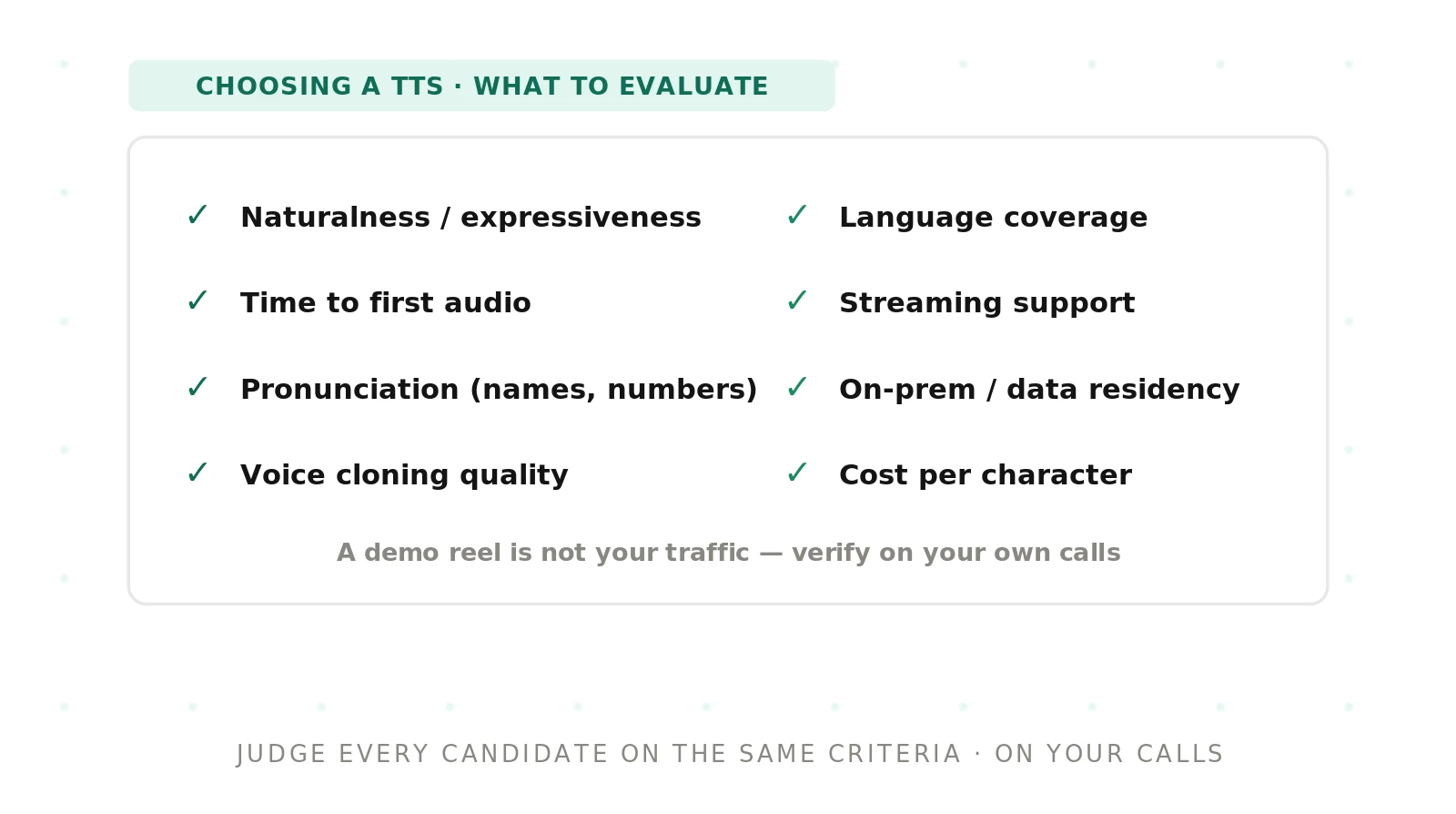
Text-to-speech is the voice your callers actually hear. It shapes trust, comprehension, and whether a call feels human. Choosing a speech synthesis provider is one of the highest-leverage decisions in your stack. Yet most teams pick on a slick demo reel and a headline price.
This guide gives you a neutral, criteria-based framework instead. We cover eight things to weigh, why each matters, and how to verify it yourself. No vendor names, no rankings — just what to look for and how to test it on your own calls.
Why the TTS choice matters more than teams expect
A voice agent has three core parts. Speech-to-text hears the caller. A model decides what to say. Text-to-speech says it back. The last stage is the one callers judge you on.
A great answer read in a robotic, mistimed voice still sounds broken. A mispronounced name erodes trust in one word. The wrong emphasis can flip a sentence's meaning. TTS quality is not cosmetic — it drives comprehension and outcomes.
TTS also sits on the critical path for latency. It cannot start until the model produces text. So its speed directly shapes the pause the caller feels. That makes TTS both a quality and a performance decision, and the two often trade off.
For the full picture of how these pieces fit, see our guide to the voice agent stack. This post focuses on the TTS layer alone.
The eight criteria that decide a TTS choice
Every serious selection comes down to the same short list. Weight them for your use case. But evaluate all of them before you commit.
1. Naturalness and expressiveness
Naturalness is how human the voice sounds. Expressiveness is whether it carries the right emotion and emphasis. Both come down to prosody) — the rhythm, stress, and intonation of speech.
Flat, monotone output signals "robot" within seconds. Good prosody makes a question sound like a question. It puts stress on the word that matters. It pauses where a human would pause.
The industry-standard measure is the mean opinion score, a 1-to-5 human rating. But vendor MOS numbers come from clean scripts, not your calls. Run your own listening test instead, on your real sentences.
2. Latency
Latency is the delay before the caller hears a reply. For TTS, the key figure is time to first audio byte. A long pause feels like the agent froze, even when it did not.
Human sensitivity to delay is well documented. The ITU-T G.114 standard puts the comfortable one-way limit around 150 milliseconds. Conversational speech has little tolerance for lag.
Latency is one criterion among several, so we keep it brief here. For a full treatment of streaming, buffering, and tail latency, read our deep dive on low-latency TTS. Do not trade too much quality for raw speed without measuring both.
3. Pronunciation accuracy
This is where many demos hide the truth. A voice can sound gorgeous and still butcher the words that matter most. Names, numbers, dates, and addresses are the hard cases.
Your callers have names the model has never seen. Your agent reads back order numbers, dollar amounts, and appointment times. A wrong digit or a mangled surname breaks the call. Accuracy on these matters more than on scripted marketing copy.
Check whether the provider supports custom pronunciation dictionaries. Check how it handles phonetic spellings. Then test it on your hardest names and your real number formats.
4. Voice cloning quality
Many teams want a branded or consistent voice. Cloning creates a custom voice from sample audio. Quality varies widely, and so does the effort required.
Ask how much source audio a clone needs. Ask whether the clone holds up across long sentences and varied emotion. A clone that sounds great on one line can drift on the next. Consistency across a full call is what counts.
Cloning also carries consent and rights obligations. Anchor your process to a recognized risk framework like the NIST AI Risk Management Framework. Never clone a voice without documented permission.
5. Language and accent coverage
If you serve more than one market, coverage decides the shortlist fast. Count the languages you need today. Then count the ones you will need next year.
Coverage is not just a language count. Accent and dialect quality vary within a language. A provider may support a language on paper but sound unnatural in it. Regional number and date formats matter too.
Test each language you actually serve, with native speakers if you can. A voice that natives find odd will cost you calls in that market.
6. Streaming support
Batch TTS returns the whole clip at once. Streaming TTS sends audio as it generates. For live calls, streaming is close to mandatory.
Streaming lets the caller hear the first words while the rest renders. That cuts perceived latency) sharply. It also lets the agent handle barge-in, when a caller interrupts mid-sentence.
Confirm the provider streams over a protocol your stack supports. Confirm it handles interruption cleanly. A voice that cannot be cut off feels rude and rigid.
7. On-premise or private deployment
Regulated industries often cannot send audio to a public API. Healthcare, finance, and government may require on-premise or private-cloud options. This can be a hard gate.
Ask whether the provider offers a self-hosted or dedicated deployment. Ask where data is processed and stored. If your compliance rules forbid public endpoints, this criterion may override everything else.
Even without a hard mandate, private deployment can reduce data exposure. Weigh it against the added operational cost of running the model yourself.
8. Cost
Cost is real, but rank it last for a reason. The cheapest voice that fails a call is not cheap. Price per character or per second is only the visible layer.
Model the full cost. Include streaming overhead, cloning fees, and any minimums. Then divide by resolved calls, not by audio minutes. A slightly pricier voice that improves comprehension can lower your true cost per outcome.
Watch for lock-in too. A proprietary voice you cannot move becomes a hidden cost later. Favor providers that let you export or reproduce your setup elsewhere.
The TTS selection criteria at a glance
Use this table as your scoring sheet. Score every provider on the same rows, using your own calls.
| Criterion | Why it matters | How to verify |
|---|---|---|
| Naturalness & expressiveness | Robotic voices lose caller trust fast | Blind listening test on your real sentences |
| Latency | Delay before first audio feels like a freeze | Measure time to first byte on your traffic |
| Pronunciation accuracy | Wrong names or numbers break the call | Test your hardest names, dates, and amounts |
| Voice cloning quality | Branding and consistency across a call | Clone from your samples, check long sentences |
| Language & accent coverage | Poor coverage fails multi-market service | Test each language with native speakers |
| Streaming support | Enables low latency and barge-in | Confirm streaming protocol and interruption |
| On-prem / private option | Compliance may forbid public APIs | Ask for self-hosted or dedicated deployment |
| Cost | Cheap-but-broken raises true cost | Model cost per resolved call, not per minute |
How to choose a TTS for your voice agent
Run this process the same way for every provider you consider. It turns a subjective demo into a defensible decision.
1. List your requirements first — Write down your languages, latency target, compliance rules, and hard gates before you look at any provider.
2. Assemble a real test script — Collect your hardest names, real number formats, dates, and typical agent replies from actual calls.
3. Run a blind listening test — Play each provider's output to reviewers without labels, and score naturalness and pronunciation identically.
4. Measure latency on your traffic — Record time to first audio byte under realistic load, not from a vendor's benchmark page.
5. Test the hard gates — Verify streaming, barge-in, cloning consent, and any on-premise requirement your compliance team demands.
6. Model the full cost — Calculate cost per resolved call across every provider, including cloning, minimums, and streaming overhead.
7. Decide and keep auditing — Choose on the combined score, then re-test after any model update, since voices can regress silently.
How TTS selection fits vendor evaluation
Choosing a TTS is one thread in a larger decision. The same discipline applies to the whole agent. Score on your own data, run identical tests, and decide on evidence.
If you are comparing full voice agent vendors, our vendor evaluation scorecard extends this framework across every layer. When you want a fair head-to-head, run every provider through the same test cases. And before any launch, hold the result against a clear production readiness bar.
The TTS choice is not a one-time event. Providers ship new models often. A voice that scored well last quarter can shift after an update. Re-run your listening test on a cadence, and sample live calls between formal reviews.
Common mistakes when choosing a TTS
The errors repeat across teams. Judging on a curated demo reel that hides the hard cases. Testing on marketing copy instead of your real names and numbers. Optimizing latency so hard that the voice turns robotic.
Others pick on price per character alone, then pay for it in failed calls. Some skip multi-language testing and ship a voice natives find odd. Many forget barge-in, so callers cannot interrupt. Each mistake is avoidable with a real test script scored on your own traffic.
For the testing methodology behind these listening tests, see our guide to evaluating TTS for voice agents. It covers how to structure the reviews and score them consistently.
Frequently asked questions
What is the best TTS for voice agents in 2026?
There is no single best TTS for every voice agent in 2026. The right choice depends on your languages, latency target, compliance rules, and budget. Score each provider on naturalness, pronunciation, latency, cloning, coverage, streaming, deployment, and cost — using your own calls, not a vendor demo.
How do I test TTS naturalness?
Run a blind listening test. Collect real sentences your agent says, generate them on each provider, and play them to reviewers without labels. Have reviewers score naturalness on a consistent scale. Compare the results across providers on identical audio, so the voice quality decides the outcome rather than branding.
Why does TTS pronunciation accuracy matter so much?
Because your calls contain names, numbers, dates, and amounts the model has never seen. A wrong digit in an order number or a mangled surname breaks trust instantly. A voice can sound beautiful and still fail these cases. Always test pronunciation on your hardest real examples, not on scripted marketing copy.
Is streaming TTS necessary for voice agents?
For live phone calls, streaming is close to essential. It sends audio as it generates, so the caller hears the first words immediately. That cuts perceived latency sharply and enables barge-in, letting callers interrupt naturally. Batch TTS, which returns a full clip at once, usually feels too slow for real conversation.
How much does latency affect a voice agent?
A lot. Delay before the first audio byte feels like the agent froze. Conversational speech tolerates little lag, and comfort limits sit near 150 milliseconds one way. Latency is one of several criteria, but a slow voice undermines every other strength. Measure time to first audio on your own traffic.
Do I need an on-premise TTS option?
Only if your compliance rules require it. Healthcare, finance, and government deployments sometimes cannot send audio to public APIs. In those cases, a self-hosted or private-cloud option becomes a hard gate that overrides other criteria. If you have no such mandate, weigh private deployment against the added cost of running it yourself.
How should I compare TTS cost?
Model cost per resolved call, not price per character or per second. Include streaming overhead, cloning fees, and any minimums. A slightly pricier voice that improves comprehension can lower your true cost by resolving more calls. Watch for lock-in too, since a voice you cannot move becomes a hidden cost later.
How often should I re-evaluate my TTS provider?
Re-evaluate on a regular cadence, not just at selection. Providers ship new models often, and a voice that scored well can regress silently after an update. Re-run your listening test periodically and after any known change, and sample live calls continuously so quality drops surface before your callers notice them.
Choosing and verifying a TTS with Evalgent
Evalgent is built to run this selection independently, on your own calls. Scenarios reproduce your real conversations — the hard names, the number read-backs, the interruptions — and run identically against every TTS provider you weigh. Profiles vary caller accent, pace, and line quality, so no voice wins on clean audio alone. Metrics measure each criterion — naturalness, pronunciation accuracy, latency to first byte, and more — on your traffic rather than on vendor claims. Evaluations run the whole suite at concurrency, and Reviews let your team replay any call to hear exactly why one voice scored higher. Because the same test set runs against every provider, the comparison is finally apples to apples. To set up an independent TTS evaluation on your own calls, book a demo.
The bottom line
The best TTS for your voice agent is the one that proves itself on your own calls, not in a vendor demo. Score naturalness, latency, pronunciation, cloning, coverage, streaming, deployment, and cost identically across providers, then decide on the evidence.
Related Articles
Why AI voice agents fail in production (and how to prevent it)
AI voice agents that ace demos still break in production. Learn the 5 root causes, how to test for each, and what production readiness actually means.
Read more
Voice agent regression testing: why LLM updates break production
LLM updates improve benchmarks but break voice agents in 5 predictable ways. How to detect and prevent regressions after every model or prompt change.
Read more