Cartesia Alternatives for Voice Agents: How to Compare TTS on Your Own Calls
On this page
Most teams look for Cartesia alternatives for one of four reasons. Price per minute, a concurrency cap, a language gap, or a voice that sounds wrong on their calls. There is no single best TTS for voice agents, so each reason points to a different shortlist of Cartesia alternatives. None of them is settled by a landing page.
This post does two jobs. First, it lists what each vendor publishes today, with the source and the date. Second, it gives you a method to compare text-to-speech on your own calls. The method matters more than the list, because the list changes every quarter.
We run no benchmarks here. Every vendor number below is a vendor claim, with its stated conditions. For the wider roster, see our TTS provider comparison. For selection criteria, see the guide to choosing a TTS. This post is narrower. It covers what to do when Cartesia is your current option and you want a fair second opinion.
What each vendor publishes, as of November 17, 2026
Every cell below comes from a vendor page we opened on November 17, 2026. If a vendor page did not state a fact, the cell says so. We left out Azure Speech because its pricing page did not show current figures when we checked.
| Provider and model | Languages | Latency (vendor claim) | Phone-line output | List price |
|---|---|---|---|---|
| Cartesia Sonic-3.6 | 44 | "First audio in under 90ms," called model latency; no network or hardware conditions given | WebSocket supports pcm_mulaw and pcm_alaw at 8,000 Hz | 1 credit per character, about 750 to 800 credits per minute |
| ElevenLabs Eleven v4 Turbo | 90+ | About 100ms median, excluding application and network latency | Not confirmed on the pages we read | $0.04 per 1,000 characters |
| ElevenLabs Flash v2.5 | 32 | About 100ms, same footnote | Not confirmed | $0.04 per 1,000 characters |
| Deepgram Aura-2 | 7 listed | No figure on the pages we read | Streaming WebSocket: mulaw at 8,000 Hz default, also alaw and linear16 | $0.030 per 1,000 characters pay as you go |
| Google Chirp 3 HD | 53 locales | No figure on the pages we read | Streaming supports MULAW and ALAW; sample rate not stated | $30 per 1M characters |
| Rime Coda and Mist v3 | Per voice, one language each | Mist v3 called "the lowest time to first audio" of the two; no figure | Raw audio/pcm stream; mu-law not mentioned | Not checked |
Sources: Cartesia models page. Cartesia Sonic page. Cartesia pricing page. Cartesia WebSocket reference. ElevenLabs models page. ElevenLabs API pricing. Deepgram voices page. Deepgram output settings. Deepgram pricing page. Google Chirp 3 HD docs. Google pricing page. Amazon Polly pricing page. Rime quickstart page. OpenAI text-to-speech guide. OpenAI deprecations page.
Three things stand out. Latency claims use different definitions. Phone-line output formats are documented unevenly. And one popular option is leaving.
OpenAI's TTS models are being shut down
OpenAI lists tts-1, tts-1-hd and gpt-4o-mini-tts as deprecated, with a shutdown date of January 6, 2027. The notice date was October 1, 2026. OpenAI points to gpt-realtime-2.1-mini through the Realtime API as the replacement. Its guide adds that this model is not supported on the /v1/audio/speech endpoint.
So OpenAI is no longer a drop-in cascaded TTS option. It is a different architecture. For that route, read our guide to building voice agents with GPT-Live. It covers the speech-to-speech versus cascade trade-off.
Why teams look for Cartesia alternatives
Match your trigger to the facts below before you start testing.
Cost per minute is the common one. Cartesia charges credits per character, with list plans from $5 to $299 per month. Test your real characters per minute, not an average.
Concurrency is next. Cartesia lists 15 concurrent TTS requests on Scale and 5 on Startup. Test your peak simultaneous calls, including retries.
Languages and voice fit come after. Cartesia lists 44 languages, ElevenLabs 90+ for v4 Turbo and Deepgram 7. Voice fit is subjective and not comparable across vendors, so listen blind on your own scripts.
Vendor risk is the least discussed. A deprecation can arrive with three months of notice, as OpenAI's did.
A tested fallback voice is cheap insurance. Our post on provider outage failover covers the runtime side of that.
Worked cost example, with assumptions
Prices are per character on most pages, and per minute on a call. To compare them, assume a speaking rate. Cartesia states about 750 to 800 credits per minute. We use 775 characters per minute for every vendor, as an illustrative assumption. Real speech rates vary by voice and script.
| Option | Published price | Arithmetic | Illustrative cost per minute |
|---|---|---|---|
| Cartesia Scale plan | $299 for 8M credits | 775 x 299 / 8,000,000 | about $0.029 |
| ElevenLabs v4 Turbo | $0.04 per 1,000 characters | 775 x 0.04 / 1,000 | about $0.031 |
| Deepgram Aura-2 | $0.030 per 1,000 characters | 775 x 0.03 / 1,000 | about $0.023 |
| Google Chirp 3 HD | $30 per 1M characters | 775 x 30 / 1,000,000 | about $0.023 |
Polly Generative at $30 per 1M characters lands at the same $0.023. Cartesia's $38 per 1M overage rate lands near $0.029. This ignores plan fees, free tiers, tax and volume discounts. The gap is a few thousandths of a dollar per minute. Compared with an LLM and telephony, TTS is rarely the largest line. Rework this table with your own characters per minute before you let price decide. Our cost of latency post shows how to price a slow reply, which often costs more than the voice.
ElevenLabs vs Cartesia: what the docs let you compare
ElevenLabs vs Cartesia is the comparison most readers search for. The pages support only a partial one.
From published facts you can compare these:
- Languages. Cartesia lists 44 for Sonic-3.6. ElevenLabs lists 90+ for Eleven v4 Turbo and 32 for Flash v2.5.
- Latency claims. Cartesia says under 90ms and calls it model latency. ElevenLabs says about 100ms median for v4 Turbo and Flash v2.5, excluding application and network latency. Neither claim states the text length, region or load. They are not the same measurement.
- Pronunciation controls. ElevenLabs accepts up to 3 pronunciation dictionary locators per request and has an
apply_text_normalizationsetting withauto,onandoff. Cartesia has a separatenormalizationsetting for dates, times and numbers, and alanguageorlocalesetting. - Interruption plumbing. Cartesia's WebSocket reference documents a
cancelflag percontext_id, so you can stop a context when a caller barges in. We read the ElevenLabs convert page, not its streaming page, so we make no claim there.
The pages cannot tell you which one reads your customer's last name correctly. They cannot tell you which recovers cleanly after a barge-in on a noisy 8 kHz line. Only your calls answer that.
For the ElevenLabs side of testing, see our ElevenLabs voice agent testing guide.
Other Cartesia alternatives worth a place in the bake-off
Streaming TTS support, phone formats and controls differ across the options below.
Deepgram Aura-2. Pricing is $0.030 per 1,000 characters on pay as you go and $0.027 on Growth. The streaming WebSocket supports mulaw at 8,000 Hz by default, which is convenient for phone legs. Input is capped at 2,000 characters per request for Aura-2. Voices cover seven languages. If you already use Deepgram for speech recognition, see our voice A/B testing guide for Deepgram.
Google Chirp 3 HD. It lists 30 voices and 53 locales. Streaming goes through streaming_synthesize with MULAW, ALAW, OGG_OPUS and PCM output. Custom pronunciations take IPA or X-SAMPA. One gotcha is worth testing. Google states SSML tags are not supported for streaming requests. Pause tags work only in the markup field.
Amazon Polly Generative. The price is $30 per 1M characters, against $16 for Neural and $4 for Standard. We did not confirm its streaming or telephony formats, so test it as unknown.
Rime. The quickstart names Coda as the flagship and Mist v3 as the fast model. It streams over an HTTP POST and returns raw PCM if you send Accept: audio/pcm. Custom pronunciation uses phonemizeBetweenBrackets on English Mist v3, and a custom lexicon on Coda. Each voice speaks one language.
OpenAI. Covered above. Treat the TTS endpoint as ending, and the Realtime path as a separate architecture decision.
For more vendors, use the TTS provider comparison. Figures in older posts, including ours, may predate those above.
Why a low latency TTS API claim does not predict your pause
A search for a low latency TTS API returns one number per vendor. Each number answers a different question.
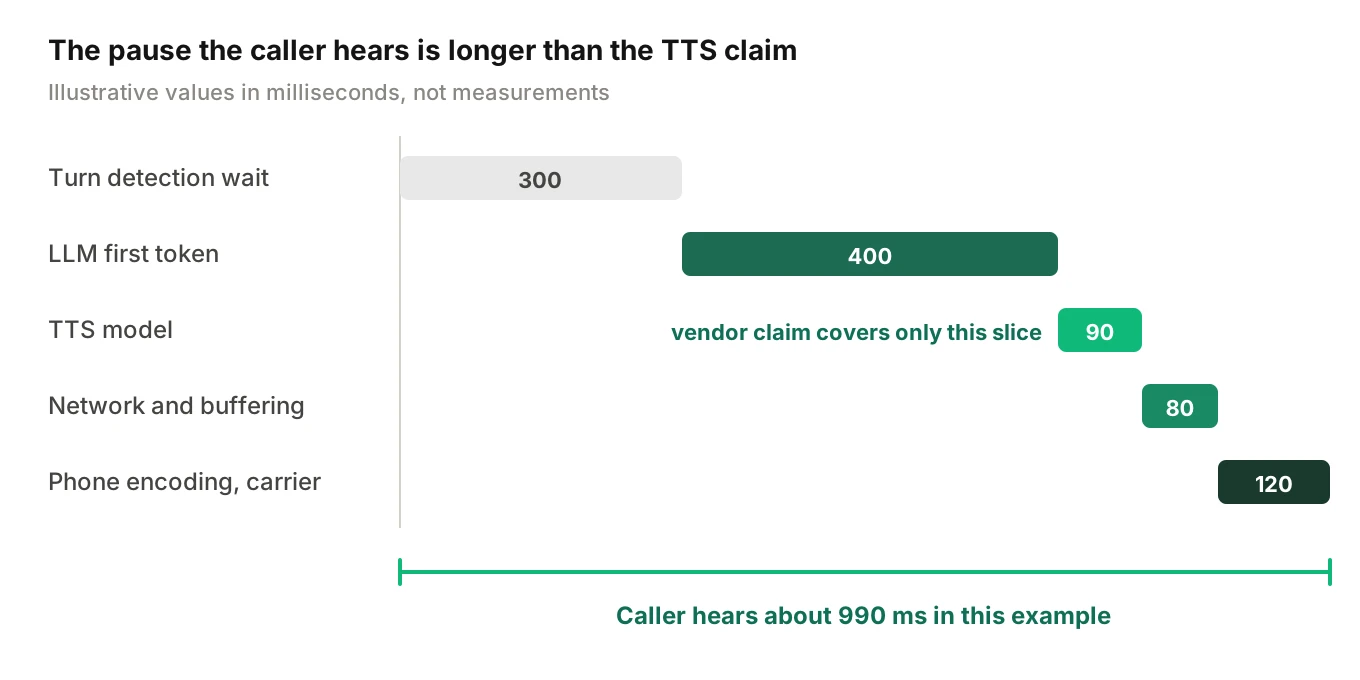
The caller hears the gap between the end of their sentence and the first sound from the agent. A vendor figure covers one slice of it. Our low-latency TTS guide explains time to first audio versus time to first byte. Here is the short version for a comparison:
- A model latency claim usually excludes your network hop.
- A median hides the slow turns that callers remember.
- A figure from a short test sentence may not hold for a 30-word address read-back.
- The audio you send down a phone line is re-encoded to 8 kHz, which adds work.
So measure time to first audio the same way for every candidate. Start the clock when the caller stops speaking in a two-channel recording. Stop it at the first audible bot audio. Do this on the final call path, not the vendor playground. Our measurement guide for TTS evaluation covers streaming and chunk boundaries in depth.
A word on sample size. With 20 runs per cell, the 95th percentile is set by one or two slow runs. Treat it as a flag, not a result. Use more runs on the cells that decide your choice.
Text to speech quality comparison for voice agents: score what breaks calls
A text to speech quality comparison for voice agents should not rank "naturalness". Vendors publish naturalness on different listener studies, so the scores do not share a scale. Score the failures that cost you a booking or a record.
Our guide to TTS evaluation explains why mean opinion scores mislead. Here is the shorter rubric to apply on each call.
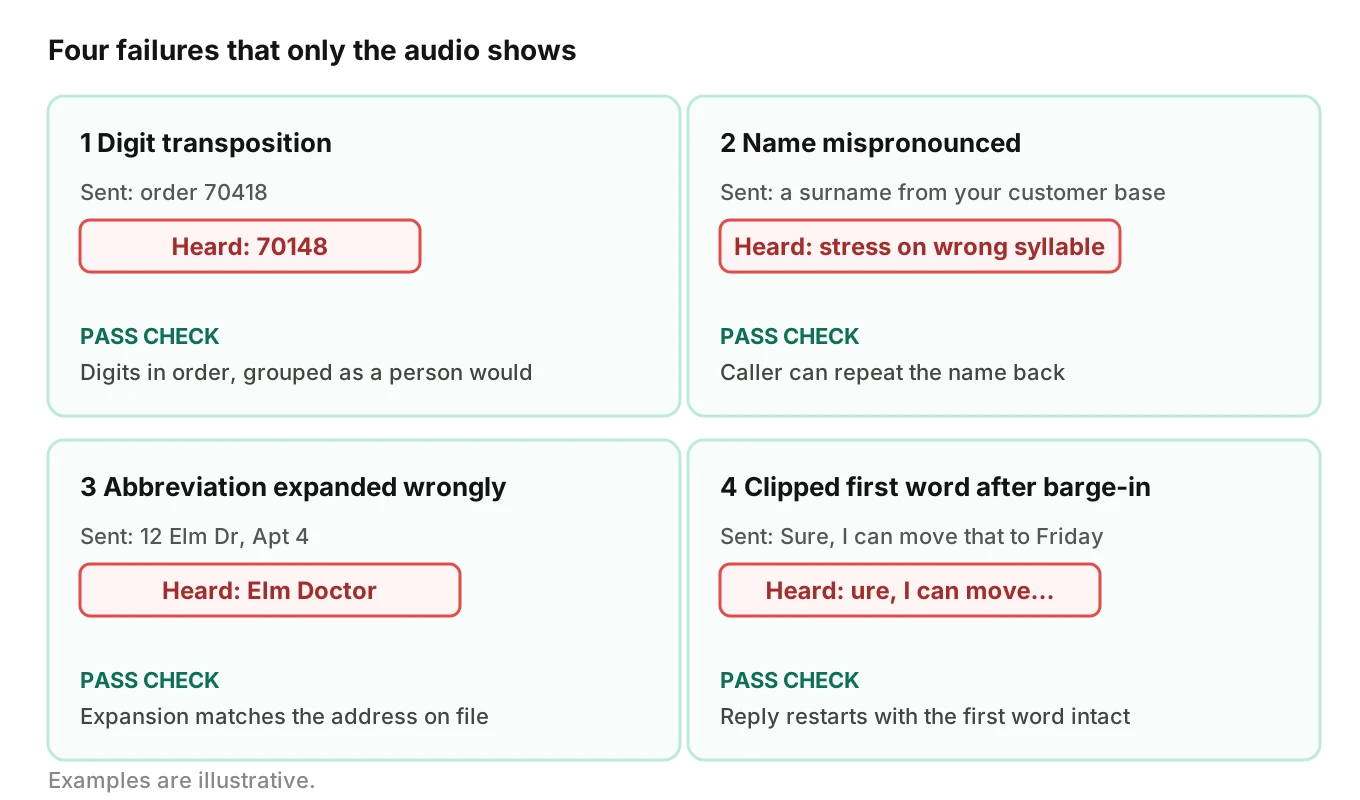
| Check | Pass condition (a starting proposal) | Why it matters downstream |
|---|---|---|
| Digit read-back | Every digit audible, in order, grouped naturally | A swapped digit corrupts the number the caller confirms |
| Names and brands | Caller can repeat the name back correctly | A mispronounced name makes callers distrust the whole call |
| Address and date expansion | "St" and "Dr", and dates, read as the caller expects | A wrong expansion changes the delivery address |
| Pacing | No run-ons or mid-sentence stalls | Callers talk over a fast or stalled agent |
| Interruption recovery | Audio stops fast; next reply starts clean | A clipped first word reads as a glitch |
| Time to first audio | Within budget on slow runs, not just the median | Pauses feel like the agent froze |
Pass conditions are a starting proposal. Set your own thresholds from your call recordings. The point is to write them down before you listen.
Why the transcript cannot judge this
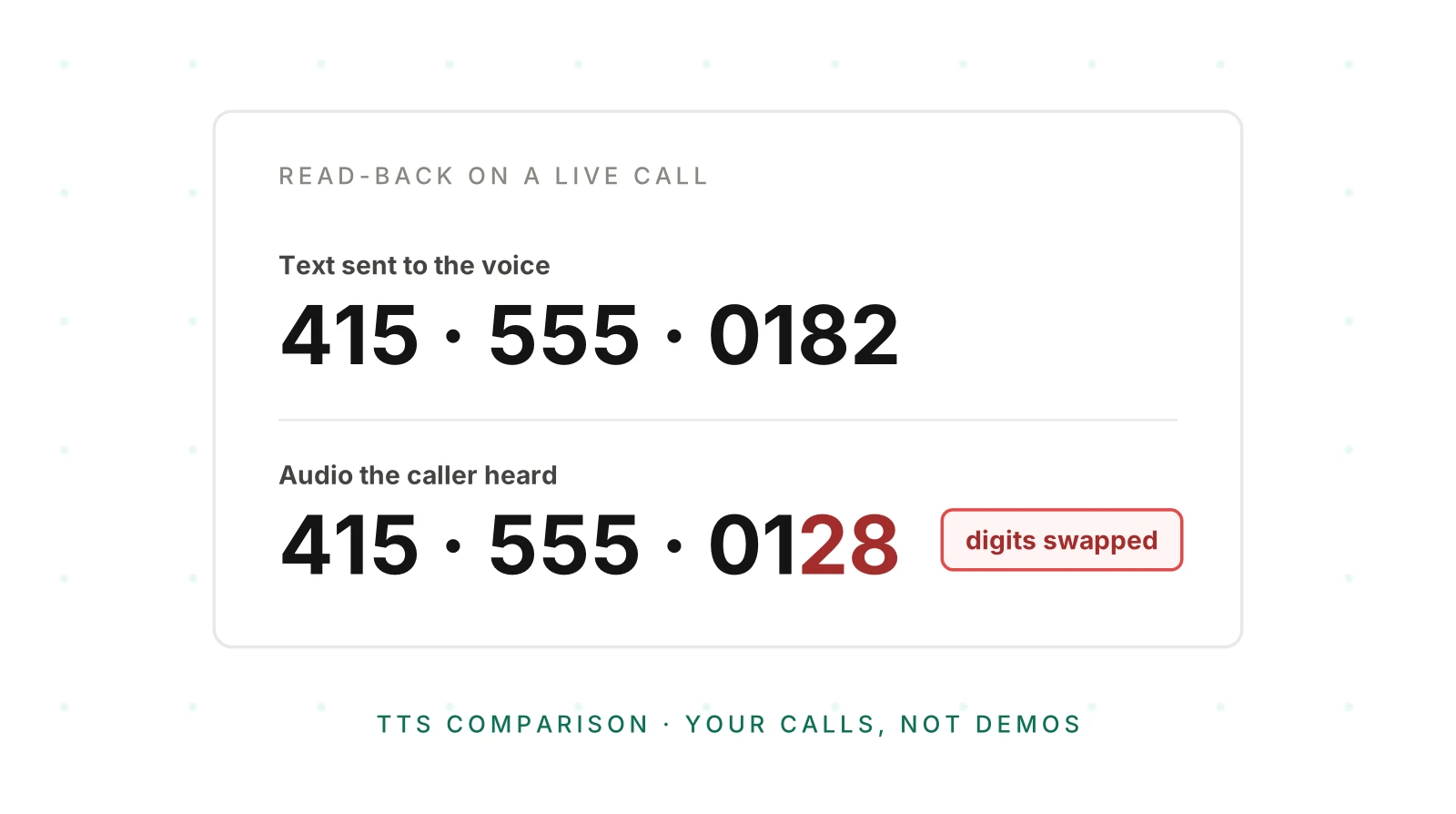
A transcript of the agent's side shows the text the TTS was sent. It does not show how that text sounded. The text can read "4 1 5 5 5 5 0 1 8 2" while the audio transposes two digits. A transcript grader passes that call. That is why we judge from the audio.
The method: a fixed scenario set and caller profiles
The idea is simple. Write the calls once. Run them against every TTS option. Compare the audio.
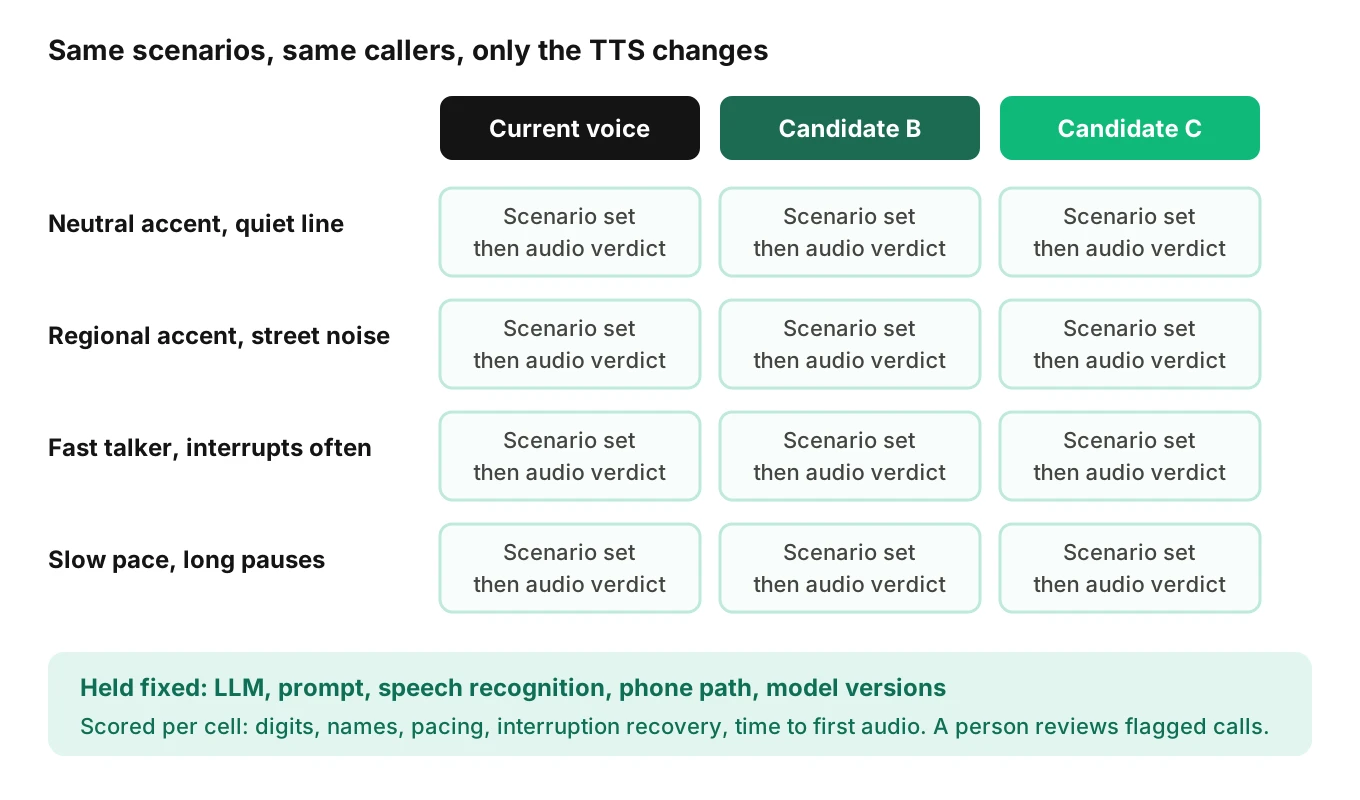
A scenario set has three parts:
1. Scripts. Eight to twelve calls that cover real flows: booking, order status, payment, a transfer, and one hard failure path.
2. Entities. Read-backs of numbers, names, addresses, emails and dates. Use names from your customer base, not "John Smith".
3. Caller profiles. Accent, pace, noise, interruption level and response delay, held constant across candidates.
Hold everything else fixed: the same LLM, the same prompt, the same speech recognition, the same phone path. Change only the TTS. Otherwise you are comparing something else.
Our posts on accent robustness, background noise and interruption detection show how to build each profile dimension.
How to compare text to speech on your own calls
1. Write down the decision first — State what you are choosing: a primary voice, a fallback, or a migration. Name your latency budget and must-have languages.
2. Shortlist two or three Cartesia alternatives — Use the vendor table to drop options that miss your phone format, languages or deprecation needs. Keep your current voice as the baseline.
3. Freeze the rest of the stack — Same LLM, prompt, speech recognition and telephony path. Pin model versions. Cartesia, for example, publishes a dated snapshot, sonic-3.6-2026-08-27, behind the sonic-3.6 alias.
4. Build the scenario set — Write scripts and entity lists from real call recordings. Add the profiles: accents your customers have, line noise, fast talkers, and callers who interrupt.
5. Run every scenario against every candidate — Run each cell several times, since TTS output and network timing vary. Record both channels at the phone path you will use in production.
6. Score from the audio — Check digits, names, pacing, interruption recovery and time to first audio against your written rubric. Do not rely on the transcript.
7. Review the verdicts with a human — Have two people listen to every failed call and a sample of passes. Resolve disagreements, then rewrite the rubric where it was vague.
8. Decide, then keep the set — Pick the winner and the fallback. Keep the scenario set and rerun it when a vendor ships a new model or a deprecation notice lands.
Step 3 is where most comparisons go wrong. If the LLM prompt changes between runs, you have measured the prompt. Our post on LLM update regression shows the same discipline for models.
What a human reviewer adds
An automated judge flags candidate failures at scale. A human settles the close calls. Is "oh" for zero acceptable on a US phone number? Those are product decisions, and a person should own them. Have a person review every flagged call.
Decision table by use case
Use this to pick which Cartesia alternatives to test first, not what to buy. Every row is a hypothesis for your bake-off, supported only by the vendor facts above.
| Use case | What matters most | Put these in the first bake-off | Watch for |
|---|---|---|---|
| Phone scheduling and reminders | Clean number and date read-back on 8 kHz | Cartesia, Deepgram Aura-2, Google Chirp 3 HD | Digit grouping and date expansion on a narrowband line |
| Support with many languages | Language coverage per caller | ElevenLabs (90+ on v4 Turbo), Cartesia (44), Google (53 locales) | Names and brands in each language |
| Cost-sensitive, high volume | Price per minute and concurrency | Deepgram Aura-2, Google Chirp 3 HD, Cartesia | Concurrency caps at your peak hour |
| Brand-voice or expressive agent | Voice fit and emotion | ElevenLabs, Cartesia, Rime | Consistency across long turns and after interruptions |
| Heavy barge-in callers | Fast stop and clean restart | Any candidate whose streaming API lets you cancel a stream | Clipped first words after a cancel |
| Strict script wording | Exact words every time | A cascaded TTS with pronunciation controls | Number and abbreviation normalization |
| Teams on OpenAI TTS today | A replacement before Jan 6, 2027 | A cascaded option above, or the Realtime route | Behaviour change on the switch |
What Evalgent does in this comparison
Evalgent is a testing, evaluation and monitoring platform for voice agents. It does not provide a TTS and does not claim integrations with the vendors above. You bring the agent; the voice vendor is one of its parts.
For a bake-off of Cartesia alternatives, Evalgent generates test scenarios from your agent's prompt and flows. Its caller profiles cover accent, pace, interruption level, response delay, background noise and language. The call simulator reaches your agent over phone, SIP or WebRTC. It judges the call from the audio, with human review of verdicts. Latency and interruptions are among the metrics, and you can add custom metrics, such as a digit read-back check. Evalgent works with teams to set up evals for their first agent; it is not self-serve.
If you run the bake-off by hand, the method above still works. The cost is the time to play and score every call. Evalgent exists for the part where that stops scaling. After you pick a voice, production monitoring can score customer-pushed recordings against the same scenarios, so a later vendor change does not go unnoticed.
Frequently asked questions
What are the best Cartesia alternatives for voice agents?
ElevenLabs, Deepgram Aura-2, Google Chirp 3 HD, Amazon Polly and Rime are the main options with current public documentation. Which one is best depends on your languages, phone format, concurrency and price. Shortlist two or three, then compare them on your own calls with the same scripts and caller profiles.
How does ElevenLabs vs Cartesia compare?
On published pages, Cartesia lists 44 languages and ElevenLabs lists 90+ for Eleven v4 Turbo. Both claim roughly 100ms or less under their own definitions, which are not the same measurement. Neither page tells you which handles your names and numbers better. Test both on your calls.
Is there a low latency TTS API I can trust from the vendor page?
Treat vendor figures as claims with conditions. Cartesia says under 90ms and calls it model latency. ElevenLabs says about 100ms median, excluding application and network latency. Measure time to first audio yourself, from caller silence to first bot audio, on your real phone path and across slow runs, not just the median.
Is OpenAI TTS still available for voice agents?
Not for long. OpenAI lists tts-1, tts-1-hd and gpt-4o-mini-tts as deprecated, with shutdown on January 6, 2027. It recommends gpt-realtime-2.1-mini through the Realtime API, which is a different architecture. If you use OpenAI TTS in a cascade today, plan a replacement and test it.
How do I run a text to speech quality comparison for voice agents?
Write one scenario set with read-backs of numbers, names and addresses. Add caller profiles for accent, noise and interruptions. Run it against each TTS with the rest of the stack frozen. Score the audio for digits, names, pacing, interruption recovery and time to first audio, and have a person review failures.
How to test TTS for phone calls at 8 kHz?
The pages we read document phone-friendly output for Cartesia (pcm_mulaw and pcm_alaw at 8,000 Hz), Deepgram (mulaw at 8,000 Hz) and Google (MULAW streaming, rate not stated). That shows format support only. Quality after narrowband encoding must be heard on your own calls.
Can I compare TTS options without an evaluation platform?
Yes. Record calls on both channels, play each candidate through the same scripts, and score them in a spreadsheet against a written rubric. It works for a first pass. It gets slow once you add accents, noise and many reruns, which is where automated scoring from the audio helps.
How often should I re-compare TTS vendors?
Rerun your scenario set when a vendor ships a new model version, changes pricing, or announces a deprecation, and before any large prompt or traffic change. Pin model versions in production so you know which voice you tested. Keep the scenario set so each rerun costs little.
The bottom line
The best Cartesia alternative is the one that reads your callers' numbers and names correctly on your phone line, within your latency budget. Vendor pages narrow the field, but only one scenario set, run against each option and scored from the audio, picks the winner.
Related Articles

How to automate voice agent testing: synthetic callers vs manual QA
Learn how ai test automation replaces manual QA for voice agents. Compare synthetic callers vs human testers, with a 5-step framework to scale without hiring.
Read more
AI Agent Testing vs Voice Agent Testing: What General Tools Miss for Voice
AI agent testing measures text outputs. Voice agent testing measures behaviour through an acoustic pipeline. Five failure categories general tools miss.
Read more