How to test accent handling in AI voice agents
On this page
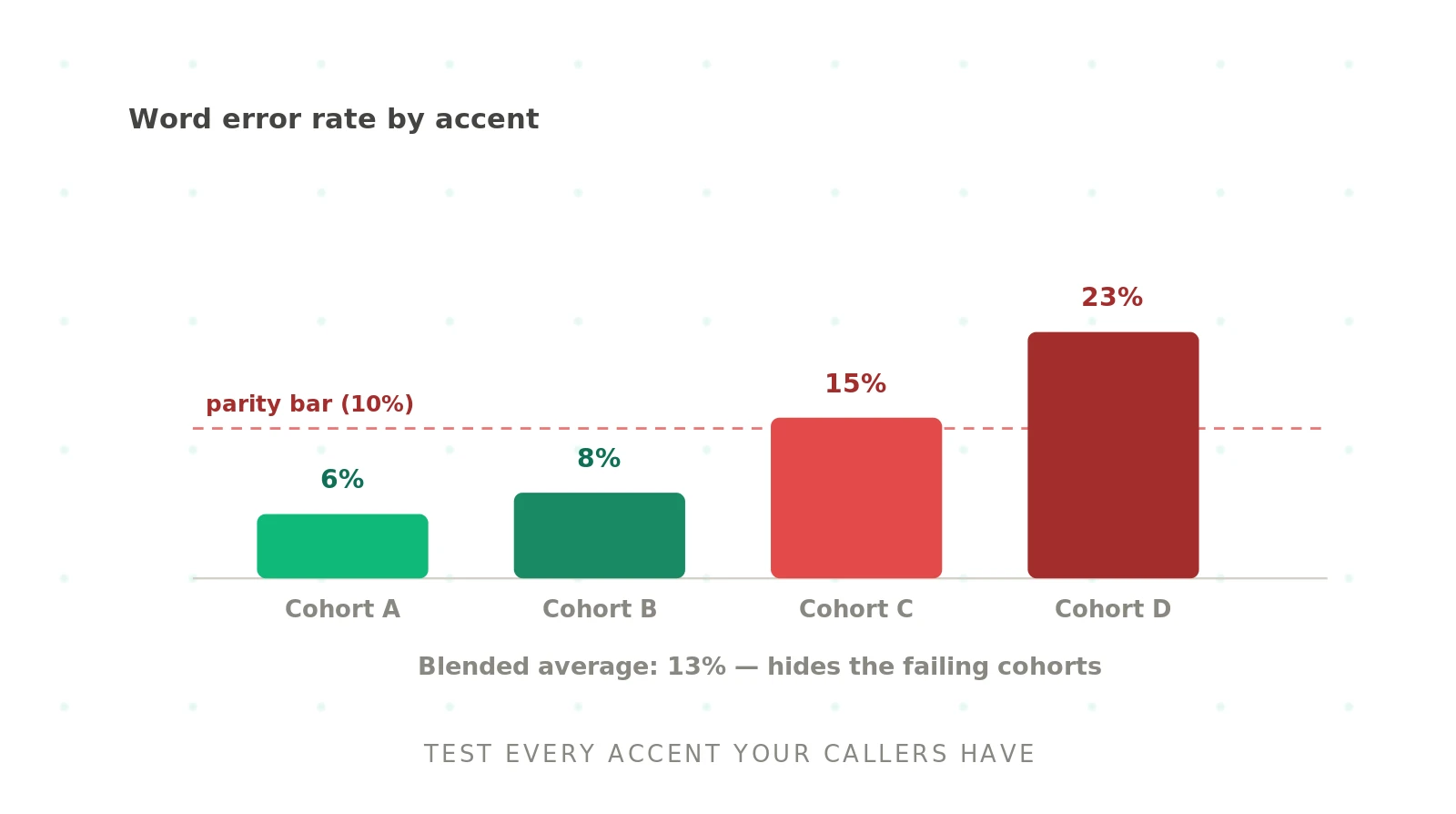
A voice agent that works for one accent and fails for another is not one agent — it is a good experience for some callers and a broken one for others. That gap hides inside a blended accuracy number. Evalgent tests per cohort. Here is how accent handling fails and how to test it.
Accent handling: a voice agent's ability to understand callers accurately across a range of accents and dialects, not just the ones its speech-to-text was tuned on.
What poor accent handling looks like
These are the symptoms on a real call:
- Higher word error rate for some accents than others.
- The agent mishears intents from non-native speakers.
- It asks certain callers to repeat themselves constantly.
- It fails on regional dialects it was never tested against.
- Blended accuracy looks fine while specific cohorts fail.
The failure is uneven. The agent works for the accents it was tested on and struggles with the rest.
Why accent handling fails
Accent handling fails when testing does not match the real caller base. A single benchmark hides the cohorts that struggle. The table maps each cause to what you hear and how to fix it.
| Cause | How it shows on a call | Fix |
|---|---|---|
| STT tuned on few accents | Poor accuracy outside them | Pick accent-robust speech-to-text; test candidates on your accents |
| No accent diversity in tests | Cohorts fail unseen | Test across the accents your callers actually have |
| Blended metric only | A low average hides bad cohorts | Report accuracy per accent cohort |
| Telephony compounds it | Narrowband worsens accented audio | Test on real call audio, not clean studio samples |
| No domain vocabulary | Names and terms break per accent | Add domain vocab; re-test each cohort |
| No fallback for misses | Repeated mishearing with no recovery | Add graceful re-prompts and confirmation |
How to test accent handling in AI voice agents
1. Map your caller accents — List the accents and dialects in your real caller base.
2. Build accent profiles — Create a caller profile per accent, on realistic call audio.
3. Run the same scenarios — Drive identical tasks across every cohort for a fair comparison.
4. Measure per cohort — Report word error rate and intent accuracy per accent, never only blended.
5. Set a parity bar — Flag any cohort that falls below your accuracy threshold.
6. Fix and re-test — Add vocabulary or change speech-to-text, then re-run every cohort together.
A worked example
A support agent shipped with 94% intent accuracy and looked ready. The number was a blend. Split by accent, US and UK callers were near 97%, but Indian-English callers sat at 82% and kept being asked to repeat. The blended average had hidden a cohort that was failing badly. Per-cohort testing exposed it, and adding accent-diverse audio plus domain vocabulary closed most of the gap before launch.
Testing accent handling with Evalgent
Evalgent tests accent handling by cohort, on realistic call audio. Profiles represent the accents in your caller base, so each is tested as a distinct group rather than blended away. Scenarios run identical tasks across every cohort, making the comparison fair. Metrics report word error rate and intent accuracy per accent, with a parity threshold you set, so a failing cohort is flagged, not hidden. Evaluations run the full matrix as batches of synthetic callers before release. Reviews let you replay a struggling cohort's calls and hear where it broke. This builds on word error rate and pairs with how to improve WER.
The bottom line
Accent handling fails unevenly, and a blended accuracy number hides the cohorts that struggle. Test the same scenarios across every accent your callers have, measure accuracy per cohort, and hold each to a parity bar before you ship.
Frequently asked questions
What is accent handling in a voice agent?
Accent handling is how accurately a voice agent understands callers across different accents and dialects. It depends mostly on the speech-to-text layer, which is often tuned on a limited range of accents. Good accent handling means comparable accuracy across cohorts; poor handling means some callers are understood well and others are misheard repeatedly.
Why does my voice agent struggle with certain accents?
Usually because its speech-to-text was trained or tuned on a narrow set of accents, so speech outside that range raises the error rate. Telephony makes it worse by stripping audio detail. Without testing across the accents your callers actually have, these gaps stay hidden behind a blended average until real callers hit them.
How do you test a voice agent across accents?
Build a caller profile for each accent in your base, on realistic call audio, and run the same scenarios across all of them. Measure word error rate and intent accuracy per cohort rather than blended, and set a parity threshold. Any cohort below it needs work — usually accent-diverse audio, domain vocabulary, or a different speech-to-text model.
Why is per-cohort accuracy better than an average?
Because a blended average can look healthy while a specific accent cohort fails badly. If most callers score high, a struggling minority barely moves the overall number. Reporting accuracy per accent surfaces the cohorts that are being misheard, so you fix the real gaps instead of trusting a figure that hides them.
Does telephony make accent handling worse?
Yes. Phone lines use narrowband codecs that strip detail from the audio, and that loss compounds the challenge of an unfamiliar accent. A model that handles an accent on clean studio audio can struggle with the same accent over a real call. Always test accent handling on realistic telephony audio, not clean samples.
How do you improve accent handling?
Choose speech-to-text that is robust across your accents, tested on your own call audio rather than vendor benchmarks. Add domain vocabulary so names and terms survive per cohort, and add graceful re-prompts for misses. Then re-test every cohort together, since a change that helps one accent can affect another.
What metrics measure accent handling?
Track word error rate and intent accuracy, broken down per accent cohort, plus task completion by cohort. The key is the breakdown: a single blended metric hides disparities. Set a parity threshold so no cohort falls too far below the best-performing one, and use it as a release gate to prevent shipping an uneven experience.
How many accents should you test?
Test the accents that actually appear in your caller base, prioritized by volume and by business risk. There is no universal number — a domestic line may need a handful, a global product many more. The goal is coverage of your real callers, not every accent in existence, with the highest-volume and highest-stakes cohorts first.
Related guides
How to test tool calling in AI voice agents
Tool calling fails when a voice agent picks the wrong function, fills bad arguments, or acts silently. Learn how to test tool calling and catch it.
How to reduce latency in AI voice agents
Voice agent latency is the pause before the agent replies. Learn what drives it, what a good target is, and how to reduce latency without losing quality.