WER vs CER: what's the difference for voice agents?
On this page
WER and CER measure the same thing — how far a transcript is from the truth — but at different granularities, and the choice changes what you see. Report only WER and a one-digit miss in an account number looks like a total failure; report only CER and you can lose sight of overall readability. For a voice agent, where names and numbers are load-bearing, knowing which to use is the difference between a useful accuracy number and a misleading one. Evalgent measures both, and this guide draws the line.
WER (word error rate): the share of words a transcript gets wrong, measured as word-level substitutions, deletions, and insertions divided by the total words spoken.
CER (character error rate): the same measure at the character level — character edits divided by total characters.
WER vs CER: the core difference
Both come from edit distance — the number of changes needed to turn the transcript into the reference — but they count in different units. WER counts whole words; CER counts individual characters.
| Dimension | WER | CER |
|---|---|---|
| Unit | Whole words | Individual characters |
| Best for | General readability, English prose | Numbers, IDs, names, spellings |
| Granularity | Coarse | Fine |
| A one-character slip | Whole word counts as wrong | Counts as a single character error |
| Languages | Clear word boundaries | Works without word boundaries |
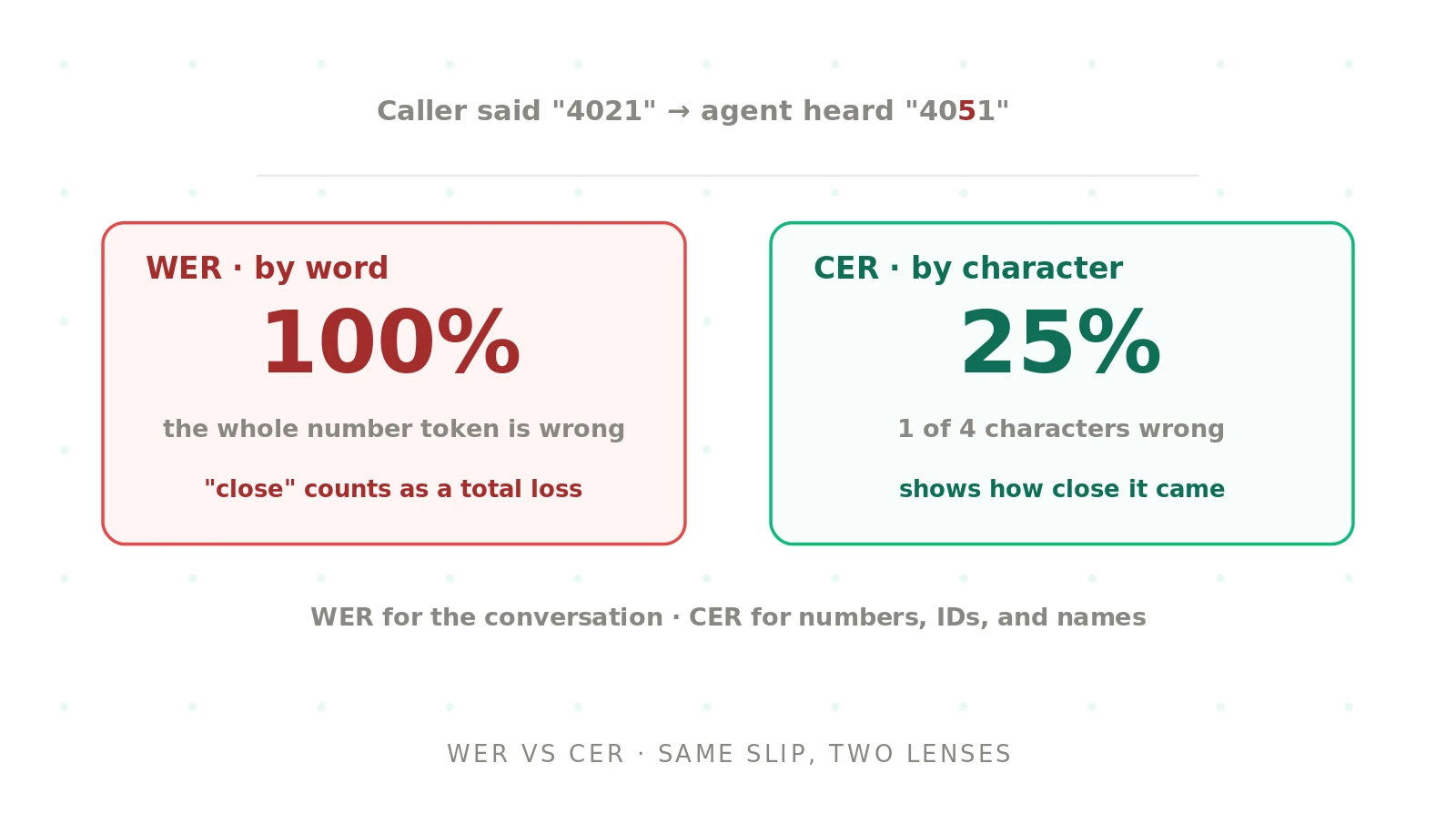
The practical consequence is how each treats a near-miss. If the agent hears "4051" instead of "4021," WER counts that number token as entirely wrong, while CER sees one character out of four. Same error, very different score — and which is more honest depends on what you are measuring.
When to use each
Use WER as your headline metric for general transcription quality, especially conversational English where whole-word correctness maps to readability. It is the industry standard, it is what most benchmarks report, and it answers "how accurate is the transcript overall?" Our full word error rate guide covers it in depth.
Use CER where characters carry the meaning. Account numbers, order IDs, confirmation codes, and spelled-out names are the cases where one wrong character breaks the outcome and WER either overstates the damage or hides it in aggregate. CER also matters for languages without clear spaces between words, where word-level counting does not cleanly apply. In a voice agent, the rule of thumb is: WER for the conversation, CER for the fields that must be exact.
Why one wrong character looks so different
The reason to hold both is that a single character behaves differently under each metric, in both directions. On a short critical field — a four-digit code — one wrong character is a full word error, so WER reads as 100% on that field while CER reads as 25%. WER makes a near-miss look like a total loss.
In the other direction, a scattering of one-character slips across a long passage can barely move WER if they fall on unimportant words, while CER surfaces them. Neither metric is wrong; they answer different questions. WER tells you how many words the agent got wrong; CER tells you how close it came, character by character. For fields where "close" still fails — an account number off by one — that difference is the whole game, a point our pronunciation guide echoes for names and numbers.
How to measure WER and CER for a voice agent
Report the metric that fits each part of the transcript, not one number for everything.
1. Normalize first — Lowercase and strip punctuation for both, so formatting differences do not count as errors.
2. Use WER for the conversation — Compute word error rate on the general spoken content as your headline accuracy.
3. Use CER for exact fields — Compute character error rate on numbers, IDs, codes, and spelled names.
4. Break it down by field — Report accuracy per field type, since a good overall WER can hide a bad number-recognition rate.
5. Test on your conditions — Measure both on noisy, accented, and telephony audio, not clean read speech.
6. Gate on what matters — Set thresholds per field: a stricter one for account numbers than for chit-chat.
A worked example
A caller reads their account number, "4021," and the agent transcribes "4051." As a word, the number token is entirely wrong, so WER on that field is 100% — the agent failed completely, by that measure. As characters, three of four are correct, so CER is 25% — a near-miss on one digit. Both are true. If your flow needs the exact number, the WER framing is the honest one: close is still wrong. If you are diagnosing how the recognizer degrades, CER tells you it was one digit off, not gibberish. Same slip, two lenses — pick the one that matches the decision you are making.
Testing WER and CER with Evalgent
Evalgent measures transcription accuracy at the granularity each field deserves. Scenarios drive realistic calls that include the load-bearing fields — account numbers, codes, spelled names — where character-level accuracy decides the outcome. Profiles vary accent, noise, and telephony conditions, since that is where both WER and CER climb. Metrics report word error rate for the conversation and character error rate for exact fields, broken down by field type, with per-field thresholds you set. Evaluations run the checks as automated batches before release, and Reviews let you replay a call and hear exactly which digit or letter the recognizer missed.
The result is an accuracy picture that does not mislead: a headline WER for readability, and a CER on the fields where one character is the difference between a completed task and a failed one. For the wider method, see the STT evaluation guide and the AI voice agent testing pillar.
The bottom line
WER counts errors by word; CER counts them by character. WER is the standard headline metric for overall transcription quality, while CER is the finer measure for numbers, names, and languages without word boundaries — the fields where a single character decides the outcome.
Use both. Report WER for the conversation and CER for the exact fields, because one wrong digit in an account number is either a total failure or a near-miss depending on which lens you use, and your callers care about the one that matches the task.
Frequently asked questions
What is the difference between WER and CER?
WER, word error rate, measures transcription errors at the word level — substitutions, deletions, and insertions of whole words over total words. CER, character error rate, measures the same idea at the character level. WER is the standard headline accuracy metric; CER is finer and better for numbers, names, and languages without clear word boundaries, where a single character can matter.
When should you use CER instead of WER?
Use CER for parts of the transcript where individual characters carry the meaning: account numbers, order IDs, confirmation codes, and spelled-out names. It is also better for languages without clear spaces between words. In those cases one wrong character breaks the outcome, and WER either overstates the error as a whole wrong word or hides it in the overall average.
Is WER or CER better for voice agents?
Neither is universally better; they answer different questions. WER is the right headline metric for conversational readability, and CER is the right measure for exact fields like numbers and names. The best practice for a voice agent is to use both — WER for the general conversation and CER for the load-bearing fields — and report accuracy per field type rather than one blended number.
Why does one wrong character give a high WER but a low CER?
Because WER counts whole words. On a short field like a four-digit code, a single wrong character makes the entire token wrong, so WER reads 100% on that field while CER reads 25%. WER treats a near-miss as a total loss because its unit is the word; CER, counting characters, shows the transcript was only one character off.
How do you calculate CER?
Character error rate is the number of character-level edits — substitutions, deletions, and insertions — needed to turn the transcript into the reference, divided by the number of characters in the reference. It uses the same edit-distance idea as WER, just at the character level. Normalize case and punctuation first, so formatting differences are not counted as errors.
Does CER replace WER?
No. CER supplements WER rather than replacing it. WER remains the standard headline metric for overall transcription quality and readability, and it is what most benchmarks report. CER adds a finer view for the specific fields where character accuracy matters. Using both gives a complete picture; using only CER would lose the word-level readability signal WER provides.
Which metric matters for account numbers and names?
Character error rate is usually more informative for account numbers, codes, and spelled names, because it shows how close the transcript came character by character. But if your flow needs the exact value, the verdict is still pass or fail — an account number off by one digit is wrong regardless of CER. Measure with CER, but gate on exact-match for fields that must be perfect.
How do you test transcription accuracy for a voice agent?
Measure WER on the general conversation and CER on exact fields like numbers and names, broken down by field type, and do it on realistic audio — noisy, accented, and over telephony — not clean read speech. Set per-field thresholds, stricter for account numbers than for casual speech, and gate releases on them so a strong overall WER cannot hide a weak number-recognition rate.
Related guides
Testing vs evaluation for voice agents: what's the difference?
Testing and evaluation for voice agents are related but distinct: testing verifies behavior pass/fail, evaluation measures quality. Here's how they differ.
VAD vs endpointing: what's the difference in a voice agent?
VAD detects whether someone is speaking; endpointing decides when they've finished. Learn the difference and why confusing them cuts callers off.