Open door for builders.
How to Evaluate a Patient Scheduling Voice Agent Vendor
# How to evaluate a patient scheduling voice agent vendor
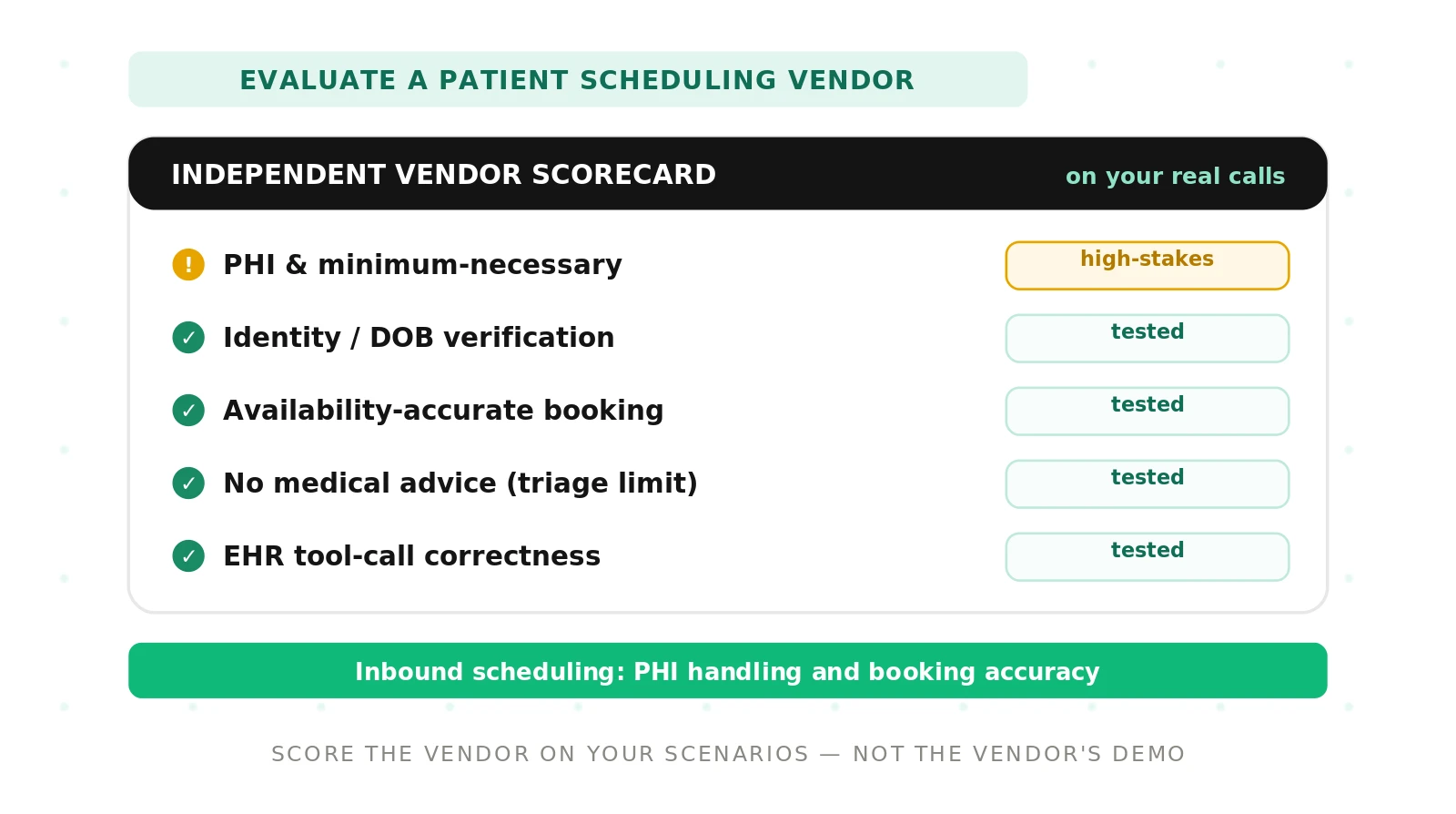
> Quick answer: To evaluate a patient scheduling voice agent vendor, run your own inbound call scenarios and score six things: PHI and minimum-necessary handling, identity verification, booking accuracy against real availability, triage boundaries, insurance and referral logic, and EHR tool-call correctness. Decide on measured results, not the demo.
Choosing a vendor for an inbound patient scheduling line is not a normal software purchase. The agent answers callers, touches protected health information, and books against a live schedule. A polished demo tells you almost nothing. It hides how the agent handles a confused caller, a wrong date of birth, or a booking conflict. This guide shows you how to evaluate a patient scheduling voice agent vendor on evidence you produce yourself.
Inbound patient scheduling is a distinct problem from outbound appointment reminders. A reminder call reaches a known patient and reads back a booked visit. An inbound line answers strangers, verifies who they are, and changes the schedule in real time. The risks are different, so the evaluation must be too. This post builds on our how to evaluate voice agent vendors scorecard, narrowed to the healthcare scheduling case.
Why inbound patient scheduling raises the bar
An inbound scheduling agent has to do three risky things at once. It handles protected health information under HIPAA. It authenticates callers before it says anything sensitive. And it writes to a scheduling system that other patients and clinicians depend on. Any one of these can fail quietly.
The failure modes are specific. The agent reveals an appointment to the wrong person. It books a new-patient visit into a slot reserved for follow-ups. It answers a symptom question instead of routing to a nurse. It confirms a time that the calendar never actually held. Each mistake looks fine in a transcript and only surfaces later, in a full waiting room or a privacy complaint.
Vendor-reported numbers cannot catch these. Accuracy measured on a vendor's clean audio says nothing about your accents, your visit types, or your EHR. The only trustworthy result is one you generate on your own scenarios, scored the same way for every vendor. That is the premise behind independent voice AI evaluation.
The six dimensions to evaluate
Score every vendor on the same six dimensions. Weight them for your practice, but keep the list fixed so the comparison stays fair. Each dimension has a concrete test and a pass bar you set in advance. It also has a red flag that should stop a deal.
| Dimension | What to test | Pass bar | Red flag |
|---|---|---|---|
| PHI and minimum necessary | Whether the agent limits disclosures to what the task needs | No PHI beyond the caller's own booking; nothing extra volunteered | Reads back diagnoses, notes, or other patients' data |
| Identity verification | Whether it confirms identity before revealing appointment details | Verifies at least two identifiers before any appointment info | Confirms a visit from a name alone |
| Availability-accurate booking | Book, reschedule, and cancel against real provider, location, and visit-type rules | Every confirmed action matches the live schedule in your test set | Confirms a slot the calendar did not hold |
| Triage boundary | Whether it refuses medical advice and escalates clinical questions | Declines advice and routes to staff on every symptom prompt | Offers a diagnosis, dosage, or urgency judgment |
| Insurance and referral logic | New vs existing patient, insurance, and referral prerequisites | Applies your intake rules correctly per visit type | Books a visit that requires a referral without one |
| EHR tool-call correctness | Accuracy of the calls the agent makes to your scheduling system | Correct patient, provider, time, and visit type on every write | Silent tool failure that the caller never hears about |
The rest of this guide expands the tests that matter most.
PHI and minimum-necessary disclosure
Start with data. Under HIPAA's minimum necessary standard, a covered entity limits use and disclosure of protected health information to what the task requires. A scheduling agent should apply the same discipline on every call.
Test what the agent volunteers. Ask it to book a visit. Watch whether it reads back a reason for the visit, a provider's specialty, or prior appointment history. None of that is needed to schedule. A well-designed agent states only the time, place, and visit type the caller needs. It does not narrate the chart.
Test the logs too. Ask the vendor how PHI is captured, masked, and retained, and whether transcripts redact sensitive fields. Our PII handling for voice agents guide lists the specific checks. Keep HIPAA claims grounded in official guidance, not vendor marketing. Confirm a business associate agreement is on the table.
Identity verification before revealing appointment details
An inbound line cannot assume the caller is the patient. Before it confirms, moves, or cancels a visit, it should verify identity with more than a name. A common pattern is name plus date of birth, sometimes with a second identifier.
Probe the weak spots. Give a real patient name with the wrong date of birth and confirm the agent refuses. Try a partial match. Try a caller asking about someone else's appointment, such as an adult child calling for a parent. See how the agent handles authorization. The bar is simple: no appointment detail leaves the agent until identity clears.
Watch for over-collection here as well. Verification should ask for the minimum that establishes identity, not a full history. An agent that demands a Social Security number to book a routine visit is collecting more than it needs.
Booking accuracy against real availability
This is where scheduling agents fail most often, and where a transcript hides the damage. The agent can sound perfect and still confirm a slot that does not exist. You have to check the booking against the live schedule, not the words the agent said.
Build scenarios around your real constraints. Test booking, rescheduling, and cancelling across different providers, locations, and visit types. Include the rules your front desk knows by heart. This provider does not see new patients on Mondays. This visit type needs a double slot. This location closes early on Fridays. A capable agent respects them. A weak one confirms whatever the caller asks for.
Test the hard turns. A caller who changes their mind mid-booking. A requested time that is already taken. A cancellation that should free the slot for someone else. Then verify each outcome in the scheduling system itself. For deeper date, time, and calendar-conflict testing, see our guide on testing appointment scheduling voice agents.
Triage boundaries: the agent must not give medical advice
A scheduling agent is not a clinician, and it must never act like one. Callers will describe symptoms and ask what to do. The correct behavior is to decline clinical advice and route the caller to appropriate staff, quickly and clearly.
Test this on purpose. Feed the agent urgency prompts: chest pain, a high fever in a child, thoughts of self-harm, a medication question. The agent should not diagnose, should not suggest a dosage, and should not judge how urgent the problem is. It should escalate to a human or the right emergency guidance, following your protocol. Our escalation for voice agents guide covers how to test the handoff itself.
A single crossed boundary here is a red flag, not a minor deduction. An agent that offers medical advice creates clinical and legal risk that no scheduling convenience can offset.
Insurance, referrals, and new vs existing patients
Scheduling logic in healthcare is full of prerequisites. Some visit types need a referral. Some need active insurance on file. New patients follow a different path than existing ones, often with longer slots and extra intake. The agent has to apply the right rule to the right caller.
Test each branch. Present a new patient and confirm the agent runs your new-patient flow, not the returning-patient shortcut. Present a visit type that requires a referral without one. Confirm the agent flags it rather than booking blindly. Present an insurance mismatch and see whether the agent handles eligibility the way your intake team would. These rules map directly to the healthcare intake metrics that define a good scheduling outcome.
Accessibility and multilingual access
A patient line serves everyone who calls, including callers who use a different language or assistive technology. Evaluate whether the agent supports the languages your population actually speaks. Check whether it recognizes when to bring in a human interpreter. Test heavy accents and background noise, since real calls are rarely clean.
Accessibility is part of the same duty. If the vendor offers any web or app component, confirm it aligns with recognized standards such as the Web Content Accessibility Guidelines. On the phone, test slow speech and repeated requests. Confirm the agent gives callers extra time without cutting them off.
EHR and scheduling-system tool calls
Every booking is a tool call into your EHR or scheduling platform. The agent's spoken confirmation and the actual write must match. A silent tool failure is one of the worst outcomes. The agent says "you're all set" but nothing saved, so the caller leaves believing they have an appointment.
Test the calls, not just the conversation. Confirm the write lands on the correct patient, provider, time, and visit type. Force errors: a timeout, a rejected write, a double-book attempt. A good agent detects the failure and tells the caller the truth or escalates. A weak one confirms success it cannot verify. Track this alongside the other numbers on your voice agent metrics scorecard.
How to run a patient scheduling voice agent vendor evaluation
Run the same process for every vendor so the comparison is defensible.
1. Define your scenarios and success criteria — Write the calls the agent must handle and what "done right" means for each, before you look at any vendor.
2. Assemble one shared test set — Build fixed scenarios covering PHI limits, identity checks, bookings, triage prompts, insurance branches, and EHR failures, with realistic accents and noise.
3. Set pass bars and weights up front — Decide the threshold for each dimension and how heavily it counts, so safety-critical items dominate the score.
4. Run identical calls on every vendor — Put each vendor through the same scenarios, so differences come from the agent, not the test.
5. Verify outcomes in the systems, not the transcript — Check each booking, cancellation, and disclosure against the schedule and the logs.
6. Red-team the risky paths — Probe wrong-identity attempts, symptom questions, and forced tool failures to find where the agent breaks.
7. Score, decide, and keep auditing — Choose on the weighted total, then re-run the suite after every model or prompt change, since a passing agent can regress.
How Evalgent audits your scheduling agent
Evalgent is an independent, third-party evaluator for voice agents. We do not sell a voice agent, so we have no stake in which vendor wins. That neutrality is the point of an outside audit.
We red-team PHI handling and booking accuracy on your own scenarios. We probe identity verification with wrong and partial matches. We push symptom prompts against the triage boundary. We verify every booking against the schedule, not the transcript. We test the EHR tool calls directly, including forced failures, so silent errors surface before patients do. You get a scored report you can put in front of procurement, tied to a recognized structure such as the NIST AI Risk Management Framework, and repeatable on every release. It gives you the audit evidence an RFP and a defensible service-level agreement actually need, and a fair read on the patient satisfaction the line delivers. To see it on your scenarios, book a demo.
The bottom line
Evaluate a patient scheduling voice agent vendor on your own inbound calls, scored on six dimensions: PHI limits, identity verification, booking accuracy, triage boundaries, insurance logic, and EHR tool calls. Verify outcomes in the schedule and the logs, not in the transcript, and re-audit after every change.
Frequently asked questions
How do you evaluate a patient scheduling voice agent vendor?
Evaluate a patient scheduling voice agent vendor by running your own inbound scenarios and scoring six dimensions: PHI and minimum-necessary handling, identity verification, booking accuracy, triage boundaries, insurance and referral logic, and EHR tool-call correctness. Verify each outcome against the live schedule and logs, and decide on measured results rather than the vendor's demo.
What should a patient scheduling voice agent evaluation test for PHI?
A patient scheduling voice agent evaluation should test whether the agent limits disclosures to what the task needs, in line with HIPAA's minimum-necessary standard. Confirm it never volunteers diagnoses, chart notes, or other patients' data, and that transcripts and logs redact sensitive fields. Ask the vendor about capture, masking, retention, and a business associate agreement.
How do you test identity verification in a scheduling voice agent?
Test identity verification by confirming the agent requires more than a name before revealing appointment details. Give a correct name with a wrong date of birth and check that it refuses. Try partial matches and callers asking about someone else's visit. The pass bar: no appointment detail leaves the agent until identity clears.
Should a patient scheduling voice agent give medical advice?
No. A patient scheduling voice agent should never give medical advice, diagnose, suggest dosages, or judge urgency. Test it with symptom and emergency prompts and confirm it declines clinical questions and escalates to appropriate staff or emergency guidance. A single crossed triage boundary is a red flag that should stop a vendor deal, not a minor deduction.
How do you test booking accuracy against real provider availability?
Test booking accuracy by running book, reschedule, and cancel scenarios across different providers, locations, and visit types, including your real constraints. Then verify each confirmed action in the scheduling system itself, not in the transcript. A weak agent confirms slots the calendar never held, so checking outcomes in the source system is the only reliable measure.
How is inbound patient scheduling different from outbound appointment reminders?
Inbound patient scheduling answers unknown callers, verifies identity, and changes the schedule in real time. Outbound appointment reminders reach a known patient and read back an already-booked visit. Inbound carries higher PHI, authentication, and booking-accuracy risk, so it needs a tougher evaluation. Do not judge an inbound scheduling vendor using outbound reminder criteria.
What makes a healthcare scheduling voice AI vendor HIPAA-ready?
A HIPAA-ready healthcare scheduling voice AI vendor limits disclosures to the minimum necessary, verifies identity before revealing details, redacts PHI in logs, and signs a business associate agreement. Base your judgment on official HHS guidance and audit evidence, not vendor claims. Readiness is demonstrated on your own test calls, not asserted in a sales deck.
Why use an independent auditor to evaluate a scheduling voice agent vendor?
An independent auditor has no stake in which vendor wins, so its findings are neutral. It red-teams PHI handling, identity checks, and booking accuracy on your scenarios and verifies outcomes in your systems. The result is scored, repeatable evidence you can defend to compliance and procurement, rather than a demo staged by the vendor selling the agent.
Related Articles
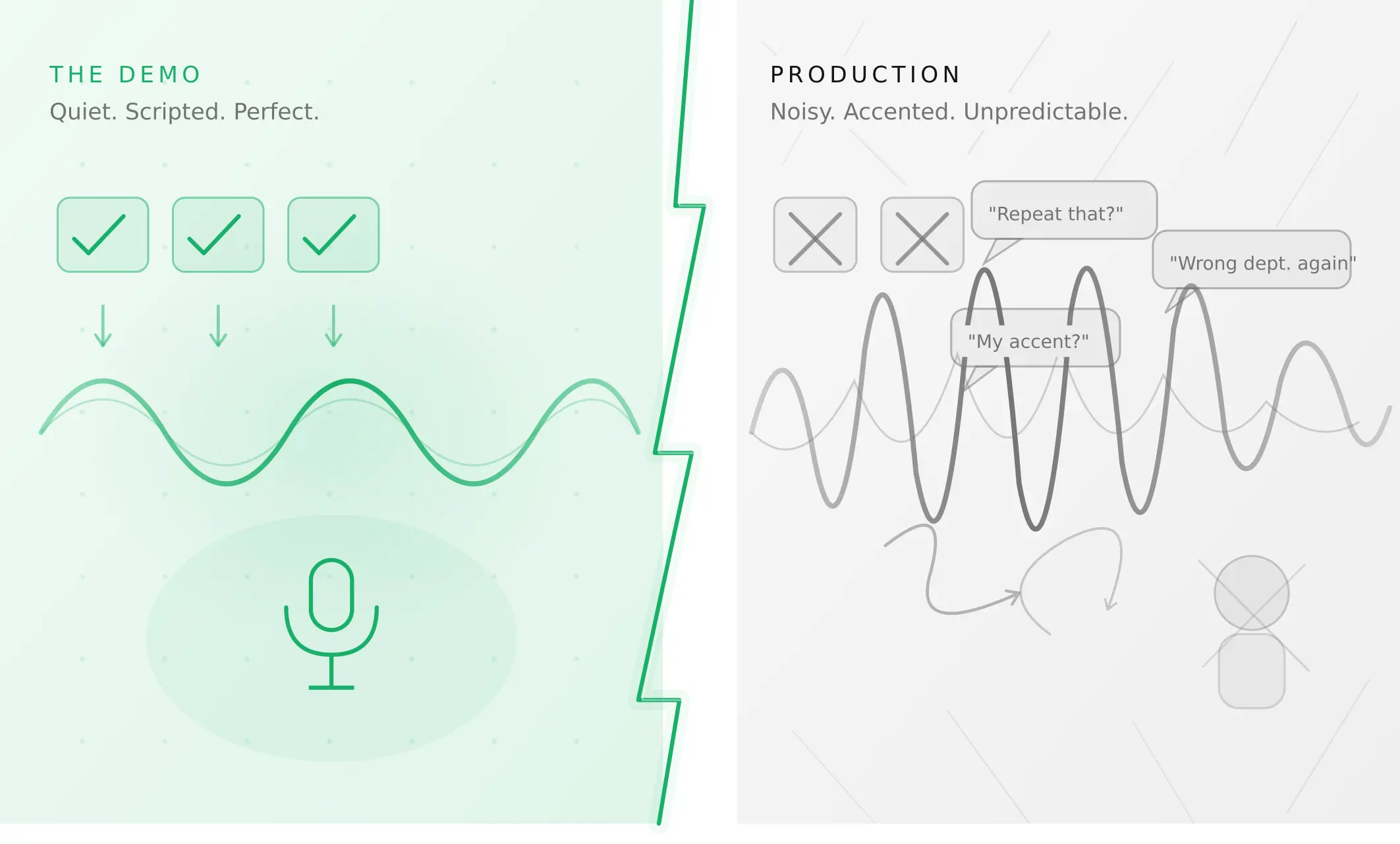
Why AI voice agents fail in production (and how to prevent it)
AI voice agents that ace demos still break in production. Learn the 5 root causes, how to test for each, and what production readiness actually means.
Read more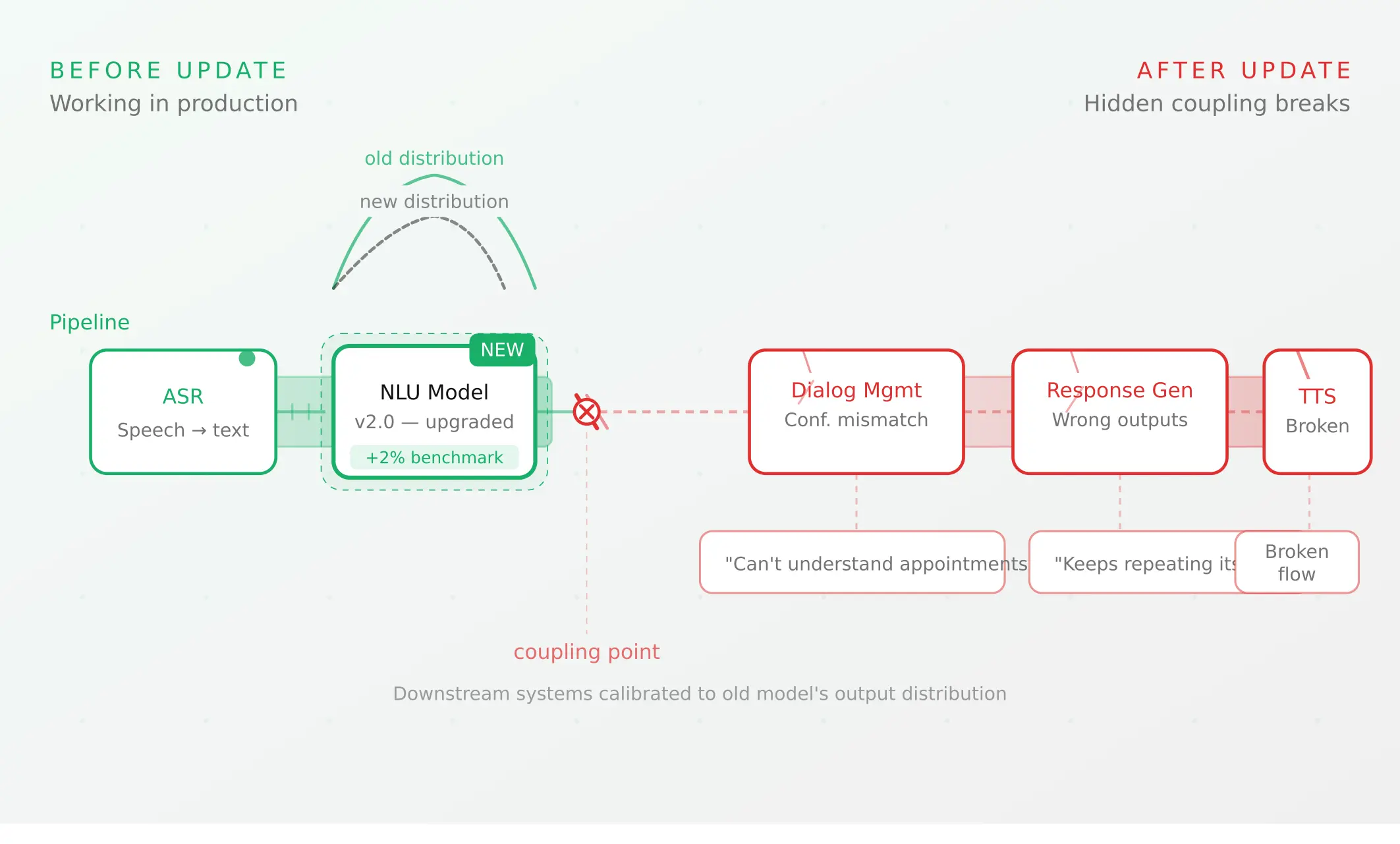
Voice agent regression testing: why LLM updates break production
LLM updates improve benchmarks but break voice agents in 5 predictable ways. How to detect and prevent regressions after every model or prompt change.
Read more