Test your voice agent
How to Measure Deflection Rate for Voice Agents
# How to Measure Deflection Rate for Voice Agents
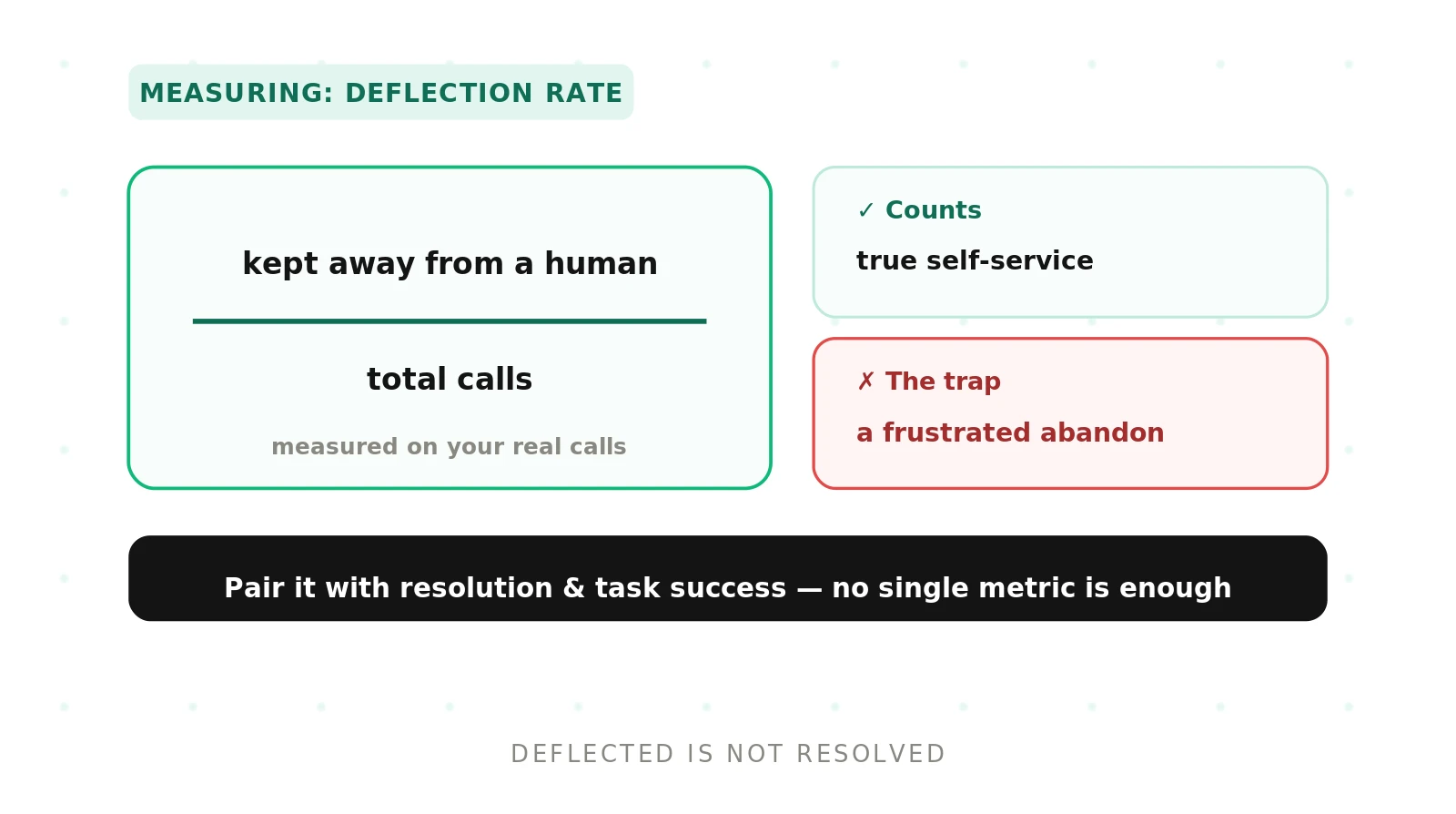
> Quick Answer: Deflection rate is the share of calls a voice agent keeps away from a human. Measure it by dividing self-service calls by total eligible calls. Report it beside resolution and repeat-contact rate. A caller who hangs up in frustration also deflects, so deflection alone can rise while service gets worse.
Deflection rate looks like a clean number. It counts the calls your voice agent handled without a human. Finance loves it because it maps straight to headcount. Vendors love it because it goes up and to the right.
The problem is what it hides. A caller who gets an answer and hangs up satisfied is deflected. A caller who gives up in frustration and hangs up is also deflected. The two look identical in the raw count. Only one of them is a good outcome.
This post shows how to measure deflection rate for voice agents without fooling yourself. We cover how to define the denominator, how to separate real self-service from abandonment, and why deflection must always be reported next to resolution and repeat-contact rate. Evalgent is the independent evaluator here, so the focus stays on the measurement, not the pitch.
What deflection rate actually measures
Deflection rate measures avoidance, not success. It answers one question: did this call stay away from a human agent? That is a cost question. It tells you how much human labor the agent displaced.
The concept comes from self-service in customer operations. The goal is cost reduction: every call the machine absorbs is a call a person does not have to take. On that narrow axis, deflection is a fair measure. More deflected calls means fewer routed to staff.
But avoidance is not service. A call can avoid a human and still fail the caller. The number treats a solved problem and a rage-quit hang-up as the same event. That is the trap. Deflection is a key performance indicator for cost, and a poor one for quality.
So treat deflection as an efficiency signal, never a satisfaction signal. It belongs on the cost side of your scorecard. It says nothing on its own about whether callers left happy. For the full metric set, see our voice agent metrics scorecard.
Deflection is not resolution
This is the distinction that saves you. Deflection means the call stayed away from a human. Resolution means the caller's problem got solved. They are different questions, and they diverge more often than teams expect.
A call can deflect without resolving. The agent stalls, the caller sighs and hangs up, and the transfer never fires. That counts as deflected. Nothing was resolved. The caller may now call back, open a chat, or churn.
A call can also resolve without full deflection. The agent solves the core issue, then warm-transfers one edge case to a person. Deflection dips. Resolution holds. That is often the right trade.
Our containment vs deflection guide defines these terms in depth. This post assumes you know them and moves to the harder job: measuring deflection so a rising number cannot hide a worse experience. The rule is simple. Deflection tells you what you avoided. Resolution tells you what you achieved. You need both.
The four outcomes behind a deflected call
Every call that avoided a human ended in one of four ways. The raw deflection count blends them into one figure. To read deflection honestly, you have to split them apart.
The table below lists each outcome, whether it counts as deflection in a naive tally, and the honest read of what actually happened. Notice that three of the four count as deflection, yet only one is a clean win.
| Deflection outcome | Counts as deflection? | The honest read |
|---|---|---|
| Self-served | Yes | True win. Caller got the answer and left satisfied. |
| Abandoned | Yes | False win. Caller gave up. Problem unsolved. |
| Repeat later | Yes | Hidden cost. Caller returns through another channel. |
| Escalated | No | Honest miss. Agent handed the call to a person. |
The danger sits in rows two and three. Abandoned and repeat-later calls inflate deflection while the caller is worse off. An agent that frustrates people into hanging up will post a beautiful deflection rate. Escalation, the one outcome that does not count as deflection, is often the most honest thing the agent can do.
This is why a single deflection number is dangerous. Move callers from escalated into abandoned and deflection rises. The experience collapses. The chart still points up.
How to measure deflection rate without fooling yourself
Honest measurement is mostly discipline about what you count and what you report alongside it. Follow these steps in order.
1. Define the denominator first. Decide which calls are eligible for deflection before you count anything. Exclude wrong numbers, silent robocalls, and requests the agent was never scoped to handle. A denominator that quietly grows or shrinks can move the rate without any real change.
2. Classify every call by outcome. Tag each call as self-served, abandoned, repeat later, or escalated, using the four buckets above. Do not collapse them into "handled by the agent." The blend is where the lie lives.
3. Separate self-service from abandonment. Set clear rules for a satisfied hang-up versus a frustrated one. Use signals like task completion, time on the failing step, repeated retries, and sentiment near the end of the call. When you cannot tell, review the audio.
4. Compute the rate. Divide true self-served calls by eligible calls for your headline deflection rate. Report the raw "no human" rate separately so the gap between the two numbers is visible.
5. Pair it with guardrail metrics. Publish resolution rate and repeat-contact rate on the same line as deflection. A deflection rise that comes with falling resolution or rising repeat contacts is a red flag, not a win.
6. Segment by intent. Break the rate down by call reason. A password reset deflects easily. A billing dispute should not. A blended average hides which intents are actually being served.
7. Audit a sample independently. Have someone outside the build team listen to a random sample and re-tag outcomes. Self-reported classification drifts toward optimism. An independent evaluation keeps the labels honest.
Run these steps every reporting period. The goal is not a higher number. It is a number you can trust and defend.
Defining the denominator so the rate means something
The denominator is where most deflection numbers go wrong. Deflection rate is a fraction. Change the bottom of the fraction and the rate moves even when behavior does not. So decide the denominator before you look at any results.
Start with total inbound calls the agent could plausibly serve. Then remove the noise. Wrong numbers, dropped connections, and silent lines are not deflection opportunities. Neither are calls for services the agent was never built to handle. Counting those punishes the agent for problems outside its scope.
Be careful with the opposite move too. Do not shrink the denominator to only the calls the agent handled well. That is circular. It guarantees a high rate and measures nothing. The denominator must include the calls the agent failed, or the metric is theater.
Write the denominator rule down and freeze it across periods. If you change it, restate prior periods on the new basis. This is basic funnel analysis hygiene. When the base moves silently, every rate built on it becomes unreadable. A stable, documented denominator is what lets you compare month to month and vendor to vendor. See how we benchmark voice agents on your own data for the full method.
Why deflection is the most gameable metric in the stack
Deflection is easy to move without improving anything. That makes it the most gameable metric a voice agent reports. The reason is structural: the metric rewards avoiding humans, and there are cheap ways to avoid humans that hurt callers.
The bluntest tactic is to make escalation hard. Bury the "agent" option. Loop the menu. Add friction to every transfer. Callers who would have escalated now hang up instead. Escalation falls. Deflection rises. Nobody was served.
A subtler tactic is over-answering. The agent confidently gives a wrong answer, the caller believes it and hangs up, and the call books as self-served. The failure surfaces later as a callback or a complaint, far from the deflection dashboard. The cost moved; it did not disappear.
This is Goodhart's law in action: when a measure becomes a target, it stops being a good measure. Optimize deflection directly and you get more deflection and worse service. There is also a survivorship bias problem. Deflected calls are the ones that did not reach a human, so the humans who could flag failures never hear them. The failures hide in the gaps.
The defense is not to abandon deflection. It is to never let it stand alone. Guardrail metrics remove the payoff from gaming, because the cheap tricks that lift deflection also drag resolution down and push repeat contacts up.
Report deflection with resolution and repeat-contact rate
A deflection rate on its own is a claim without evidence. Reported with two guardrails, it becomes trustworthy. Always publish three numbers together: deflection, resolution, and repeat-contact rate.
Resolution rate catches abandonment. If deflection climbs while resolution falls, callers are giving up, not getting served. The gap between the two is your abandonment problem, sized in real terms. A healthy agent moves both numbers up together.
Repeat-contact rate catches the deferred failure. Count how many deflected callers come back within a fixed window, through any channel. A high repeat rate after a deflected call means the first contact did not stick. The problem was postponed, not solved. Cost per resolved contact tells the same story from the money side, which our cost per resolution breakdown works through.
Read the three as a set. Deflection up, resolution up, repeat contacts flat or down: a real win. Deflection up, resolution down or repeat contacts up: a warning, whatever the headline says. This triangulation is the whole discipline. No single number can fake all three at once.
Escalation deserves a place too. A well-designed handoff is a feature, not a failure. Our escalation guide covers when a call should reach a human quickly. An agent that escalates the right calls, fast, often serves people better than one chasing a higher deflection score.
Measuring deflection is testing plus evaluation
Getting these numbers right takes two activities people often conflate. Testing checks whether the agent behaves correctly on known inputs. Evaluation judges the quality of outcomes across real traffic. Deflection measurement needs both.
Testing gives you controlled cases. You know the caller intent and the correct outcome in advance, so you can verify that a solved call is tagged self-served and a failed one is not. Evaluation samples live calls, where intent is messy and outcomes are ambiguous, and scores them against a rubric.
Our testing vs evaluation guide draws the line clearly. For deflection, the practical takeaway is that classification rules validated in testing must be applied to a live sample and re-checked by a human. Otherwise the tags drift toward whatever makes the number look good.
This is also why an outside party helps. A rigorous voice agent evaluation uses the same denominator, the same outcome buckets, and the same audit process across every vendor and every period. Consistency is what makes deflection comparable at all.
The bottom line
Deflection rate measures calls kept away from a human, not calls actually solved. Report it beside resolution and repeat-contact rate, on a frozen denominator, or a rising number can hide a worse experience.
Want an independent read on whether your agent's deflection is real service or a vanity number? Book a demo and Evalgent will measure it against resolution and repeat contact on your own calls.
Frequently asked questions
What is deflection rate for a voice agent?
Deflection rate is the share of eligible calls a voice agent handles without transferring to a human. It measures how much human labor the agent displaced. It is a cost and efficiency signal, not a measure of whether callers actually got their problem solved.
How do you calculate deflection rate?
Divide the number of calls handled without a human by total eligible calls, then multiply by 100. The honest version uses only true self-served calls in the numerator. Report the raw "no human" rate separately so the gap between avoidance and real self-service stays visible.
What is a good deflection rate for a voice agent?
There is no universal target. A good rate depends on intent mix, scope, and how strictly you define the denominator. Chase a healthy rate for your call types with resolution holding steady, not a high headline number. A rate that rises while resolution falls is not good.
How is deflection rate different from resolution rate?
Deflection measures whether a call stayed away from a human. Resolution measures whether the caller's problem got solved. A call can deflect without resolving, such as a frustrated hang-up, and it can resolve while escalating one edge case. Always report both so avoidance is never mistaken for success.
Why is deflection rate considered a gameable metric?
Because you can lift it without helping callers. Hiding the transfer option makes frustrated callers hang up, which counts as deflection. Over-confident wrong answers book as self-served while the failure surfaces later. The metric rewards avoiding humans, and cheap ways to avoid humans often hurt the caller.
How do abandoned calls affect deflection rate?
Abandoned calls inflate it. A caller who gives up and hangs up looks identical to a caller who got an answer, so both count as deflected in a naive tally. Separate satisfied hang-ups from frustrated ones using task completion, retries, and end-of-call sentiment, and confirm ambiguous cases with audio review.
How should I define the deflection denominator?
Start with all inbound calls the agent could plausibly serve. Remove wrong numbers, silent lines, and out-of-scope requests. Do not shrink it to only calls the agent handled well, which is circular. Freeze the rule across periods and restate prior numbers if you change it, so rates stay comparable.
Which metrics should I report alongside deflection?
Report resolution rate and repeat-contact rate on the same line as deflection, segmented by intent. Resolution catches abandonment, and repeat contact catches deferred failures that return through other channels. Reading the three together stops a rising deflection number from hiding a worse caller experience.
Related Articles
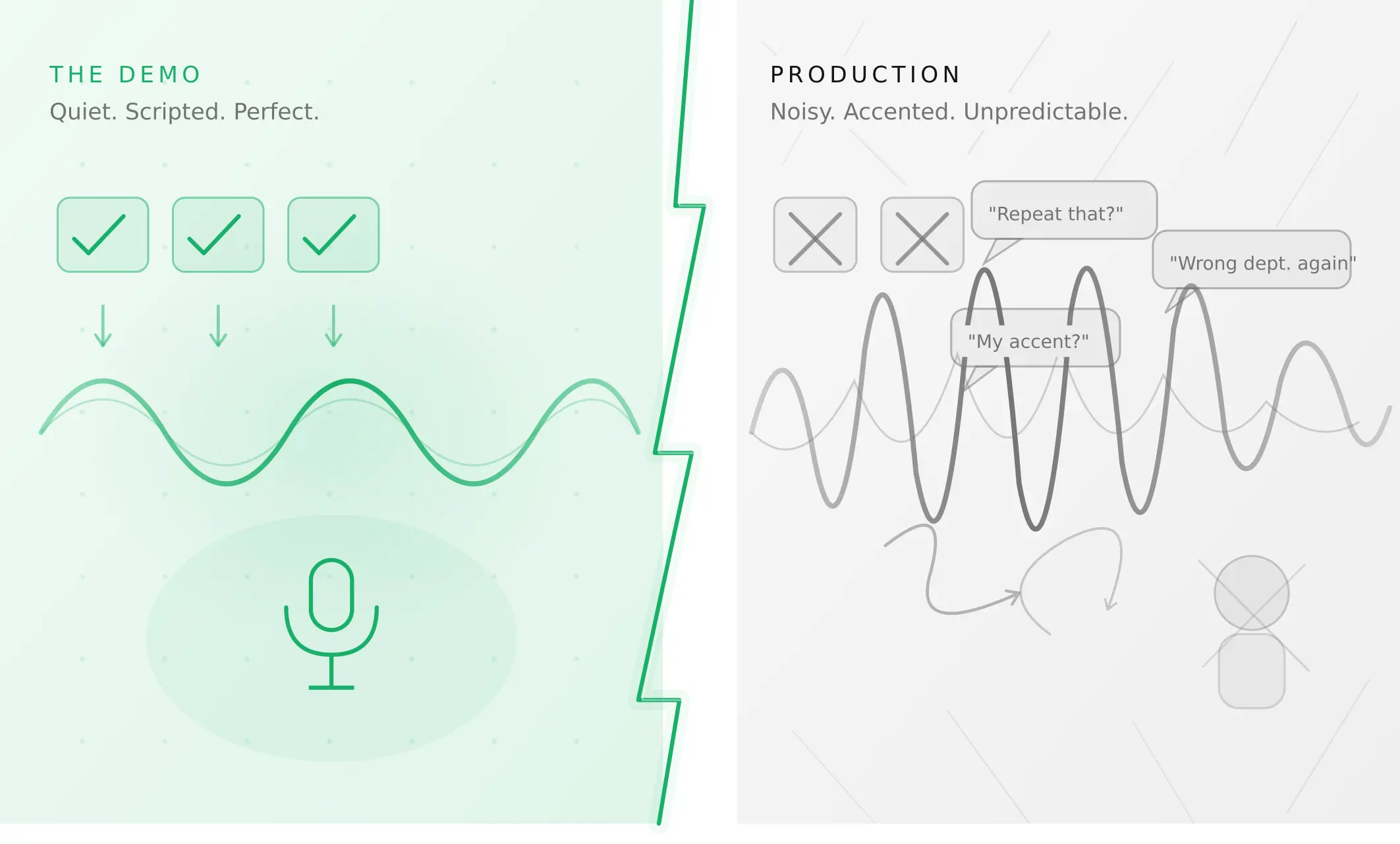
Why AI voice agents fail in production (and how to prevent it)
AI voice agents that ace demos still break in production. Learn the 5 root causes, how to test for each, and what production readiness actually means.
Read more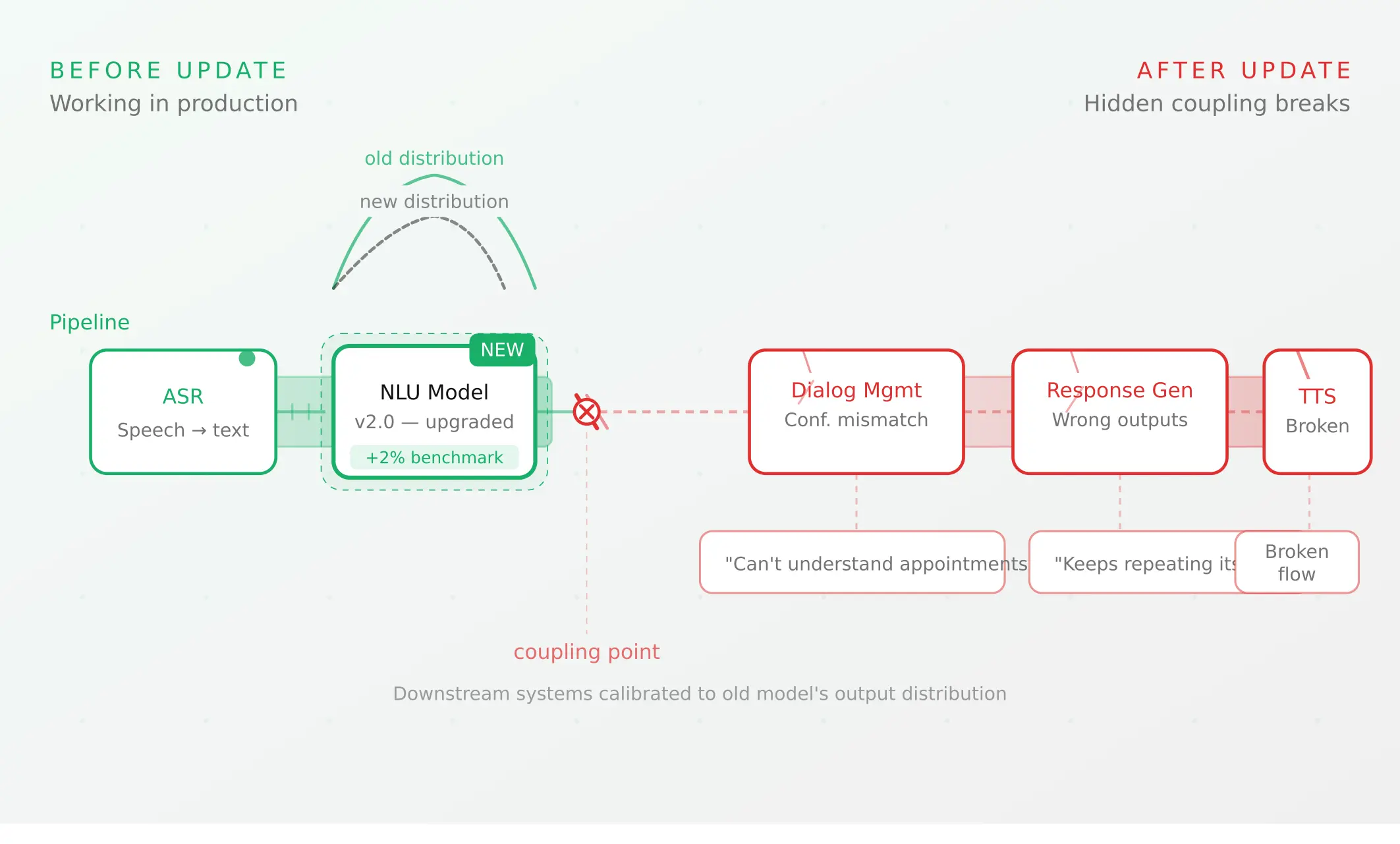
Voice agent regression testing: why LLM updates break production
LLM updates improve benchmarks but break voice agents in 5 predictable ways. How to detect and prevent regressions after every model or prompt change.
Read more