Test your voice agent
Cost per resolved call vs cost per minute
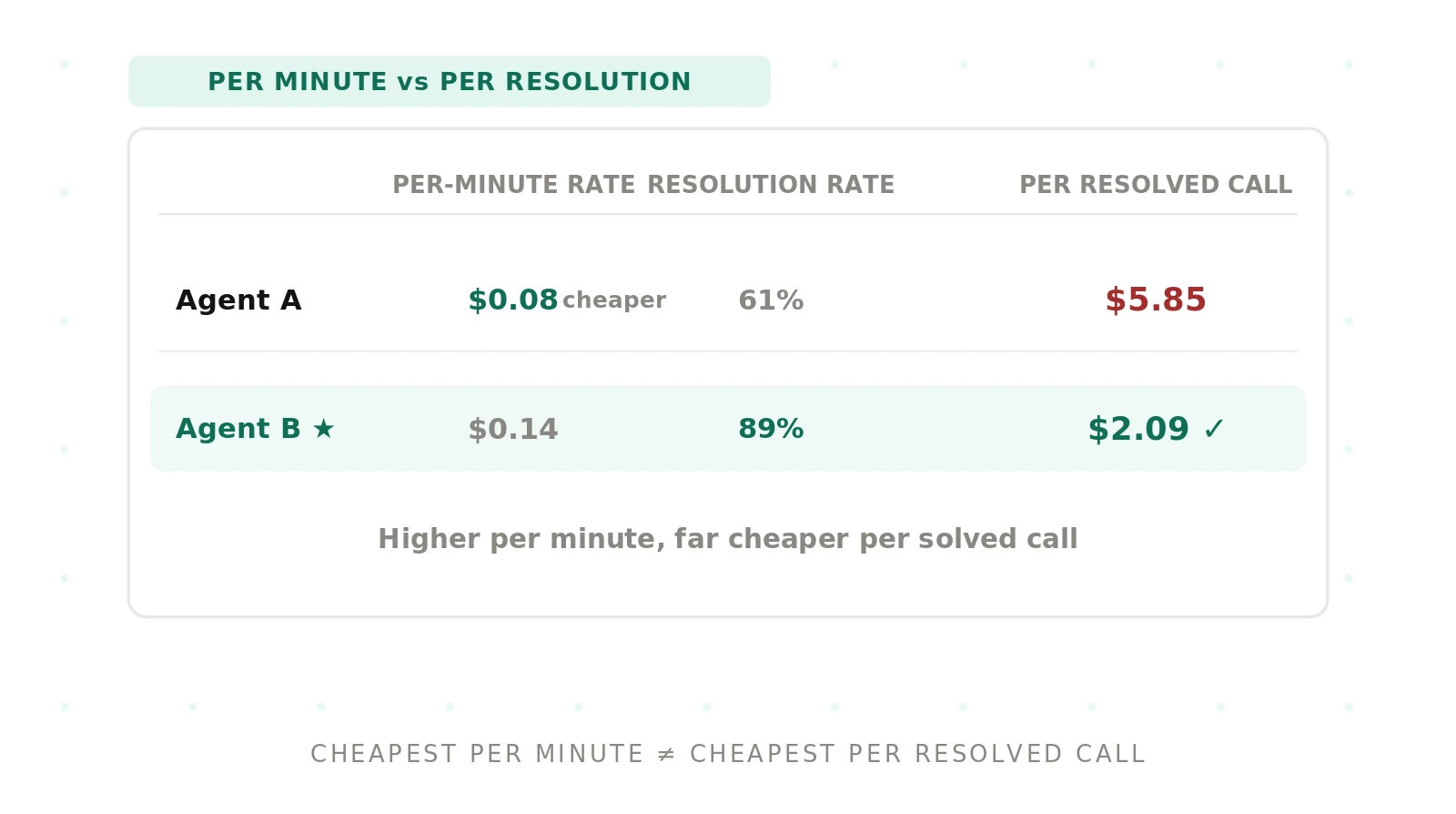
> Quick Answer: Cost per resolved call is the per-minute rate times average call minutes, divided by the resolution rate, plus the cost of escalating failed calls. It is the true unit cost of a voice agent because it prices outcomes, not talk time. The cheapest agent per minute often costs the most per resolution.
Buying a voice agent on its per-minute rate is like buying a car on the price of a gallon of gas. The number is real, but it answers the wrong question. What you actually pay for is a resolved call: a caller who got what they needed and hung up satisfied, without a human stepping in. That is the unit of value your business receives, and it should be the unit of cost you compare vendors on.
Per-minute pricing is seductive because it is simple and it is printed on the pricing page. Cost per resolved call takes a little arithmetic and one number vendors rarely volunteer: the resolution rate. But once you run the math, the ranking of your shortlist can flip completely. The agent with the lowest sticker price frequently turns out to be the most expensive place to resolve a call.
This guide defines the metric, shows the formula step by step, and works through a full example comparing two agents where the cheaper-per-minute option loses badly. Evalgent sits on the measurement side, so we will keep the product light until the end and focus on the math.
Why per-minute pricing hides the real cost
A per-minute rate measures the cost of the agent talking. It does not measure whether the talking accomplished anything. Two agents can both cost you money for every minute of audio, yet only one of them actually closes the caller's request. The other one burns minutes, fails, and hands the call to a human who costs far more.
Think of it in unit cost terms. In cost accounting, unit cost is total cost divided by units produced. For a voice agent, the unit produced is a resolved call, not a minute of speech. A minute is an input; a resolution is the output. Pricing on the input tells you nothing about how efficiently the input turns into output. This is the same reasoning behind cost per action in advertising, where spend is judged against completed actions rather than raw impressions.
Per-minute rates also invite a perverse incentive. An agent that talks longer bills more, and a longer call is not a better call. If a chatty agent takes seven minutes to do what a crisp one does in four, the per-minute rate flatters the chatty agent by hiding its inefficiency in the denominator. Average handle time and per-minute rate move in opposite directions, and only cost per resolution reconciles them.
The deeper problem is the failed call. When an agent cannot resolve a request, the cost does not stop at the wasted minutes. The call escalates to a human agent, and now you pay twice: once for the machine that tried and failed, and again for the person who cleans up. A low per-minute rate paired with a low resolution rate is a machine that generates expensive human work. For the full picture of what sits behind the headline number, our breakdown of what a voice agent really costs walks through the layers.
What cost per resolved call actually measures
Cost per resolved call answers a single question: how much did it cost your business to successfully complete one caller's request with the agent? It rolls three things into one number.
First, the direct spend on the agent for every call it attempts, resolved or not. Every attempt consumes minutes and bills at the per-minute rate. Second, the resolution rate, which determines how many attempts turn into successes. Third, the escalation cost, because the calls the agent fails still have to be handled by someone, and that labor is a real cost of running the agent at its current quality.
The metric is a form of true total cost of ownership thinking applied at the level of a single interaction. It resists gaming. You cannot lower cost per resolved call by simply talking faster or bidding down the per-minute rate, because a cheaper agent that resolves fewer calls pushes more volume into the expensive escalation path. The only durable way to drive the number down is to resolve more calls correctly. That aligns the metric with the thing you actually want.
One clarification on what counts as resolved. A resolution is not the agent saying goodbye. It is the caller's intent being satisfied without a human handoff and without a repeat call on the same issue. Containment, where the call simply never reaches a human, is not the same as resolution. A call can be contained and still fail the customer, who then calls back angry. Our guide on containment versus deflection untangles those definitions, and getting them right is what makes the denominator trustworthy.
How to calculate cost per resolved call
Here is the full procedure. Work through it once by hand and the logic sticks.
1. Get the honest per-minute rate. Start with the vendor's headline rate, then add the pass-through costs that ride on top: telephony, premium voices, and any usage tiers. The rate you use should be the all-in figure you will actually be billed, not the marketing floor. Hidden add-ons are common, so pin them down; our note on pricing hidden costs lists the ones that catch teams out.
2. Measure average call minutes. Take the mean duration of a real call, including the calls that fail. Do not use a best-case demo. Failed calls often run long because the agent flails before giving up, so excluding them understates the cost. Multiply the per-minute rate by average minutes to get the agent cost per attempted call.
3. Measure the resolution rate. This is the fraction of attempted calls the agent resolves correctly, judged against the strict definition above. This number is the whole game, and it must come from evaluation against real scenarios, not a vendor's self-report. It is the denominator, so a small error here swings the result more than anything else.
4. Estimate the escalation cost. For every call the agent fails, a human handles it. Use your loaded cost per human-handled call: agent wage, benefits, overhead, and the minutes the call takes. Multiply that by the share of calls that fail, which is one minus the resolution rate.
5. Add the two cost streams per attempt. For a batch of calls, sum the agent cost across all attempts and the escalation cost across all failures. This is your total cost to serve that batch, capturing both the machine and the humans it created work for.
6. Divide by resolved calls. Take the total cost for the batch and divide by the number of calls the agent actually resolved. The result is cost per resolved call. This is the number you compare across vendors.
7. Re-run it per scenario. A blended average hides the truth. An agent may resolve simple balance checks cheaply and hemorrhage money on disputes. Calculate the metric per intent, then weight by your real call mix. Where you spend most, resolution matters most.
The compact formula: cost per resolved call equals (per-minute rate times average minutes, plus failure share times escalation cost) divided by resolution rate. The escalation term is what punishes low-quality agents, and it is exactly the term per-minute comparisons ignore.
Worked example: the cheaper agent loses
Consider two agents on a shortlist for a customer-support line. Agent A is the budget option with a low per-minute rate. Agent B costs nearly twice as much per minute. On the pricing page, Agent A wins in a landslide. Let us run the real math.
We will use a loaded escalation cost of $6.00 per human-handled call, which is a modest, illustrative figure for a support interaction. All numbers below are illustrative and meant to show the mechanics, not to represent any specific vendor.
Agent A bills $0.08 per minute and averages 6.5 minutes per call, so each attempt costs about $0.52 in agent time. It resolves 55% of calls. Agent B bills $0.14 per minute and averages 4.5 minutes, so each attempt costs about $0.63. It resolves 82%. Note that the better agent is also faster, which is common: a competent agent gets to the point.
Take a batch of 100 calls each. For Agent A, agent time costs 100 times $0.52, or $52. It fails 45 calls, and at $6.00 each that is $270 of escalation. Total cost is $322 to resolve 55 calls, so cost per resolved call is about $5.85. For Agent B, agent time costs 100 times $0.63, or $63. It fails 18 calls, or $108 of escalation. Total cost is $171 to resolve 82 calls, so cost per resolved call is about $2.09.
| Agent | Per-minute rate | Avg minutes | Resolution rate | Escalation cost / failed call | Cost per resolved call |
|---|---|---|---|---|---|
| Agent A (cheaper per minute) | $0.08 | 6.5 | 55% | $6.00 | $5.85 |
| Agent B | $0.14 | 4.5 | 82% | $6.00 | $2.09 |
The cheaper-per-minute agent is nearly three times more expensive per resolved call. Agent A looked 43% cheaper on the pricing page and turned out to be 180% more expensive where it counts. The gap comes almost entirely from escalations: because Agent A fails nearly half its calls, it manufactures a mountain of human work that dwarfs its per-minute savings.
Notice how sensitive the result is to the resolution rate. If Agent A improved to 75% resolution with everything else held constant, its cost per resolved call would fall to roughly $3.09, still worse than Agent B but far closer. The denominator moves the answer more than the per-minute rate ever does. That is why measuring resolution accurately, and not trusting a self-reported figure, is the highest-leverage thing a buyer can do. It is the difference between a sound return on investment case and a bill that keeps surprising finance.
Turning the metric into a decision
Cost per resolved call is not just a report card; it is a decision tool. Once you have it per scenario, three moves follow naturally.
Set a resolution floor. If an agent falls below a certain resolution rate on your high-volume intents, its cost per resolved call climbs so fast that no per-minute discount can rescue it. Define that floor before you shop and treat it as a gate, the same way our production readiness bar treats safety and latency thresholds. An agent that cannot clear the floor is not cheaper; it is disqualified.
Compare on the metric, not the sticker. When you evaluate vendors, put cost per resolved call in the scorecard and make the per-minute rate a supporting line item. Our checklist for how to evaluate voice agent vendors shows where the metric fits alongside quality and reliability measures. A vendor who resists giving you the resolution data you need to compute it is telling you something.
Track the trend, not just the snapshot. Resolution rates drift as prompts change, models update, and call mixes shift. A monthly cost-per-resolved-call figure catches regressions that a static per-minute rate never will. Tie it back to the broader business case in your voice agent ROI model, where a rising resolution rate compounds into real savings over the contract.
The discipline here is ordinary cost accounting: attribute all costs to the unit of output and compare on that unit. Voice agents are unusual only in how tempting it is to skip that step, because the per-minute rate is so conveniently pre-printed. Skipping it is how teams end up with a cheap agent and an expensive support floor.
A note on minutes and latency
Average minutes belong in the numerator, and they are not fixed. An agent that resolves the same intent in less time lowers cost per resolved call directly, so speed is an economic lever, not just a comfort. But speed has a floor set by physics and human perception. The ITU's guidance on one-way transmission time, ITU-T G.114, pins conversational latency budgets that a voice agent must respect to feel natural. Cut minutes by being crisp, not by clipping the caller off before their intent is met, which tanks resolution and backfires in the denominator. The two levers, shorter calls and higher resolution, have to move together.
Frequently asked questions
What is cost per resolved call for a voice agent?
It is the total cost to successfully complete one caller's request. You calculate it as the per-minute rate times average call minutes, plus the cost of escalating failed calls, all divided by the resolution rate. It prices outcomes rather than talk time, which makes it the true unit cost for comparing agents.
Why is cost per minute a misleading metric?
Per-minute pricing measures the cost of the agent talking, not the cost of resolving anything. It ignores failed calls and the human escalations they trigger, and it rewards longer calls by hiding inefficiency in the denominator. An agent can win on per-minute rate while losing badly on cost per resolved call.
How do I calculate the resolution rate?
Measure the share of attempted calls where the caller's intent was satisfied without a human handoff and without a repeat call on the same issue. Judge it against real scenarios, not vendor self-reports. Calculate it per intent, then weight by your actual call mix, because blended averages hide where an agent quietly fails.
Can the cheapest voice agent per minute cost the most per resolution?
Yes, and it often does. In the worked example above, an agent 43% cheaper per minute cost 180% more per resolved call. A low per-minute rate paired with a low resolution rate generates expensive human escalations that erase the savings many times over. The per-minute discount is a mirage.
What escalation cost should I use in the calculation?
Use your fully loaded cost per human-handled call: agent wage, benefits, overhead, and the minutes the call consumes. Apply it to the share of calls the agent fails, which is one minus the resolution rate. Even a modest escalation cost dominates the math once resolution rates dip, so estimate it honestly.
How is resolution different from containment?
Containment means the call never reached a human. Resolution means the caller's intent was actually satisfied. A call can be contained and still fail the customer, who then calls back. Using containment as your denominator inflates the resolution rate and understates true cost per resolved call, so define the terms strictly.
How often should I recalculate cost per resolved call?
Recalculate monthly, and after any prompt change, model update, or shift in call mix. Resolution rates drift, and a static per-minute rate will never surface a regression. A recurring cost-per-resolved-call figure catches quality slippage early, before it shows up as a swollen escalation bill at the end of the quarter.
Does a longer average handle time always raise cost per resolution?
Longer calls raise the numerator, so yes, all else equal. But cutting minutes by rushing callers lowers resolution and raises the denominator's penalty through escalations. The goal is to be crisp while still meeting intent. Speed and resolution have to improve together, not by trading one for the other.
Measuring the resolution rate with Evalgent
Cost per resolved call is only as trustworthy as its denominator, and the denominator is the resolution rate that vendors rarely measure the way a buyer needs. Evalgent is an independent platform that measures that resolution rate against your real call mix, so the economics you compute rest on evidence rather than a self-report. Five primitives make it repeatable.
- Scenarios encode the real intents your callers bring, from simple lookups to messy disputes, so resolution is measured where it actually matters.
- Profiles simulate different caller types, accents, and moods, exposing where an agent's resolution rate quietly collapses.
- Metrics capture resolution, average minutes, and escalation triggers, the exact inputs the cost-per-resolved-call formula needs.
- Evaluations run the same scenarios across competing agents, producing comparable resolution rates instead of incomparable pricing pages.
- Reviews let your team confirm what counts as resolved, keeping the denominator honest and consistent over time.
Put the resolution rate on solid ground and the true cost per resolution follows. To see it against your own agents, book a demo.
The bottom line
Cost per resolved call is the only metric that prices what your business actually buys. Compare agents on it, and the cheapest per minute is often the last one you should pick.
Related Articles
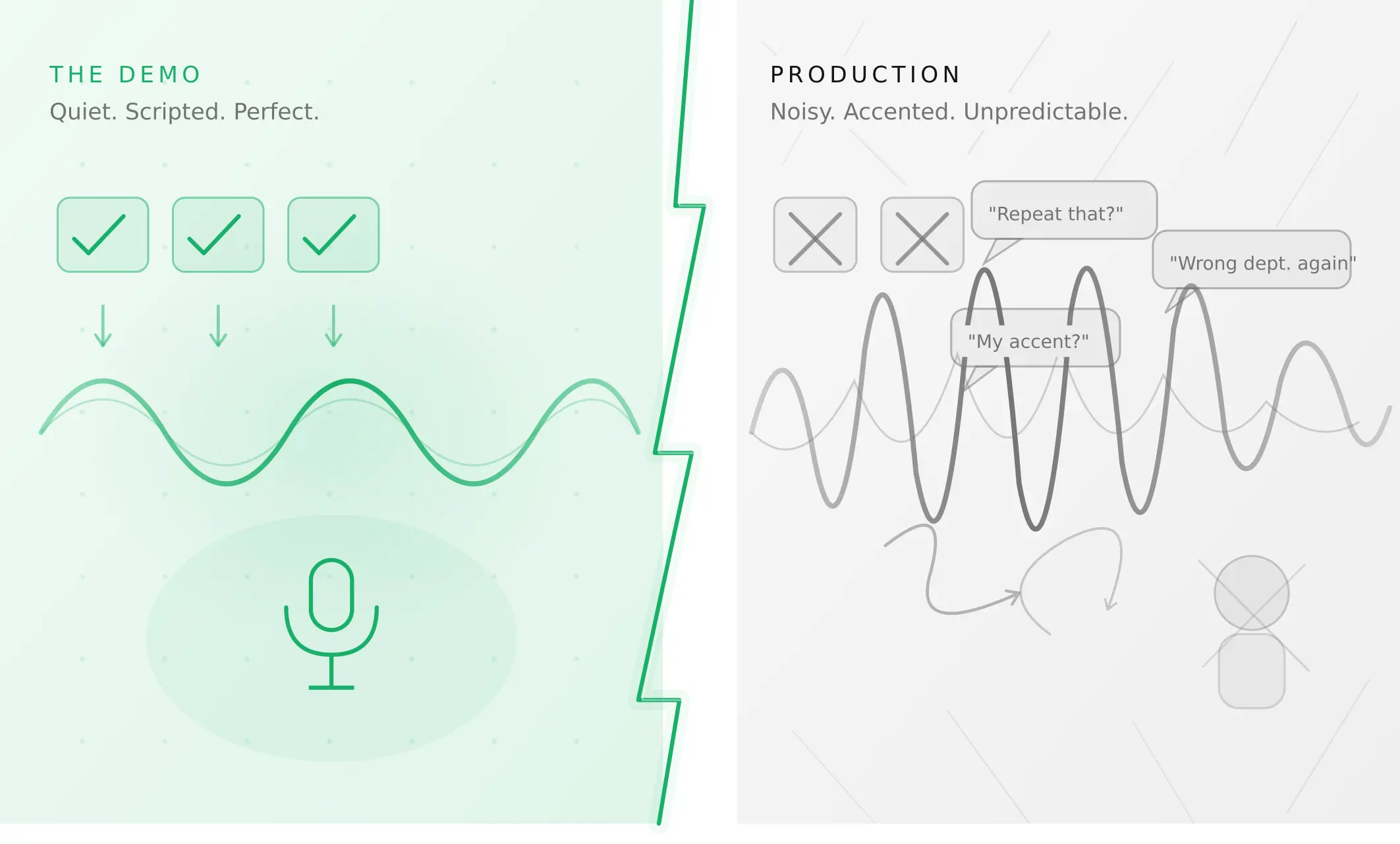
Why AI voice agents fail in production (and how to prevent it)
AI voice agents that ace demos still break in production. Learn the 5 root causes, how to test for each, and what production readiness actually means.
Read more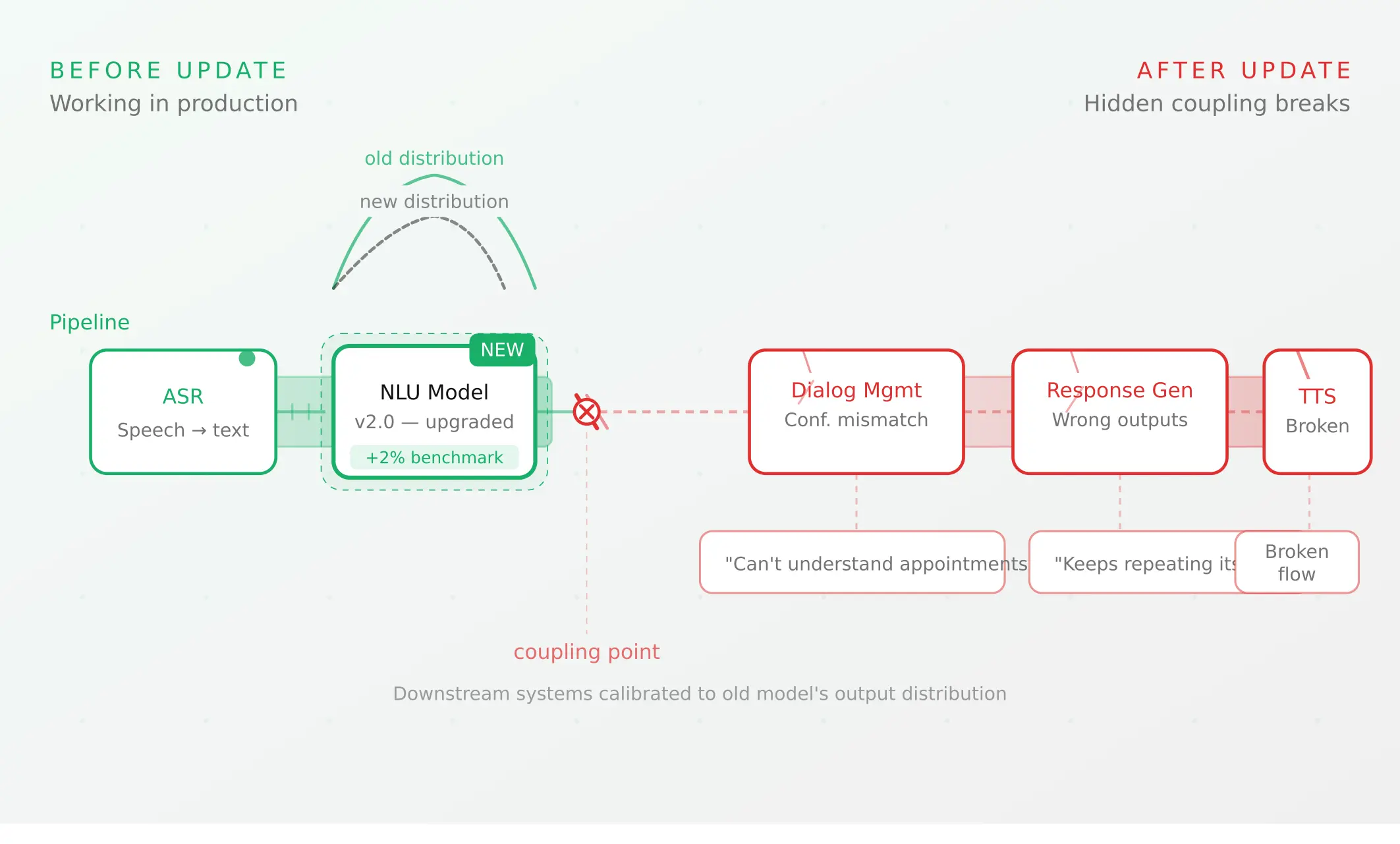
Voice agent regression testing: why LLM updates break production
LLM updates improve benchmarks but break voice agents in 5 predictable ways. How to detect and prevent regressions after every model or prompt change.
Read more