Test your voice agent
How to Measure Average Handle Time for Voice Agents
# How to measure average handle time for voice agents
Quick answer
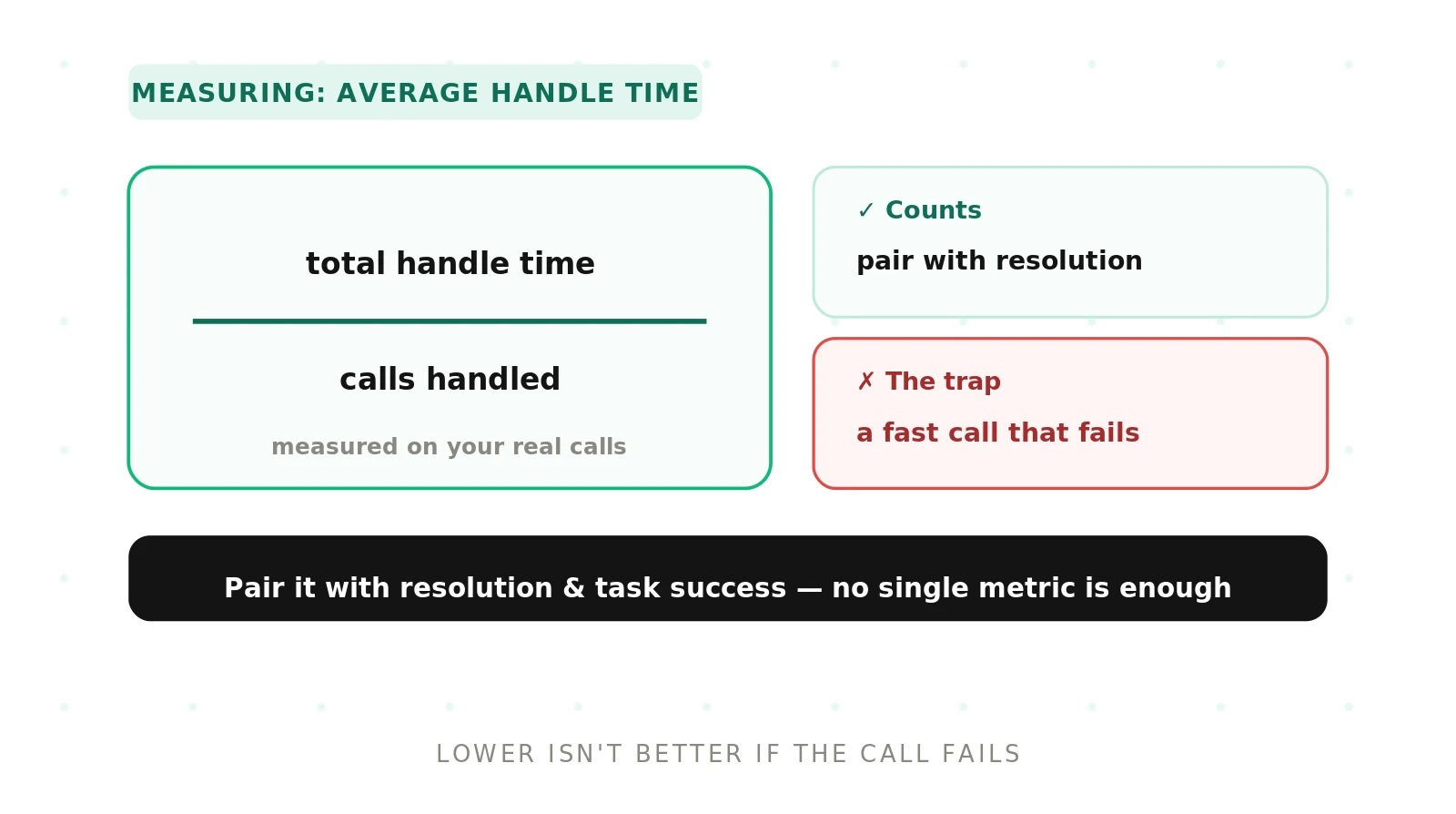
Average handle time for voice agents is the total time to handle one call, including talk, tool and latency waits, and wrap-up. Measure it per call, then report percentiles, not just the mean. Lower is not always better: pair average handle time with resolution, because a fast call that fails costs more than a slightly longer one that resolves.
Average handle time is a borrowed metric. It came from human call centers, where it counted the minutes an agent spent per contact. Voice agents inherited the number, but not always the meaning.
The trouble is simple. A voice agent can be fast and wrong. It can end a call in forty seconds and leave the caller with nothing. So the raw number needs a second number beside it. This post shows how to measure average handle time honestly, what pushes it up, and why speed alone is a trap.
What average handle time means for a voice agent
Let us define the term before we measure it.
> Average handle time: the mean total time spent handling one call, from the moment the agent answers to the moment wrap-up finishes. It combines talk time, waiting, and post-call work into a single figure.
The metric is old and well understood in contact centers. The concept of average handling time predates AI by decades. It grew up inside the call centre world, where staffing and cost depend on how long each contact takes.
For a voice agent, the same clock runs. But the segments differ. A human agent talks, holds, and types notes. A voice agent talks, waits on tools, and writes its own wrap-up record. The names change. The idea does not.
Average handle time is a key performance indicator, not a goal in itself. It tells you how long calls take. It does not tell you whether they went well. That gap is the whole point of this article.
The components of average handle time
A single number hides a lot. To measure it well, break the call into parts. Each part has its own clock.
Talk time
Talk time is the spoken conversation. The agent speaks, the caller speaks, and turns pass back and forth. This is the visible part of the call. It is usually the largest slice.
Tool and latency waits
Between turns, the agent often waits. It calls a database. It checks an order. It runs a lookup. Each wait adds time the caller feels as silence. This slice is easy to miss because nobody is speaking.
Latency is its own subject. The delay from speech to response shapes how long a call feels. Our latency for voice agents guide covers the budget in detail. Slow transcription is a common culprit; see how to reduce STT latency for that stage.
Wrap-up time
After the caller hangs up, work can continue. The agent may summarize the call. It may update a record. It may trigger a follow-up. This post-call step counts toward handle time, even though the line is closed.
Hold and transfer segments
Some calls pause. The agent may hold while a tool runs long. Or it may transfer to a human. Both add time. Both belong in the total, and both should be tagged so you can see them separately.
How to measure average handle time for a voice agent
Here is the step-by-step method. Follow it in order. The goal is a number you can trust and defend.
1. Define the call boundaries. Decide exactly when handle time starts and stops. Start at answer. Stop when wrap-up completes. Write this down so every call is measured the same way.
2. Timestamp every segment. Log a timestamp at each transition: answer, first response, each tool call, hold, transfer, hangup, and wrap-up end. These raw times are your source of truth.
3. Sum the segments per call. Add talk, waits, hold, transfer, and wrap-up for each individual call. This gives you one handle time per call, not a blended guess.
4. Tag each call with an outcome. Mark whether the caller's task succeeded, failed, or escalated. Handle time means nothing without this label attached.
5. Aggregate with percentiles. Compute the median, the 90th, and the 95th percentile, not just the mean. Report the spread, because the tail is where callers suffer.
6. Segment by call type. Split the numbers by intent, caller profile, and scenario. A refund call and a password reset have different natural lengths. A blended average hides both.
7. Compare against resolution. Put handle time next to task success rate for the same calls. Watch the two together. This is the only way to catch fast failures.
8. Re-run on every change. Treat the measurement as a regression suite. Run it on each model swap, prompt edit, or tool update, so drift shows up early.
This method works on your own call logs. For a walkthrough on running metrics against your data, see benchmarking voice agents on your own data.
Average handle time components and how to reduce them safely
The table below breaks the call into its parts. For each, it shows what the segment includes and how to trim it without breaking the call. Note the last column. Every reduction has a quality risk if pushed too hard.
| Component | What it includes | How to reduce without hurting quality |
|---|---|---|
| Talk time | Spoken turns between agent and caller | Trim filler and repetition; keep confirmations that prevent errors |
| Tool and latency waits | Database calls, lookups, model delays | Cache, parallelize, and stream; do not skip checks that ensure accuracy |
| Dead air | Unfilled silence during processing | Add short spoken acknowledgments; never cut the wait by guessing an answer |
| Repetition loops | Re-asking for the same detail | Fix transcription and grounding errors; keep one clarifying question when needed |
| Wrap-up time | Summaries and record updates | Automate summaries in the background; do not drop the audit record |
| Hold and transfer | Pauses and human handoffs | Route sooner when the agent is stuck; do not force containment to save seconds |
Why lower average handle time is not automatically better
This is the most important idea in the post. A shorter call is not a better call.
Imagine two calls. The first lasts ninety seconds and solves the problem. The second lasts forty seconds and does not. The second call has a lower handle time. It is also a failure. The caller will call back, or churn, or complain.
A fast failure costs more than a slow success. The caller pays twice: once for the wasted call, and again for the callback. The business pays too, in repeat contacts and lost trust. So a falling handle time can hide a rising failure rate.
There is a darker version of this trap. An agent can learn to end calls quickly by giving up. It can rush callers off the line. It can force a resolution that was not real. Handle time drops, and the dashboard looks great, while callers leave unhappy. Watching speed alone rewards exactly this behavior.
The fix is to never read handle time alone. Pair it with an outcome metric. We cover the full set in our voice agent metrics scorecard. The short version: speed without resolution is not efficiency. It is failure, faster.
What inflates average handle time
When the number climbs, it is usually one of a few causes. Each one is fixable once you can see it.
Dead air
Dead air is silence the caller did not expect. It happens while the agent waits on a tool or a model. The caller hears nothing and wonders if the line dropped. Long silences also make callers talk over the agent, which restarts turns and adds time.
Slow tools
Tool calls are a frequent hidden cost. A lookup that takes four seconds adds four seconds to every call that uses it. Multiply that across thousands of calls and the total is large. Slow tools inflate handle time without any spoken words.
Repetition
Repetition is the loop of re-asking. The agent mishears a name and asks again. Or it loses context and repeats a question. Each loop adds turns. Poor transcription accuracy on names and numbers is a common root cause here.
Over-confirmation
Some confirmation is good. Too much is waste. An agent that reads back every field twice slows the call. The skill is knowing which confirmations prevent errors and which just pad the clock.
Bad routing
An agent that should transfer but does not will loop. It tries and fails and tries again. Late escalation inflates handle time and frustrates the caller. Sometimes the fastest resolution is a quick, clean handoff.
Use percentiles, not just the mean
The mean is a poor summary for handle time. It hides the tail.
Consider a set of calls where most finish in a minute, but one in ten runs to five minutes. The mean looks healthy. Yet that slow tenth is where callers abandon. A single average cannot show you this. You need the distribution.
Report the median alongside the mean. The median is the middle call, and it resists outliers. Then add the 95th percentile. That number tells you how long your slowest calls run. It is the number that predicts complaints.
Handle time is a latency-shaped metric, and latency is not normally distributed. The concept of latency) in engineering carries the same lesson. The tail matters more than the center. For the difference between raw latency and what the caller feels, see our latency vs response time guide.
Pair average handle time with resolution and task success
Handle time answers one question: how long did the call take? It cannot answer the question that matters: did the caller get helped?
For that, you need an outcome metric. Task success rate measures whether the caller's goal was reached. First call resolution measures whether the issue stayed solved without a repeat. Read handle time next to these, always.
The pairing catches the fast-failure trap. A call that is short and successful is genuinely efficient. A call that is short and failed is a problem in disguise. Only the outcome metric tells them apart. Watch for a definition of "handled" that quietly counts giveaways as wins; our guide on containment versus deflection unpacks that risk.
This is also why measurement should be independent. A vendor that reports its own handle time has a reason to make it look short. An outside evaluator scores speed and quality on the same calls, with the same definitions, and no incentive to flatter either. Our post on independent voice AI evaluation explains why the separation matters.
How Evalgent measures handle time and quality together
Evalgent is an independent, third-party evaluator for voice agents. It measures average handle time the way this post describes: per call, by segment, with percentiles, and never alone.
For every call, Evalgent times talk, tool waits, dead air, and wrap-up. It tags each call with a task-success outcome. Then it reports the two side by side. You see whether a faster agent is genuinely more efficient, or just failing sooner. Because the scoring sits outside the vendor, the numbers are ones you can put in front of a buyer or a board. For the wider method, see our voice agent evaluation overview.
The bottom line
Average handle time is a cost metric, not a quality metric, so measure it per call and report it with percentiles. A short call that fails is worse than a longer one that resolves, so always pair handle time with an outcome and let an independent party score both.
Frequently asked questions
What is average handle time for a voice agent?
Average handle time for a voice agent is the mean total time spent handling one call. It runs from the moment the agent answers to the moment wrap-up completes. It includes talk time, tool and latency waits, hold, transfer, and post-call work. It is a cost and efficiency measure, not a measure of whether the caller was actually helped.
How do you measure average handle time for voice agents?
Timestamp every segment of each call: answer, responses, tool calls, hold, transfer, hangup, and wrap-up. Sum those segments per call to get one handle time each. Tag each call with an outcome. Then aggregate using the median and 90th and 95th percentiles, segmented by call type. Always compare the result against task success rate for the same calls.
What inflates average handle time in a voice agent?
Five causes dominate. Dead air is unfilled silence while tools or models run. Slow tools add seconds to every call that uses them. Repetition loops re-ask for details after mishearing. Over-confirmation reads back fields the caller already gave. Bad routing keeps the agent looping when it should transfer. Fixing these trims time without cutting real work.
Is lower average handle time always better for voice agents?
No. Lower average handle time is not automatically better. An agent can end calls fast by giving up, rushing callers, or forcing a fake resolution. That drops handle time while raising the failure rate. A fast call that fails costs more than a slightly longer one that resolves. Always read handle time alongside an outcome metric.
What is a good average handle time for a voice agent?
There is no single good number, because it depends on the task. A password reset is naturally short. A complex claim is naturally long. Compare handle time within the same call type, not across types. A blended average hides both. Judge each segment against its own resolution rate, and treat any drop in handle time with a drop in resolution as a warning.
Should you use the mean or median for average handle time?
Report both, and add percentiles. The mean is skewed by a few very long calls, so it can look healthy while the tail suffers. The median shows the typical call and resists outliers. The 95th percentile shows how long your slowest calls run. That tail number predicts complaints and abandonment better than the mean ever will.
How does dead air affect average handle time?
Dead air is silence the caller did not expect, usually while a tool or model runs. It inflates handle time without any spoken words, so it is easy to miss. Long silences also make callers talk over the agent, which restarts turns and adds more time. Short spoken acknowledgments during waits reduce dead air without skipping any real processing.
How do you reduce average handle time without hurting quality?
Cache and parallelize slow tool calls, stream responses, and fix transcription errors that cause repetition. Automate wrap-up in the background. Route to a human sooner when the agent is stuck. Never cut confirmations that prevent errors or drop the audit record.
Ready to see your handle time and resolution measured together, by an independent party? Book a demo with Evalgent.
Related Articles
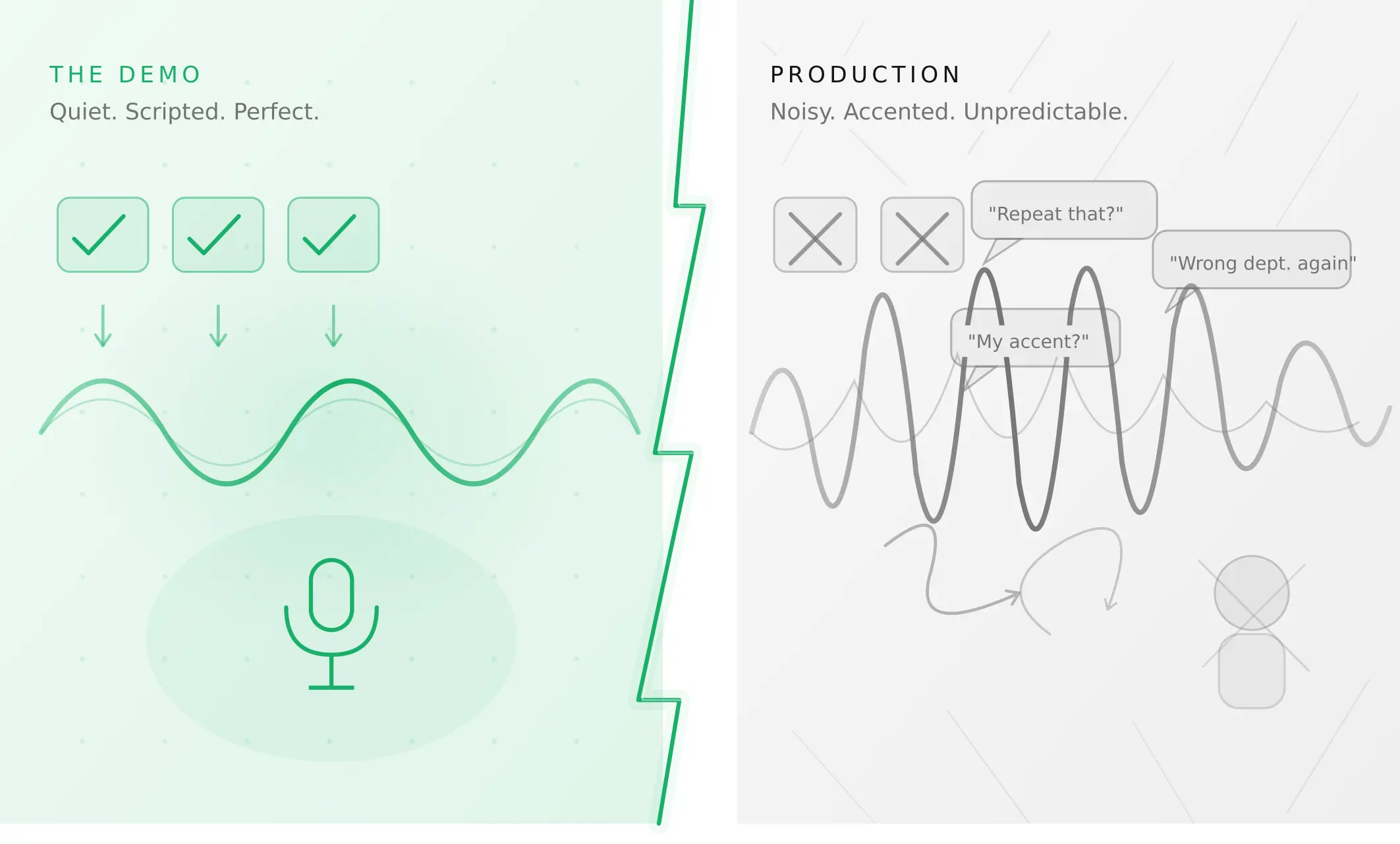
Why AI voice agents fail in production (and how to prevent it)
AI voice agents that ace demos still break in production. Learn the 5 root causes, how to test for each, and what production readiness actually means.
Read more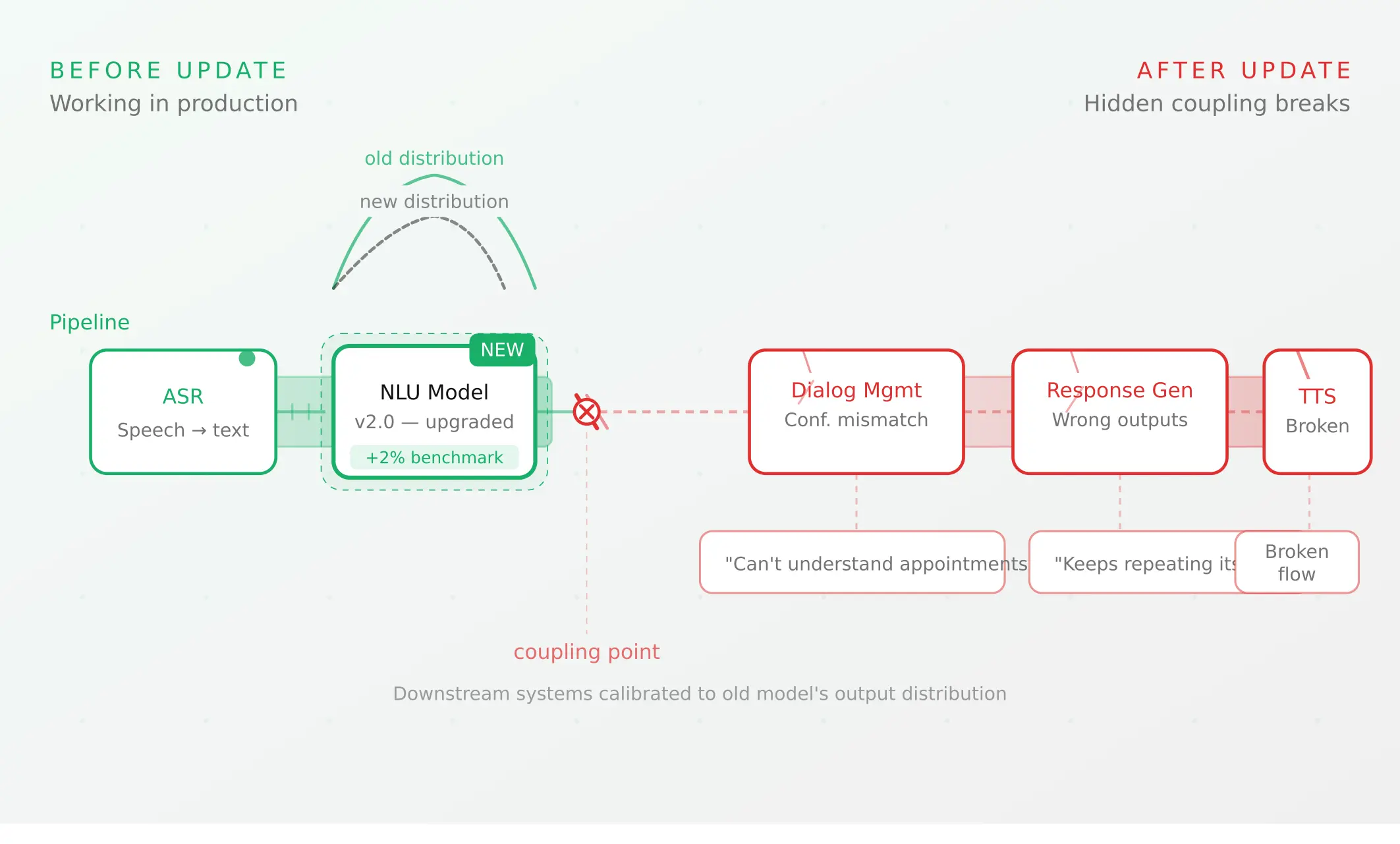
Voice agent regression testing: why LLM updates break production
LLM updates improve benchmarks but break voice agents in 5 predictable ways. How to detect and prevent regressions after every model or prompt change.
Read more