AI Receptionist for Home Inspectors: What It Must Handle and How to Test It
On this page
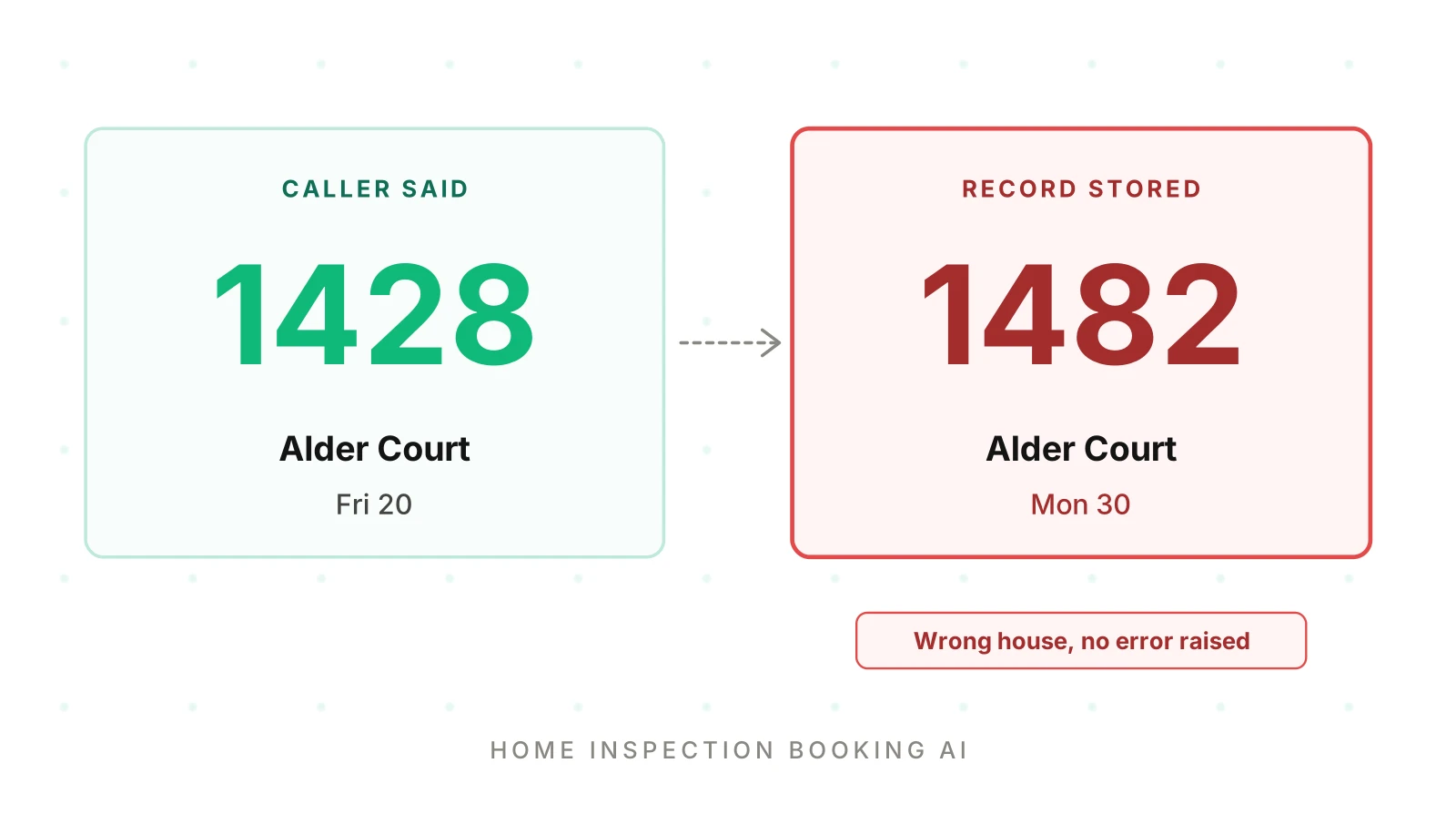
A realtor calls from a driveway. Her buyer's inspection window closes Friday. She says, "Fourteen twenty-eight Alder Court, Friday the twentieth, ten a.m." A truck idles behind her. The agent hears "fourteen eighty-two" and "Monday the thirtieth." It says "Great, you're all set" and sends a text. The booking record now holds a different house and a date ten days late. No error appears anywhere. The inspector finds out on Friday morning, or never.
This is the failure that matters for an AI receptionist for home inspectors. The call sounds fine. The booking is wrong. This guide covers what the agent must handle, how the record breaks, and how to test it before it takes real calls. It ends with questions to ask a vendor. The example above is illustrative, not a measured case.
The guide is for owners and product teams who run or build a voice agent that answers for inspection companies. For the wider home services playbook, start with our AI receptionist QA guide for home services and booking accuracy for home services.
What an inspector's phone line really carries
A home inspector's phone does not ring like a restaurant's. Most callers are mid-transaction. Many are agents with a contract clock running. Others are buyers who have never hired an inspector. Each type needs different handling.
Here are the call types a home inspector answering service must cover, and what each one writes.
| Call type | Typical caller | What the agent must capture or decide | Silent failure |
|---|---|---|---|
| New booking | Buyer or buyer's agent | Address, property type, size, year built, date window, access | Wrong address or date stored |
| Realtor on a deadline | Buyer's agent | Contract deadline, earliest slot, who attends | Slot confirmed past the deadline |
| Add-on question | Buyer | Which add-ons exist, what they add to time and price | Add-on promised but never booked |
| Property-type question | Anyone | Whether the company inspects it | "Yes" to a type the company declines |
| Pricing | Buyer | Quote from the price table only | Invented or rounded price |
| Reschedule or cancel | Buyer or agent | Find the right booking, move it, re-check travel | Wrong booking moved |
| Report delivery | Buyer or agent | When and how the report arrives, who gets it | Report promised on a day nobody set |
| Out-of-area | Anyone | Service area check by address | Booking outside the service area |
| Upset client | Client after the inspection | Log, de-escalate, hand off to a person | Agent argues or defends findings |
Two things stand out. First, most rows end in a write to a scheduling or CRM system. Second, the riskiest rows are the ones where the agent must say no. Refusing a price, a slot or a property type is a behaviour you have to test on purpose.
What a booking call writes, and how one wrong word corrupts it
The call is the front door to a four-step workflow. Capture, act, confirm, write back.
1. Capture. The agent collects address, property type, square footage, year built, foundation, add-ons and a preferred window.
2. Act. It checks the calendar, travel time and the price table.
3. Confirm. It reads back the key fields and offers a slot.
4. Write back. It creates the booking, sends the confirmation and notifies the inspector.
Each step can fail while the conversation sounds clean. The stored fields drive everything downstream: the route, the confirmation text, the invoice and the agreement the client signs.
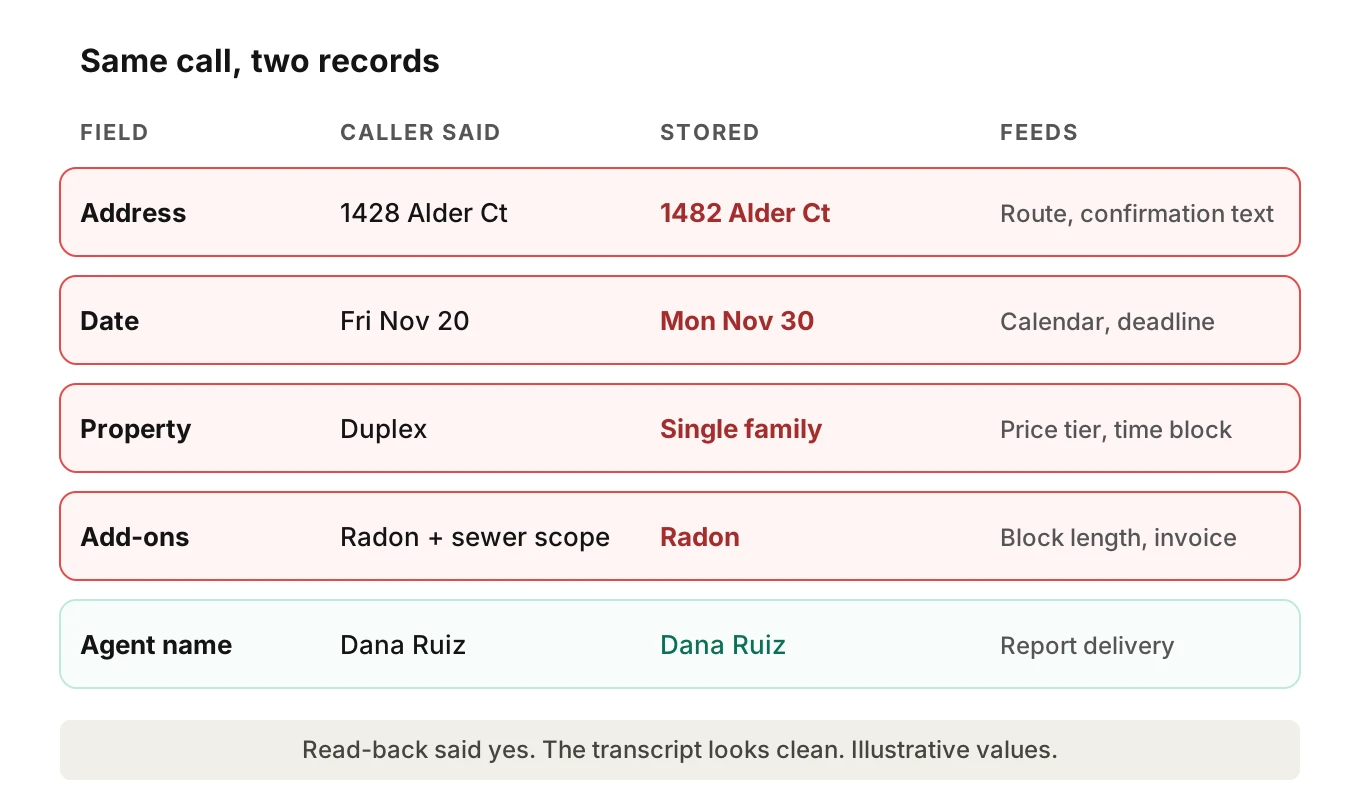
Booking record accuracy: the share of bookings whose stored address, date, property type and add-ons match what the caller meant. It is the metric that ties the voice layer to a truck arriving at the right house.
A transcript review sees the read-back and little else. The tool call that created the booking holds the real answer. Our guide to tool argument accuracy from speech covers that layer in general.
Why addresses and dates are the weak point
Addresses and dates are strings of digits and short words. Speech systems handle them worse than ordinary prose. The Sheffield SNuC study tested spoken number identifiers. A baseline system scored 98.4% word accuracy and 81.7% sentence-level accuracy (Barker et al., LREC 2022). One wrong digit ruins a whole address. Score the field, never the word.
Google researchers also showed that end-to-end recognizers struggle with numeric sequences. Their fixes cut word error rate by up to 8x on the longest sequences (Peyser et al., arXiv 1907.01372). Meta researchers reported that biasing lists and few-shot examples gave 17.8% and 9.6% relative improvements over a first-pass system across their datasets (Sun et al., arXiv 2309.00723). Street names are the same kind of entity. None of these papers used inspection calls, so treat them as direction and measure on your own audio. For the metric itself, see STT accuracy for names and entities. For a sister failure in food delivery, see address errors in pizza delivery AI.
Four ways the record goes wrong without a sound
| Failure | How it happens | What the record shows | Who finds out |
|---|---|---|---|
| Swapped digits | "Fourteen twenty-eight" heard as "fourteen eighty-two" | Valid address on the same street | Inspector, at the wrong house |
| Date slip | "Twentieth" heard as "thirtieth", or the wrong month | A real date, ten days late | Realtor, when the window closes |
| Property type default | Caller says "duplex", agent stores "single family" | Wrong price tier and wrong time block | Client, at invoice |
| Add-on dropped | "Radon and sewer scope" stored as "radon" | Short time block, wrong price | Inspector, on site |
Notice the first row. A mis-heard digit often lands on a real address. Address validation will not flag it. The only reliable catches are a structured read-back and a check against what the caller can confirm, such as the cross street or the listing.
Handling realtor callers and tight deadlines
Buyer's agents are repeat callers with a clock. They speak fast, give addresses from memory and call from cars or open houses. They also call about several properties in one week.
The agent should do four things well:
- Ask for the deadline early. "When does your inspection window end?" lets the agent filter slots before offering any.
- Never confirm a slot past the deadline. If none exist, say so and offer a handoff.
- Read the address back in chunks. "One-four-two-eight, Alder Court. Is that right?"
- Capture who attends. Agent, buyer, or lockbox access changes the visit.
Realtor calls also expose a policy question. Should the agent promise a slot, or only request one? A request is safer. A hard promise needs a live calendar and a conflict check. Decide this explicitly, and test it.
Add-on services and the scope question
Add-ons are where callers get confused. They ask for "the whole thing" and expect radon, mold and sewer scope to be included. Often they are not part of a standard inspection.
Standards of practice make this easy to ground. The InterNACHI Standards describe a home inspection as "a non-invasive, visual examination of the accessible areas of a residential property." They say the inspector is not required to determine "the presence of airborne hazards, including radon" or "the presence of mold, mildew or fungus" (InterNACHI Standards of Practice). The same standards say the inspector is not required to "inspect underground utilities" or "wastewater treatment systems, septic systems or cesspools" (InterNACHI exterior and plumbing sections). A state can set its own rules. Arizona's home inspector standards, for example, say inspectors are not required to determine "the presence or absence of any suspected environmental hazards," and list radon and mold among them (Arizona Board of Technical Registration). This is not legal advice. Your company's agreement and state rules decide what you offer.
The practical point is simple. These services are often sold as separate line items. The agent needs a knowledge base that says what each one is, whether this company offers it, how much time it adds and what it costs. It must not improvise.
Radon changes the calendar
A radon test is not a one-hour task. EPA says short-term tests "remain in your home for two days to 90 days, depending on the device." For a 2- or 3-day test, you should "close your windows and outside doors at least 12 hours before beginning the test" (EPA, A Citizen's Guide to Radon).
That has scheduling consequences. A radon add-on may need a device placement, a pickup visit and a house-closed instruction for the seller. The agent must know which of those your company does and must tell the caller. If it books only the inspection and forgets the pickup, the add-on is silently half-sold.
Scheduling around inspection windows and travel
Inspection days are long blocks separated by drives. The agent does not just check "is 10 a.m. free." It must check duration, travel and the caller's deadline together.
Worked example, illustrative. An inspector has a 9:00 to 12:30 job in one town. The next job is across the county, 50 minutes away. A caller asks for 1:00 p.m. The slot looks free on the calendar. With travel, the earliest arrival is 1:20. With a 30-minute buffer for notes and lunch, it is 1:50. A 1:00 offer is a conflict.
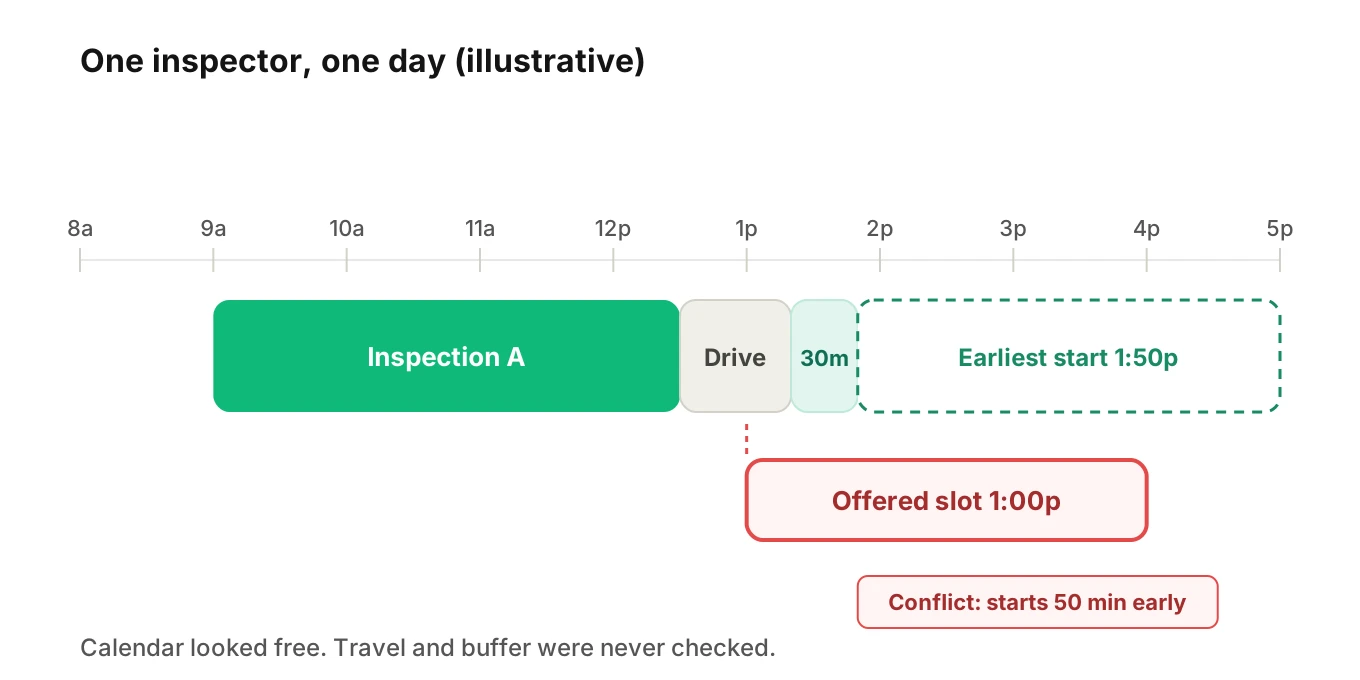
Duration depends on the property. Square footage, age, foundation type and add-ons all change the block. Your company, not the agent, should define the time rule. A simple form is:
block_minutes = base(property_type, size_band) + sum(add_on_minutes)
earliest_start = previous_end + travel_minutes + buffer_minutes
offer slot only if earliest_start <= slot_start and slot_end <= deadline
This is simplified. The point is that the agent reads these values from a table. It never reasons them from memory. Then your test can assert that every offered slot satisfies the rule.
For a related inspection workflow, see roof inspection AI scheduling. For general appointment testing, see testing appointment scheduling voice agents.
Pricing, reschedules and report questions
Pricing. Callers ask "how much" in the first ten seconds. The hard constraint is simple: never quote a price that is not in the knowledge base. If the table has price bands by size and add-on, the agent quotes those. If the property is outside the table, it says a person will confirm. A rounded or guessed number becomes a promise.
Reschedules. The agent must find the right booking first. Two bookings for the same agent on the same street are common. It should confirm by address and date, then re-run the conflict check for the new slot. Moving a booking without that check is how double bookings happen.
Report delivery. Callers ask when the report arrives and who gets it. The agent may only repeat what the company has set. It should not promise a turnaround it cannot see. It should also take care when sharing a report with a third party, since the client may need to consent. Treat names, addresses and access codes as personal data in logs. See PII leakage detection.
Questions to ask a vendor
Demos show the happy path. These eight questions expose the rest. Each has a good answer you can hold a vendor to.
1. Can I see a sample booking record with a state per field? A good answer shows confirmed, unconfirmed and unknown states, not one blank-or-filled value.
2. How does it read back addresses and dates? A good answer chunks digits, repeats the date with the weekday and asks for a yes.
3. What happens when a caller is unsure of property type or size? A good answer stores "unknown" and flags a person.
4. Does it ever state a price that is not in my table? A good answer is a refusal and a handoff, and the vendor can show it.
5. How does it check travel and conflicts before offering a slot? A good answer reads your live calendar and your travel rule, and fails safe when the calendar is unreachable.
6. What happens when a write to my scheduling system fails? A good answer makes the failure visible to your staff, not silent.
7. How is quality measured on my calls, and who sees the numbers? A good answer is per-call scoring on your traffic, not a demo reel.
8. Can I test it myself before go-live? A good answer lets you call it with your hardest callers.
For the full procurement process, see evaluating a receptionist voice agent vendor. Our sister guides show the same pattern for HVAC, auto repair, pool service and insurance agencies.
How to test an AI receptionist for home inspectors before it takes real calls
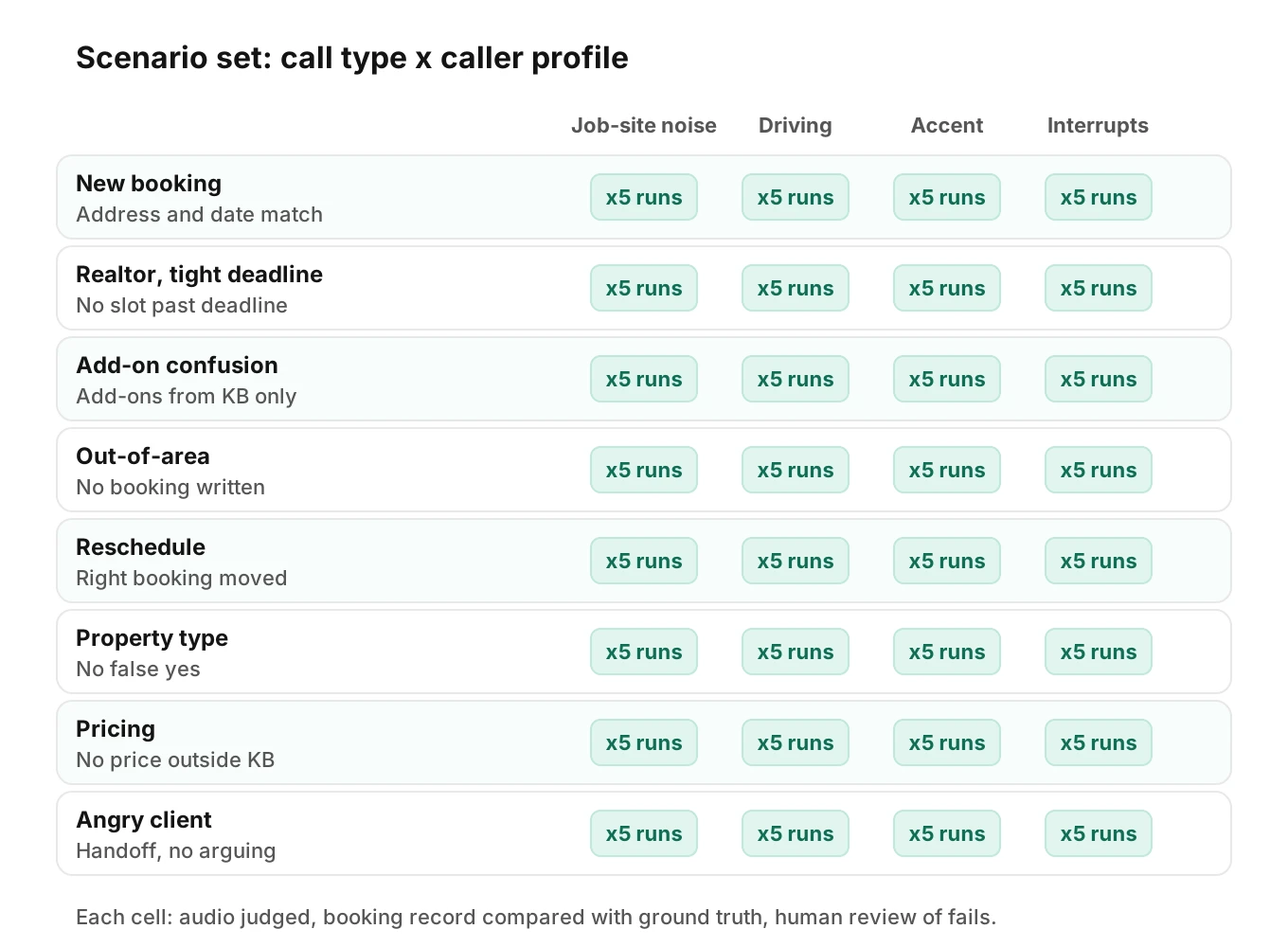
Build a scenario set by call type. Run each scenario under several caller profiles. Judge the booking record and the audio. These steps give you a suite you can rerun on every prompt or model change.
1. List call types. Use the table above: new booking, realtor on a deadline, add-on confusion, out-of-area, reschedule, property-type question, pricing, report delivery and upset client.
2. Write expected records, not expected words. Each scenario has a ground-truth booking: address, date, property type, size band, add-ons and price.
3. Set hard constraints. Never quote a price that is not in the knowledge base. Never confirm a slot that conflicts with travel or the deadline. Never accept an address outside the service area. Never promise a report time the company has not set.
4. Add caller profiles. Use job-site noise, a driving caller, a fast talker, an accent, long pauses and interruptions. Evalgent's caller profiles set accent, speech pace, interruptions, response delay and background noise for each scenario.
5. Call over the real phone path. Browser audio skips telephone compression. Evalgent's simulator reaches an agent over phone (PSTN), SIP or WebRTC.
6. Judge from the audio. A transcript can look right while the audio shows a talk-over or a clipped digit. Evalgent evaluates the audio and uses an LLM and Jev as a judge, with evidence and human review of verdicts. See transcript versus audio evaluation.
7. Assert on the write. Compare each stored field with the ground truth. Add a separate assertion that every offered slot passes the travel rule.
8. Run each cell several times. Speech systems vary. A scenario that passes 9 of 10 runs fails once in ten live calls. Report pass rates per field.
9. Add human review. Have a person listen to every failed and borderline call. See human-in-the-loop evaluation.
10. Gate releases. Rerun the set before every prompt change. See shipping prompt changes safely.
Example scenarios and what each must prove
| Scenario | Caller profile | Pass condition |
|---|---|---|
| Realtor, Friday deadline | Driving, fast, truck noise | Address and date stored correctly; no slot after Friday |
| "Do you do the whole thing?" | Calm buyer, vague | Agent lists add-ons from the knowledge base; none assumed |
| Radon plus sewer scope | Accent, long pauses | Both add-ons stored; time block includes both |
| Out-of-area address | Quiet caller | Agent declines or hands off; no booking written |
| Reschedule, two similar bookings | Interrupts often | Correct booking moved; travel check rerun |
| Price for an unlisted property type | Pushy | No invented number; handoff offered |
| "Where's my report?" | Irritated | Only company-set facts; log and handoff |
| Upset after inspection | Angry | No defending findings; handoff to a person |
Monitoring after launch
Pre-launch tests use scripted callers. Production gives the real ground truth. Compare bookings with what the inspector actually found on arrival: right address, right property type, right add-ons. Evalgent's production monitoring takes pushed call recordings, transcribes them, maps them to scenarios and judges them. It flags PII leakage, tool-call failures, latency spikes and policy failures, with fix recommendations.
A drop in address accuracy after a model change points to the speech layer. A drop in add-on capture points to the prompt or the read-back. Slice by call type and by caller condition so you can tell which.
Frequently asked questions
Can an AI receptionist book home inspections?
Yes, if it captures address, property type, size, add-ons and date window, then writes them to your scheduling system. The booking is only as good as the stored fields. Test the record, not just the conversation, and confirm that conflicts and travel are checked before any slot is offered.
What should a home inspector answering service handle?
At minimum: new bookings, realtor calls with deadlines, add-on questions, property-type checks, pricing, reschedules, report-delivery questions and out-of-area callers. It also needs a clean handoff to a person for upset clients and anything outside its knowledge base.
How does AI phone answering for home inspectors handle add-ons like radon?
It should read from your service list. Say what each add-on is, whether you offer it, how much time it adds and what it costs. Radon may need a placement and a pickup visit, so the agent must book both, not just the inspection.
Can the AI quote inspection prices?
Only from your price table. The hard rule is never to quote a number that is not in the knowledge base. If the property or add-on is outside the table, the agent should say a person will confirm, then hand off.
How do you test home inspection booking AI before go-live?
Write scenarios by call type, add noisy caller profiles, call over the real phone path and judge the audio. Compare each stored field with a ground-truth record. Add a check that every offered slot passes your travel and deadline rule.
What goes wrong with addresses and dates?
Speech systems can swap digits or months and still produce a valid address or date. The record looks fine and nobody notices until the inspector arrives. Chunked read-backs, weekday-plus-date confirmation and field-level tests catch most of these.
Should the agent confirm a slot or only request it?
That is a policy choice. Confirming needs a live calendar, travel rule and conflict check. If those are not reliable, request the slot and let a person confirm. Whichever you choose, test the rule with conflicting and past-deadline requests.
Does an AI receptionist replace the office staff?
It changes what staff handle. Routine bookings and questions can move to the agent, while upset clients, odd properties and anything outside the knowledge base go to a person. Measure handoff quality as carefully as booking accuracy.
The bottom line
An AI receptionist for home inspectors is judged by the booking record it writes, not by how natural the call sounded. Test every call type under realistic noise, with hard constraints on price, slots and scope, before it takes a real call.
Related Articles
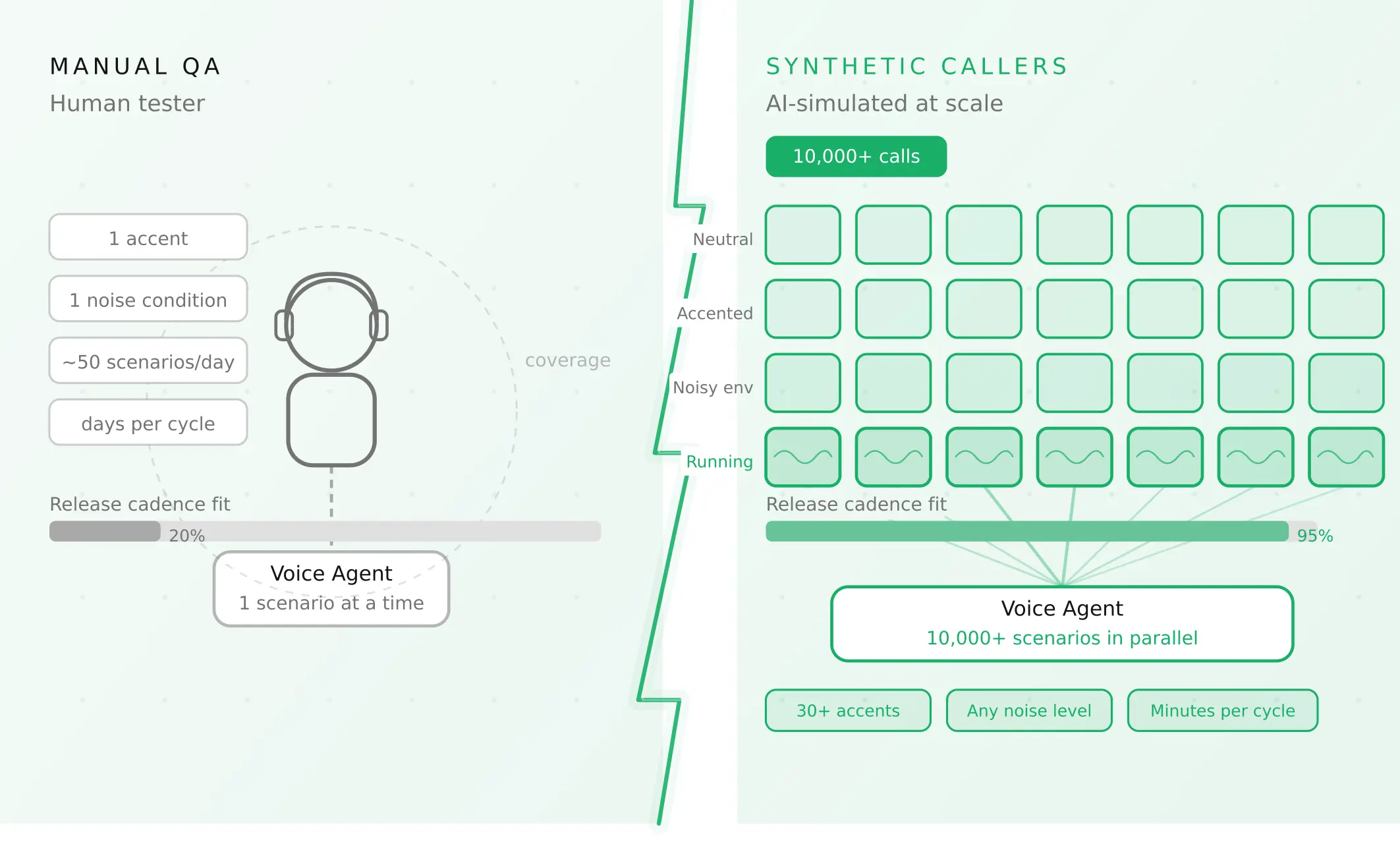
How to automate voice agent testing: synthetic callers vs manual QA
Learn how ai test automation replaces manual QA for voice agents. Compare synthetic callers vs human testers, with a 5-step framework to scale without hiring.
Read more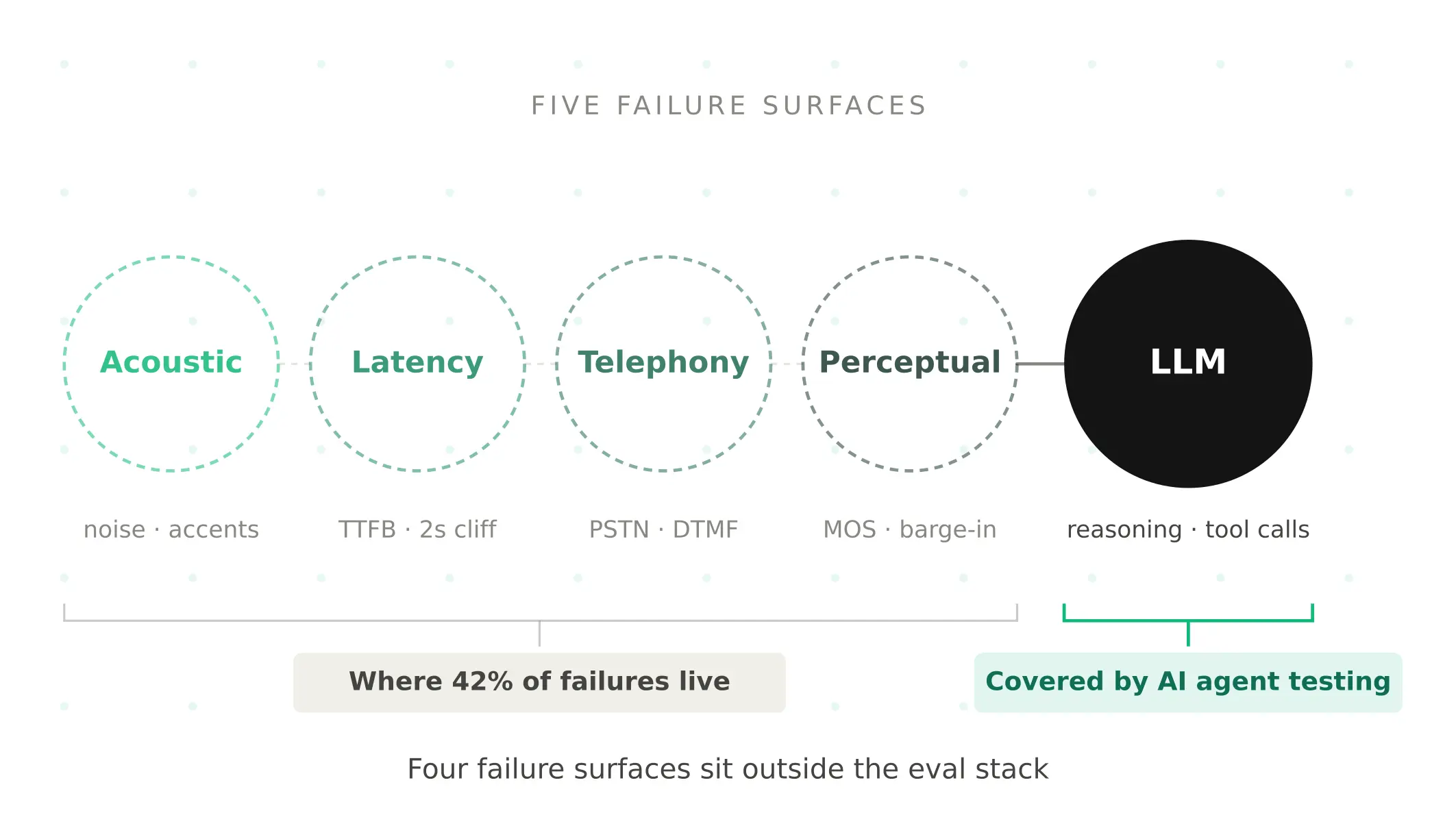
AI Agent Testing vs Voice Agent Testing: What General Tools Miss for Voice
AI agent testing measures text outputs. Voice agent testing measures behaviour through an acoustic pipeline. Five failure categories general tools miss.
Read more