Test your voice agent
Voice Cloning Quality: How to Evaluate It
# Voice cloning quality: how to evaluate it
Quick answer
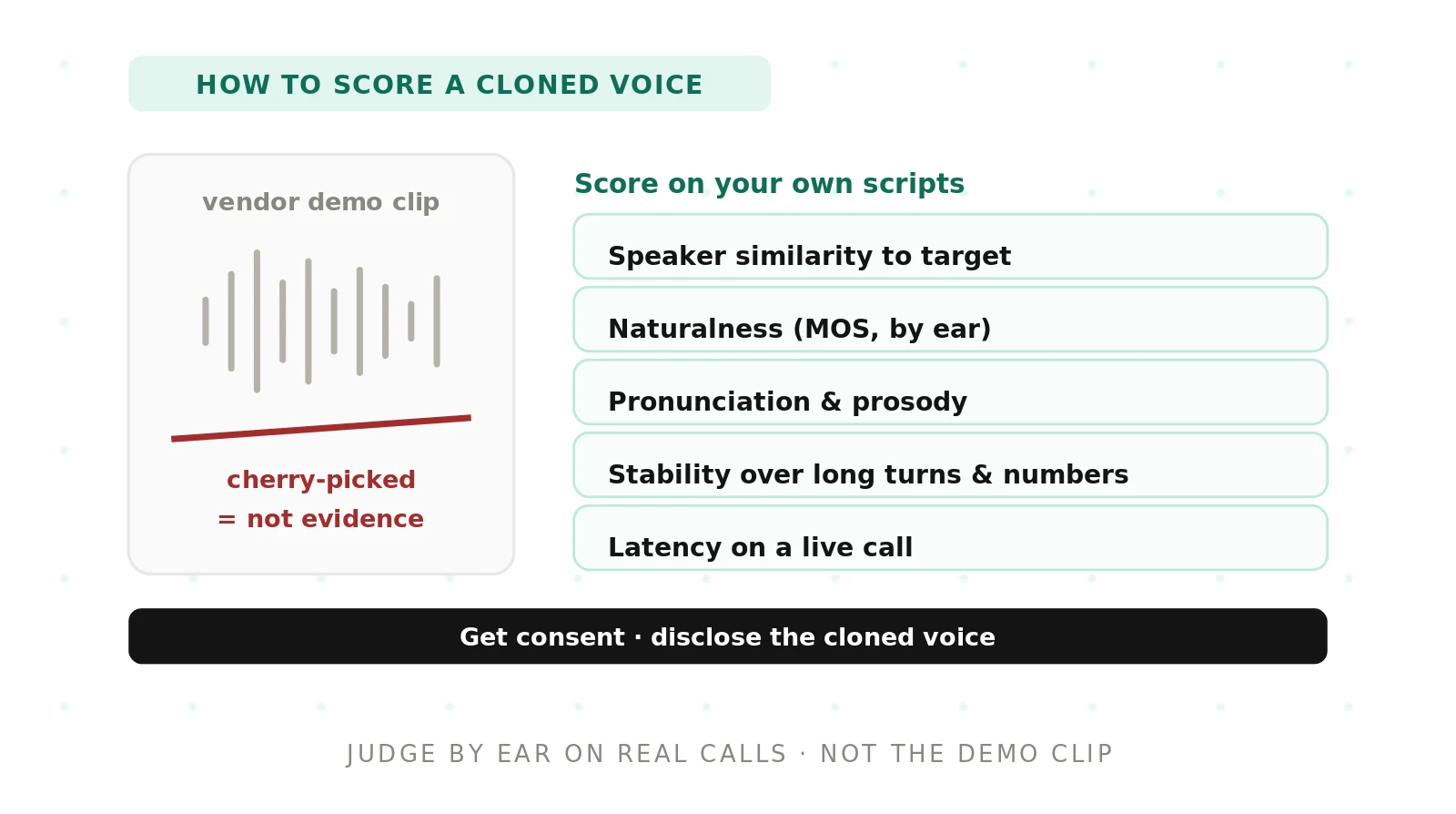
To evaluate voice cloning for voice agents, score seven things by ear on your own calls: speaker similarity, naturalness, pronunciation, prosody, stability across long turns, emotion, and latency. Vendor demo clips are cherry-picked and short, so they hide the failures. Independent listening on real scripts is the only reliable test.
A cloned voice sounds perfect in the demo. Then it says a customer's last name, reads a 16-digit account number, or handles a two-minute call, and it falls apart. The demo clip was ten seconds long and written to flatter the model. Your calls are longer, messier, and full of the exact words that break synthetic speech.
This guide explains how to evaluate voice-cloning quality for a voice agent. It covers the dimensions that matter, how to measure each one, and what "good" looks like. It also explains why subjective listening on your own scripts beats any vendor reel, and it covers consent and disclosure. This is general information, not legal advice.
What voice cloning is
> Voice cloning: the use of a text-to-speech model to reproduce a specific person's voice, usually from a short recording. The output speaks new words in that person's timbre, accent, and cadence.
Voice cloning is a branch of speech synthesis. A model learns the acoustic signature of a target voice. It then generates fresh audio for text it never saw. The result is a voice that sounds like the source, saying things the source never said. Wikipedia's overview of voice cloning covers the underlying methods.
Voice agents use cloning for a few reasons. A brand may want one consistent voice across every call. A company may license a specific actor. Some teams clone a founder or a well-known spokesperson. In each case the promise is the same. The agent should sound like that person, not like a generic robot.
The problem is that "sounds like" is doing a lot of work. A clip can sound like the target for ten seconds and drift over two minutes. It can nail a greeting and mangle a name. Evaluation exists to find those cracks before your callers do.
Why vendor demo clips mislead you
Demo clips are marketing. They are chosen, not sampled. A provider records many takes, keeps the best one, and ships it. You hear the top of the distribution. Your callers hear the whole curve.
There are three reasons a demo flatters the model.
Length. Demos are short. Synthetic voices are most stable in the first few seconds. Drift, breath artifacts, and pitch wobble show up over longer turns. A ten-second clip never runs long enough to break.
Script. Demo scripts use easy words. They avoid rare names, spelled-out emails, long numbers, and code-switching. Those are the inputs that expose a clone. Your calls are full of them.
Selection. You are hearing one clean take. Real calls are one take, live, with no retries. The variance you never see in the demo is the variance your customers get.
This is the same trap that shows up across voice agent evaluation. The demo shows the ceiling. Production shows the average. To judge a cloned voice, you have to test the average on inputs you control.
The dimensions of cloned-voice quality
A cloned voice is not one score. It is a set of qualities that can move independently. A voice can be highly similar to the target and still sound robotic. It can be natural and still mispronounce every name. Evaluate each dimension on its own.
Speaker similarity. Does the clone sound like the target person? This is the core promise of cloning. It maps to the field of speaker verification, which asks whether two samples are the same voice. For agents, the honest test is a listening panel that knows the target.
Naturalness. Does it sound like a human at all? A voice can miss the target yet still sound human, or match the target and sound synthetic. Naturalness is usually scored with a mean opinion score, a 1-to-5 rating from listeners. The ITU-T P.800 standard defines the method.
Pronunciation. Does it say hard words correctly? Names, streets, drug names, and brand terms are where clones fail. Our pronunciation testing guide covers how to build a word list that stresses the model.
Prosody. Does the rhythm and stress sound right? Prosody) is the melody of speech. Flat prosody is the fastest way to sound like a machine. Good prosody puts stress on the right word and pauses in the right place.
Stability. Does it hold together over a long turn? Synthetic voices drift. Pitch wanders, volume dips, and artifacts creep in as a sentence runs long. Test with turns of thirty seconds or more.
Numbers and names. Does it read digits, dates, and money cleanly? "$1,204.50" and "March 3rd, 2026" trip up many models. So do phone numbers and confirmation codes read aloud.
Emotion and expressiveness. Can it sound warm, apologetic, or urgent when the moment calls for it? A refund apology should not sound cheerful. A clone that reads everything in one tone feels wrong even when the words are right.
Latency. How fast does the first audio arrive? A cloned voice that takes a beat too long feels frozen. Latency is a quality dimension for cloning, just as it is for any voice. See our low-latency TTS guide for targets.
Robustness over a call. Does quality hold across a whole conversation, not just one turn? Barge-in, retries, and topic changes all stress the model. The question is whether turn ten sounds as good as turn one.
Quality dimension vs how to measure vs what good looks like
| Quality dimension | How to measure it | What "good" looks like |
|---|---|---|
| Speaker similarity | Blind listening panel that knows the target voice | Listeners consistently accept it as the target |
| Naturalness | Mean opinion score (MOS), 1–5, per ITU-T P.800 | Averages near the top of the scale, few low outliers |
| Pronunciation | Scripted word list of names, streets, and terms | Zero mispronounced items on the core list |
| Prosody | Ear scoring for stress, pacing, and pauses | Stress lands on the right words, pauses feel natural |
| Stability | Turns of 30+ seconds, checked for drift | No pitch wander, volume dip, or artifacts late in a turn |
| Numbers and names | Digits, dates, money, and codes read aloud | Every number and name is clear and correct |
| Emotion | Scripts that require warmth, apology, or urgency | Tone matches intent, no flat delivery on hard moments |
| Latency | Time to first audio on live turns | First audio starts fast enough to feel responsive |
| Robustness | Full multi-turn calls with barge-in and retries | Turn ten sounds as good as turn one |
How to run a voice-cloning evaluation
You do not need a lab. You need your own scripts, a small panel of listeners, and a scoring sheet. Here is a repeatable process.
1. Define the target. Write down what the voice is supposed to sound like. If you are cloning a specific person, gather clean reference audio of them. This is your ground truth for similarity.
2. Build real scripts. Pull from actual calls, not the vendor's demo copy. Include the hard cases: customer names, addresses, dollar amounts, dates, confirmation codes, and spelled-out emails.
3. Cover long turns. Add at least a few turns of thirty seconds or more. Cloned voices drift over length, so short scripts hide the failure.
4. Record on live calls. Run the scripts through the agent as a caller would hear them. Capture the audio, not just the transcript. A transcript cannot tell you the name was mangled.
5. Score by ear. Have listeners rate each dimension in the table above. Keep panels blind to the vendor so brand does not bias the score.
6. Rate similarity against the target. Play the clone next to the reference audio. Ask listeners whether it is the same voice, not just whether it sounds good.
7. Log every failure. Note the exact word, number, or moment that broke. A single mangled name on a real script matters more than a strong average.
8. Re-test after changes. Voices change when the model, prompt, or settings change. Re-run the same scripts so you can compare like for like. Our guide to benchmarking on your own data covers building a stable test set.
The output is a scorecard per dimension, plus a list of specific failures. That is far more useful than a single number, and far more honest than a demo reel.
Why audio scoring beats transcript scoring here
Voice cloning is an audio problem. A transcript cannot capture it. The words "Dr. Nguyen" look correct on paper even when the agent mispronounces the name. The words "$1,204.50" read fine as text even when the audio garbles the digits.
Everything that makes a clone good or bad lives in the sound. Similarity, prosody, drift, and emotion have no text representation. This is why cloned-voice quality has to be judged by ear. Our deeper comparison of transcript versus audio evaluation makes the general case. For cloning, the point is absolute. If you are not listening, you are not evaluating.
Subjective listening has a reputation for being soft. It is not, if you structure it. A blind panel, a fixed script, and a per-dimension sheet turn opinion into repeatable data. The scores are subjective by nature because human ears are the customer. A number a machine likes means nothing if a caller finds the voice off-putting.
Where automated metrics help and where they stop
Automated tools have a place. A speaker-embedding model can flag when a clone drifts far from the target. A metric can catch gross pronunciation errors at scale. These are useful screens for a first pass across many calls.
But they stop short of the thing you care about. A model can say two clips are acoustically close. It cannot tell you the voice sounds smug in an apology. It cannot tell you the pacing feels rushed. Naturalness, warmth, and "does this sound off" are human judgments. The P.800 MOS method exists precisely because listeners, not machines, define naturalness.
Use automated metrics to triage. Use human listening to decide. The two are not rivals. The machine finds the calls worth a human ear, and the human makes the call.
Consent, disclosure, and legal considerations
Cloning a voice raises questions that quality scores do not touch. A cloned voice can impersonate a real person. That power is why regulators are paying attention. The FTC's Voice Cloning Challenge framed the harms clearly, from fraud to appropriating a voice artist's livelihood.
Two duties come up again and again.
Consent. If you clone a real person's voice, get their permission in writing, scoped to how you will use it. A voice is closely tied to identity, and the same techniques power malicious deepfake audio. Cloning without consent is both an ethical and a legal risk.
Disclosure. Callers generally deserve to know they are talking to an AI, and in some contexts the law requires it. A cloned voice that sounds human raises the stakes. Many teams have the agent state that it is automated early in the call.
None of this is legal advice. Rules vary by state and by industry. Talk to counsel before you deploy a cloned voice in a regulated setting. Evaluation and compliance are separate jobs, and you need both.
Evaluating cloned voices with Evalgent
Evalgent is an independent, third-party evaluator for voice agents. We do not build or sell the voice you are testing. We score cloned-voice quality by ear, on your own scripts, on real calls, across every dimension in the table above.
That independence is the point. A vendor grading its own clone has an incentive to pass it. An outside panel does not. This is the same case we make for independent voice AI evaluation and for a structured vendor scorecard. If a provider's demo sounds great, prove it holds on your calls.
If you are choosing between cloned voices from different providers, or checking one before launch, book a demo to see how independent, by-ear scoring works.
Frequently asked questions
How do you evaluate voice cloning quality for a voice agent?
Score it by ear on your own call scripts, not the vendor's demo. Rate speaker similarity, naturalness, pronunciation, prosody, stability over long turns, emotion, and latency separately. Use a blind listening panel and a fixed script that includes hard names, numbers, and dates. Log every specific failure, then re-test after any model or setting change.
What is speaker similarity in voice cloning?
Speaker similarity measures whether a cloned voice sounds like the target person. It is the core promise of cloning and relates to speaker verification, which asks whether two recordings are the same voice. The honest test is a blind panel that knows the target, playing the clone next to reference audio and judging whether it is the same person.
What is a good MOS score for a cloned voice?
Mean opinion score rates naturalness from 1 to 5 using listener ratings, defined by the ITU-T P.800 standard. Higher averages are better, and a good clone sits near the top of the scale with few low outliers. There is no universal pass mark. Compare candidates on the same scripts and panel rather than chasing an absolute number.
Why do voice cloning demo clips look better than real calls?
Demo clips are short, scripted with easy words, and hand-picked from many takes. Synthetic voices are most stable in the first few seconds, so short clips never run long enough to drift. Demos also avoid rare names, long numbers, and spelled-out emails, which are exactly the inputs that expose a clone. Real calls include all of them.
Do you need consent to clone a voice?
If you are cloning a real person's voice, get written permission scoped to your intended use. A voice is tied to identity, and cloning without consent carries ethical and legal risk, especially since the same techniques power malicious deepfakes. Rules vary by state and industry, so consult legal counsel. This is general information, not legal advice.
Can automated metrics measure cloned voice quality?
Automated metrics help triage at scale. A speaker-embedding model can flag drift from the target, and rule checks can catch gross pronunciation errors. But they cannot judge naturalness, warmth, or whether a voice sounds off in an apology. Those are human judgments. Use metrics to find calls worth a listen, then let human ears make the final decision.
How does voice cloning affect latency in a voice agent?
Cloned voices still have to generate audio, so time to first audio matters. A clone that starts a beat too late feels frozen, no matter how good it sounds. Latency is a real quality dimension for cloning. Measure time to first audio on live turns, and treat a slow but beautiful voice as a failed test, not a trade-off.
Should you disclose that a voice agent uses a cloned voice?
Callers generally deserve to know they are speaking with an AI, and some contexts require disclosure by law. A cloned voice that sounds human raises the stakes further. Many teams have the agent state it is automated early in the call. Requirements vary by state and industry, so confirm with counsel. This is general information, not legal advice.
The bottom line
Evaluate a cloned voice by ear, on your own scripts, across similarity, naturalness, pronunciation, prosody, stability, emotion, and latency. Trust independent listening on real calls, not the vendor's demo reel.
Related Articles
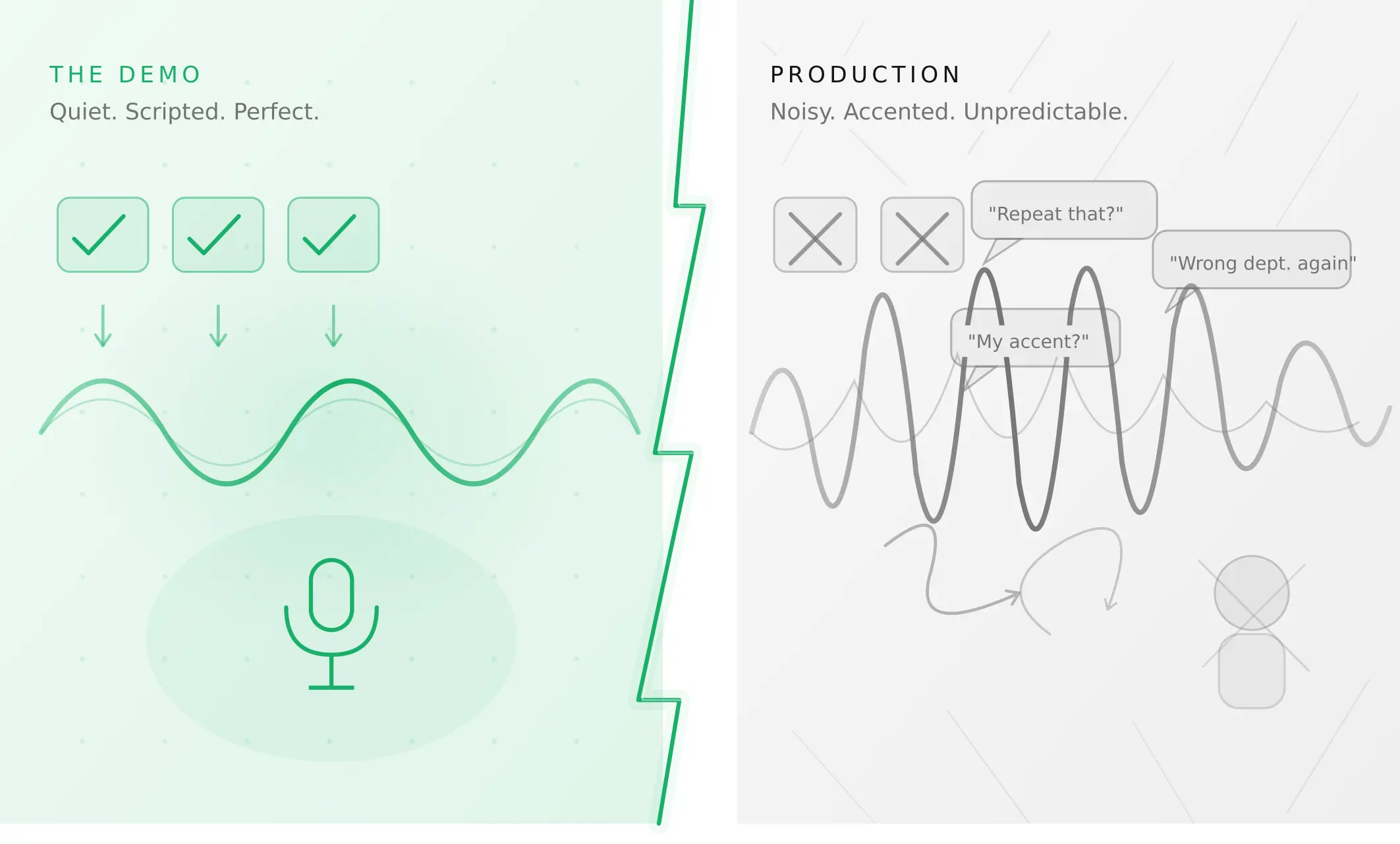
Why AI voice agents fail in production (and how to prevent it)
AI voice agents that ace demos still break in production. Learn the 5 root causes, how to test for each, and what production readiness actually means.
Read more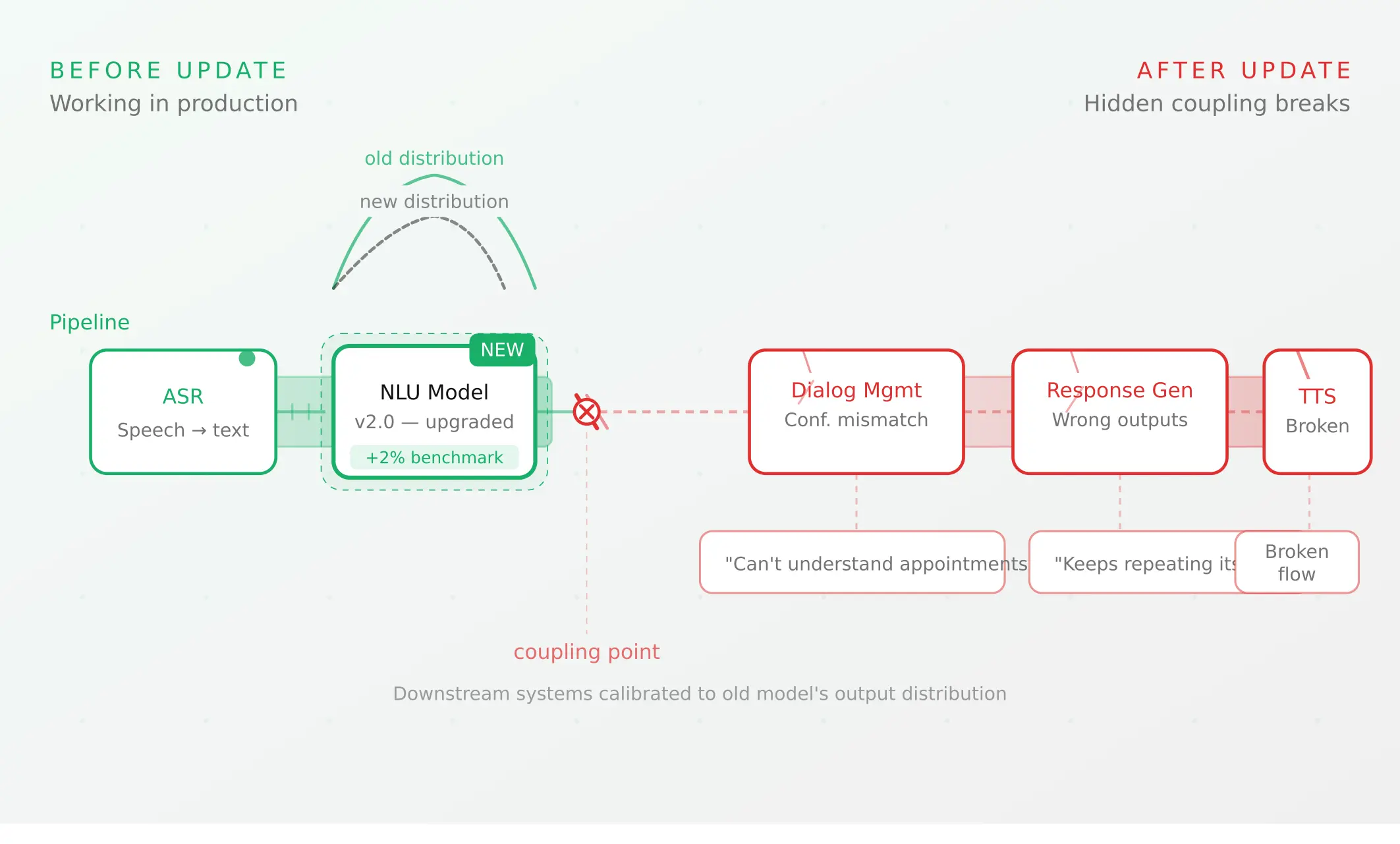
Voice agent regression testing: why LLM updates break production
LLM updates improve benchmarks but break voice agents in 5 predictable ways. How to detect and prevent regressions after every model or prompt change.
Read more