Test your voice agent
Voice Agent Vendor Comparison Matrix Template (2026)
# Voice agent vendor comparison matrix template (2026)
Quick answer
A voice agent vendor comparison matrix is a weighted scorecard that ranks providers on the criteria that matter, using evidence instead of demos. You list criteria like accuracy, latency, containment, compliance, and cost, weight each by priority, then score every vendor from one to five on identical test calls.
Most teams pick a voice agent vendor the wrong way. They watch three demos, like one, and reverse-engineer the reasons afterward. That decision cannot be defended six months later. A comparison matrix fixes this. It forces the criteria out into the open before any vendor is scored.
This post gives you a ready-to-use template. It covers the nine criteria that belong in the matrix, how to weight them, how to score with evidence, and how to keep a slick demo from skewing the result. The decision matrix is a proven tool. Here it is adapted to the realities of a phone call.
Why a weighted comparison matrix beats a demo
A demo is a performance the vendor controls. They pick the scenario, the script, and the happy path. You see the agent at its best on calls the vendor chose. You learn almost nothing about your hardest traffic.
A comparison matrix removes that control. It is built on the weighted sum model: each criterion carries a weight, each vendor earns a score, and the weighted total decides. The math is simple. The discipline is what matters.
The matrix does three things a demo cannot. First, it makes the criteria explicit before anyone is scored. Second, it forces the same test across every vendor. Third, it produces a number you can hand to procurement, finance, or an auditor.
That last point is the real payoff. When a stakeholder asks why you chose this vendor, "the demo felt polished" is not an answer. A weighted score tied to your own test calls is. The matrix turns a matter of taste into a matter of evidence. It is the backbone of any defensible vendor evaluation.
The nine criteria that belong in the matrix
The criteria stay constant across vendors so the comparison is fair. Nine cover most voice agent buying decisions. Add or cut rows to fit your situation, but start here.
Accuracy on your data. This is transcription and understanding on your real callers. It reflects your accents, your noise, and the names, dates, and amounts your calls contain. A vendor's clean-audio word error rate does not predict this. Score it on your recordings.
Latency and concurrency. Latency is the pause the caller feels, measured at the tail, not the average. The ITU-T G.114 standard puts the comfortable one-way limit near 150 milliseconds. Concurrency asks whether that latency holds under peak call volume. Many agents degrade when the lines fill up.
Containment. Containment is the share of calls the agent resolves without a human. Do not confuse it with deflection. Our guide on containment versus deflection draws the line. A high deflection rate can hide callers who gave up, not callers who were helped.
Compliance. This covers refusals, disclosures, and policy adherence. Map it to a recognized framework like the NIST AI Risk Management Framework. Regulated industries should weight it highest. A single mishandled disclosure can outweigh a latency edge.
Security. This is data handling, encryption, access control, and audit logging. It is a pass or fail gate for many buyers. Run a real requirements review here, not a checkbox. A vendor that stores call audio insecurely fails before scoring begins.
Integration. This measures how well the agent fits your stack. Think telephony, CRM, ticketing, and knowledge sources. A strong agent that cannot reach your systems is a weak product. Score the effort to connect it, not just the promise that it connects.
Total cost of ownership. Price per minute is the smallest part. Total cost of ownership includes integration work, tuning, monitoring, and the cost of failed calls. Score cost per resolved outcome, not cost per minute. The cheapest per minute is often the most expensive per solved problem.
Support and SLA. This is the vendor's commitment when things break. Read the service-level agreement for uptime targets, response times, and remedies. A weak SLA shifts outage risk onto you. Score the contract, not the sales promise.
Roadmap risk. This is the bet on the vendor's future. Consider funding, model dependencies, and the odds of a sudden pricing change. It is the hardest row to score, so treat it as a lower weight but never zero. A cheap vendor that may vanish is not cheap.
Weighting the criteria for your use case
The criteria are fixed. The weights are yours. This is where the matrix becomes a decision about your business, not a generic ranking.
Assign weights that sum to 100. Give the criteria that decide the outcome the most points. A single set of weights applied to every deployment hides the tradeoffs that actually matter. Write the weights down before you score any vendor.
Weighting depends on the job. A support line weights containment and task success highest. A healthcare intake agent weights compliance and security highest. An outbound sales agent weights latency and naturalness higher. The same three vendors can rank differently under two weight sets, and that is the point.
For a more rigorous method, the analytic hierarchy process derives weights from pairwise comparisons. Most teams do not need it. A simple sum-to-100 split, agreed with stakeholders, is enough. What matters is that the weights are explicit and locked before scoring starts.
The voice agent vendor comparison matrix template
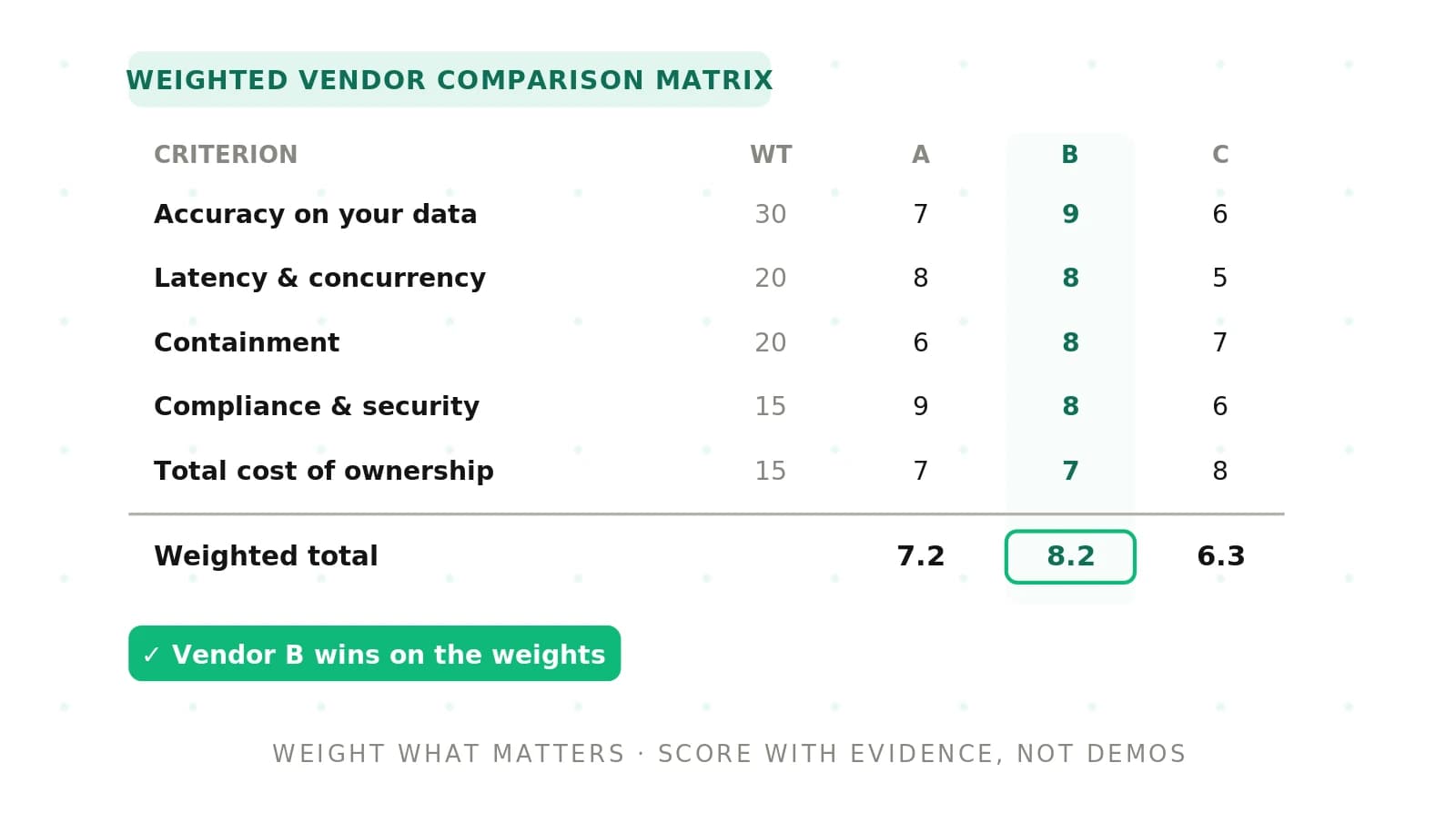
Here is the template. Copy it, set your own weights, and fill the vendor columns with scores from one to five. Five is excellent, one is a failure, and three is acceptable. The example weights below suit a customer support line. Change them for your use case.
Multiply each score by its weight, sum the columns, and the highest weighted total wins. The scores shown are illustrative, not a rating of any real provider.
| Criterion | Weight | Vendor A | Vendor B | Vendor C |
|---|---|---|---|---|
| Accuracy on your data | 18 | 4 | 5 | 3 |
| Latency and concurrency | 15 | 3 | 4 | 5 |
| Containment | 16 | 5 | 3 | 4 |
| Compliance | 12 | 4 | 4 | 2 |
| Security | 10 | 5 | 3 | 3 |
| Integration | 10 | 3 | 4 | 4 |
| Total cost of ownership | 9 | 4 | 3 | 5 |
| Support and SLA | 6 | 3 | 4 | 3 |
| Roadmap risk | 4 | 3 | 5 | 2 |
| Weighted total (out of 500) | 100 | 396 | 396 | 362 |
Read the totals with care. Vendor A and Vendor B tie here, which is common. The tie is a signal, not a dead end. Break it on the criteria you weighted highest, or add a decisive row like a security gate. A tie also tells you the two are genuinely close, and the choice can rest on softer factors.
Keep the filled matrix as an artifact. Attach the scores, the test set, and the raw evidence behind each number. That bundle is what makes the decision auditable later.
How to build and score the matrix
Follow these steps in order. Each one produces evidence you can keep. Skipping a step is how demo bias creeps back in.
1. List the criteria. Start with the nine above. Add rows for anything specific to your business, such as a required language or a hard data-residency rule. Remove rows that do not apply.
2. Set the weights. Split 100 points across the criteria with your stakeholders. Tie each weight to a business outcome. Lock the weights before you contact vendors.
3. Define the scoring scale. Use one to five. Write down what each level means for every criterion, so a three means the same thing to everyone. This is what stops scoring from drifting.
4. Build one shared test set. Assemble real call scenarios from your own data. Include the hard cases on purpose: accents, interruptions, noise, and policy questions.
5. Run the same calls on every vendor. Put each vendor through the identical scenarios. Capture transcripts, audio, and outcomes. Running the same test cases across vendors is what keeps the comparison honest.
6. Score each criterion from the evidence. Grade every vendor on the recorded calls, not on their slides. Fill each cell with a number you can defend.
7. Compute the weighted totals. Multiply each score by its weight and sum the columns. The highest total leads, subject to any pass-or-fail gates.
8. Write the rationale. State the winner, the margins, and the tradeoffs. Record where the losing vendors fell short. Store the matrix with its evidence.
The process is what makes the matrix fair. Run it identically for every vendor, and the ranking becomes something you can prove.
Scoring with evidence, not vendor self-report
The matrix is only as good as the numbers in the cells. Vendor-reported figures cannot fill them. Every vendor measures accuracy, containment, and latency its own way, on data it chose. One vendor counts a transfer as a success. Another counts it as a failure. The numbers were never comparable.
The only trustworthy score is the one you produced. Run your test set, record the calls, and grade the results against your scale. This is the difference between checking a box and measuring an outcome. Our guide on testing versus evaluation explains why the two are not the same thing.
Independence matters as much as evidence. The vendor should not grade its own agent. Neither should the internal champion who already picked a favorite. A neutral scorer removes the conflict at the center of the decision. That is the case for independent voice AI evaluation, where the party checking the results has no stake in the winner.
Avoiding demo bias and other scoring traps
Demo bias is the most common failure. A polished demo anchors the whole decision, and the matrix gets filled to justify the favorite. Guard against it by scoring only on your test set, never on the demo. Have the scorer grade calls without knowing which vendor produced them.
Watch for these other traps too. Each one quietly corrupts the matrix.
Weight tampering. Adjusting weights after seeing scores, to push a favorite ahead. Lock weights first, and change them only with a written reason.
Vanity criteria. Rows that sound impressive but do not affect the outcome. Cut any criterion you cannot tie to a business result.
Uneven test sets. Giving vendors different scenarios or letting them supply their own results. Every vendor faces the identical set.
Single-run scoring. Judging on one call per scenario. Voice agents vary run to run, so score across repeats and average.
Ignoring the tail. Scoring average latency while callers feel the worst moments. Measure at the p90 or p95, not the mean.
Handling multiple vendors on one honest test set is the surest defense against all of these. The structure protects the decision from the pressures inside your own team.
Adapting the template to your buying situation
The template is a starting point, not a fixed form. Real buying situations vary, and the matrix should flex to match. Describe your situation in a sentence, then adjust rows and weights accordingly.
A regulated healthcare buyer replacing a legacy IVR should add a data-residency gate and weight compliance and security above 30 combined. A high-volume retail support line preparing for holiday peaks should weight concurrency heavily and score latency under simulated load. A lean startup running its first outbound campaign should weight integration and cost higher, because engineering time is the scarce resource.
Each situation reshapes the matrix without breaking it. The criteria and the scoring discipline stay the same. Only the weights and a few rows change. That flexibility is what lets one template serve procurement, engineering, and compliance from the same evidence base.
Where independent scoring fits
The hardest cell to fill honestly is the one you have a stake in. Your team built the test harness. Someone already prefers a vendor. The deadline is pushing you to close. This is structural, not a character flaw.
Evalgent is an independent, third-party evaluation platform for voice agents. It runs your criteria and your test set across every vendor, then fills the matrix with scored evidence rather than vendor self-report. The output is a documented, neutral scorecard you can defend.
The value is defensibility. When procurement asks for justification, you have a third-party report. When your board asks how you know the agent is safe, you point to independent scores. For the wider discipline, start with our pillar on voice agent evaluation, and see how a formal third-party audit turns the matrix into a signed result.
Frequently asked questions
What is a voice agent vendor comparison matrix?
A voice agent vendor comparison matrix is a weighted scorecard for choosing a provider. You list criteria such as accuracy, latency, containment, compliance, and cost, assign each a weight, and score every vendor on identical test calls. The weighted totals rank the vendors on evidence, not on demos or self-reported numbers.
How do you weight criteria in a voice agent comparison matrix?
Split 100 points across the criteria and give the most points to what decides the outcome. Weights depend on the job: containment leads for support, compliance leads for healthcare, latency leads for sales. Agree the weights with stakeholders and lock them before scoring any vendor, so the split reflects priorities rather than a favorite.
What criteria belong in a voice agent vendor comparison matrix?
Nine criteria cover most decisions: accuracy on your data, latency and concurrency, containment, compliance, security, integration, total cost of ownership, support and SLA, and roadmap risk. Keep the criteria constant across vendors so the comparison stays fair. Add rows for business-specific rules like data residency, and cut any row that does not apply.
How do you score voice agent vendors with evidence?
Run one shared test set across every vendor and grade the recorded calls, not the vendor's slides. Use a one-to-five scale with written definitions for each level. Capture transcripts, audio, and outcomes. Score each criterion from that evidence. Vendor-reported figures cannot fill the cells, because no two vendors measure the same way.
How do you avoid demo bias when comparing voice agent vendors?
Score only on your own test set, never on the demo. Have the grader review calls without knowing which vendor produced them. Lock the weights before scoring so no one tunes them to a favorite. Score across repeated runs and measure latency at the tail. These steps keep a polished demo from anchoring the decision.
Should you use a 1-5 or 1-10 scale to score voice agent vendors?
A one-to-five scale works best for most teams. It is easy to define, and each level can carry a clear meaning per criterion. A one-to-ten scale invites false precision that the evidence rarely supports. Whichever you pick, write down what each level means so a given score means the same thing to every grader.
How is total cost of ownership included in a voice agent comparison matrix?
Total cost of ownership is one weighted criterion, scored as cost per resolved outcome rather than cost per minute. Include integration work, tuning, monitoring, and the cost of failed calls that reach a human. The cheapest per minute is often the most expensive per solved problem, so score the full lifecycle cost.
Who should fill in a voice agent vendor comparison matrix?
A neutral scorer should fill the cells, not the vendor and not the internal champion who already has a favorite. The people running a selection are rarely neutral about its result. An independent evaluator, or a third-party platform, removes that conflict and produces scores your board, procurement, and auditors can trust.
The bottom line
A voice agent vendor comparison matrix turns a gut decision into a weighted, evidence-based ranking you can defend. Set the criteria and weights first, score every vendor on one shared test set, and keep the filled matrix as your audit trail.
Fill the cells with independent evidence rather than vendor self-report, so the ranking holds up when your board or auditors ask. Book a demo to see how Evalgent scores every vendor on your own test calls.
Related Articles
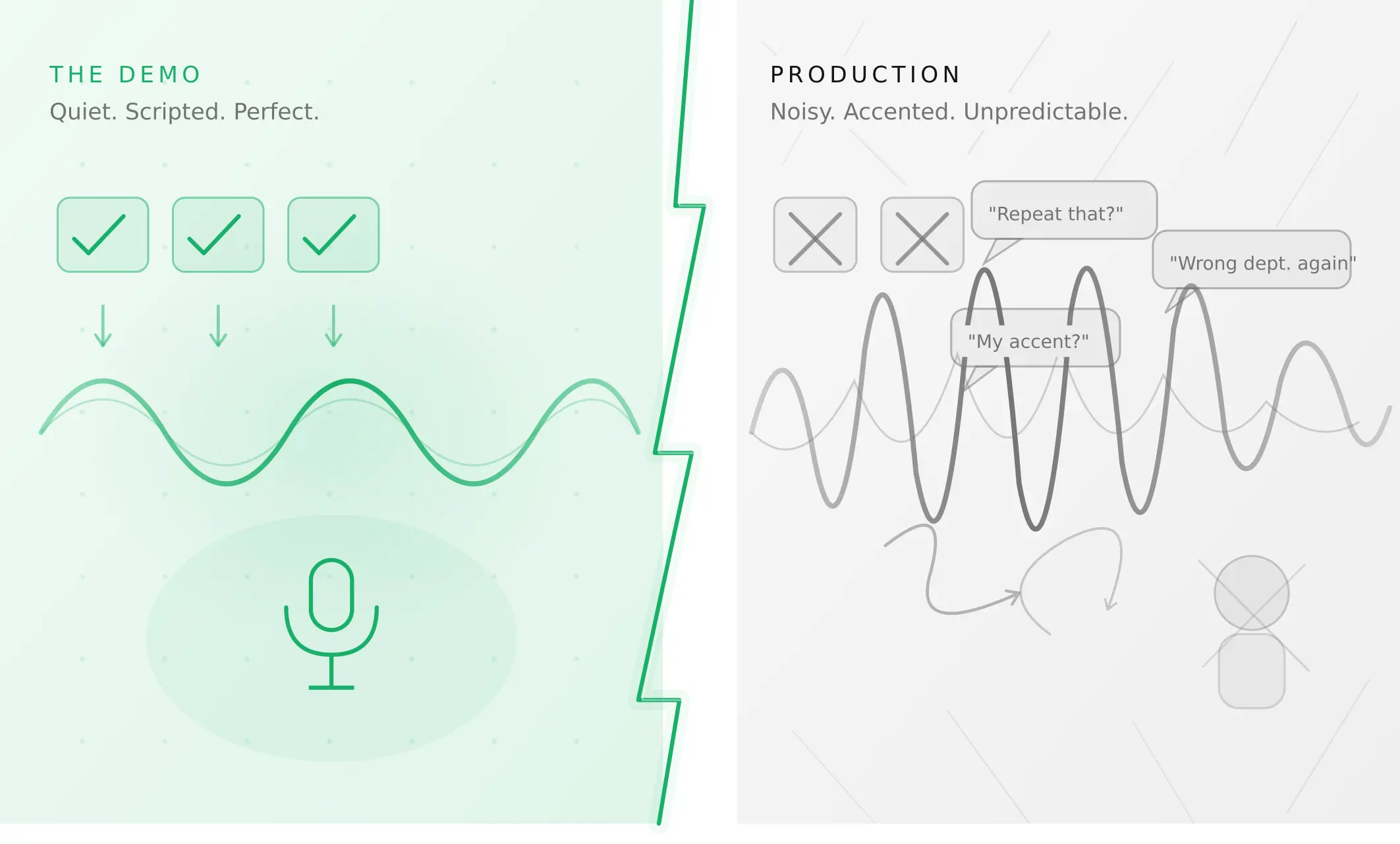
Why AI voice agents fail in production (and how to prevent it)
AI voice agents that ace demos still break in production. Learn the 5 root causes, how to test for each, and what production readiness actually means.
Read more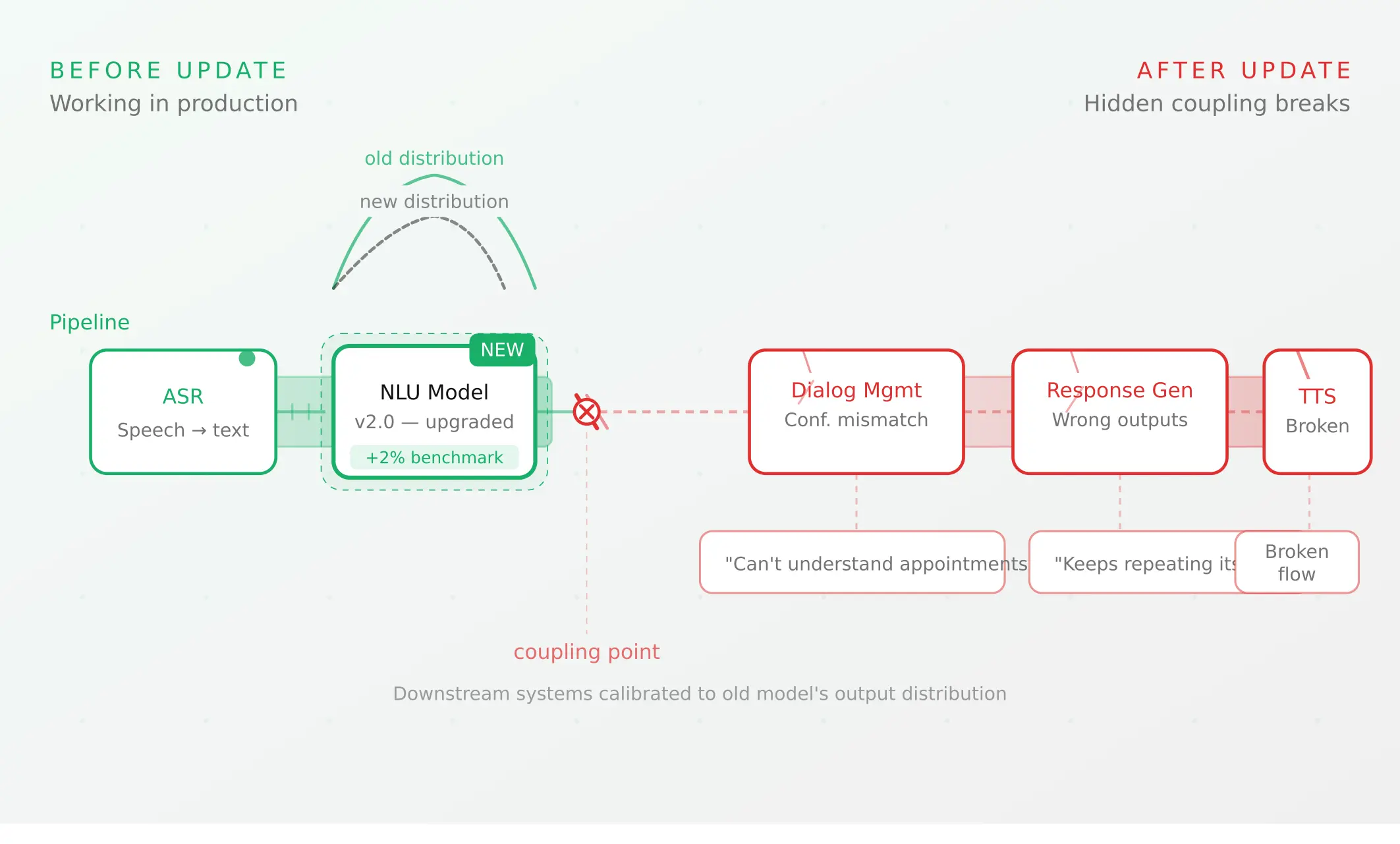
Voice agent regression testing: why LLM updates break production
LLM updates improve benchmarks but break voice agents in 5 predictable ways. How to detect and prevent regressions after every model or prompt change.
Read more