Test your voice agent
Voice Agent Total Cost of Ownership Explained
# Voice agent total cost of ownership explained
Quick answer
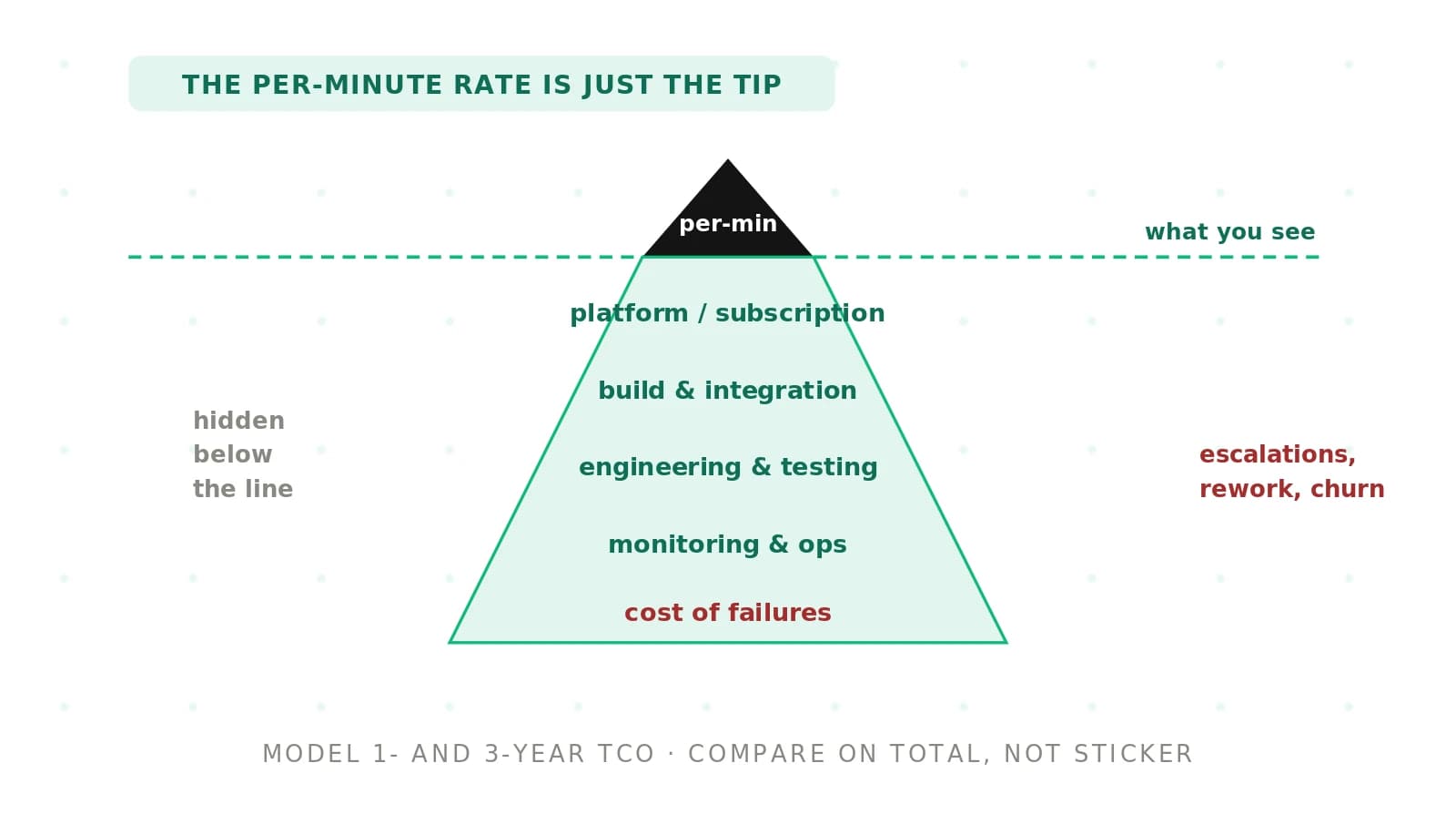
Voice agent total cost of ownership is the full cost of running an agent over its lifetime, not the advertised per-minute rate. It sums usage, platform fees, build and integration, ongoing engineering, testing, monitoring, and the cost of failed calls. Model it over one and three years to compare vendors on real spend.
Most voice agent buying decisions start with the wrong number. A vendor quotes a few cents per minute, the spreadsheet looks clean, and the deal feels easy. Then the real bills arrive from every layer of the stack, and the finance team asks why spend is triple the model. The gap is not fraud. It is structure. The sticker rate covers a thin slice of what a production agent actually costs to run.
This post maps the full picture. It covers the cost categories that make up voice agent total cost of ownership, what drives each one, and how to build a model you can defend. The goal is simple. Compare options on total cost over time, not on the headline price.
What total cost of ownership means for a voice agent
> Total cost of ownership (TCO): the sum of every cost tied to acquiring, running, and maintaining a system across its full life. It counts direct fees and the indirect costs that never reach a single invoice.
Total cost of ownership is an old idea from procurement and IT finance. The purchase price is the visible part. The larger part is what you spend keeping the thing useful over years.
A voice agent fits this pattern well. It is not one product. It is a chain of metered services plus the people who build, test, and watch it. The per-minute rate reflects one layer. TCO reflects all of them, plus the cost of the calls that go wrong.
Buyers who model only the rate are doing a partial cost-benefit analysis. They weigh a narrow cost against a broad benefit. That math always flatters the cheapest sticker, and it routinely picks the wrong vendor.
Why the per-minute rate hides most of the cost
The advertised rate is a unit price. Unit prices feel safe because they scale linearly in your head. Ten thousand minutes at five cents reads as five hundred dollars. Clean, predictable, done.
The trouble is what the number excludes. Some vendors bundle speech, language, and voice into the rate. Others quote a thin orchestration fee and pass those components straight through. Two vendors can post near-identical headline rates while one bill lands at double the other.
The rate also assumes the agent already works. It does not on day one. It has no integrations, no tested prompts, and no monitoring. Those are real costs, and they sit outside the quote. Our breakdown of hidden costs that never reach the invoice covers the surprises in detail.
So the rate answers the wrong question. It tells you what orchestration costs. You need to know what a completed, resolved call costs, all in.
The cost categories that make up voice agent TCO
A defensible model has six categories. Each has its own driver. Miss one and the total is wrong.
Usage: speech, language, voice, and telephony
Usage is the metered core of every call. Four services run in sequence, and each is billed on its own basis.
- Speech-to-text. Priced per minute of audio. Higher-accuracy models and custom vocabularies cost more.
- The language model. Priced per token. Long prompts, chatty replies, and heavy retrieval all raise tokens per call.
- Text-to-speech. Priced per character or per minute. Premium, natural voices cost more than basic ones.
- Telephony. Priced per minute by the carrier, plus number rental and separate inbound and outbound rates.
These behave like cloud computing costs. They scale with volume, and they spike with design choices you may not notice until the invoice. Our per-minute explainer covers what an AI voice agent costs at the usage layer.
Platform and subscription fees
Most vendors charge a platform fee on top of usage. It may be a monthly minimum, a seat license, a per-number charge, or a tiered subscription with usage caps.
This fee is easy to forget because it is flat. Flat costs still compound. A monthly minimum you never reach is money spent on nothing. The pricing models post breaks down how these structures differ across vendors.
Build and integration
The rate card assumes the agent connects to your systems. It never does at the start.
An agent that cannot look up an order, check an appointment, or verify a caller is an expensive answering machine. Making it useful means integration work. You connect the CRM, the scheduling system, the knowledge base, and the call routing. That is engineering time, and engineering time is money the rate never mentions.
For a serious deployment, build and integration can exceed the first year of usage fees. Treat it as a real line, not a footnote.
Ongoing engineering, testing, and evaluation
Voice agents are not set-and-forget. Prompts drift. Models get updated. Backends change their APIs. Each change can quietly break behavior that worked last month.
Keeping quality steady takes ongoing engineering and a real testing program. You need regression suites, scenario coverage, and a way to measure accuracy before every release. This is the line most buyers underestimate, and it is where quality problems hide until a customer finds them.
Monitoring and observability
Once the agent is live, you have to watch it. Monitoring covers call recording, transcript review, dashboards, alerting, and the tooling to catch drift in production.
Skipping this does not remove the cost. It defers it. An unwatched agent fails silently, and silent failures surface as churn and complaints. Continuous monitoring is cheaper than the fallout.
The cost of failures: escalations, rework, and churn
This is the largest and least-counted category. Every minute you pay for is not a minute that worked.
Picture a call that fumbles for ninety seconds and resolves nothing. You paid for it. The caller's problem still exists, so they call back and you pay again. Or they escalate to a human, and now you pay for both the agent and the person. One unresolved issue can spawn several billed interactions.
There is also revenue leakage. A caller who could not get help is more likely to churn. That lost revenue is a genuine opportunity cost, and it belongs in the model. This is why we argue for measuring cost per resolution rather than cost per minute.
Watch one trap here. Some vendors report high containment while counting deflection as contained. A call the agent hung up on is not a call it handled. The containment versus deflection guide explains why the distinction changes your cost math.
Cost categories, drivers, and how to estimate them
The table below maps each category to its driver and a practical way to estimate it. The figures named are illustrative placeholders, not benchmarks. Replace them with quotes and your own call data.
| Cost category | What drives it | How to estimate (illustrative) |
|---|---|---|
| Usage: speech, language, voice, telephony | Call volume, call length, model tier, token count | Sum per-minute and per-token quotes across a sample of real call transcripts |
| Platform and subscription | Seats, minimums, per-number fees, tier caps | Read the contract; add flat fees even when volume never hits the cap |
| Build and integration | Number of systems, API complexity, one-time setup | Scope developer-weeks, then price at a loaded internal engineering rate |
| Ongoing engineering, testing, eval | Release cadence, scenario coverage, model updates | Estimate recurring engineering hours per quarter plus testing tooling |
| Monitoring and observability | Call volume watched, retention, alerting needs | Price observability tooling plus review hours per thousand calls |
| Cost of failures | Failure rate, escalation rate, repeat-call rate, churn | Model failed and escalated minutes, repeat contacts, and lost revenue |
How to build a voice agent TCO model
Follow these steps to turn scattered quotes into a defensible one-year and three-year number.
1. Define the unit. Pick a resolved contact, not a minute, as the base unit. A minute measures effort. A resolution measures value.
2. Estimate call volume and length. Use real or projected monthly volume and average handle time. Segment by call type if they differ sharply.
3. Price the usage stack. Get per-minute and per-token quotes for speech, language, voice, and telephony. Apply them to a sample of real transcripts, not an average guess.
4. Add platform and subscription fees. Include every flat fee, seat, minimum, and per-number charge. Count minimums you may not reach.
5. Scope build and integration. List each system to connect. Estimate developer-weeks and price them at a loaded internal rate.
6. Budget ongoing engineering, testing, and monitoring. Add recurring hours for prompt work, regression testing, and production review. Include tooling costs.
7. Model the cost of failures. Estimate failure and escalation rates. Add repeat calls, human handoff minutes, and a churn assumption for unresolved contacts.
8. Roll up one-year and three-year totals. Sum the categories, then extend across three years. Discount future years if you need a present-value view.
9. Verify the quality inputs independently. The failure rate drives the biggest line. Confirm it with a third-party evaluation, not a vendor self-report.
Modeling one-year and three-year TCO
A one-year model catches the setup shock. Build and integration land mostly in year one, so the first year looks front-loaded. That is normal. Do not let a heavy year one scare you off a vendor whose ongoing costs are low.
A three-year model tells the real story. Usage, engineering, monitoring, and failure costs repeat every year. Over three years, those recurring lines dwarf the one-time build. A vendor with a slightly higher rate but far fewer failures often wins the three-year total.
When you compare years, put future costs in today's terms. Net present value discounts later spend so a three-year total is not inflated by nominal dollars. It also lets you weigh an expensive year one against cheaper later years honestly.
Do not forget the benefit side. TCO is only half of the return on investment equation. A higher-cost agent that resolves more calls can still be the better financial choice.
Comparing options on total cost, not headline price
The headline rate is the one number that varies least between vendors. The costs that decide your bill vary the most. So a comparison built on the rate compares the least important thing.
Build the same six-category model for every option. Use identical volume, call types, and failure assumptions. Then compare the three-year totals and the cost per resolution. The ranking often flips from what the rate cards suggested.
This is also where outcome-based pricing enters the conversation. When you pay per resolved contact, the vendor absorbs some failure cost, which changes the model's shape. It does not remove the need to verify quality. It changes who carries the risk.
The one input you cannot take on faith is quality. It sets the failure rate, and the failure rate sets the largest cost line. This is the core of how to evaluate voice agent vendors before you sign.
Where independent evaluation fits
Every category in a TCO model traces back to one thing. How well does the agent actually work? Accuracy, containment, and resolution quality set the failure rate, and the failure rate drives escalations, rework, and churn.
Vendors report these numbers themselves, and their tests are rarely designed to fail. That is a conflict of interest, not a fraud. It still leaves your biggest cost line resting on a marked-own-homework figure.
Evalgent is an independent, third-party platform that tests voice agents against your scenarios and grades accuracy and quality directly. The point is to verify the quality inputs that drive downstream cost, so your TCO model rests on measured behavior rather than a sales deck. That is the case for independent evaluation as a standard step in procurement.
Even public standards bodies treat measured quality as the basis for cost decisions. The NIST definition of cloud computing frames metered service as a defining trait, and latency budgets like ITU-T Recommendation G.114 set the one-way delay targets that shape a natural call. Measurement, not marketing, decides what good looks like.
Frequently asked questions
What is voice agent total cost of ownership?
Voice agent total cost of ownership is the full lifetime cost of running an agent. It counts usage across speech, language, voice, and telephony, plus platform fees, build and integration, ongoing engineering, testing, monitoring, and the cost of failed calls. It is far larger than the advertised per-minute rate.
Why is the per-minute rate a poor measure of cost?
The per-minute rate covers only the orchestration layer. It excludes component pass-through fees, integration work, ongoing engineering, monitoring, and the cost of failed and escalated calls. Two vendors with the same headline rate can produce very different bills once every category is counted, so the rate ranks the least important factor.
What cost categories belong in a voice agent TCO model?
Six categories belong in the model. Usage across speech, language, voice, and telephony. Platform and subscription fees. Build and integration. Ongoing engineering, testing, and evaluation. Monitoring and observability. And the cost of failures, which covers escalations, rework, repeat calls, and churn. The failure category is usually the largest.
How do I estimate the cost of failed voice agent calls?
Start with the failure and escalation rates from an independent test. Add the minutes you pay for on failed calls, the human minutes for escalations, and the repeat calls each failure spawns. Then add a churn assumption for unresolved contacts. This category is often the biggest single driver of total cost.
How should I model one-year versus three-year TCO?
Model both. Year one is front-loaded because build and integration land early. The three-year view shows recurring costs, which repeat every year and usually dwarf the one-time build. Discount future years to present value so the totals compare fairly, then rank vendors on the three-year number and cost per resolution.
Does outcome-based pricing lower total cost of ownership?
Outcome-based pricing shifts some failure cost to the vendor, since you pay per resolved contact rather than per minute. That changes the model's shape and who carries the risk. It does not remove the need to verify quality independently, because resolution quality still determines how many contacts count as resolved.
How does call quality affect voice agent cost?
Quality sets the failure rate, and the failure rate drives the largest cost line. A low-accuracy agent produces more failed calls, more escalations, more repeat contacts, and more churn. Higher quality raises containment and cuts every downstream cost. This is why measured accuracy belongs at the center of any serious TCO model.
Why use an independent evaluator when modeling voice agent TCO?
The failure rate is the biggest cost input, and vendors report their own quality metrics using tests built in-house. An independent evaluator like Evalgent tests the agent against your scenarios and grades accuracy directly. That gives your model a measured failure rate rather than a vendor estimate, so the largest line rests on verified behavior.
The bottom line
Voice agent total cost of ownership is the sum of usage, platform, build, engineering, monitoring, and failure costs across the agent's life, not the sticker rate. Model one-year and three-year totals, compare on cost per resolution, and verify the quality inputs independently before you sign.
Ready to ground your TCO model in measured quality rather than vendor claims? Book a demo to see how independent evaluation verifies the accuracy that drives your real cost.
Related Articles
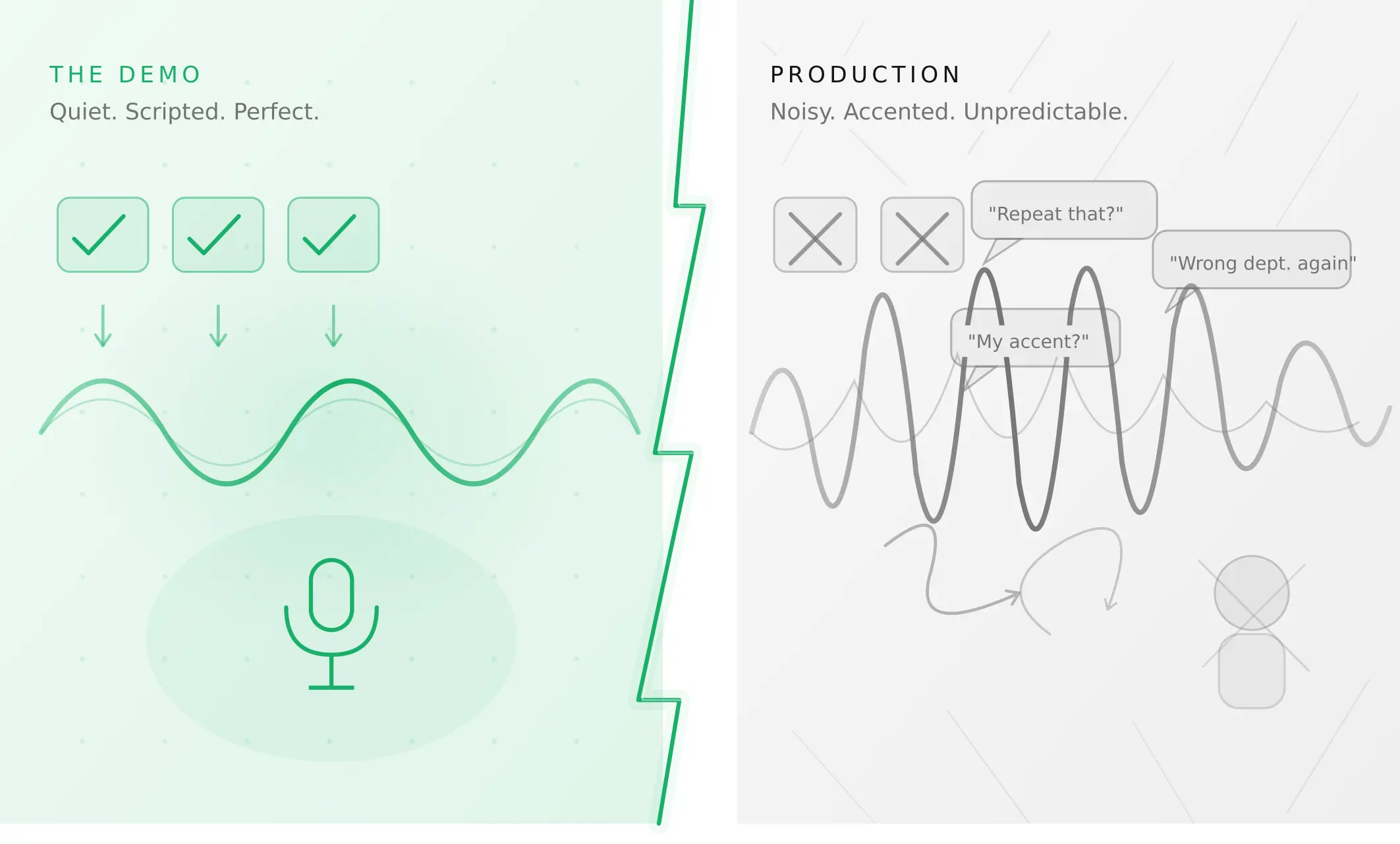
Why AI voice agents fail in production (and how to prevent it)
AI voice agents that ace demos still break in production. Learn the 5 root causes, how to test for each, and what production readiness actually means.
Read more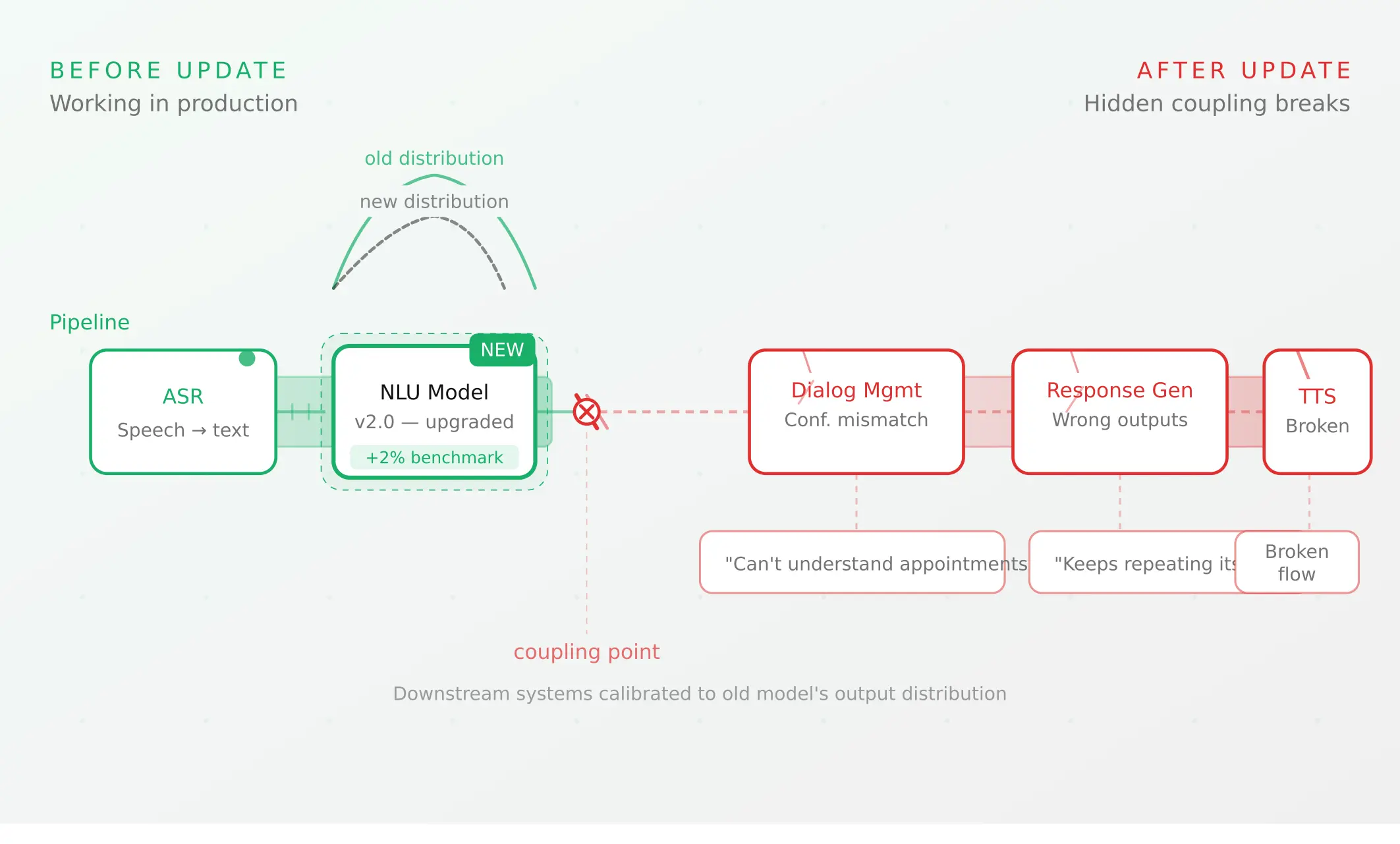
Voice agent regression testing: why LLM updates break production
LLM updates improve benchmarks but break voice agents in 5 predictable ways. How to detect and prevent regressions after every model or prompt change.
Read more