Test your voice agent
Voice agent ROI vs human-handled calls
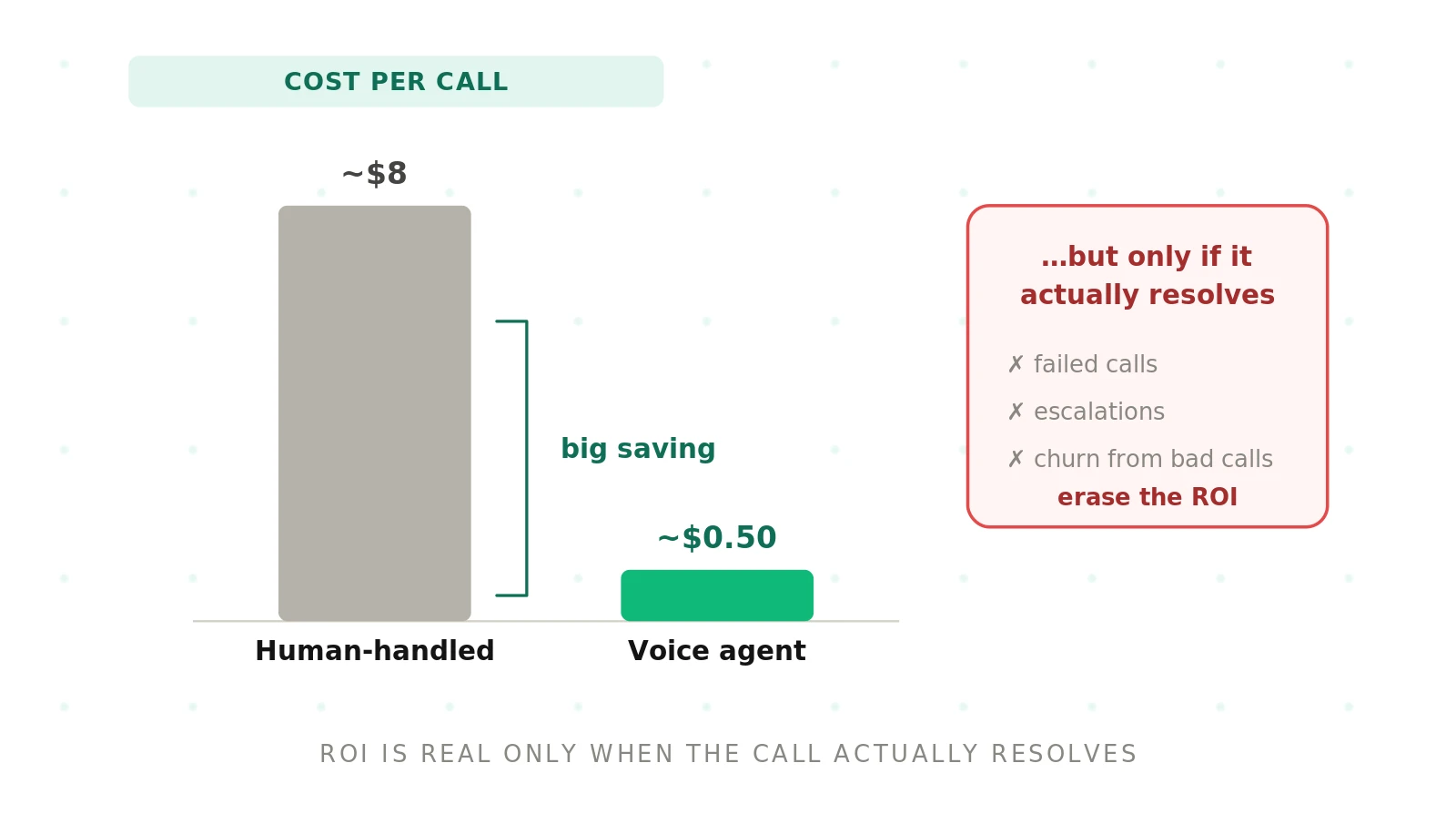
> Quick Answer: A voice agent's ROI is the labor cost it removes minus what it costs to run — counted only on calls that actually resolve. A human-handled call can cost several dollars; an automated one, cents. But an agent that escalates, fails, and churns callers can post negative real ROI.
Every voice agent pitch leans on the same arithmetic: humans are expensive, software is cheap, so automation pays for itself. The math is real, but the headline version is almost always too kind. It counts the calls a human handles and the pennies an agent charges, and quietly assumes every automated call ends as well as a human one would. That assumption is where most ROI models fall apart.
This guide builds an honest return on investment model for a voice agent versus human-handled calls. We will price both sides of the call, show how resolution rate — not per-minute cost — drives the real savings, work out a payback period, and be clear about when the return is genuine and when it is an illusion propped up by a spreadsheet. The numbers here are illustrative ballparks, framed as ranges, not quotes. Your own figures should replace them.
Why per-call cost is the wrong headline
The number vendors love is cost per minute or cost per call for the agent alone. It is small, and it looks decisive next to a loaded hourly wage. But a per-minute price answers the wrong question. What a business actually spends is the total cost of ownership: the runtime cost of the agent, plus the cost of every call it fails to resolve and hands back to a human, plus the cost of the calls it resolves badly.
A cheap agent that only finishes half its calls is not half the price of a human. It is the runtime cost of every attempt, plus a human's cost for the half that escalate, plus whatever the botched half costs you in repeat calls and lost customers. The unit cost that matters is cost per resolved call, not cost per minute — a distinction we unpack in the cost per resolution breakdown.
What a human-handled call actually costs
Start with the side you already pay for. The fully loaded cost of a human-handled call is more than a wage divided by call volume. It includes:
- Wages and benefits, the largest slice.
- Recruiting, onboarding, and training, amortized across a workforce with real turnover.
- Management, QA, and scheduling overhead.
- Facilities, tooling, and licenses per seat.
- Idle and wrap-up time — agents are not talking on every paid minute.
Divide the loaded annual cost of a team by the calls they actually resolve and you get a per-call figure that is usually several dollars, often more for complex or regulated work. This is the baseline your automation has to beat. The AI voice agent cost guide covers the automated side of the ledger in the same detail.
What a voice agent actually costs
The automated side has its own layers, and only the first is the per-minute rate people quote:
- Runtime cost per minute — speech-to-text, the model, text-to-speech, telephony, and platform fees.
- Build and integration — connecting the agent to your systems, a real upfront cost.
- Testing and evaluation — the pre-release work that decides whether the agent is safe to ship. We cover its own return in the ROI of testing piece; this post is about the agent, not the testing.
- Ongoing maintenance — prompt updates, model changes, monitoring, and re-testing as the agent drifts.
- Escalation cost — every call the agent cannot finish still costs a human to resolve.
The runtime cost per resolved call is genuinely low — often a fraction of a dollar even after you account for retries. The trap is treating that number as the whole cost while ignoring build, maintenance, and, above all, escalation.
Cost per call: an illustrative comparison
Here is a side-by-side model. Every figure is an illustrative ballpark to show the shape of the math, not a quoted price. Plug in your own.
| Input | Human-handled call | Voice-agent call |
|---|---|---|
| Direct handling cost | ~$4.00–$7.00 (loaded) | ~$0.10–$0.40 runtime |
| Resolution rate | ~90–95% | ~55–80% (varies widely) |
| Escalation to human | n/a | remaining calls at human cost |
| Build / integration | already sunk | one-time, amortized |
| Cost per resolved call | ~$4.50–$7.50 | depends heavily on resolution rate |
The key row is the last one. At 80% resolution, the agent's blended cost per resolved call stays low, because only one call in five falls back to a human. At 55% resolution, nearly half of every call still costs human money, plus the runtime you already spent trying to automate it. The per-minute rate barely moved between those two scenarios. The resolution rate moved everything.
Resolution rate is the real lever
This is the single point most ROI models miss. Runtime cost per minute varies within a narrow band. Resolution rate — the share of calls the agent finishes without a human — swings from below half to above 80% depending on the agent's quality and the difficulty of the calls. Because escalated calls carry the full human cost, resolution rate dominates the blended number.
A useful way to see it: savings per call are roughly the human cost multiplied by the resolution rate, minus the agent's runtime cost. Push resolution from 55% to 80% and you have not improved savings by a quarter — you have moved the largest cost term by that much on every single call. This is why quality and ROI are the same conversation, and why the difference between containment and genuine resolution matters so much; the containment vs deflection guide draws that line.
Payback period and the honest ROI formula
Once you have a per-call saving, the payback period is straightforward: divide your one-time build and integration cost by the monthly saving. If integration cost a fixed sum and the agent saves a few thousand dollars a month at its real resolution rate, payback lands in months, not years — when the agent is good.
The full cost-benefit analysis is:
Annual ROI = (calls × resolution rate × human cost per call − annual runtime − annual maintenance − escalation cost) ÷ (build cost + annual runtime + maintenance)
Notice what this formula refuses to hide. Runtime and maintenance are ongoing, not one-time. Escalation is a cost, not a rounding error. And resolution rate sits right at the front of the benefit term, where a small change reshapes the whole result. Model it once with an 80% agent and once with a 55% agent, and you will see two different businesses.
When ROI is real vs illusory
ROI is real when the agent resolves a high and stable share of the calls you route to it, resolves them correctly, and does so on calls that are genuinely automatable. The savings show up as fewer human minutes on repetitive, well-scoped calls, and callers do not come back angry.
ROI is illusory when the model assumes a resolution rate the agent never hits in production, ignores escalation cost, or counts "contained" calls that were not actually resolved. A caller the agent stalls until they hang up is not a saved call — it is a deflected one that becomes a repeat call, a bad review, or churn. Poor quality erodes ROI three ways: failed calls waste runtime, escalations cost human time anyway, and a frustrated caller may not come back at all. Latency plays in here too; humans notice one-way transmission delay past roughly 150 ms, and a laggy agent quietly raises abandonment. That is how an agent can post negative real ROI while its spreadsheet shows a win.
How to model voice agent ROI honestly
Follow these steps to build a model you can defend to finance.
1. Establish the human baseline. Calculate the fully loaded cost per resolved human call — wages, benefits, overhead, and idle time — not a raw wage divided by volume.
2. Segment your calls. Split traffic into automatable and non-automatable. Only the automatable share is in scope; do not model savings on calls that were never candidates.
3. Measure real resolution rate. Use the agent's actual resolution rate on representative calls, not a vendor's demo number. This is the input that moves the answer most, so measure it, do not assume it.
4. Price the full agent cost. Add runtime, amortized build, ongoing maintenance, and the human cost of every escalated call. Runtime alone understates it.
5. Compute cost per resolved call for both sides. Compare like for like — resolved calls, not attempts or minutes.
6. Calculate payback and annual ROI. Divide one-time build by monthly savings for payback; run the full formula for annual return at your real resolution rate.
7. Stress-test the assumptions. Re-run the model with a lower resolution rate and higher escalation. If the return only survives at optimistic quality, your ROI depends on quality you have not yet proven.
Beyond cost: the value ROI misses
A pure cost model undersells a good agent and oversells a bad one. A high-quality agent adds value a spreadsheet rarely captures: 24/7 coverage, zero hold times, instant scaling for spikes, and consistent handling. A poor agent does the reverse — it damages the brand on every call, and that cost lands on revenue, not the support line. Both effects are real, and both track quality, not per-minute price. Before you count either, make sure the agent clears the production readiness bar, and pressure-test any vendor's resolution claims using the vendor evaluation checklist.
Voice agent ROI with Evalgent
ROI is only real if resolution and quality are measured honestly, because a low-quality agent has negative real ROI no matter what the per-minute rate says. Evalgent is where that measurement happens. Scenarios define the automatable calls you actually route to the agent, so resolution is measured on real work, not a demo. Profiles vary accents, behaviour, and difficulty, so a resolution rate holds up across the callers you serve rather than only the easy ones. Metrics score resolution, escalation, and containment against custom thresholds, separating calls that truly resolved from calls that merely ended. Evaluations run these as automated batches before release, so you know the resolution rate your ROI model depends on before you bank on it. Reviews let your team hear the failed and escalated calls, where the difference between real and illusory savings actually lives. If you want your ROI model built on a resolution rate you can trust, book a demo.
The bottom line
A voice agent's ROI lives in its resolution rate, not its per-minute price. Model the cost of every failed and escalated call honestly, and the return is real only when the agent is genuinely good.
Frequently asked questions
How do you calculate voice agent ROI?
Subtract the agent's full annual cost — runtime, amortized build, maintenance, and escalation — from the human labor it removes, then divide by the total investment. The labor removed equals automatable calls times resolution rate times loaded human cost per call. Resolution rate sits at the front of that term, so it moves the answer more than any other input.
What is the ROI of a voice agent vs human agents?
It depends almost entirely on resolution rate. A high-resolution agent replaces most human minutes on automatable calls at a fraction of the cost, giving strong positive ROI. A low-resolution agent escalates so many calls that you pay runtime plus human cost, which can leave ROI flat or negative. Quality, not per-minute price, decides the outcome.
How much cheaper is a voice agent than a human call?
On a resolved call, an automated one can cost cents against several dollars for a human — an order-of-magnitude gap. But that gap only applies to calls the agent actually resolves. Every escalated call still costs human money, so the blended saving is the raw gap multiplied by the resolution rate, which is usually far below 100%.
What is the payback period for a voice agent?
Divide one-time build and integration cost by the monthly saving at your real resolution rate. For a genuinely good agent handling meaningful volume, payback often lands in months. For a weak agent, the monthly saving shrinks as escalations pile up, and payback stretches out or never arrives. The build cost is fixed; the saving is what varies.
When is voice agent ROI illusory or negative?
When the model assumes a resolution rate the agent never reaches in production, ignores escalation cost, or counts stalled calls as resolved. A deflected caller who hangs up becomes a repeat call or churn, not a saving. If the return only survives at optimistic quality you have not proven, the ROI is illusory and may be negative once real outcomes land.
Does containment rate affect voice agent ROI?
Yes, but containment and resolution are not the same thing. Containment counts calls that did not reach a human; resolution counts calls that were actually solved. An agent can contain a call by stalling a caller who then gives up. That inflates containment without saving anything real. Model ROI on genuine resolution, not raw containment, or the savings are fictional.
How does call quality change voice agent ROI?
Quality drives resolution rate, and resolution rate drives ROI, so quality is the whole game. A high-quality agent resolves more calls correctly, escalates fewer, and keeps callers, all of which lift the return. A low-quality agent wastes runtime on failed calls, escalates anyway, and churns customers, which can push real ROI below zero even at a low per-minute rate.
Should you replace human agents entirely with a voice agent?
Usually no. Some calls are non-automatable, and forcing them onto an agent tanks resolution and ROI. The stronger model routes automatable, repetitive calls to the agent and keeps humans for complex, sensitive, or high-value work. Segment your traffic first, automate only the calls that genuinely resolve, and measure the resolution rate before committing to any replacement ratio.
Related Articles
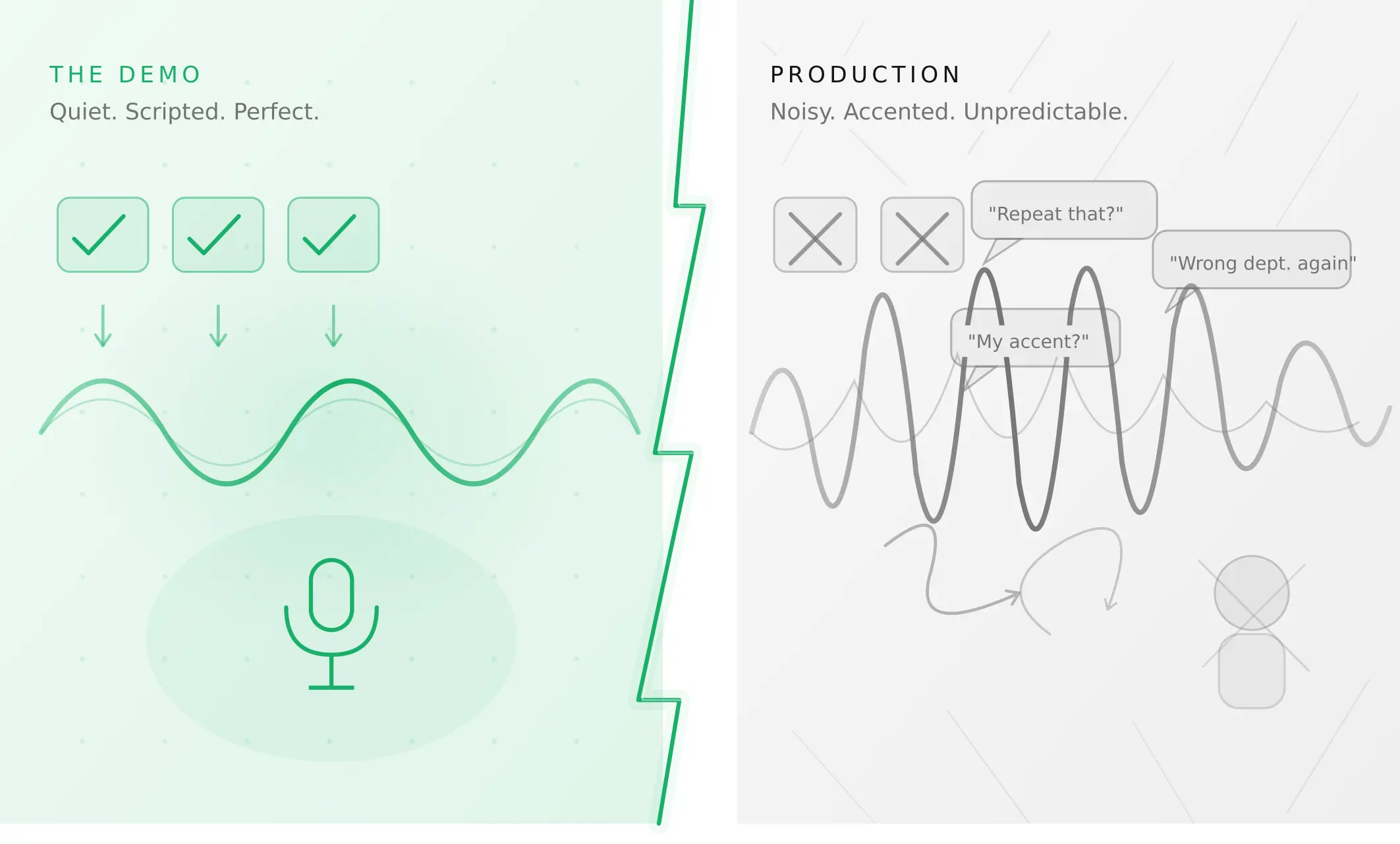
Why AI voice agents fail in production (and how to prevent it)
AI voice agents that ace demos still break in production. Learn the 5 root causes, how to test for each, and what production readiness actually means.
Read more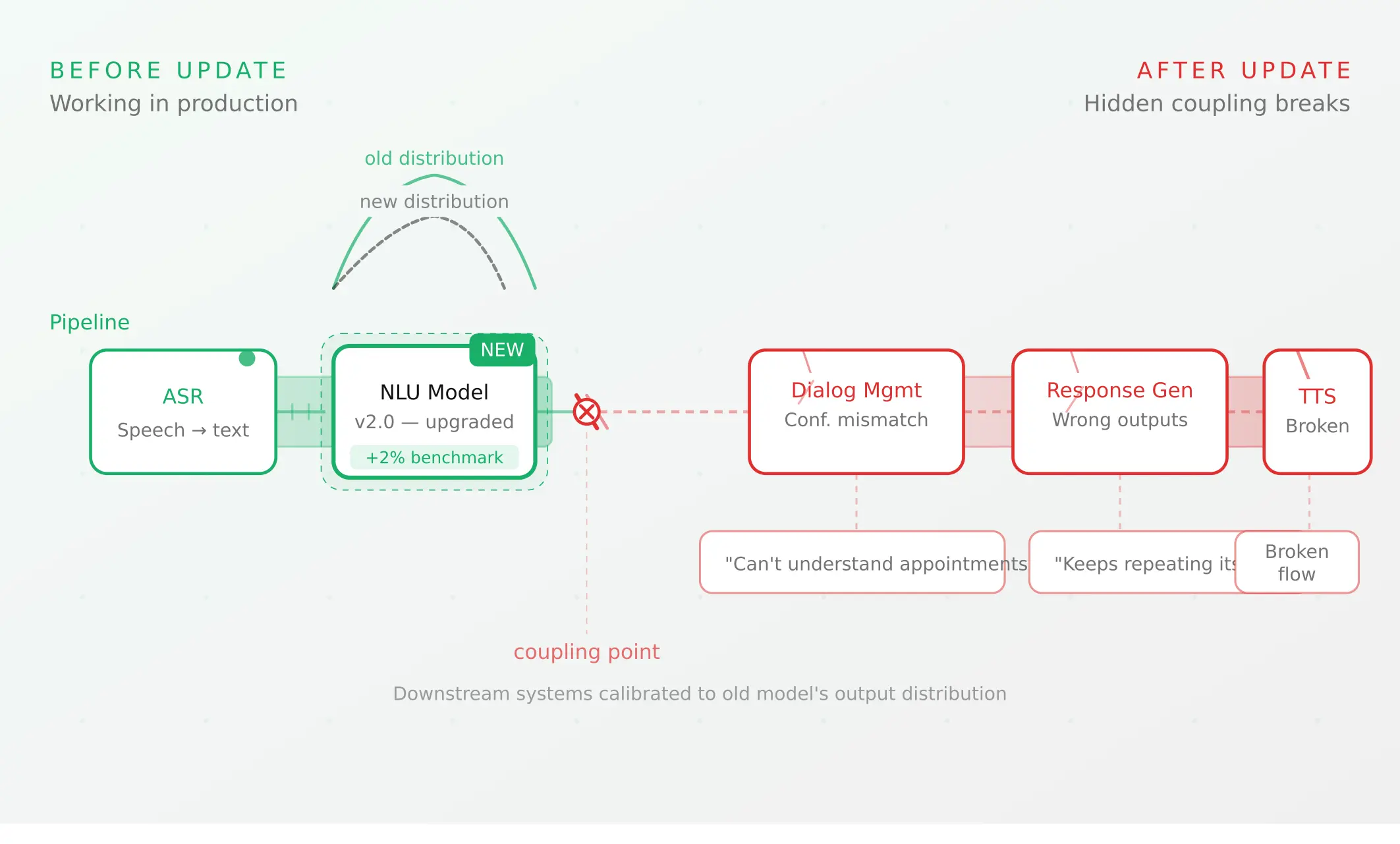
Voice agent regression testing: why LLM updates break production
LLM updates improve benchmarks but break voice agents in 5 predictable ways. How to detect and prevent regressions after every model or prompt change.
Read more